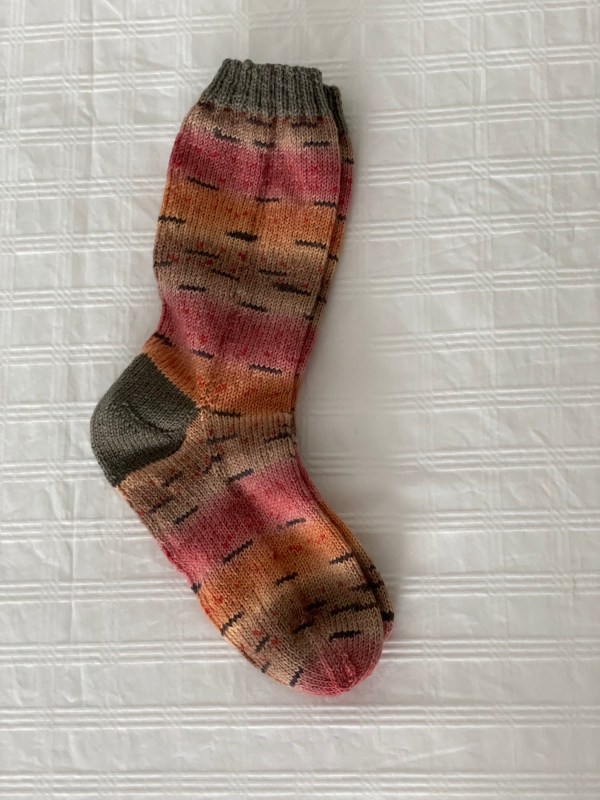
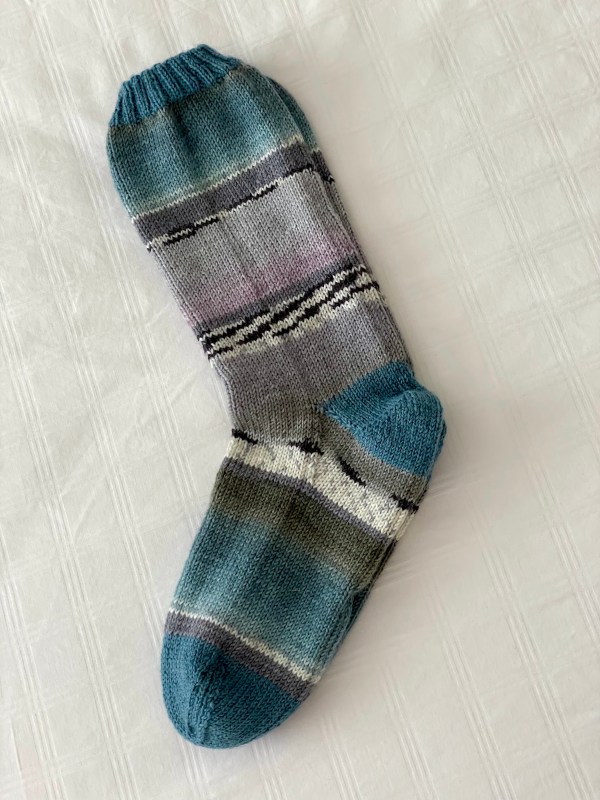
I’m working away at my yarn stash – these yarns are turning out interesting socks. I like how the golden pair has dark accents. The long repeat on the blue sock creates an interesting colour flow.
The blue sock was a surprise! I knit the contrasting cuff from a 4-ply yarn in my stash – that’s all I ever use. However, I’d bought the blue yarn at Woolworks in Mahone Bay not realizing it (and the three other balls I had picked up) were a 6-ply! When I started knitting the leg the yarn felt funny…heavy in my hand, uncomfortable. I’d probably knit close to 20 rows before I thought to look at the label – only to discover I was working with 6-ply yarn. I had three choices: unravel what I’d done and substitute a different 4-ply, change my needles to a larger size (needing to unravel what I’d done and work with a different number of stitches), or keep knitting the socks. I decided to keep knitting.
As it is, the cuff, heel and toe are knit from 4-ply; the rest of the sock is 6-ply. I’m confident that whoever gets these socks won’t ever notice the difference. What surprised me was how different the heavier yarn felt in my hands. I didn’t like it. And of course, using the smaller 2.5mm needles I’ve used to knit at least 100 pair of socks made the sock more dense than if I’d knit using 3.0mm needles. The problem with the larger needles is having to use fewer stitches if I wanted the socks to turn out the same size – the number of rows would also be different – everything was an unknown. I kept working with my 2.5mm needles.
I knit almost every evening for relaxation – the sock production is a by-product but not my primary motivation. I find my mind slows down when I’m knitting in front of the TV. My attention isn’t on the screen entirely and at the end of the evening I’ve another 20-30 rows completed – I’m not wasting my time but I’m also not rushing to finish the socks – I’m just relaxing!
I returned the other three balls of 6-ply yarn even though they each had a lovely colour scheme. I exchanged them for 4-ply balls. I didn’t like the colours as they appeared in the ball but I’m discovering they’re knitting into interesting socks! I’ve one sock completed, the second half done – a pattern I didn’t expect emerged. It was challenging finding a starting place to match the first sock but I succeeded in the end. I will end up with a pair of matched socks from this new ball of yarn.
Been gone a month – I’ve been busy sewing and knitting, and engaged in my daily/weekly routine but for some reason I haven’t managed to sit at the computer and describe what I’ve been up to. So let’s get to it.
Mid August, I wanted to start a new quilt. I looked through my fabric stash and decided to use a jelly roll I’ve had for a couple of years.
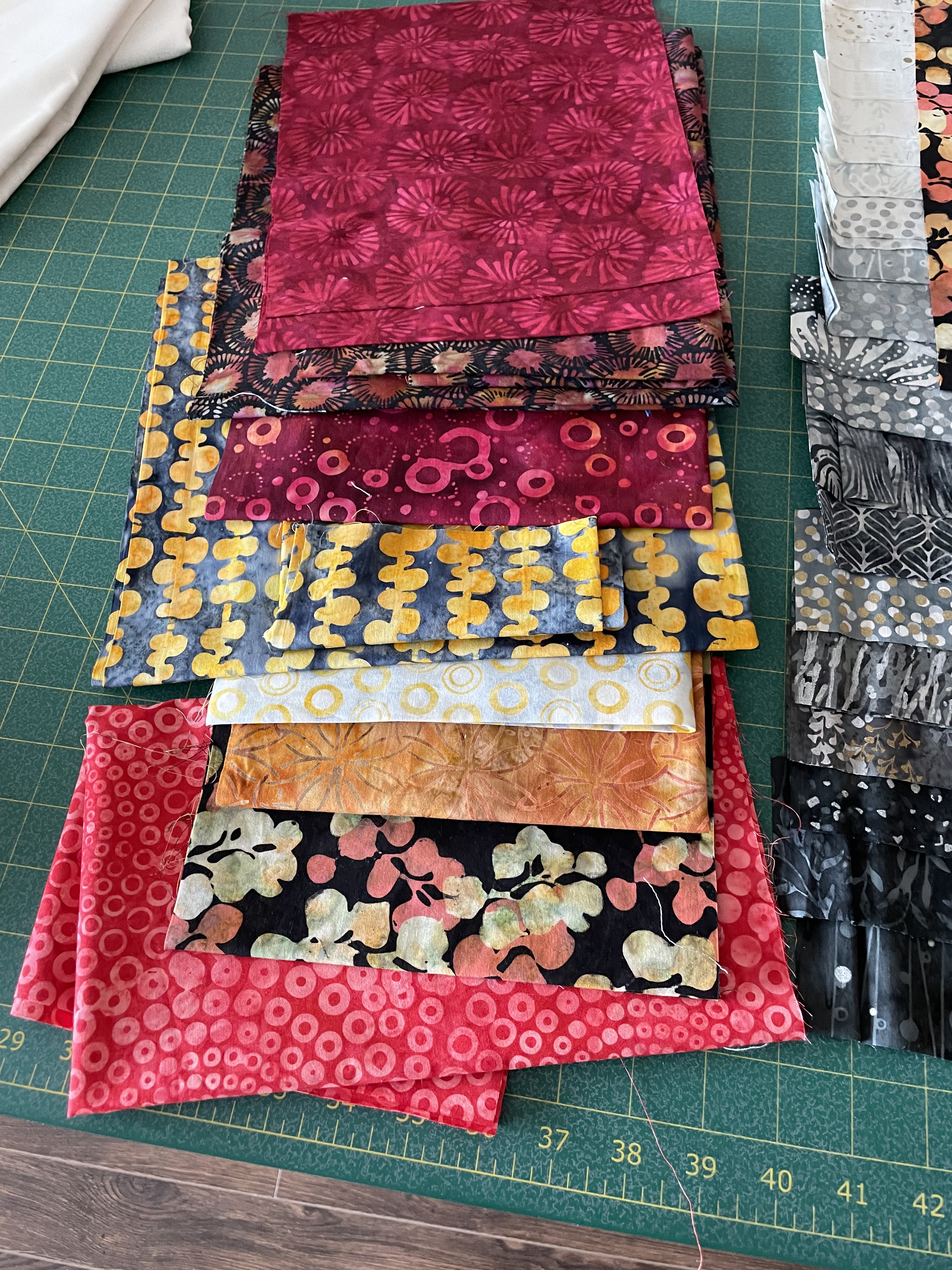
Jellyroll Strips Laid OutContrast FabricsContrast Fabric With JellyrollSquares In Squares
The jellyroll fabrics (20 strips) ranged from black to white with many gradations of grey. Dull on its own – I decided I needed some strong contrasts. Because the strips were batik, I selected bright batik scraps to contrast with the black/white. I decided to make “square in square” blocks, cut them into triangles on the diagonal, then arranged them in squares again. All is fine, until I try arranging the resulting squares into a larger array only to end up with a hodgepodge I wasn’t happy with.
First Attempt
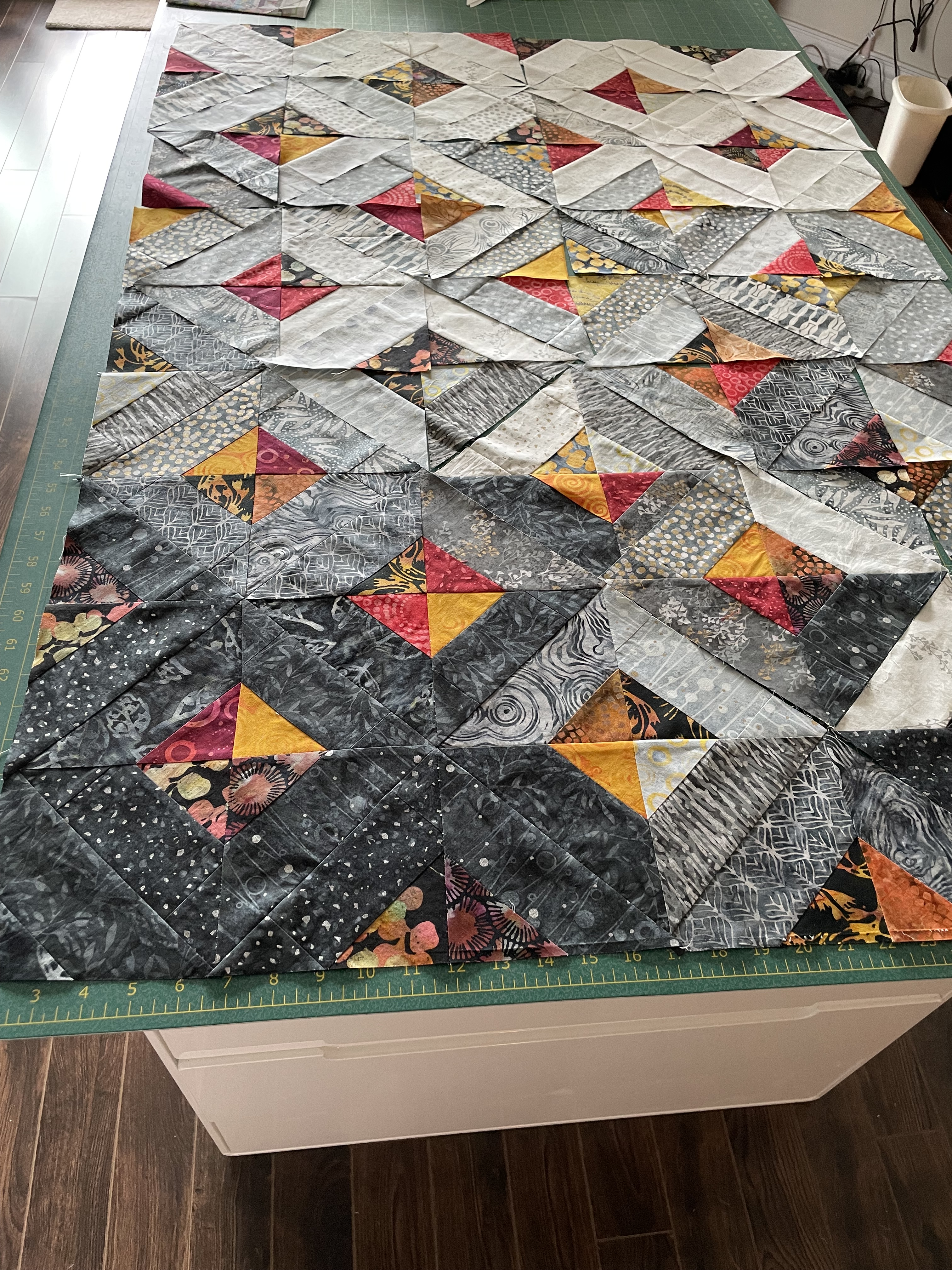
There’s a hint of a gradation from black to white but it doesn’t work overall because each of my blocks has light/medium/dark elements and to get a good colour flow I need some blocks that are very dark and some that are completely white. To make that happen I had to make many more blocks from scratch.
Second Array
This time, I established a dark corner and a light corner and tried filling in. I was working on my cutting table, rather than on my floor beside the cutting table as I usually do, because I’d injured my right knee and couldn’t get up and down. It didn’t occur to me at that moment that I could set up a design wall using a length of batting hung from a rod in my spare room (in front of the closet door) to hold the triangles/squares to audition placement – that came later.
So I filled up my cutting table with a layout I thought would be the darker bottom half of the quilt top. I made the mistake of actually sewing these blocks together into a 6×12 array. I was planning on filling the cutting table again this time with the top half but then I couldn’t see what I’d already constructed. This was when I set up a design wall:
Array #3
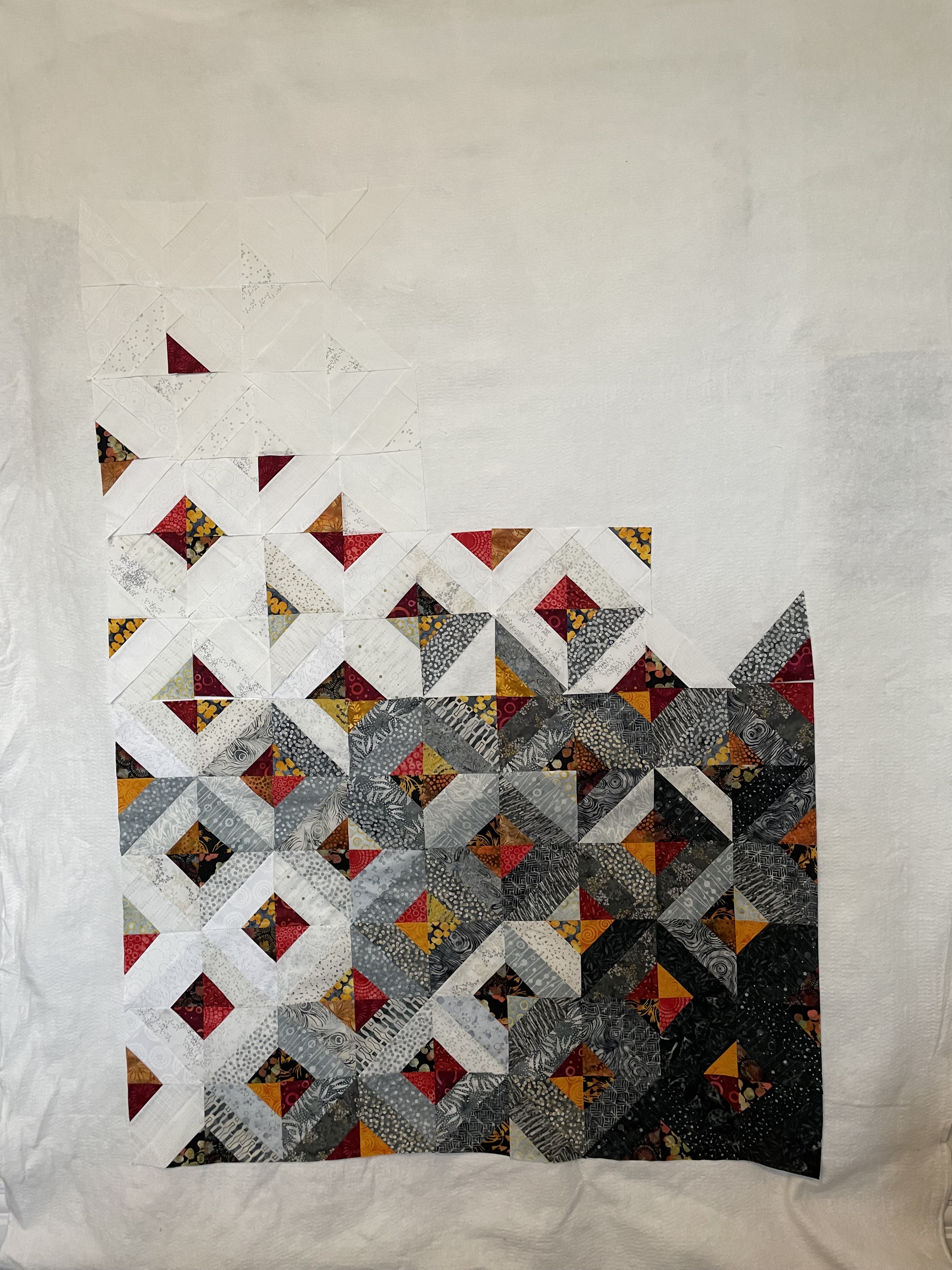
I placed the assembled bottom half of the panel at the bottom of the wall and started laying out more blocks. Two things were immediately obvious: 1. I didn’t have enough “black” extending from the lower right corner and 2. the grey extended too far across in the middle of the emerging piece. I’d also run out of triangles at this point and needed to make another 60 or so.
By this time I had stopped making squares in squares and instead I cut trapezoids from the jellyroll strips (I had to open the second package I had on hand) as well as triangles from the contrast fabrics. I’d figured out that working with reassembled squares wasn’t helpful – I was better off constructing just triangles where I could control the colours I was juxtaposing and had more freedom when placing them.
Array #4
Close, I thought but I still wasn’t completely happy with the colour flow so I played with it over the next few days – shifting blocks in the top half, and pinning other triangles over existing triangles in the sewn bottom portion.
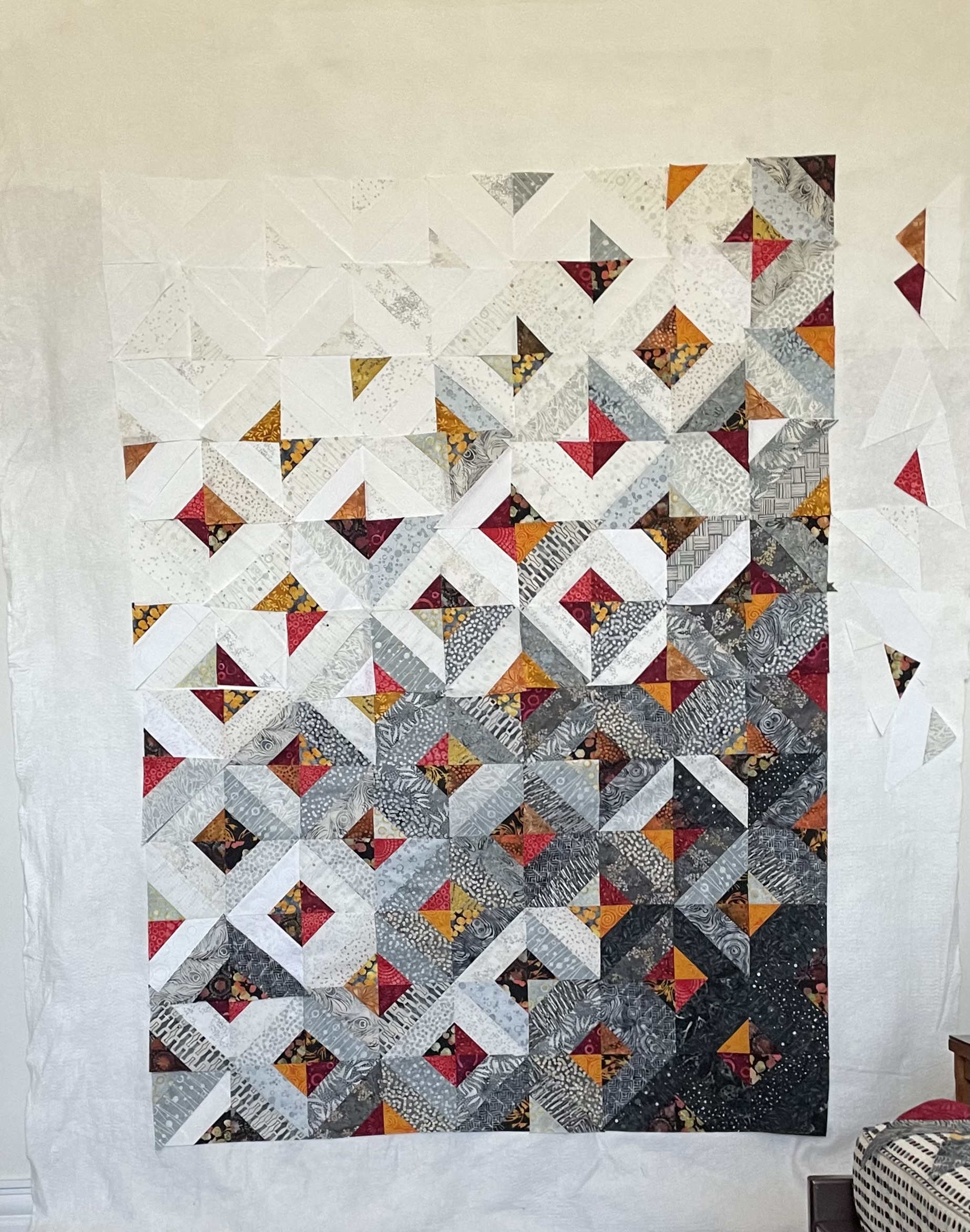
Final Array
It took a couple of days looking at the design wall and moving and pinning elements until I was finally satisfied with the look of my panel. Yesterday, I took a photo, then very carefully stacked the pieces in the top six rows, numbering each stack so I knew the order and orientation of the pieces in each stack. Then I carefully repinned and labelled the changes I’d made to the bottom panel – knowing I would have to take much of it apart in order to get the arrangement I wanted.
It’s taken the better part of two days to reconstruct the bottom half of the quilt top:
Reassembling In ProgressFinished Bottom Portion
Now I have the bottom portion of the array back together – many of the changes were subtle ones, mainly involving extending the darker batiks further across the panel, limiting the lighter, brighter trapezoids and triangles until the mid area.
Tomorrow I’ll start sewing the six top stacks together, row by row – it won’t take long because I’m not having to carefully unstitch many interlocked seams!
As you can gather, this whole process would have been much easier had I planned out on graph paper what I was thinking about, but that’s not how I seem to work. I much prefer just starting and building and designing as the project unfolds. I find improvising so much more interesting because I have no idea where I’m going to end up. Always a surprise and satisfying. It’s how I write as well – just get some words on the screen and see where they take me. I never know what I’m writing about until I get well into something and an ending emerges. That’s my creative process.
I have no idea what I’m going to do with the back – do I want to make another 36 of these triangle elements for an insert or do I want to try something else – still thinking about that.





 jmn
jmn 