A week ago someone mentioned Wordle to me – I hadn’t come across it on my own. In spite of my reasonable size vocabulary, I’m not great at crossword puzzles. I don’t seem to have unassociated words floating around in my head. I have lots of words in meaning units, but I can’t easily just pull out a word based on an ambiguous clue.
So I was skeptical about Wordle. Nevertheless I gave it a try.
My first go was a disaster – couldn’t even find out how to submit a word! Finally, I discovered the “ENTER” button below the keyboard. Next I discovered I couldn’t think of 5-letter words. Useless. So I did a bit of online searching and came up with some useful tips and handy word lists to start the game.
Screenshot Showing Game Opening (Including Enter Button)
I quickly came across the “opening word” strategy – try to cover as many vowels as possible in a single word – two good words: AUDIO, and ADIEU – you’re almost certain to get at least one vowel, occasionally two. The vowels are likely in the wrong location but you’re on your way. There are a bunch of opening word selections – here’s one with some helpful starting words.
Strategy two: high frequency consonants and consonant clusters. I had to google for lists of 5-letter words with various consonant and vowel combinations – they just wouldn’t pop into my head. Once I had some lists in front of me I started coming up with words on my own. I now have lists of 3-vowel words, 2 vowel words, words using S, L, T, R, N, M, P, H – some of the most commonly used consonants. Then there are consonant clusters: CL, CR, DR, FL, FR, GL, GR, ST, STR, WR, – I’ve probably missed a few here, but you get the drift.
I read somewhere in the last day or two, don’t waste time on a final S – there seem to be no plural words so save your S for other positions in the word. Also, there can be double letters – both consonants and vowels – that can be tricky.
With my word lists at hand, I’m getting better at the game – I’ve even managed to solve it several times in 6 words, a few times in 4 words. Today’s word HUMOR I missed altogether (my 6th word ROUGH had 4 letters R, O, U, H all in the wrong location – I would never have thought of HUMOR because my spelling for the word is HUMOUR! This is an American English game.
I’ve been thinking about this for days, weeks, maybe months. As the number of days since the first COVID-19 lockdown in what – March 2020? – continues growing, I’ve found myself becoming annoyed, often angry, about all the talk on radio, TV, in newspapers of the wave of growing depression, mental illness, whatever; about how difficult these days are for so many people. The questions people keep asking are “When will this be over?” “When can I just forget about Omicron and get on with my life?”
It’s perfectly clear – NOT GOING TO HAPPEN. The current “wave” will peak, the number of new cases, of hospitalizations, of deaths, will decline slowly (maybe more quickly ?), but some form of COVID-19 is going to be with us for the foreseeable future. Vaccines are helping ameliorate the severity of the disease; new treatments are becoming available. However, COVID-19 will continue affecting our lives.
People’s heads are in the wrong place. They’re focusing on the many brick walls they’re contending with, butting their heads against them. What we need is a public reframing of the situation. Our discourse needs to change.
The Right Question
Atul Gawande’s 2014 non-fiction book “Being Mortal” is about living better with age-related frailty, serious illness, and approaching death. It’s subtitle “Medicine and What Matters in the End” directs you to consider important questions about end of life issues and maybe consider how current western medical practice might have this all wrong. Being Mortal is a book about end of life; but it’s more than that.
Everyone dies.
In our current world that day could unexpectedly come sooner than anticipated. Every day in our local news the number of COVID-19 related deaths is announced – some are old people, others are middle-aged, and even some much younger. None of us knows when that day will arrive.
The announcement is followed by reminders to follow public health guidelines to keep ourselves safe, to think about the public good, to do what we can to avoid the spread of the disease. Then there are the radio talk shows, the TV programs about how depressed everybody seems to be, how difficult a time people are having.
Right now, Gawande’s book applies to all of us – all of us are mortal. As he works through the book he describes how as a practicing physician/surgeon he comes to see living as a series of decisions – for me the focusing question he asks is “How do I live the best possible day today given the constraints/the reality the world is forcing on me?”
What small pleasures would make this a good day? I ask myself. In no particular order – a visit to my 92 year-old friend Joan; a kibbitz with Ruby; a walk in the snow; my morning aquacise class; that small piece of dark chocolate; a small magnum ice cream bar; some fried liver for supper; getting a new sewing project underway or making progress on something I’m already working on; a chance to sit and read; adding another 20 rows to a pair of socks; a cup of tea with Deb or MaryAnn; things that catch my eye as possible photos (whether I take out my camera or not); watching a well done drama on TV (while knitting), actually getting the laundry done or cleaning away the dinner dishes, crawling into a bed with fresh sheets…. Those are the kinds of things on my list – what might be on yours?
An Anthurium and a Clivia in front of Deb’s window yesterday
Life is a succession of moments – some stand out, others are fleeting. We all have potential time to notice the small stuff around us, to see the pollen grains on the anthurium flower, the way the light shines through the Clivia bloom, to savour the taste of a cup of ginger tea.
I understand how lucky I am. I haven’t had to home school three young children while trying to work from home and keep everything in the house and family functioning. I haven’t lost my job or constantly had to worry about whether I was being exposed to the virus. As difficult as those situations are, with help from the rest of us, it is possible to get through each day. We haven’t really helped one another enough, taken time to pitch in when we see someone else is overwhelmed. That’s part of the problem – our constant attention to “me”. It’s a tiny thing I do a couple of times a week – spending three hours putting together rapid testing kits – 40 kits an hour is as fast as I can go – but it’s something, and I find it a satisfying way to spend time even though I’m tired at the end of a shift.
I’ve been keeping an eye on our local hospitalization counts – as soon as they start declining noticeably I will have the knitting ladies in for an afternoon of conversation and laughter. What we’re all missing most of all is companionship. We can still see individual friends for short periods of time, safely distanced; we can talk to them on the phone (much more satisfying than texting). As soon as it’s possible I will make sure the group convenes and we can enjoy knitting and being together for an afternoon.
Three weeks ago I booked a blood test at one of the regular blood collection locations in the region – last week, when I arrived the waiting room was full, the hallway was full – at least a two hour wait (several lab technicians were absent due to COVID-19 exposure). My test wasn’t urgent so I went back to my car, cancelled the appointment on my iPhone then booked another for a week later – today. The speediest location where I could book an online appointment (only online/telephone booking is available right now, no walk-in) was at the Dartmouth General Hospital Blood Collection Drive-through.
Today, I remembered to take the requisition paper and my appointment confirmation printout with me when I went to the pool, my appointment was for 11:10. Because I wasn’t sure precisely where I was going, I headed to the DGH right after my aquacise session to give myself time to get lost – in fact, I didn’t have a problem. I took the Mt. Hope exit from the 111 highway; stayed on Mt. Hope until I reached the DGH. The turn into the Drive-through was well marked.
The drive thru saves time because during the COVID-19 pandemic, disinfecting the blood-collection chair between patients takes between five and 10 minutes. (Catherine Buckie) – image from: https://www.cbc.ca/news/canada/nova-scotia/drive-thru-blood-testing-dartmouth-1.5733364 (I didn’t think to take a picture of the garage door ahead of me while I waited to enter)
I was greeted by a woman warmly dressed in a parka who directed me to follow the red truck ahead of me, which I did. I reached a booth with a young woman who asked me to put my mask on and to hand her my requisition and appointment information, which I did. She signed me in, then asked me to inch forward and wait at the garage door ahead of me.
It felt like going to the car wash!
I turned off my car, waited for the garage door to open. Started my car, drove forward until I reached a designated spot just before the exit garage door (just like at the car wash), then turned my car off as directed by the signs in front of me.
I didn’t need to get out of my car – I rolled down my window, took off my jacket, pulled my left arm out of my sweater sleeve, handed my blood requisition to the technician who asked for it, stuck my arm out the driver side window. She quickly took a couple of vials of blood.
I was asked by another woman (interesting, the drive-through idea was a woman’s, the facility was staffed by women…) if I’d be willing to answer a few questions: How did I rate the experience 1-5 – I gave it a 10! Would I do this again – absolutely! Would I recommend it to others – you bet!
I was in, and out, in 10 minutes!
Everybody was friendly and efficient.
In the lane next to the blood collection drive-through, was a COVID-19 vaccination drive-through – the line of cars was longer there but I bet the whole thing was reasonably quick as well.
Somebody’s doing some innovating – I applaud them and for sure support their efforts. The initiative needs to be expanded to many locations in the province.
So I’m spreading the word – if you’ve got a drive-through site for blood work or vaccination – use it! If you don’t have either, contact your public health officials and recommend they consider the possibility.
Oh, and by the way, I’ve signed up to build more Rapid Test Kits this coming week. Here in NS a large number of volunteers are doing our best to meet the demand for Rapid Test Kits.
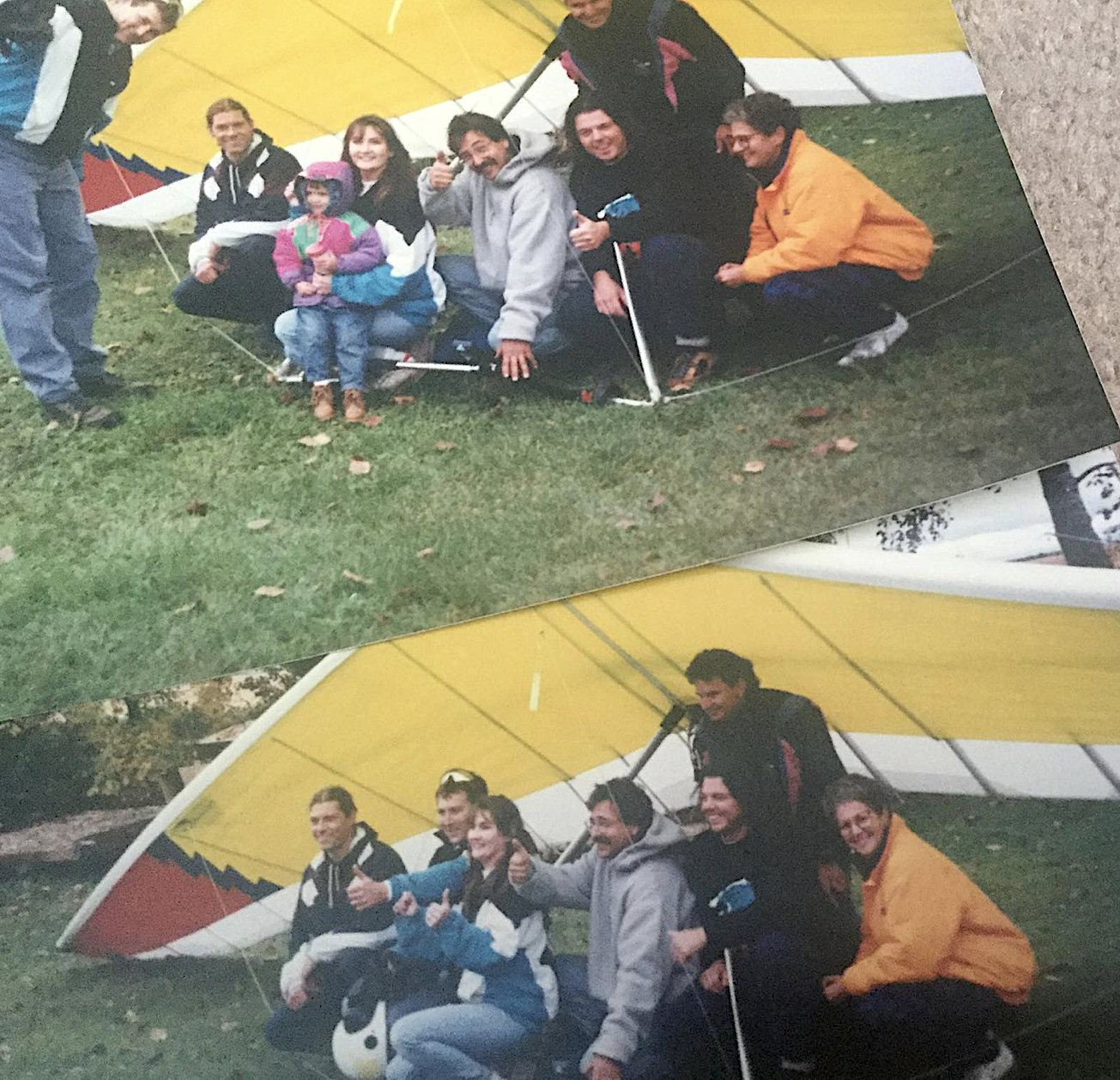
I received this pair of photos from a Manitoba friend I’ve kept in contact with. That’s me in the yellow fleece on the right side.
Those were my hang gliding days – I wouldn’t be surprised if that photo was actually taken on a late fall weekend fly-in in Dauphin Manitoba. I don’t recognize the glider but I recognize, and can name, all but one of the people in the pictures.
I did love flying. I didn’t get to do a lot of solo flying – my technique never got good enough that I felt safe in the air on my own but I did a lot of flying at the control bar with a number of different instructors. What a wonderful feeling to be high in the air with just the wind whistling past, the fields below, and the wide panorama in front of us.
High Over Makapu’u Point ~1993
I even got to fly, after launching, high over Makapu’u Point on a couple of occasions, from the California hills somewhere near Santa Barbara, even outside Bendigo Australia with the chill Antarctic wind reaching us.
This all took place when I was living in Manitoba.
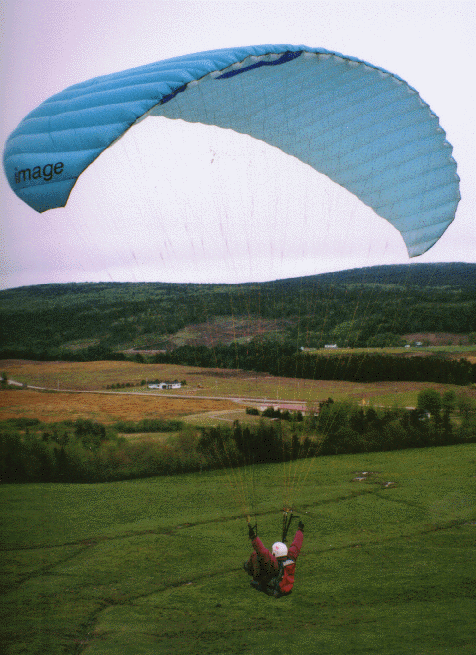
When I returned to Nova Scotia, in 1997, I switched to paragliding – trying to get a hang glider to the various rustic launch sites available to us was just physically beyond me and I wasn’t about to ask a fellow pilot to carry my glider to the top of the hill for me! I could manage the paragliding gear (glider, harness, helmet, arm pads, gloves) myself, though.
All Geared UpAbove The Blueberry Fields
It took quite a bit of training before I felt confident enough to actually push myself off launch after inflating the glider. I remember clearly my first real parading flight on the hill at Fox River. I’d inflated the glider (I’d got good at that), but was reluctant to start the run – Brian Wheaton gave me a big push and I was in the air, aiming for the landing site beyond the trees at the far edge of the blueberry fields. The flight lasted less than 2 minutes but I landed successfully on my feet!
That was it. I made the trip to Parrsboro regularly over the next many years hoping to find good flying conditions when I arrived but often the wind was too light or too strong. However, once in a while I managed to get into the air.
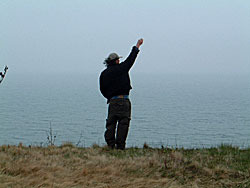
Wind WaitingChecking The Wind
I’d have kept at the sport except I discovered I had osteoporosis and suddenly a hard landing on my bum wasn’t such a good idea. My flying career was over.
I hung out with the pilots for another couple of seasons – I loved being at the top of the hills watching the gliders weave back and forth along the shore edge.
At Port GravilleAt Second Beach
Eventually I stopped attending the Annual Flying Festival. Life moves on.
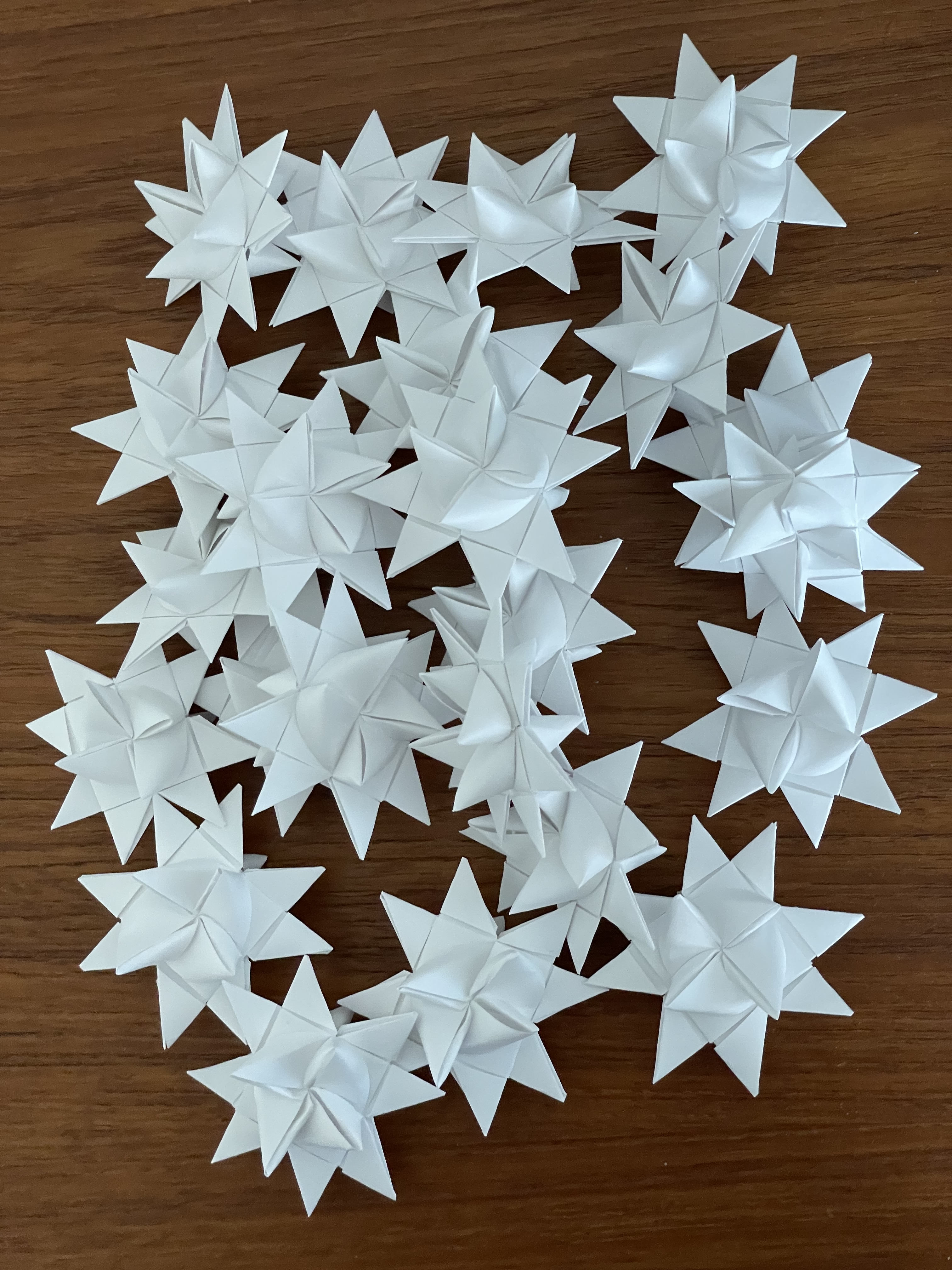
It’s become another recent Christmas tradition – I make a few Danish paper stars to hand out to my neighbours and friends in the apartment building. I finished the two dozen I was planning to make last evening. All they need now is string so they can be hung on a tree or wreath. I’ll pass them around as soon as I get that done, later today.
If you’re interested in trying your hand at making these I found, after a lot of searching, some instructions online: Danish Paper Stars. Let me know how you get on.
It took a star or two before I wove the initial paper strips in the right counterclockwise direction (short arm on top). Once I got the initial steps right, my hands remember the twisting movements and the rest of the folding and twisting are there.
I learned to make these stars at least 40 years ago. Didn’t make them for many years. Started again four years ago. Another few years and people will have enough stars to decorate an entire tree!
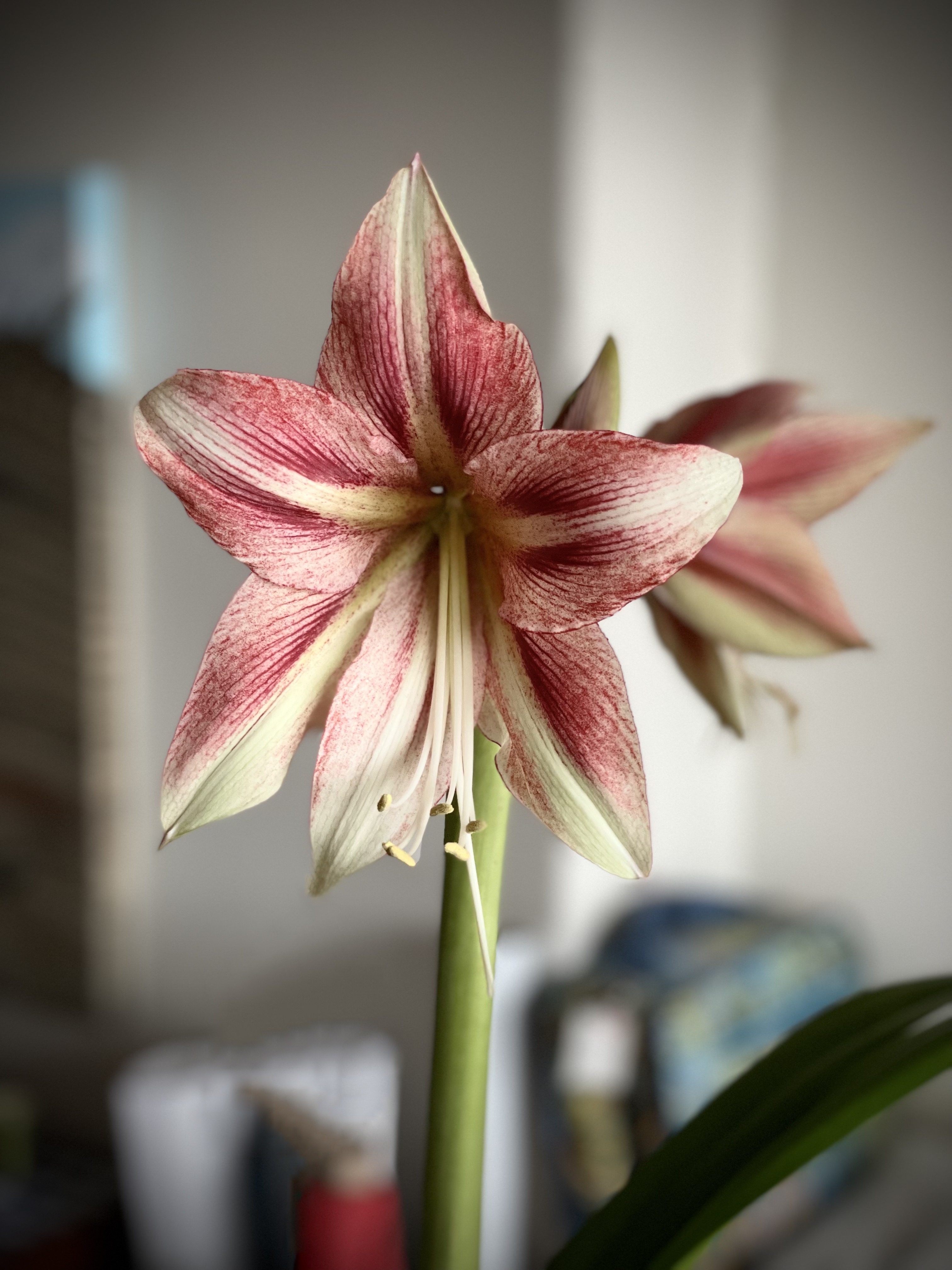
This season I bought my usual Amaryllis but there were Calla Lily kits available, too. So I picked up one just to see what it would turn out like.
Long and gangly. Looks like I will have just three blooms on the plant. The first flower has already lasted at least three weeks – the Amaryllis has come and gone but these three Calla Lily flowers are still going strong.
Amaryllis
I was surprised by the green hue of the Amaryllis – I did get four flowers on a single stock but they weren’t the vibrant colour I expect from this bulb.
Throughout the past year and half, Nova Scotia has been focused on early detection of COVID-19 cases. To begin with that meant many Pop-up Rapid Testing sites – staffed by volunteers, in locations where the presence of CoVID-19 was suspected. I helped out with that effort, registering people as they came in. I did that for a couple of months until the number of cases declined, and while a couple of testing sites continued, they were downtown and difficult for me to get to, so I stopped volunteering.
On Nov 9, I joined the Rapid Testing “Test To Protect” effort. For a couple of months volunteers had been making up rapid testing kits for distribution to the airport but the effort ramped up in late October when the NS Department of Health decided to issue kits to school children in order to pick up early warning of COVID-19 spreading among unvaccinated school-age kids. I decided it was time I helped out again. So a couple of times a week, until last week when TTP closed down for the holidays, I helped assemble Rapid Test Kits.
You wouldn’t think putting a few bits and pieces into plastic bags would take much effort – but it did. A four hour shift doesn’t seem like a lot of time – but it was.
When you walked into the assembly room (a large open space with 25 tables – one person at a table, , hands sanitized, wearing a mask) the walls were lined with large labelled boxes – some holding test kit stuff, others already packed with test kits ready for distribution, and on tables dividing the room a WALL of small boxes containing what you needed to make either 30 or 15 kits depending on the batch we were preparing.
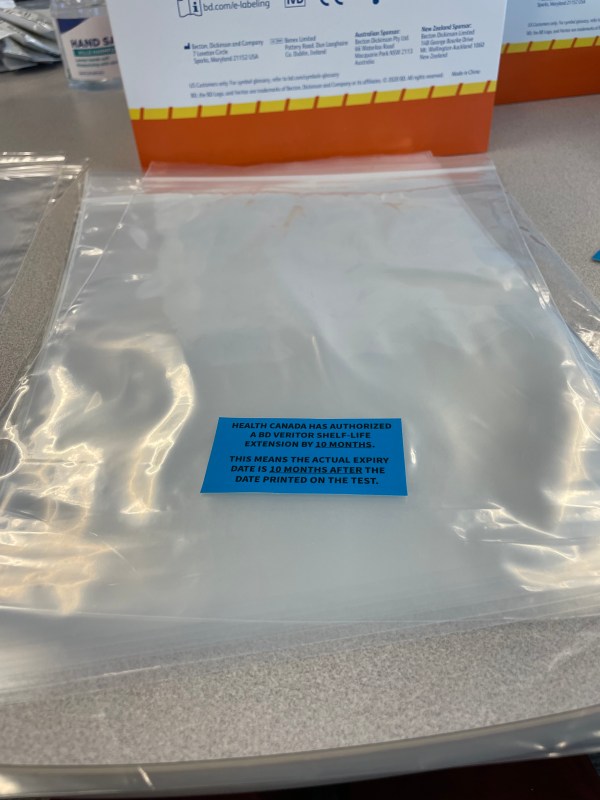
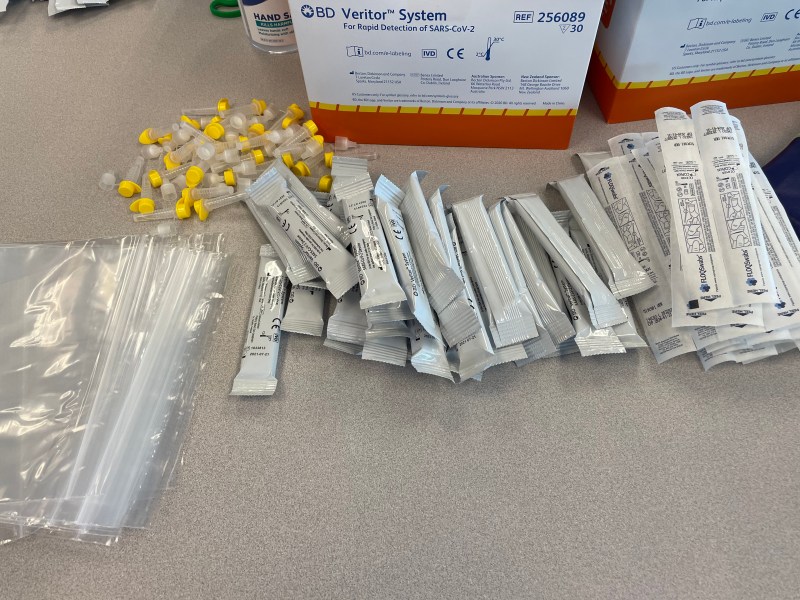
Label on bagStacked testing componentsComponents in bag x 2Test kits in boxOne Box – 15 double testsRecent Rapid COVID-19 Antigen Testing Kits For The Airport
You started by adding labels to the bags explaining the “expiry” date on the test strips could safely be ignored. Next you carefully laid out the test components (swabs, test strips, small vials with testing solution) so you could pick up what you needed to place in each bag. Then you filled and sealed each bag and placed it back in the original box.
We started out assembling 30 single test kits; we progressed to 15 double test kits – these to be handed out to arriving passengers at the airport. Working as quickly as I could, it still took me slightly more than 15 minutes to do a single box of test kits. The assembling took a lot of repetitive physical effort (the tables were a bit too high for me – I found it less stressful on my back and shoulders to stand when filling the bags). More difficult was the concentration required to make sure you put the precise number of each component into each bag! You didn’t want to end up short something or to have something left over – that meant you had to go back through all 15 or 30 bags to find where the error had happened! Each bag needed to have the exact number of swabs, vials with testing solution, and testing strips!
I breathed a sigh of relief every time I finished a set of bags neither short something or with any component left over.
In three and a half months, hundreds of volunteers have managed to assemble well over 500,000 test kits for kids and arriving passengers at the airport. A herculean effort. We don’t know yet whether we’ll be called back into action in January but I’m sure everybody who helped out will return, particularly since Omicron looks like it’s set to take off like wildfire here in the province as it has everywhere else.
My friend Andrea has a sharp eye! She sent me this photo this morning. She’s getting better at this than I am. I’m still seeing faces in my bathroom floor, in the granite wall beside the elevators, in my kitchen tools – all things I’ve taken photos of before. I haven’t been as vigilant as I ought to have been, obviously. Andrea is outdoing me!
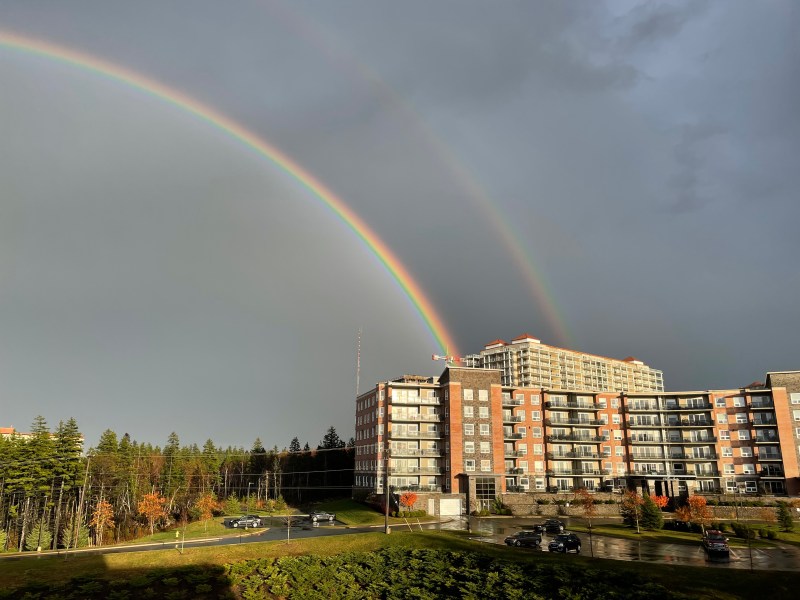
I was at my cutting table just how tracing a jacket pattern when I happened to glance out the window – an astonishing complete double rainbow!
The sun had come out behind my building with the rain still falling in front of me allowing the sun to create this amazing sight. Can’t remember when I last saw a rainbow like this.
I used the wide angle lens on my iPhone 12, adjusted the vertical alignment of the building on the right, but otherwise the photo is unedited; this is the colour in its full glory – a glowing rainbow against a dark sky.
The Two Halves Of The Rainbow
I took a raft of photos while the sun shone – it didn’t last long – the rain has returned, the sun gone behind the dark clouds behind.
For a moment it was compelling – I called a couple of friends to share the event.
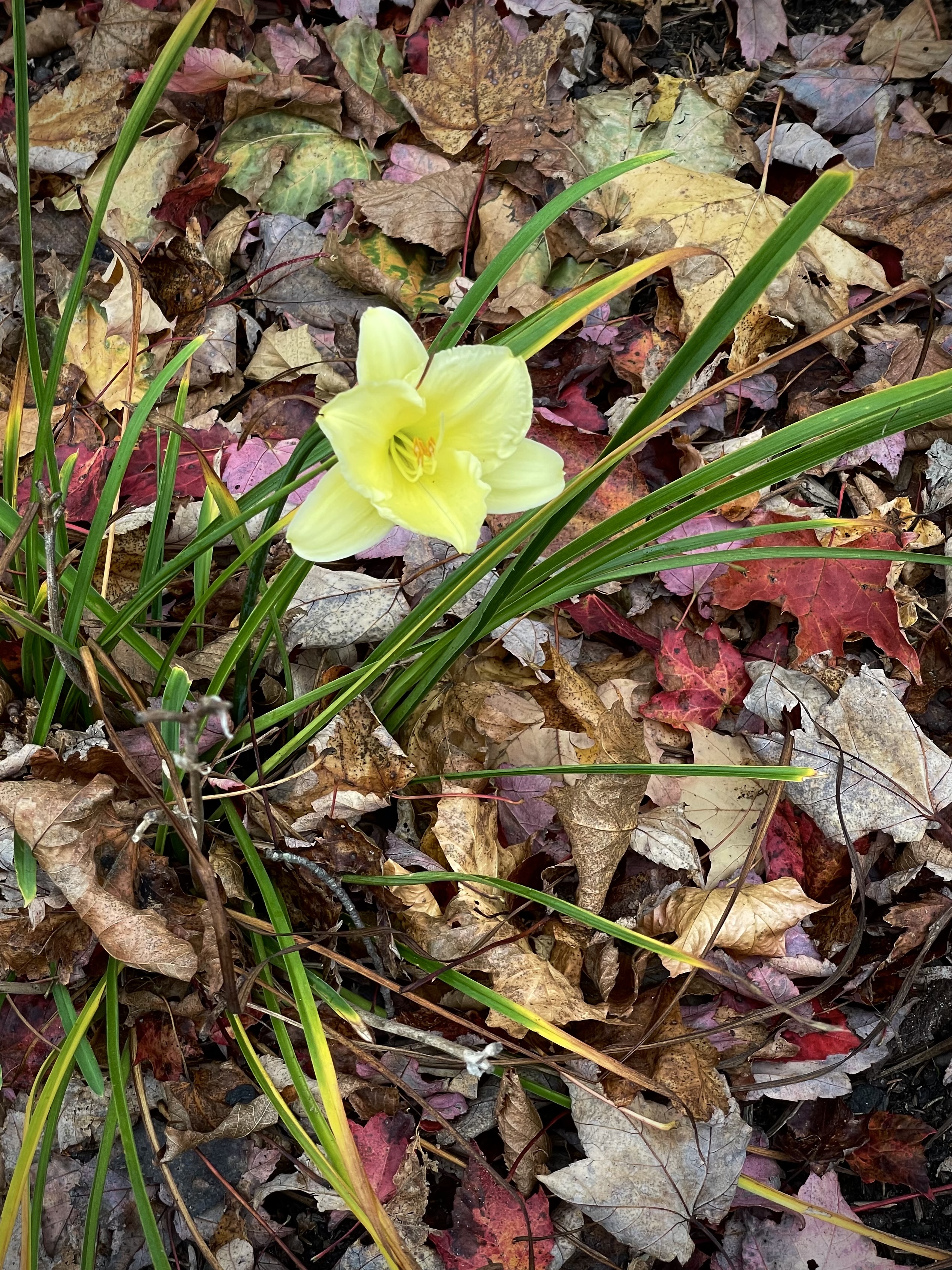
I stopped by Chelsea Lane to visit my friend Joan. Parked in the cul-de-sac and as I started up the path there it was – the last Stella Doro Daylily peeking out from the fallen leaves. They bloom profusely, and although we haven’t had any actual frosty nights, they stopped blooming locally around the middle to end of September. What a nice surprise to find this lone bloom standing bravely against the autumn background.
I spent a bit of time editing the image, cropped it, tried intensifying the background colour. And then I happened to produce this:
Edited with PhotoRoom
What a difference setting the bloom against a black background with just wisps of green/yellow foliage. A rather dramatic rendering.











 jmn
jmn 