The Destruction

This morning in my email there were links from friends, passing on items I hadn’t seen because I don’t do Facebook. Three of them are serious analyses of this past week in the US.

I also found today’s NYT Editorial “Now Is Not The Time To Tune Out

It’s becoming obvious that people in the US are finally waking up to what is really going on in their country and they’re starting to push back. Too bad they weren’t paying attention before the election! The warnings were there, loud and clear. People needed to see what the real consequences of putting trump in the presidency would be. And they’re not pretty.

It was all predictable. trump wasn’t hiding his plans. Project 2025 laid them out clearly in hundreds of pages of detail! The majority of people disregarded it all. But his agenda has been clear since 2015! And now he (and his oligarchs) are executing the plan!

I could see it coming – I wrote this the day after the election in November:
https://jmn111.wordpress.com/wp-admin/post.php?post=11973&action=edit&calypsoify=1
Lots of other people could see it coming, too. Now it’s happening.

People are also writing about how citizens can resist – Robert Reich offers a long list of actions individuals can take to push back against the destruction: Robert Reich – What You can Do

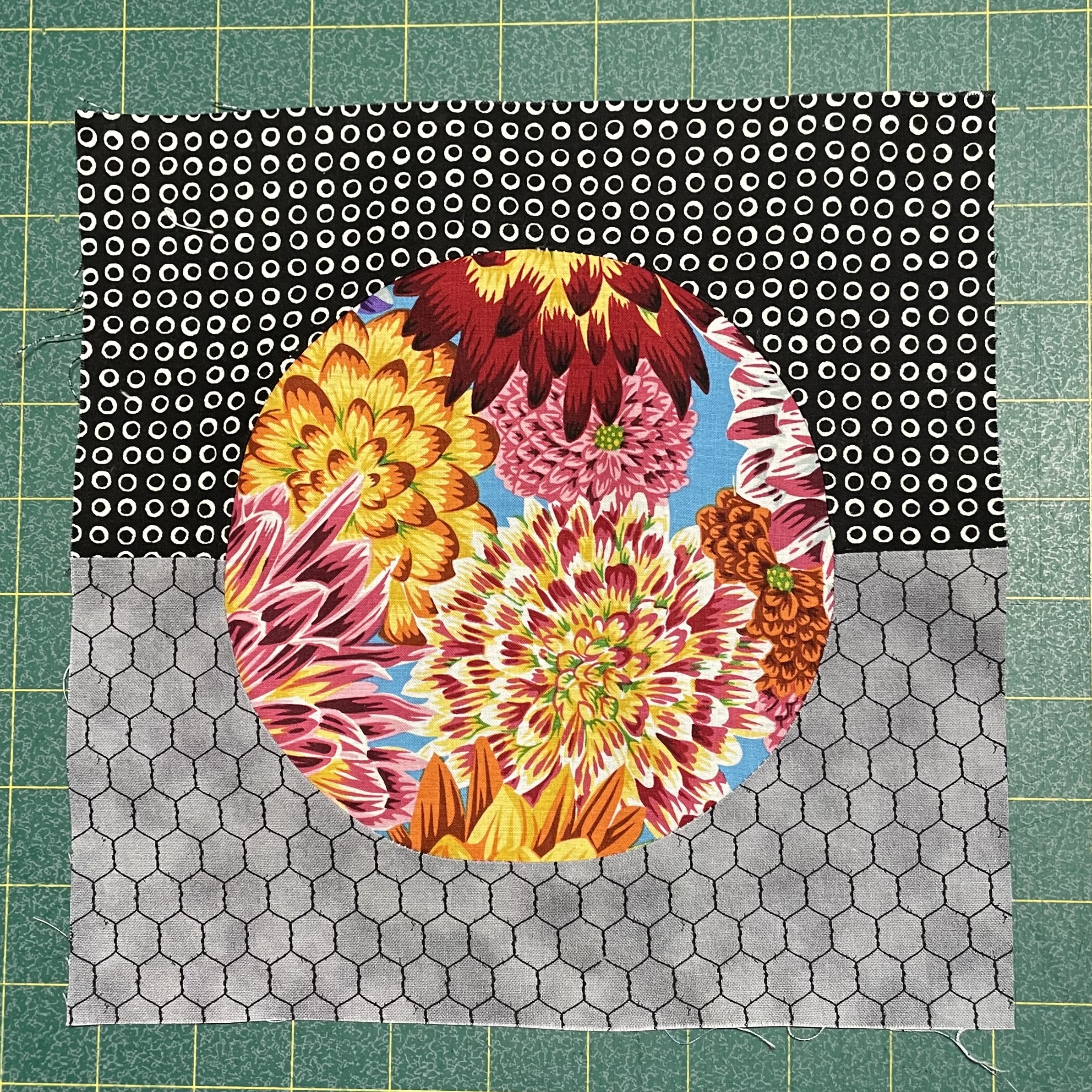
I wish I could be sharing my fibre art but I’m not producing much these days (I’m not even getting much knitting done, either). I managed to edge stitch the appliqué circles on that piece I was working on. I began thinking I was making a quilt – this is as far as I could go with the idea. The background is too dark – a reflection of what I’m feeling these days? I need to try another using lighter fabrics. Perhaps that will brighten my outlook!

It still isn’t finished – I’m planning on a very narrow binding using a black fabric with tiny circles. I’m also going to back it with a bit of stiffening so it retains it shape when it’s hung. Another day or so of work to finish it. After that – I have no idea. Likely a couple of garments that are waiting to be made.

My creativity seems to be on hold right now when I definitely need it most!

Bubbles

Bubbles!

This is where I am at the moment – 21 1/2″ x 18″. There are four insert circles, the smaller circles are fused raw edge appliqué. Although I’ve ended up with an even number, the distribution and colour feel comfortable.

I’ve been auditioning fabric for a thin inner border and a wide outer border – no luck. Everything I’ve tried – light fabrics, medium fabrics, dark fabrics – all look wrong. I think the piece is telling me to end here and finish with a facing, not a binding!

The next question is whether to quilt or not. I need to do decorative stitching around the appliqué (and possibly outside the inset circles, as well) – I have to wait until I’ve finished the stitching the appliqué to decide.

The point of this effort was to expand my technical know-how – to see how difficult it was to do an insert circle. Definitely not a beginner skill. After five circles, I’ve decided the sewing works best for me with the background on top, just four pins to hold the 3/6/9/12 positions, sewing slowly, one small section at a time, so I can align the opposing curves as closely as possible and still maintain a 1/4″ seam.

I’m not giving up on this idea – I still want to make a table runner and a quilt using it – it’s a matter of deciding whether to use pieced backgrounds, as I’ve done here, or a subtle print/batik throughout. I have to audition some fabric to see what might work.

Inset and Appliqué?

Bubbles?

Four inset circles with appliqué? This is all an experiment. First, the blue background doesn’t add anything – it shows I want to stay with greys, lights and blacks. That block also shows I don’t want pieced circles – I want to use the large prints from my Kaffe Fasset collection – I like the statement each circle makes.

Second, three of those inset circles are not too bad, one is kind of wonky – an appliqué over the wobble would hide the imperfection. Also the piece is stark without the smaller circles – I can’t see trying to inset them, much too difficult – the bigger the circle the easier to inset, I’m finding. I’ve also been moving the circle around in the square, rather than place it at the centre. Will continue doing that.

I also wanted to sew four blocks together and inset a circle at the intersection – there aren’t enough blocks here to try that. I may have to add another couple, making the piece longer, to see whether I can add an inset circle at the intersection. This has become an experiment going in directions I wasn’t expecting.

I have enough here for a fibre wall piece. I want to replace the blue and see what I have . I haven’t nailed down precisely what I want this to be – stopping at this point and finishing the small piece will let me start over.

I’ve been scouring Pinterest for “circle” and seen a lot of very interesting ideas for quilts made with both insert and appliqué circles. I need to review the images I’ve collected and rethink where I’m trying to go with this project.

Inset Circles

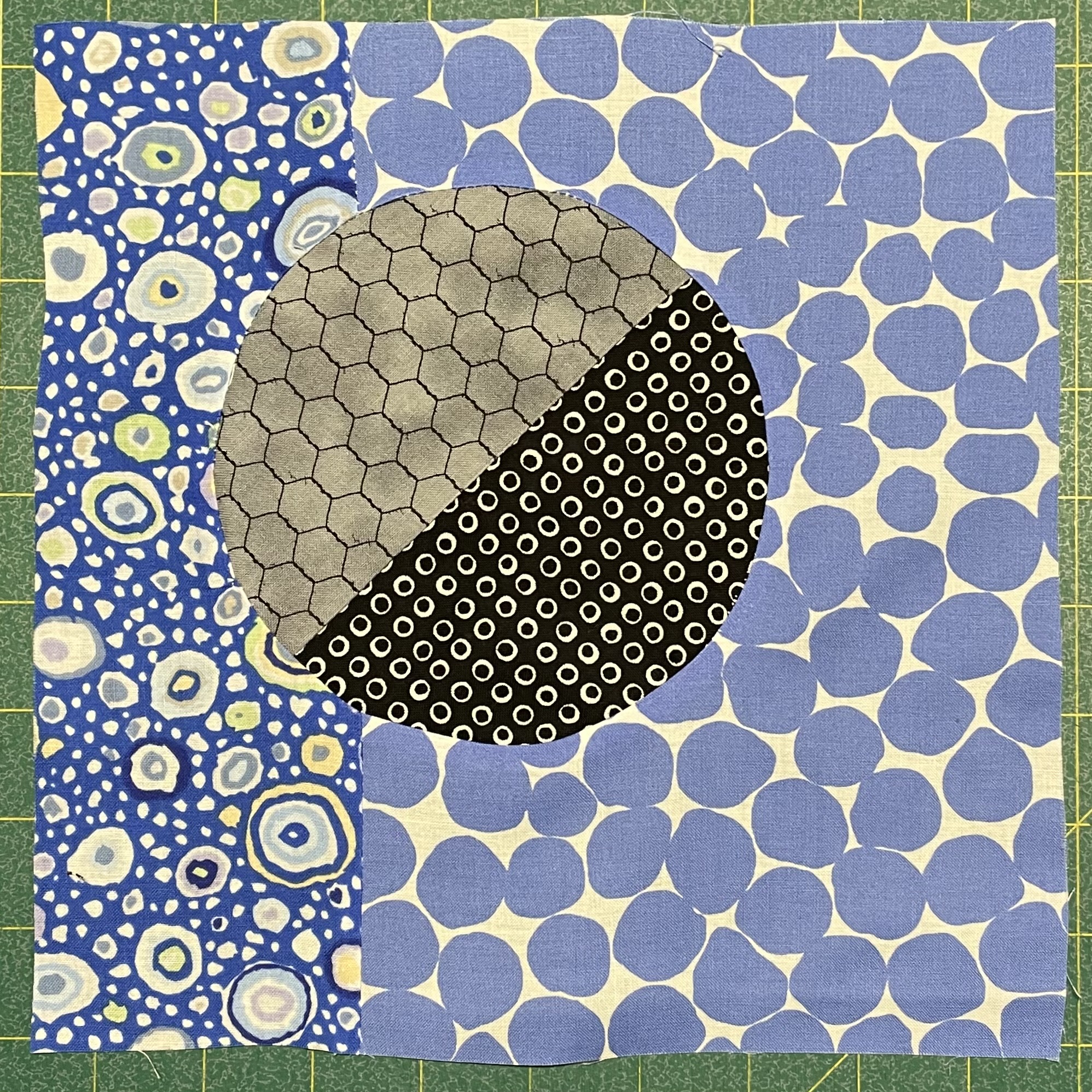
I decided to try inset circles – an extension of Drunkard’s Path (a square with a contrasting pie-shaped piece in one corner. With an inset circle you cut a background square then remove a circle; cut a contrasting circle 1/2″ larger in diameter, then carefully line up a few markings and inset by sewing a 1/4″ seam. When pressed you get a pretty good inset circle. (These two blocks are 9 1/2″.)

I’m playing around with this idea in a number of ways. In the first block (left) I created a background from two pieces of fabric, cut the circle from the centre of the block, then inset a strong contrasting circle. In the second block (right) I offset the piecing seam for the background as well as the centre of the circle (which in this case was the offcut from the first block!).

I’m playing around with scraps – just to see what happens. I had a better idea of how to manage the fabric when sewing the second block. I need more practice. I want to cut my circle insets from pieced fabric assembled using curved seams. In block #2 the circle was pieced across the diagonal simply because that was how I’d assembled the first block background.

My next experiment will be to piece the background slightly offset, but the make a more intricately pieced fabric for the circle. We’ll see how that goes.

I’m not sure whether I’m working on a quilt or a fibre art piece – I will have a better idea once I’ve made several inset circle blocks!

Sold!

On Sunday I took down the Craig Gallery Exhibit (can’t believe the three weeks went by that fast). I was collecting the tags on each item when I discovered a red dot on one of the quilts – SOLD! That was a surprise. From the start I wasn’t sure about pricing the quilts (and other pieces). Looks like I wasn’t out of the ball park after all.

Not only did I sell a quilt, I sold one of the wall art pieces, as well as two 6×6 floral pieces (one has been sold twice – a friend of my sister Donna wanted the same piece that another person had already bought; I wasn’t able to say “No” to her so I’m creating another; that’s actually three of the 6×6 pieces sold).

All in all, a good outcome for a show of this size, in a location like this. A lot of visitors dropped in, they all spent more time looking at the quilts and other fibre art pieces than usual, and all left with smiles. When I was in the gallery visiting with friends who’d come to see the exhibit, all sorts of people either eavesdropped on what I was explaining, or came over more overtly to join the conversation. Everybody I spoke to was very engaged and interested in how my art was constructed.

I learned from the Exhibit that I’m creating art!

Pieces sold:

Craig Gallery 2024

I’m exhausted!

Thanks goodness I had the foresight to ask a friend to come with me and we had the help of one of the young gals at the gallery pitching in. The Craig Gallery is a largish space – I took 13 quilts, 9 fibre art pieces, 5 floral pieces, and 22 of the 6×6 pieces. (I brought 2 quilts home with me).

Hanging an exhibit is always time consuming – walking into an empty gallery it’s hard to know where to start. I had visited during the summer so I knew more or less how many quilts I could hang on each wall, but still, deciding which quilt to hang where takes time. We arrived at 10:00am; finished at 2:50pm (with a half hour for some lunch and a large glass of water).

I still have work to do – there’s a spot for one more small piece (which will need a label) – I will take that with me Thursday before the opening begins and hang it then. There’s also a video screen outside the gallery which presents a slide show of what’s inside – I need to create a slide show of the quilts and other works and email that to the gallery.

Nevertheless, the exhibit is hung. While we were finishing up, people started coming in – the front door was open, even though the gallery was formally closed. We welcomed everybody who wanted to see the show.

I had fun explaining what they were looking at – if you’re not a quilter you have no idea what work actually goes into this kind of art. The question I’m always asked: “How long does it take to make one of these pieces?” I can calculate the “cutting, piecing, assembling, quilting, finishing” time – I can make a quilt in about three weeks. But how do I calculate the “thinking about it before you begin time, the collecting fabrics time, shopping for that last bit of colour fabric time, selecting thread colours time, creating the quilting design time, sleeping on it time, looking at it on the design wall time”? Incalculable.

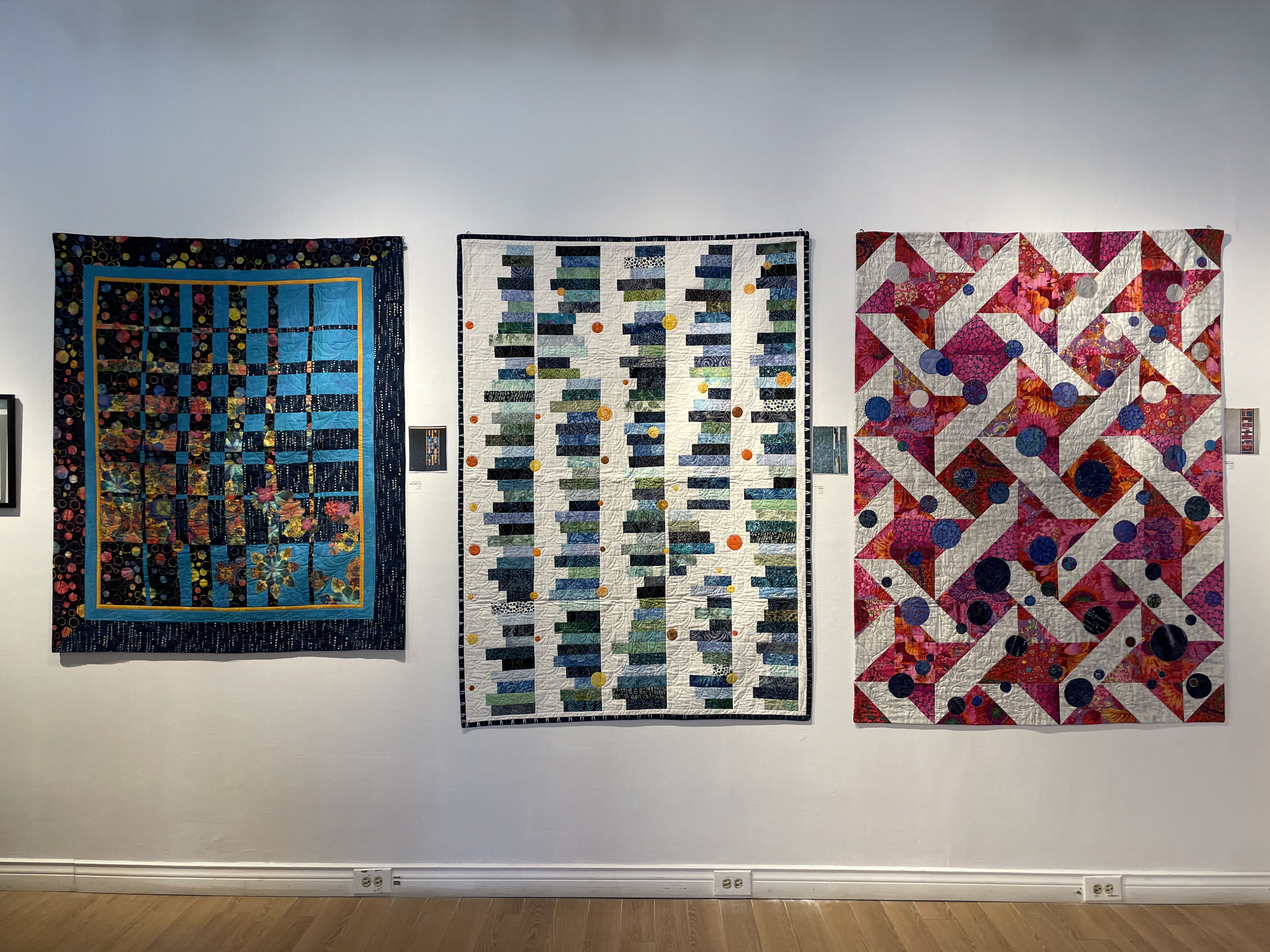
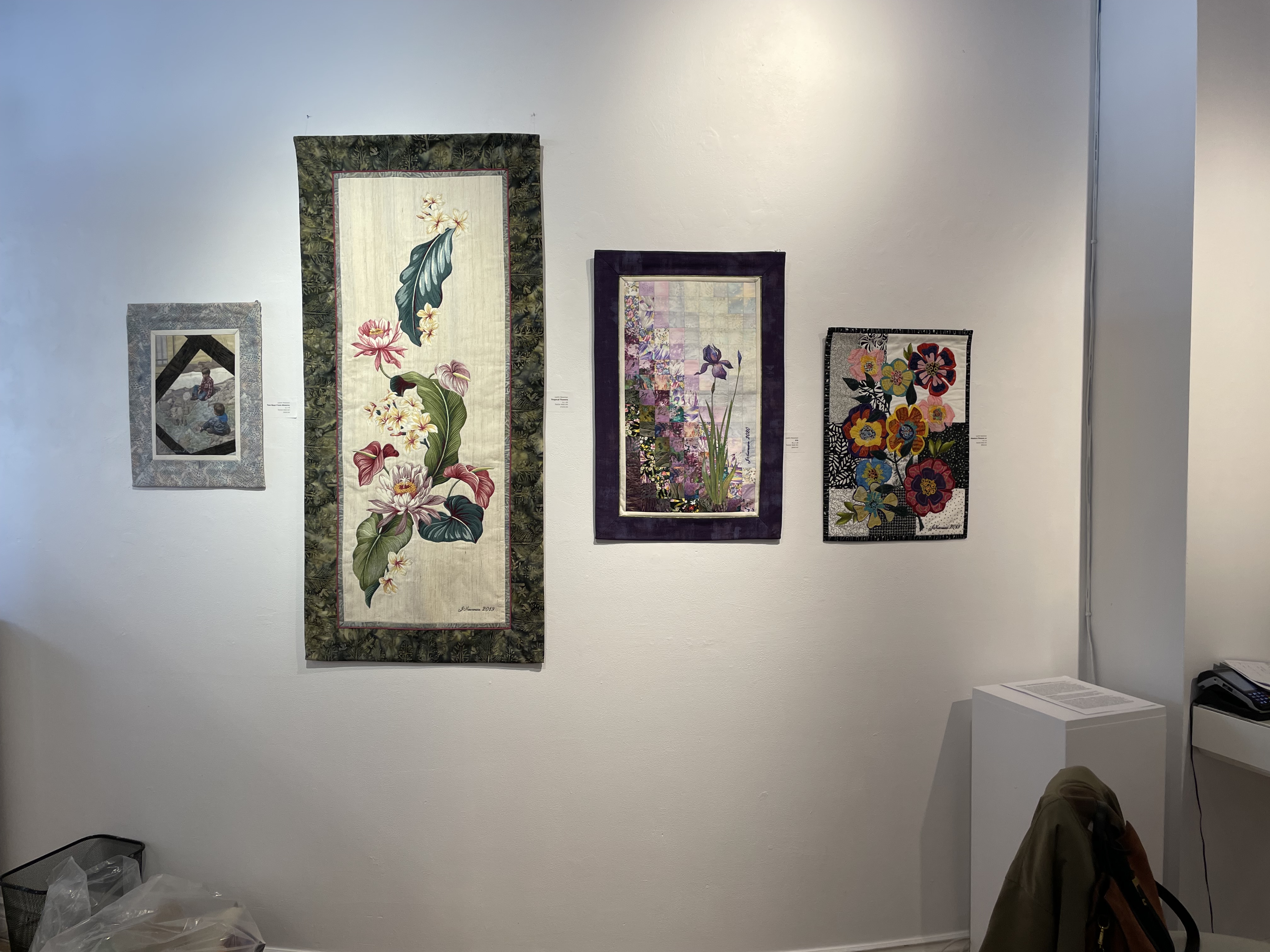
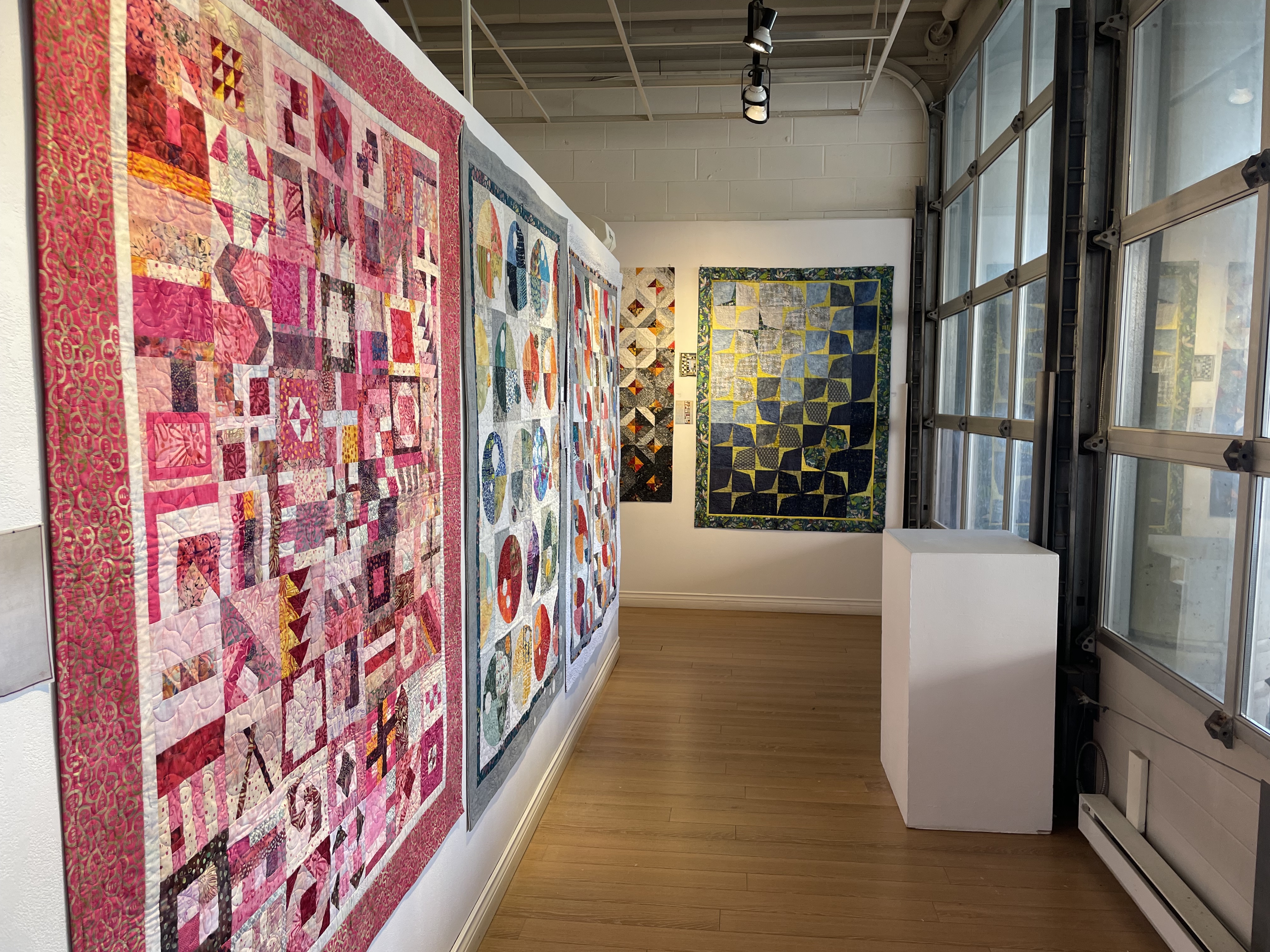
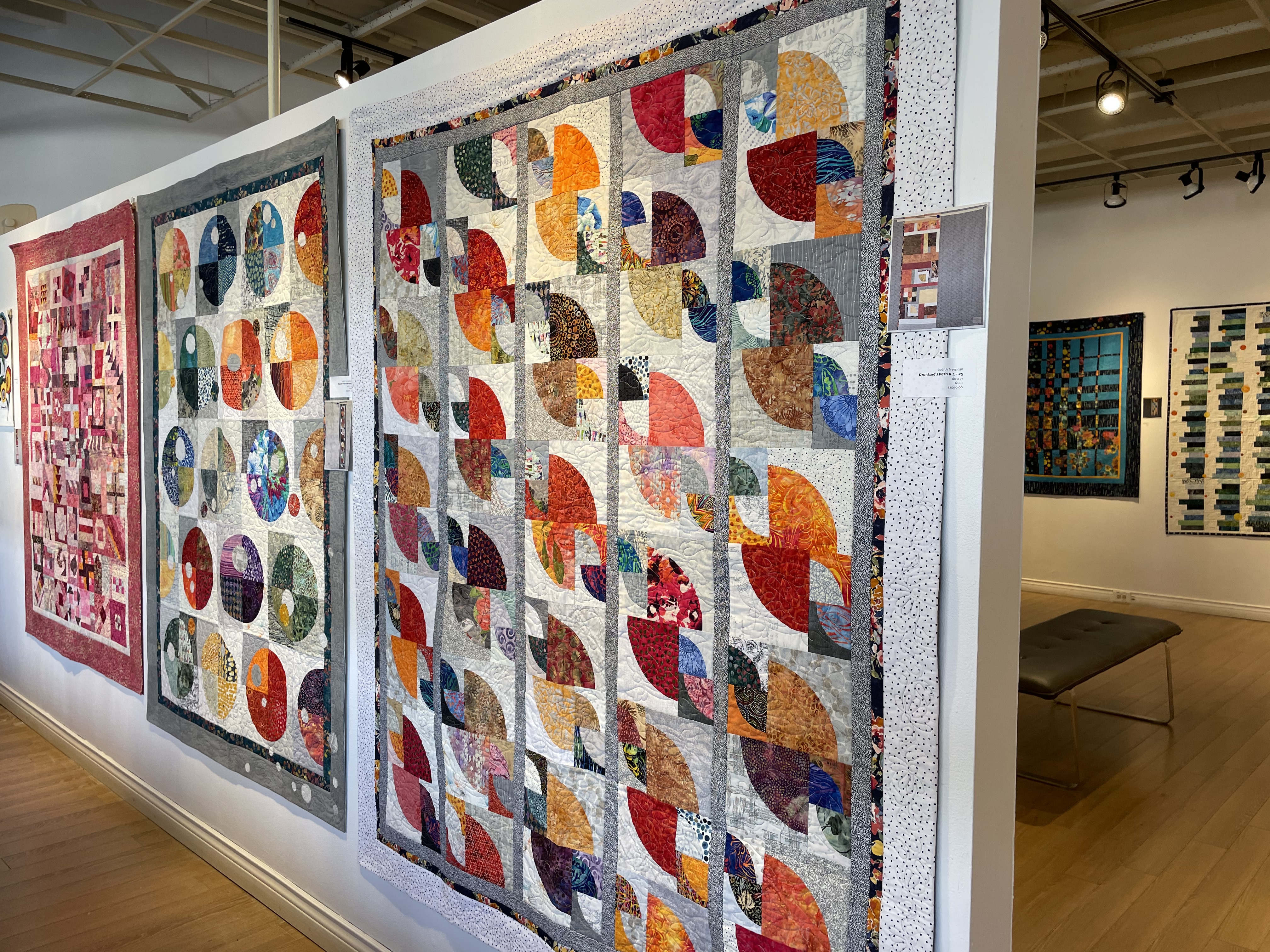
This is how the show looks (click on the images to see enlargements):

The photos don’t do the experience justice – if you’re anywhere nearby, drop in. The quilts and fibre art really need to be seen in person.

The show is up until Nov 24 2024 at:

The Craig Gallery
Alderney Landing
2 Octerloney Street
Dartmouth NS

Nightfall

I finally finished this quilt this past week. It turned out to be a lot more work than I anticipated. I thought I was making a simple quilt block – square-in-square but that didn’t work out because of the colour flow I was after. In the end I had to construct each triangle element from scratch! Which took a lot longer.

The back took a lot of “walking around” time – I just couldn’t settle on an idea. One Tuesday evening when my friend Neha was here sewing with me (that’s another story) I made up five square in square blocks from leftover bits – that broke the log-jam and I was able to sort out a 15″ strip to insert in the backing fabric.

Then there was the matter of layout – I sewed most of the dark blocks together to begin with but then had to disassemble the partial panel because the colour flow wasn’t working. To get a decent colour flow, I ended up pinning triangles, and trapezoid pieces on top of the developing panel on a design wall I improvised in order to get a clearer colour placement. Then I had to take blocks apart to insert the new required piece.

I put the layers together. I created two possible block patterns using my out-of-date Pfaff Premier 2+ software (it still runs on my Mac but not for much longer I’m expecting – then I don’t know what I’ll do, because the cost of a subscription for the software on MySewnet is crazy expensive!):

I chose Block 1 after doing a test run with some muslin and batting. I wanted the simplicity of the curves in the first design; I will use the Block 2 design on another quilt sometime.

Because the blocks were placed in the quilt on-point, I had to quilt on the diagonal. When all 44 blocks were filled in, I still had 18 triangle half blocks along the sides with 2 quarter blocks at one end to complete the quilt.

I also changed thread colour to match the colour gradation – I stitched the dark corner with an almost black variegated thread, the top left corner I quilted using white; in between I used three different grey variegated threads to blend with the changing colour. I used a light variegated grey on the back throughout.

I used the off-cuts from the backing for binding – which allowed me to match up the design on the back. I finally added a label.

I finished yesterday by hand basting a hanging sleeve at the top so I can display the quilt. (I still have 8 quilts that need hanging sleeves – gotta get those done over the weekend.)

I’m just about ready for the Craig Gallery Show:

If you’re in the vicinity do drop in!

Sewing/Quilting Tools

I taught a class yesterday at Sew With Vision on “Basic Alterations” – taking clothing in at the waist, under the arms; shortening pant/jeans legs, adjusting straps, etc. I wanted the two gals to understand there’s not a lot you can do to make a RTW (ready to wear) garment bigger; however, you can make adjustments to make something smaller.

For example, my high-belly measurement is much larger than it was ten years ago (related to my age and the meds I take). Not much I can do about dropping the weight from that location. So when I was buying a vest for fall wear, I bought 1XL to fit my belly, which meant it was too big around the hips, and the armholes needed adjusting. I could have done some complex taking apart, but instead, I just took darts in the shoulder seams (and hand stitched the dart to the lining so it laid flat); I did the same at the hips – a dart in the side seam from waist to hem by machine, then hand stitched the dart down. Now the vest fits decently and looks fine.

The one enlargement adjustment I do to make something bigger is to add elastic gussets to the waist of pants when the waist just gets too tight (my hips and thighs have stayed the same size for more than 20 years!). [I’ve previously described how I add elastic gussets to pants: https://jmncreativeendeavours.ca/2018/04/02/elastic-inserts/]

Back to the class – while the gals were working on small adjustments to garments for themselves and their children, it became obvious they had a few tools. Because I wasn’t expecting to do any sewing myself, I’d neglected to bring my sewing kit with me (https://jmncreativeendeavours.ca/2017/12/12/sewing-tools-organizer-finished/). We had to hunt through the shop’s tool collection (of dull very well used tools) to find what we needed. I told the gals I’d make them up a list of necessary sewing tools.

I’ve previously described five essential quilting tools I have at each sewing machine (https://jmncreativeendeavours.ca/2019/01/30/my-5-essential-quilting-tools/).

5 Essential Sewing/Quilting Tools
  • A Seam clipper/ripper
  • Self-threading needles (for embedding quilting thread ends)
  • Sharp 4 1/2″ embroidery scissors
  • Precision 3″ tweezers
  • Frixion Erasable Pen

But I use a lot more tools regularly.

Essential Sewing/Quilting Tools

I’ve laid out my tools, clustering those in the same category.

  • Measuring Tools
    • Rotary Cutting Ruler 6″ x 24″ – a good first measuring cutting tool
    • A measuring tape with both metric and inches on both sides
    • A metal 15″ ruler with both metric and inches
    • A slide ruler with notches for measuring and marking short distances
    • A small plastic ruler for checking short measurements (metric and inches)
  • Cutting Tools (these are going to seem expensive, they are, but expect to pay a lot more than you anticipate to get good sharp tools – I like KAI scissors – they feel good in the hand, they’re sharp and bit less costly than some other good brands)
    • 8″ shears – for cutting out garment patterns (I use a rotary cutter for cutting out patterns but there are curves that sometimes call out for shears)
    • 4 1/2″ embroidery scissors – I use these for snipping and cutting small pieces
    • 3 1/2″ precision embroidery scissors for removing stitches and close cutting
    • A sharp seam ripper (I change them as soon as they feel dull; I buy them in quantity to have plenty on hand and within easy reach)
    • A Seam Ripper Clipper (in photo above)
    • A 45mm rotary cutter with a supply of spare blades always on hand (I order in bulk online)
    • A Self-healing Cutting Mat – I recommend starting with a 24″ x 36″ mat (I have a 3′ x 6′ mat that covers my entire cutting table – expensive but useful)
    • Rotary Cutting Rulers and Templates – start with a 6″ x 24″ ruler
    • A Shape Cut Template/Ruler – this makes cutting strips of fabric very easy
Shape Cut Ruler
  • Marking Tools
    • Heat Erasable marking pens (Frixion are the most common, but I’ve bought acceptable ones in sets online)
    • Clover Chaco Liner – makes a fine chalk line (can purchase refills)
    • Chakoner – a heart-shaped chalk line drawing tool
    • A Fons and Porter or Bohin mechanical pencil with white lead (I have other colours, too, but I use the Frixion pens for marking on light fabrics and the chalk liners or pencil for marking on dark)
    • Post it notes, small and larger – I use them to identify cut fabric for both sewing and quilting
    • Masking Tape – I mark fronts and backs of garment pieces, for example, so I know what is what
    • Fine Sharpie Permanent Marker – another tool I keep at each sewing machine
    • A .7mm lead mechanical pencil (with .7mm HB lead) – perfect for pattern drafting on paper
    • Medical Exam Table Paper 18″x125′ ideal for tracing garment pattern pieces
  • Bobbins and Bobbin Holder
    • A supply of empty bobbins for each different sewing machine – each colour thread needs its own bobbin! You always want an empty bobbin around and each machine may take a different size bobbin (even from the same company)
    • A bobbin holder or box to keep bobbins in order and easily accessible and storable
  • Thread – there’s no point in sewing with cheap thread! Your machine won’t like it and the garment or quilt won’t like it either! I suggest
    • Aurifil 50wt cotton thread (variegated in two shades of grey for quilt piecing) – this is a lovely, strong, low lint thread, although expensive
    • Wonderful 50 weight cotton thread – a bit heavier than Aurifil but I use it for quilting a lot
    • Gutterman polyester thread (50wt)
    • Mettler polyester thread (50wt)
    • Coats and Clark polyester thread (50wt) – this is my least favourite but do use it to match with fabric when I have to
  • Other Useful Tools
    • A brush for cleaning lint from the sewing machine
    • A “HumpJumper/Seam Jumper” multi-purpose tool (the tool I have for lifting the presser foot for thick fabric also has a small hole for inserting a new machine needle – handy
    • A fine crochet hook for pulling threads hidden beneath quilt top or bringing pulled threads to the back of a knit garment
    • A Snag Repair Tool (Snag Nab-it) to bring pulled thread to back of knit fabric
    • A Large Safety Pin – for pulling elastic or ribbon through channels in garment or other sewing construction
    • A roller of sticky tape – great for picking up threads on your ironing board or fabric
    • Fray Check fabric glue
    • Glass Head straight pins (I like 1 1/16″ length – I find shorter ones harder to handle).You want glass heads because the iron won’t melt them! You want bead heads because they’re much easier to pick up
    • 1″ Curved Safety Pins for holding a quilt sandwich together (these small pins are a good size – the larger ones are awkward to sew around when quilting)
    • Washers – the largest you can find in the hardware store – great for holding paper patterns on fabric – much better than pinning – you need at least 6 (8 is better to have on hand; they’re inexpensive)
    • In addition to the feet that come with your machine, you will want extra feet for different jobs – you can find sets online that come with both a low-shank and high-shank adaptors (the set I have from Love/Sew works on both my old Singer Featherweight and my Brother Quilter)
    • NEEDLES – you need lots of spare needles – you need a fresh needle every time you start a new project (when I’m quilting, I change needles every 30,000-40,000 stitches – in other words, I change my needle two to three times during the quilting process). I buy needles in bulk – in boxes of 100 – for the needles I use most: Universal 80, Embroidery 75, Quilting 75. I also use Top-Stitching 90, and various Stretch/Ballpoint needles, Twin Needle 75 4mm & 6mm, also it’s useful to have Denim /Jeans needles 90 for working with denim. Schmetz and Inspira (as well as Klasse) are all sturdy needles which come in many sizes and for all fabric types [https://www.schmetzneedles.com/pages/sewing-machine-needle-chart?srsltid=AfmBOopLOpsA-oGFmbcXGBllCANtjbRxzSIvBejuXQKS0Bgcuf11qDSv]
      Just remember: dull needles can ruin your project, and there’s nothing worse than breaking a needle and not having a new needle on hand
    • A pin holder with a magnetic mouth used for storing discarded needles and bent pins – you can also use a large pill container with a lid, even a mason jar – something to collect used sharps
    • A magnetic pin holder
Magnetic Pin Holder
Sewing Machine Needles
  • Ironing Board and Iron – if possible keep your ironing board always set up – makes it much easier to just get a project going. You want a good pad and cover – I have a felted wool padding and I use a heavy twill unbleached cotton to make my table cover – I make a new cover every two years or so
  • A sewing table at the right height for your body (I had mine made for me – lower than a standard table height because I’m short and my upper arm measurement is somewhat long) – a dedicated sewing table means you can keep your machine set up and ready to go.
  • An adjustable stool – I have what’s called a Saddle Seat that I can adjust to the perfect height to keep my shoulders down and relaxed when I’m sewing (I actually have two of them which I move around as I need them). Even though they don’t have a back support, the seat forces you to sit with your knees below your hips which puts the lower back in a good position for extended working (although if you’re quilting or making a garment from scratch, you’re pressing as you go which gets you standing and moving to and from the ironing board a lot).
  • A Cutting Table at a comfortable working height – I created mine from a teak dining room table on a double set of wood bed lifts – makes it the perfect height for me
My Sewing Studio
  • Shelves and drawers and containers for storing fabric, notions, zippers, thread, patterns, tools
  • Trash cans – one at each sewing station
  • Good lighting

Finally Back Again

Been gone a month – I’ve been busy sewing and knitting, and engaged in my daily/weekly routine but for some reason I haven’t managed to sit at the computer and describe what I’ve been up to. So let’s get to it.

Mid August, I wanted to start a new quilt. I looked through my fabric stash and decided to use a jelly roll I’ve had for a couple of years.

The jellyroll fabrics (20 strips) ranged from black to white with many gradations of grey. Dull on its own – I decided I needed some strong contrasts. Because the strips were batik, I selected bright batik scraps to contrast with the black/white. I decided to make “square in square” blocks, cut them into triangles on the diagonal, then arranged them in squares again. All is fine, until I try arranging the resulting squares into a larger array only to end up with a hodgepodge I wasn’t happy with.

First Attempt

There’s a hint of a gradation from black to white but it doesn’t work overall because each of my blocks has light/medium/dark elements and to get a good colour flow I need some blocks that are very dark and some that are completely white. To make that happen I had to make many more blocks from scratch.

Second Array

This time, I established a dark corner and a light corner and tried filling in. I was working on my cutting table, rather than on my floor beside the cutting table as I usually do, because I’d injured my right knee and couldn’t get up and down. It didn’t occur to me at that moment that I could set up a design wall using a length of batting hung from a rod in my spare room (in front of the closet door) to hold the triangles/squares to audition placement – that came later.

So I filled up my cutting table with a layout I thought would be the darker bottom half of the quilt top. I made the mistake of actually sewing these blocks together into a 6×12 array. I was planning on filling the cutting table again this time with the top half but then I couldn’t see what I’d already constructed. This was when I set up a design wall:

Array #3

I placed the assembled bottom half of the panel at the bottom of the wall and started laying out more blocks. Two things were immediately obvious: 1. I didn’t have enough “black” extending from the lower right corner and 2. the grey extended too far across in the middle of the emerging piece. I’d also run out of triangles at this point and needed to make another 60 or so.

By this time I had stopped making squares in squares and instead I cut trapezoids from the jellyroll strips (I had to open the second package I had on hand) as well as triangles from the contrast fabrics. I’d figured out that working with reassembled squares wasn’t helpful – I was better off constructing just triangles where I could control the colours I was juxtaposing and had more freedom when placing them.

Array #4

Close, I thought but I still wasn’t completely happy with the colour flow so I played with it over the next few days – shifting blocks in the top half, and pinning other triangles over existing triangles in the sewn bottom portion.

Final Array

It took a couple of days looking at the design wall and moving and pinning elements until I was finally satisfied with the look of my panel. Yesterday, I took a photo, then very carefully stacked the pieces in the top six rows, numbering each stack so I knew the order and orientation of the pieces in each stack. Then I carefully repinned and labelled the changes I’d made to the bottom panel – knowing I would have to take much of it apart in order to get the arrangement I wanted.

It’s taken the better part of two days to reconstruct the bottom half of the quilt top:

Now I have the bottom portion of the array back together – many of the changes were subtle ones, mainly involving extending the darker batiks further across the panel, limiting the lighter, brighter trapezoids and triangles until the mid area.

Tomorrow I’ll start sewing the six top stacks together, row by row – it won’t take long because I’m not having to carefully unstitch many interlocked seams!

As you can gather, this whole process would have been much easier had I planned out on graph paper what I was thinking about, but that’s not how I seem to work. I much prefer just starting and building and designing as the project unfolds. I find improvising so much more interesting because I have no idea where I’m going to end up. Always a surprise and satisfying. It’s how I write as well – just get some words on the screen and see where they take me. I never know what I’m writing about until I get well into something and an ending emerges. That’s my creative process.

I have no idea what I’m going to do with the back – do I want to make another 36 of these triangle elements for an insert or do I want to try something else – still thinking about that.

I don’t have a vote

At the top of my email this morning was the daily offering from Steve Brodner – a shocker: https://substack.com/home/post/p-147061422?source=queue

“Christians, get out and vote! Just this time! You won’t have to do it anymore. Four more years, you know what? It will be fixed, it will be fine. You won’t have to vote anymore, my beautiful Christians. I love you, Christians. You got to get out and vote. In four years, you don’t have to vote again. We’ll have it fixed so good, you don’t have to vote.” [trump speaking in Florida 7/26/2024]

I searched “Did trump actually say christians get out and vote…” – just to confirm he’d said it as Brodner quoted. It wasn’t that I didn’t believe Brodner, I was interested in finding out more about the context and whether any of the major news outlets would bother to report the comment. 

I definitely found headlines, so trump’s rantings are garnering some attention. They need a lot more attention. Given the overall context of his “speeches” I’m taking the words at face value – vote him into office and that’s the end of meaningful presidential elections. I suppose he could be saying that he’ll have changed the political reality to such an extent that even if there were to be elections whether Christians vote or not won’t matter because any election would simply be pro forma. 

I’m on the sidelines in this US election. I don’t have a vote. I’m Canadian. I’m fascinated with the way the election has changed since last Sunday when Biden announced he was passing the torch to Kamala Harris. Energy was palpable almost immediately. I am hoping she can maintain and grow support for her campaign because trump winning the election would be horrific. At least that’s how I see it from my vantage point in Nova Scotia, Canada. 

Not only would a trump win be dreadful for the US, it would change lives in Canada in some expected and many unexpected ways. The economic impact would be felt here instantly. But more egregious would be the way in which our political conversation would change – becoming even more partisan, more vicious, more divisive on all sides. We don’t need that.

So I watch the campaign with more than a little concern. I read trump’s words as invoking a dictatorship – support me this time and that’ll be the end of it – I’ll make sure you’ll never need to vote again.

I’m hoping Harris can build and sustain momentum – the US needs her to win. The rest of the world needs her to win.

Go Kamala, go girl! 

But I don’t have a vote….

[PS: If you don’t know much about it check out Project 2025 – it’s the GOP/Trump blueprint for a trump presidency – the document itself is 900 pages long, but this synopsis will fill you in.]