This one is #3. I finished it yesterday. A surprising number of thread changes involved in this one. I’m pleased with how the flower centre turned out – I didn’t feel it needed a metallic thread; the dark brown/black set up enough contrast with the golden yellow to make the flower lively. The challenge is deciding how much stitching and where. The flowers look better when there is some unstitched space but there still needs to be enough thread painting to give the flower texture.
More To Come
This is what’s on my cutting table (anti-clockwise starting at the bottom left) – a purple poppy (needing to be fussy cut), a Blue Flag iris, Bradford Pear, a clematis, a peony, a day lily, and a hibiscus I cut from some Hawaiian bark cloth which I’m not going to use. Instead, I added a few more printed photos to the collection – a yellow/pink phalaenopsis, a more vibrant purple iris, and a golden/red hibiscus. That gives me the ten flowers I’m hoping to complete for this set.
I’m waiting now for my latest order of 6×6 mounted canvases to arrive so I can mount these pieces when I’ve finished thread painting. This project will take me another ten days or so to complete.
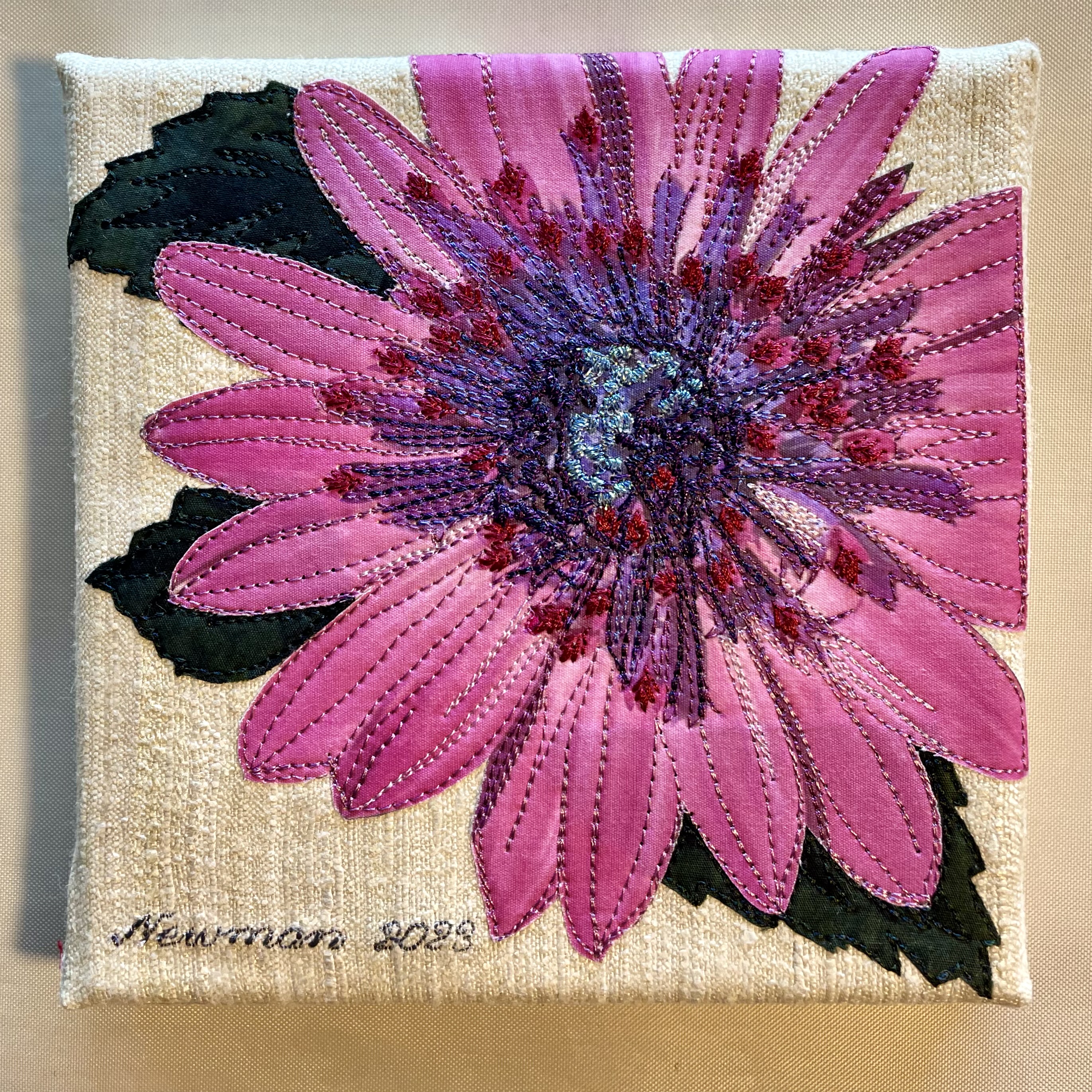
Osterspermum are African daisies. I first noticed them at garden centres maybe 20+ years ago. They come in a range of colours from off white to a lovely purple, red, orange. I started planting them in the container gardens on my back deck. Over the years I took lots of photos of them.
Osteospermum
I decided to include an Osteospermum in the set of ten pieces I’m working on.
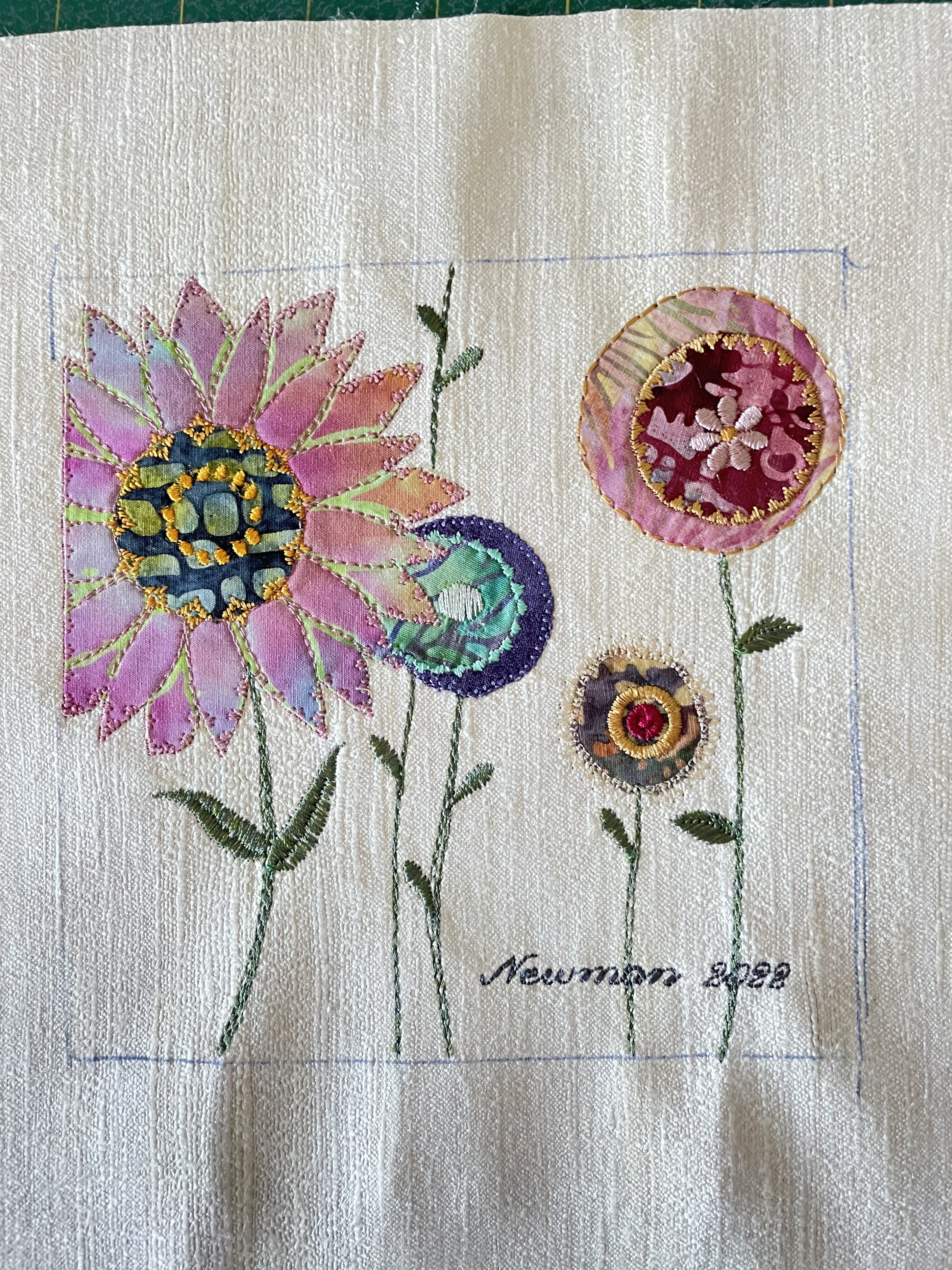
Again, on a raw silk background, I fused the fussy cut flower printed on cotton. I selected a variety of rayon and polyester embroidery thread to use for the thread painting. Then I started stitching – first the flower edges with a dusty pink thread, then I spent about an hour designing a stitch to use for the small central florets – I stitched each one separately. Then I worked my way into the centre. wanted to catch the viewer’s eye at the centre – I used a metallic thread paired with a rayon to stitch the unopened florets at the very centre. Last came the leaves.
A second 6×6 piece finished.
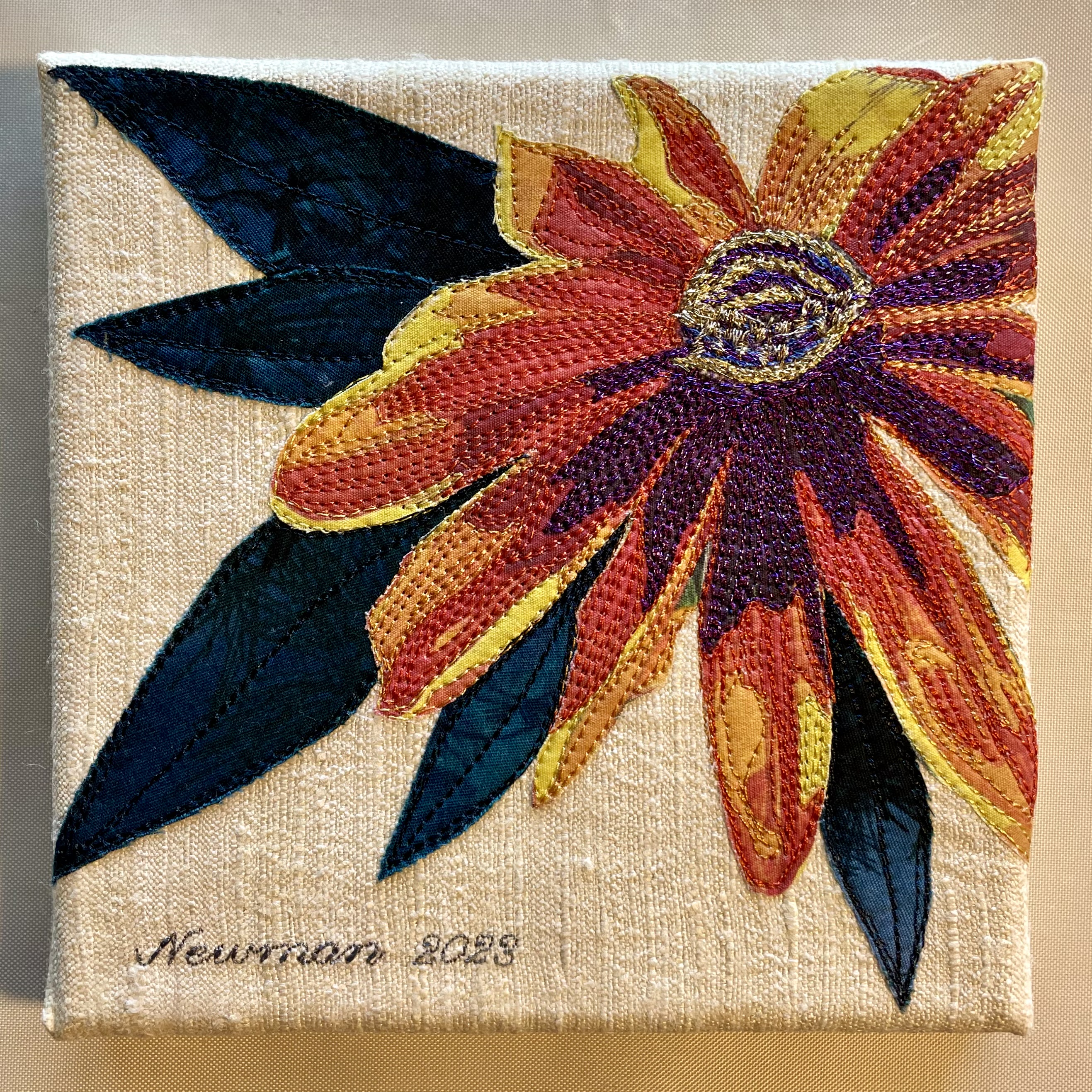
Then I went back to Rudbeckia II – I wasn’t happy with the flower centre. I removed the piece from the canvas backing, pressed it lightly and reworked the centre and dark purple areas thread painting with metallic thread.
Rudbeckia II – Reworked
You can just see the glint of the metallic thread at the centre and in the deep purple areas. The thread painting with metallic thread gives more depth and texture at the flower centre. The slight glint of purple metallic thread livens the whole flower.
This is my second go at the Rudbeckia. This time I printed the flower on fabric, pulled off the plastic backing, added fusible web, then fussy cut out the flower. I dug through dark green scraps, added fusible web, then cut leaf shapes. I fused leaves and flowers to a 9″ x 9″ raw silk square of fabric which I’d backed with Sewer’s Dream interfacing to stabilize it.
Then I began stitching! It took several hours to thread paint the flower – constantly changing thread and bobbin colour – using the “hover” function on my machine to simulate free motion sewing.
This time, I left myself enough space on the background to apply a signature. Having used fusible web, my raw edges are relatively smooth, not fraying as was the case with the first Rudbeckia.
I think I’m rather happier with this version than I was with the first prototype.
I started working on this quilt around Jan 22. It’s gone more slowly than some quilts because there were decisions along the way I found difficult to make – but I completed it last night. Yesterday I finished quilting the wide outer border, added the facing/hidden binding and hand sewed it on the back. Label added last.
Quilt TopQuilt BackPlanets With Moons
I’ve tentatively called the quilt “Planets with Moons”. The finished dimensions: 49 1/2″ wide by 68″ long – a rather large throw, a bit too long to hang on a wall unless you have rather high ceilings. It certainly is a good length if you’re a tall person!
I’m particularly pleased with the back strip. In fact, I’m thinking I might do an entire quilt based on that idea – a 6″ drunkard’s path block attached to two 3″ drunkard’s path blocks. The resulting oval shape is interesting. I wonder what it would look like if I limited my colour palette to two colours (blending various shades). Something to think about.
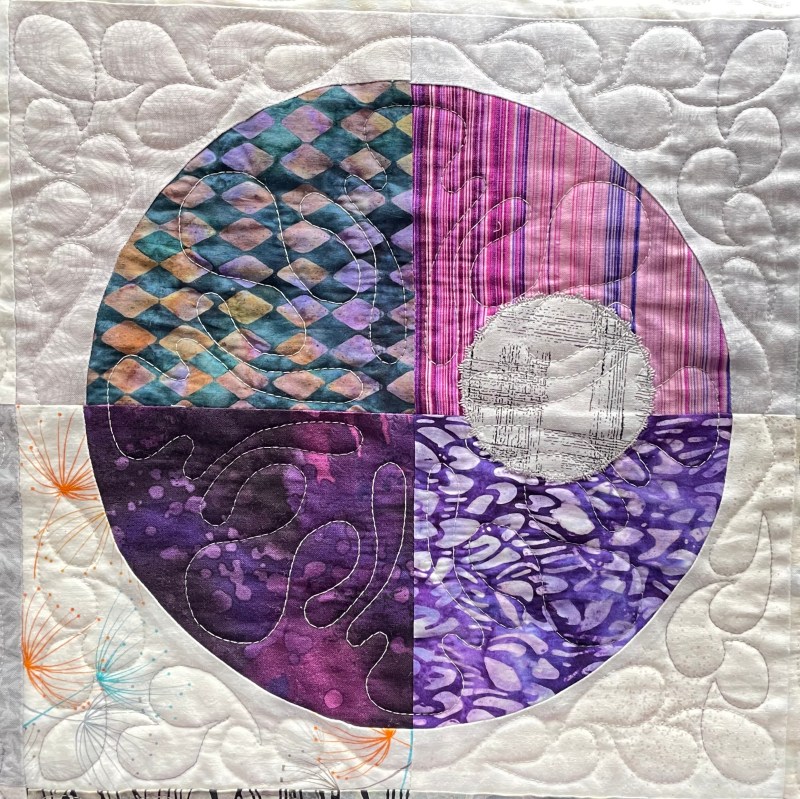
Quilting the project was somewhat complicated. I started by setting up a circular embroidery to fill the individual large circles and quilted them all. Next I had to design an embroidery to fill half the background square (I could only embroider two sections at a time (either left two or right two) because of the hoops I have. Filling the background took three days – a total of 35 embroidery repeats. Then I decided to adapt the circular embroidery into a long narrow element for the border. That left a small corner embroidery which I added to finish each corner.
A quilted block – circle and backgroundQuilted border and cornerQuilting Detail
The challenge with quitting in the hoop is getting the embroideries to line up and join. Lots of math involved in trying to position and adjust the size of each embroidery so the stitching is precisely where you want it (my Pfaff Creative Icon 2 has a “precise positioning” capability which makes quilting in the hoop possible). I did “touch” the large circles in a few spots but for the most part I managed to avoid crossing the circle/square boundary. I stitched both sides of the narrow batik sashing in the ditch but chose not to add a quilting to that element, it was narrow enough that it didn’t require quilting.
With this quilt now done, I can put it in the pile for the Art Labs showing in the summer. I will hang it with several other quilts I’ve made using Drunkard’s Path, showcasing the technique as an artistic choice. The other grouping I have ready includes three “Convergence” quilts. So far, then, I have seven quilts set aside for that show. I will now turn to working on smaller wall art pieces, including a set of 6″ x 6″ which I’ll show at Art Labs, but they’ll really be for next December in Tatamagouche!
It’s being able to show my art that keeps me working at it. There’s always some time pressure – keeping in mind how much I need to actually produce for a show to work. Fortunately, I don’t need all new pieces for each show, I’m able to show older pieces along with a few newer ones which creates a new context for each piece.
I haven’t done much textile art for the past month or so – not since the 6×6 pieces. Nothing in particular has called out to me.
This morning I decided I had to start something. I keep a folder on my desktop “Wall Art” where I stick ideas. I looked at Charlie’s first swim photo – I’ve never been happy with my original piece created using raw-edge appliqué. I’ve wanted to print the photo on fabric and embellish it.
Charlie’s First Swim
The problem is his dad sent me a small version of the photo on his phone and when I attempt to enlarge it I get a very pixilated image. This morning, I printed an enlargement on paper – I’m going to try stitching that to see whether I can sharpen the image with some thread painting. If it works, I’ll print Charlie on fabric and carry on from there.
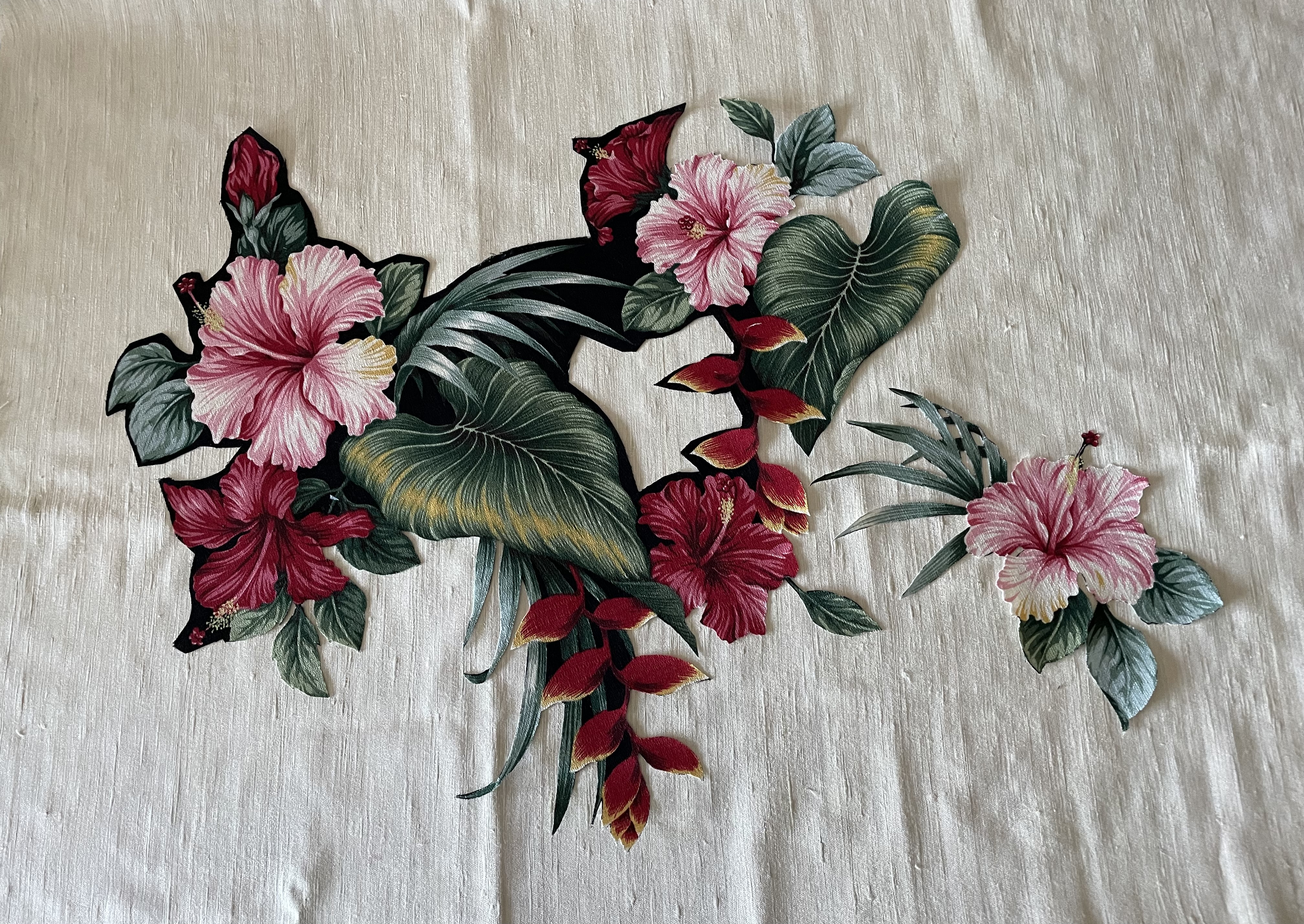
Another thought was to revisit the bark cloth in my stash. I selected an array of hibiscus and heliconia from the black fabric, pressed a sheet of Pellon 805 fusible web to the back, and started fussy-cutting the flowers.
Hawaiian Flowers
I’ll carry on trimming off the black. I plan to use a panel of natural raw silk as background. This may be a project I’ll work on while working on other things.
However, this doesn’t feel like a start – I definitely want to do some quilting – just not sure where to begin.
I finished the edge stitching, embroidery and leaves/stems on the last of the ten pieces this morning. I removed the excess stabilizer from the back and pressed each block.
Now each needs to be mounted on a 6×6 stretched canvas panel. I still have to decide whether to place batting beneath each before securing the silk to the back of the wooden frame. I’ll cut out a few pieces of batting and see how it looks. I also have to trim the silk panels to remove excess fabric so they’ll attach smoothly to the framing.
That’s for another day.
I survived Hurricane Fiona – the NE winds howled and pounded rain against my windows for a couple of hours. This storm was as severe as Hurricane Juan in 2003 – even though landfall was about 150kms from Halifax (Fiona came ashore at Canso) – in 2003 the city took a direct hit. Nevertheless winds here were strong enough to do significant damage. We were given ample warning – emergency measures folks were concerned about damage from falling trees because they still have all their leaves. They weren’t wrong.
I didn’t suffer a power outage, although a good portion of the city is still without electricity and for some it will take days before repair crews can get to them. A friend came over this morning to shower and do a bit of laundry! She’s hoping to have her power restored before Wednesday (which is her predicted date!).
I’ve been procrastinating the past week – no idea why – but today I got back to the two 6×6 pieces I had 1/2 finished and completed them.
There are now six. [The outline is done with a Frixion heat-erasable pen. I’ll remove it when I’m ready to mount the individual pieces on the 6×6 stretched canvas frames.]
6×6 Six Finished
I have another couple of hours this afternoon – there are four 6×6 prepared – I’ll get a start on the edge stitching for a couple of them.
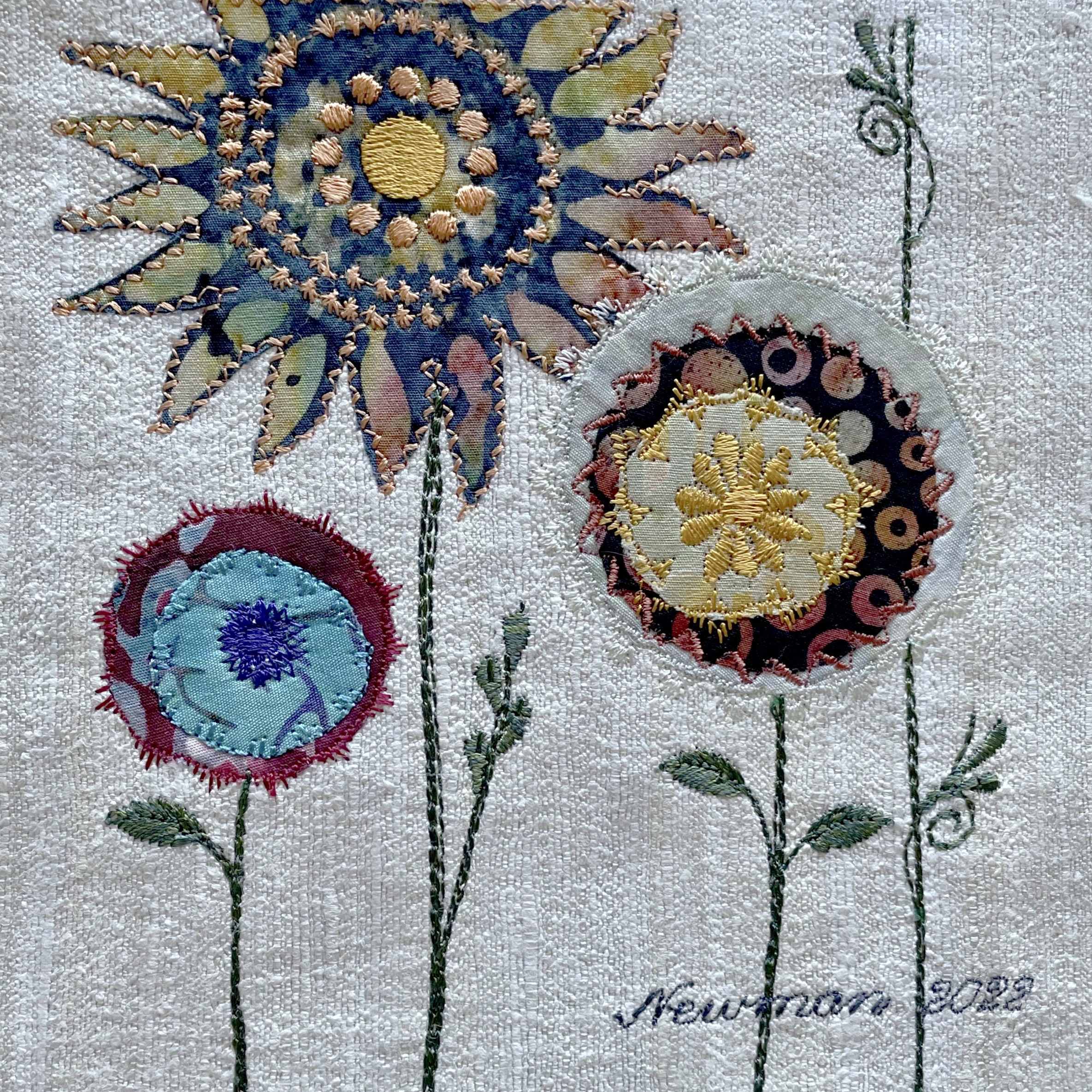
It’s taking about three hours to do each block what with the edge stitching on each piece of fabric, free motion stitching in the stems, stitching the leaves (which are decorative stitches) and embroidering the centres (which is taking way more time than I expected – for some reason my top thread is fraying when I’m embroidering so I get stops where I have to clean up the mess, backtrack the embroidery, then continue stitching.
So far, the signature is stitching out without breaking the thread! After I’ve pressed the block, I’ve redrawn the 6″ outline with a Frixion (heat-erasable) pen so I know where my edges are.
Three more left of the original six I prepared. When those are finished (in about a week or so) I’ll layout the remaining four.
Finished this pair of socks on Friday and began a new pair that I think I might keep. The stash keeps growing – I will definitely have plenty of socks to share for Christmas. Last week I contacted the gal who wanted 4 pairs of socks from me two weeks before last Christmas – I told her this was the time to place her order. She said no socks this year. Do I really believe her? When she asked last year I just squeezed her order through – I had to take one pair, remove the toes, lengthen the foot by an inch, reknit the toes – she was lucky I had enough time to do that. I’ve already put aside a couple of pairs with someone’s name on them. I’ll just keep knitting as usual.
The Christmas Show Challenge
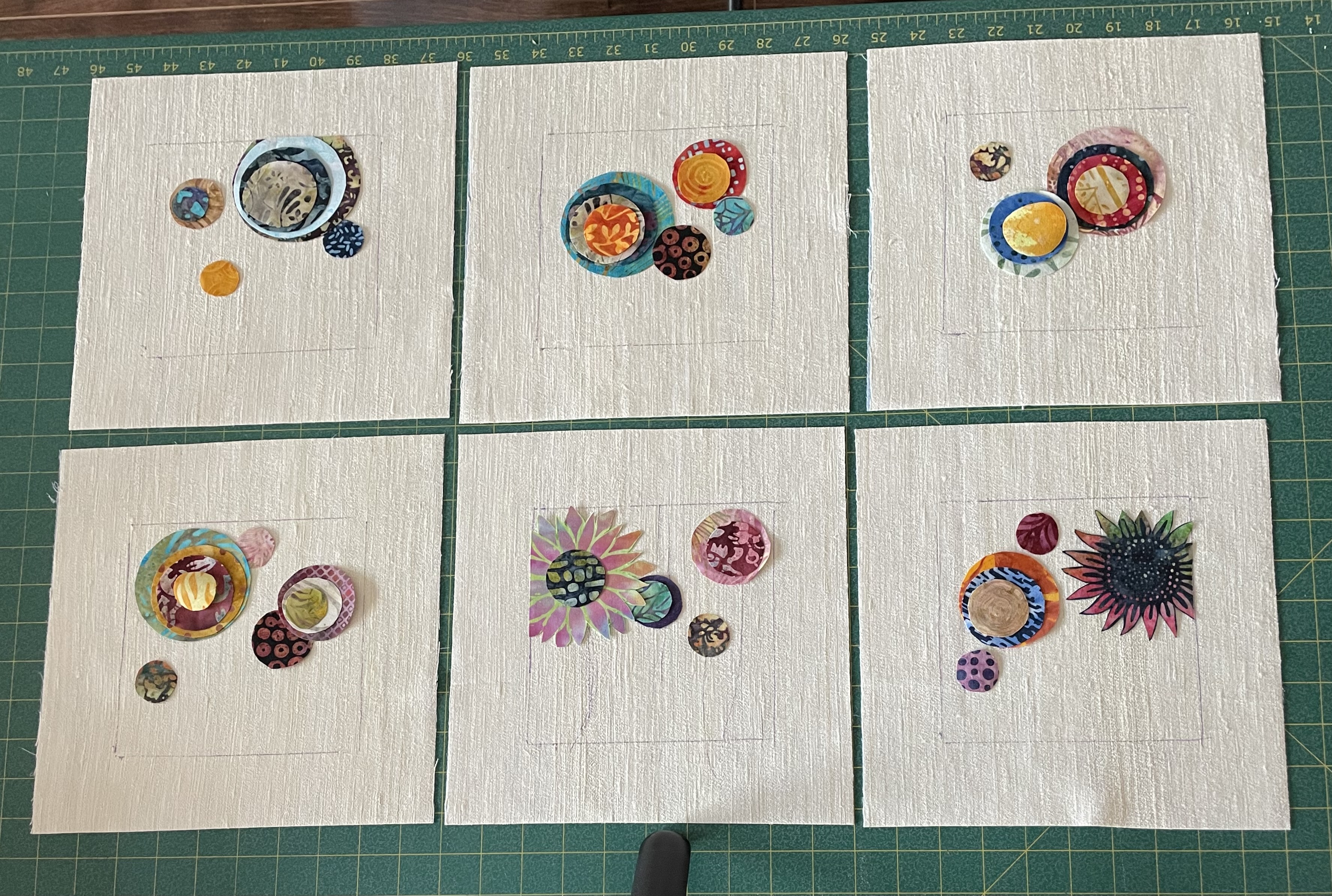
I finally made a decision regarding the 6″x6″ blocks – to use the textured raw silk for the background, to fuse batik circles of various sizes to the background to simulate “modern flowers”. I cut out ten 10″ blocks from the raw silk I have on hand, backed it with sewer’s dream to stabilize it, marked 6″ squares in the middle (using a heat erasable pen). Next, I added fusible web to a pile of batik scraps and cut out a lot of circles. I have started arranging and fusing circles to the raw silk.
Six Blocks Laid Out (but not yet fused)
Because all ten blocks will be shown next to one another, I’ve worked to vary placement, even cropping some of the flowers so the appearance of the blocks is different. I have to edge stitch the cropped edge so there are no raw edges at the edge of a piece.
I’ve completed one of the blocks
First finished 6″ Block
The slight wobble at the bottom of the block will be eased out when I mount the fabric over the stretched canvas.
Looks like each block will take me between 2 and 3 hours to embellish. It doesn’t look like a humungous amount of stitching but it takes more time than you think to edge stitch each bit of batik, then to add stems and leaves, and signature. The stems are free motion. The leaves are decorative stitches each requiring careful placement. The flower centres are embroideries which want precise positioning and often involve thread changes. It all takes time.
I’ve got another block sitting on my machine waiting to worked on tomorrow.
In my stash, I have several metres of raw silk – I bought it in Toronto in 2008 to do wall art. I cut a strip, backed it with sewer’s dream – light weight woven fusible interfacing – to stabilize the weave of the silk and to eliminate some fraying at the edges, then cut the strip into 7 1/2″ blocks. I also had some fabric with these roses which I thought might work as appliqués – I backed a piece of the fabric with Pellon 805 fusible web, fussy cut these two flowers, fused them to the silk, thread painted them, added a signature, trimmed the block to 6 1/4″, bordered it, finally I mounted it.
Again, those corners are driving me crazy! Adding the black silk border adds quite a bit of bulk at that critical location and makes it nearly impossible to get a tight, square fold at the corner so while the fold look OK when you look at it from the side you can see the “pointy” bit sticking out when you look at the block face on.
I’m not sure how I feel about the raw silk – I think it has a bit too much texture compared to the woven silk I used on the other flower piece:
Also, I think I prefer the whimsy of the “Modern Flowers”.
I can’t source anything close to this woven silk here in Halifax; I’ve ordered several different types of silk from two different suppliers. Until it arrives (10 days/2 weeks?) I’ll keep playing with the raw silk squares, making more Modern Flowers arrangements. I think that’s where I’ve landed. Because I’ve cut the raw silk at just 7 1/2″ (8 1/4″ is what I need for wrapping around the stretched canvas) I’m going to have to trim and border the blocks but I want to explore different leaf types and lots of different appliqué placement.










 jmn
jmn 