I’ve been engaging in a written conversation with a quilting blogger – her most recent entry was about the physical stresses that are a part of quilting. Most people don’t think about the strain and tension that goes along with quilting – the ergonomics of sewing are critical.
I replied to Melanie with the following:
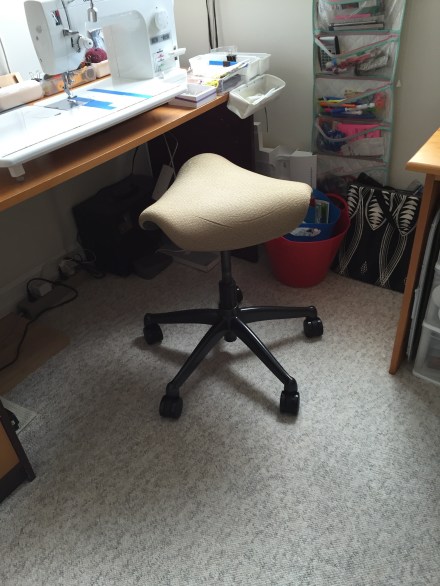
Saddle Chair
For me, the relationship between the height of my sewing machine bed (2 1/2″ above the table top) and the seat height of my saddle seat is critical! Table top – 26″; seat height 22″. That allows me to sit straight, swivel on the seat, support my feet on the wheel supports on the seat, with my arms and shoulders relaxed and elbows at a perfect 90 degree angle. There is no back support on my my saddle chair but sitting on it forces a straight back, neck alignment.
I do big cutting jobs on my dining room table which is too low, but I trim on my ironing board which is 32″ high – a wee bit low but I’m never standing there for long periods of time. Sit to sew, stand to press, trim… I can work comfortably for three – four hours.
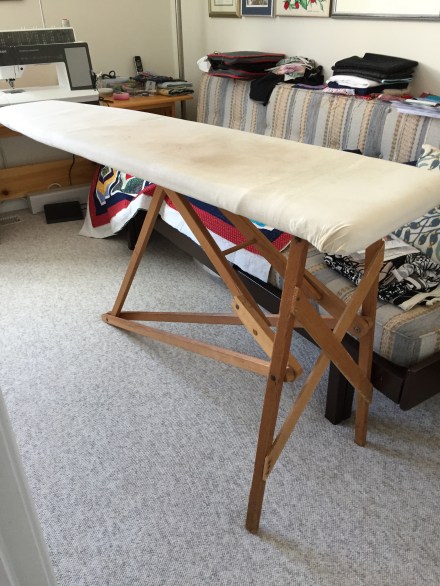
Ironing Board – at least 100 years old!
Melanie then asked:
I haven’t tried a saddle chair. I’ve seen them at shows offered for longarm quilting, which might help when doing very fine work. Is your ironing board adjustable? I feel like I often do a lot of pressing at a time.
My saddle chair is adjustable and I have it set at almost the highest it will go. My ironing board, as you can see is NOT adjustable. I bought this old thing at least 50 years ago at the Salvation Army in Toronto for $1.50! Aside from it’s height, it’s wider and longer than a modern metal ironing board. It also has a solid wood board which now has many layers of padding on it so it holds heat very well. I’ve had new boards but have given them away – this is the best ironing board I’ve ever had. Every year or so, I make a new cover which I install over the old ones. I use an unbleached light weight canvas. At the same time, I tighten all the screws in the legs to keep the board from collapsing when I set it up to press.
There are times, when I’m starting a new quilt that I will have a lot of fabric pressing to do – like today, I just cut out 75 seven inch blocks from a collection of 19 asian inspired fabrics – I’m going to do a drunkard’s path quilt next and I needed to press the fabrics before cutting them so my cutting would be reasonably accurate. The ironing board height, however, seems to be OK. I can press for quite a while before feeling tension in my middle back.
So comfort while sewing – you bet. It’s important to have a working set-up that doesn’t put undue strain on the back and neck, or wrists. It would be awful to end up with a repetitive stress injury and not be able to sew/quilt any more!
 These are the socks for my friend Sab (who works for Lufthansa). She asked me for a pair of socks she could wear with her uniform – indigo and red – but Lufthansa’s colours are indigo and a golden yellow, so I incorporated both the red and yellow into the socks, making sure there was a reasonable amount of navy at the cuff end so she can wear them in her boots without the colour showing! At least I hope that’s what will happen.
 See what I mean – at the moment I’m knitting on 68 stitches – the “pattern” will change when I reduce to 64 in another 10 rows or so. Then I suspect there will be a set of spirals that appear. That’s the pleasure of knitting with variegated yarn – I love seeing what pops out as I knit!


 jmn
jmn 