“Granddaughters”

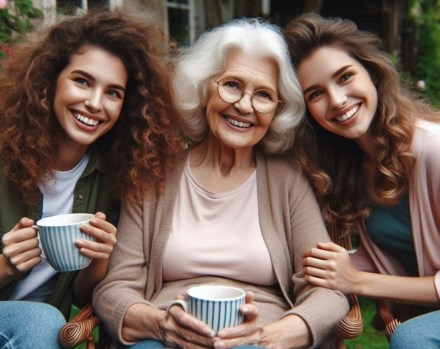
Granddaughters (AI Generated)

It began a year and a half ago. A phone call from my sister Donna wondering whether I knew anybody who could help a new immigrant with English. I don’t know whether that was a subtle way of trying to draw me into her sponsorship work with new immigrants fleeing terror at home, or a request for help to find someone to teach English to adults. I said I could help out.

I’d spent my professional life teaching teachers about literacy – helping them understand their own strategies, as well as encouraging them to explore ways of engaging their students so they in turn could discover the skills and pleasures of reading and writing proficiently. While I had no training in English as a second language, I understand first language learning and how learners (of all ages) become adept speakers / listeners / readers / writers.

I met Basira the week she and her family (her husband and three young sons) arrived here in Halifax. Ahmad spoke understandable English but Basira understood almost none. The danger for her, and many immigrant women, is that she’d not learn English well enough to live in the community successfully and independently. As a young woman with children she needed to become an English speaker as quickly as possible.

I agreed to spend time with her each week, expecting she’d soon be enrolled in English classes through ISANS (Immigrant Services Association of Nova Scotia). Turns out that proved difficult. There had been a recent influx of immigrants from countries like Syria, Iran, Afghanistan, Ukraine, and there was a severe shortage of tutors. Basira went on the waiting list and she and I carried on.

I arrived at her apartment one morning each week and we’d spend time engaged in conversation. That was a challenge for both of us. Armed with translators on our phones, I’d translate English into Persian, Basira did the reverse. What helped was she knew the English alphabet. The family had lived in Turkey for three years before being accepted in Canada. The Turkish alphabet is close to English so she’d become accustomed to the phonetic correspondences. It turned out she also understood a bit of English. In addition, she’d become reasonably independent in Turkish during the time she spent there; she wasn’t afraid to tackle another new language.

Along with conversation, I brough along library books intended for very young children – few words but lots of supportive illustration. I had two aims: to offer vocabulary and English sentence structure without formally teaching either. To select appropriate books took quite a bit of time at my local library every couple of weeks – I’d read 10 books for every one I selected. It wasn’t long before Basira was needing books with longer stories, broader vocabulary and more complex sentence structure. (During this time, she gave birth to her fourth son – a new Canadian.)

I had never married; I had no children. I have a close relationship with my sister Barb’s daughter and son and their children. Now, as I grew to know her, Basira was beginning to feel like part of my family – like a granddaughter.

I’d been working with Basira for eight months when Shukria, her husband and infant son arrived in Halifax. They too needed support. Jawad spoke some English; Shukria spoke none. Same deal – I visited once a week to spend time with each of them, engaging in conversation and reading children’s books. Back to the library – simple children’s books this time for Shukria, more informative ones for Jawad.

We enjoyed our weekly time together. Occasionally they’d invite me to join them for an evening meal. I helped out in whatever other ways I could. Slowly but surely they, too, began to feel like family – Shukria like a granddaughter.

Both Basira and Shukria began formal English lessons at ISANS six months ago; I continue to spend time every week with each of them. Time I enjoy and which still seems to be useful for them.

A couple of weeks ago, I added another “granddaughter.” My local sewing shop got in touch to find out whether I might be interested in helping a young woman from India make an A-line dress. Sure, I could make time. That’s how Neha has come into my life.

She’s from northern India, speaks fluent English. Our relationship is built around sewing. She’s sharp, dexterous, funny, asks terrific questions. Last week we almost finished the first of what will definitely become a series of dresses.

Printed Cotton Kurta Set With Dupatta 

It turns out it’s not an A-line dress she wants to make, but what she calls a “suit” – the tunic-like top worn over pants that women from northern India wear. She wants it with a full skirt that will flare when she’s dancing!

This coming week we’ll put the finishing touches to this first dress and begin working on the second “muslin” that she’s already cut out. When that one is done, we’ll make another in better fabric, using what we’ve learned from the two muslin’s we’ve constructed.

So, now I seem to have three “granddaughters”. Wonderful, much younger women who enrich my life in ways I’d never have imagined a year and a half ago! I’m getting to watch them figure out how to live in Canada; I’m watching their children, week-by-week grow and develop. The babies have both become toddlers – walking, running. Their babbling is in Persian so I can’t tell whether we’re getting meaningful speech or not, although I suspect a good deal of Arvin’s chatter contains some actual words. I get to pass on the sewing information gleaned from a lifetime of quilting and garment-making to someone eager to learn how to sew.

These “granddaughters” enrich my life, keeping me in close contact with young people so I, in turn, get to learn how women their age view this complicated world in which we are now living. Their friendship is a wonderful gift that is keeping me young.
Socks And A Hat

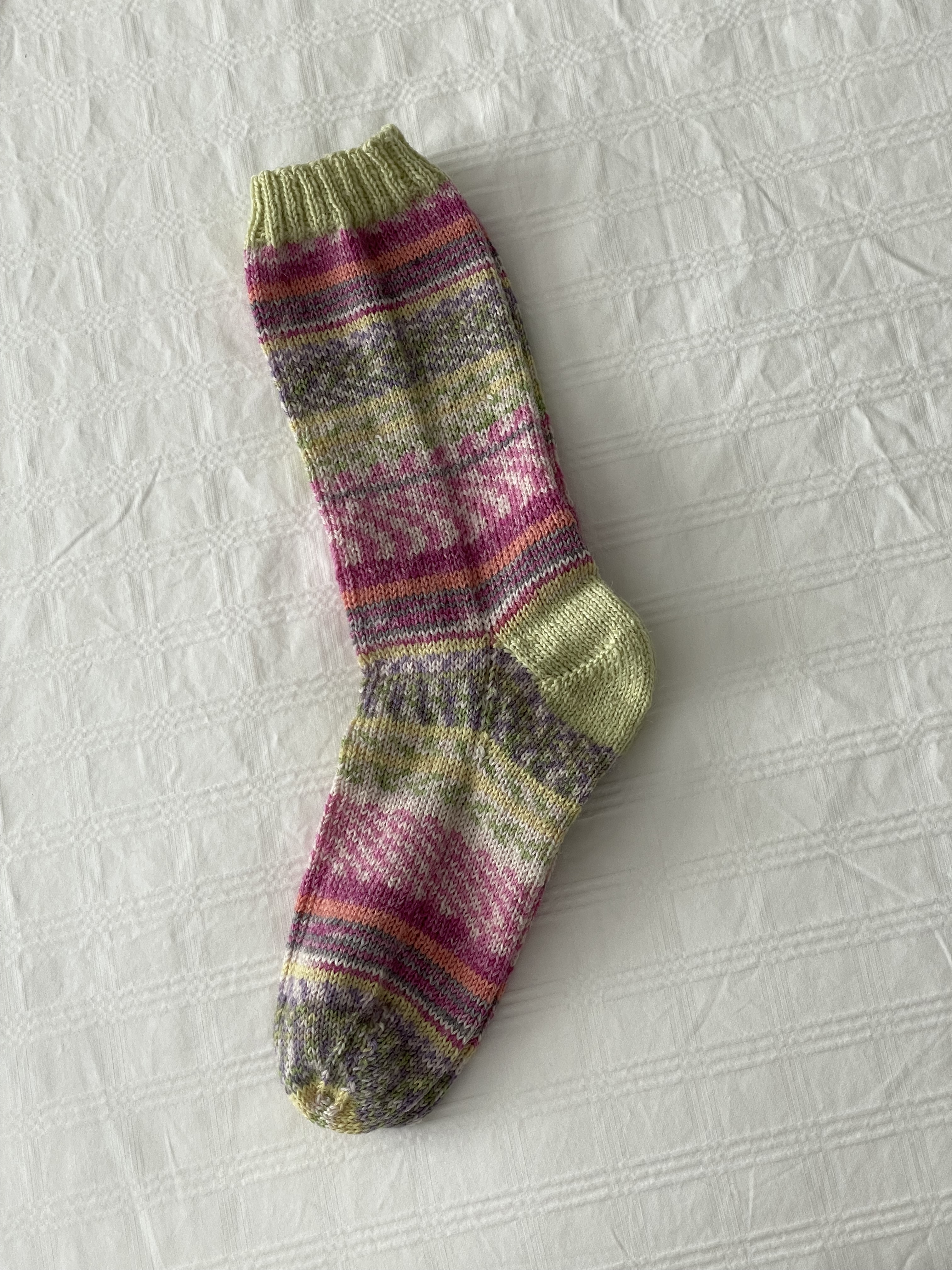
I picked up this ball of yarn at Fabricville. I don’t usually buy yarn there because they’ve mainly sold Kroy and I find it too heavy to knit comfortably and I don’t like the weight of the socks. However, a couple of months ago I noticed they’d stocked a much nicer sock yarn, lighter, softer, so I bought this ball.

The socks turned out nicely. Somebody will enjoy wearing them!

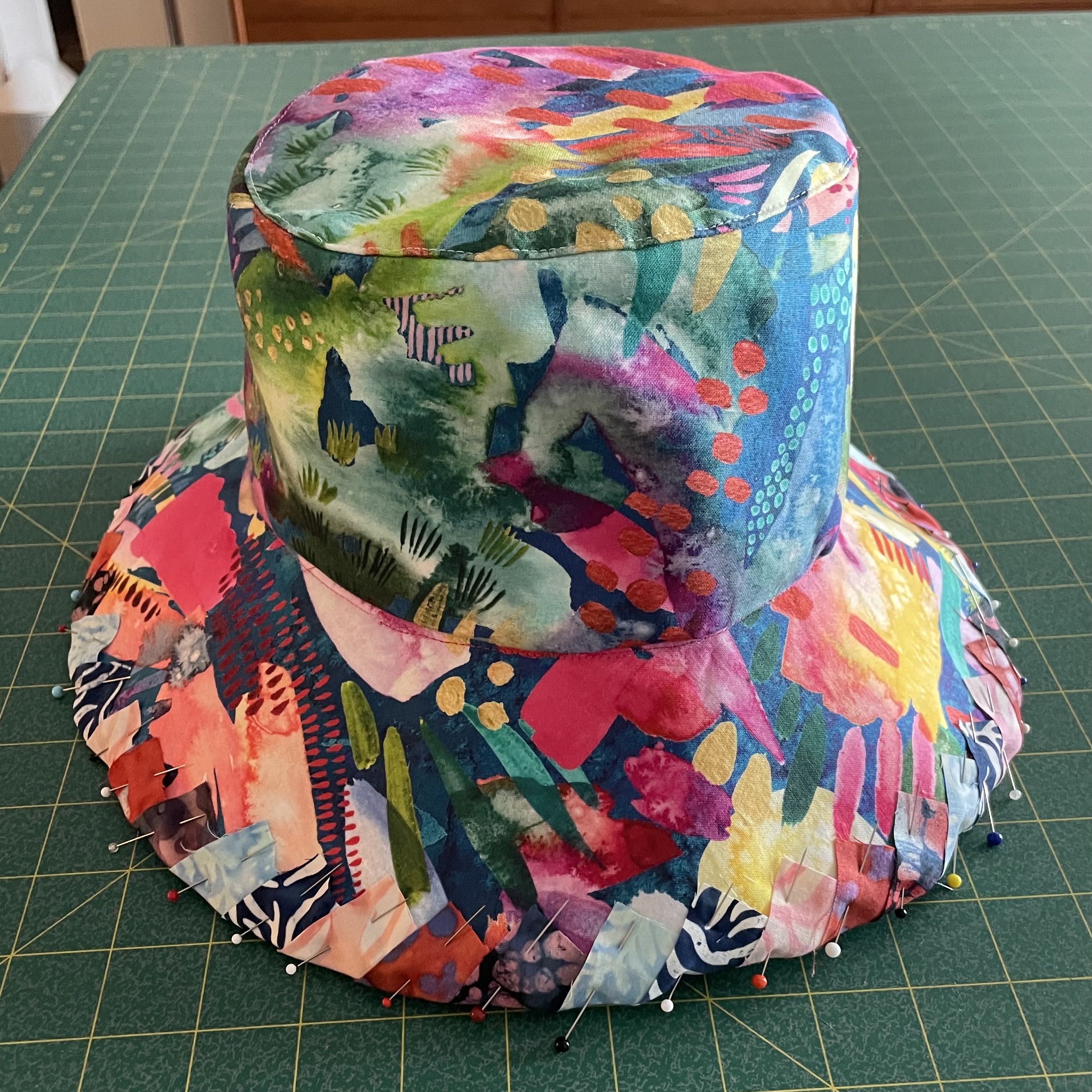
Then this past week I decided to make a new sunhat for myself. My friend Deb was giving a class on the Closet Core Sunhat. It’s a free pattern with instructions and a tutorial. I traced a copy of her size 22 hat, bought some fabric, then got to work. Deb had done some prep work on the pattern – reducing the 5/8″ seam allowance to 3/8″ which made sewing the seams much easier (next time I make it, I’ll reduce the seams to 1/4″).

This isn’t my first sunhat. I wanted a reversible hat – one that I could wear on either side. I didn’t follow the instructions. What I did, instead, was to make an outside hat, and an inside hat, then fit them together with the open edge the edge of the brim. I thought about finishing that raw edge with a binding, but instead used a bunch of small squares I had leftover from some previous sunhats (the colours blended/contrasted with the colours in the fabrics I used). I did some heavy free-motion sewing around the edge, securing the squares, using variegated Sulky thread both top and bottom. To finish the hat, I sewed a spiral, using my presser foot as guide, starting from where the brim attaches to the crown to meet the trim at the brim edge.

What makes this hat work as well as it does is the interfacing! I interfaced both the inside and outside hats with a stiff interfacing I normally use for the front placket of a shirt. That was a bit of overkill – I probably could have just done the outside hat and not the inside hat (that’s what I’ll do when I make the hat for my niece – at least until I see whether it makes the crown stiff enough or not). I also included a heavyweight fusible interfacing in the brim which has made it very stiff which I’m most happy with.

I also came across a very nice wide brimmed summer hat from Spruce Crafts. It comes in S/M/L sizes with separate pattern pieces for each size.

Then there’s my original instructions for drafting your own sunhat pattern.

Two Panels

Two 6×6 Panels – Completed

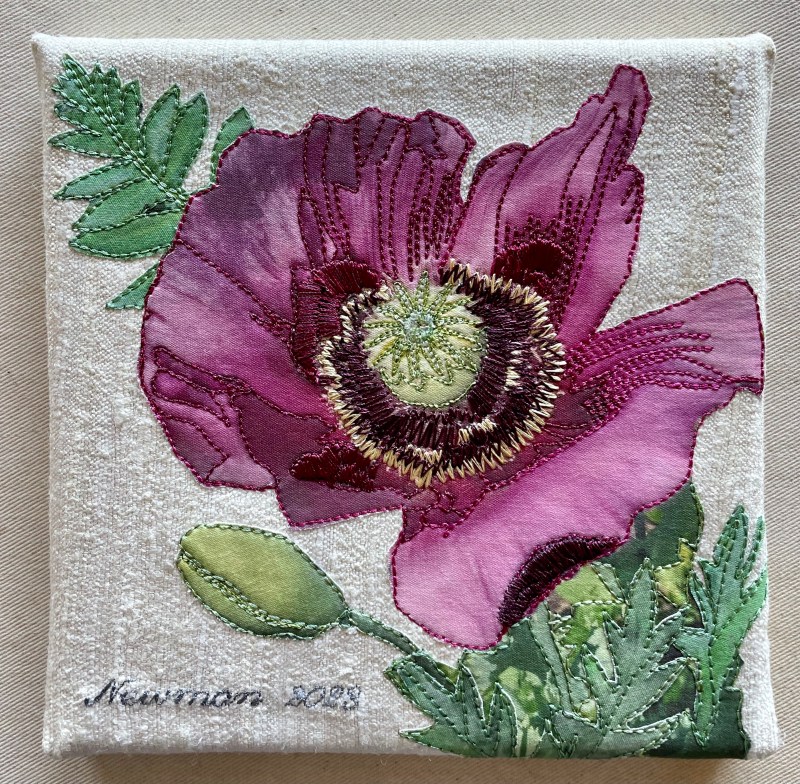
I finished up the panel I was working on yesterday and completed a second today. I’ve got a better handle on how to make the outline flower stand out by how I position the underlying circles and setting the leaves so they appear to be under the flower petals. I also downsized the signature a bit so it’s less prominent. I think this idea is now working.

I only need six more!

6×6 Revisited

Remember my 6×6 wall art pieces? Brandt Eisner was in touch again a couple of months ago with an invitation to join his summer “Squared Away” Pop-up show mid-July. Again, “the only requirement is the work should be 6″x6″ in total and be hangable on the wall”.

So, OK. I need to come up with another idea. I’m still stuck on floral interpretations.

First Attempt

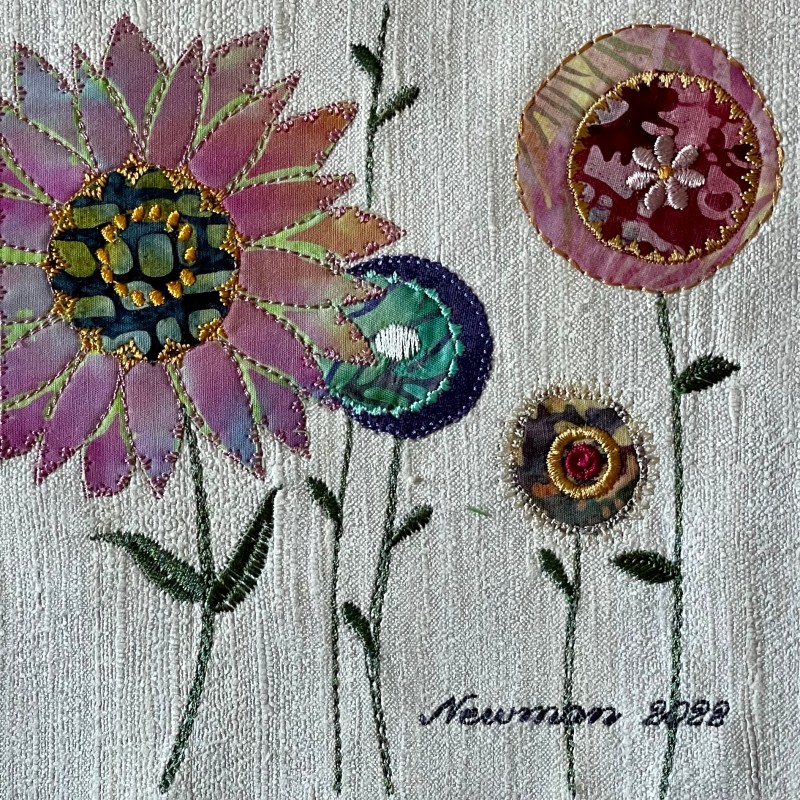
Ignore the black framing. My idea was to create a machine embroidery in the shape of a free-motion flower outline, which I stitched over an offset fabric circle fused to a raw silk background fabric. I liked the overall placement of the embroidery but the flower centre wasn’t strong enough, and I wanted some leaves, so I free-stitched some then coloured them in with water soluble Inktense coloured pencils. The leaf colour isn’t strong enough, I need to come up with a way of adding appliqué leaves. Also the blue thread on the blue fabric is very dull. I need stronger colour to create a better contrast.

Second Attempt

Definitely more colourful, but the floral print overwhelms the flower outline! Here I tried two overlapping circles, with some leaves I cut from scraps in a box where I store leftovers, but neither are effective. I tried calming the detail in the print fabrics with the Inktense coloured pencils which helped obscure the detail of the fabric but then the flower outline disappears! And I don’t like the leaves.

Third Attempt

This version is closer to what I see in my minds-eye. The silk background fabric gives an overall subtle texture to the piece. The dark, small patterned fabric sets up a background, the flower outline is a good contrast and stands out. I used a small fabric circle as background for the embroidered flower centre (using the precise positioning capabilities of my embroidery machine to position the embroidery). I overstitched the flower centre elements to emphasize them. I added some leaf shapes cut from fabric scraps backed with fusible web (glue) although I haven’t yet stitched them, I will do that tomorrow. I also tried out the position of the signature which is a bit too large. I have to scale that back a bit.

I’m getting closer to knowing what I’m doing.

Brandt asked for up to eight pieces of art. I will create eight pieces for the show. I have a month to make them; I expect I’ll have them done in a couple of weeks. Then I can move on to the next project!

Denim Shirt/Jacket

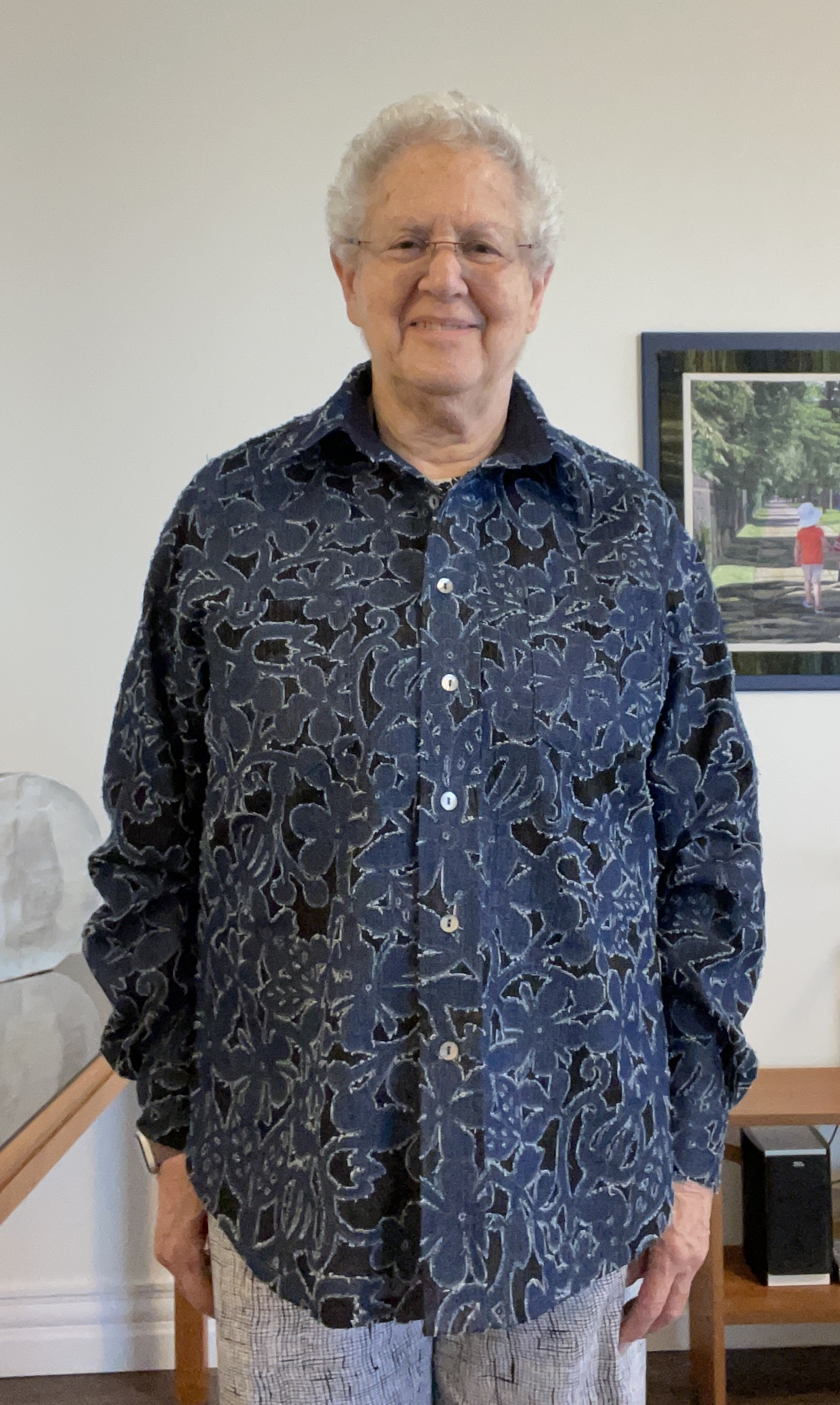
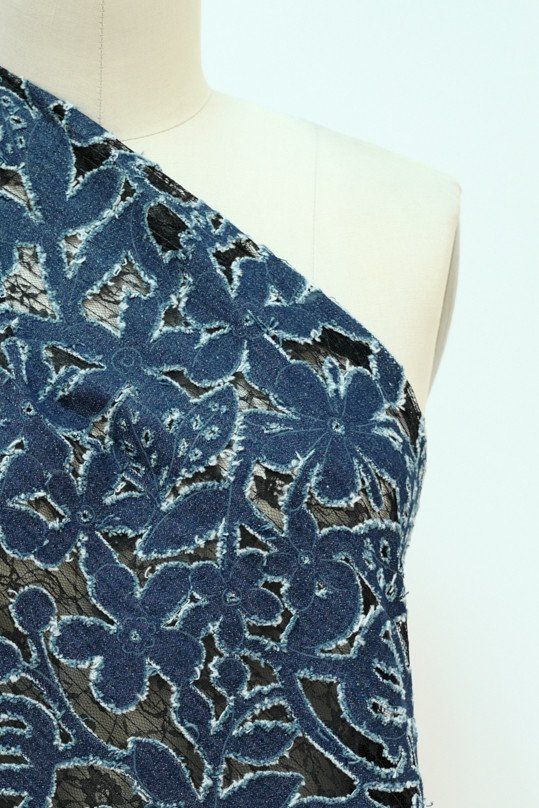
Here’s the finished denim “lace” jacket. Turned out rather well. It will be a useful garment to have in my wardrobe this summer.

I bought the fabric from Marcie Tilton at least three years ago ( I didn’t keep the receipt – I just remember the fabric was expensive but it had my name on it – BTW I just checked, there is none on the website now, not a surprise). In the photo below you can see the lace backing to stabilize the cutwork in the denim.

I started by backing the fabric with a fusible lightweight polyester interfacing because I wasn’t planning on lining the finished garment and I thought it would be easier to work with. That went more easily than backing the eight metres of silk dupioni when Marni and I were making her wedding dress!

Once the fabric was backed, I cut out the garment. I used a navy silk dupioni (which I had in my stash) for the facings, sleeve plackets, and the inner yoke. The silk gives a stability to the shoulder area that the denim lace didn’t have.

Sewing the shirt together was not simple! The denim lace was made by stamping out a floral pattern from a lightweight cotton denim, then backing it with a polyester lacy fabric to fill in the “holes” and hold the denim in shape. However, when you go to sew the seams the lace backing was stretchy so I had to be very careful not to pull on the edges while stitching. The collar, collar stand, and cuffs were particularly difficult to work with because of the different weights of parts of the denim lace. I did a lot of careful, slow seam ripping as I was sewing the cuffs in order to get the edges to fit precisely.

Assembling the shirt took quite a bit longer than I expected it to, but I’m happy with how it turned out in the end.

“Just Grow Up!”

Nobody would have guessed Goldie would be the last one standing, but she is.

Goldie, one of my mother’s younger sisters,  turned 100 this past February, having outlived her eight siblings. She’s my last surviving aunt or uncle in both my mother’s and father’s families. 

She’s aware of what’s going on around her, not quite so mobile anymore, but definitely still going strong; Goldie’s planning on reaching 108 (the age of the oldest resident in her retirement building). Who knows, she might get there. After all, with much determination and effort, she managed to regain her speech following a stroke two years ago. She has pushed herself to walk again after a fall that broke her hip a year ago. Yes, she uses a walker, but she gets around the building under her own steam.

I was in Toronto a couple of weeks ago, visiting family. I try to make at least one trip a year to show my face so the grandnephews have a person to associate with my name. I always make a point of visiting Aunt Goldie. After all, there may not be a next visit. 

This time my sister and I arranged to visit just after Goldie’s lunchtime. We had a lovely time catching up—what was going on in my life, what was happening in hers, her children’s, grandchildren’s, and great-grandchildren’s.

Goldie has lived in this community for at least a decade. She made the decision to move from independent living in her condo to assisted living when her son-in-law retired, and he and her daughter were now planning to spend their winters in the warmth of California. With Goldie nearing 90, they were worried about not being around to support her. Goldie made the generous decision to move to assisted living so they could enjoy their retirement freedom without being anxious about her.

The community she moved into is pleasant, with attentive staff and many residents who are still active and social. Goldie decided to make the most of the situation and reached out to other residents. Her strategy paid off. People accepted her company and conversation. Staff pop into her room to check on how she’s doing, ask if can they do anything for her, and chitchat about their families and ask about hers. Over time, Goldie has built a community for herself.

One of the other residents who had a room next to Goldie was actually a neighbour who had lived across the street from her in Halifax. Marie had moved to Toronto, as had Goldie, to be near children and grandchildren. They spent time together, enjoying one another’s company. A couple of months ago, Marie died. Goldie missed her but stoically moved on. Shorty after Marie died, another former neighbour from Halifax arrived in the community. Emma (around 95) is not adjusting well to the transition from independent to supported living; she is cranky, miserable, in tears a good deal of the time.

Goldie has visited Emma often but told us she is running out of patience with her. 

“In fact, yesterday I told her to grow up! Life changes! You have to be flexible. Move on. If you give this place a chance, you can make a life for yourself here. Just grow up!” 

And with that, Goldie walked out of Emma’s room. The image of Goldie at 100 telling Emma at 95 to “grow up!” was just too funny; we burst out laughing.

At 81, I think about the wisdom of Goldie’s approach to living. If you’re cheerful and friendly with people, they’re happy spending time with you, sharing what’s going on in their lives, interested in yours. If you’re miserable, wishing you were elsewhere, closed off, people stay away. It’s a choice we all have to make, not just when we’re old, but throughout our lives.

In our older years, choosing to be open to new people becomes more important, if difficult. As people in our circle of friends move away or die, we need to actively seek out new people (both young and old) with whom to spend time. Critical to making new friends is being open, cheerful, and interested. 

No point in trying to hold on to the past, we all have to constantly “just grow up!”

Aunt Goldie