The Kneeling Chair

About 45 years ago I bought my Balans Kneeling Chair. Loved it from the get-go.

You can see it’s a minimalist design –  first introduced at the Scandinavian Furniture Fair in Copenhagen in 1979, Variable was one of the first prototypes derived from the Balans concept, by Hans Christian Mengshoel. I bought mine at the Danish House on the St. Margaret’s Bay Road (that store is long gone). I must have bought in ’79 or ’80. It’s travelled with me wherever I’ve lived.

It’s amazing to sit/kneel on. Although there is no back, you’re forced to sit in such a way that your lower back is supported. I’ve used it at my computer desk – even designed my desk surface height so that when I’m on this seat the desk height is perfect for my back and arm length. I can sit on the chair for long spells.

However, my Balans chair is showing its age – it’s been getting creaky. I’ve tightened the bolts regularly (one of the bolts in the cross piece is stripped and won’t fully tighten any more) but the creaking hasn’t completely gone away. I’ve even glued the cross piece to stabilize it better; that hasn’t helped. So I decided to replace it.

A quick search located me several variations on the chair – some original ones from Varier (the original maker) although not with the stained birch colour I have and for lots of money! I checked around for a knock-off. They’re out there. I found one on Amazon

Same base height as my Balans chair but the overall chair height was likely a problem. I ordered one anyway (not too expensive) and it arrived within a couple of days. I had no trouble assembling it. Next, I tried it out. The 4″ padding turned out to be 3″ too high! My desk and all of my sewing tables were built to be 3″ lower than a standard table top – this chair with all that padding had me sitting higher than was comfortable.

I could return the chair, but rather than go through that hassle, I decided to reupholster it. First I checked with a local upholstering company (I’ve used them before) – I didn’t need new fabric, just wanted to have the seat and kneeling pads reconfigured with 1″ foam and the fabric reattached. I was quoted a price that was more than I’d paid for the chair. I decided to tackle the job myself.

It wasn’t difficult removing the staples from the undercover. I decided, rather than fighting the remaining staples attaching the fabric to the plywood seat (and there were a lot of them), to cut the fabric away. With some effort I was able to remove the 4″ piece of composite foam. I replaced it with a 1″ polyester woven batting and reattached the fabric. Now I have a usable chair.

I also removed the front stabilizing bar – it got in the way of my feet. I’m still deciding whether to remove the second stretcher – I’ll leave it there for now.

I was short a sewing chair for my serger/coverstitch sewing machines (I have two Humanscale Pony Saddle Seats – one at each of the other sewing stations). I tried this chair there. With the seat lower, it feels right. So that’s where it sits for now.

I’ve decided to give my original seat a facelift. I’ve dug out some upholstery fabric leftovers – there’s enough of the fabric I have currently on that seat to redo it. I’ll tighten all the bolts one more time. I’m guessing my original Balans chair may have another 45 years of life in it yet!

Nightfall

I finally finished this quilt this past week. It turned out to be a lot more work than I anticipated. I thought I was making a simple quilt block – square-in-square but that didn’t work out because of the colour flow I was after. In the end I had to construct each triangle element from scratch! Which took a lot longer.

The back took a lot of “walking around” time – I just couldn’t settle on an idea. One Tuesday evening when my friend Neha was here sewing with me (that’s another story) I made up five square in square blocks from leftover bits – that broke the log-jam and I was able to sort out a 15″ strip to insert in the backing fabric.

Then there was the matter of layout – I sewed most of the dark blocks together to begin with but then had to disassemble the partial panel because the colour flow wasn’t working. To get a decent colour flow, I ended up pinning triangles, and trapezoid pieces on top of the developing panel on a design wall I improvised in order to get a clearer colour placement. Then I had to take blocks apart to insert the new required piece.

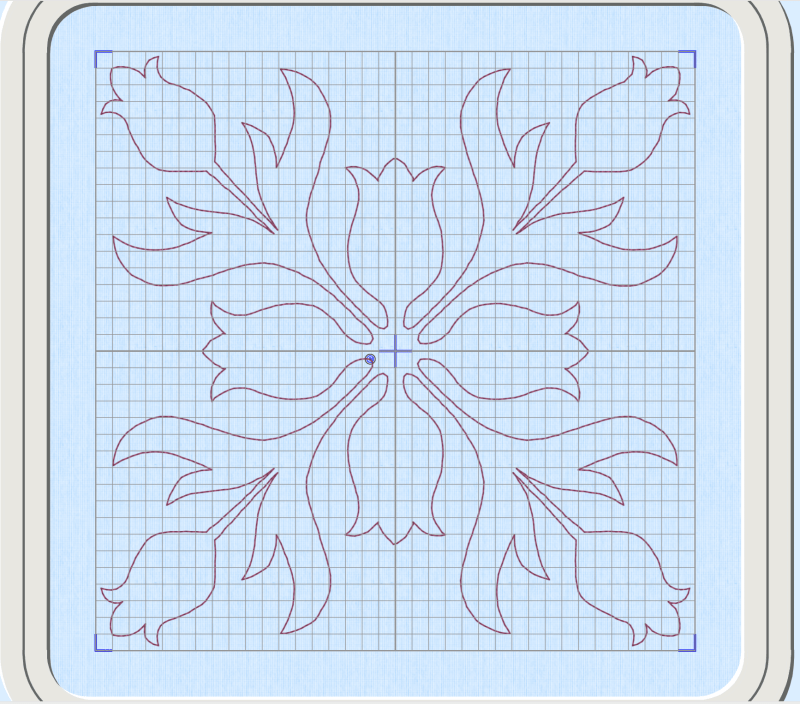
I put the layers together. I created two possible block patterns using my out-of-date Pfaff Premier 2+ software (it still runs on my Mac but not for much longer I’m expecting – then I don’t know what I’ll do, because the cost of a subscription for the software on MySewnet is crazy expensive!):

I chose Block 1 after doing a test run with some muslin and batting. I wanted the simplicity of the curves in the first design; I will use the Block 2 design on another quilt sometime.

Because the blocks were placed in the quilt on-point, I had to quilt on the diagonal. When all 44 blocks were filled in, I still had 18 triangle half blocks along the sides with 2 quarter blocks at one end to complete the quilt.

I also changed thread colour to match the colour gradation – I stitched the dark corner with an almost black variegated thread, the top left corner I quilted using white; in between I used three different grey variegated threads to blend with the changing colour. I used a light variegated grey on the back throughout.

I used the off-cuts from the backing for binding – which allowed me to match up the design on the back. I finally added a label.

I finished yesterday by hand basting a hanging sleeve at the top so I can display the quilt. (I still have 8 quilts that need hanging sleeves – gotta get those done over the weekend.)

I’m just about ready for the Craig Gallery Show:

If you’re in the vicinity do drop in!

I Am Canadian

In my newsfeed from the New York Times this morning was this article by Carlos Lozada:

An immigrant from Peru, Lozada details the conundrums he faces daily regarding his immigrant identity. I was deeply moved by his writing. Moved enough to write a personal note to him at his email address at the NYT. (I don’t expect him to answer.)

His opinion piece evoked a memory of what Joy Kogawa had to say in Obasan, her novel written in 1981. I felt compelled to find those words again and share them with Lozada.

Here is the letter I wrote him:

Carlos, 

As I was reading your piece, I can’t tell you how it resonated for me.  What’s interesting is I was born here in Canada, my mother was born in Canada, my father was an immigrant as were all my grandparents; I personally feel more “immigrant” these days than at any other time in my life (I’m heading toward 82!). In today’s actively antisemitic world I feel my token “jewishness” separating me from my “christian” friends and neighbours. The conundrums you describe are present in my life in such subtle ways but they are there.

I feel my “immigrantness” weekly when I visit two young Afghan families recently come to Canada. I spend a couple of hours a week with each family chatting in English, reading children’s books in English, to help them learn a language they are working so hard to learn. I visit weekly for these young women to help them overcome the isolation a lack of common language forces upon them. These new permanent residents to Canada have become like grandchildren/great-grandchildren in the almost two years I’ve known them. 

I can’t imagine their decision to leave Afghanistan and their families behind. I know the facts of their escapes through Iran, arriving in Turkey as illegals, the unimaginable luck of making contact with a Canadian citizen sponsorship group who helped bring them to Canada. I’m not an official part of that group (my youngest sister is), but through my investment of time these past two years, I have come to feel a small bit of what my grandparents must have experienced, who knew they would never see those they left behind, many of whom a few decades later would have ended in Nazi crematoria. Both sets of grandparents left Lithuania and Poland/Ukraine respectively and arrived in Canada in the early 1900s. I have no names of those left behind but I am absolutely certain many relatives did not survive WWII.

Canada, like the USA, is a nation of immigrants, yet so many people seem disconnected from that reality. In Canada, we’re a bit more aware of our crimes against the First Nations people – our halting attempts at reconciliation keep reminding us that we displaced them, disenfranchised them, demeaned them and that everybody else has immigrant origins from all over the world. 

We are experiencing in Canada a growing sentiment that we don’t want more immigrants, we need to keep “these people” out – they’re taking “our” jobs (in spite of the fact that Canadians don’t want to do the jobs they are willing to do), making housing impossible to find (that’s really the fault of those of us who made development decisions fifty years ago), overrunning our healthcare system (who actually made the decisions to cut back spending on medicine, education, dentistry, social work, … forty  years ago?). We need these new people for their willingness to work hard, for the cultural diversity they bring to us, for their talents and skills which enrich our community.

Shortly after it was published (1981) I read Joy Kogawa’s novel “Obasan” – there’s a passage in it that has stayed with me these 40+  years – written words of the Aunt (Obasan) who had been born in Canada but sent with her family to a Japanese internment camp during WWII:

—————————————

“The entire manuscript was sixty pages long, I skimmed over the pages till I came across a statement underlined and circled in red: I am Canadian. The circle was drawn so hard the paper was torn. Three lines of a poem were at the top of the page.

Breathes there a man with soul so dead
Who never to himself hath said:
This is my own, my native land!

The tanned brown edges of the page crumbled like autumn leaves as I straightened out the manuscript.

The exact moment when I first felt the stirrings of identification with this country occurred when I was twelve years old, memorizing a Canto of “The Lay of the Last Minstrel.”

So many times after that I repeated the lines: sadly desperately, and bitterly. But at first I was proud, knowing that I belonged.

This is my own, my native land.

Then as I grew older and joined the Nisei group taking a leading part in the struggle for liberty, I waved those lines around like a banner in the wind:

This is my own, my native land.

When war struck this country, when neither pride nor belligerence nor grief had availed us anything, when we were uprooted, and scattered to the four winds, I clung desperately to those immortal lines:

This is my own, my native land.

Later still, after our former homes had been sold over our vigorous protests, after having been re-registered, fingerprinted, card-indexed, roped and restricted, I cry out the question:

Is this my own, my native land?

The answer cannot be changed. Yes. It is. For better or worse, I am Canadian.”

—————————————

Securely Canadian having been born here myself, I still feel Obasan’s struggle as somehow my own.

Your NYT piece has evoked all those same feelings about country and belonging that I found those many years ago in Kogawa’s writing,

Thanks for such a passionate piece.

Judith Newman