Our “1938”?

A friend commented this morning: One wonders if this moment is our “1938”?

I replied:

“It’s 6:30am. I can’t fall back to sleep. I’ve been thinking the very same thing! Yesterday it was Columbia! On Feb. 1 it will be Canada and Mexico. The militia are now armed and active and there’s no one who will stop them wreaking havoc against the “enemies”. The courts are a joke. There are people who see what’s coming, but they are powerless to stop it. The moment for that has come and gone. And then there’s the tech panic over China’s latest AI announcement. And out of control AI. This time it’s all out economic warfare and who knows what else! And it’s all happening so fast that nobody can see it all, no time to react, and no way to run from it or toward it. There’s so much disruption you can’t get a handle on it. We will all need to make the personal decision to go along or to resist and resistance will need to be creative. Yes, I do think this is our 1938 moment!”

Last night I watched “Resistance: They Fought Back” on PBS – a documentary about Jewish resistance during the Holocaust. It premiered last night – International Holocaust Remembrance Day.

We’ve all heard of the Warsaw Ghetto Uprising, but most people have no idea how widespread and prevalent Jewish resistance to Nazi barbarism was. Instead, it’s widely believed “Jews went to their deaths like sheep to the slaughter.”  Filmed in Poland, Lithuania, Latvia, Israel, and the U.S., Resistance – They Fought Back provides a much-needed corrective to this myth of Jewish passivity. There were uprisings in ghettos large and small, rebellions in death camps, and thousands of Jews fought Nazis in the forests. Everywhere in Eastern Europe, Jews waged campaigns of non-violent resistance against the Nazis.

That’s partly why I couldn’t fall back to sleep. Since the day trump was elected I’ve been uneasy. OK, now people will get what they voted for, I said to myself. It wasn’t going to be pretty; he’d telegraphed his plans openly with Project 2025. I wasn’t prepared for how fast everything would unravel. In a single week it’s become clear how trump’s agenda will unfold.

The best example of what’s coming is what happened to Columbia yesterday/day before – Seth Abramson gives the most succinct description of what transpired: https://sethabramson.substack.com/cp/155917891. trump sent deportees to Columbia without any prior consultation with Columbia, and he used a military plane to shuttle them – an overt display of disrespect to Columbia. Columbia rejected the military flight (though not explicitly the deportees). trump then issued a 25% tariff on Columbian exports to US along with withdrawing diplomatic clearances. Columbia threatened retaliatory tariffs on coffee, corn, flowers. The corn got somebody’s attention – corn farmers? Columbia backed down, trump withdrew the tariffs. The outcome of all of this? The rest of the world is on notice that tariffs is the big 2×4 trump plans to wield if you don’t give him what he wants.

But capitulation can’t be the go-to response for nations under threat. Canada/Mexico have been under threat of tariffs for weeks (months). The purported reasons are illegal immigration and drug smuggling. Both countries have taken steps to improve border control to prevent people and drugs crossing into the US. However, it’s not about people and drugs; it’s about subjugation! February 1 is a few days away. I expect the tariffs will be applied on Canada/Mexico exports, anyway. Then it will be retaliatory tariffs and other restrictions imposted against the US by Canada/Mexico. And on it will go.

Back to the documentary. What do you do, what can you do, when your livelihood, your very life, is threatened. The Jews in Europe redefined “resistance” – surviving any way you could was fighting back against Nazi extermination plans. Walking to the gas chambers with dignity – they knew that was the fate they were facing – spit in the face of their Nazi exterminators. Surreptitiously holding religious services, smuggling books into the ghetto, singing, sharing what little they had, looking after one another were all actions of resistance.

What forms of resistance can nations take? We’re going to find out, I guess. It’s not going to be pretty – people aren’t at all prepared for the hardship and difficulty to be managed when nations face bullying like trump’s. They’ll rage against leaders who resist, and many will scream and push for compliance, not understanding that caving in brings more bullying!

I wasn’t alive in 1938. I have no idea how the German population understood what Hitler was proposing to do to the “enemies within” and to national neighbours. Some obviously did – they emigrated as quickly as they could. This time, there is no place to immigrate to – where would you go to be out of reach of China or Russia or the US if it comes to that?

This is a stand and be counted moment, if there ever was one. At the end of week one I’m exhausted and overwhelmed and terrified.

As Maggie Muggans said: “I don’t know what will happen tomorrow!” It’s not looking good. Start making connections, keep an eye out for people and groups that will help you stand tall and strong.

Bishop Budde’s Sermon

I’m a devout atheist. Have been since the age of 8. I grew up in a secular Jewish home with parents who weren’t observant in any way. My encounter with religious nonsense happened when in fourth grade I was given a Gideon bible and then was required to relinquish it because the rabbi didn’t want the children of his congregation to be exposed to any Christian scripture. 

At 8, I was already a rabid reader. For me, this bible was just another story book. At 8, I was offended by the oppressive way the rabbi (and my acquiescing parents) determined to restrict my reading choices. At 8, I quietly took a stand. I would become a skeptical Jew. 

At age 12, I prepared for a Bat-Mitzvah. Not the same full religious coming of age ritual in which boys participate, just a small contribution within a Friday evening service. That, in itself, spoke loudly to me of the inferior status of women within Judaism. Worse, was my encounter with the book of Leviticus during the preparation for the service. I was particularly offended by the description of the “uncleanliness” of women. The rabbi offered flowery explanations of those passages when I questioned the proscription. I didn’t buy them – they were male rationalizations against the essence of woman. At age 12, I walked away from religion.

So I respond to Bishop Budde’s sermon in an a-religious way. I respond to the politics of her act. I respond to her courage to confront these significant social issues in a very public way with the very people deciding the fate of many frightened people!

If you haven’t seen the critical part of her sermon you must watch it:

Listen to her words and watch the faces of the powerful!

If you want to understand why she took a deep breath and spoke aloud these deepest tenets of her faith watch her interview with Rachel Maddow: 

John Pavolitz urges other religious leaders to follow suit: 

Don’t Let Bishop Budde Stand Alone: A Challenge to Every Minister in America

Not only am I an atheist, I’m a Canadian not an American citizen. But the escalating chaos I see as an outside observer makes me fearful for the majority of US citizens because the rising tide of hate and xenophobia will pit neighbour against neighbour, will break long standing friendships, disrupt families, make the vulnerable even more vulnerable. 

Steve Schmidt sounded a warning in his Substack today: 

The Warning with Steve Schmidt: The big lie

These and many more upcoming decisions by trump and his administration are going to have world-wide consequences. I don’t claim to be prescient; but the rising tide is obvious to anybody willing to see.

Twenty Lessons On Tyranny

Timothy Snyder shared his Twenty Lessons On Tyranny eight years ago on the occasion of the 2017 inauguration. He reshared the list again today Jan 20 2025: https://substack.com/home/post/p-155209838?source=queue

Read his post (it’s short and to the point). Print it. Pass it on.

The advice is relevant everywhere in today’s world, whether you live in an autocratic country or a democracy (?). I’m astounded by the number of rich and powerful who have already kowtowed to the wannabe autocrat violating Lesson #1: Do not obey in advance!

https://anntelnaes.substack.com/p/why-im-quitting-the-washington-post

Says it all.

[Ann Telnaes resigned from the Washington Post over this cartoon – they refused to publish it because it included Jeff Bezos bowing down and making a payment both of which he did for a ticket to the inauguration(?).]

Bubbles

Bubbles!

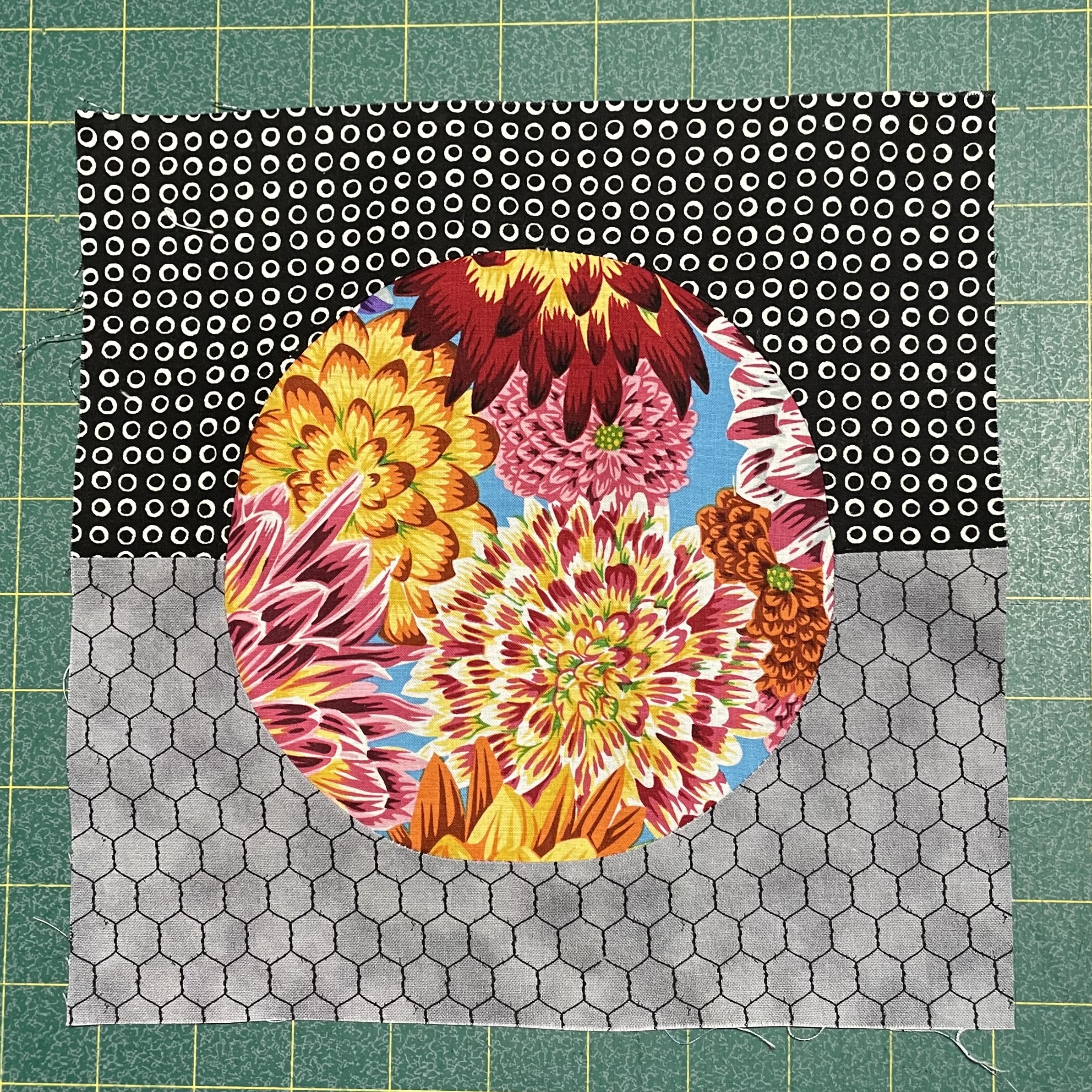
This is where I am at the moment – 21 1/2″ x 18″. There are four insert circles, the smaller circles are fused raw edge appliqué. Although I’ve ended up with an even number, the distribution and colour feel comfortable.

I’ve been auditioning fabric for a thin inner border and a wide outer border – no luck. Everything I’ve tried – light fabrics, medium fabrics, dark fabrics – all look wrong. I think the piece is telling me to end here and finish with a facing, not a binding!

The next question is whether to quilt or not. I need to do decorative stitching around the appliqué (and possibly outside the inset circles, as well) – I have to wait until I’ve finished the stitching the appliqué to decide.

The point of this effort was to expand my technical know-how – to see how difficult it was to do an insert circle. Definitely not a beginner skill. After five circles, I’ve decided the sewing works best for me with the background on top, just four pins to hold the 3/6/9/12 positions, sewing slowly, one small section at a time, so I can align the opposing curves as closely as possible and still maintain a 1/4″ seam.

I’m not giving up on this idea – I still want to make a table runner and a quilt using it – it’s a matter of deciding whether to use pieced backgrounds, as I’ve done here, or a subtle print/batik throughout. I have to audition some fabric to see what might work.

Inset and Appliqué?

Bubbles?

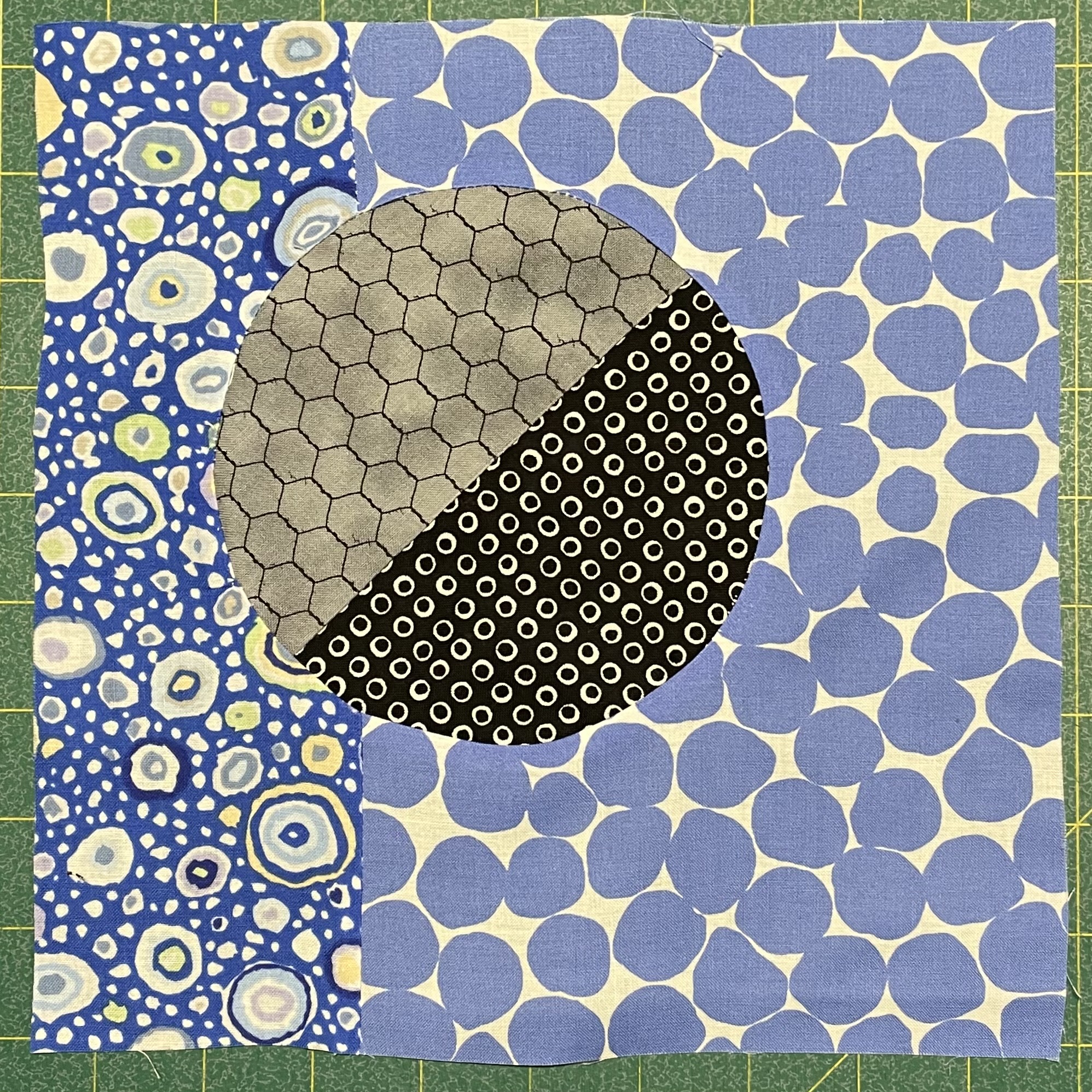
Four inset circles with appliqué? This is all an experiment. First, the blue background doesn’t add anything – it shows I want to stay with greys, lights and blacks. That block also shows I don’t want pieced circles – I want to use the large prints from my Kaffe Fasset collection – I like the statement each circle makes.

Second, three of those inset circles are not too bad, one is kind of wonky – an appliqué over the wobble would hide the imperfection. Also the piece is stark without the smaller circles – I can’t see trying to inset them, much too difficult – the bigger the circle the easier to inset, I’m finding. I’ve also been moving the circle around in the square, rather than place it at the centre. Will continue doing that.

I also wanted to sew four blocks together and inset a circle at the intersection – there aren’t enough blocks here to try that. I may have to add another couple, making the piece longer, to see whether I can add an inset circle at the intersection. This has become an experiment going in directions I wasn’t expecting.

I have enough here for a fibre wall piece. I want to replace the blue and see what I have . I haven’t nailed down precisely what I want this to be – stopping at this point and finishing the small piece will let me start over.

I’ve been scouring Pinterest for “circle” and seen a lot of very interesting ideas for quilts made with both insert and appliqué circles. I need to review the images I’ve collected and rethink where I’m trying to go with this project.

Inset Circles

I decided to try inset circles – an extension of Drunkard’s Path (a square with a contrasting pie-shaped piece in one corner. With an inset circle you cut a background square then remove a circle; cut a contrasting circle 1/2″ larger in diameter, then carefully line up a few markings and inset by sewing a 1/4″ seam. When pressed you get a pretty good inset circle. (These two blocks are 9 1/2″.)

I’m playing around with this idea in a number of ways. In the first block (left) I created a background from two pieces of fabric, cut the circle from the centre of the block, then inset a strong contrasting circle. In the second block (right) I offset the piecing seam for the background as well as the centre of the circle (which in this case was the offcut from the first block!).

I’m playing around with scraps – just to see what happens. I had a better idea of how to manage the fabric when sewing the second block. I need more practice. I want to cut my circle insets from pieced fabric assembled using curved seams. In block #2 the circle was pieced across the diagonal simply because that was how I’d assembled the first block background.

My next experiment will be to piece the background slightly offset, but the make a more intricately pieced fabric for the circle. We’ll see how that goes.

I’m not sure whether I’m working on a quilt or a fibre art piece – I will have a better idea once I’ve made several inset circle blocks!

What Small Thing Would Help You Right Now?

I just read an interesting article “Eight Words to Say to a Friend“! It’s about a young woman and her small daughter landing in Cambridge England, late at night, arriving at their college accommodation, utterly exhausted. Their friend, whom they were visiting, popped out of her apartment, hugged them, and asked:

What small thing would help you right now now?

She continues:

Not: Can I do something for you? 

Not: How can I help?

Not the terribly generic and unhelpful: Let me know if you need anything.(Anything???!)

But: “What small thing would help you right now?

Something about the specificity, the smallness of it, was a revelation. 

These days, I’m often in the position of seeing someone needing support of some kind or other. I used to ask “Can I do something for you?” and been turned away, graciously, but my offer of help rejected, nevertheless.

I started asking, “What can I do for you?” A bit more specific, but not any more effective.

I learned as a teacher the question I needed to ask a struggling student was not “How can I help you?” but “What do you need help with?” Again, the focus is shifted from me to the learner. It worked with even the most recalcitrant kid (1).

What small thing would help you right now?” is definitely a better question in a social situation – focused on my friend and not on me. I have to try it, the next time I’m able to offer assistance when I find a friend dealing with a stressful situation!


(1) Another critical incident (2009; Newman, Judith “On Becoming A Better Teacher”).

One of the most difficult transitions I personally have had to make has been dealing with kids’ resistance, their ‘not-learning’ as Herb Kohl (1994) calls it. Just when I think I have some control over my responses I run into a kid who pushes me back into my instinctual, authoritarian way of responding. There’s one like that in one of the third grade classes I’ve been visiting.

In my experience when kids avoid engaging, offering some support brings about a small shift in attitude. Usually I can get a kid to ‘just try’. I’ve learned that helping kids to be successful overcomes a lot of their resistance. But I can’t even get near this one — Andrew, I’ll call him. He cuts me off by turning away from me before I can offer help of any kind. His body language is real clear — stay away!

Part of Andrew’s problem is that he doesn’t read or write very well. At age nine, that’s starting to be serious. He’s bright, so he knows what the others can do and he can’t. He behaves aggressively — pinching, hitting, or jabbing his classmates with a pencil. They don’t want anything to do with him. His behaviour keeps them from discovering his shortcomings, but at a cost — by isolating himself he is unable to build friendship.

I’m flummoxed. Andrew is showing quite clearly he won’t learn from me. And each time I attempt to engage him I seem to be digging the hole deeper. Andrew evokes the ‘witch’ in me. Although I understand his antagonism, I react to it in a way that doesn’t help him. I find myself wanting to force him to try.

I have no trouble engaging Jake, who drives the teacher crazy. He doesn’t make me bristle the way Andrew does. The question is what about the behaviour gets to me in Andrew’s case and not in Jake’s. What in my own history is being triggered by Andrew and not by Jake?

Maybe it’s the way Andrew rejects assistance. When he cuts me off I just walk away. I’ve learned there’s no point in attempting to cajole him and I have no authority to insist he do anything. But I’m not happy walking away. I keep wondering what I’m doing that evokes Andrew’s resistance and what I could do that would permit us to work out a different kind of relationship (JN. Journal: 11/7/1995).

Writing about the problem helped me see Andrew and I were engaged in a power/control struggle.

I was rereading Interwoven Conversations (Newman, 1991) the other day when I came across a critical incident about Danny — a six-year old who taught me to ask “Do you need help?” before barging in. I’m barging in with Andrew; he immediately raises his barriers, which in turn angers me because it leaves me nowhere to go. Hmm. So I guess I should at least be giving him some room to let me know how I can help him before we’re embroiled in his not-learning game. I can see I should ask if he needs help and accept it if he says ‘No.’ That gives him an out and me a way of leaving gracefully. I’ll try that tomorrow morning and see what happens (JN. Journal: Nov. 14, 1995).

The next day, when I asked Andrew if he needed help he considered my offer and then told me precisely what assistance he wanted when I followed up by asking ‘What do you need help with?’ That surprised me. In other words, I discovered that asking if he needed help made it possible for Andrew to retain control of the situation. It made it possible for him to engage in learning with me. My reflective writing helped me understand what was causing my struggle with Andrew and what I might do about it.

Bev, Andrew’s teacher, and I had a conversation one afternoon in which she described how she learned to accept his clear signals that he wouldn’t comply. As she wrote later

The issue of power and Andrew’s behaviour was a serious issue. I found myself challenged by the dilemma of how to give Andrew the power he needed without ‘caving in’ to his tyrannical behaviour. How could I get out of the power struggle that I didn’t want to be in and that Andrew continually created? One clue for me came when he told me one day that he didn’t want to go to music and if I forced him to go he would misbehave so that he would be sent out of the room. At that moment I knew he had it figured out — he was in control and he knew it. I had to learn ways of negotiating activities with him, allowing him acceptable choices. Instead of reacting in an authoritarian way I had to find ways of allowing him to choose to engage. Andrew has taught me that I can’t make anyone do anything he doesn’t want to; external power has limited impact; it’s internal power that makes a positive difference (BC. Journal: 4/21/1995).

Bev learned how to negotiate with Andrew. Her important insight was that Andrew was always in control and that she would never get anywhere trying to force him to do anything. Because she has become adept at reading his signals, he’s become much more involved and proficient at reading and writing and his behaviour is considerably less resistant. My coming to understand the dynamics of my interaction with Andrew allowed me to talk with Bev about his resistance and avoidance of learning. In turn, Bev and I were each able to restructure our relationship with Andrew.

O Canada!

Today, there was an op-ed piece in The Globe and Mail by Jean Chrétien – a former Prime Minister of Canada (1993-2013). It’s his 91st birthday and he has decided to speak out about trump’s threats against Canada. He lays out ways in which Canada, and Canadians, are not Americans:

I can tell you Canadians prize our independence. We love our country. We have built something here that is the envy of the world – when it comes to compassion, understanding, tolerance and finding a way for people of different backgrounds and faiths to live together in harmony.

We’ve also built a strong social safety net – especially with public health care – that we are very proud of. It’s not perfect, but it’s based on the principle that the most vulnerable among us should be protected.

This may not be the “American Way” or “the Trump Way.” But it is the reality I have witnessed and lived my whole long life.

We all recognize the current stresses Canadians are dealing with regarding public health care and housing but the undergirding principle, “that the most vulnerable among us should be protected and helped“, is still a Canadian value. In spite of the large current influx of immigrants, “people of different backgrounds and faiths“, we’ve done our best to live in harmony in our diverse communities. We are, after all, a country of immigrants; everyone, but people from our First Nations, are here because our forebears came from somewhere else. We know we need more people to sustain and build a vibrant Canada; that means welcoming newcomers.

He goes on:

If you think that threatening and insulting us is going to win us over, you really don’t know a thing about us….We may look easy-going. Mild-mannered. But make no mistake, we have spine and toughness.

To present and future leaders of our country he has this to say:

…you don’t win a hockey game by only playing defence. We all know that even when we satisfy one demand, Mr. Trump will come back with another, bigger demand. That’s not diplomacy; it’s blackmail.

…we also have to play offence. Let’s tell Mr. Trump that we too have border issues with the United States. Canada has tough gun control legislation, but illegal guns are pouring in from the U.S. We need to tell him that we expect the United States to act to reduce the number of guns crossing into Canada.

He adds several more issues the US needs to resolve with Canada to hold up their side of the “friendship” relationship before ending with: 

Every time that Mr. Trump opens his mouth, he creates new allies for all of us. So let’s get organized! To fight back against a big, powerful bully, you need strength in numbers.

I am ready at the ramparts to help defend the independence of our country as I have done all my life.

Trump’s threats to Canadian sovereignty are not a joke! If we’re to survive the next several years, we’re all going to have to become more engaged in the national conversation as leaders do their best to defend the independence of Canada and work to make our community and country a better place!

I’m 82; I’m ready to join Mr. Chrétien “at the ramparts!” I’m reaching out to find people who feel it’s time for a network to tackle the big problems facing us. We don’t all have to live in the same place to work together; we just need common goals and strategies. Anybody interested in joining Mr. Chrétien and me?

Socks Done

Peach Socks

Well these socks turned out well. The peach solid blended nicely with the peach in the variegated yearn and the other colours are bright and serve as accents for the main colour. And believe it or not, there was exactly enough of the peach solid to finish the second toe. I was prepared to add some mauve, orange and yellow to the toe if I had to. That meant I would have to undo the toe in the first sock so I could match what I did with the second sock. But none of that was necessary – there was enough peach solid to do the job.

Leftovers for next pair of socks

There’s enough yarn left in the ball to make a pair of legs, for sure. I’ve added a mauve solid for cuffs, heels and toes. I have a second variegated yarn that I’m going to interleave with the peach variegated which will give me more than enough for a full pair of socks. The socks I want to make are a slightly smaller size for a friend who wears a size six shoe. Plenty of yarn here.

To prep for the socks, my next step is to divide both variegated yarns exactly in half so I know how much I have for one sock (and be assured there will be the same amount available for the second sock)! Now, to divide the yarn and get going!

Amaryllis

Double Amaryllis

I bought this bulb in late November, planted it mid December. The photo on the package showed a single petal layer, but I’ve got a mix between single and double! There isn’t a full third layer of petals and it looks like there’s a single stamen! So likely an infertile flower – but lovely to look at. Two more blooms to come and maybe a second stalk (likely not). The stalk on this flower is quite short – not a bad thing since when the stalks become long, the plant has a tendency to overbalance and topple over. That’s not going to happen with this short stalk.

Not much else going on. Almost finished a pair of socks – this evening I anticipate. Then I plan to use the leftovers for another pair of socks – I’ve pulled out some contrasting solids that I will interleave with the variegated yarn to make sure I have enough for a smaller pair of ladies socks.

The holiday baking is nearly all consumed (well, not all of the fruitcake). That will be consumed over the year either to take to the knitting group or for a friend; I am able to avoid snacking on it, thank goodness.

Just about to open my fabric stash and sort through the batiks. There are some lovely batik fat quarter bundles I’ve seen online, but there’s no point in buying more until I see what I have already.

My life goes on calmly in spite of the political craziness all around. Canada amalgamating with the US – I swear, I’ll sign up to help organize a resistance group. The Prime Minister responded with “a snowball’s chance in hell” but where is Poilievre! Not a peep – where does he stand on this massive insult? Does he think it’s a great idea? How is he planning on dealing with trump 2.0? Not a word – just screaming anti-Trudeau garbage! And people consider that leadership? It’ll be interesting to see who steps up to lead the Liberal Party. The Liberals can’t win this coming election in the spring, but they don’t have to suffer a Mulroney massacre, either, if they can choose someone who knows how to offer a strong positive message and organize people and policy.

Back to resistance – a month ago I joined an American resistance organization – Indivisible: A Practical Guide to Democracy On The Brink – to eavesdrop on the discussion and to access their resources. This is one of many groups that sprang up in the run-up to the November US Election. This one has grown considerably since November. I’m lurking to have access to their “Strategies, Tactics, & Tips For How Everyday Americans Can Fight Back Together Wherever We Live”. We’re going to need those tactics if Canadians are stupid enough to give Poilievre a substantial majority government! Those of us opposed to his way of doing politics are going to have to organize dissent in a substantial way. Interested in joining me?