While watching the election coverage the other night, I finally finished a pair of socks.
I was’t sure I had enough of the mauve yarn to complete two toes – so I dug through my stash for another leftover. Came up with the turquoise. There was enough in that ball to finish the pair of socks.
I just hung up from a long conversation with a good friend. A day has passed since the Canadian federal election. She wanted to know what my take was on the outcome. I’ve had a couple of days to think about that.
My first takeaway is that the Ottawa riding of Carleton said to Poiliever – no thank you. We saw the real you at the “freedom” convoy in Jan/Feb 2022! We remember; not fooled by your election persona. Poilievre lost his seat in Parliament.
The Conservatives didn’t win the most seats. While they gained 24 they fell short of any kind of win. Enough Canadians didn’t trust Poilievre to take the helm. Enough Canadians wanted nothing to do with his confrontational politics – his constantly blaming everybody else for what he called a failed Canada. Enough Canadians couldn’t imagine this one-song candidate as Prime Minister of the country. Enough Canadians sent a message to Poilievre and his Conservative party – we don’t like how you play this game.
You refuse to acknowledge the global climate crisis. You are blind to our country’s need to find a path toward a fossil-fuel-free future. We need to build energy independence across Canada – using fossil fuels for now perhaps, but simultaneously and collectively we must build a cross country non-carbon energy network. You don’t seem to understand that going forward any consideration of natural resource extraction/development will have to include Indigenous peoples in any decision-making. You seem more than willing to jettison foreign aid as an extravagance, yet foreign aid builds friends and allies; helping less fortunate nations provide medical, agricultural, educational resources for their population benefits us, too. You totally don’t get the important role the CBC plays in our cultural landscape – it can’t be defunded without great cost, particularly to our rural and northern communities. You say nothing about supporting Ukraine – a beacon in the fight for national freedom from which Canada could learn a lot (we could easily be in the same position were trump to make good on his insistence that Canada become the 51st state!). You tout “the biggest crackdown on crime” – but ignore the difficult circumstances that nurture criminal activity. Your view of immigration is blind to the realities that force people to seek refuge from the political violence and climate driven changes where they live.
Fortunately, enough Canadians voted against this Canada.
Enough Canadians supported Carney for the Liberal Party to win the largest number of seats in Parliament – 169 (three short of a majority); but there was skepticism, too. There was enough support for him to become PM, but not enough for the Liberal Party to work unencumbered!
What I think the electorate has said to Parliament is,
“Hey folks! It’s time to collaborate!”
The economic, social and political threats to Canada are great. We can’t afford the luxury of the constant negative harping about what the government is doing wrong now and in the past. We’ve drawn a line and said “Work with one another!”
We all agree on the problems we face – the economic challenges wrought by trump’s tariffs his threat to our sovereignty our housing shortage pathways to a renewable energy future our healthcare chaos income inequalities a balance in immigration sustainable cities a stronger federal/provincial working relationship…
We’ve said: “Work together to solve these and other problems.”
And do it as quickly as you possibly can – the future will be upon us before we realize it!
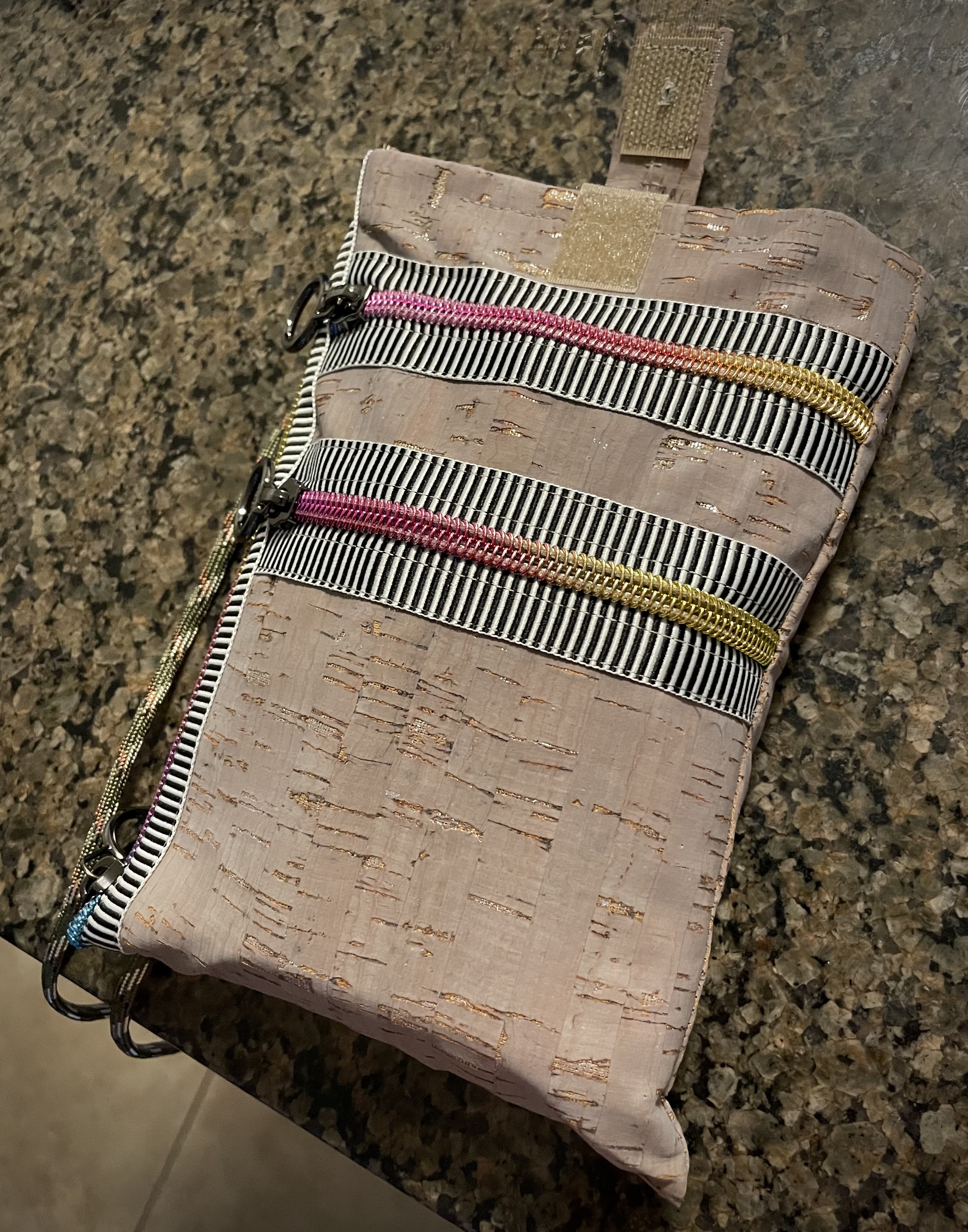
In fact, this is the third one. I made one using a bit of leftover painted leather, but wasn’t happy with it – the design wasn’t straight on the piece leather and it annoyed me. I did a second using some leftover royal blue leather, but when I took it apart to add some firm backing, the leather split!
This one is made from a cork fabric. Not easy to work with – it’s stiff and turning the bag rightside out took a bit of effort, but I’m happy with it, even if it could be a 1/2″ wider. I can still get everything into it, but it’s a tight squeeze. I’m hoping the fabric will soften and stretch a bit, maybe not. I also have no idea how long the fabric will last before the thin layer of real cork begins peeling off!
Now on to fixing some errant place mats I made for a friend. We didn’t preshrink the fabric (a bad decision) and the backing fabric shrank when she washed them. I made eight. Four are still unused. I’m going to quilt them with a tight design so when the backing shrinks it will just give the placemats some texture. The other four I’m going to have to take apart, and remake trimming the top fabric to fit the backing. Once they’re sewn back together, I’ll quilt them, too. The taking apart is an evening project while watching TV.
In my neck of the woods, the first serious harbinger of spring is the coltsfoot – small yellow flowers close to the ground. A friend had a few show up at her place two weeks ago. They showed up around my apartment building early this past week. Most people don’t look closely enough and mistake them for dandelions.
I love how they peek out from the gravel and bits of dead vegetation. You can’t miss them. Those small green leaves in front of the flowers are actually wild strawberry, they’ll get buried by the large coltsfoot leaves which will show up after the flowers are done.
They offer a cheery pause from all the gloomy news both in Canada and the US and the rest of the world!
Let’s talk about the moment Donald Trump blinked. It wasn’t loud. It wasn’t a tweetstorm or a rally rant. When the tariff threats that had the world on edge—125% on China, 25% on Canada’s autos, a global trade war in the making—suddenly softened. A “pause,” he called it. A complete turnaround from the chest-thumping of the past week. And the reason? Mark Carney and a slow, deliberate financial maneuver that most people didn’t even notice: the coordinated Treasury bond slow bleed.
This wasn’t about bravado. It was about leverage. Cold, calculated, and devastatingly effective.
Trump’s pause wasn’t because people were getting yippy…
Turns our PM was at the helm, here! He saw what was coming and did something about it – no fanfare on the campaign trail, no waving flags, no patting himself on the back. He talked to the EU, to Britain, to Japan, others, with a plan – slowly sell their US Treasury Bills and let the market do the talking. They were ready for the tariffs that trump had announced well in advance of “Liberation Day”. When those silly tariffs were announced the selling began. It didn’t take long.
Rewind a bit. While Trump was gearing up his trade war machine, Carney, Canada’s Prime Minister, wasn’t just sitting in Ottawa twiddling his thumbs. He’d been quietly increasing Canada’s holdings of U.S. Treasury bonds—over $350 billion worth by early 2025, part of the $8.53 trillion foreign countries hold in U.S. debt. On the surface, it looked like a safe play, a hedge against economic chaos. But it wasn’t just defense. It was a loaded gun.
Carney didn’t stop there. He took his case to Europe. Not for photo ops, but for closed-door meetings with the EU’s heavy hitters—Germany, France, the Netherlands. Japan was in the room too, listening closely. The pitch was simple: if Trump went too far with tariffs, Canada wouldn’t just retaliate with duties on American cars or steel. It would start offloading those Treasury bonds. Not a fire sale—nothing so crude. A slow, steady bleed. A signal to the markets that the U.S. dollar’s perch wasn’t so secure.
That’s the message Carney delivered in his call with Trump last week. No leaks on the exact words, but the outcome speaks volumes. Trump didn’t just pause the tariffs; he backpedaled hard. China’s still in the crosshairs—125% duties are no joke—but Canada? The EU? Japan? They’re off the hit list. For now, at least. Why? Because Carney’s play wasn’t noise. It was power.
Let’s be real: Trump’s spent years calling Canada a freeloader—remember his 2019 NATO jabs?—while ignoring the inconvenient truth. Canada’s $350 billion in U.S. debt isn’t charity. It’s a lifeline. Japan’s trillion-plus? Same deal. The EU’s pile? Ditto. These countries aren’t just buying bonds to be nice; they’re bankrolling the U.S. government. And when they threaten to pull the plug, even slowly, Washington listens.
This was the determining factor in Trump’s surrender. Not the public spats, not the retaliatory tariffs Canada slapped on U.S. autos (though those stung). It was the quiet, coordinated threat of a Treasury bond unwind that bent Trump’s knee. Carney didn’t need to shout. He didn’t need to posture. He lined up the free world—Japan, the EU, Canada in lockstep—and showed Trump the cliff’s edge. Strategic brilliance doesn’t get louder than that.
Carney also issued Canadian Treasury bonds in USD which was another brilliant way to strengthen Canada’s position and financial reputation. Little triggers and strategies you get when the world’s most respected economist is your PM…
You get the drift. Apparently, the instigator of the T-Bill selloff that scared the shit out of trump was Carney. The experienced banker. The person who understands international finance.
Carney made sure to tell the world that despite Trump kissing our northern ring, we’re not negotiating shit until after the election. He also said we’re still moving away from our relationship with the US for greener, saner pastures.
Looks like we have THE man for the job.
We need to make sure we elect enough Liberals for him to continue in the job. PP wouldn’t have had a clue how to do this, or that it could be done. All he knows is how to name call. To act like trump.
I wrote this piece on Oct 19/24 – after reading Lozada’s piece. I thought I’d share it today because the excerpt from Obasan is even more relevant than it was in October!
This is my own my native land.
I wonder whether others are feeling the same ambiguity I am about what being Canadian involves, particularly as election day draws closer and we are facing perhaps a life-shaping decision between the divisive, trumpish, anger of PP and the well informed, experienced, financial expert to lead our government. We don’t vote for a Prime Minister, which makes the decision more complicated but ultimately that’s the decision influencing how I will mark my ballot. As things stand, I can’t vote Conservative no matter how capable my local candidate may be.
An immigrant from Peru, Lozada details the conundrums he faces daily regarding his immigrant identity. I was deeply moved by his writing. Moved enough to write a personal note to him at his email address at the NYT. (I don’t expect him to answer.)
His opinion piece evoked a memory of what Joy Kogawa had to say in Obasan, her novel written in 1981. I felt compelled to find those words again and share them with Lozada.
Here is the letter I wrote him:
Carlos,
As I was reading your piece, I can’t tell you how it resonated for me. What’s interesting is I was born here in Canada, my mother was born in Canada, my father was an immigrant as were all my grandparents; I personally feel more “immigrant” these days than at any other time in my life (I’m heading toward 82!). In today’s actively antisemitic world I feel my token “jewishness” separating me from my “christian” friends and neighbours. The conundrums you describe are present in my life in such subtle ways but they are there.
I feel my “immigrantness” weekly when I visit two young Afghan families recently come to Canada. I spend a couple of hours a week with each family chatting in English, reading children’s books in English, to help them learn a language they are working so hard to learn. I visit weekly for these young women to help them overcome the isolation a lack of common language forces upon them. These new permanent residents to Canada have become like grandchildren/great-grandchildren in the almost two years I’ve known them.
I can’t imagine their decision to leave Afghanistan and their families behind. I know the facts of their escapes through Iran, arriving in Turkey as illegals, the unimaginable luck of making contact with a Canadian citizen sponsorship group who helped bring them to Canada. I’m not an official part of that group (my youngest sister is), but through my investment of time these past two years, I have come to feel a small bit of what my grandparents must have experienced, who knew they would never see those they left behind, many of whom a few decades later would have ended in Nazi crematoria. Both sets of grandparents left Lithuania and Poland/Ukraine respectively and arrived in Canada in the early 1900s. I have no names of those left behind but I am absolutely certain many relatives did not survive WWII.
Canada, like the USA, is a nation of immigrants, yet so many people seem disconnected from that reality. In Canada, we’re a bit more aware of our crimes against the First Nations people – our halting attempts at reconciliation keep reminding us that we displaced them, disenfranchised them, demeaned them and that everybody else has immigrant origins from all over the world.
We are experiencing in Canada a growing sentiment that we don’t want more immigrants, we need to keep “these people” out – they’re taking “our” jobs (in spite of the fact that Canadians don’t want to do the jobs they are willing to do), making housing impossible to find (that’s really the fault of those of us who made development decisions fifty years ago), overrunning our healthcare system (who actually made the decisions to cut back spending on medicine, education, dentistry, social work, … forty years ago?). We need these new people for their willingness to work hard, for the cultural diversity they bring to us, for their talents and skills which enrich our community.
Shortly after it was published (1981) I read Joy Kogawa’s novel “Obasan” – there’s a passage in it that has stayed with me these 40+ years – written words of the Aunt (Obasan) who had been born in Canada but sent with her family to a Japanese internment camp during WWII:
—————————————
“The entire manuscript was sixty pages long, I skimmed over the pages till I came across a statement underlined and circled in red: I am Canadian. The circle was drawn so hard the paper was torn. Three lines of a poem were at the top of the page.
Breathes there a man with soul so dead Who never to himself hath said: This is my own, my native land!
The tanned brown edges of the page crumbled like autumn leaves as I straightened out the manuscript.
The exact moment when I first felt the stirrings of identification with this country occurred when I was twelve years old, memorizing a Canto of “The Lay of the Last Minstrel.”
So many times after that I repeated the lines: sadly desperately, and bitterly. But at first I was proud, knowing that I belonged.
This is my own, my native land.
Then as I grew older and joined the Nisei group taking a leading part in the struggle for liberty, I waved those lines around like a banner in the wind:
This is my own, my native land.
When war struck this country, when neither pride nor belligerence nor grief had availed us anything, when we were uprooted, and scattered to the four winds, I clung desperately to those immortal lines:
This is my own, my native land.
Later still, after our former homes had been sold over our vigorous protests, after having been re-registered, fingerprinted, card-indexed, roped and restricted, I cry out the question:
Is this my own, my native land?
The answer cannot be changed. Yes. It is. For better or worse, I am Canadian.”
—————————————
Securely Canadian having been born here myself, I still feel Obasan’s struggle as somehow my own.
Your NYT piece has evoked all those same feelings about country and belonging that I found those many years ago in Kogawa’s writing,
Thanks for such a passionate piece.
Judith Newman
I finally made it back to my sewing machine. This week I finished a housecoat (no photo since I’m wearing it!) Today I made an iPhone case for a friend – she asked me to make her a new one since her new phone is too large for the old one. I just finished it:



 jmn
jmn 