I Sold A Pair Of Socks!

It’s a longish story. A couple of weeks ago my niece (and husband) were having dinner with her brother (and wife) and another couple, friends of my nephew. I don’t recall how the conversation turned to knitting but out came photos of my socks.

Paula fell in love with them and really wanted a pair.

My niece call me to ask how she might go about getting a pair – I said two things: my generic sock (those in my stash) fit someone who wears a size 7 1/2 to 8 shoe; and they cost $50.

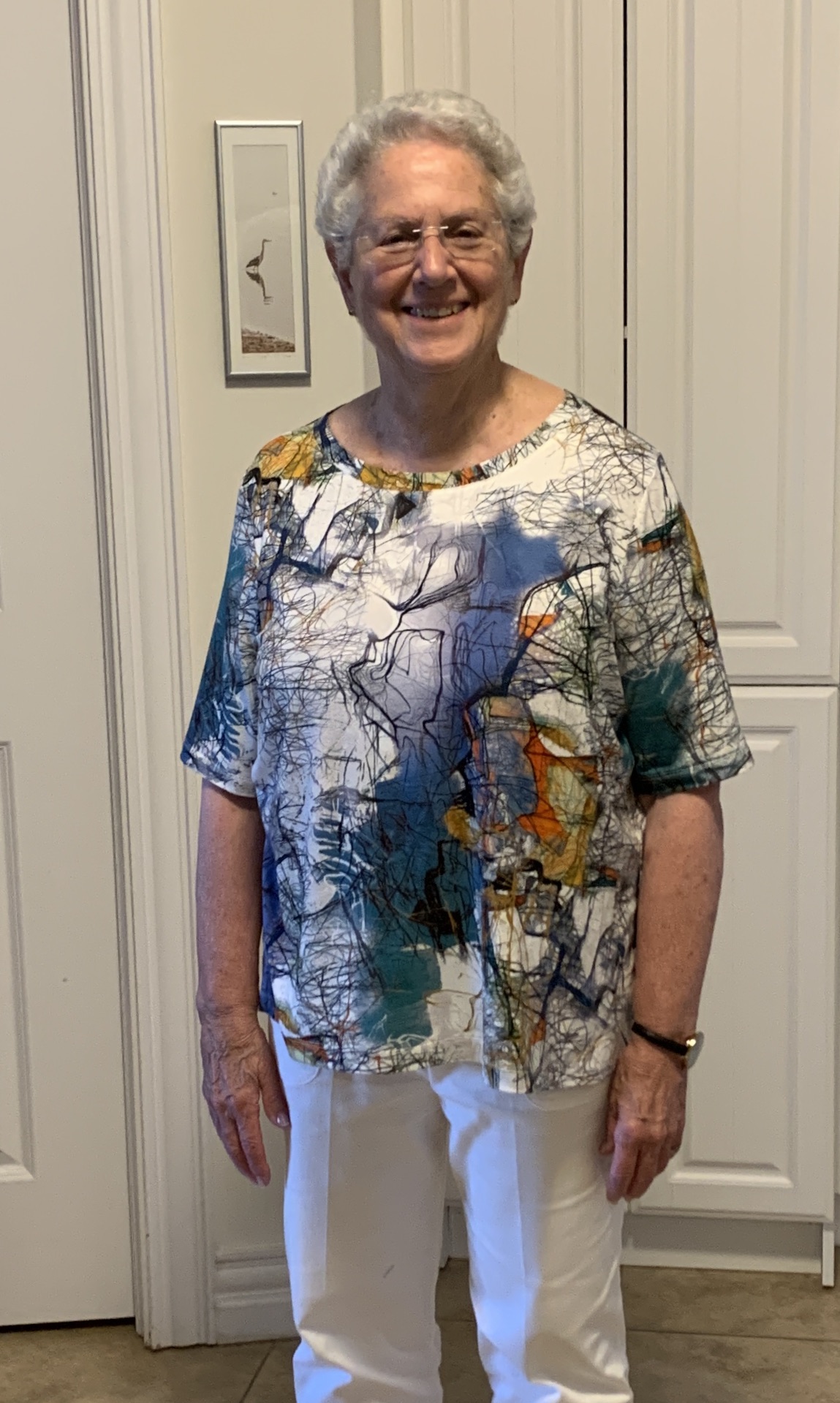
Paula’s Socks

My niece paused, said she’d relay the information to Paula.

The next day I get a call from my nephew – Paula is visiting and he wants me to talk to her about socks.

So I tell Paula the same thing – she wears a size 7 1/2 shoe – good. I tell her they’re expensive and I explain why – the yarn costs $25 a ball (before I’ve knit a stitch), it takes me 25 hours to knit a pair, and I won’t work for less than $1/hour. “Fine,” she says; she knits hats and appreciates the effort that goes into the socks.

We look at the socks in my stash (using the camera on my phone) and she chooses a pair she thinks are wonderful.

She sends me a money transfer. In turn I put the pair of socks in the mail. Oh, and I asked her to send me picture of her wearing the socks.

They arrived yesterday. She’s thrilled. This is the picture she sent me.

Good thing I’m not relying on sock sales to keep me going. People find the price prohibitive – don’t know why – were they able to make them themselves the yarn would still cost $25 and it likely would take them a lot longer than 25 hours to knit a pair. I figure it’s a deal.

So I keep knitting and sell the odd pair and give them as gifts on birthdays and at Christmas. What else am I going to do with the 26 pairs of socks I manage to knit in a year?

[I knit only in the evening with the TV on – so although I knit reasonably quickly it takes me about two weeks to turn out a pair of socks. 52 weeks a year divided by 2 weeks is 26 pairs of socks – that’s pretty close to what I actually complete along with some sock repairs I do during the year.]


Skyline #1 – Completed

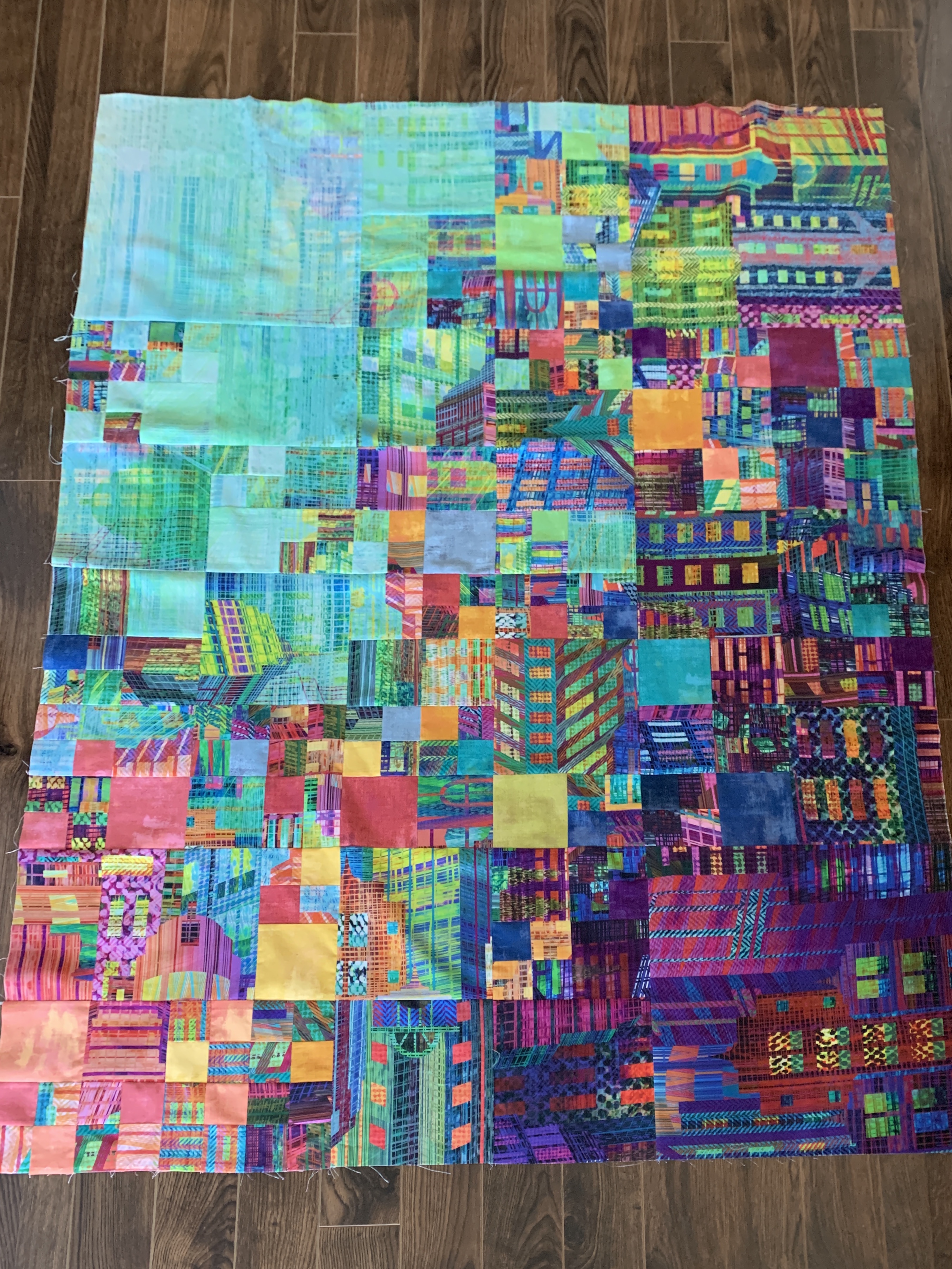
Here it is. Finished. I just hand-stitched the hidden binding and the label in place.

Skyline #1

I’m quite pleased with how this piece turned out. Final dimensions: 48″ x 64″ – not a bad size for a throw quilt and still reasonable to be hung on a wall should anyone be interested.

I used three different colours of variegated Aurifil (50wt) to quilt the project – on top a darkish purple (with mauve) in the purple corner, a medium turquoise (with light turquoise) in the lighter sections, and a red blend in the peach sections. You really have to look hard to see the differences but it was necessary – a occasional dark purple segment in the turquoise or peach sections would have stuck out; same with a turquoise or red in the dark purple on the bottom right. I used a green variegated thread for the back throughout. That worked well.

I was fortunate, that when I trimmed the backing/batting off, I had enough backing fabric from the four sides that I was able to use the offcuts to bind the quilt. So the hidden binding matches the quilt back!

Skyline #1 – Back

This is the third quilt I’ve used a hidden binding on. I elected to do that here because I felt a regular binding would “frame” the quilt top and I wanted it to be open, without limits. Same with the back, the hidden binding brings the elements to the quilt edge nicely.

Now on to the second in this series.

Latest Socks

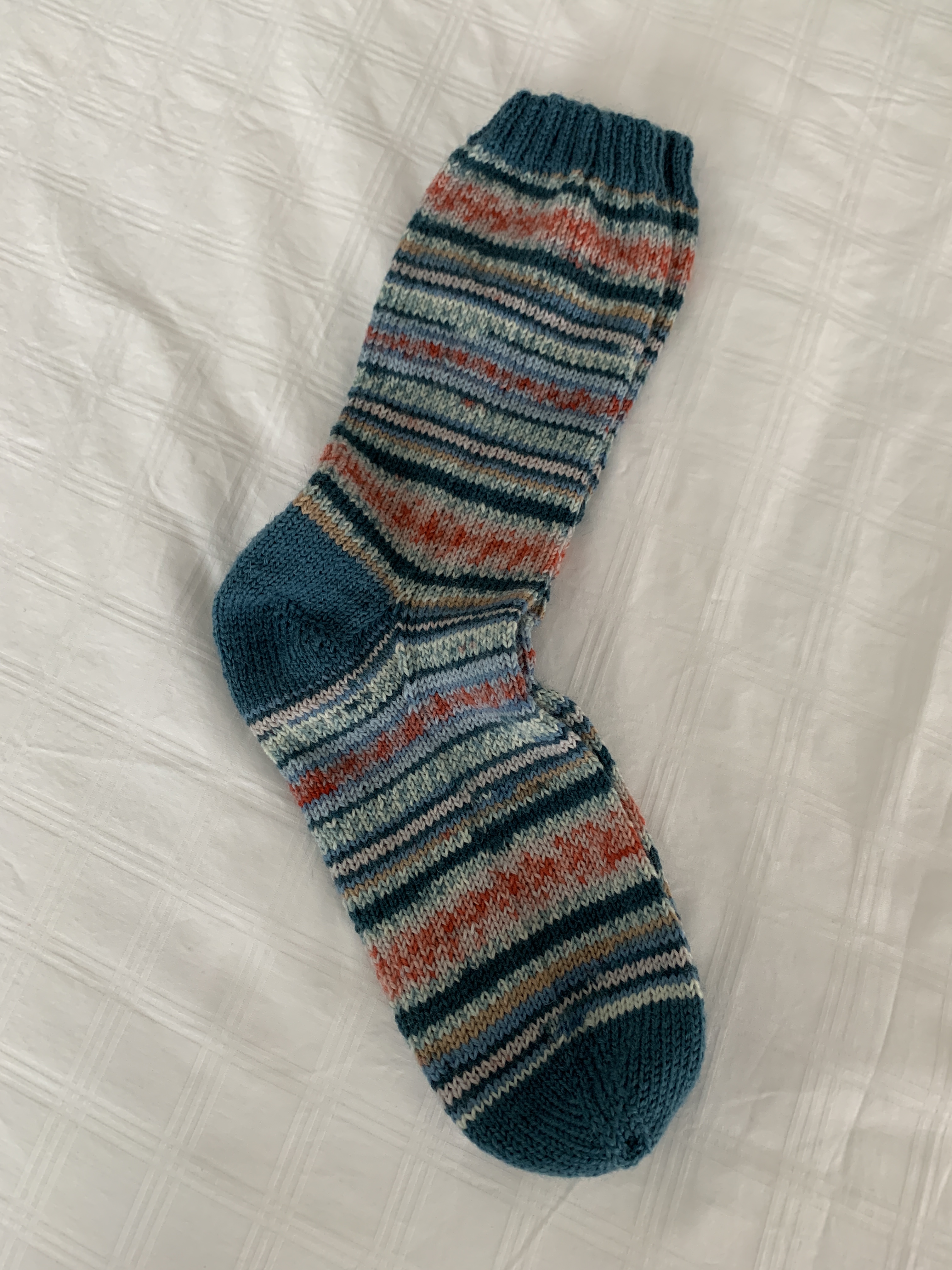
Latests Socks

I keep knitting – it’s relaxing. I can justify sitting in front of the TV mindlessly working away on socks and feel I’m doing something productive.

I liked the strong contrasts in this particular yarn and I thought the grey solid contrast brightens the other colours.

Finished last night.

Covid-19 “Safe Zone” Revisited

A Batch Of Children’s Masks

People are relaxing their vigilance – washing hands less, moving closer to other people, putting their masks aside. Here in Nova Scotia we’re pretty safe! We’ve had mostly zero new cases each day for the past 10 weeks and the occasional new case has been linked to travel from outside the province. But with university students returning (and maybe self-isolating) and classes set to resume, we could be facing a surge in new cases over the next several weeks.

I thought I’d revisit an article I found very helpful for setting a reasonable tone about how to stay safe which I came across in early April – Saving Your Health One Mask At A Time by Peter Tippett.

He talks about “safe zones” – we’re not exposed to virus everywhere we turn. If we keep our homes and cars clean – they’re safe zones. Being outdoors with others is a relatively safe zone. The article turns down the panic level in a very useful way.

The whole article is worth reading but here are his “Key Takeaways”:

Key Takeaways

Social Distance—Stay six feet from people is a good thing. Ten feet is even better.  

Safe Zone—For most folks, your house is a safe zone.

    • For you, and for family living with you, your yard is likely a safe zone. 
    • When outside, and with no other people nearby, you are in a safe zone
    • For most people, your car should be a safe zone.

Masks—The easiest, most reliable precaution you can take when out of your safe zone

    • If you work with the public, you should absolutely be wearing a mask on the job.  
    • If you are in a safe place, a mask has low value, because the risk is already low. 
    • If you are going to put the same mask on and off, then treat the outside as contaminated and the inside as safe.  
    • If you handle the outside of your mask, then consider your hands as contaminated, and wash them.  
    • Don’t touch the inside of your mask with your hands or anything else dirty.  
    • Put the cloth mask in the laundry at least daily. (or wash with warm water and soap). 
    • Have at least two masks so one can be in the wash and the other clean when needed 
    • Don’t bother boiling masks before you wear them. The detergent in your washing machine is easier, stronger, and more likely to succeed by far.  

And above all—enjoy your safe zone with your family, friends, cat or dog.
Be Well,
Peter

I just thought the idea of “safe zone” worth revisiting as we are likely approaching another surge in cases. The interesting thing is, if we keep up the preventive measures, we’re much less likely to pick up flu this season (I’m still planning on getting my annual flu shot), or even getting a cold. All that hand washing/sanitizing can’t help but reduce transmission of our usual respiratory viruses.

This past week I’ve been making a batch of children’s masks – camouflage fabric for boys, rainbows, animals for girls. They’re quite a bit smaller than the adult size I’ve been making. I also came across little silicone sliding pieces that can be applied to the elastic to shorten or lengthen it so it fits around the ears more comfortably. I’m adding those to these masks.

Children’s Masks In Progress

The Closing Down Of Summer

Fall’s on the way. You can feel it in the air. You can see it in the colour of the sunlight. Although today is a warm day (24° C), there’s that something in the breeze, you can smell it, hinting at the change of season.

At The Public Gardens

Yesterday at the Public Gardens wild bees were busy harvesting nectar and pollen – there were some hive bees foraging, too. It was interesting watching the wild bees push the hive bees out of the way – no room for interlopers.

I’ve written about the closing down of summer before.

In the opening pages of Alastair MacLeod’s short story: The Closing Down Of Summer (in the collection: As Birds Bring Forth The Sun) he begins:

It is August now, towards the end, and the weather can no longer be trusted. All summer it has been very hot. So hot that the gardens have died and the hay has not grown and the surface wells have dried to dampened mud. The brooks that flow to the sea have dried to trickles and the trout that inhabit them and the inland lakes are soft and sluggish and gasping for life. …

At the end of July we said to ourselves and to each other, “The August gale will come and shatter all of this.” The August gale is the traditional storm that comes each August, the forerunner of the hurricanes that will sweep up from the Caribbean and beat and lash this coast in the months of autumn. The August gale with its shrieking winds and crashing muddied waves has generally signalled the unofficial end of summer and it may come in August’s very early days. But this year, as yet, it has not come and there are only a few days left. Still we know that the weather cannot last much longer and in another week … the pace of life will change. 

That’s what it feels like today and has felt like for the past week – there has been no August gale, just mostly sunny days – no rain which we desperately need and begin to want. But the air has changed, the colour has begun changing. The Queen Anne’s Lace is ending, the Goldenrod droops, I’ve seen Chicory in a few spots already. The plants know the season is changing.

The folks in the building where I live have been meeting outdoors in a green spot beside our garage driveway – we bring our chairs and knit, or box lunches and share a meal. We can likely do that for September and with jackets maybe October but after that outdoor gatherings won’t be possible.

We’ve all enjoyed the laughter and camaraderie these outdoor gatherings have given us. We will need to find ways to continue congregating – with masks, social distancing, and cleaning the indoor spaces before we leave. We will find a way to carry on – we have to. We’re now accepting the Covid-19 rituals to which we’ve become accustomed will be necessary for the foreseeable future, for a year? maybe longer?

This closing down of summer, now in the air, signals changes we will have to invent in order to sustain our community. We’ll find a way to carry on. As will everyone else.

Skyline #1 – Piecing Completed

The piecing of the quilt top is finished. I’m happy with the colour flow.

Skylines #1 – Piecing Complete

Now to assemble the back, set up the quilt sandwich, and quilt it.

That’s it for today. Gotta catch a bit of the lovely weather – you can feel a hint of fall in the air – it’s been there for over a week now. It won’t be long before fall will begin showing itself.

Skyline #1

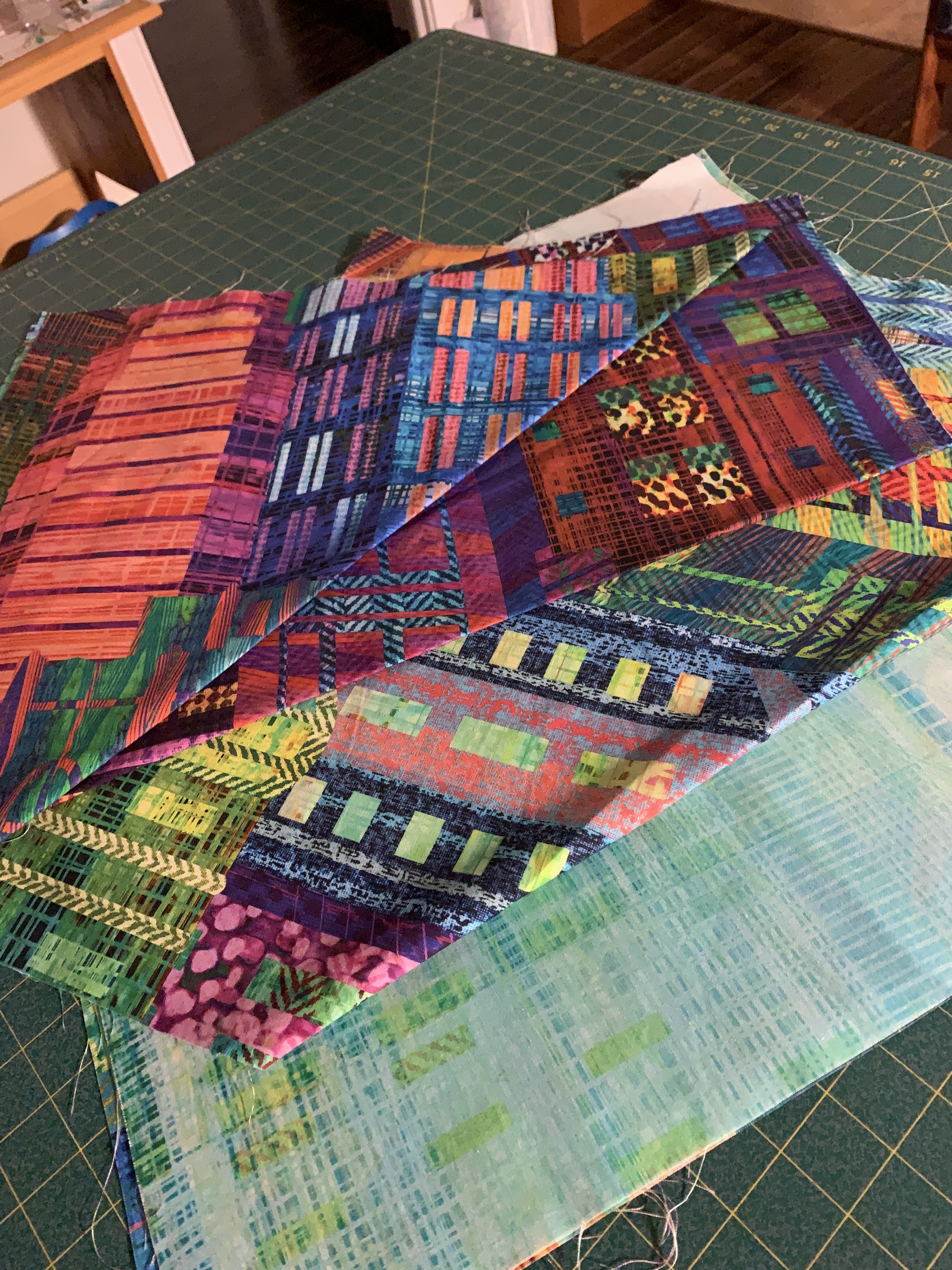
On July 9, I mentioned the Hoffman’s “Skyline” panel I’d bought – I was thinking about how I might play again with “Let The Trumpet’s Sound” drunkard’s path motif using this multi-coloured fabric.

Hoffman Skylines – Multi

I finally got going on on Aug 10, when I cut my 1m wide panel into 10 different 21″ squares. Then I walked around the fabric for another week!

I took a deep breath on Aug 17 and cut the 21″ blocks into smaller sizes:

  • 3 x 16.6″ – a dark, a medium, a light
  • 14 x 8.5″
  • 36 x 4.5″ and
  • 120 x 2.5″ blocks.

I also cut 32 x  2.5″ blocks from several complementary shades of “Grunge” fabric from my fat quarter stash. I more or less sorted everything by colour, I stitched many of the 2.5″ blocks into 4-patch elements, then I began laying out blocks on my cutting table:

Skylines #1 – First Corner

The large pale block, two 8.5″ blocks, then filled in with a combination of 4-patch and 4.5″ blocks….

Skylines #1 – Medium Tones

Next, I grouped more blocks into medium-toned groupings until I had no more space available on my cutting table, at which point I very carefully moved everything to the floor.

Skylines #1 – Incomplete Layout

I laid out all the blocks I had cut – I still needed the equivalent of approximately 15 x 4.5″ spaces – the few remaining scraps I had left of the “Skylines” were too small so I turned again to my collection of “Grunge” fat quarters, selected a dozen I thought would coordinate well with my layout.

As I was filling in spaces, I moved blocks around until I had a more coordinated colour flow:

Skylines #1 – Completed Layout

Now I had a clear alignment of lights, darks, and medium colours – with a grouping of peach tones in the lower left corner.

Looking at the layout with a friend that evening, the small pale mauve “Grunge” blocks were stand-outs – they had to go; I replaced them with other colours which blended better. And then I began assembling the quilt top into 12 x 16.5″ blocks:

Skylines #1 – Partially Assembled

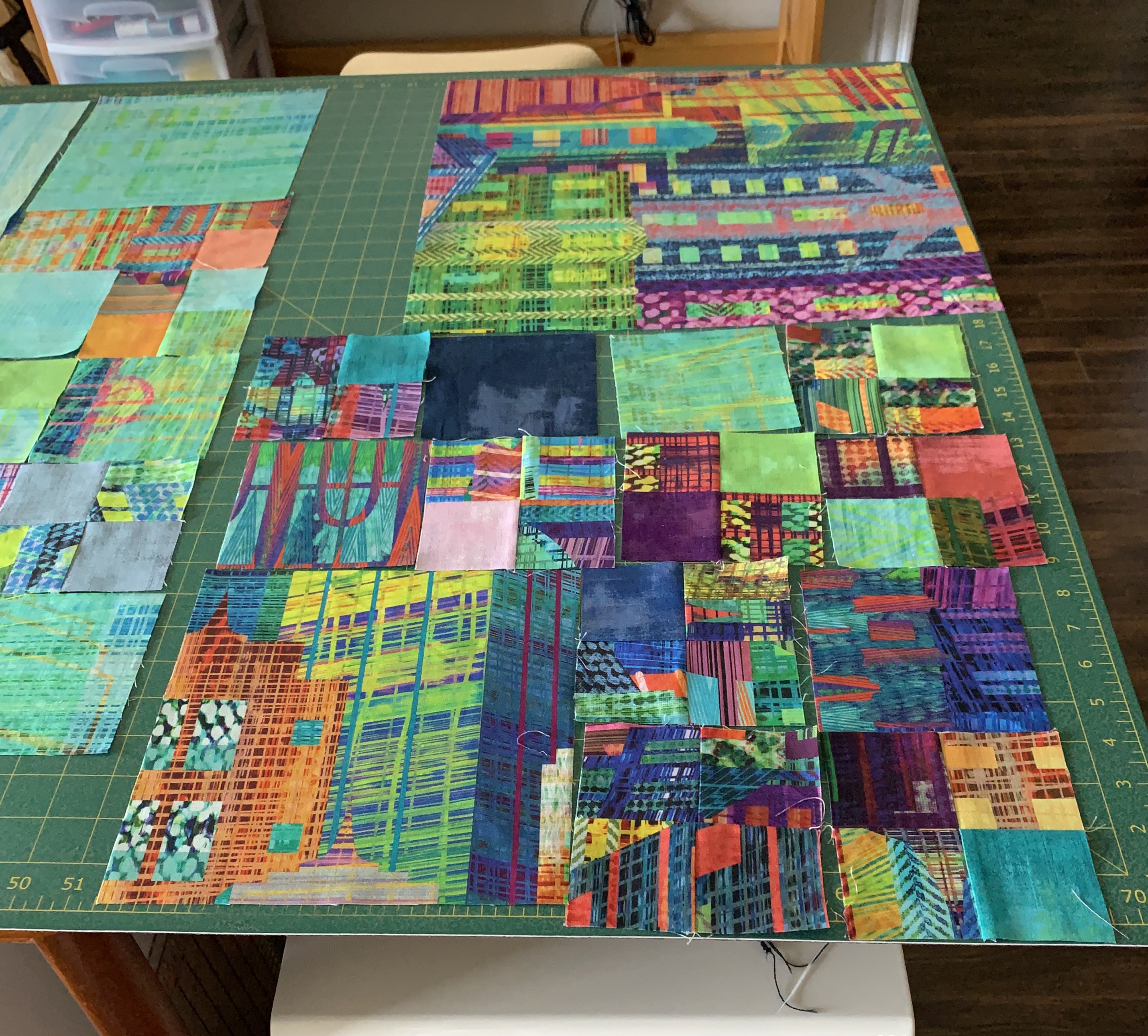
The top row, the second row, and the bottom row are now sewn together. The layout in the middle two rows used a couple of the 8.5″ blocks staggered across two rows – hence the jog in the second row. The third row is laid out on my cutting board ready to be assembled:

Skylines #1 – Third Row Ready to Assemble

That’s this morning’s work. Once I have all four rows done I’ll put them together. Leaving them separate at this point lets me lay them out, check for colour flow, and replace any “eye-sore” spots more easily – taking apart the smaller strips is much less complicated then replacing blocks in the middle of a large panel!

Oh, and I picked up another metre of the “Skylines” fabric – bringing my total, now, to four panels. I’ve decided to insert an 8″ – 10″ strip in the back of each of the “Skylines” quilts. Did I say I have plans for doing THREE quilts using this fabric? I intend to call the series “Skylines Triptych.”

Another Pair of Socks And Other Stuff

On August 3, I finished yet another pair of socks:

Turquoise Socks

I kinda liked working on them. It was a long repeat so the pattern kept being interesting to work on. They’ve gone into the give-away stash (which is getting large).

Then I worked on a t-Shirt I’ve been meaning to make for over a year using one of the three gorgeous pieces of Marcy Tilton digital printed French cotton knit I had in my garment making stash.

New t-Shirt

I finished making it yesterday then I wore it – but it was too big (makes me look dumpier than I actually am) – I’d made a pattern from a Talbot’s t-Shirt I’d purchased last year which fits nicely, but the pattern didn’t quite translate to the stretchiness of the fabric. Today, I took 5/8″ off each side and it looks less sloppy. I may still shorten the sleeves as well. I’m happy with the fit of the neck and the shoulders are OK. When I’m satisfied with how this one fits, I’ll make the other two.

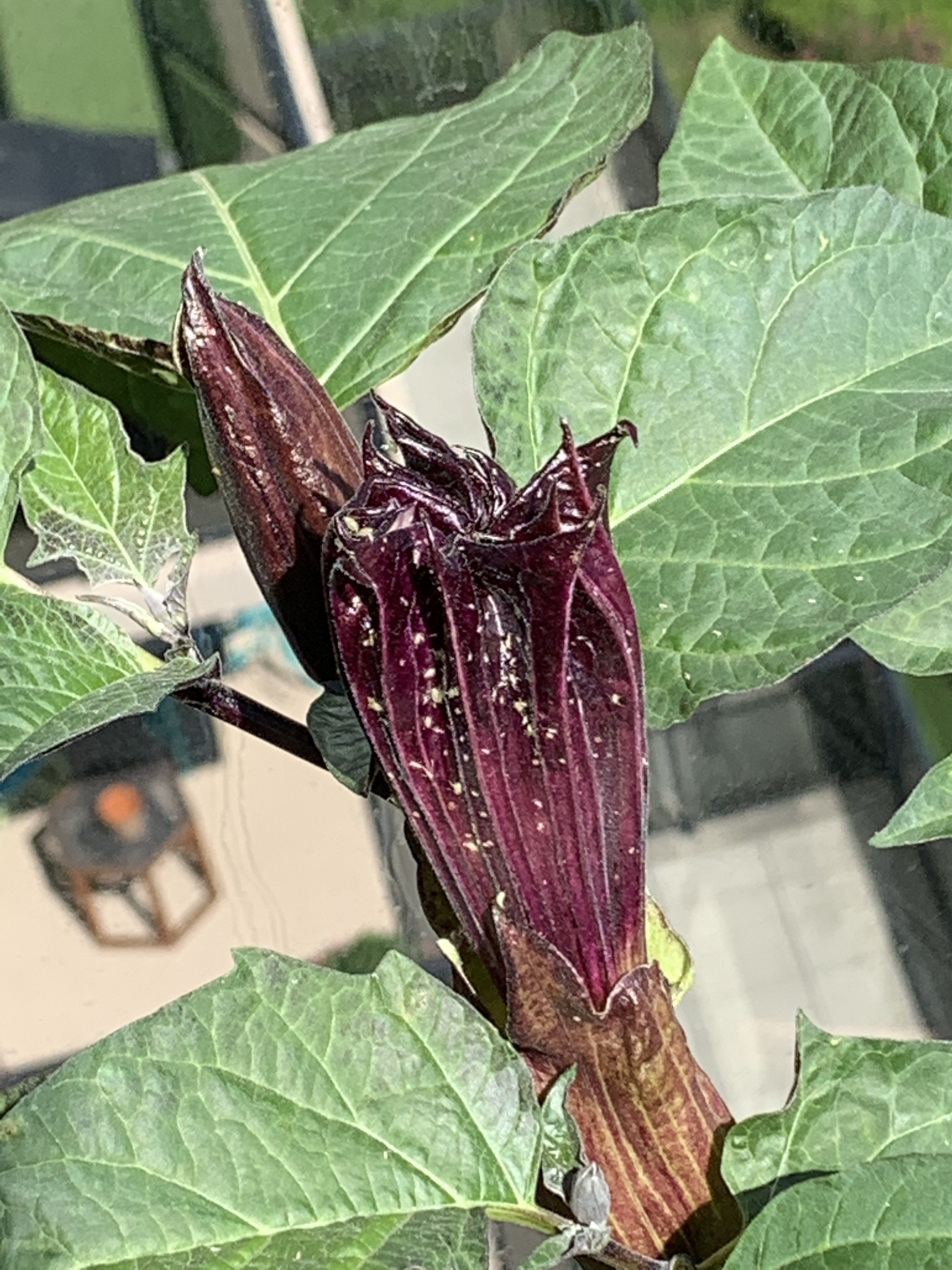
Today I had what I think are the last three blooms on my Datura plant. The pot is in the sunniest corner of my balcony but already the shorter day length is affecting the plant. I have no more buds coming along and leaves are yellowing and dropping off.

The Last Of The Datura Flowers

Tomorrow these three flowers will be drooping then in a couple of days they’ll fall off. At that point I’m probably going to get rid of the plant. I’ve enjoyed watching these spectacular flowers unfold. I just wish I had a sunnier spot for it. In the right conditions it would bloom till well into the fall. It’s an annual so there’s no point in trying to salvage it.

On July 9, I mentioned the Hoffman Skylines fabric I had bought.

Hoffman – Skylines Fabric

I’ve been walking around it since then. Last week I finally cut one of the two panels I have into 21″ square blocks. Now you no longer see the print as skyscraper buildings – now the colours pop out. I think I am going to try something with drunkard’s path.

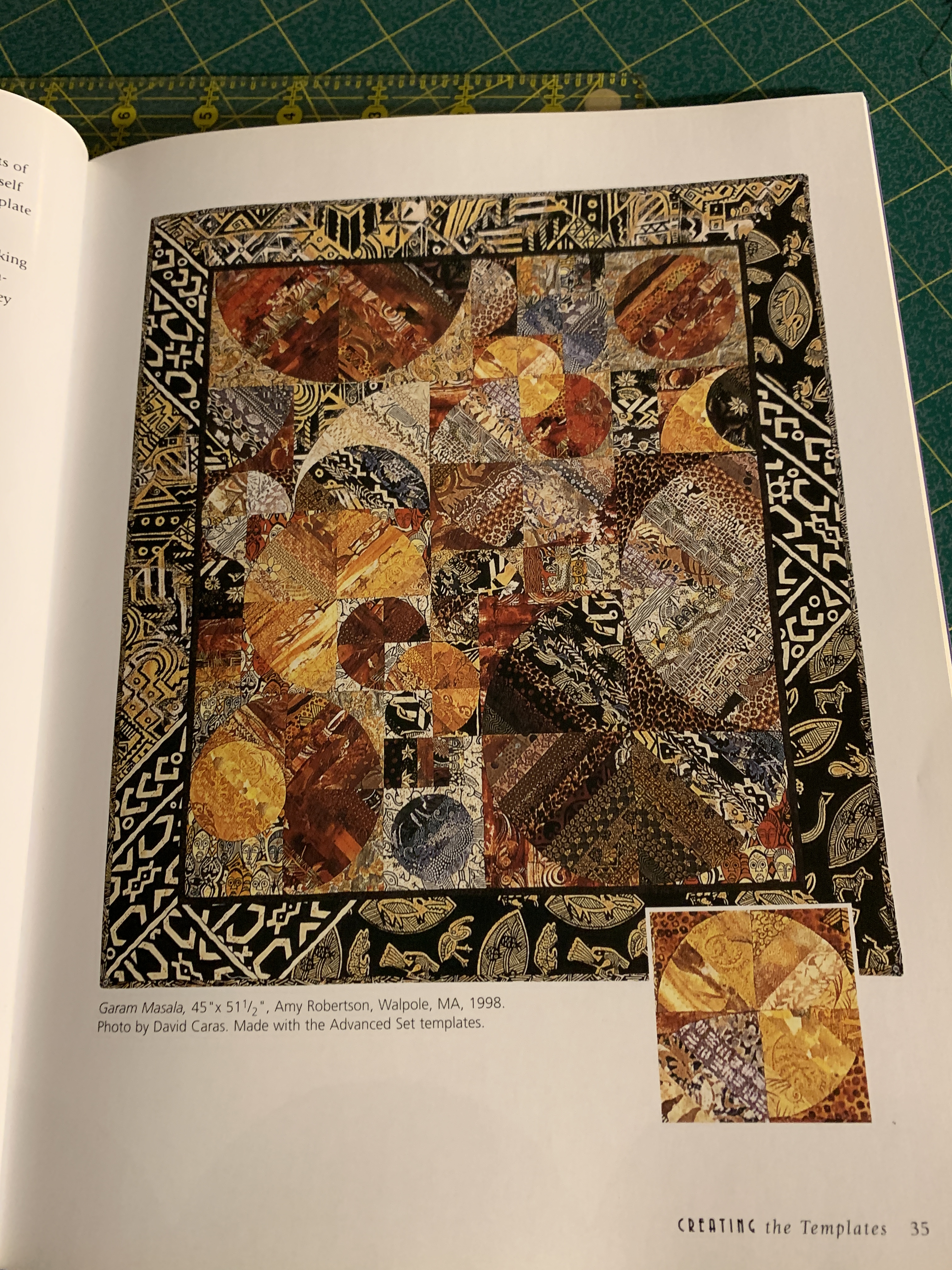
A friend loaned me Louisa Smith’s book “Strips ‘n Curves” – she creates strip pieced fabrics from which she creates a wide range of drunkard’s path blocks. With my multi-coloured Hoffman fabric I don’t have to do any strip piecing, I can use it as it is. So now I have to figure out a  large block size to make the first drunkard’s path block, then scale down from there to work out smaller versions which will fit into an array. I was going to add more solid colours but the jumble of colour in the photo from the book makes me think I may just build my blocks from contrasting portions of the Skyline fabric and let the colour do the talking.

I’ve been dithering about this for a couple of weeks. I think I may be ready to cut the fabric now.

Datura Again…

Datura – Jimson Weed

This I had to share.

This morning I had one bloom – that would be it for today, I thought. I just happened to glance out my bedroom window at the balcony now, almost dusk, to discover two more this evening. Looks like several more will open tomorrow.

So I went out on the balcony to photograph the plant – oh my – what an overpowering scent. My airway immediately shut down – had to head back indoors. I’m still wheezing. Lovely to look at, though!

This is yesterday – covered with aphids! I promptly dug out my Safer Soap, prepared a spray bottle, and doused the plant. I guess the aphids haven’t prevented the blooms from opening. I’ll douse the plant again tomorrow morning.

Marlene, my friend who gave me the plant, told me I’d enjoy it. She was definitely right.

Five Islands

Five Islands is a spectacular location on the NS Fundy Coast on the way to Parrsboro via Hwy 2 (the Glooscap Trail). Sitting on a park bench yesterday at Lighthouse Park, overlooking the islands, it’s clear from the panorama that at one time the islands must have been one continuous point of land projecting into the Bay connected to the mainland beyond the island at the far left of the photo. In the photo you see the western end of Moose island on the left. From left to right you have Moose, Diamond, Long, Egg, and Pinnacle islands. Beyond Pinnacle Island you can just see a seastack called Pinnacle Rock on the far right.

Five Islands At Low Tide

I’ve been driving by Five Islands on my way to Parrsboro for more than twenty years. Each time I’ve always wanted to take a photo of the islands at that spot on the highway where you come around a bend and see the islands through a gap in the trees. But there’s no stopping spot there – there’s sort of one on the water side of the road but I have never stopped until yesterday. I left the car parked on the shoulder, hazard lights on, and walked ahead until I got to the exact location where you can see the islands framed by the opening in the marsh.

Five Islands

The perspective here is somewhat different from the view at Lighthouse Park – you only see four islands with Moose Island on the far left and Pinnacle Stack on the right. At this angle, Diamond Island is hidden behind Moose.

My friend Ruby and I sat for quite a while on the headland bench enjoying the peaceful quiet of the afternoon. There were a pair of clammers digging quahogs on the mud flats while the tide was out but they quickly ended their harvest when the tide began coming in. This is the Bay of Fundy – the tide comes in very quickly and the water becomes very deep very fast. These locals were taking no chances and although their buckets were only partially full they knew enough to leave at the first sign of water returning.

At Five Islands

I was able to capture a photo of Ruby on the bench watching the men at work in the distance. This will definitely be my next wall art piece. I love her relaxed posture, her position against the coast, her head against the sky. I don’t know whether I’ll show low tide or imagine the Bay at high water. All to be determined.

The two of us had a lovely day. I wanted to return to the exhibit to take more photos and I knew Ruby would love to see the quilts hanging. After a short visit to the gallery (we were sneaking in because it was closed to visitors yesterday due to social distancing restrictions (there was a drawing workshop happening with Tom Forrestall) while the workshop participants were away having lunch), we had delicious lobster rolls at the Harbourview Restaurant then slowly made our way back to Halifax, taking side trips on small roads I’ve passed for years but never explored.

It was a lovely day.

BTW – show comes down Aug. 20 in the afternoon.