Bits and Pieces

Latest Socks

Finished these socks last week. Good colours, zippy patterning. They took a bit longer than usual – I didn’t knit my usual 20-30 rows each evening – maybe because I wasn’t feeling like knitting. Anyway, they’re done and added to the sock stash.

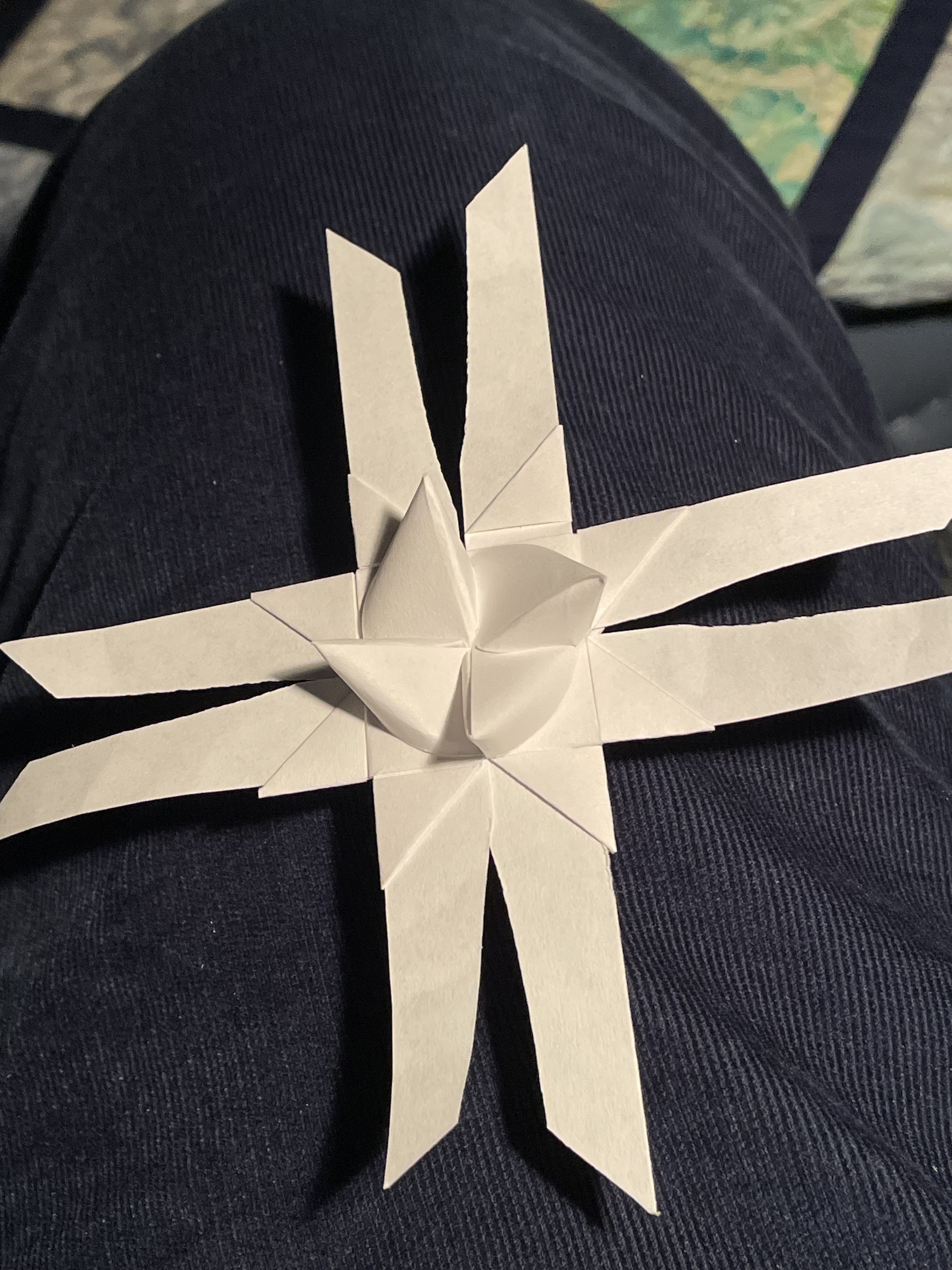
I started a new pair – can’t leave the needles empty but that knitting has been interrupted with Danish Paper Stars.

———–

I’ve been handing out Danish Stars to neighbours and friends for the past six years. Everybody knows where they come from when they find them on their door handle. Some have become so bold as to ask whether I’ll be making more this year. No way out of it – I had to make another batch of paper stars.

I started by cutting the 1/2″ strips of legal paper and began making stars. Two evenings of paper folding and I have 18 stars. I will need at least 40 (more likely 50) before I’ve finished. I’ve used up the paper I prepared; I need to cut more paper today. The knitting is suffering – I’ve had to put it aside to make time for star construction!

———–

My sister Barb called me on Sunday evening to sing me a verse to a song wondering whether I remembered it and might know where it came from. Sounded like a Disney song from something like Snow White – except it wasn’t. Two hours of searching with Google and ChatGPT returned nothing. Usually if I ask Google for lyrics using the bits I remember a song turns up. Not this time. I finally gave up.

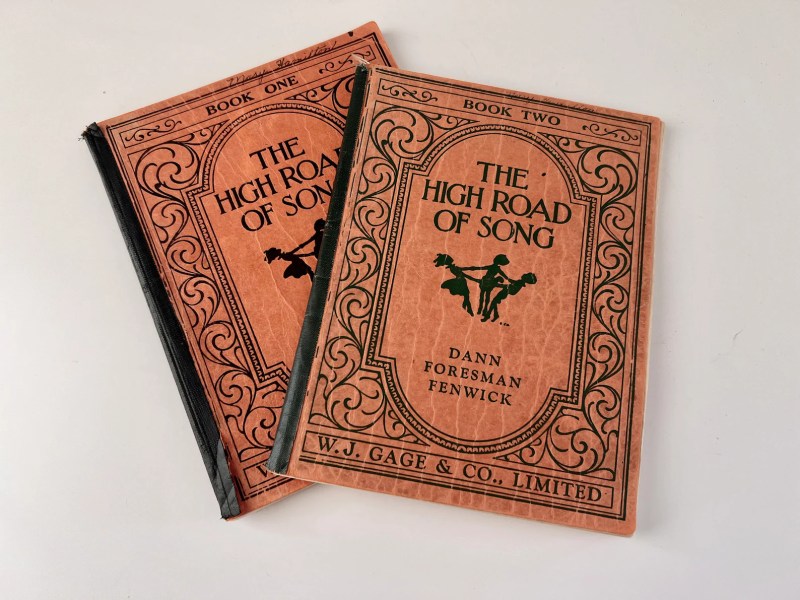
The next evening however it dawned on my it might be a song from our childhood, one we learned in school. When I was in 5th grade (1953) the woman in charge of music for the city schools recruited a group of girls from our class to sing some songs from the songbook being used in the schools at that time:

I was one of that select group and I still have that vinyl recording! A very long time ago I managed to have the record digitized so I have the 22 song tracks on my computer. Didn’t I find the song there in the first group of four songs!

Going To The Fair

The birds are singing, the bells are ringing
There’s music in all the air, heigh ho
As altogether in golden weather we merrily go to the fair, heigh ho!

We have no money for ribbons bonny,
Our clothes are the worse for wear
But little it matters in silk or in tatters
We merrily go to the fair.

The lads and lasses, the time it passes
?????????  [There’s fun to be had everywhere], heigh ho
As altogether in golden weather we merrily go to the fair, heigh ho!

———

There’s that one line I can’t make out on the recording – it has to be something like the lyrics I’ve guessed.

I called Barb to tell her I’d found the song – I still can’t find the lyrics anywhere online although I know the song must be in the “unison” High Road of Song Book One for elementary grades.

I learned that song 71 years ago! Imagine still remembering it.

How’s This For A Face?

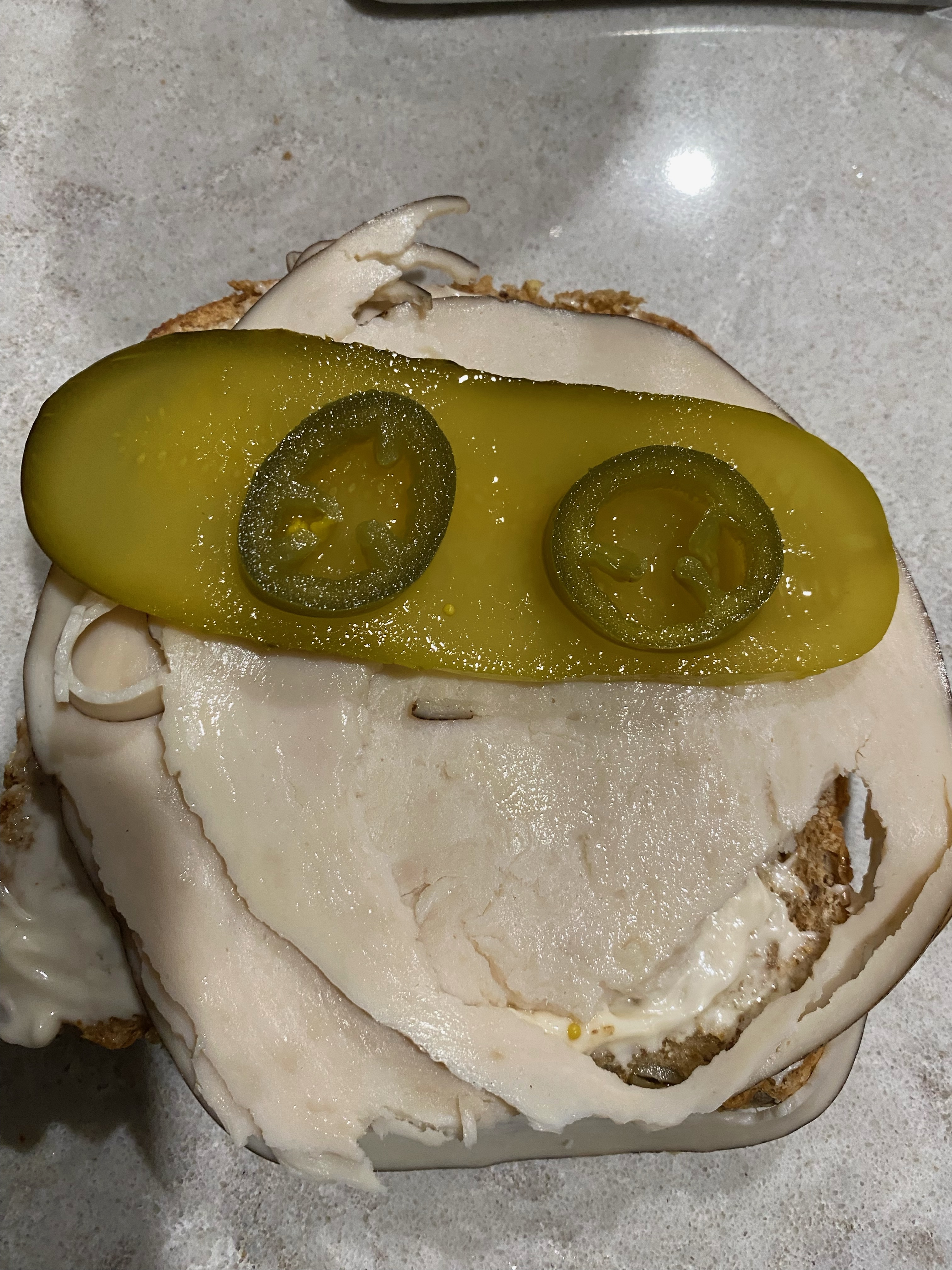
Pickle Face

This image arrived in my email the other day from my friend Andrea – a great face with a mouth and an ear and a bit of hair (all three of which were serendipitous Andrea contends). The pickle arrangement may have been intentional (although not sure about that).

I love it when “faces” turn up unexpectedly. I see them daily, but don’t always get to photograph them.

The latest – the benches at the pool, the feet of which perform a perfect ballet first position:

iShot – Prostock Studio

But I never have my phone with me when I’m in the pool so no photo – although today I couldn’t NOT see the paired pool deck bench feet all in a row like a corps de ballet performing Balanchine’s ballet Serenade (Tchaikovsky).

Invisible Costs

One of the invisible costs of trump being elected appeared in my email today.

I subscribe to “Your Local Epidemiologist” – a blog (on Substack) by Katelyn Jetelina an epidemiologist who writes about epidemiology in understandable ways. Her piece today is sobering!

Now What For Public Health?” she asks.

The U.S. election this week sent shock waves through the field of public health—not just domestically, but internationally as well.

For many in public health, like me, the prospect of national leadership by individuals with an established track record of ignoring the evidence is deeply disconcerting. This has led to anxiety (and even feelings of loss and sadness). So much is unknown about the future of this field—from policies like routine vaccinations, to the impact of falsehoods moving mainstream, to the resources available to hold up an “invisible shield” for the public’s health.

What is becoming increasingly clear is that we are entering a new world. 

Public Health is one of those government functions that runs in the background. It provides what epidemiologists call “The Invisible Shield“. But public health, today, is increasingly under siege, underfunded, fighting hard to keep the public healthy in an environment of conspiracy theories, crackpot science, and a vaccine denier about to assume the responsibility for keeping the American public healthy!

Wanna bet there will be significant cuts to funding for the CDC? What about vaccine research (not just ongoing for COVID-19, but for flu, measles, RSV, all those regular viruses that come around year after year?). Forget about regular immunization for kids to attend school – that will become a thing of the past, I’m sure. Can you not anticipate how the health of the nation will fare?

Public health also oversees water quality, food safety, and on and on. Here’s a list from the American Public Health Association:

Every day, public health people are working – mostly behind the scenes – to prevent hazards and keep people healthy. For example, public health is responsible for:

  • Tracking disease outbreaks and vaccinating communities to avoid the spread of disease.
  • Setting safety standards to protect workers.
  • Developing school nutrition programs to ensure kids have access to healthy food.
  • Advocating for laws to keep people safe, including smoke-free indoor air and seatbelts.
  • Working to prevent gun violence.
  • Addressing the impact of climate change on our health.

All pretty important functions. All likely about to be curtailed to some extent or other.

I can’t imagine the exasperation, frustration, outright rage of public health officials who know what the impact of cutting public health funding and departments is going to have on public health!

And this is just a single invisible cost. I anticipate there will be so many others.

Let’s hope we don’t turn on our public health workforce here in Canada!

The Canada Letter (NYTimes, Nov 7 2024)

In my inbox this morning was this Canada Letter by Ian Austen from the NYTimes.

The headline: Canada Could Use a New Approach to Dealing With Trump This Time

The substance of the piece comes about half-way through:

On it is Mr. Trump’s promise to impose tariffs on everything that enters the U.S., apparently from anywhere in the world, to pay for a wide variety of programs. He has vowed to “demolish” the country’s intelligence agencies, which he has portrayed as part of a politicized “deep state” out to get him.

His agenda also calls for mass deportations of undocumented people — a policy that is likely to prompt a wave of asylum seekers to Canada — along with other measures to restrict immigration, both legal and illegal. And Mr. Trump said that he would “encourage” Russia “to do whatever the hell they want” to members of the NATO defense alliance that do not meet their unofficial commitment to spend 2 percent of their economic output on their militaries. Canada is prominent among them.

I recommend you read the piece in its entirety! It discusses trade talks (and concessions we’ll be forced to make); the influx of refugees from the US fleeing deportation (we’re not going to be able to reject the majority of these people). It forecasts the end of our supply management system (farmers you’re going to be forced to compete with the international market!). Maybe further oil development including a pipeline to the eastern seaboard (might there be a side pipe to eastern Canada? Probably unlikely – we’ll be selling our oil with high tariffs, though!). We’re also going to have to up our defence spending “hugely” – to reach the 2% the rest of NATO spends.

There’s nothing unexpected in that list, except all of it will make the cost of living in Canada rise further. The costs of refusing to reduce our carbon footprint will also climb as we pay for larger and more frequent natural disasters… What can I say?

Have you heard Poilievre offer policy on any of these issues? No. He’s running on an anti Trudeau platform. So how do you think he’s going to tackle what’s coming at us like a speeding train?

And none of that accounts for escalating war in several hotspots around the world and any unexpected events like another pandemic (always on the horizon, and we’re still completely unprepared to deal with anything like that).

I’m not feeling upbeat today (I wasn’t yesterday, either). So I’m off to teach a class to a group of women wanting to learn how to use their serger sewing machines. I can at least make myself useful and help them get a handle on how to thread the machines and what you can do with them.

Later this afternoon, there’s a party at the Craig Gallery to celebrate my Fibre Art exhibit. That will lift my spirits a bit.

Find someone to do something for today. Be a good friend. It will make you feel better, too!

All Over Again…

On Nov 9 2016 I wrote the following:

In Mourning…

All day I’ve been feeling like someone close to me has died. It started, of course, around midnight last night when it was becoming obvious Trump would likely win the election. I went to bed, fell asleep actually, but woke around 3:00 am to go to the bathroom and on my way back to bed I took a look at 538.com on my phone and although Trump hadn’t quite got all the electoral college votes he needed he was almost there, with Clinton having no chance. I couldn’t fall asleep so I watched a movie on Netflix until 5:00 am dozed off and got up about 8:00 this morning (having made sure I wouldn’t hear the 8:00 am news with Trump making his acceptance speech) feeling such a sense of loss.

I’m Canadian – I didn’t, couldn’t, vote in the election but that didn’t mean I didn’t have a personal stake in it. Like everyone else around the world I will be personally affected by decisions this president-elect will make and there is no reason to believe he will make a 180° turn now.

David Remnick said what I was feeling and fearing:

All along, Trump seemed like a twisted caricature of every rotten reflex of the radical right. That he has prevailed, that he has won this election, is a crushing blow to the spirit; it is an event that will likely cast the country into a period of economic, political, and social uncertainty that we cannot yet imagine. That the electorate has, in its plurality, decided to live in Trump’s world of vanity, hate, arrogance, untruth, and recklessness, his disdain for democratic norms, is a fact that will lead, inevitably, to all manner of national decline and suffering.

Thomas Friedman was also direct:

Donald Trump cannot be a winner unless he undergoes a radical change in personality and politics and becomes everything he was not in this campaign. He has to become a healer instead of a divider; a compulsive truth-teller rather than a compulsive liar; someone ready to study problems and make decisions based on evidence, not someone who just shoots from the hip; someone who tells people what they need to hear, not what they want to hear; and someone who appreciates that an interdependent world can thrive only on win-win relationships, not zero-sum ones.

I can only hope that he does. Because if he doesn’t, all of you who voted for him — overlooking all of his obvious flaws — because you wanted radical, disruptive change, well, you’re going to get it.

And I just got an email from a Canadian friend who got the following from a Canadian friend of hers:

This morning I feel like the  loss you feel after losing a family member in an horrific accident.   I guess we have.  Careful reflection will be needed in the grieving process to be sure it is not instead a fatal epidemic. 

Feel free to pass on the message and to join me in this time honored expression of grief. 

Jane

jane

So I’m passing on her message and while I may not wear a black armband I’m certainly feeling the loss.

Nov 6 2024

Today I’m grieving.
What else is there to say?

Nov 6 2024 @ 9:15pm

I had this to say to a friend who’d written me during the day:

I have nothing new to say! I said it in 2016.

Grieving, angry at people who can’t see what’s coming at them. There’s been plenty of warning.

My friend Ruby, 92, has a friend who is also 92, born in Holland in 1932. She spent her early years living through the build up to WWII. The family owned a farm. During the fighting, they sheltered downed allied pilots. She remembers taking food to Canadian airmen hiding under the floorboards of the barn where the cattle were housed. 

For the past months she’s been worrying about what she clearly sees is coming. She lived through it then. Ruby said the other night she (her friend) was in tears and feeling terror like she experienced as a small child. There are too few of these people left alive.

I was born in 1943. I don’t remember the actual war, but I remember the troops coming home, and I remember the years immediately after the war – the late 1940s and what people wrestled with and tried to understand.

There is no reasoning with those folks who voted for hatred and division. They will feel it when their health care is diminished if not eliminated. They’ll feel it when the crazy tariffs raise prices like nothing they’ve seen yet. They’ll feel it when actual people they know are deported. They’ll feel it when climate change escalates bringing more fire and flood and hurricanes and tornadoes and drought because the administration refuses to admit such a phenomenon exists. They’ll feel it when allies back away and strengthen ties among themselves isolating the US. They’ll feel it when more and more women die needlessly because of a lack of women’s health care… I could go on and on. Maybe then, they’ll take a look at what’s happened to them and understand it was the choice they made.

We’re not far from the same situation here in Canada.

The western crazies aren’t going away. Poilievre is going to puff up his chest and swagger about imitating the idiot to the south. He’ll bad mouth Trudeau and because people are tired of Trudeau they’ve stopped listening/hearing his message of building for people and will support the “hate and division” parade.

Here in the east there’s a lot of scepticism about Poilievre – a reasonable number of people may be reflecting on what’s happened today and believe we need to take another path, not the one that denies climate change and won’t plan for it. Some people will understand we (Canada) need to scale back our dependence on gas and oil and continue to accelerate green options. They’ll be concerned about housing and food costs and the limited availability of both for many. They’ll think about how to help with the medical emergency across the country. They’ll think about inflation and tariffs and maybe understand we need to disentangling our trade dependence on the US and look for allies and customers and partners elsewhere in the world. Even though most don’t listen to CBC they might think about how that organization still ties us together across the country.

At least I can hope so, but I’m not holding my breath.

Judith

Nov 9 2024

Just finished reading Jamelle Bouie’s opinion piece in today’s NYT.

The voters who put Trump in the White House a second time expect lower prices — cheaper gas, cheaper groceries and cheaper homes.

But nothing in the former president’s policy portfolio would deliver any of the above. His tariffs would probably raise prices of consumer goods, and his deportation plans would almost certainly raise the costs of food and housing construction. Taken together, the two policies could cause a recession, putting millions of Americans — millions of his voters — out of work.

Precisely what I’m expecting to unfold. Read the whole article: What Do Trump Supporters Know About The Future He Has Planned For Them?

Here’s John Pavlovitz:

The election results, while a cheap and easy high to red voters in the moment, will prove to be a mirage that gives way to a grim reality that no rally speech can distract them from. 

And maybe, just maybe, in the coming weeks and months when there is no Democratic president or congress to lazily blame for the fact that they can’t pay their mortgage, afford their medical bills, sustain their business, or provide for their children, they might actually be ready to stand alongside us and defeat the real enemy within.

Here’s hoping when that times comes, it won’t be too late. 

MAGAs have lost, too. They just don’t know it yet.

If you listened, read, paid attention to what trump said, if you took any time to read synopses of Project 2025, you’d have realized what is going to happen over the next 100 days. They said it out loud. They shouted it from the treetops!

You just weren’t paying attention…

An Amazing “Face”

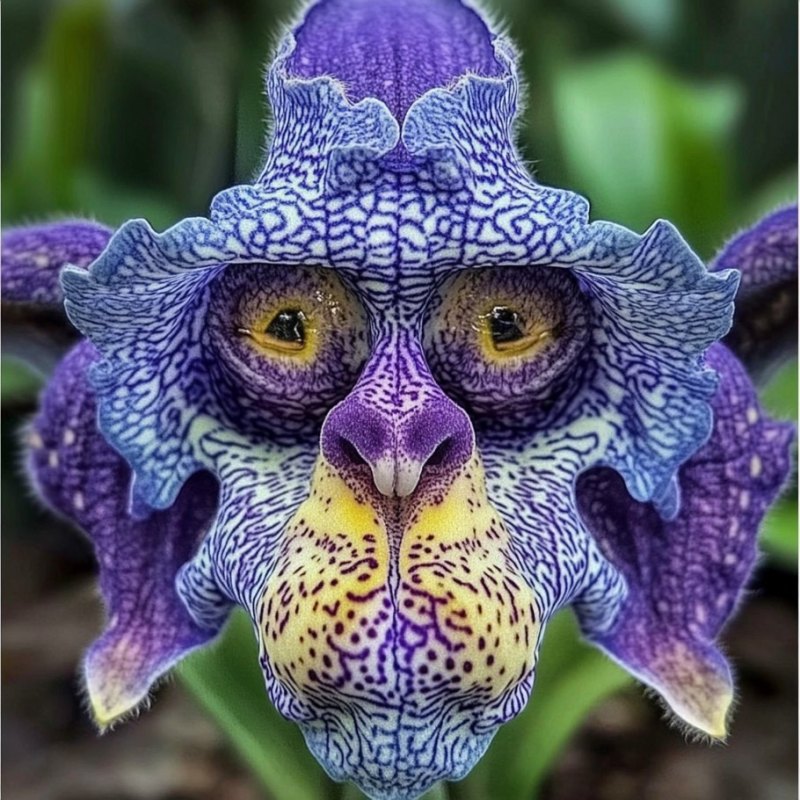
A friend send me an image of this incredible “face”:

Just sharing it, because…

If you don’t trust the image, google “Monkey Orchid” – you’ll be astonished by the variety of faces in these orchids from Peru and Ecuador.

The Kneeling Chair

About 45 years ago I bought my Balans Kneeling Chair. Loved it from the get-go.

You can see it’s a minimalist design –  first introduced at the Scandinavian Furniture Fair in Copenhagen in 1979, Variable was one of the first prototypes derived from the Balans concept, by Hans Christian Mengshoel. I bought mine at the Danish House on the St. Margaret’s Bay Road (that store is long gone). I must have bought in ’79 or ’80. It’s travelled with me wherever I’ve lived.

It’s amazing to sit/kneel on. Although there is no back, you’re forced to sit in such a way that your lower back is supported. I’ve used it at my computer desk – even designed my desk surface height so that when I’m on this seat the desk height is perfect for my back and arm length. I can sit on the chair for long spells.

However, my Balans chair is showing its age – it’s been getting creaky. I’ve tightened the bolts regularly (one of the bolts in the cross piece is stripped and won’t fully tighten any more) but the creaking hasn’t completely gone away. I’ve even glued the cross piece to stabilize it better; that hasn’t helped. So I decided to replace it.

A quick search located me several variations on the chair – some original ones from Varier (the original maker) although not with the stained birch colour I have and for lots of money! I checked around for a knock-off. They’re out there. I found one on Amazon

Same base height as my Balans chair but the overall chair height was likely a problem. I ordered one anyway (not too expensive) and it arrived within a couple of days. I had no trouble assembling it. Next, I tried it out. The 4″ padding turned out to be 3″ too high! My desk and all of my sewing tables were built to be 3″ lower than a standard table top – this chair with all that padding had me sitting higher than was comfortable.

I could return the chair, but rather than go through that hassle, I decided to reupholster it. First I checked with a local upholstering company (I’ve used them before) – I didn’t need new fabric, just wanted to have the seat and kneeling pads reconfigured with 1″ foam and the fabric reattached. I was quoted a price that was more than I’d paid for the chair. I decided to tackle the job myself.

It wasn’t difficult removing the staples from the undercover. I decided, rather than fighting the remaining staples attaching the fabric to the plywood seat (and there were a lot of them), to cut the fabric away. With some effort I was able to remove the 4″ piece of composite foam. I replaced it with a 1″ polyester woven batting and reattached the fabric. Now I have a usable chair.

I also removed the front stabilizing bar – it got in the way of my feet. I’m still deciding whether to remove the second stretcher – I’ll leave it there for now.

I was short a sewing chair for my serger/coverstitch sewing machines (I have two Humanscale Pony Saddle Seats – one at each of the other sewing stations). I tried this chair there. With the seat lower, it feels right. So that’s where it sits for now.

I’ve decided to give my original seat a facelift. I’ve dug out some upholstery fabric leftovers – there’s enough of the fabric I have currently on that seat to redo it. I’ll tighten all the bolts one more time. I’m guessing my original Balans chair may have another 45 years of life in it yet!

I Am Canadian

In my newsfeed from the New York Times this morning was this article by Carlos Lozada:

An immigrant from Peru, Lozada details the conundrums he faces daily regarding his immigrant identity. I was deeply moved by his writing. Moved enough to write a personal note to him at his email address at the NYT. (I don’t expect him to answer.)

His opinion piece evoked a memory of what Joy Kogawa had to say in Obasan, her novel written in 1981. I felt compelled to find those words again and share them with Lozada.

Here is the letter I wrote him:

Carlos, 

As I was reading your piece, I can’t tell you how it resonated for me.  What’s interesting is I was born here in Canada, my mother was born in Canada, my father was an immigrant as were all my grandparents; I personally feel more “immigrant” these days than at any other time in my life (I’m heading toward 82!). In today’s actively antisemitic world I feel my token “jewishness” separating me from my “christian” friends and neighbours. The conundrums you describe are present in my life in such subtle ways but they are there.

I feel my “immigrantness” weekly when I visit two young Afghan families recently come to Canada. I spend a couple of hours a week with each family chatting in English, reading children’s books in English, to help them learn a language they are working so hard to learn. I visit weekly for these young women to help them overcome the isolation a lack of common language forces upon them. These new permanent residents to Canada have become like grandchildren/great-grandchildren in the almost two years I’ve known them. 

I can’t imagine their decision to leave Afghanistan and their families behind. I know the facts of their escapes through Iran, arriving in Turkey as illegals, the unimaginable luck of making contact with a Canadian citizen sponsorship group who helped bring them to Canada. I’m not an official part of that group (my youngest sister is), but through my investment of time these past two years, I have come to feel a small bit of what my grandparents must have experienced, who knew they would never see those they left behind, many of whom a few decades later would have ended in Nazi crematoria. Both sets of grandparents left Lithuania and Poland/Ukraine respectively and arrived in Canada in the early 1900s. I have no names of those left behind but I am absolutely certain many relatives did not survive WWII.

Canada, like the USA, is a nation of immigrants, yet so many people seem disconnected from that reality. In Canada, we’re a bit more aware of our crimes against the First Nations people – our halting attempts at reconciliation keep reminding us that we displaced them, disenfranchised them, demeaned them and that everybody else has immigrant origins from all over the world. 

We are experiencing in Canada a growing sentiment that we don’t want more immigrants, we need to keep “these people” out – they’re taking “our” jobs (in spite of the fact that Canadians don’t want to do the jobs they are willing to do), making housing impossible to find (that’s really the fault of those of us who made development decisions fifty years ago), overrunning our healthcare system (who actually made the decisions to cut back spending on medicine, education, dentistry, social work, … forty  years ago?). We need these new people for their willingness to work hard, for the cultural diversity they bring to us, for their talents and skills which enrich our community.

Shortly after it was published (1981) I read Joy Kogawa’s novel “Obasan” – there’s a passage in it that has stayed with me these 40+  years – written words of the Aunt (Obasan) who had been born in Canada but sent with her family to a Japanese internment camp during WWII:

—————————————

“The entire manuscript was sixty pages long, I skimmed over the pages till I came across a statement underlined and circled in red: I am Canadian. The circle was drawn so hard the paper was torn. Three lines of a poem were at the top of the page.

Breathes there a man with soul so dead
Who never to himself hath said:
This is my own, my native land!

The tanned brown edges of the page crumbled like autumn leaves as I straightened out the manuscript.

The exact moment when I first felt the stirrings of identification with this country occurred when I was twelve years old, memorizing a Canto of “The Lay of the Last Minstrel.”

So many times after that I repeated the lines: sadly desperately, and bitterly. But at first I was proud, knowing that I belonged.

This is my own, my native land.

Then as I grew older and joined the Nisei group taking a leading part in the struggle for liberty, I waved those lines around like a banner in the wind:

This is my own, my native land.

When war struck this country, when neither pride nor belligerence nor grief had availed us anything, when we were uprooted, and scattered to the four winds, I clung desperately to those immortal lines:

This is my own, my native land.

Later still, after our former homes had been sold over our vigorous protests, after having been re-registered, fingerprinted, card-indexed, roped and restricted, I cry out the question:

Is this my own, my native land?

The answer cannot be changed. Yes. It is. For better or worse, I am Canadian.”

—————————————

Securely Canadian having been born here myself, I still feel Obasan’s struggle as somehow my own.

Your NYT piece has evoked all those same feelings about country and belonging that I found those many years ago in Kogawa’s writing,

Thanks for such a passionate piece.

Judith Newman

Sewing/Quilting Tools

I taught a class yesterday at Sew With Vision on “Basic Alterations” – taking clothing in at the waist, under the arms; shortening pant/jeans legs, adjusting straps, etc. I wanted the two gals to understand there’s not a lot you can do to make a RTW (ready to wear) garment bigger; however, you can make adjustments to make something smaller.

For example, my high-belly measurement is much larger than it was ten years ago (related to my age and the meds I take). Not much I can do about dropping the weight from that location. So when I was buying a vest for fall wear, I bought 1XL to fit my belly, which meant it was too big around the hips, and the armholes needed adjusting. I could have done some complex taking apart, but instead, I just took darts in the shoulder seams (and hand stitched the dart to the lining so it laid flat); I did the same at the hips – a dart in the side seam from waist to hem by machine, then hand stitched the dart down. Now the vest fits decently and looks fine.

The one enlargement adjustment I do to make something bigger is to add elastic gussets to the waist of pants when the waist just gets too tight (my hips and thighs have stayed the same size for more than 20 years!). [I’ve previously described how I add elastic gussets to pants: https://jmncreativeendeavours.ca/2018/04/02/elastic-inserts/]

Back to the class – while the gals were working on small adjustments to garments for themselves and their children, it became obvious they had a few tools. Because I wasn’t expecting to do any sewing myself, I’d neglected to bring my sewing kit with me (https://jmncreativeendeavours.ca/2017/12/12/sewing-tools-organizer-finished/). We had to hunt through the shop’s tool collection (of dull very well used tools) to find what we needed. I told the gals I’d make them up a list of necessary sewing tools.

I’ve previously described five essential quilting tools I have at each sewing machine (https://jmncreativeendeavours.ca/2019/01/30/my-5-essential-quilting-tools/).

5 Essential Sewing/Quilting Tools
  • A Seam clipper/ripper
  • Self-threading needles (for embedding quilting thread ends)
  • Sharp 4 1/2″ embroidery scissors
  • Precision 3″ tweezers
  • Frixion Erasable Pen

But I use a lot more tools regularly.

Essential Sewing/Quilting Tools

I’ve laid out my tools, clustering those in the same category.

  • Measuring Tools
    • Rotary Cutting Ruler 6″ x 24″ – a good first measuring cutting tool
    • A measuring tape with both metric and inches on both sides
    • A metal 15″ ruler with both metric and inches
    • A slide ruler with notches for measuring and marking short distances
    • A small plastic ruler for checking short measurements (metric and inches)
  • Cutting Tools (these are going to seem expensive, they are, but expect to pay a lot more than you anticipate to get good sharp tools – I like KAI scissors – they feel good in the hand, they’re sharp and bit less costly than some other good brands)
    • 8″ shears – for cutting out garment patterns (I use a rotary cutter for cutting out patterns but there are curves that sometimes call out for shears)
    • 4 1/2″ embroidery scissors – I use these for snipping and cutting small pieces
    • 3 1/2″ precision embroidery scissors for removing stitches and close cutting
    • A sharp seam ripper (I change them as soon as they feel dull; I buy them in quantity to have plenty on hand and within easy reach)
    • A Seam Ripper Clipper (in photo above)
    • A 45mm rotary cutter with a supply of spare blades always on hand (I order in bulk online)
    • A Self-healing Cutting Mat – I recommend starting with a 24″ x 36″ mat (I have a 3′ x 6′ mat that covers my entire cutting table – expensive but useful)
    • Rotary Cutting Rulers and Templates – start with a 6″ x 24″ ruler
    • A Shape Cut Template/Ruler – this makes cutting strips of fabric very easy
Shape Cut Ruler
  • Marking Tools
    • Heat Erasable marking pens (Frixion are the most common, but I’ve bought acceptable ones in sets online)
    • Clover Chaco Liner – makes a fine chalk line (can purchase refills)
    • Chakoner – a heart-shaped chalk line drawing tool
    • A Fons and Porter or Bohin mechanical pencil with white lead (I have other colours, too, but I use the Frixion pens for marking on light fabrics and the chalk liners or pencil for marking on dark)
    • Post it notes, small and larger – I use them to identify cut fabric for both sewing and quilting
    • Masking Tape – I mark fronts and backs of garment pieces, for example, so I know what is what
    • Fine Sharpie Permanent Marker – another tool I keep at each sewing machine
    • A .7mm lead mechanical pencil (with .7mm HB lead) – perfect for pattern drafting on paper
    • Medical Exam Table Paper 18″x125′ ideal for tracing garment pattern pieces
  • Bobbins and Bobbin Holder
    • A supply of empty bobbins for each different sewing machine – each colour thread needs its own bobbin! You always want an empty bobbin around and each machine may take a different size bobbin (even from the same company)
    • A bobbin holder or box to keep bobbins in order and easily accessible and storable
  • Thread – there’s no point in sewing with cheap thread! Your machine won’t like it and the garment or quilt won’t like it either! I suggest
    • Aurifil 50wt cotton thread (variegated in two shades of grey for quilt piecing) – this is a lovely, strong, low lint thread, although expensive
    • Wonderful 50 weight cotton thread – a bit heavier than Aurifil but I use it for quilting a lot
    • Gutterman polyester thread (50wt)
    • Mettler polyester thread (50wt)
    • Coats and Clark polyester thread (50wt) – this is my least favourite but do use it to match with fabric when I have to
  • Other Useful Tools
    • A brush for cleaning lint from the sewing machine
    • A “HumpJumper/Seam Jumper” multi-purpose tool (the tool I have for lifting the presser foot for thick fabric also has a small hole for inserting a new machine needle – handy
    • A fine crochet hook for pulling threads hidden beneath quilt top or bringing pulled threads to the back of a knit garment
    • A Snag Repair Tool (Snag Nab-it) to bring pulled thread to back of knit fabric
    • A Large Safety Pin – for pulling elastic or ribbon through channels in garment or other sewing construction
    • A roller of sticky tape – great for picking up threads on your ironing board or fabric
    • Fray Check fabric glue
    • Glass Head straight pins (I like 1 1/16″ length – I find shorter ones harder to handle).You want glass heads because the iron won’t melt them! You want bead heads because they’re much easier to pick up
    • 1″ Curved Safety Pins for holding a quilt sandwich together (these small pins are a good size – the larger ones are awkward to sew around when quilting)
    • Washers – the largest you can find in the hardware store – great for holding paper patterns on fabric – much better than pinning – you need at least 6 (8 is better to have on hand; they’re inexpensive)
    • In addition to the feet that come with your machine, you will want extra feet for different jobs – you can find sets online that come with both a low-shank and high-shank adaptors (the set I have from Love/Sew works on both my old Singer Featherweight and my Brother Quilter)
    • NEEDLES – you need lots of spare needles – you need a fresh needle every time you start a new project (when I’m quilting, I change needles every 30,000-40,000 stitches – in other words, I change my needle two to three times during the quilting process). I buy needles in bulk – in boxes of 100 – for the needles I use most: Universal 80, Embroidery 75, Quilting 75. I also use Top-Stitching 90, and various Stretch/Ballpoint needles, Twin Needle 75 4mm & 6mm, also it’s useful to have Denim /Jeans needles 90 for working with denim. Schmetz and Inspira (as well as Klasse) are all sturdy needles which come in many sizes and for all fabric types [https://www.schmetzneedles.com/pages/sewing-machine-needle-chart?srsltid=AfmBOopLOpsA-oGFmbcXGBllCANtjbRxzSIvBejuXQKS0Bgcuf11qDSv]
      Just remember: dull needles can ruin your project, and there’s nothing worse than breaking a needle and not having a new needle on hand
    • A pin holder with a magnetic mouth used for storing discarded needles and bent pins – you can also use a large pill container with a lid, even a mason jar – something to collect used sharps
    • A magnetic pin holder
Magnetic Pin Holder
Sewing Machine Needles
  • Ironing Board and Iron – if possible keep your ironing board always set up – makes it much easier to just get a project going. You want a good pad and cover – I have a felted wool padding and I use a heavy twill unbleached cotton to make my table cover – I make a new cover every two years or so
  • A sewing table at the right height for your body (I had mine made for me – lower than a standard table height because I’m short and my upper arm measurement is somewhat long) – a dedicated sewing table means you can keep your machine set up and ready to go.
  • An adjustable stool – I have what’s called a Saddle Seat that I can adjust to the perfect height to keep my shoulders down and relaxed when I’m sewing (I actually have two of them which I move around as I need them). Even though they don’t have a back support, the seat forces you to sit with your knees below your hips which puts the lower back in a good position for extended working (although if you’re quilting or making a garment from scratch, you’re pressing as you go which gets you standing and moving to and from the ironing board a lot).
  • A Cutting Table at a comfortable working height – I created mine from a teak dining room table on a double set of wood bed lifts – makes it the perfect height for me
My Sewing Studio
  • Shelves and drawers and containers for storing fabric, notions, zippers, thread, patterns, tools
  • Trash cans – one at each sewing station
  • Good lighting