Climate Change Has Caught Up With My Wardrobe!

I may not have written much but I’ve been making pants these past few weeks. Why, you might ask, with a closet full of summer and winter pants, I doubled down on making pants?

Well, the weather in Nova Scotia has been unending sunshine. We don’t get weather like this. The “normal” in NS is a day of sunshine sandwiched between two days of rain! If it’s one thing we can count on here is lots of rain, all summer long. Then September comes and we get our best weather into the middle/end of October. Sunny, if a bit cool, days wonderful for being outside. For six weeks, maybe seven, we get our best weather of the year.

Not this year. It rained for most of June, days on end, and then July came and the sun came out and it stayed. In fact the weather has been so dry it’s been considered a drought! Wells have gone dry. Activity in the woods has been banned. We’re conserving water because the water level in the watershed lakes is extremely low.

The outcome of all of this is, after Labour Day when that one “fall’ day would normally arrive and I’d change over to winter clothes, that day hasn’t yet happened. I realized I needed a couple pair of fall coloured, if somewhat light in weight, pants to wear in this shoulder season that we never have! Something a bit heavier than the summer cotton pants and lighter than my fall corduroy or denim pants/jeans.

In addition, Sally at Sew With Vision asked if I’d do a class on making a basic pair of pants. I’d agreed. So I dug out my Japanese Monpei instructions and took a look at them. Monpei are constructed using 4 rectangles based on hip measurement for width and from waist to a smidge above the floor for length.

To create a crotch, the traditional Monpei uses a gusset based on two crotch triangles. I wanted the crotch to be incorporated into the front and back of the pants. So I decided to draft a pattern first.

I started by drawing two rectangles – one for the front, one for the back. I marked the vertical centre line (to use as the grain line), and drew in the horizontal crotch depth (including ease and seam allowances at waist and crotch).

I shaped the crotch using the measurements suggested for the gusset and drew the appropriate triangle to the front and the back along one side at the crotch depth. (In the Monpei instructions, the gusset triangles are cut from the top edge of the rectangle and repositioned at the appropriate depth along one side – the centre front/back seam.

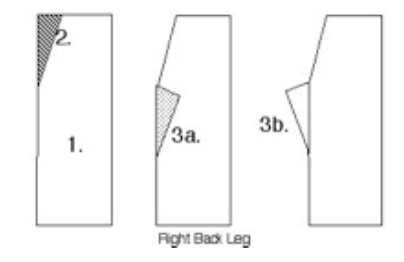
In my drafting the centre front edge remained straight (because I need to be able to pull the pants over my hips and my waist and hip measurements are almost the same). I used a French curve both front and back to round out the crotch shape.

Then I shortened the centre front crotch length by 1″ and rounded the “waist” with the French curve, because my front crotch length is shorter in the front than the back.

I drafted pieces for a pocket to be placed on top and incorporated into the waistband and side seam (pants without pockets are useless!), and a pocket facing. Finally I created waistband facings.

Because the Monpei gives me a rather nicely fitting pair of pants I decided to go ahead with the basic design without comparing my drafting to any of the several pull on pants patterns in my pattern stash.

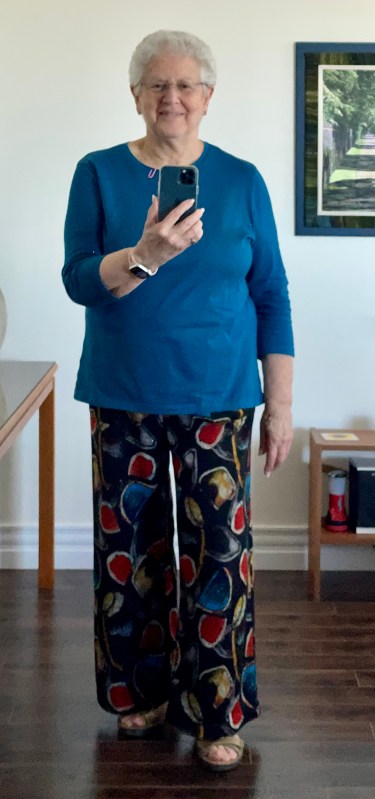
Using a Polyester/rayon knit fabric, I ended up with these:

Although you can’t see them, the front pockets are there.

I made two pair of denim pants using the same basic construction but added a fish-eye dart down the centre back and shaped the side seam to narrow the legs a bit. I also added a back pocket to conceal the top of the fish-eye dart.
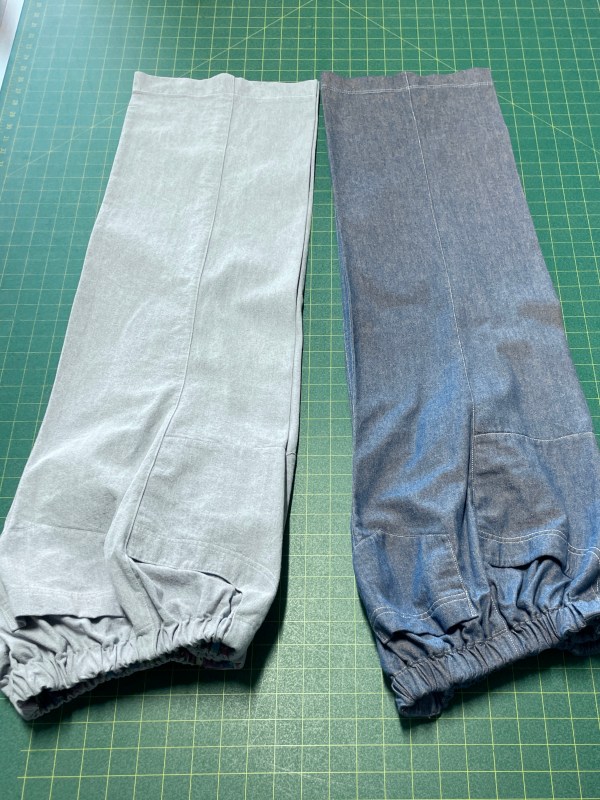
Then I tackled pants for Sally!

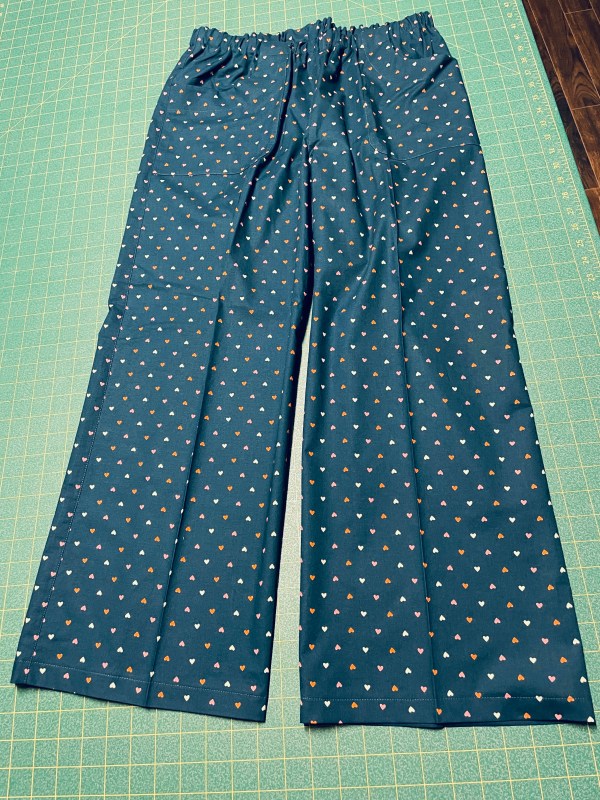
First I made a muslin from the Monpei pattern I drafted using Sally’s measurements (no pockets – although I added the waistband facing elastic, and hemmed the legs so I could gauge the fit). The crotch depth worked well, but the legs were a bit short. Next I made the pants for Sally adjusting the leg length and adding pockets.

The plan is to display the Monpei/pants in the shop so people have an idea of what they’d be making when they registered for the class. (I have a hunch Sally is intending to wear them!)

So I’ve been sewing, just not writing about it.

Kantha

Red Kantha

I was gifted this kantha, made in Bangladesh, a couple of months ago (I won’t go into the long story of how it came to me). The quality of both the kantha quilting and the embroidery is exceptional. I can’t imagine the hours it took some woman to execute it. All hand work, done for pennies!

I can’t see using it as a bedspread, although it would fit my queen bed. Instead, I intend to make a spring/summer loose coat from it.

What you see is half the kantha, the half beneath is identical. There’s certainly enough fabric to make a gorgeous garment – I see the half medallion (at the top centre) at the neckline with the large embroidery below at the centre of the back. I could then cut the two fronts from the other side, same thing – medallion at the neckline, same embroidery below. I visualize loose sleeves with the border along the edge. I think the half may be long enough for the border to be at the hem of both front and back, as well.

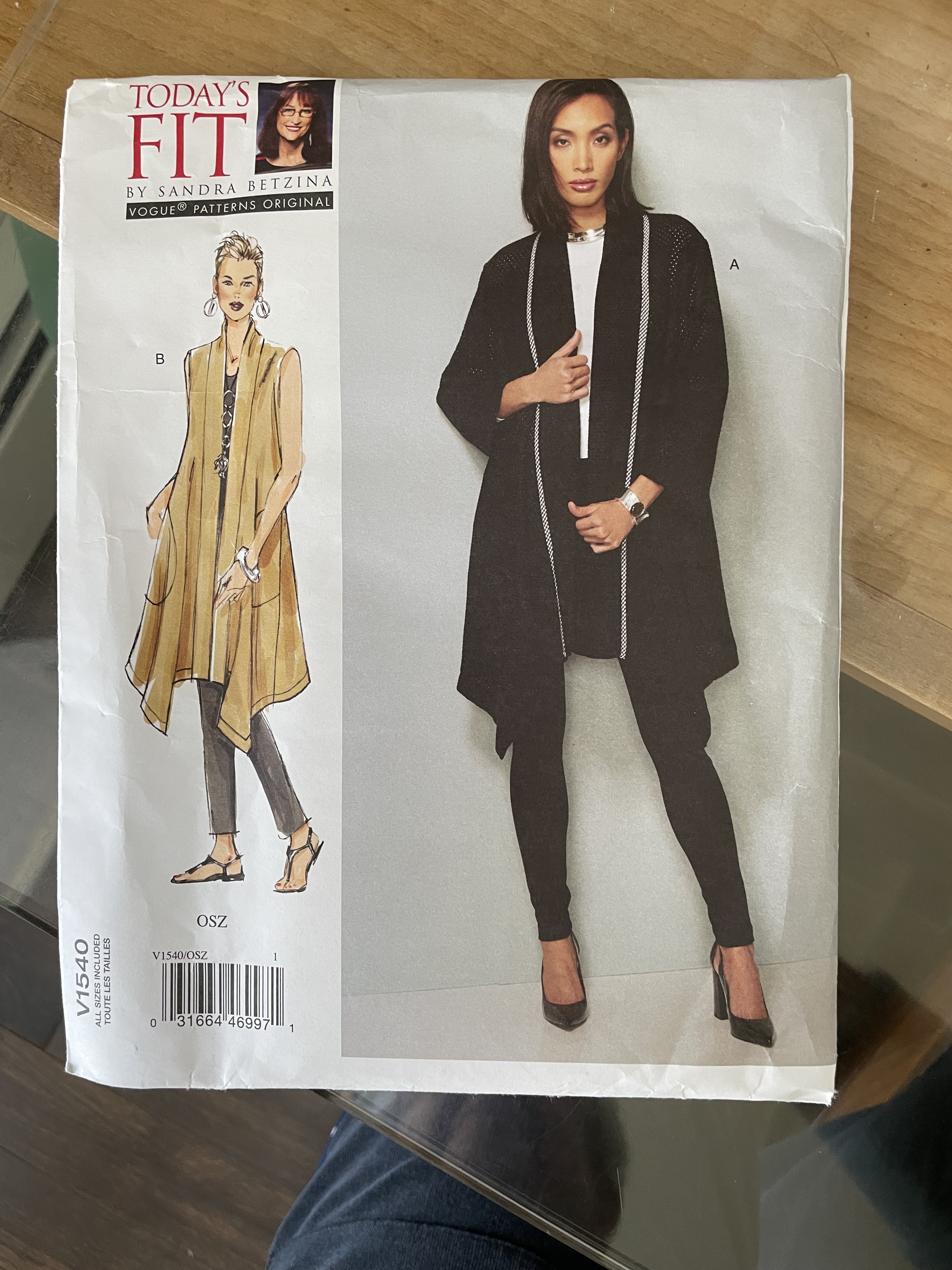
In my patten collection I just found this garment by Sandra Betzina –

Fitted at the top, flowing through the bottom. I like the folded neckline although I would fold it to the inside (otherwise, the way Betzina constructs it, that folded neckline would expose the unfinished back of the fabric). The other thing I could do is make that “scarf” element separately, attaching it to the front, then top stitching it underneath. It would do that same thing – provide heft and shape to the neckline and the front edges. I might actually be able to find two pieces of the kantha border to do that!

I would also straighten the hem – I’m not a pointed hem kinda gal. That would mean lengthening the centre front and back/removing the points. I do want pockets – probably not inserted in the side seams but added using a welt opening closer to the front edge.

Also, because this is an unlined garment, I would bind the seams on the inside using some batik fabric.(Betzina suggests pressing the seams open and adding a Hong Kong finish on the raw edges.) At the moment I don’t see any other adjustments except I might put a couple of hidden hook/eye closings just above the waist so I can close the coat on a windy day.

I think I’m ready to start working on it – our weather is just warming enough that I’d get to wear it a few times before it becomes too warm to warrant even a light coat.

Working With Decorative Zipper

Normally, when you apply a zipper, the zipper tape is hidden within the garment or bag or whatever. But lately I’ve been using a decorative zipper which has interesting tape I want to showcase. How do you apply a zipper in that situation?

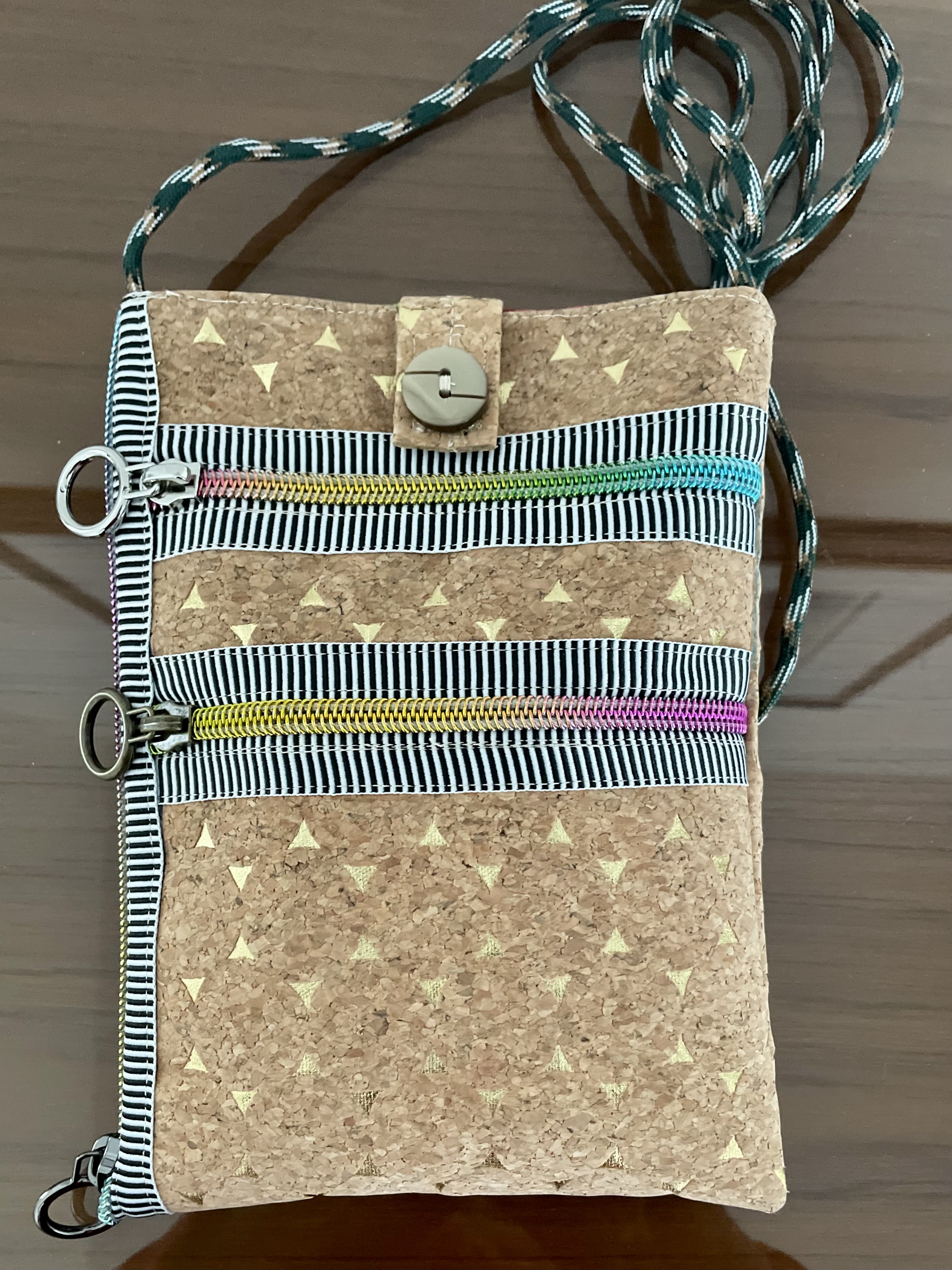
Here’s my cork iPhone case which I finished a couple of days ago using the zipper tape as a focal detail:

iPhone Case using Cork and Decorative Zipper

Now, that I have finally figured out how to apply decorative zipper tape, I’m about to make another bag – I will take photos at each step so I can prepare instructions.

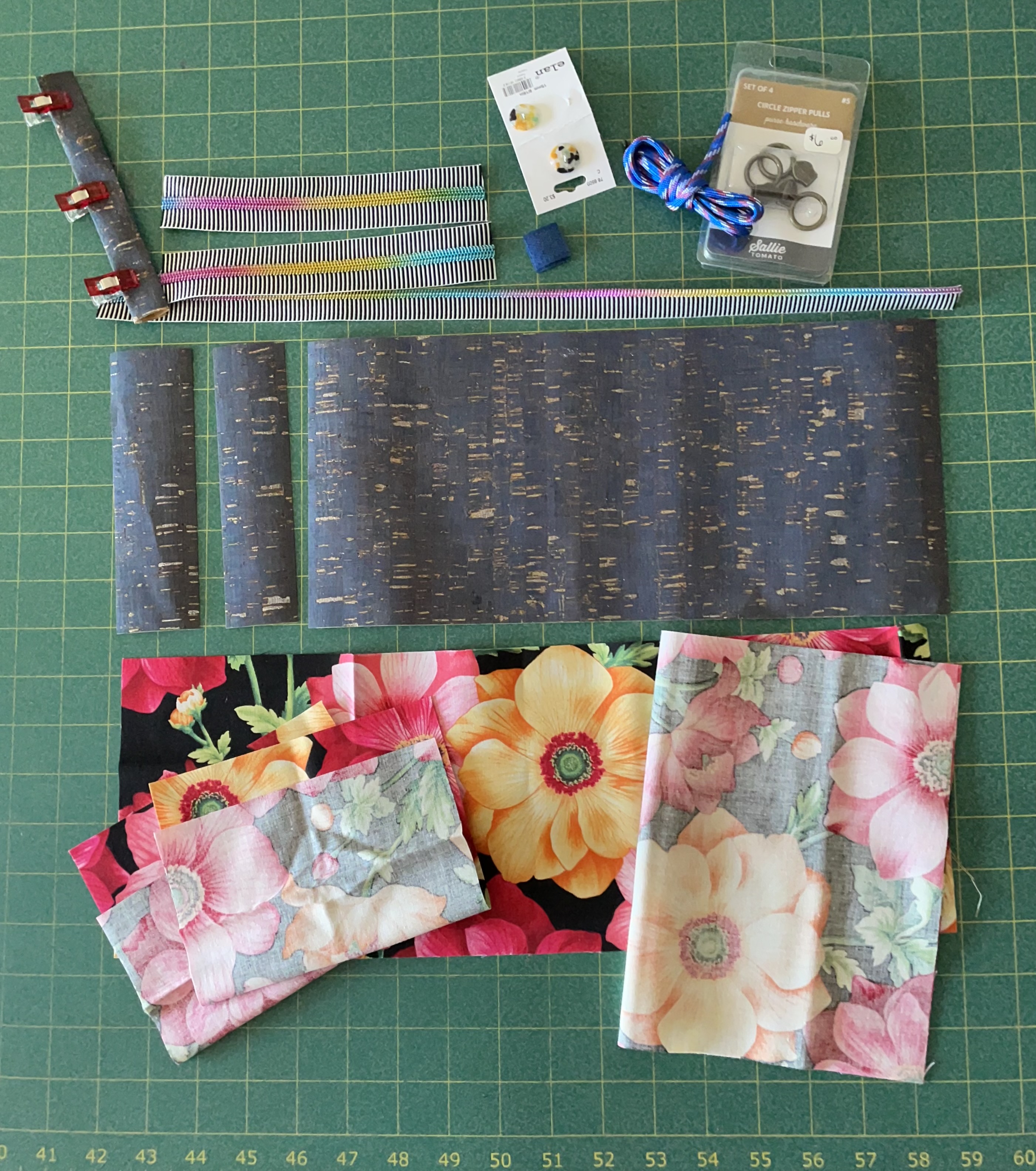
Step one – prepare all the elements:

Supplies for iPhone Case

What do I have?

I’ve cut a 6″ x 16″ wide strip from some denim cork fabric;
I cut 1 3/4″ and then 1 1/2″ pieces from one end;
I had a leftover 2″ x 6″ piece which I’ve folded in thirds for the tab (upper left with clips).

I had one 17″ length of zipper tape (the other half of the tape I had used on the completed bag above), I cut two more 7″ pieces of zipper tape (longer than the width of the bag so I have some wiggle room to add the slides); I have three slides.

I cut four pieces of lining fabric:
one piece of 6″ x 16″,
one piece – 8″ x 12 1/2″,
two pieces 6″ x 8 1/4″ (to accommodate the size of a credit card)

A piece of velcro
An interesting button
48″ of parachute cord

With everything prepared, I’m ready to sew.

I will start by constructing the tab – the cork strip is folded in thirds, I’ll use a decorative stitch to hold it together; next, I’ll add the “hooks” part of the velcro to one end; last, I’ll stitch the button to one end (as a decoration).

Step two – the body.
I’ll start by applying zipper tape between the small strips, then along one side….

Now – on to actually making the case. I hope to have the photos by later this afternoon. I’ll write instructions tomorrow and add them here when they’re done.


May 3 2025

I made the second bag two days ago, taking pictures as I worked, only to discover when I went to document the process that I’d created the pockets “top-down” (which works but is too difficult to describe and follow because you’ve got to keep your pocket linings out of the way as you work your way down!).

I should have worked from the “bottom-up” – adding zipper and pocket lining to the “bottom” pocket first, then the upper pocket second. So now I have to make another bag, take pictures as I work, so I can describe what I do.

I’ll get to that when I can. (Here’s where I’d put a “sad” emoji).

Here’s the finished bag:

You can’t tell how I constructed it once it’s done. However, it would have been much easier to describe the process had I installed the bottom pocket first.

Oh, well.

I Am Canadian!

I wrote this piece on Oct 19/24 – after reading Lozada’s piece. I thought I’d share it today because the excerpt from Obasan is even more relevant than it was in October!

This is my own my native land.

I wonder whether others are feeling the same ambiguity I am about what being Canadian involves, particularly as election day draws closer and we are facing perhaps a life-shaping decision between the divisive, trumpish, anger of PP and the well informed, experienced, financial expert to lead our government. We don’t vote for a Prime Minister, which makes the decision more complicated but ultimately that’s the decision influencing how I will mark my ballot. As things stand, I can’t vote Conservative no matter how capable my local candidate may be.


An immigrant from Peru, Lozada details the conundrums he faces daily regarding his immigrant identity. I was deeply moved by his writing. Moved enough to write a personal note to him at his email address at the NYT. (I don’t expect him to answer.)

His opinion piece evoked a memory of what Joy Kogawa had to say in Obasan, her novel written in 1981. I felt compelled to find those words again and share them with Lozada.

Here is the letter I wrote him:

Carlos, 

As I was reading your piece, I can’t tell you how it resonated for me.  What’s interesting is I was born here in Canada, my mother was born in Canada, my father was an immigrant as were all my grandparents; I personally feel more “immigrant” these days than at any other time in my life (I’m heading toward 82!). In today’s actively antisemitic world I feel my token “jewishness” separating me from my “christian” friends and neighbours. The conundrums you describe are present in my life in such subtle ways but they are there.

I feel my “immigrantness” weekly when I visit two young Afghan families recently come to Canada. I spend a couple of hours a week with each family chatting in English, reading children’s books in English, to help them learn a language they are working so hard to learn. I visit weekly for these young women to help them overcome the isolation a lack of common language forces upon them. These new permanent residents to Canada have become like grandchildren/great-grandchildren in the almost two years I’ve known them. 

I can’t imagine their decision to leave Afghanistan and their families behind. I know the facts of their escapes through Iran, arriving in Turkey as illegals, the unimaginable luck of making contact with a Canadian citizen sponsorship group who helped bring them to Canada. I’m not an official part of that group (my youngest sister is), but through my investment of time these past two years, I have come to feel a small bit of what my grandparents must have experienced, who knew they would never see those they left behind, many of whom a few decades later would have ended in Nazi crematoria. Both sets of grandparents left Lithuania and Poland/Ukraine respectively and arrived in Canada in the early 1900s. I have no names of those left behind but I am absolutely certain many relatives did not survive WWII.

Canada, like the USA, is a nation of immigrants, yet so many people seem disconnected from that reality. In Canada, we’re a bit more aware of our crimes against the First Nations people – our halting attempts at reconciliation keep reminding us that we displaced them, disenfranchised them, demeaned them and that everybody else has immigrant origins from all over the world. 

We are experiencing in Canada a growing sentiment that we don’t want more immigrants, we need to keep “these people” out – they’re taking “our” jobs (in spite of the fact that Canadians don’t want to do the jobs they are willing to do), making housing impossible to find (that’s really the fault of those of us who made development decisions fifty years ago), overrunning our healthcare system (who actually made the decisions to cut back spending on medicine, education, dentistry, social work, … forty  years ago?). We need these new people for their willingness to work hard, for the cultural diversity they bring to us, for their talents and skills which enrich our community.

Shortly after it was published (1981) I read Joy Kogawa’s novel “Obasan” – there’s a passage in it that has stayed with me these 40+  years – written words of the Aunt (Obasan) who had been born in Canada but sent with her family to a Japanese internment camp during WWII:

—————————————

“The entire manuscript was sixty pages long, I skimmed over the pages till I came across a statement underlined and circled in red: I am Canadian. The circle was drawn so hard the paper was torn. Three lines of a poem were at the top of the page.

Breathes there a man with soul so dead
Who never to himself hath said:
This is my own, my native land!

The tanned brown edges of the page crumbled like autumn leaves as I straightened out the manuscript.

The exact moment when I first felt the stirrings of identification with this country occurred when I was twelve years old, memorizing a Canto of “The Lay of the Last Minstrel.”

So many times after that I repeated the lines: sadly desperately, and bitterly. But at first I was proud, knowing that I belonged.

This is my own, my native land.

Then as I grew older and joined the Nisei group taking a leading part in the struggle for liberty, I waved those lines around like a banner in the wind:

This is my own, my native land.

When war struck this country, when neither pride nor belligerence nor grief had availed us anything, when we were uprooted, and scattered to the four winds, I clung desperately to those immortal lines:

This is my own, my native land.

Later still, after our former homes had been sold over our vigorous protests, after having been re-registered, fingerprinted, card-indexed, roped and restricted, I cry out the question:

Is this my own, my native land?

The answer cannot be changed. Yes. It is. For better or worse, I am Canadian.”

—————————————

Securely Canadian having been born here myself, I still feel Obasan’s struggle as somehow my own.

Your NYT piece has evoked all those same feelings about country and belonging that I found those many years ago in Kogawa’s writing,

Thanks for such a passionate piece.

Judith Newman


I finally made it back to my sewing machine. This week I finished a housecoat (no photo since I’m wearing it!) Today I made an iPhone case for a friend – she asked me to make her a new one since her new phone is too large for the old one. I just finished it:

Now to make another for myself.

“What Should I Make?”

I just finished reading Barbara Emodi’s piece on Substack: Making Sense. The gist of her thoughts is this:

I read this week of a research study that said the high alert, anxious part of our brains in on the left side of the brain. On the right side is creativity. The researcher said that we need that relief and that when she was anxious, worried or stressed, she didn’t try to manage it, face it, or process it. Instead of asking herself, “what should I do?” she asked herself, “what should I make?”

This advice came at the right time for me. I have been getting some new covers made for a series of little short books I write. I used to think that it was not the best use of my time to write something so light, when I could be struggling to create significant literature. But this is who I am, what I have to give right now. Easy stories about decent people.

And writing them does me more good than maybe it does my readers.

That’s the point. Making something to add to the world is the job now. A jar of sauerkraut, a flower bed, a knitted sock, a voice added to a choir.

The destroyers come and go.

I think she’s right about that – it’s closing in on a month of incredible chaos but I’m finally beginning to spend less time trying to make sense of what is otherwise quite overwhelming. There are more and more people engaging in tracking the atrocities. I’m beginning to limit myself to a few whose writing represents thoughtful analyses of what’s going on.

Here’s a list of sources I’m keeping tabs on:

  • The MidasTouch Network – a quickly growing online news network – I don’t watch the videos, I’m a print person – there are news items to read.
  • Indivisible.org – an activist group also growing by leaps and bounds – they’re one of the official faces of the resistance. They provide lots of good ways of making your voice heard.
  • Andrew Coyne – A writer for The Globe And Mail – I don’t always agree with his arguments, but they’re worth reading. Here’s his latest piece: The democratic world will have to get along without America. Unfortunately you have to be a subscriber to read his writing. The link I’ve provided has been gifted. You should be able to read it.
  • Timothy Snyder – An academic researcher (on fascism) is providing a reasoned running analysis of the consequence of the musk/trump moves. He’s a must read, I think.
  • Charlie Angus – a Canadian MP has interesting arguments from a Canadian Perspective!
  • A Letter From A Maritimer – Elisabeth Rybak has a current series of well written pieces about what’s happening in the political realm of Canada.

I have many more people I follow, but pick one and see where that gets you. It will be hard to stop, I warn you!

As for “What Should I Make?” – This past week I did a class on “Getting To Know Your Serger” with a group of people new to the world of serging. My goal was for each of them to be able to leave class understanding how the machine works, how the four “needles” interact, and knowing how to thread it correctly for a 4-thread overlock stitch. Mission accomplished. Everybody left with smiles!

It wasn’t the first time I’ve done that class so preparing for it took not much time. Coming week I’m doing a new class: Beyond Overlock – What else can you do with your serger? Serger #2 for short! Now that has been a lot of work this weekend. I had to make a batch of samples showing several stitches and techniques:

  • 4-thread overlock
  • 3-thread overlock
  • rolled edge
  • gathering
  • blind hem
  • attaching elastic
  • encasing elastic
  • sewing in the round
  • curves (convex and concave)
  • corners (outer and inner)
  • sewing knits
  • sewing light fabrics (silk, voile, lawn, etc.)
  • coverstitch (maybe…)

The truth is, although I’ve owned a high end Baby Lock Evolution serger for several years, I use exactly two stitches – 4-thread overlock and rolled hem! I gave up the hassle of converting overlock to coverstitch in favour of owning a Janome coverstitch machine! It’s set up beside the serger and immediately available for hemming finished garments.

My advice on buying a serger – buy a basic mechanical serger (I’ve tried a Juki MO-654DE – it’s a good, inexpensive, machine), and if you’re tired of hemming with a twin needle on your regular machine then consider a coverstitch machine. Owning both will have cost you a fraction of a high end computerized serger! The only downside is you need space for the second machine!

The other thing I “made” was a remake of a pair of jeans – making the waistband larger using a technique I found on Pinterest I’ve not tried before:

The image says it all. Worked well.

I still have the fibre art piece sitting on my cutting table waiting to be finished. Maybe I’ll get to it today after I get a second pair of jeans remade!

Small Zippered Bags

Yesterday I was packing small gifts for people like the gal who cuts my hair, the one who does my nails, my pedicurist. I had made small fruit cakes just after Thanksgiving; during the summer I’d bought a half dozen small tubes of my favourite hand cream (which I actually use as hair cream!); I added a Danish star to each bag but I needed something more.

I have no zippered bags left in my stash – I have to make a couple of dozen soon. There was, however, a small prototype of this diagonal zippered bag. I hunted through my sewing files and found instructions (click on instructions to read & print them):


Instructions

I quickly chose some fabric for the outside and lining, cut out three 10 1/2″ squares, cut the squares along the diagonal. I rummaged through my zipper tape stock and cut out 3 lengths of zipper then separated them (each bag uses one half of the zipper tape). I chose contrasting pulls. Then I followed the instructions.

Three Zippered Bags

I added one to each bag.

I still had three bags cut out with zipper tape selected ready to sew. This afternoon I made those bags up along with another half dozen.

Small Stash of Zippered Bags

I now have a small stash of diagonal zippered bags. They’re perfect for that bit of jewelry you’re taking with you on a trip!

Recovered

Recovered Balans Chair

I’ve had the fabric, and a pattern to cut out the seat, hanging around my computer room for close to two months – just couldn’t get around to actually recovering the chair.

Today.

I managed to get it done today. In the end, I used the leftover fabric I had kept in my closet from the last time I recovered it (at least 20 years ago). There was more than enough for the seat and two kneeling pads. I used leftover batting to pad the seat and pads – they’re padded enough to soften them but not so much that it’s puffy.

The whole job – unscrewing the seat and kneeling pads from the frame, removing the staples from the previous covering, serging the fabric raw edges, placing double-sided tape on the seat and kneeling boards, stapling the new cover back in place, and reattaching seat and pads back to the frame – took me about three hours (with a time out for lunch).

This job is crossed off my “to do” list; now on to the next.

I have a floral fibre piece that’s been hanging around for at least 18 months – it needs a ton of thread painting. I barely started when I began the piece up. I’d hoped to have it finished so I could show it at the Craig Gallery – I didn’t get to it. It’s now at the top of the list, along with two other fibre pieces I’ve been wanting to do for a couple of years.

Both pieces are composed of a couple of photos. I’ve set up a mock up to suggest a potential layout of each piece.

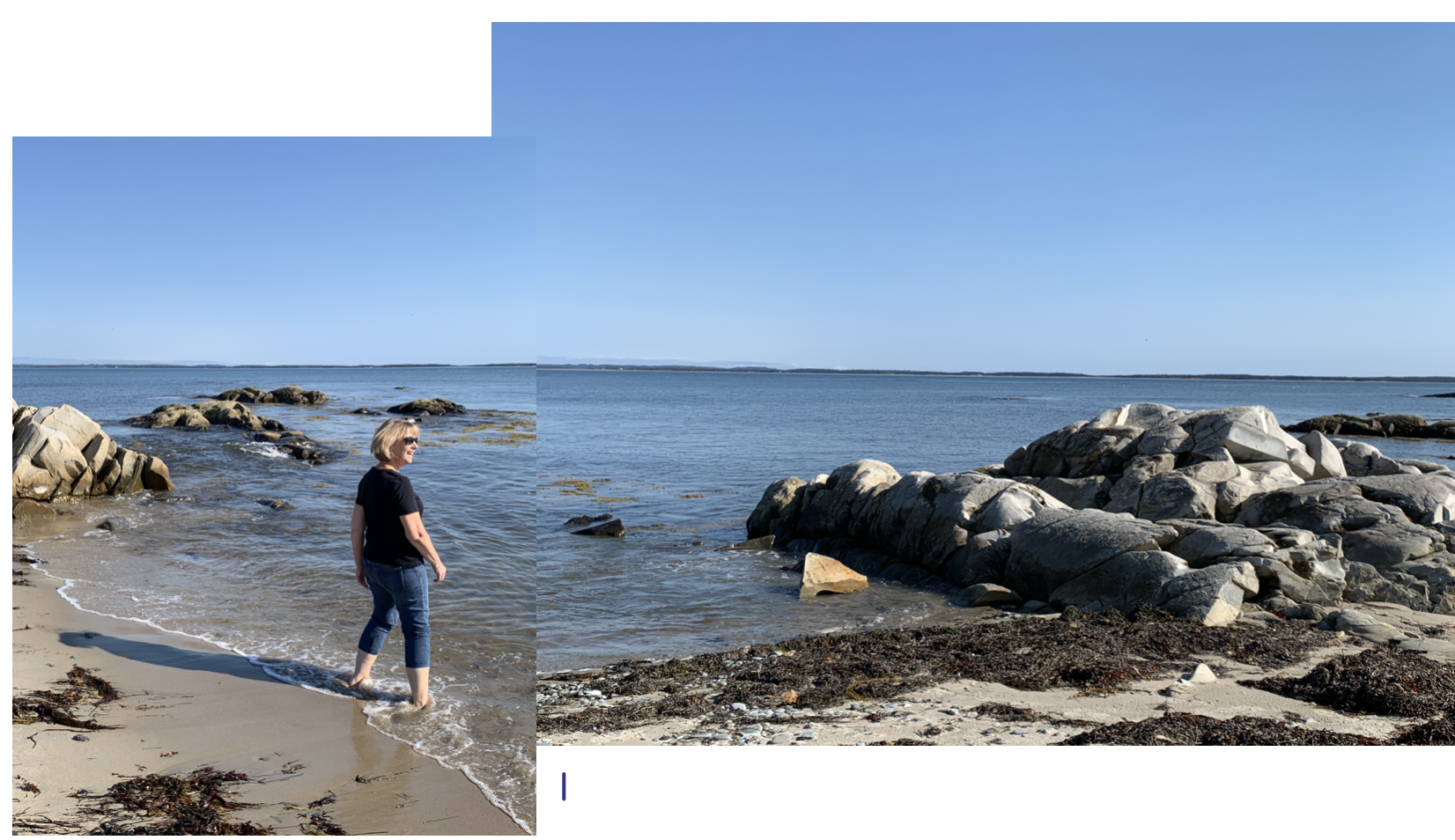
In “Fall Day at Green Bay” I intend cropping the rocks on the right and expanding the water between Deb and the rocks a bit. I want the content of the piece to end up around 15″ x 12″; framing will add to the dimensions.

In “Five Islands Lighthouse Park” I want to focus on the five islands which will mean playing with the perspective somewhat. The positioning of the large red Adirondack chairs with Joy and Dave will be determined by how that whole background shapes up. Again I’m aiming for a 15″ x 12″ pieced image, framing outside of that.

I’m still in the walking around and thinking about these two pieces phase; not quite ready to begin pulling fabric from drawers and boxes. In both projects I am going to have to paint white fabric for the sky. I’ll mix acrylic paint, dilute it, and brush it on white cotton/poly (which takes paint better than 100% cotton). I don’t have any in the house – that’s something I have to pick up in the next week.

There are a couple of potential garments also hovering in the back of my mind – I’m resisting them. I feel a need to get more art on the go.

A Great Idea

This is one that I wish I’d thought of myself! But I didn’t.

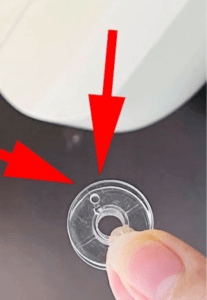
Getting a bobbin started can be tricky – keeping the thread taut when you start winding can be an issue. Here’s a perfect solution to that problem!

Just had to share it.

Note: If your bobbin has a curved top, as my Pfaff bobbins do, be sure to thread through the groove in the flat bottom side, bring the thread through the centre toward the curved top.

Pfaff Bobbin

Turns out there isn’t a “hole” in the bottom of the bobbin! Here’s how I figured out how to do this – thread the bobbin in the normal fashion, then – take your tread from the top to the bottom of the centre hole. Place the bobbin on the bobbin winder, thread coming out of the bottom of the bobbin, trim the thread against the bobbin. Then press the button to make the bobbin thread – hands free! That’s the best part – threading the bobbin is now hands free (the way it is on my Brother Quilter! Yeah!

Sewing/Quilting Tools

I taught a class yesterday at Sew With Vision on “Basic Alterations” – taking clothing in at the waist, under the arms; shortening pant/jeans legs, adjusting straps, etc. I wanted the two gals to understand there’s not a lot you can do to make a RTW (ready to wear) garment bigger; however, you can make adjustments to make something smaller.

For example, my high-belly measurement is much larger than it was ten years ago (related to my age and the meds I take). Not much I can do about dropping the weight from that location. So when I was buying a vest for fall wear, I bought 1XL to fit my belly, which meant it was too big around the hips, and the armholes needed adjusting. I could have done some complex taking apart, but instead, I just took darts in the shoulder seams (and hand stitched the dart to the lining so it laid flat); I did the same at the hips – a dart in the side seam from waist to hem by machine, then hand stitched the dart down. Now the vest fits decently and looks fine.

The one enlargement adjustment I do to make something bigger is to add elastic gussets to the waist of pants when the waist just gets too tight (my hips and thighs have stayed the same size for more than 20 years!). [I’ve previously described how I add elastic gussets to pants: https://jmncreativeendeavours.ca/2018/04/02/elastic-inserts/]

Back to the class – while the gals were working on small adjustments to garments for themselves and their children, it became obvious they had a few tools. Because I wasn’t expecting to do any sewing myself, I’d neglected to bring my sewing kit with me (https://jmncreativeendeavours.ca/2017/12/12/sewing-tools-organizer-finished/). We had to hunt through the shop’s tool collection (of dull very well used tools) to find what we needed. I told the gals I’d make them up a list of necessary sewing tools.

I’ve previously described five essential quilting tools I have at each sewing machine (https://jmncreativeendeavours.ca/2019/01/30/my-5-essential-quilting-tools/).

5 Essential Sewing/Quilting Tools
  • A Seam clipper/ripper
  • Self-threading needles (for embedding quilting thread ends)
  • Sharp 4 1/2″ embroidery scissors
  • Precision 3″ tweezers
  • Frixion Erasable Pen

But I use a lot more tools regularly.

Essential Sewing/Quilting Tools

I’ve laid out my tools, clustering those in the same category.

  • Measuring Tools
    • Rotary Cutting Ruler 6″ x 24″ – a good first measuring cutting tool
    • A measuring tape with both metric and inches on both sides
    • A metal 15″ ruler with both metric and inches
    • A slide ruler with notches for measuring and marking short distances
    • A small plastic ruler for checking short measurements (metric and inches)
  • Cutting Tools (these are going to seem expensive, they are, but expect to pay a lot more than you anticipate to get good sharp tools – I like KAI scissors – they feel good in the hand, they’re sharp and bit less costly than some other good brands)
    • 8″ shears – for cutting out garment patterns (I use a rotary cutter for cutting out patterns but there are curves that sometimes call out for shears)
    • 4 1/2″ embroidery scissors – I use these for snipping and cutting small pieces
    • 3 1/2″ precision embroidery scissors for removing stitches and close cutting
    • A sharp seam ripper (I change them as soon as they feel dull; I buy them in quantity to have plenty on hand and within easy reach)
    • A Seam Ripper Clipper (in photo above)
    • A 45mm rotary cutter with a supply of spare blades always on hand (I order in bulk online)
    • A Self-healing Cutting Mat – I recommend starting with a 24″ x 36″ mat (I have a 3′ x 6′ mat that covers my entire cutting table – expensive but useful)
    • Rotary Cutting Rulers and Templates – start with a 6″ x 24″ ruler
    • A Shape Cut Template/Ruler – this makes cutting strips of fabric very easy
Shape Cut Ruler
  • Marking Tools
    • Heat Erasable marking pens (Frixion are the most common, but I’ve bought acceptable ones in sets online)
    • Clover Chaco Liner – makes a fine chalk line (can purchase refills)
    • Chakoner – a heart-shaped chalk line drawing tool
    • A Fons and Porter or Bohin mechanical pencil with white lead (I have other colours, too, but I use the Frixion pens for marking on light fabrics and the chalk liners or pencil for marking on dark)
    • Post it notes, small and larger – I use them to identify cut fabric for both sewing and quilting
    • Masking Tape – I mark fronts and backs of garment pieces, for example, so I know what is what
    • Fine Sharpie Permanent Marker – another tool I keep at each sewing machine
    • A .7mm lead mechanical pencil (with .7mm HB lead) – perfect for pattern drafting on paper
    • Medical Exam Table Paper 18″x125′ ideal for tracing garment pattern pieces
  • Bobbins and Bobbin Holder
    • A supply of empty bobbins for each different sewing machine – each colour thread needs its own bobbin! You always want an empty bobbin around and each machine may take a different size bobbin (even from the same company)
    • A bobbin holder or box to keep bobbins in order and easily accessible and storable
  • Thread – there’s no point in sewing with cheap thread! Your machine won’t like it and the garment or quilt won’t like it either! I suggest
    • Aurifil 50wt cotton thread (variegated in two shades of grey for quilt piecing) – this is a lovely, strong, low lint thread, although expensive
    • Wonderful 50 weight cotton thread – a bit heavier than Aurifil but I use it for quilting a lot
    • Gutterman polyester thread (50wt)
    • Mettler polyester thread (50wt)
    • Coats and Clark polyester thread (50wt) – this is my least favourite but do use it to match with fabric when I have to
  • Other Useful Tools
    • A brush for cleaning lint from the sewing machine
    • A “HumpJumper/Seam Jumper” multi-purpose tool (the tool I have for lifting the presser foot for thick fabric also has a small hole for inserting a new machine needle – handy
    • A fine crochet hook for pulling threads hidden beneath quilt top or bringing pulled threads to the back of a knit garment
    • A Snag Repair Tool (Snag Nab-it) to bring pulled thread to back of knit fabric
    • A Large Safety Pin – for pulling elastic or ribbon through channels in garment or other sewing construction
    • A roller of sticky tape – great for picking up threads on your ironing board or fabric
    • Fray Check fabric glue
    • Glass Head straight pins (I like 1 1/16″ length – I find shorter ones harder to handle).You want glass heads because the iron won’t melt them! You want bead heads because they’re much easier to pick up
    • 1″ Curved Safety Pins for holding a quilt sandwich together (these small pins are a good size – the larger ones are awkward to sew around when quilting)
    • Washers – the largest you can find in the hardware store – great for holding paper patterns on fabric – much better than pinning – you need at least 6 (8 is better to have on hand; they’re inexpensive)
    • In addition to the feet that come with your machine, you will want extra feet for different jobs – you can find sets online that come with both a low-shank and high-shank adaptors (the set I have from Love/Sew works on both my old Singer Featherweight and my Brother Quilter)
    • NEEDLES – you need lots of spare needles – you need a fresh needle every time you start a new project (when I’m quilting, I change needles every 30,000-40,000 stitches – in other words, I change my needle two to three times during the quilting process). I buy needles in bulk – in boxes of 100 – for the needles I use most: Universal 80, Embroidery 75, Quilting 75. I also use Top-Stitching 90, and various Stretch/Ballpoint needles, Twin Needle 75 4mm & 6mm, also it’s useful to have Denim /Jeans needles 90 for working with denim. Schmetz and Inspira (as well as Klasse) are all sturdy needles which come in many sizes and for all fabric types [https://www.schmetzneedles.com/pages/sewing-machine-needle-chart?srsltid=AfmBOopLOpsA-oGFmbcXGBllCANtjbRxzSIvBejuXQKS0Bgcuf11qDSv]
      Just remember: dull needles can ruin your project, and there’s nothing worse than breaking a needle and not having a new needle on hand
    • A pin holder with a magnetic mouth used for storing discarded needles and bent pins – you can also use a large pill container with a lid, even a mason jar – something to collect used sharps
    • A magnetic pin holder
Magnetic Pin Holder
Sewing Machine Needles
  • Ironing Board and Iron – if possible keep your ironing board always set up – makes it much easier to just get a project going. You want a good pad and cover – I have a felted wool padding and I use a heavy twill unbleached cotton to make my table cover – I make a new cover every two years or so
  • A sewing table at the right height for your body (I had mine made for me – lower than a standard table height because I’m short and my upper arm measurement is somewhat long) – a dedicated sewing table means you can keep your machine set up and ready to go.
  • An adjustable stool – I have what’s called a Saddle Seat that I can adjust to the perfect height to keep my shoulders down and relaxed when I’m sewing (I actually have two of them which I move around as I need them). Even though they don’t have a back support, the seat forces you to sit with your knees below your hips which puts the lower back in a good position for extended working (although if you’re quilting or making a garment from scratch, you’re pressing as you go which gets you standing and moving to and from the ironing board a lot).
  • A Cutting Table at a comfortable working height – I created mine from a teak dining room table on a double set of wood bed lifts – makes it the perfect height for me
My Sewing Studio
  • Shelves and drawers and containers for storing fabric, notions, zippers, thread, patterns, tools
  • Trash cans – one at each sewing station
  • Good lighting

Socks And A Hat

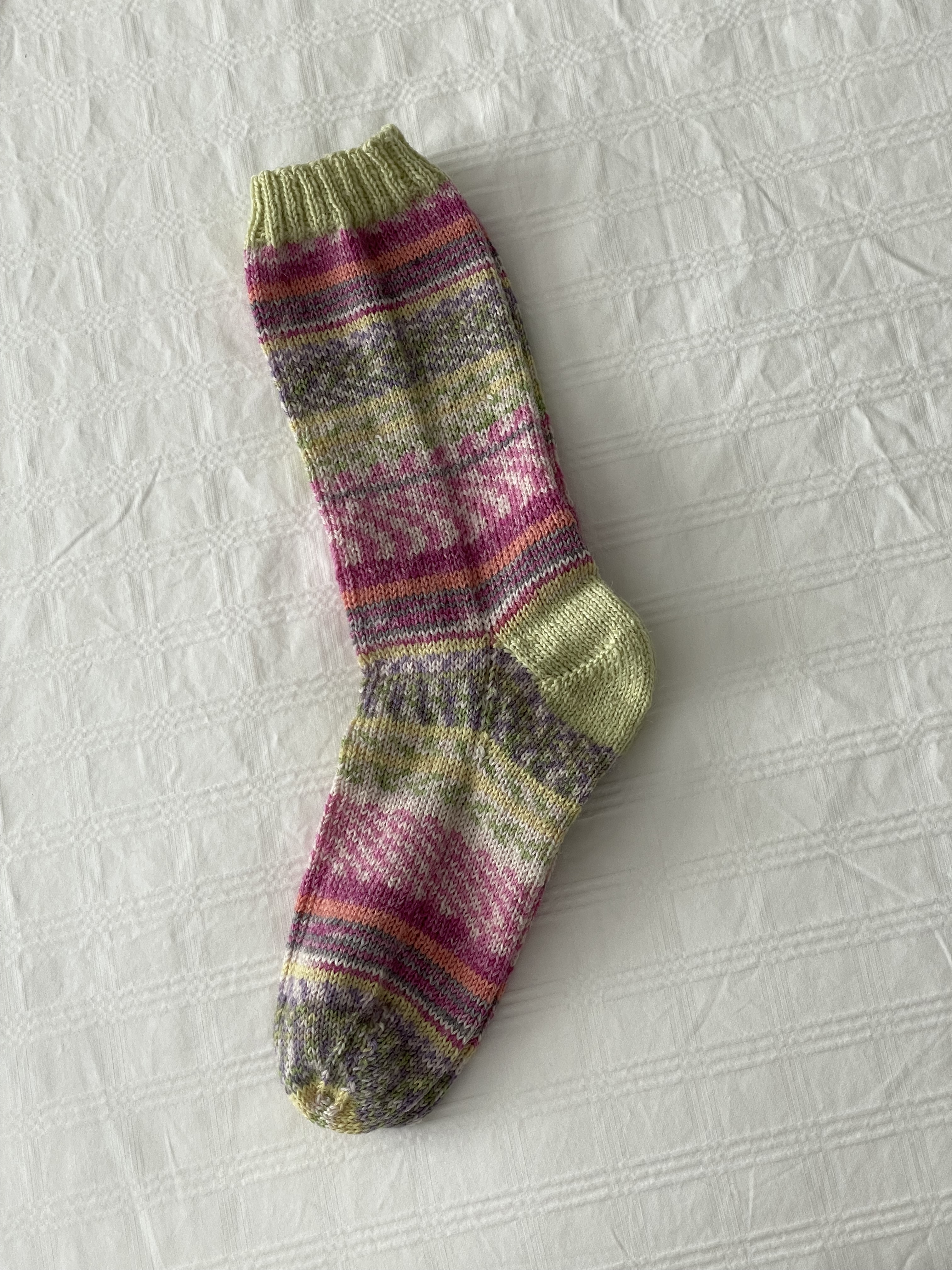
I picked up this ball of yarn at Fabricville. I don’t usually buy yarn there because they’ve mainly sold Kroy and I find it too heavy to knit comfortably and I don’t like the weight of the socks. However, a couple of months ago I noticed they’d stocked a much nicer sock yarn, lighter, softer, so I bought this ball.

The socks turned out nicely. Somebody will enjoy wearing them!

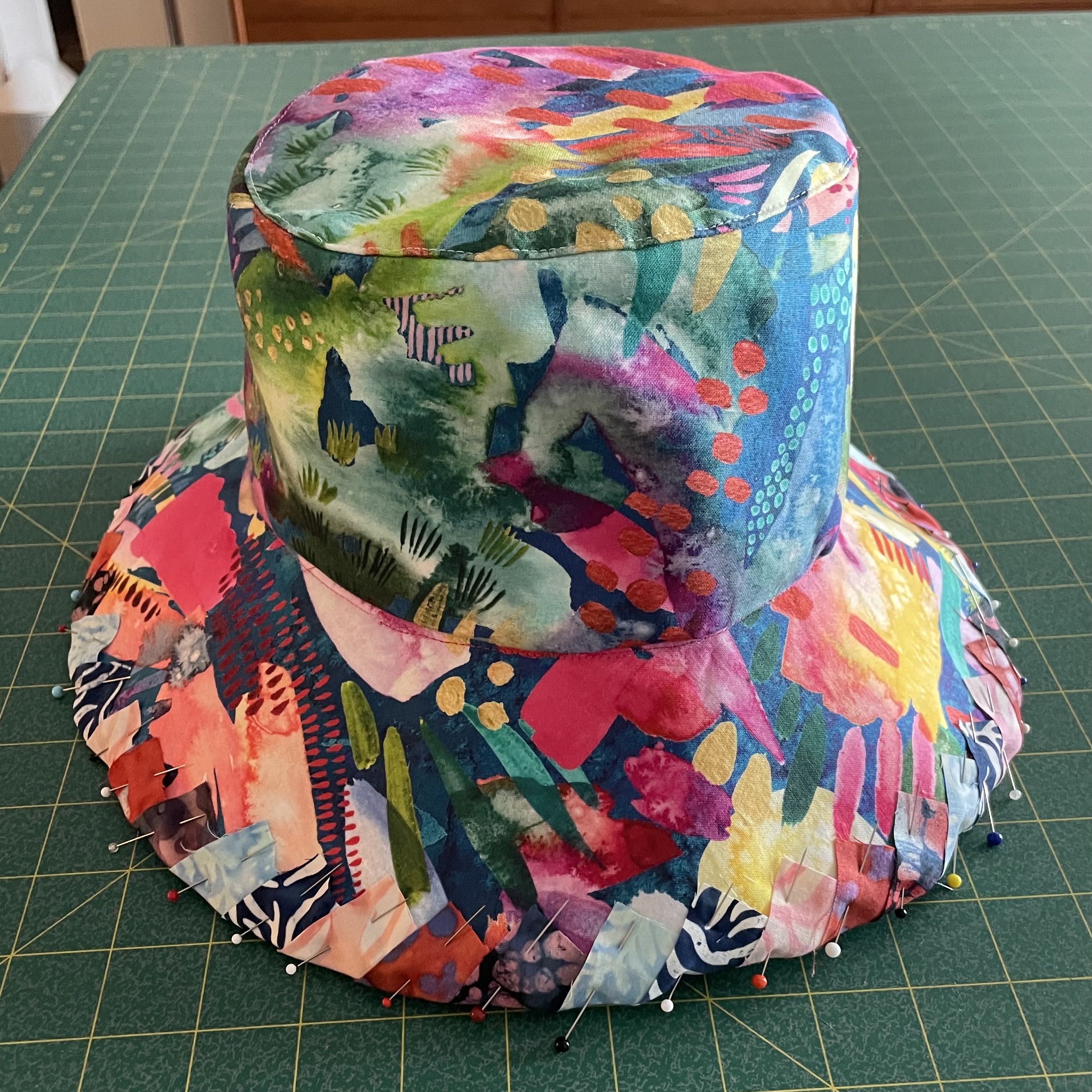
Then this past week I decided to make a new sunhat for myself. My friend Deb was giving a class on the Closet Core Sunhat. It’s a free pattern with instructions and a tutorial. I traced a copy of her size 22 hat, bought some fabric, then got to work. Deb had done some prep work on the pattern – reducing the 5/8″ seam allowance to 3/8″ which made sewing the seams much easier (next time I make it, I’ll reduce the seams to 1/4″).

This isn’t my first sunhat. I wanted a reversible hat – one that I could wear on either side. I didn’t follow the instructions. What I did, instead, was to make an outside hat, and an inside hat, then fit them together with the open edge the edge of the brim. I thought about finishing that raw edge with a binding, but instead used a bunch of small squares I had leftover from some previous sunhats (the colours blended/contrasted with the colours in the fabrics I used). I did some heavy free-motion sewing around the edge, securing the squares, using variegated Sulky thread both top and bottom. To finish the hat, I sewed a spiral, using my presser foot as guide, starting from where the brim attaches to the crown to meet the trim at the brim edge.

What makes this hat work as well as it does is the interfacing! I interfaced both the inside and outside hats with a stiff interfacing I normally use for the front placket of a shirt. That was a bit of overkill – I probably could have just done the outside hat and not the inside hat (that’s what I’ll do when I make the hat for my niece – at least until I see whether it makes the crown stiff enough or not). I also included a heavyweight fusible interfacing in the brim which has made it very stiff which I’m most happy with.

I also came across a very nice wide brimmed summer hat from Spruce Crafts. It comes in S/M/L sizes with separate pattern pieces for each size.

Then there’s my original instructions for drafting your own sunhat pattern.