Original URL: http://wkdesigner.wordpress.com/2008/08/18/summer-wide-brimmed-hat/

You need:
- tracing paper
- scotch tape
- tape measure
- compass
- approx. 1 yd. of Pellon ® fleece interfacing, 45″ wide
I used 1/2 m. fusible drapery stiffening – 60″+ wide - approx. 1 1/2 yds. of bottom-weight or upholstery fashion fabric, 54″- 60″ wide
I used 1/2 m. of two different batik fabrics (batik is a bit stiff) each was 44″ wide - approx. 1/2 yd. of lining fabric, 45″ wide
I didn’t use any lining fabric - approx. 3/4 yd. of grosgrain ribbon, 2″ wide
I didn’t use any grosgrain ribbon – instead, I made the hat reversible - coordinating thread
MEASUREMENTS
Begin by measuring the circumference of your head. Wrap the tape measure around the back of the head, over the ears, and high up on the forehead. For most people, this will be approximately 22 ½ inches.
Add 1” (I used ¾”) to your head measurement. This is the head fitting measurement (This number may vary due to hairstyles as well. Most people will pull back the hair or put it in an up-do to wear the hat properly.)
My head measurement was 21.75″
Next, you need to determine the radius (R) you will use to create a circle.
Use the formula, C = 2 ? R, where ? = 3.14
Eg. 23.5 = 2 x 3.14 x R
R = 23.5 divided by 6.28
R = 3.75
For a head fitting measurement of 23 ½” (1/4”), you need a radius of 3 ¾”.
I used a radius of 3.5″
| Head Measurement | Head Fitting Measurement Circumference: Head + ¾” | Radius | Upper Crown Curve Measurement | Radius for Crown Top | |
| Example | 22.5” | 23.5 | 3.75 | ||
| My measurements | 21.75 | 22.5 | 3.58 (I used 3.5 ) | 19” | 3.0 + ¼” |
| Your measurements |
PATTERN
CROWN
CROWN SIDE

- Draw a rectangle equal to the head fitting measurement X the radius amount.
- Divide the rectangle into 8 equal parts.
- Slash each line from the top of the rectangle to almost the bottom edge.
- Overlap each section left of center by ½” at the top to nil at the bottom and tape down.
- Repeat for each section right of center.
- Trace this new shape onto a new sheet of paper and blend the curved topline smooth.
- Add ½” (¼” )seam allowance around the perimeter. Label the 2 short ends, centerback (CB) and the centerline, centerfront (CF). I added just ¼” around the perimeter for the seam allowance
- Draw a grainline 45 degrees to the center line. This is the side section of the crown.
CROWN TOP
- Measure the new curved seam that you have created. Record this measurement.
If your Head Fitting Measurement was 23, then this curved top for the crown side will
be 7 X 3 ½” less – or 19.5”
This measurement is crucial for determining the radius of the crown top.
Record this Upper Crown Curve Measurement in the chart on the first page. - Using the formula again, determine R for the top of the crown.
Take the measurement you determined above and divide by 6.28 to calculate the radius for the crown top. Record this Crown Top Radius in the chart on the first page. - If you measure the circumference of the top section, it should equal the curved seam measurement of the side section.
(Adjustment Tip: Increasing or decreasing the circle by 1/8” all around will change the circumference by approximately ½” (1/4”)).
- Use a compass and draw a circle using the amount for the Crown Top Radius.
- DON’T DO THIS STEP.
Divide the circle into quarters. At the top and bottom of the circle extend out ½” (1/4”). At the sides of the circle, reduce inwards by ½” (1/4”). Join these points with a smooth arc blending into each point to create an oval. Re-check the circumference of the oval. It should still equal that of the new curved seam on the side section.
I tried the oval top for the crown and didn’t like how it looked – I used the circle for the top which looked better. - Add ½” (¼”) seam allowance to the circumference of the Crown Top circle and draw a straight grain line from CF to CB. This is the crown top.
BRIM

- Fold a large piece of paper in half, then half again; open out flat. (This sheet of paper should be at least 21” X 21” – tape enough paper together to end up with a sheet that is this size. )
- Draw the 2 intersecting lines. Place a point in the center of the intersection.
- Using a compass, draw a circle with a radius (r) based on the Head Fitting Measurement plus 1”. Remember we only used ¾” – the measurement you want is the “Head Fitting Measurement – circumference” measurement you put in the chart on the first page
- From the same point, draw a second circle with a radius (r) plus 5 ½”. I just added 5 1/2” to the value of (r) – a 5 1/2” brim is plenty wide!
- This is the brim width. (You may increase the width of the outer edge if you desire).
- The inner circle must equal the Head Fitting Measurement. Starting at the top of the circle, measure half the head measurement to the left of center and repeat on the right of center. Mark a point at each interval. Square out from this point to the outer edges. Label these edges, CB. This is the interfacing pattern. (There is NO seam allowance here)
- Trace this brim shape onto a new sheet of paper. Add ½” (¼”) seam allowance all around the brim pattern. Draw a straight grainline parallel to the centerline. This is the upper and lower brim patterns.
At this point I stitched the interfacing using a zig-zag stitch and tried it on – I found the inner circle a bit snug so I cut away 1/8″ all around the inner circle (and removed the same amount from the two brim fabric pieces (rather than redrafting the whole pattern. I was able to ease in the crown just fine.
My seam allowances are all 1/4″ – when I was drafting the pieces I allowed for 1/4″ seam allowances. I use a 1/4″ quilting foot to sew the seams. The 1/4″ is more than enough seam width and then you don’t have to trim or snip anything.
I added markings to each piece to remind me to snip the CF, CB, and half way along the two sides – in other words, I marked the 1/4 markings so that I could match up the pieces when I assembled the inner and outer hats.
CUTTING
- Cut the brim interfacing 2X I’ve tried it with only interfacing one side of the brim but it’s better if both sides are interfaced. DO THIS FIRST – Butt the two CB edges together and zigzag stitch it together. Try this piece on to check for fit. (Adjustment Tip: Increasing or decreasing the circle by 1/8” all around will change the circumference by approximately ½” (1/4”)). If you make adjustments to the fit of this piece make the necessary adjustments to the fabric pieces for the brim.
- Cut the brim 2X (on straight grain)
- Cut the crown side 1X; lining 1X (on bias grain) I cut two – one from each fabric
- Cut the crown top 1X; lining 1X (on straight grain) I cut two – one from each fabric
- Cut the crown side interface 1X (on bias grain) Because the batik is a bit stiff I didn’t use any interfacing here
- Cut 1 strip of self bias 2” wide; length to equal outer edge of brim + 2” (on bias grain) This is for the bias binding at the brim edge. You can use this to bind the brim edge or you can cut ~ 70 squares from your hat and lining fabrics 1 ½” ¼”X 1 ½” ¼”to overlap along the brim edge and free motion stitch them in place – see photos of my hats below.
ASSEMBLY
- On the brim interface piece, butt the two CB edges together and zigzag stitch it together. Try this piece on to check for fit. (Adjustment Tip: Increasing or decreasing the circle by 1/8” all around will change the circumference by approximately ½” (1/4”)). If you make adjustments to the fit of this piece make the necessary adjustments to the fabric pieces for the brim.
- On each brim piece, pin and baste CB seam with right side together. Stitch seam using a ½” (¼”) seam allowance and press open.
- Sandwich the interfacing between the two brim pieces with face sides up, lining up the CB seams. Baste together.
- Do rows of topstitching parallel to the outer edge, ½” (¼”) apart, starting from the inner edge. (I use the width of the presser foot as a spacer.) The more stitching you put, the stiffer the brim.
- Bind the outer edge of the brim with the bias cut strip of self-fabric, beginning from the CB seam, folding in ½” ¼”to bind, and then turning under the end to encase the starting point. Press edge flat.
- Baste the side interface to the wrong side of the side section.
- With right sides together, pin and baste the CB seam. Stitch seam using a ½” (¼”) seam allowance and press open. Grade seam allowances.
- Divide top edge of crown side and the crown top into quarters. Match up these points, pin and basting with right sides together. Machine stitch the side section to the top of the crown, using a ½” (¼”) seam allowance. Trim and grade the upper seam allowance and interfacing only.
- Repeat the same procedure for the hat lining.
- With wrong sides together, place lining into crown, aligning with CB seam and baste seam allowances together. Turn right side out.
- Now, insert crown into center hole of brim. Match up CB seams and pin and baste crown to brim. Machine stitch using a ½” (¼”) seam allowance. (Clip seam allowance if there is any buckling).
- Sew in grosgrain ribbon as a “sweatband”. This should equal the head fitting measurement less the inch. Lay the ribbon on top of the seam allowance and edge stitch along the ribbon edge. Overlap at CB. Trim the seam allowance with pinking shears. Turn the ribbon up into the crown to conceal the raw edge of the seam allowance and tack to CB seam with hand stitching. I didn’t do this because my hat was reversible.

Here are my assembly instructions for making a wide brim reversible hat:
- Join CB seam on brim interfacing using a zig-zag stitch to abut the edges. Try it on for fit.
- Sew brim CB seam 1/4″ seam allowance, press open. Apply the interfacing to the wrong side of the brim fabric.
- Sew CB seam on crown side, matching CF, CB and the two side markings; 1/4″ seam allowance. Press open.
- Sew brim and crown side together matching CF, CB and the two side markings; 1/4″ seam allowance. Press seam toward crown side.
- Sew crown side and crown top together matching CF, CB and the two side markings; ¼” seam allowance. Press seam toward crown side.
- Repeat steps 2-5 to construct the “inner hat”.
- Turn inner and outer hats inside out. Place wrong sides of the crown tops together, align the back seams. Stitch the two crown tops together within the seam allowance.
- Draw the outer hat crown down over inner crown. Push inner brim to inside of crown, then stitch brim/crown seams together within the seam allowance.
- Lay inner and outer brim together (right sides out), press. Stitch concentric circles starting presser foot width from the crown/brim seam and working toward the brim edge. OR free-motion sew the two brims together.
- You can use bias binding to trim the brim edge OR cut seventy 1 1 /2″ squares (half from each fabric). Alternating fabrics, fold each square in half along the diagonal, place at the edge of the brim, pin in place. Overlap the squares by about half the diagonal. Carefully stitch back and forth over the squares to hold them in place, remove pins and stitch several more times both sides of the brim to securely attach the squares to the brim.
Rolled-brim Summer Hat

The Rolled-brim Summer hat is done the same way as the wide-brim hat.
The measurements for the crown are identical.
Follow the instructions for drafting the crown side and crown top given above for the wide-brim hat.
The difference is with the brim.
BRIM PATTERN
- Fold a large piece of paper in half, then half again; open out flat.
- Draw the 2 intersecting lines. Place a point in the center of the intersection.
- Using a compass, draw a circle with a radius of 7 ¾”
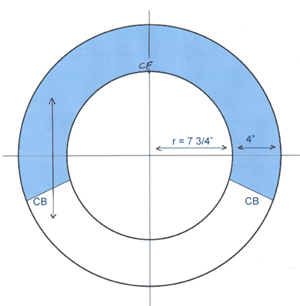
Here is where the difference comes in: to get the rolled brim you need a reduced segment of a larger circle but you still need an inner measurement that matches the head fitting measurement.
- With a bit of trial and error I found a working radius to make the rolled brim is 7 ¾”
- From the same point, draw a second circle with a radius (r). I just added 4 1/4” to the value of (r) –
a 4 1/4” brim is plenty wide! - This is the brim width. (You may increase the width of the outer edge if you desire).
I simply added 4 1/4” to the circumference of the first circle I drew (with the 7 ¾” radius) to obtain the brim.
- The following steps are the same as for the wide-brim.
- The inner circle must equal the Head Fitting Measurement. Starting at the top of the circle, measure half the head measurement to the left of center and repeat on the right of center. Mark a point at each interval. Square out from this point to the outer edges. Label these edges, CB. This is the interfacing pattern.
- Trace this brim shape onto a new sheet of paper. Add ½” (¼”) seam allowance all around the brim pattern. Draw a straight grain line parallel to the centerline. This is the upper and lower brim patterns.
CUTTING & ASSEMBLY
The cutting and assembly of the rolled-brim hat is the same as the construction for the wide-brim hat above.
Here is a link to a printable version of the instructions for making the hat.
 jmn
jmn 