Sweet Kugel – 2016

Sweet Kugel

Sweet Kugel

That time of year again.Two days before Christmas – making the sweet kugel for Christmas dinner at Marlene’s. Can’t make just one, my sister Donna loves this kugel so one for her (for her freezer); and one for a friend also in time for Christmas dinner.

I described in detail last year how I make it – Sweet Kugel – so I won’t go into the details again. If you want to learn how it’s done click on the link.

They’ve been in the oven about 20 minutes and already the apartment is smelling wonderful!

More Variations On A Theme

img_8214

I was curious to see if I could apply the half-zipper technique to my standard zippered bag construction – that meant figuring out a way to have the seams concealed between outer layer and lining. Turns out to be quite easy.

Instead of cutting two sides 6″ x 8″ I cut one piece 6″ x 16″ – I sewed the zipper to one long edge, added lining. Here’s the crucial difference – I didn’t top stitch the zipper, instead I steam pressed the zipper making sure both lining and outside were well pressed away from zipper edge. That allowed me to add the slide, fold the bag in half, separate the lining from the outside, sew the remaining side seam (from lining to outside with little tab inserted near the zipper) making sure zipper protruded on the lining side as I sewed. Next I made sure to open the zipper. Finally, I stitched the outside bottom, turned bag right side out pulling lining beyond the zipper, folded lining bottom seam allowance under and top stitched the lining bottom, pushed lining back inside bag, pressed.

I had a zippered bag with a “loop” zipper, and concealed seams.

I made six from four fat quarters which I had just bought so now I know exactly what my materials cost:

The fabric to make six 6″ x 8″ bags cost me $12; batting – I used large pieces leftover from a quilt (batting costs $26/m so say I used 1/16 m ) – $1.65, thread (can’t calculate), zipper (I buy zipper tape and slides from The Zipper Lady @ $36 for six yards (that includes exchange as well as shipping and handling), $10 for 40 slides (25¢/slide) – I get two bags from 1/2 yard so zipper costs me  $10.50/six bags (a bit less than if I’d bought zippers individually at the fabric store). Total for the materials: $25.65 for six bags = $4.27/bag. Labour: It took me 2 hr to make six bags – time per bag, ~20 min (that’s pressing the fabric, cutting fabric and zippers, sewing it all together, pressing again). At $20/h labour works out to $6.65/bag. Total costs: $4.27 + $6.65 = $10.92. Profit – 20% of costs = $2.19. Total cost of one 6″ x 8″ bag: $13.12!

People tell me I should sell them at the craft market – I’d be selling the bags at a loss if I charged $10/bag!

So even a small zippered bag is a gift of love.

That’s it for bag-making for now!

Variations On A Theme

img_8212

Experiments

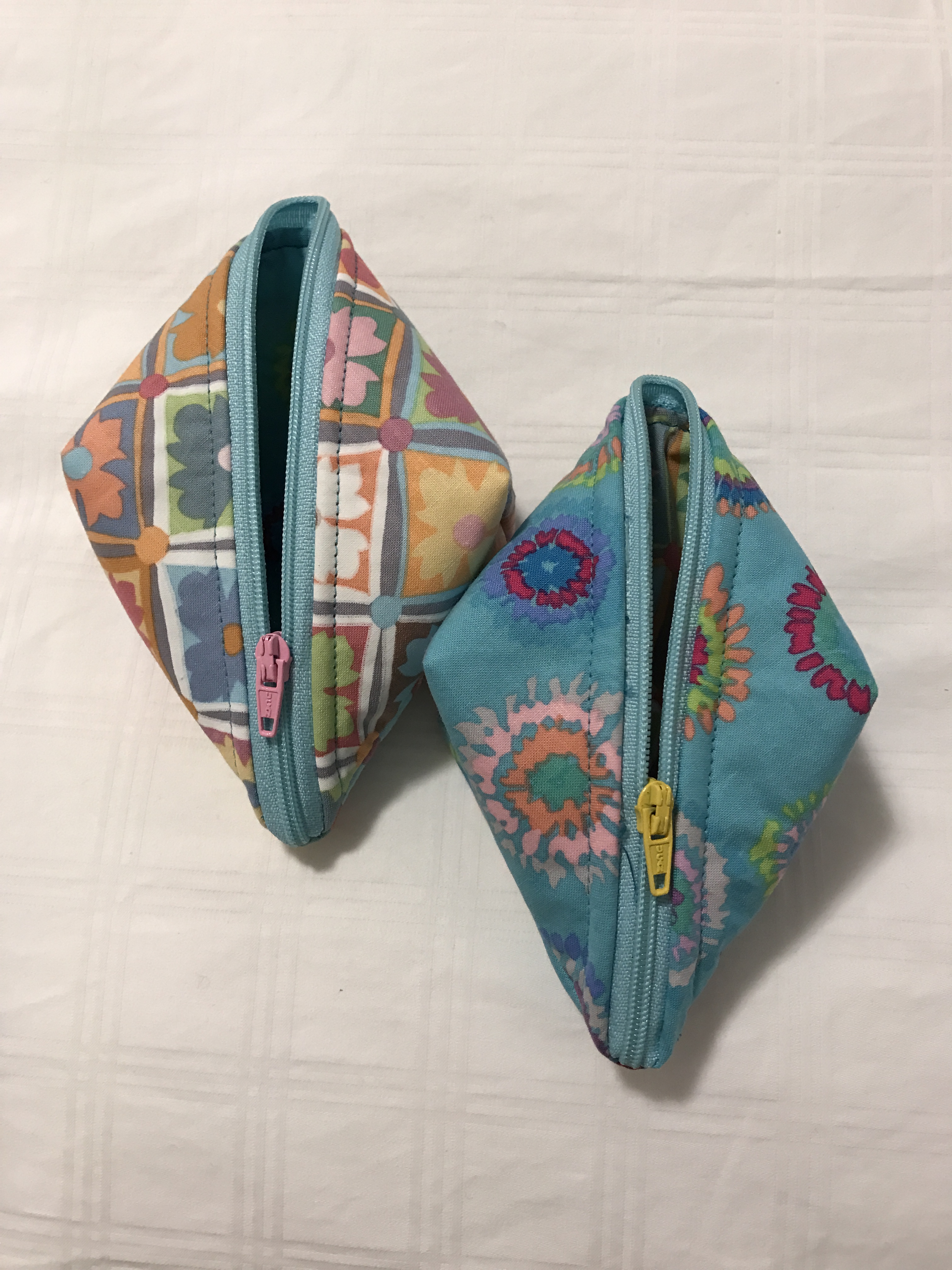
It’s not a big stretch from a “sweetpea pod” to a “pyramid pod” – the pyramid is based on a similar idea – instead of sewing the two side seams in the same direction as I would for a flat bag, you sew one side seam (closed zipper end) with the zipper in the middle and the second (the open end) with the zipper at one end. I made this pyramid pod (on the left) with a double zipper tape but I still have to experiment to figure out how to construct it with a single zipper tape (the way I did the sweetpea pods).

The two bags on the right were sewn with a single zipper tape. To use this technique (with the zipper top stitched) I had to finished the seams within the bag, rather than concealed by the lining. However, if I don’t top stitch the zipper, it should be possible to make the bag with concealed seams – have to try that next.

Pods

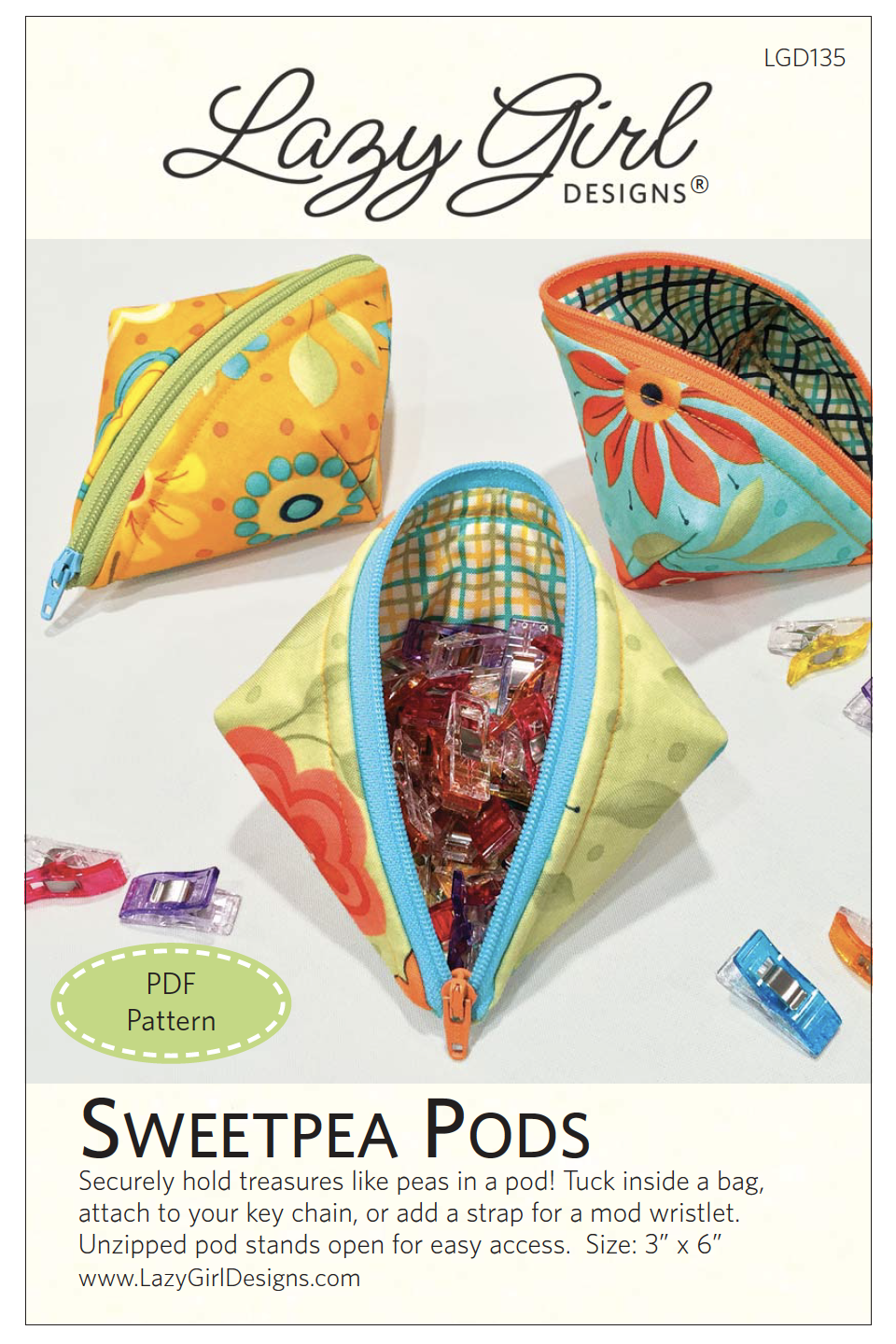
Very early this morning (couldn’t get back to sleep), I was looking online for ideas for a Christmas gift for a fourteen year old girl. Last year I knit her a scarf, year before I made a small shoulder bag. I needed something for Christmas day to take to dinner at her grandmother’s house. I came across this picture of Lazy Girl Designs “Sweetpea Pods.” I tracked it down to a Craftsy pattern:

pod

What caught my attention was the way the zipper was attached – a longish zipper is separated and one half is applied to the zipper edge and the slide is then attached to either end to create a zipper that closes from half of a zipper tape. Clever idea!

Given I didn’t have time to puzzle out how the pods were constructed, I did something I rarely do – I actually bought the pattern at 7:00 am this morning, downloaded it, then proceeded to try making one.

My first attempt was a disaster – in large part because I didn’t fuse the outer fabric to the batting – each time I tried sewing the side seams I kept missing the outer fabric on one side. My pod ended up lop sided and quite a bit smaller than intended.

I persevered. My second pod at least looked somewhat like the pods in the pattern picture, but I still needed to refine my sewing.

Pods 3 & 4, however, turned out just fine!

img_8210

Tomorrow I have to buy some velvet ribbon and hair elastics to put in the pods so I can wrap them as a gift.

This zipper idea is one I need to try on one of my usual zippered bags – it could be a neat way of zipping them up!

Boring Socks II

Adding interest

I bought four balls of reasonably boring variegated yarn during the summer. The challenge has been to come up with ideas to liven up the color contrasts. In this case, what works is the single row of turquoise near the top of the sock and again in the instep. The rows of burgundy and rust add very little contrast. 

So the next pair in shades of blues and greys will want something that pops out – need to think about a bright green or a red.

Sleeping On It…

img_8207

Partially quilted light areas

Never ceases to amaze me how my brain keeps working while I sleep and when I wake I have a solution to the problem I walked away from (temporarily). I trust my sleeping brain implicitly – it always comes through; there’s always a solution the next day. That was how I worked when I was writing – stop when I got to a place where I wasn’t sure how to proceed – next day, ideas were just there! Always! Same with the quilting – walk away from a decision point, come back next day and there’s a way to work things out.

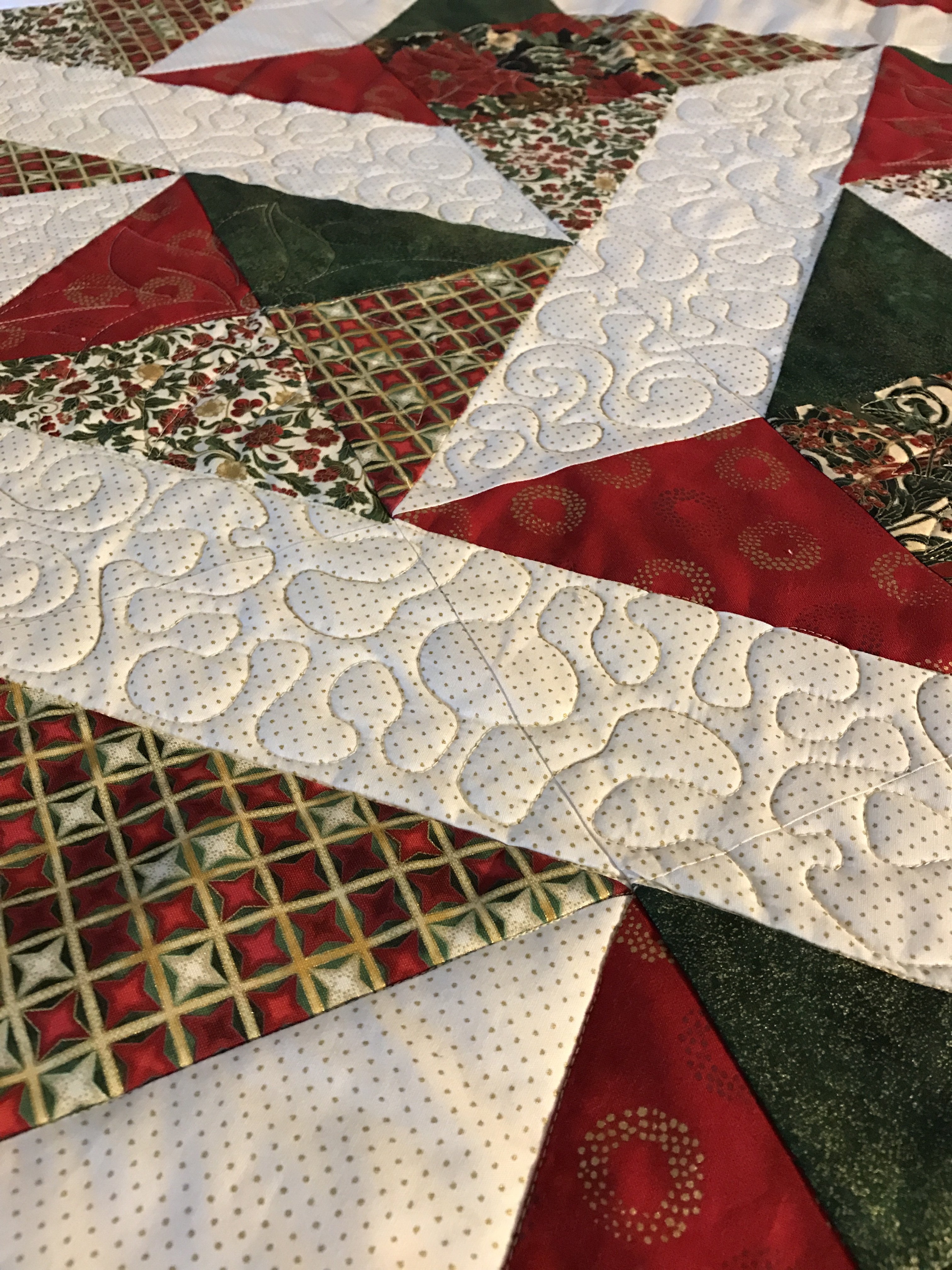
Last night the problem I needed to solve was how to quilt the light diagonal spaces in the quilt because the fabric expanse was too big (4″ x 20″) to lay flat – I needed to fill the space with something. I thought about just straight line quilting but that seemed too boring. I woke this morning thinking about stippling and knew how to set that up. I traced the light diagonal shape onto paper, sketched in some stippling, scanned the drawing, opened the image in Photoshop and scaled it to the right size, saved the image, imported it as background into my TruEmbroidery Create software and created a design based on my sketch (had to do some adjusting to balance the fill). I did a test run to see  how the stippling worked out – it was perfect! Just the right size for the space.

So far, I’ve quilted in eight of the spaces – I have four large ones, four light triangles and eight smaller diagonal pieces to go – that’s three different embroideries, in all, to fill all the different shaped light areas. I’ll probably work at this some more this afternoon, and it will still take at least another day, if not two, to complete the fill work.

Cost of table topper?

Overhead: $0 – I won’t cost the electricity to run the machines, the iron, the lighting in the studio, rent for the studio space.

Supplies: $100 – the backing fabric alone cost me $40 (cotton fabric these days is ~ $20/m) – then there’s the four half metres of red/green printed fabrics, plus the metre of dotted cream fabric – so $100 is an estimate, my materials may have cost a bit more and I’m not counting in thread or machine needles.

Batting: $30 – batting is $26/m plus tax – the cotton needle punched batting I buy is 90″ wide so I needed a metre.

Labour: $20/hr – I’m a skilled artisan, my time is worth more than minimum wage! My education consulting hourly rate used to be anywhere from $100 – $200/hr, my web design hourly rate is $50/hr. I should be charging the same kind of rate for the sewing/quilting but let’s go with $20.

I will have put in at least 15 hours (probably more over 7-8 days) to make this Christmas table topper so labour = $300.

Total cost for the topper were I selling it: $430.

However, the topper is a gift for a long-time friend; it’s a labour of love.

Christmas Table Topper

img_8206

Table Topper

I’ve worked on this project all day – started quite early piecing all the small blocks together. Then I discovered I hadn’t bought enough backing fabric so I had to go out (just as the storm was starting) to pick up 2.1 m of backing fabric to be able to cover the length (81″) in one piece.

I’ve done about half of the stitching in the ditch. I got bored, so I set up an embroidery design to quilt the eight small squares and the “diamonds” in the centre. That’s now done. I’ve stitched around the outer edge 2″ from the edge to establish a border. I chose not to bind the project, instead, again I did a pillow case finish with the back.

Because the edges of all the blocks are cut on the bias, I’m having trouble getting every section of the topper to lay flat – it’s most obvious in the light diagonal sections – the way to solve that, of course, is to embroider/quilt each section and I may actually do that tomorrow. It isn’t quite as simple as it sounds because each of the long light diagonals is 17″ – I don’t have a hoop large enough to do that. so each of those sections would have to be done as two embroideries. Hooping each of those areas, however, would stretch the fabric flat and the stitching would hold the fullness in place so the topper would look flatter. I’m going to sleep on it!

Finished dimensions: 35″ x 81″ (to fit a 34″ x 80″ table with both extensions open).

Christmas Table Runner

Christmas Table Runner

Christmas Table Runner

I used the leftover fabric from the table topper to make this runner for another friend. It should look nice on her dining room table. It’s constructed on the diagonal – that’s how it’s possible to have the central “diamonds” overlap the triangles on the sides (with the addition of a narrow strip attached to the light strips to create the illusion of  overlap).

Took a bit of fiddling to piece the top and I made some mistakes that I took apart and redid – which is why the two mid-side triangles are a different fabric! (They were meant to be the same as the other red/green fabric). In the end, however it all worked out with the fabric I had on hand.

I chose not to bind the runner, instead attached the back using a “pillow case turn” – I just didn’t have enough of any one of the prints to do a complete binding and the point was to complete the runner without having to buy more fabric and, besides, I like the neatness of the finished edge – nothing to distract from the basic elements.

img_4152

Blocks stacked, ready to chain stitch

Now back to the table topper – the pieces are all lined up on my sewing table ready to be chain stitched and the top assembled. It’ll take a couple of hours and it will be done, too.

Christmas Table Topper

img_6885

Christmas Table Topper – in progress

Zippered bags finished, I’m back at work on a Christmas Table Topper for a friend. Her table is 34″ x 80″ extended – with my half-square triangles finished size = 5 3/4″ I’ll finish at 35″ x 80 1.2″ which will work on her table.

So back to half-square triangles – in this instance I have four strong printed fabrics with a light background. I wanted to try a truncated “Starburst” but the layout looked like nothing with my finished dimensions so I’ve opted for “flowers” with two different square print centres which will alternate from section to section. The square print fabrics are tying the coloured triangles together and providing some continuity to the design.

This is one end of the topper – there are two more sections of three rows each and a final end section of four rows for a total of 14 rows. I have backing fabric which I’m not going to bother to piece and I’m not planning on using batting but plan, instead, to use a panel of muslin to give the topper a bit of heft but no puffiness – balancing wine glasses on a quilt topper can be problematic. The muslin should provide just a small bit of substance to the topper. I plan on stitching all three layers using “stitch in the ditch” – but you never know, I might do something more complex once I get the topper assembled.

I’m also planning to use a pillow case assembly for the back – no binding, the back is placed on the top, right sides together; you sew around the outside (1/4″ – 1/2″ seam allowance) leaving an opening on one side so you can turn the whole thing inside out like a pillow case, press, hand stitch the opening closed, then quilt – the fastest way of completing a quilt.

No time tomorrow to work on this but I will likely be able to get the top pieced on Thursday. Finishing the topper will take no time at all. I’m not in a rush – don’t need to give it away until Christmas Eve.

Then a table runner using the same fabrics but NOT half-square triangles! I want something with more density for the runner.

So the Christmas sewing, which I never intended doing, is moving right along.

For the Mah Jongg Player

I heard from my friend Karen this morning:

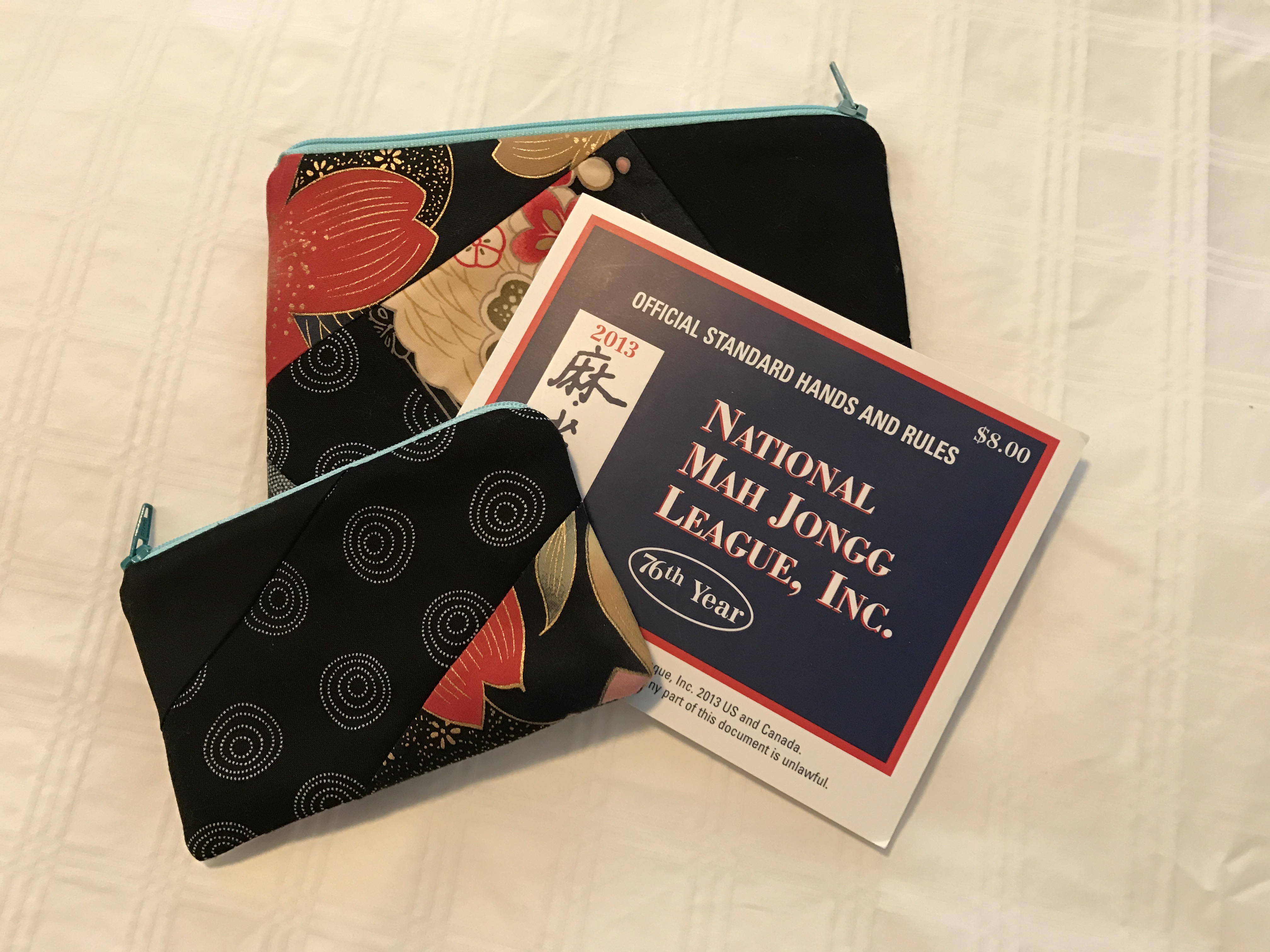
I have an idea… if the larger bag could hold a Mah Jongg card, and a smaller matching little zippered change purse inside that could hold $3-$5 in change, you’d have a terrific gift for Mahj players no matter what the fabric, but especially if it were in an Asian pattern…

So here we are:

img_8190

Small bags for the Man Jongg player

Didn’t take long to make. A trip to my scrap boxes for some small Asian fabric leftovers. Some batting and lining and zippers. Putting it all together went quickly as well.

Now to get it in the mail – just not today!

img_8191

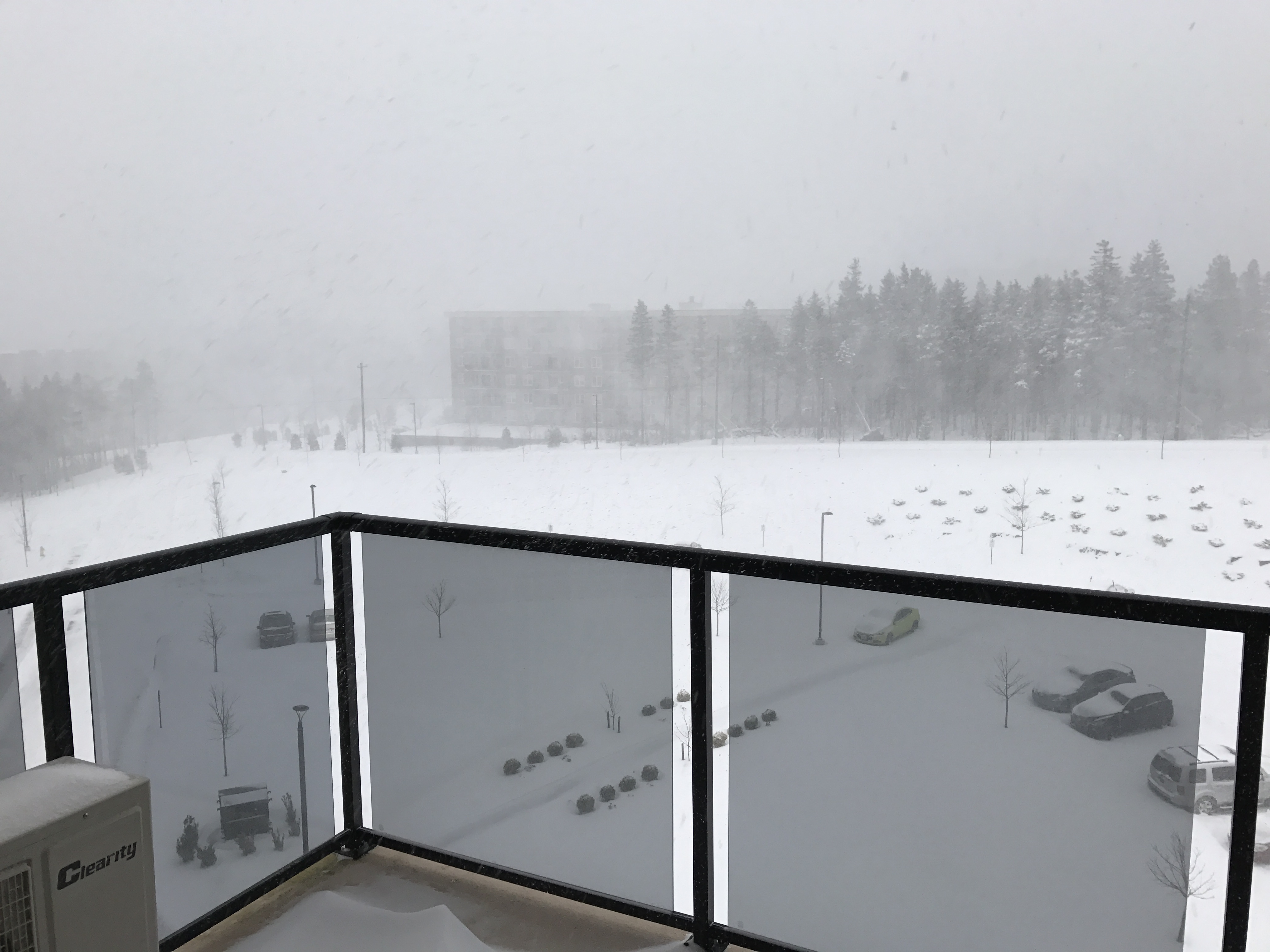
A Nova Scotia Blizzard

We’re being advised to stay at home, it’s obvious why. I’m not budging from the apartment!