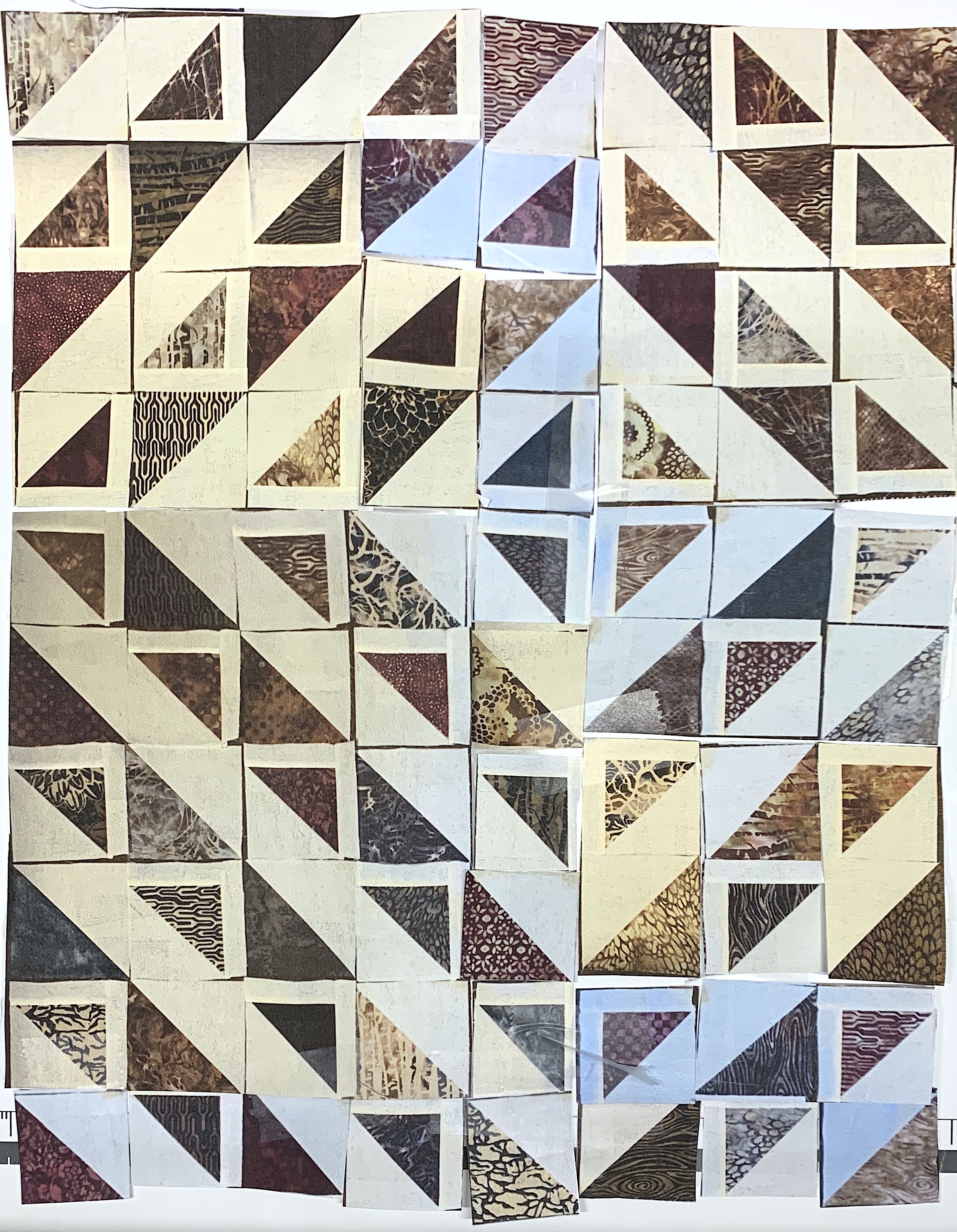
Finished – At last

Season’s greetings!

I started playing with this quilt on Oct 12. Ten/eleven weeks ago. I just finished hand stitching the hidden binding on the back! Finally – my Christmas day project – to get this quilt done.

Once I had the quilt top assembled I found I could move along again. I made the decision to use the Holtz fabric intact on the back rather than cut it up. I had to incorporate the two pieces I had in order to have enough to complete the back – that’s even after inserting a 14″ strip I assembled from bits and pieces leftover from the quilt top – a much better use of that very busy fabric!

I would have completed the quilt with a conventional binding, except I didn’t have enough of the bronze cork fabric to do that. So in the end I used the leftover strips from the backing to make a hidden binding.

I’m glad the quilt is finally completed. I kept avoiding it because I knew I wasn’t going to be happy with the finished project – nothing there that pops out to say “notice me!”. In fact, I may decided to showcase the quilt back, which I think is much more interesting, in upcoming exhibitions.

So on to the next project – a couple of wall art pieces which I’ve been thinking about for over a year! Time to start working on the first of them.

OK, The Finished Quilt Top

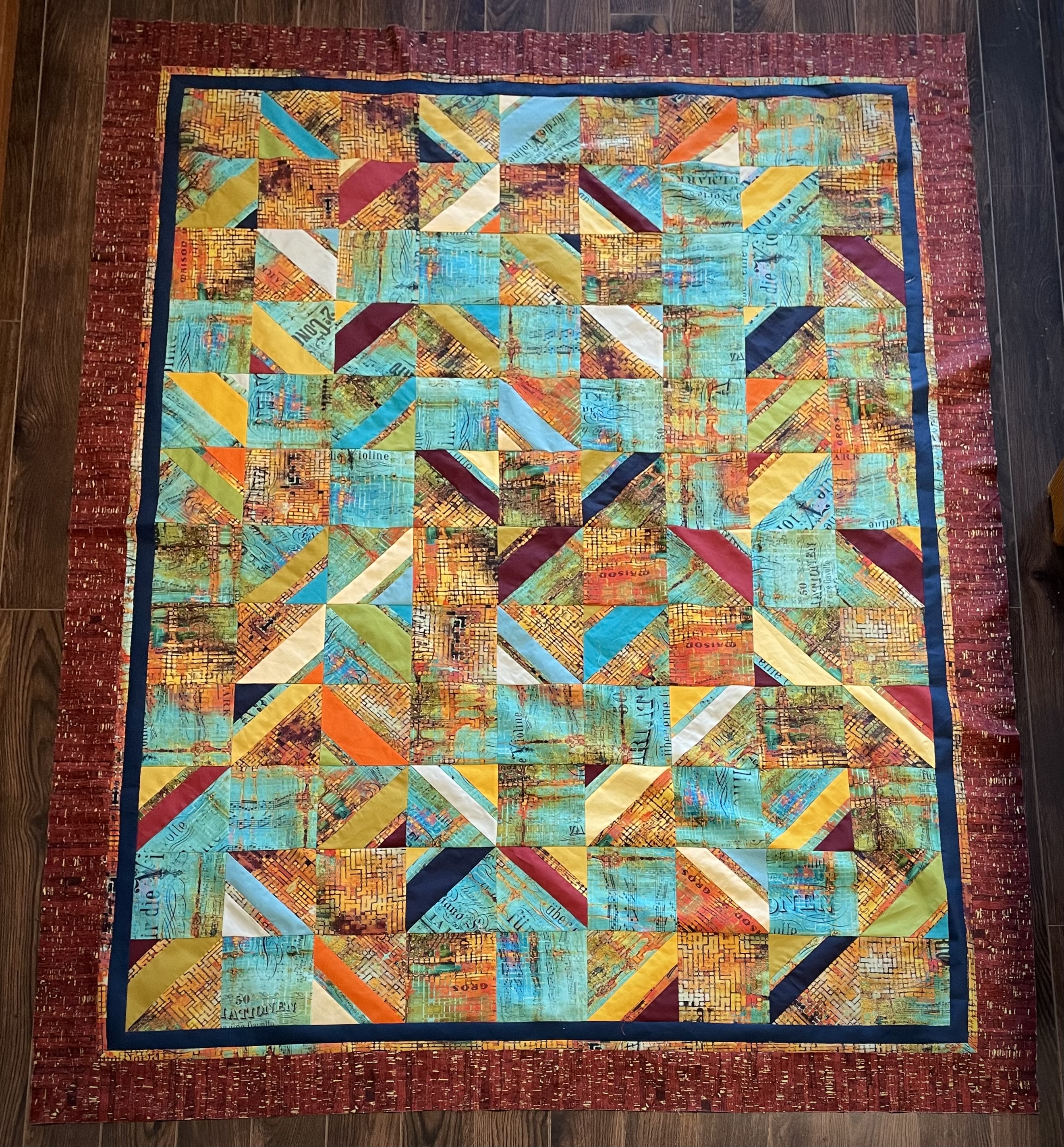
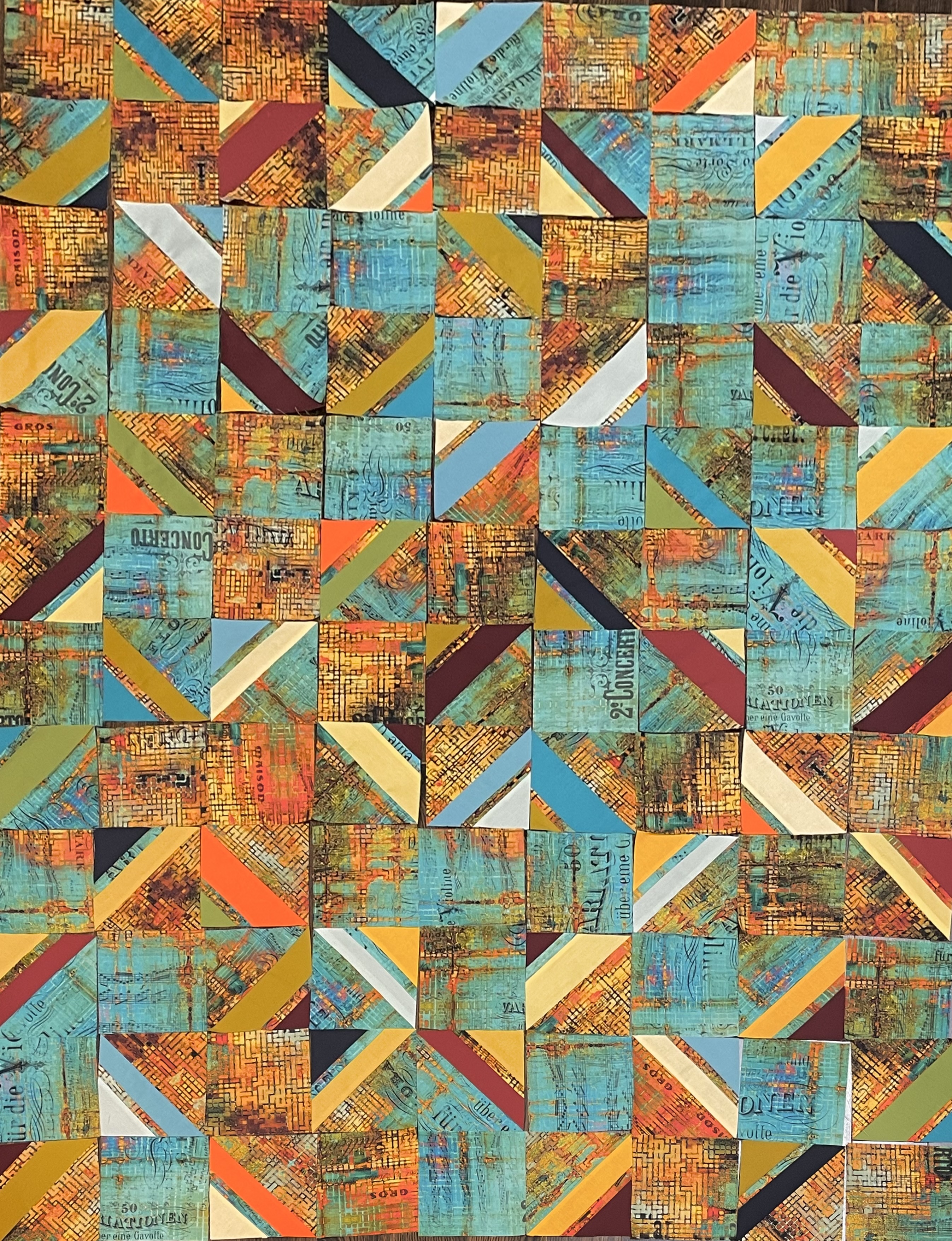
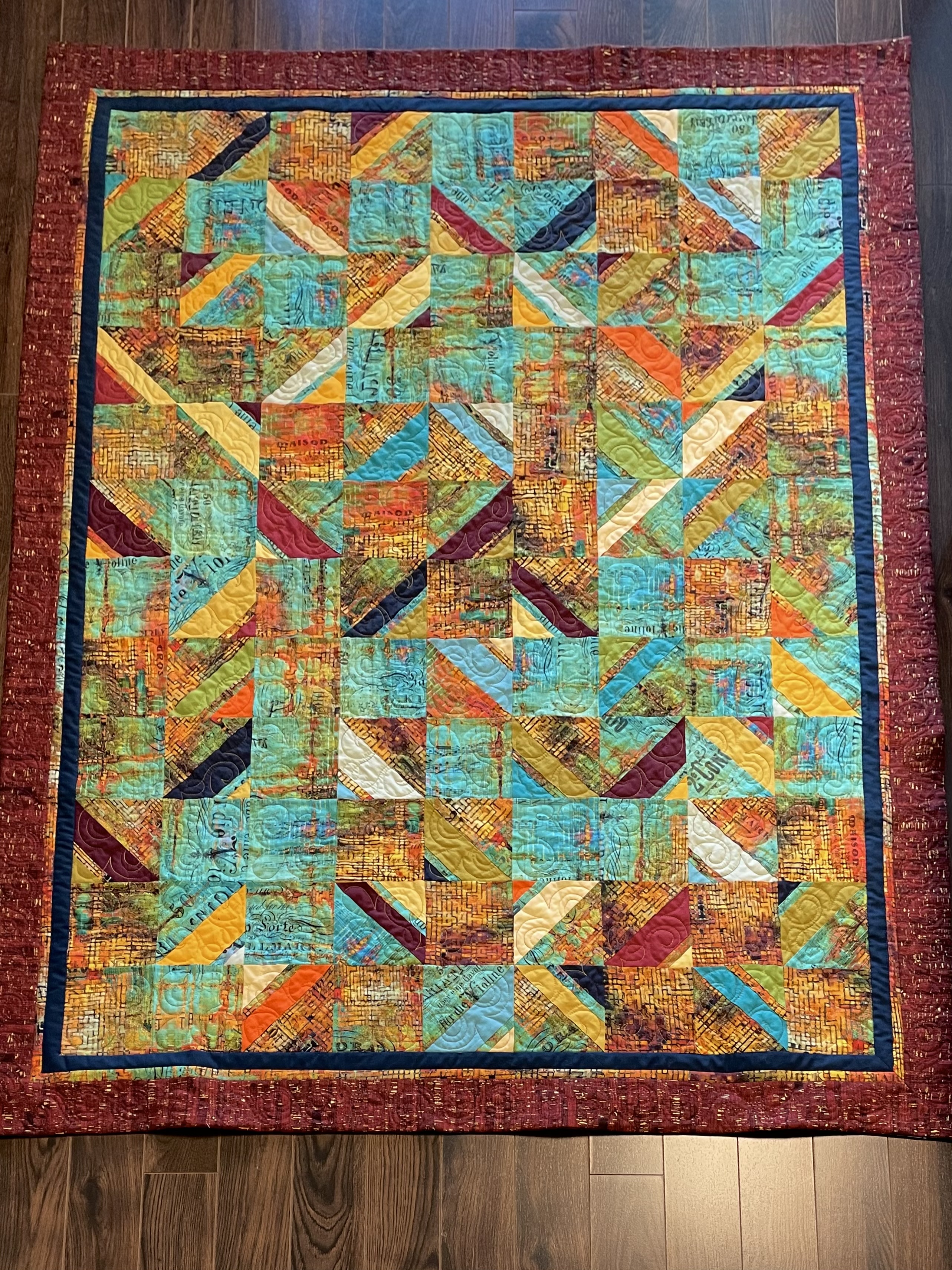
Here it is – the finished quilt top. It’s not the idea I had in my head when I started! It’s what I’ve ended up with, however; I can live with it.

It’s just another half-square triangle quilt; nothing special. The border pulls it together. I’d never have guessed I was going to use the “cork” fabric to finish the project but the brick colour brings out the various reds/oranges/yellows in the print fabric and the solids. One of the benefits of having a relatively large fabric stash.

Did I tell you about the discussion I had with a friend about “the stash”? I’ve decided I can call my fabric collection a “stash” as long as I’m using it to create new work. The moment I stop, it becomes a “hoard” and I turn into a hoarder!

Gotta keep working – I’ve more fabric and supplies in my apartment than I can use up in a lifetime. In the end I will die a hoarder!

Sally mentioned the other day, when I dropped into Sew With Vision about something, she’d like to hang it. I’m all for that. It’ll be interesting to see what people think of it.

Now onto the back. I’m going to use what I have left of the Free Spirit: Tim Holtz, Eclectic Elements, Abandoned, Rusted Patina fabric along with some border remnants, and the unused blocks I set aside. I want to see how large swaths of the fabric works, against a small amount of detail.

Catchup

It’s days since I posted anything but I’ve been chugging along as always.

Danish Paper Stars

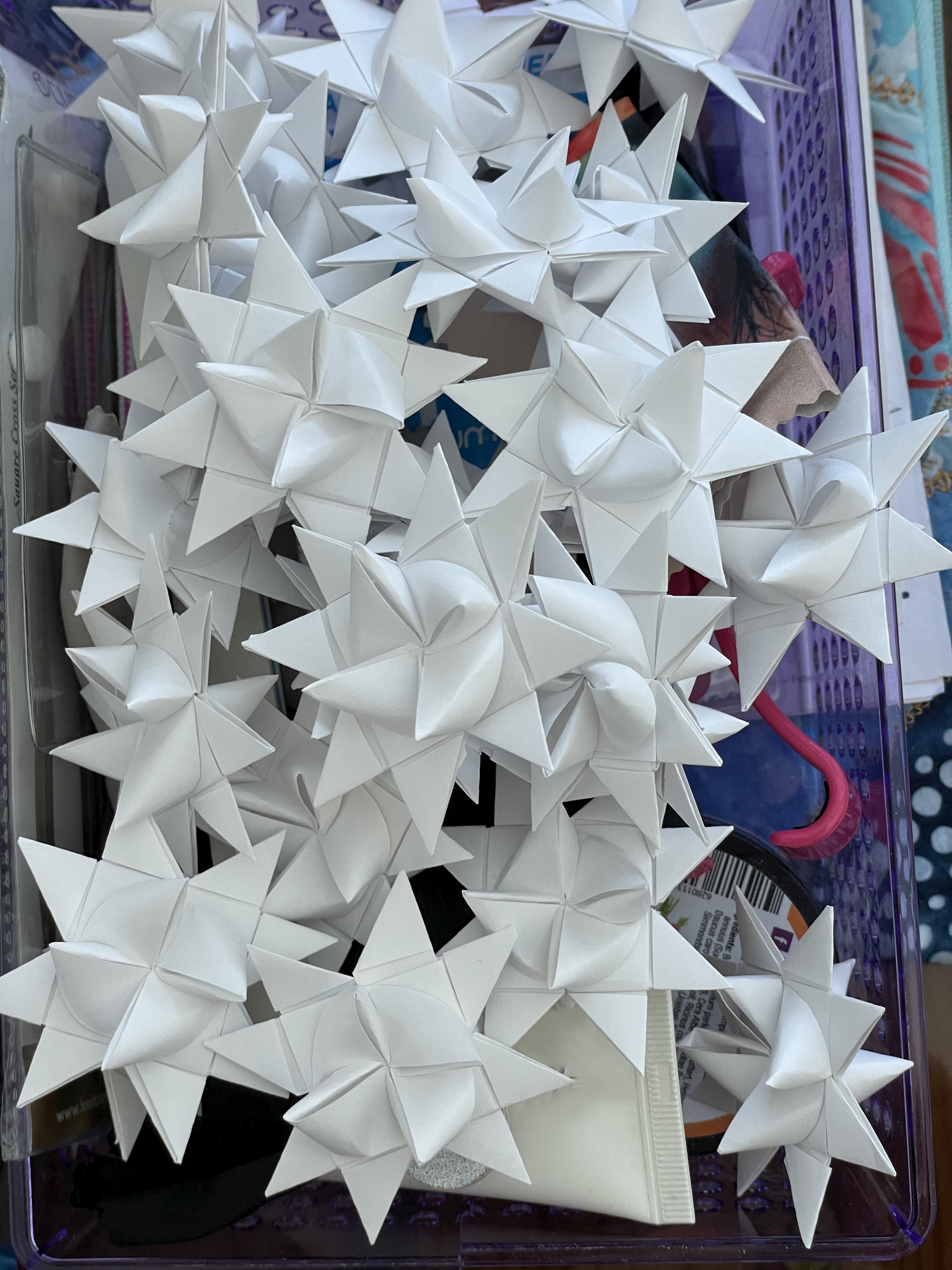
Danish Paper Stars – it’s become a seasonal tradition to make stars to share with neighbours and friends. I’ve made a total of close to 60 this year. I started with about 45 – which I distributed the other evening (one star per apartment). When I got home I realized I didn’t have enough left for friends so last evening I made another 15! That’s it for stars this year. It takes me about 8 minutes to make a star. [The website I found a couple of years ago describing how to make the stars is still functioning so click here if you want to try your hand at making a few!] [If that link doesn’t work try here.]

The Quilt Top – it’s been a chore but I finally managed to piece the panel together. I rummaged through my stash looking for fabrics to border it with. I came up with something.

The challenge with the burgundy “cork” fabric is that it’s directional so I’ll have to consider how to use it on all four sides – it will require some piecing, I think. Deciding to include a thin strip of the backing fabric ties the whole thing together. It don’t see any appliqué that will enhance this panel which is already way too busy!

Can’t say I’m ecstatic about this creative effort – the background fabric [Free Spirit: Tim Holtz, Eclectic Elements, Abandoned, Rusted Patina PWTH126] turned out to be much busier than I anticipated. I loved the colour combinations, but cutting it up just accentuated the “busy-ness” and adding the solids as I did made the whole panel out of control. That’s the challenge of improvising – it doesn’t always work out as you’ve imagined it.

The Rusted Patina fabric should have been used as very large pieces which is what I’m going to do on the back. I managed to purchase enough from a number of online sources to do that. I want to see what making a small strip through the dominant backing fabric will do. In any case I want to use up what I have. I don’t intend doing anything more with it. Lesson learned!

I just keep carrying on.

If you have time I recommend Barb Emodi’s recent Substack piece: Comes With The Territory.

So, This Was My Idea

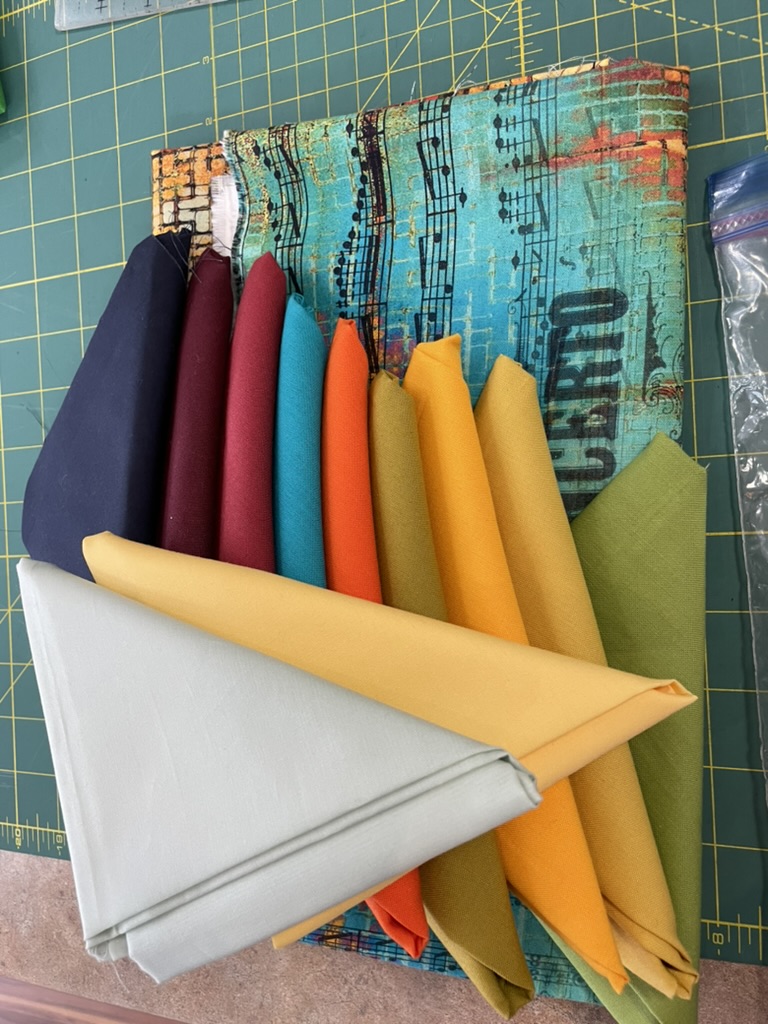
Remember when I started this quilt I had a wonderful bright fabric with yellows/oranges/ turqoises/blues. Because the solids weren’t quite light/bright enough, I added a couple more to liven the array.

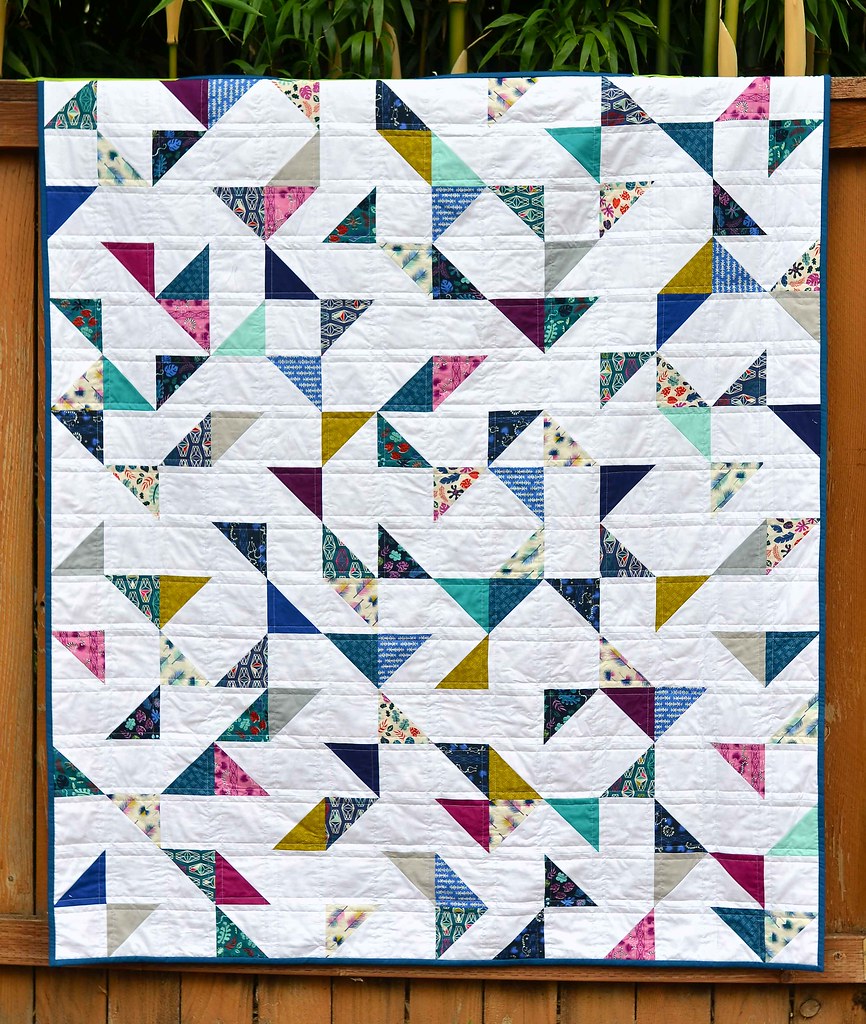
I had an idea in my head based on a quilt I’d seen on Pinterest

Another HST Idea

to use the print as my background, the solids as accents, with the solid triangles formed from three strips.

This afternoon I finally got back to sewing on this quilt (I’ve been avoiding it for over a month). It didn’t take long to sew the strips for the “solid” triangles, pair each strip with a strip of background print fabric, cut the HST.

56 HST with Solids

Each strip pair gave me four blocks – I just needed to lay them out interspersing them with background blocks.

Tentative Layout 9×12 Layout

I find it very interesting that when I look at the pieces on my floor the yellows/oranges stand out, but the photo brings out the turquoises/blues! The pale yellow solid elements brighten the ensemble. The pale blues are lost among the music elements of the background. The orange solids, the burgundy stripes connect with the background print (on the floor – not so much in the photo), and the navy doesn’t do much of anything. I’m not sure I see much point in playing around with the layout – I don’t think it will make much difference to this rather drab quilt top.

My challenge now is to come up with some way to make this layout interesting. Would a solid sashing in one of the lighter yellows accomplish that? Use the background fabric for a border? What about circle appliqués (of different sizes) cut from the solids placed in some kind of cascade?

Whatever I do, it will have to involve the solids because that background fabric, which I thought would be striking is so busy when cut up, that it overpowers everything else!

Got any suggestions? I sure don’t know where to go from here.

Since I began working on the project, I’ve had a hunch I wasn’t going to be happy with the outcome. My fallback position was to assemble the array, make it into a quilt (with batting and a backing), then use it to make a jacket! Looking at the potential panel, however, I don’t think the jacket would be outstanding, either.

I hate it when the work goes sideways as it has here.

An Idea…

I was looking at the print fabric and the solid fat quarters and thinking I didn’t have “light” in my collection. So I eliminated the colour to see what my tonal contrasts looked like – not too bad, but I could use a bit more light in my colour assortment.

Also, I want to showcase the print even though, in a sense, it’s the background. I found an idea on Pinterest I thought might accomplish that for me:

You have to stretch your imagination to visualize the white above as my print fabric, and the print triangles as my solids. Even further, I’m thinking I will break up the triangle with strips from at least two different solids and include a narrow strip of the background fabric as well.

Just playing around with scrap fabric I start to get a sense of what this idea might yield:

Playing Around

Now imagine that bullrush print as my bright yellow/orange/turquoise/green fabric, those triangle elements as the bright solids above and you get a glimmer of where I think I’m heading. I have more bullrush fabric and a couple of different brown/taupe solids to add to the above – tomorrow I’ll do those and include them to the array.

There is actually a pattern for this quilt online: Lagoon Quilt Tutorial but I’m not planning on following it. The block size in the pattern is 4 1/2″ – I want to end up with 5″ or 6″ blocks (not sure which yet). My final quilt size will be more rectangular then the Baby or Lap quilts for which Erika @ KitchenTableQuilting gives dimensions. Her triangles are “solid”, mine will be striped. Lots of differences. What I’m taking from the quilt photo is the inclusion of squares from the background fabric – in my case, the foreground fabric! What I didn’t want was to bury that very interesting print amidst the solids – this way I can showcase it.

One thing stopping me from proceeding at the moment is that I don’t have enough of the print fabric. I’ve ordered some (because my local shop has none left), and I’m waiting for it to arrive! (I’m also in hold mode because my right wrist has decided to be painful – arthritis that will take a bit of time to settle down – cutting with a rotary cutter is almost impossible and I tried but can’t cut with my left hand). As soon as the fabric arrives (and my wrist settles down), I’ll get to work on this quilt.

New Quilt – In Progress

Four days ago I shared my work on a new quilt – I had sewn together 3 panels of four strips each – I had 7 panels left to create.

4 Panels Sewn

I’ve worked away at the panels – finished sewing them yesterday.

40 Strips Sewn in 10 Groups of Four

Here’s where it got interesting. I made the decision to revamp the panels into 4 sets of 10 strips – I accomplished that by sewing two sets of 4 then splitting the next adjacent panel in half and joining the resulting 2 strip sets to the first 8 and the second 8. Repeated that with the remaining strips giving me 4 sets of 10.

What I did next was create two 20.5″ squares from each 10 strip panel, matched up two non-identical panels, stitched around the outside, then cut along the diagonals. From my first two panels I got the following:

The first eight blocks laid out

Not a bad start – you get two large blocks with an encircled square. But my other eight blocks are very different in colour so how do I use them?

The first layout was a more or less random placing of the 16 blocks. The second layout set up a dark square in the centre and build more or less randomly on that centre. The third layout took the initial 8 blocks and added the second eight to the sides. At the moment I have no idea which to use. Each time I look at the photos I see new conflicts I want to resolve.

In addition, I’m planning on putting a navy speckled 1/2″ sashing between all the blocks which should actually bring the hodgepodge of colour together – fingers crossed on that. Furthermore, I really don’t want a square quilt! I want a rectangular one. I could get that, if after sewing the square together, I cut each of the two sides in half and place the cut pieces at the top and bottom! I have a hunch I may actually do that.

I worked on another half-square triangle project yesterday as well – the quilt is really a half-square triangle block (just built from 10 strips rather than a smaller number, usually 4).

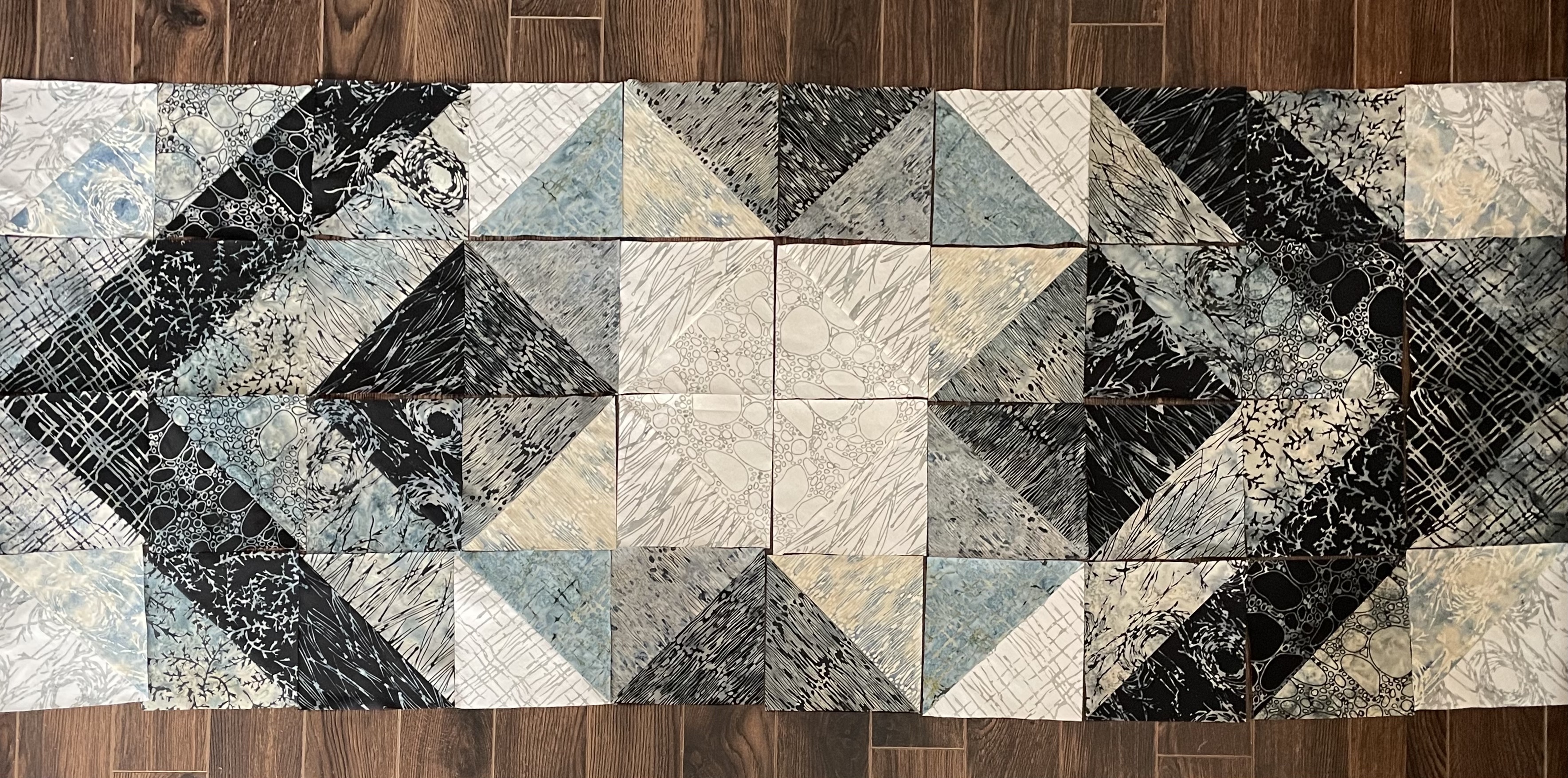
Table Runner

I’m on the calendar to teach a quilting class Thursday on experimenting with HST. I had a layer cake – I matched up the fabrics – same batik pattern in two different colours, and made the blocks. This is the layout I will probably use. I can’t really sew the blocks together since I want to use them to show the many different ways these blocks can be assembled. In fact, it’s Sunday, tomorrow is a holiday, I won’t find out whether anybody actually signed up for the class till Tuesday – at which point I’ll have to scramble to contact the participants to notify them about what to bring to class on Thursday. Crazy! If nobody has signed up I’ll be able to work on the quilt!

Charm Quilt – Finished

Finished the quilt last evening. When all the quilting in the hoop was done (it went reasonably quickly), I added the binding. I didn’t want much of a binding but in the end I finished with a 1/4″ binding on the front (3/4″ binding on the back) which had to be hand-sewn. I never do hand sewing if I can help it – but in this case the binding on the back was wider than on the top and I didn’t want a machine stitched seam next to the binding; so hand sewing it was.

Charm Quilt – Finished

I’m pleased with how the back turned out, as well. I was able to use the column of HST I’d taken from the panel on the front, added a few sashing pieces that evoked the colour pallet of the front with a slightly darker grey fabric.

Finished Charm Quilt Back

This could be a quilt top on its own!

Now, I’d intended working on this quilt as a demonstration for the “quilt in the hoop” class – it was cancelled a week ago, the gals couldn’t make it yesterday, so far only three are able to come next week. I just kept working on the quilt and I finished it. So for the class (whenever it happens) I’ll work on my sample muslin piece. For now, I’ll be back to working on the bargello table runner.

Charm Quilt Top

In the end I went with an on-point square layout set off-centre.

7 x 10 HST Panel

However, the finished panel was too small, even with 3.5″ borders, to be a good size throw quilt. So what to do with it…

I had used all of the white/grey background fabric I had, I had no batik charms left. I also thought the 8 x 10 array wasn’t rectangular enough, so I removed one of the columns – set it aside to use in the quilt back.

Next, I decided to use the panel offset to one corner and create narrow pieced stripes in the wide border to the left of the panel as an accent for the HST array.

Completed Quilt Top

To build out the quilt, I added 9″ of backing fabric (a different pale grey/white fabric which blended with the original fabric) to the bottom of the panel so I knew the length of the  side panel. Then I began building pieced strips from everything I could find in my stash which blended, or implied, burgundy – the focal colour of the batik charms. I offset the strips by varying amounts from either the top or the bottom of the side piece by inserting appropriate amounts of backing fabric into the piecing. I completed the wide side border with a wide strip cut from the length of backing fabric to avoid a large, obvious mitre across the middle of it.

Finally I added a 3.5″ mitred outer border.

Now I’m ready to construct the backing. I bought a darker grey/white printed fabric for backing. I have a 4.5″ strip of HST I removed from the panel. I haven’t measured the panel width but I’m guessing it’s close to 54″ wide. So my insert panel will need to be at least 12″ wide.

No idea yet how the back will shape up. That’s for tomorrow.

Another HST Quilt

Two weeks ago at class one of the gals gave me a batik charm pack in exchange for the materials I’d given her. The batiks – five related colours – all felt “burgundy”. I thought they’d work with a light background. I decided to create unequal half-square triangles.

I raided my stash of larger fabric pieces and found a remnant of a white with grey fabric from the Zen Chic Fragile Collection.  I measured it carefully – thought I had enough for 40 5″ squares, plus sashing pieces; I started cutting. Turns out I was close, but I had to hunt through boxes of scraps hoping to find a wee bit more – luckily I found exactly enough to scrounge 8 more 4 1/2″ sashing pieces. That was it – there are no scraps of any kind left! This fabric collection, this colour in particular, were popular and are nowhere to be found. Trust me, I looked for hours online.
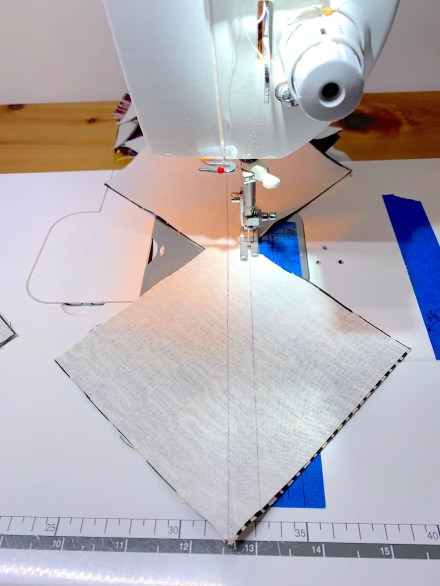
Stitching Unequal HST

To construct the unequal HST I marked the diagonal, then another parallel line 1/2″ to one side. I chain stitched the diagonals, cut the blocks apart, chain stitched the second line, cut them apart. Then cut between the two lines of stitching. After pressing the blocks open, I added a 1″ sashing to two sides of the smaller triangles.

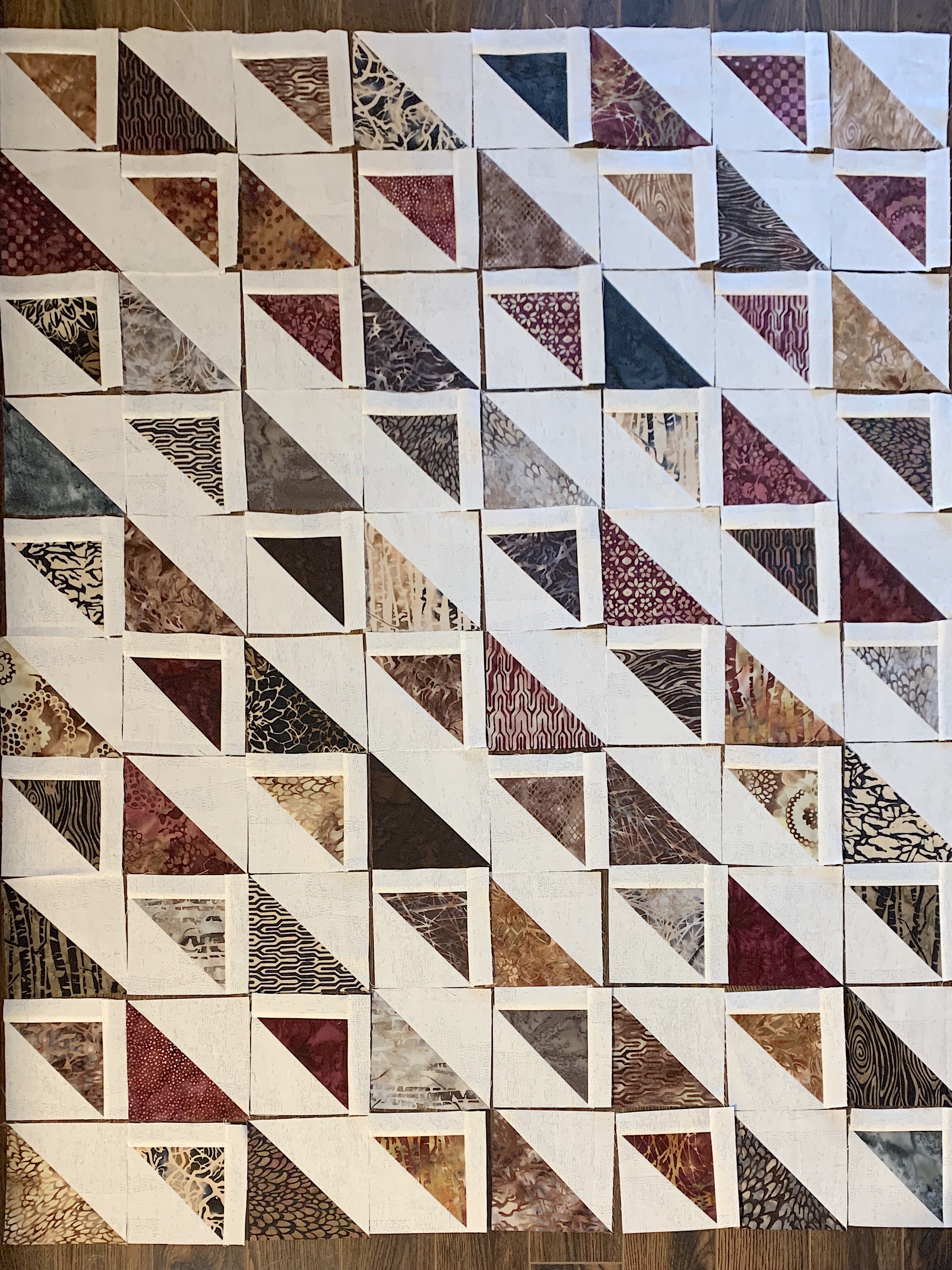
I’ve interleaved larger and smaller triangles and this is the 8 x 10 array I currently have on my floor. Kinda interesting….

Current Layout On The Floor

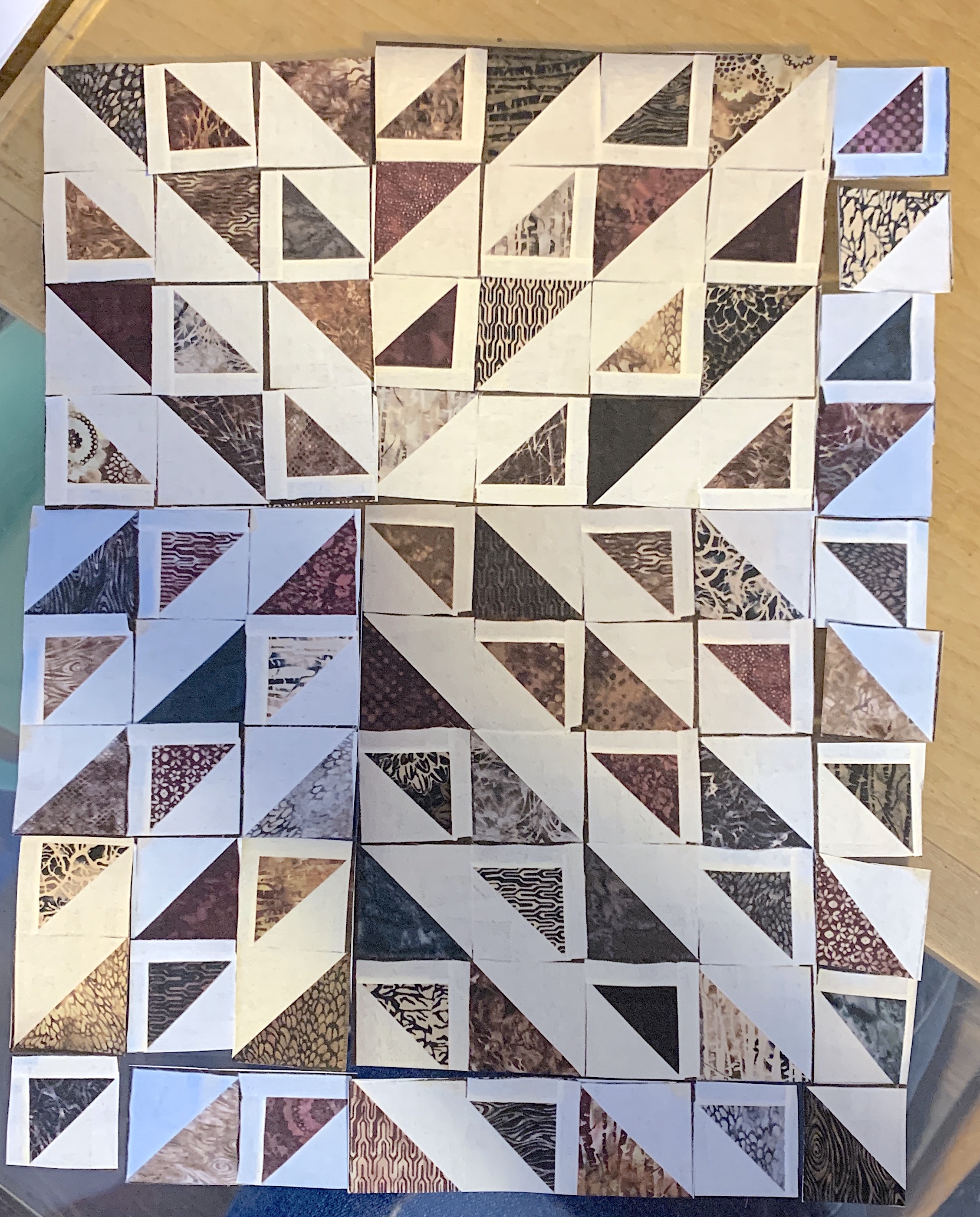
I decided to see what other arrays are possible. I took a photo, then cut the paper into sections so I could try other arrangements:
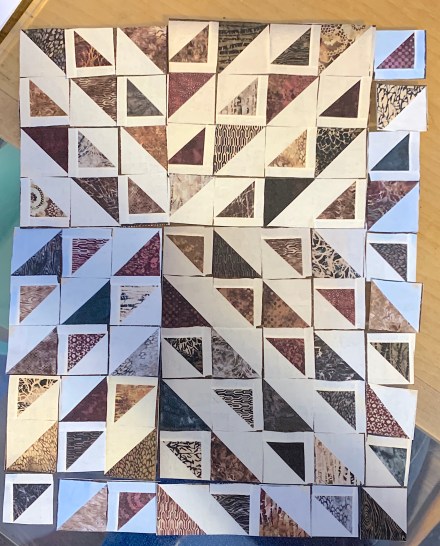
Pinwheel Array

The pinwheel is off centre (centre is at position 4/3). While the centre should provide focus, it doesn’t seem to in this case – what’s there is too busy.

Next layout:
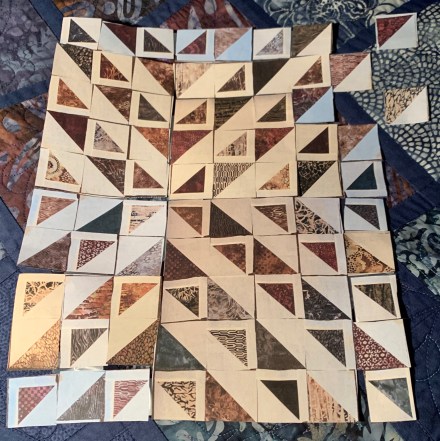
Chevrons

The chevrons work better – the white lines draw your eye in toward the offset centre. However, this layout requires two smaller triangles which I don’t have. I have two of the larger triangles but not a single scrap of fabric to convert them into smaller triangles – no fabric to construct sashing!

I’ll probably stick with the array I currently have on the floor – I need to leave it there for a day or so to make sure I’m happy with the colour distribution.

I didn’t say the reason I’m doing this quilt is so I can demonstrate for a class in early February how to “quilt-in-the-hoop“. I need both a quilt top and back to do this. Stitched, this array is going to be on the small side (but with no more burgundy batik squares and no more backing fabric to extend the size by a row/column or two, I will enlarge the panel with an inner sashing and a wide outer border so the finished size lands somewhere between 40″-45″ x ~55″- 60”.

I have a piece of complementary burgundy fabric large enough for sashing; and the other day I bought a metre of soft grey which should work for the border. I’m thinking a hidden binding from the main backing fabric might be in order because I don’t think I want to define the outer edge of the quilt with another strong colour.

First to assemble the blocks into a panel. I’ll work on that tomorrow.


Another possible layout:
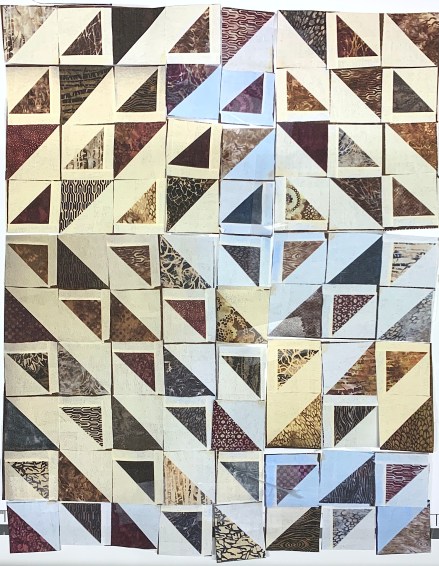
Diamond

This one works – and I’d complete the diamond on the right in the border (including a narrow sashing all around up to, but not including, that point…).

Hmmmm.

[BTW – I’ve been doing these different layouts by cutting a paper printout of the layout currently on my floor and holding it together with tape – no need to spend time on the floor arranging and rearranging blocks! The reason for placing my layout on the floor – my cutting table is too narrow to hold the width of the panel and I don’t have a space where I can hang a flannel design wall. I suppose I could set up a flannel panel and use weights to hold it in place on the floor – that could help keep the blocks from sliding around – but I’d still have to be on my knees to work with it.]
Layer Cake Quilt

I’ve been working on this new quilt for the past ten days. I started with sixteen grey batik 10″ squares and eighteen assorted beige/blue/grey 10″ squares – in effect a “layer cake.” I’d had the fabric in my stash for over a year not sure what to make with it. I didn’t have enough of the grey squares to do a whole quilt top so I added some Zen Chic (Fragile, Chalk Stamped) yardage which I also had in my collection. I decided to do an outer “border” with the white, doing the centre of the quilt using the grey batik.

I cut each 10″ square in four and constructed a total of 96 half square triangles, making sure I had enough blocks using the white to build the perimeter of the quilt top. Next I carefully laid out my HST and began sewing them together. Each block has four HSTs separated with a sashing constructed from 4 1/2″ rectangle “snowball” blocks – turns out I had a jelly roll using many of the same fabrics as the mixed batik 10″ squares I began with. I pulled out 12 strips to use for the sashing. To complete the snowballs I needed 384 one and a half inch white squares to add to the four corners of each rectangle.

Assembling The Elements

So far, I’ve assembled half of the inner panel of the quilt top – you can now see the white perimeter taking form and the grey batik interior squares are emerging.

Quilt Top – half pieced

I have two more columns of blocks to construct to add to this half panel. Then I will border the panel with more of the white patterned fabric. I have enough backing fabric that I should be able to add a narrow border of that fabric as well.

In the meantime it’s back to the snowballs – I have 48 more to construct. Once the snowballs are done the remainder of the top construction will go quickly.