Medallion Quilt VII

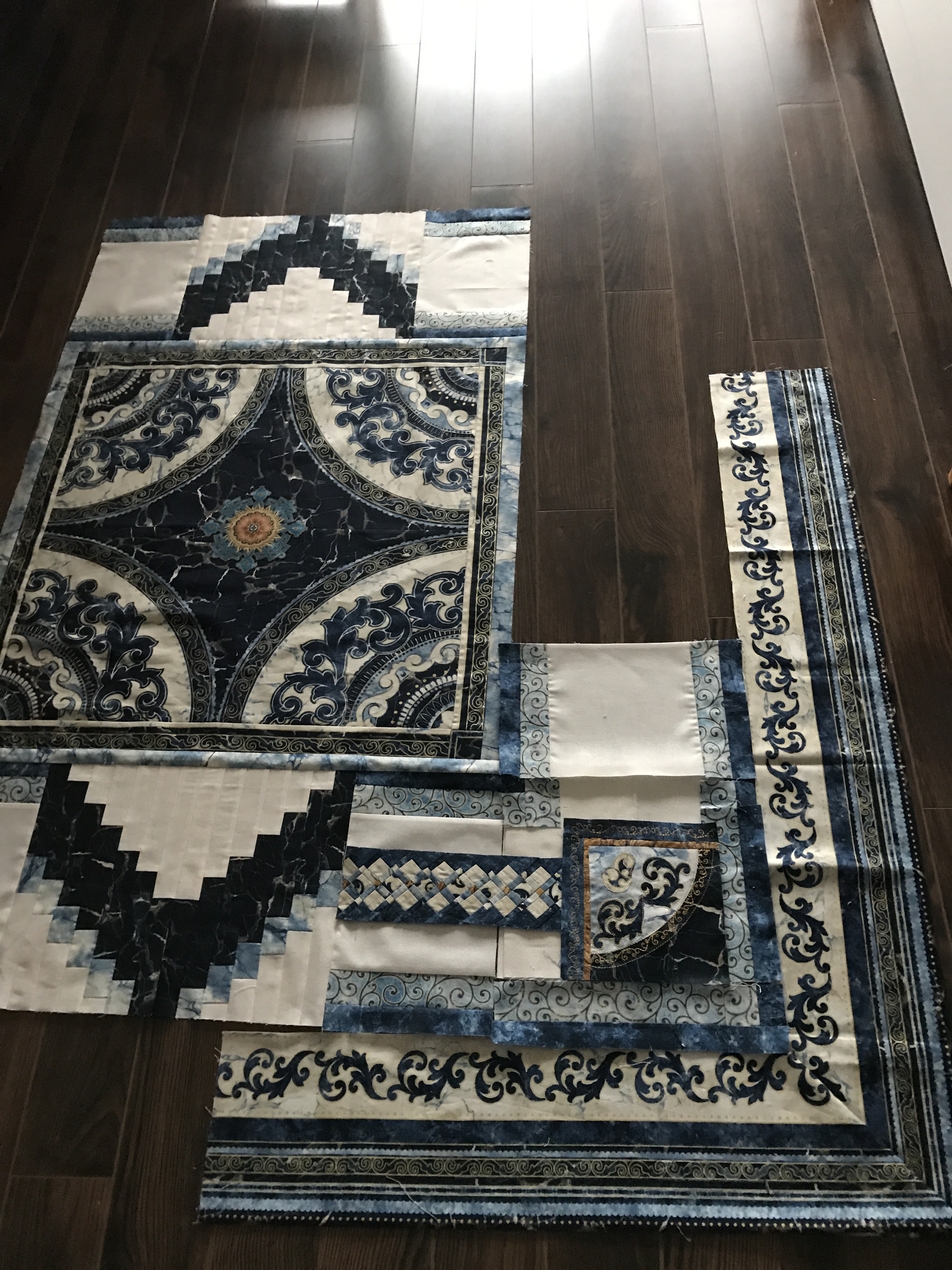
Corner In Progress

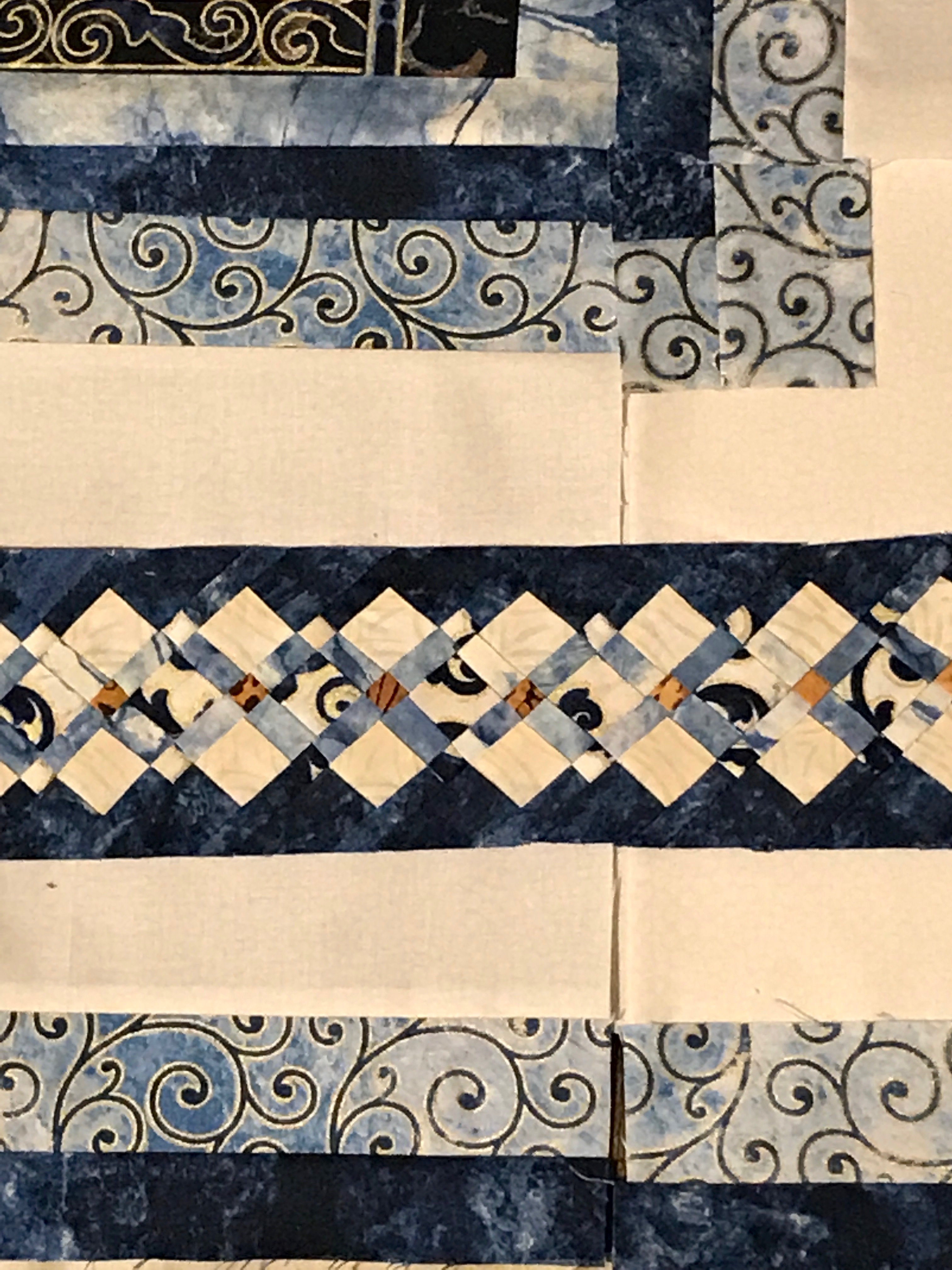
I can go no further until I do the embroidery on the remaining three corners and piece the seminole strips but it’s now possible to see how I can sew all these elements of the quilt together – attach elements, but then open the edges so I can sew the next piece then resew the end of the seam – in other words: partial seams. I now know what the measurements for these corner segments are as well since I’ve been able to fit in the first of the eight which fit between the on-point border and the corner square.

So now, back to embroidery and seminole piecing!

Medallion Quilt VI

Just finished piecing the remaining two parts of the on-point border. Now you can see the effect I’m after. I also added in a narrow (finished width-1/4″) orange/gold border which ties in the center panel with the corners (see lower right corner). I’ve prepped the four corner drunkard’s path blocks – they’re next on the to do list. I’ve added fusible web to the curlicues – I’ll cut them out during the US Open Tennis this afternoon, fuse them to the blocks, then top stitch them and add the embroidery to the curved seam on that block. I’ve also pieced enough fabric to cut and assemble the seminole strips.

On-point Border Pieced

As you can see, there are still gaps between the plain border sections and the corner block…. I want to extend those sections and insert the seminole strip in the middle – the challenge is how to assemble all of that – I’m going to have to work with partial seams! What I don’t know yet are the dimensions I need for that spacer block (with the seminole strip) to have the corner come out correctly. It would be easy to piece it in the conventional way were it possible to put a seam across the seminole strip but I want that strip in a single piece from the wide on-point border to the corner!

I have no idea how to assemble these corner sections. I’m postponing that problem-solving until after I have all the seminole strips stitched and the corner blocks  finished.

Medallion Quilt V – Update

Got it!

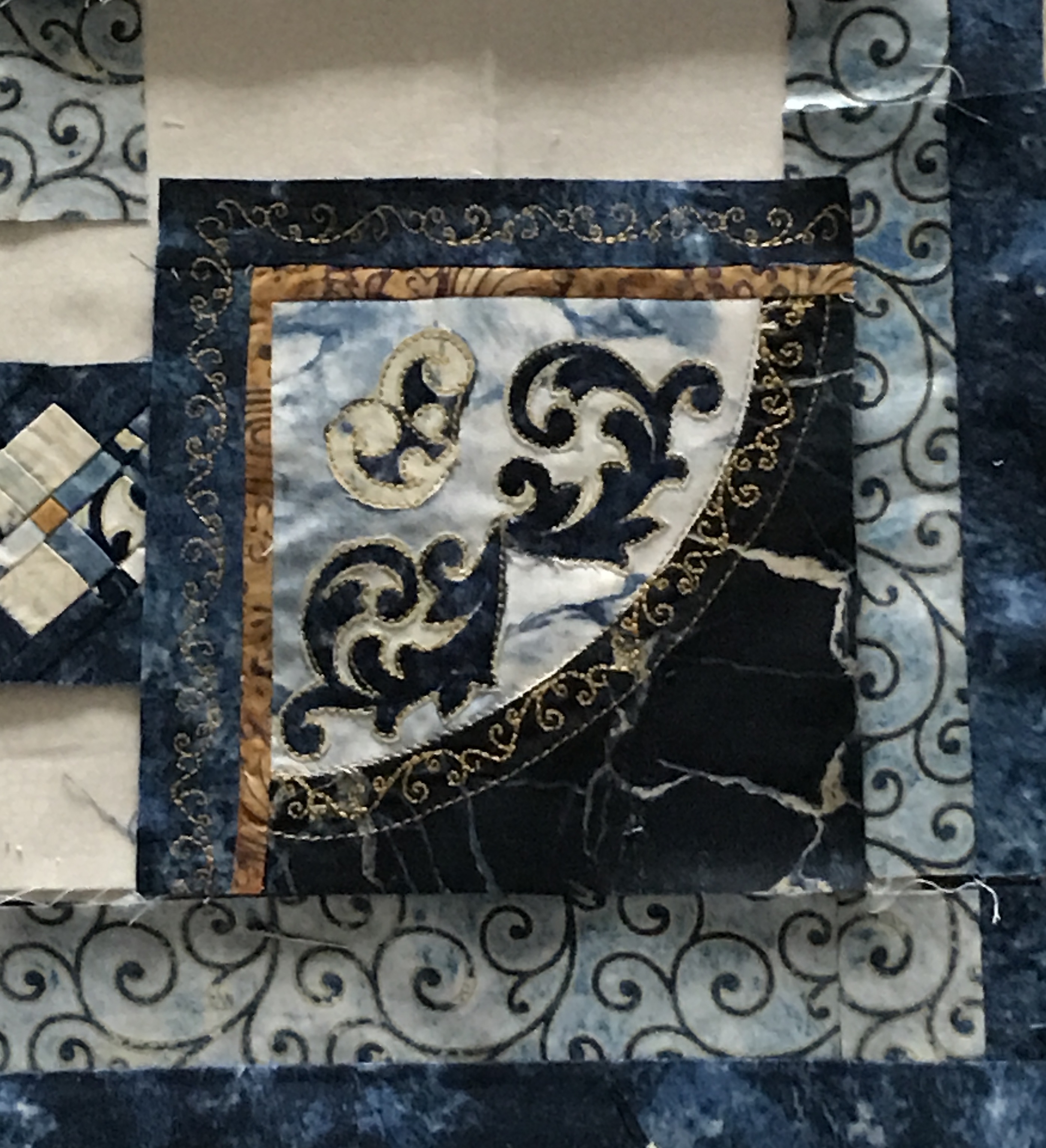
Once I thought about embroidery I could consider appliqué. So that’s what I did. I fussy cut two dark scrolls and two light pieces. I glued them in place (I will adhere them with fusible web on the real blocks), then edge stitched them. I started using a double thread but that was too heavy – so I finished with a single thread. Then I embroidered a scroll along the curved edge and on the two binding edges (I will actually have enough of the printed scroll to do two sides – just not four). I also tried a 1/4″ inner border in the orange/golden fabric to bring out that bit of colour – but looking at it now, I think it’s too much, probably will leave it out – just the tiny dots in the seminole piecing).

Corner Block – Detail

Here’s the block in context:

Appliquéd / Embroidered Corner Block

This now has the balance I was looking for. It provides context for the corner block. Next I will have to decide whether to embroider an edge on the seminole piecing – perhaps just a line of straight stitching adjacent to the seam on each side where it’s joined in.

This finally feels right. Now I have to construct four corner blocks.

Medallion Quilt V

The corner has been driving me crazy. My brain has been working on it while I’m sleeping and wakes me an hour early with fresh ideas!

I’m slowly getting there. A couple of days ago I was searching for border ideas and came across photos of seminole patchwork.

Seminole Patchwork Sampler

I particularly liked the middle strip and decided to try it. My fabrics are on the heavy side so accomplishing this piecing when I want to end up with 1/4″ blocks has required quite a bit of careful piecing and pressing. I wanted to bring in a hint of the orange/golden colour which I was able to do. I also wanted to use the white/blue scroll fabric, which I also incorporated. So here is the sample strip; now to make seven more!

Seminole Patchwork

This is how I see using that border strip – I think it comes close enough to the “feeling” of the printed patterns that if I insert it along the middle of the white blocks (on each side of the bargello on-point border) and bring it up to the corner block (on all four corners) it will do a couple of things: first, bring in a tiny hint of the orange/golden colour and second, connect the corner to the on-point border.

Quilt in Progress

This is a close up of the corner as it stands at the moment:

Corner Detail

The single drunkard’s path block here balances the center – and the blue marble is almost right. If I had only bought a second medallion panel! Then I would have had more printed fabric with which to work. I’ve looked online but there is none of this fabric to be had (a few background bits of the brown colourway but no blue anywhere). So I’ve got to improvise.

The dark marble fabric is fine, but I have to do something with the lighter blue – I think the tone of the blue works, but the fabric doesn’t have quite enough detail to balance the rest of the quilt. Maybe this is a place where I might try some machine embroidery, perhaps even using an orange/golden rayon thread, to add detail to the blue marble. I’d piece it, if I could but think of a way to do something based on the quarter circle, but at the moment I can’t see what that might be. Could a narrow border of some sort be enough to tie the block in?

I’ve auditioned the corner with the scroll-y beige fabric but it’s too busy. Even if I were to border it with something it still is too strong.

Corner Detail with Scroll Fabric

Actually, the corner blocks need a border – I’d love to border them with the same gilt strip I used for the center panel but I only have enough border fabric for the outside. So if I were to border the drunkard’s path blocks it has to be with something else….

Medallion Quilt

“Medallion quilts have a central area that dominates the overall design. Other design elements are added around the center, increasing the quilt’s size as new ‘rows’ are added around the center.”

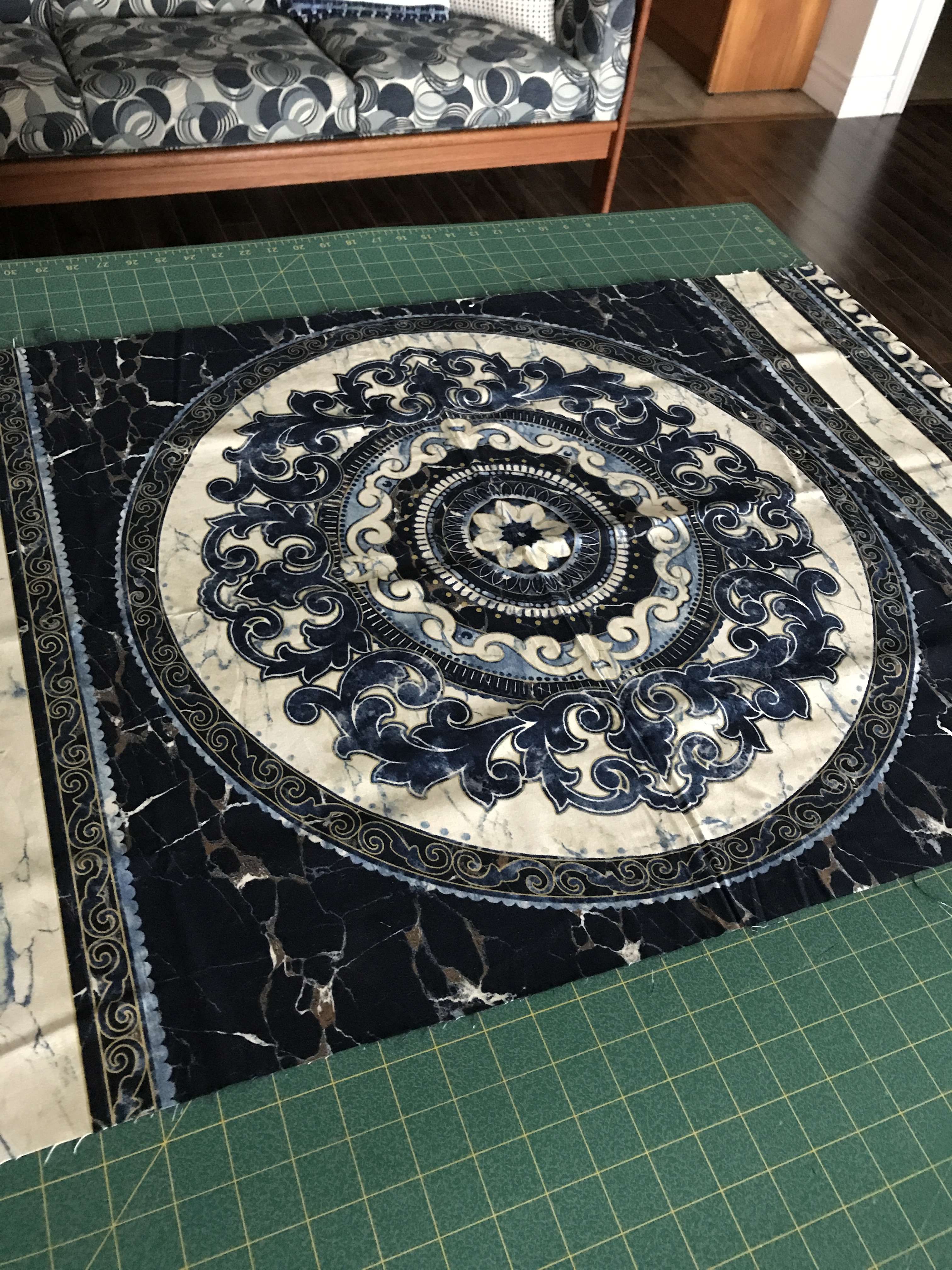
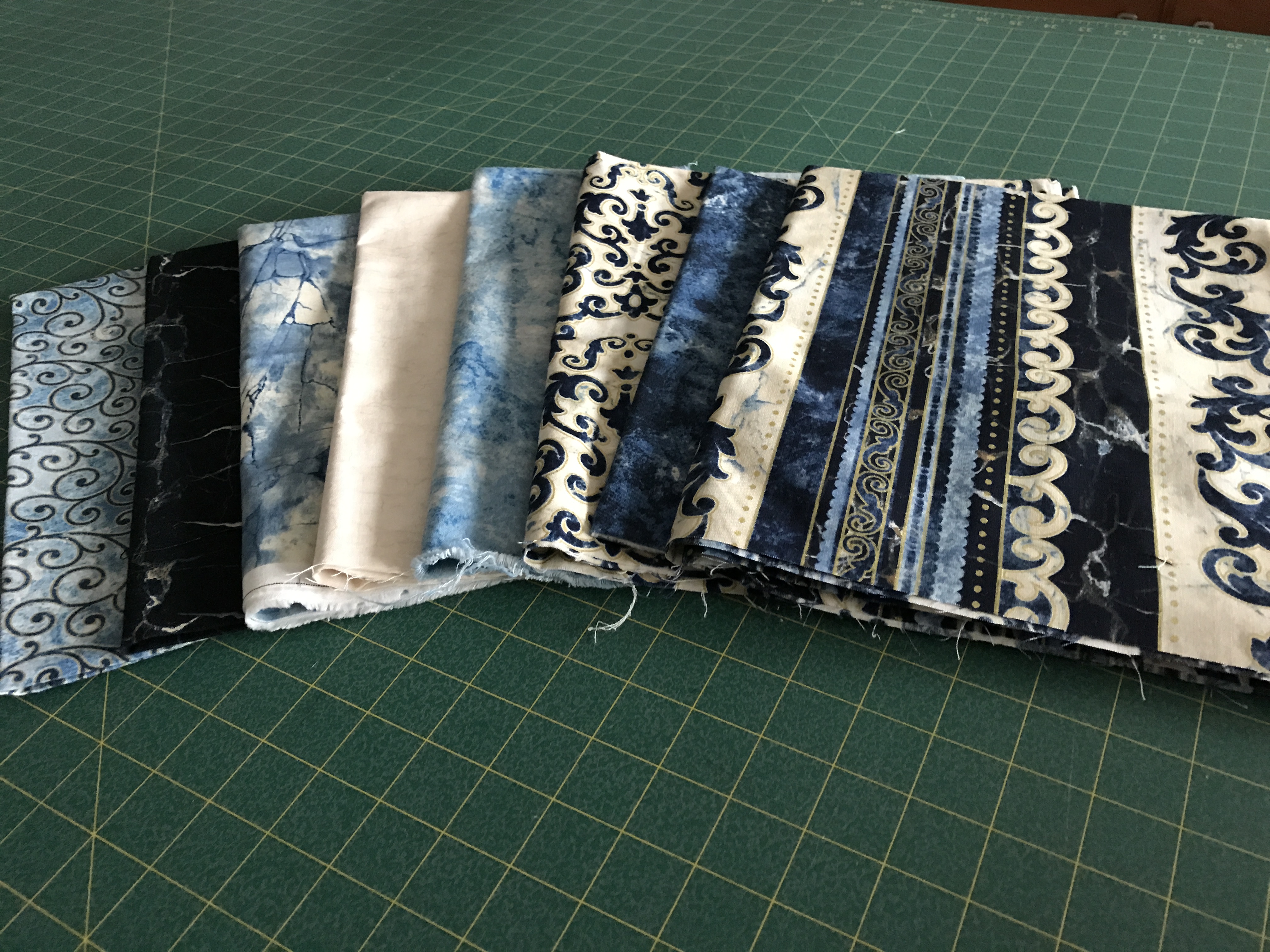
The center in a medallion quilt is usually pieced, occasionally it begins with a single largish printed element. In this case I have a 24″ printed medallion – a Northcott Stonehenge Medici fabric panel which I bought a couple of years ago along with 1/2m of each of the accompanying fabrics. I thought it might make a nice medallion quilt with the fabric doing most of the work. Well, it will, but the question is do I want to use this medallion at all, or should I do a pieced quilt using the fabrics from the Stonehenge Medici collection building a central motif from scratch?

Northcott Stonhenge Medici Panel

Northcott Stonehenge Medici Fabrics

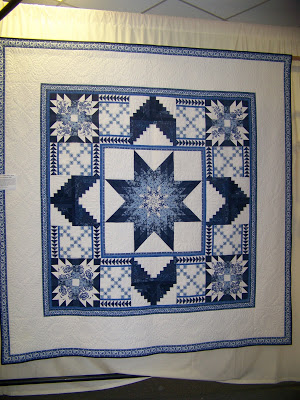
At the moment the fabrics are sitting on the cutting table as I think about how to proceed. For example, I could do something like the medallion quilt below by Borderline Quilter:

Medallion Quilt by Borderline Quilter

The problem is I’m sure my boredom threshold would quickly be reached attempting all the beautiful but finicky piecing that Kay Bell has done. I can see me building squares within squares, flying geese, half-square triangles, etc. but not tiny ones. What I particularly like about the quilt above are the blocks which create the illusion of the on-point border as background. My fabrics already have an element for a wide outer border (which I used in a previous quilt):

Garden Trellis with Wide Print Border

and will use again here. For now, I will probably go to Melanie McNeil’s Medallion Quilt Lessons to help me think about what I might do with my fabrics.

Foggy Morning – Completed

Done!

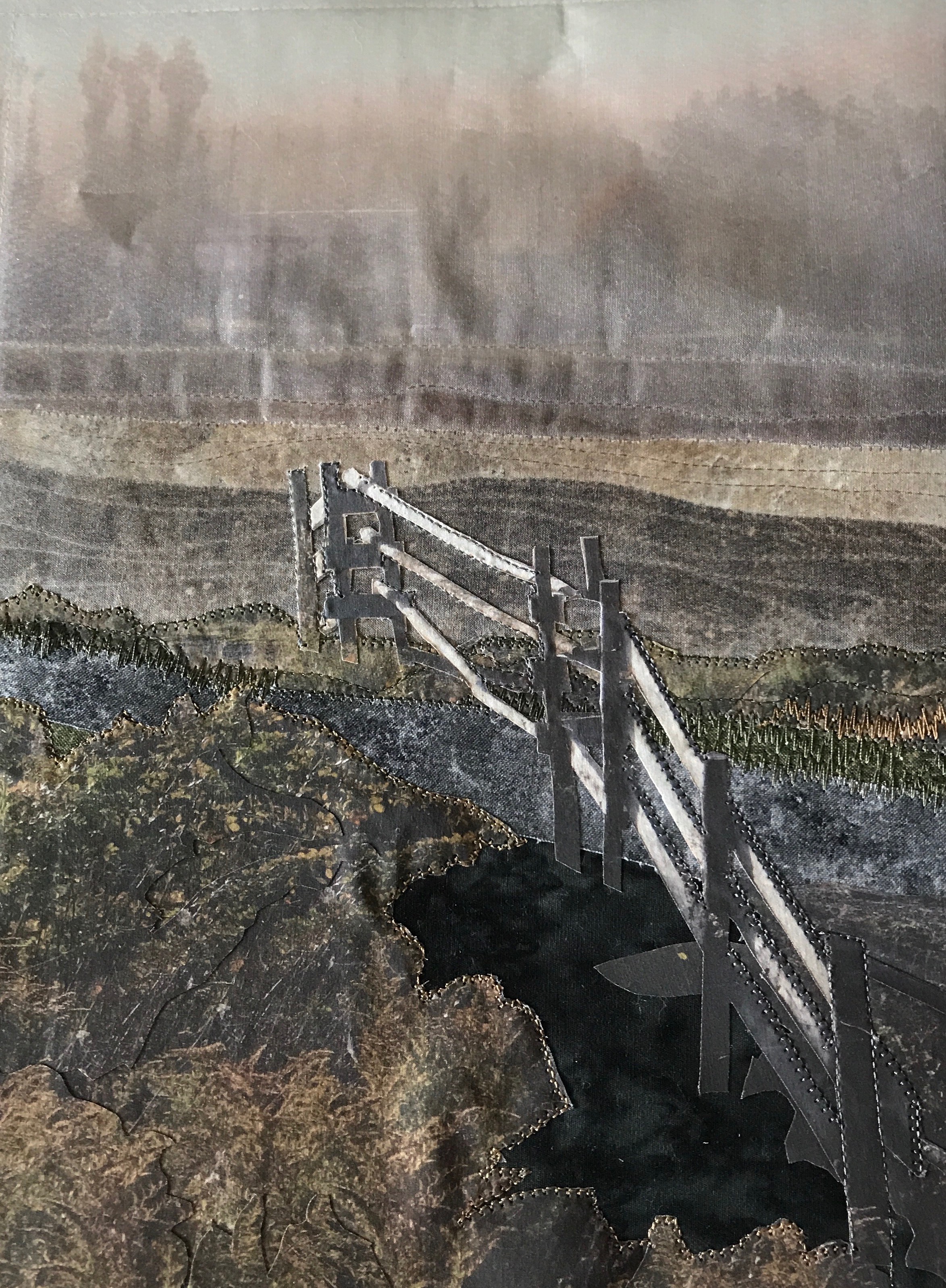
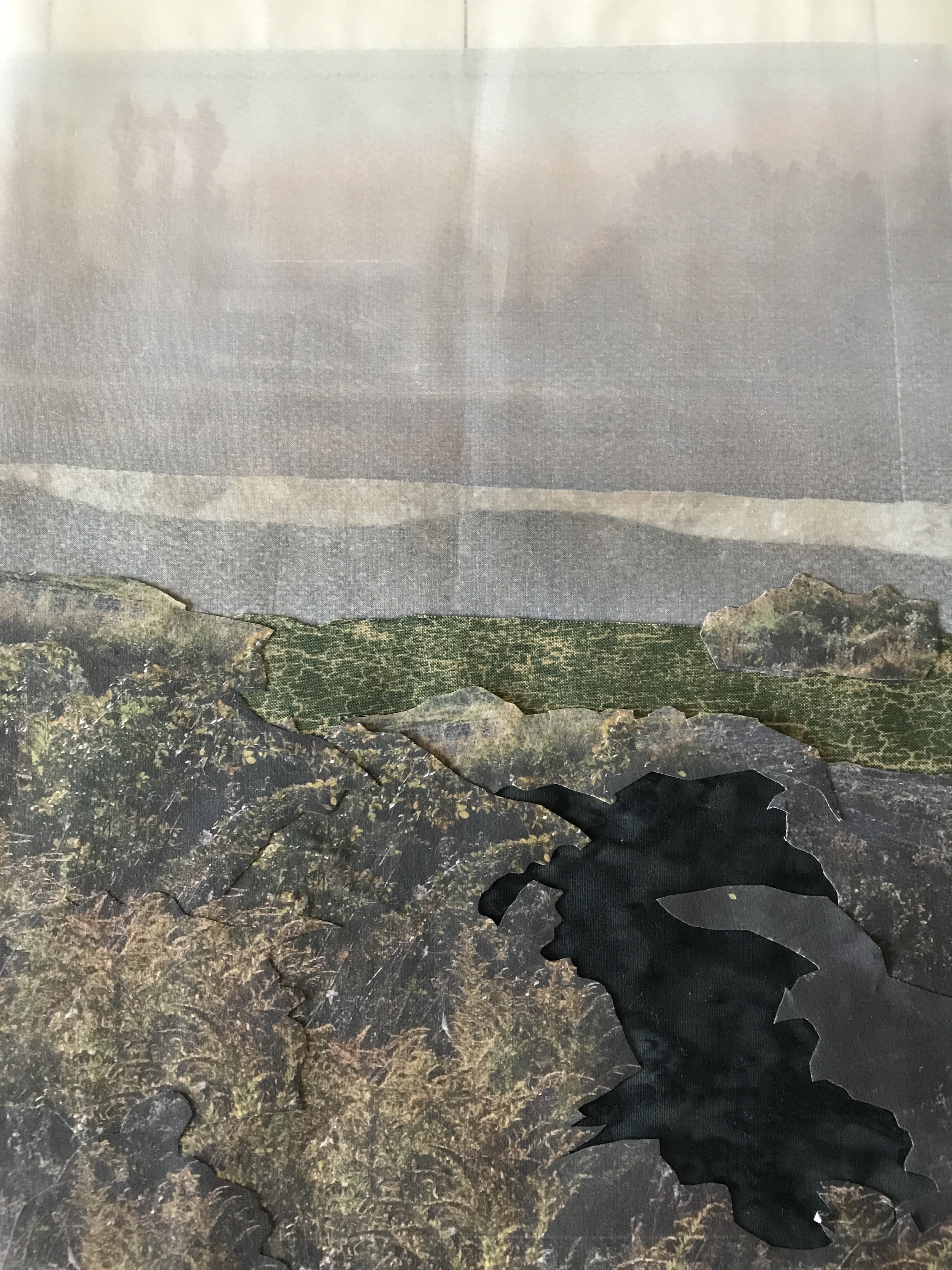
Just finished the hidden binding (with a sleeve for a rod to hang the art piece. I darkened the uprights on the fence a bit with permanent marker after I’d put on the dark piping – now the two are more balanced. The border fabric has the texture of old barnboard which brings out the colours in the scene in a way I’m happy with. That fabric was a lucky find yesterday – a fabric by Moda: grunge! And the distant fog obscures the trees and buildings in the distance but when you look more closely you can just make them out (as you would with fog).

Foggy Morning – Completed

That’s it for now. That gives me eight wall art pieces to take to Parrsboro beginning of September.

Foggy Morning – II

Here is the piece after working on it for a large part of the day.

First, I placed the fabrics for the distant background and middle ground, covered them with silk organza (which I fused to the fabrics below – I didn’t want to stitch over the organza (which would have destroyed the “fog” effect I was trying to achieve), instead, I did quite a bit of stitching to suggest the texture of the fields in the distance before fusing the organza in place.

Next, I laid in the foreground, including the fence (which I had very carefully cut out using very sharp scissors from the photograph printed on fabric – did that weeks ago). Then, I began edge stitching all those elements. I have maybe about 1/3 of the edge stitching done – some on the brush in the foreground and on the fence to hold them in place. I was beginning to feel the strain in my back so I stopped working to discover I’d just put in close to 5 hours on the project! Time slips away when I’m working on something like this – “I’ll just to this one more bit…” and before I know it, the day has disappeared.

Foggy Morning – In Progress I

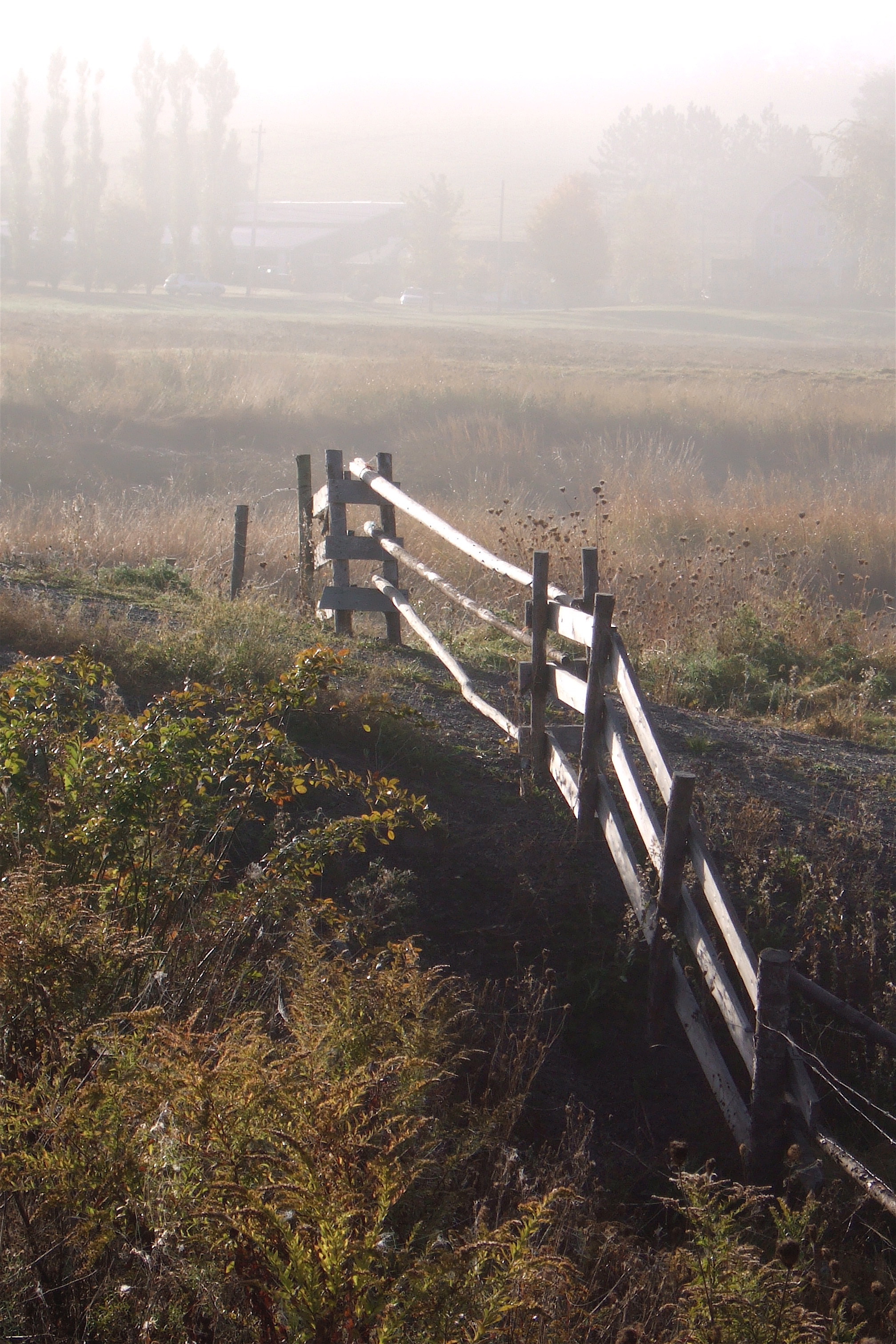
Here is the original photo for comparison – it’s getting there. The colours are somewhat different, but when the thread work is done it should be closer to the photo – that’s what I’m aiming for, anyway!

Foggy Morning – Photo

Foggy Morning – I

I was on a photo-taking adventure near Canning NS, on a foggy October morning in 2006, with David Lacey, a NS landscape artist. Near the beginning of our backroad trip we spotted an old fence at the edge of a field. The sun was still low and the ground fog hadn’t yet completely burned off. Standing where I was, the sunlight on the fence created a sharp contrast to the morning fog hovering over the farm buildings in the distance.

Foggy Morning – Photo

This was one of the photos I’d set aside as a possible subject for a textile art piece. The challenge is creating the “fog” – it seemed to me I could capture the faded texture of the foggy distance with a layer of silk organza over an underlying image  of the farm buildings and trees printed on fabric.

First, I enlarged and printed the top half of the photo on fabric and added a fusible backing. Next I’ve added layers of printed fabric to the middle ground which is still somewhat obscured by the fog. I will do quite a bit of thread painting in this middle ground to increase the detail although it will be covered with organza.

The foreground, consists of pieces cut from the photo printed on fabric which will be thread painted to bring out the detail. The shadow of the ditch is created using an underlay of black batik. Now that I compare the photo and my pieces of fabric (not yet fused in place, thank goodness) I can see I’ve missed the cow path which is integral to the image. So I will have to go back to my fabric stash to find a dark grey something to set that up….

Foggy Morning – In Progress I

Here is the fence, the focal point of the piece, tentatively in place –  I can see I will need to do a lot of thread work where the fabric meets the organza in order to marry the foreground and the middle ground better.

Foggy Morning – In Progress II

However, I’m happy with the start – I’m beginning to see how to construct this piece.

First Swim – Revisited

It turns out my efforts to represent the shading of the child’s body with layers of differently colored fabric was misconstrued and interpreted as “clothes” by the majority of people who viewed the piece. Very few spontaneously saw him as naked. This was because the contrast between the lights and darks was too great – an artifact of the limited pallet of flesh-toned shades of fabric I was able to assemble.

Original Piece

So I darkened the ligher elements with crayon and wax pastels and stabilized the shading using a hot iron which melts the applied surface wax into the fabric. Now the child is seen as naked.

Child Darkened

I’m much happier with how people are responding.

Portrait

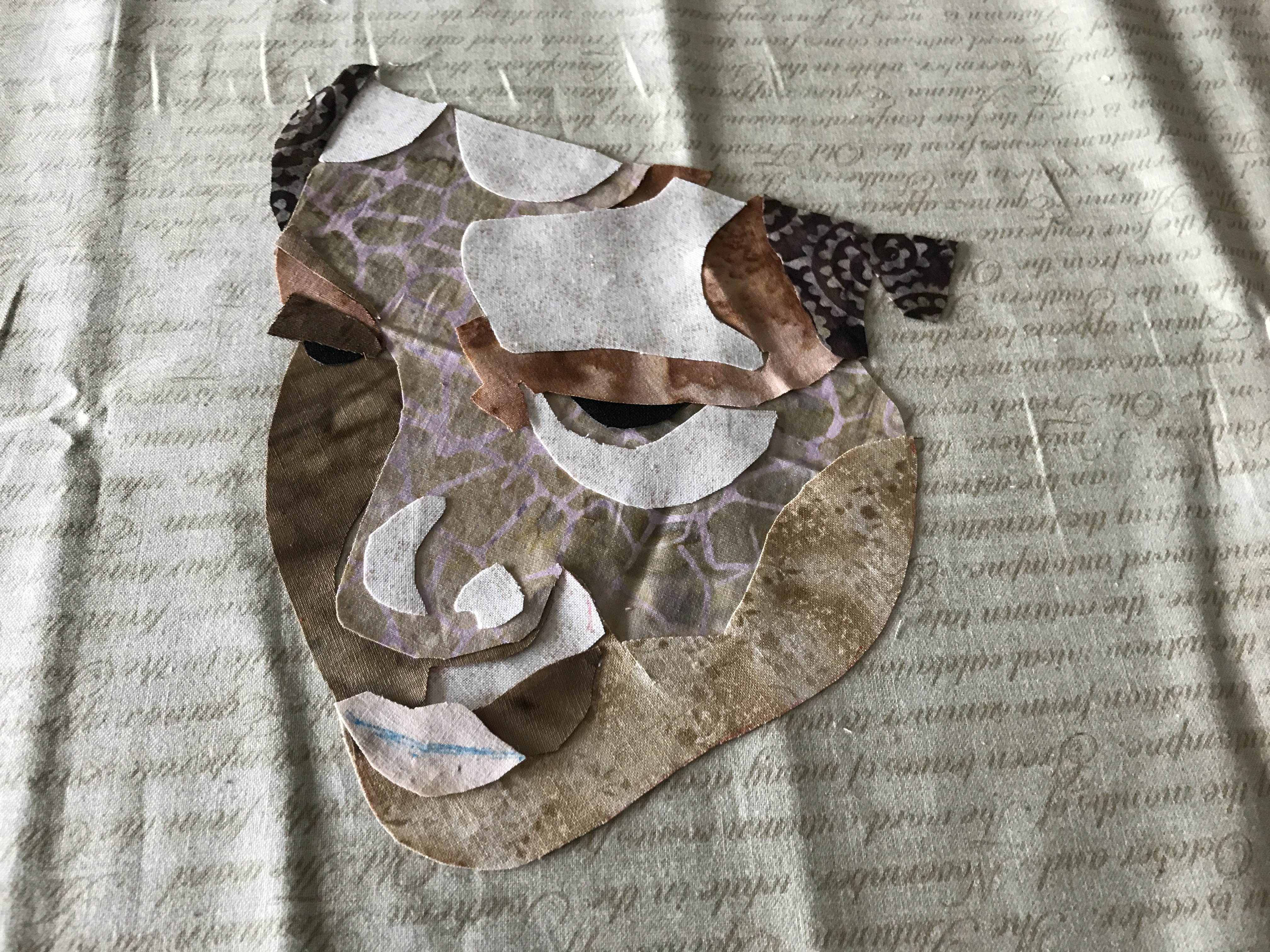
Another demonstration: a pieced portrait.

I started with an image of a face, printed it in black and white, outlined the colour boundaries, pulled all the beige tone fabrics from the stash I could find (large pieces and scraps), created templates for the large areas using baking parchment paper, cut them out, then created templates for the smaller areas, and cut those out.

What I didn’t do here, but should have, was to apply fusible web to the fabric before cutting it – instead, I’ll use a glue stick to adhere the cut out pieces to the background.

I was mainly playing around to see if what I ended up with resembled a face in any way and it does. Once I’ve glued the pieces down, I’ll probably do a bit of edge stitching to hold the thing together.