Quilt Top Finished (almost)

This is the cause of my problem! I finally figured it out yesterday.

My circles aren’t quite circular! I thought it was because I’d cut my quarter circles out a bit large then trimmed them smaller. I wondered whether my sewing was accurate enough. Neither of those.

My problem stemmed from the template I was using to cut the quarter circles! You can see the radius at the edge is 6 1/2″ from the corner to the circumference. But look at the centre radius – from corner to circumference is something like 3/16″ too short! So every quarter circle I cut, was flattened at the mid-point from the seams, and making the “pointy” bits happen at the seams.

I partially solved the problem by trimming the end points 1/1 6″ which helped round out the shape, but if you look closely at the finished quilt top you can still see the irregularity.
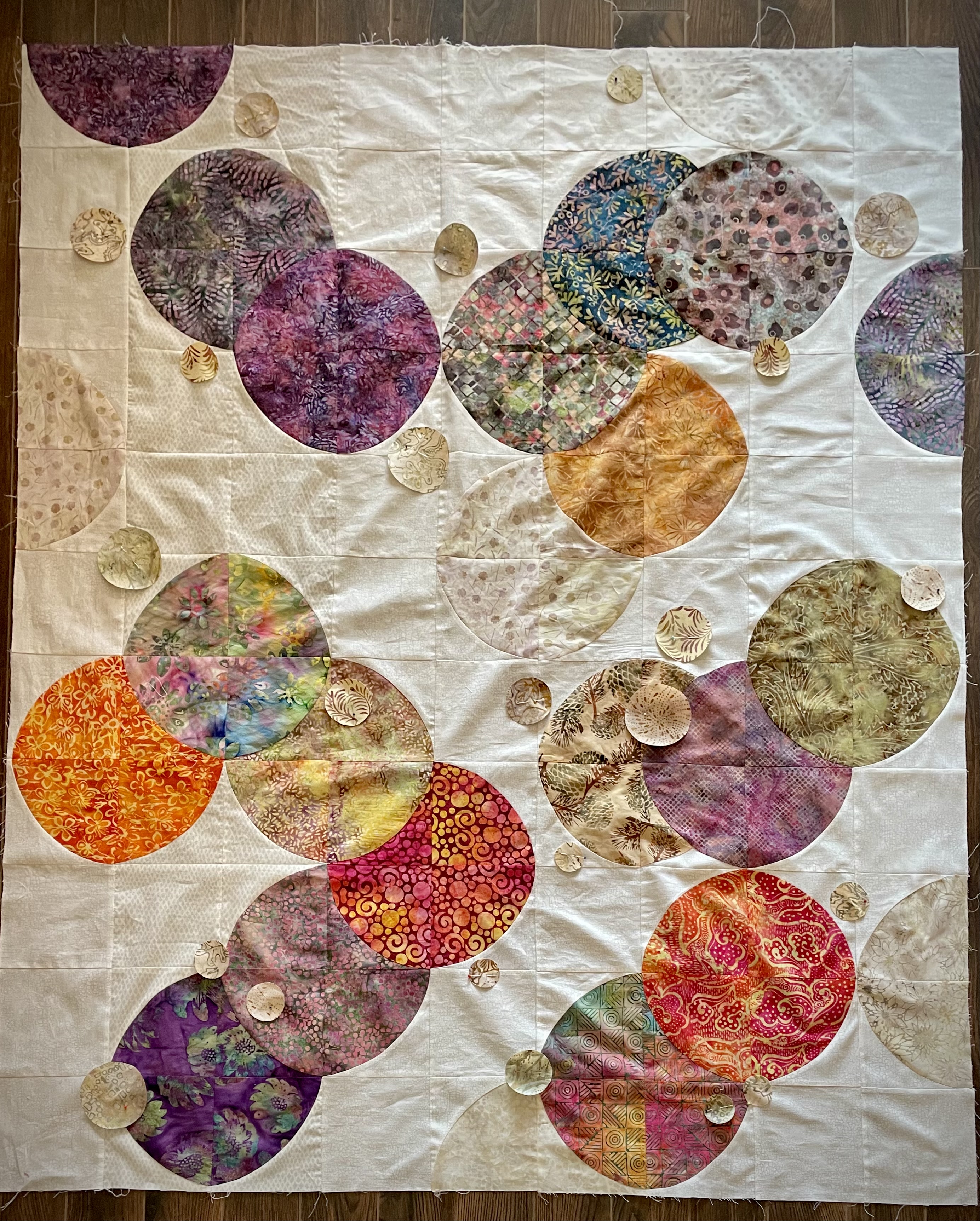
To compensate for my not-quite-round circles, I decided to appliqué smaller circles at strategic points – some are placed to eliminate the “pointy” bit at the seams, others to pull your eye from the flattened circumference.

I collected batik bits from a couple of scrap boxes, a range of light beige with a bit of contrast. These smaller circles are obvious but not blatant. I think this will rescue the quilt top. These small circles are pinned in place for now while I think about placement for the next couple of days. I will fuse them in place when I’m satisfied with the placement. I will also edge stitch them with decorative stitches and rayon thread.

If I didn’t mention the lack of circularity, you might not have noticed it, but I think you’d still feel a niggling something about those circles. This way, there’s more to look at and the eye isn’t drawn to that abnormality quite so much.

Because I’d cut all the pieces before I began sewing, the only real solution would have been to discard these pieces in a scrap box to reshape for a different quilt, and start from scratch with a more accurate quarter circle template. I had used all I had of some of these fabrics, I’d have had to redevelop the colour scheme; I’d have needed to order more crackle for background, come up with another stripe background fabric.

Not happening.

I am going to reshape the quarter circles on the back. I can get away with that, because I haven’t cut any “L” shaped pieces yet. So whatever template I find in my collection (or one I will make from template plastic) I will use to reshape the “pie” pieces and cut the “L” pieces. The sewing will be much easier than it was making these blocks!

Minimalist Quilt – Finished

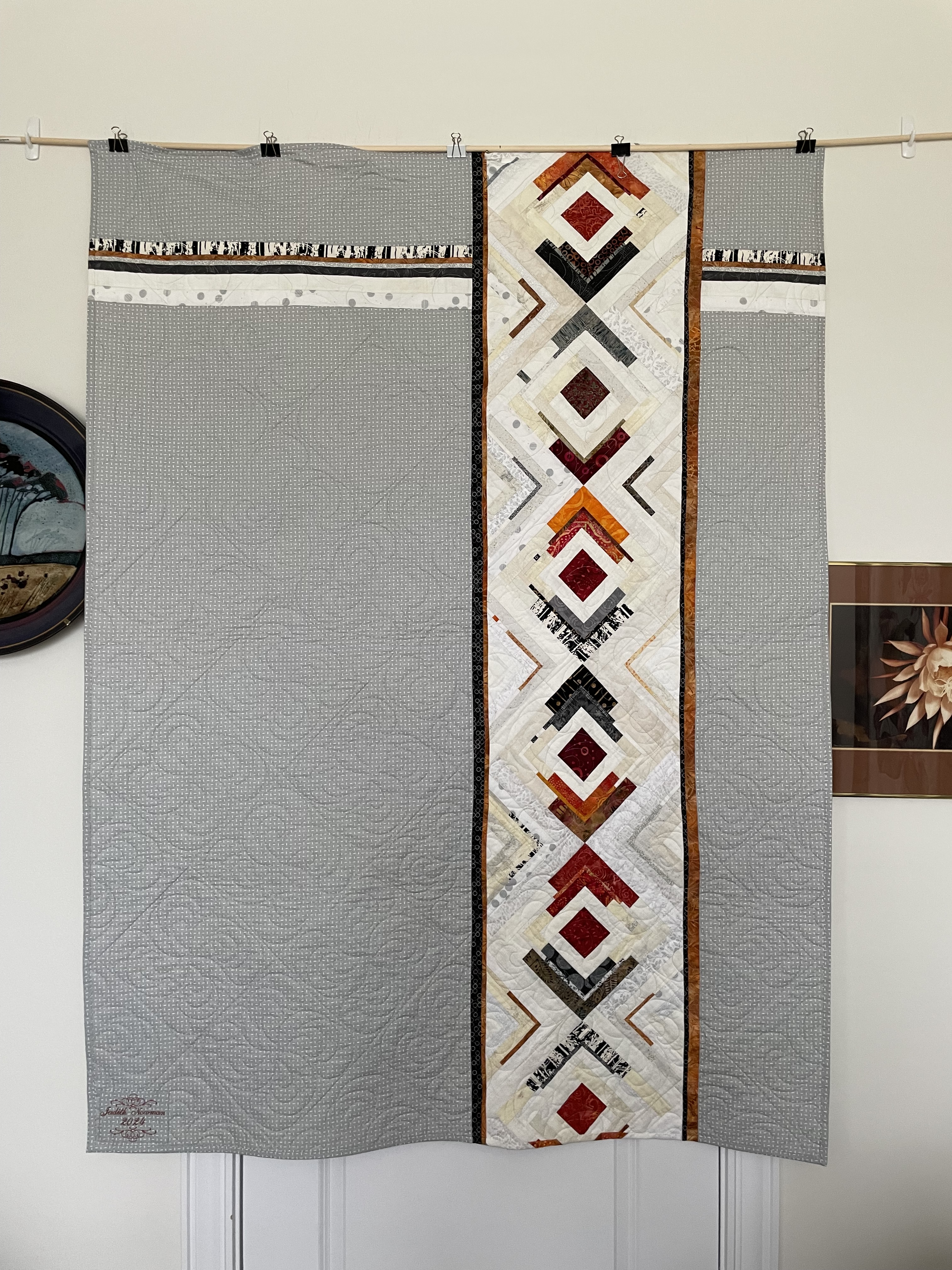
It took longer than I had planned (a variety of distractions took over and slowed the quilt work), but this quilt if finally completed! Piecing the back needed improvisation – I was short about 8″ of backing fabric so I inserted a horizontal strip. In the end I decided to use the trimmings from the back to do a narrow 1/4″ binding which I hand stitched on the back.

I’m pleased with how the quilt turned out. I like the range of shades in the “background” elements and the placement of the strong log cabin blocks (in fact all the blocks are constructed as log cabin, although the dimensions of the background blocks (light coloured ones) is different than the brighter coloured ones – this was necessary to vary the placement of the thin elements in each block.

I still have a box full of strips from this quilt that I’m going to have to do something with – I have no idea what yet, but I think if I start sewing strips together I’ll come up with some kind of block I can use for a new quilt.

Coming weekend I’m working with a group of women on the Zippered iPhone Case. One of the gals wants to use a #5 coil zipper (a standard zipper is #3 coil) on a somewhat larger case. So I figured I ought to try one myself.

Zippered Case with Decorative Zipper

There’s a challenge to working with a decorative zipper! Because it’s placed on top, it’s not simple to attach it to the fabric and lining. The accommodations I made for the front pockets were relatively straight forward, but adding the side zipper made it impossible to slip the open-end lining into the back…

Botched “phone” pocket!

Because of how I applied the side zipper which involved stitching down the lining, it was impossible to slip the phone pocket in behind the zippered pocket on the side!

I have to take this whole project apart and start over – I need to come up with some other way of adding the lining to the zippered side pocket so it lets the phone pocket slip in where it should go.

Organized II…

4th Round of Strips Organized

I spent the morning adding the round of narrow strips to each block. That sewing didn’t go quickly because I can’t chain piece anything – each strip had to be constructed as I worked my way around a block; no two strips are the same. I’ve made an effort to not use any fabric more than once in each round to avoid duplicates when I start joining blocks.

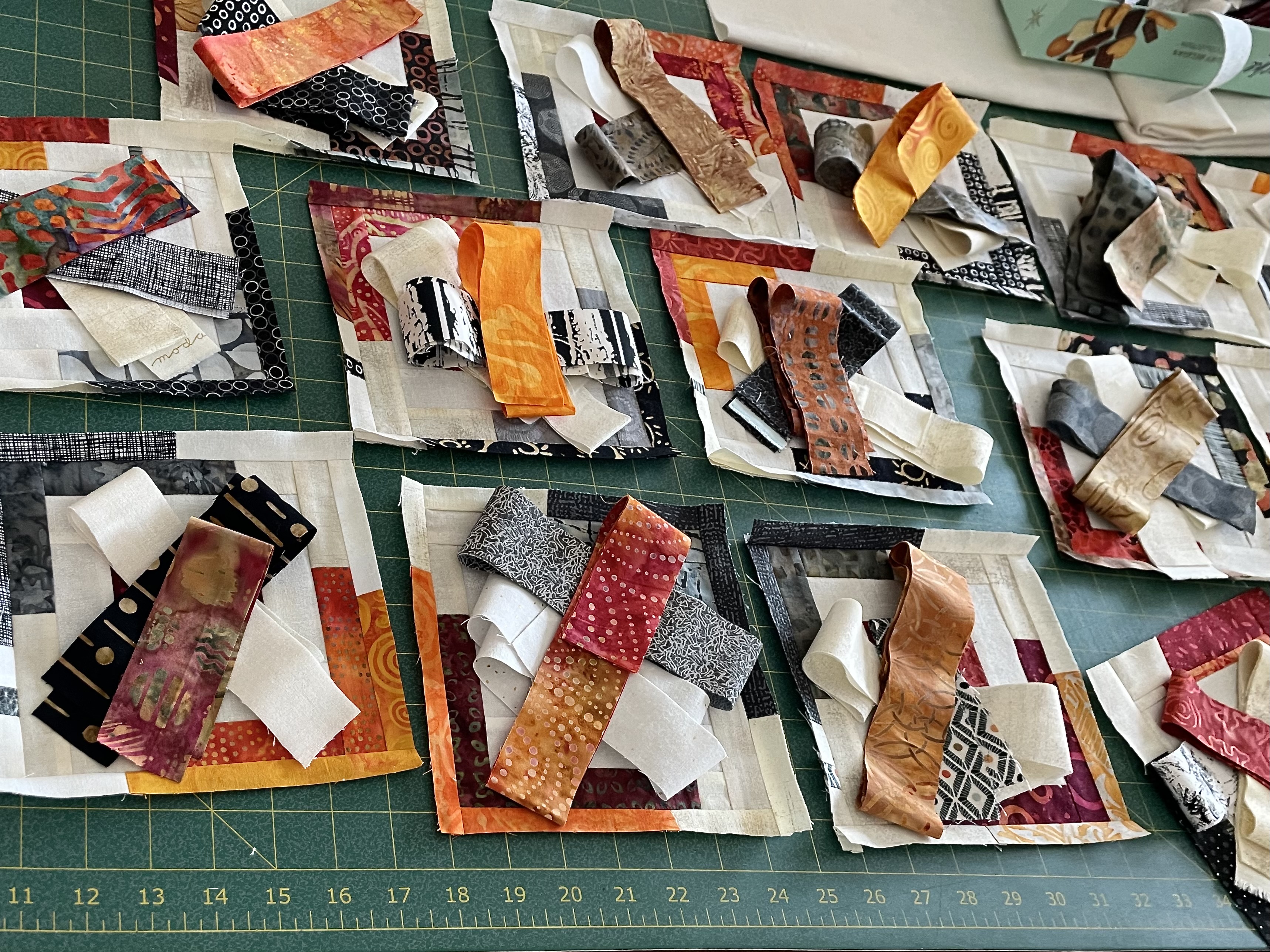
Once I was finished adding the narrow border to each block, I laid them all out and placed the strips for the next round on each, doing my best to avoid repeating, in this final round, any fabric I used in previous rounds. I will check that each block has no repeated fabrics when I go to sew this outer round of strips. I have enough different fabric strips to be able to do that. That’s the case for both the “reds” as well as the “greys”.

Now I’m set to do the last round on these blocks.

Organized…

Round 2 Set Up

So how do I organize the fabrics, the cutting, and the collecting so I can make ~20 different blocks? I figured out I needed to cut and sort three different sizes from each of the fabrics – 3/4″, 1 1/4″, and 1 1/2″. I sorted the sizes into different boxes (I had neither enough room nor boxes to sort colours, greys, and background light fabrics into separate boxes, so I sorted just by size.

3/4″ Sorted

I did the cutting and sorting yesterday. I also bordered and trimmed all 20 center squares (3″ blocks”). The bordering went quickly because I was able to chain piece the strips one side at a time. This morning I laid out all 20 of the bordered squares

Top: Bordered Centre Square / Middle: 1 1/4″ Strips To Add; Bottom: Level 3 Stitched

I’ve decided to add 1 1/4″ strips to 15 of the blocks, but to use the narrow 3/4″ strips with 5 of the blocks – so they’re not all the same construction.

Blocks with Level 2 Narrow Strips – Ready To Sew

The remaining blocks will have 1 1/4″ strips at Level 2, with narrow 3/4″ strips at Level 3. All blocks will have the same strip width (1 1/2″) for the outer round.

Now, I’m ready to sew. I’m starting with the 5 blocks with narrow strips. First I’m going to set up all the strips by joining background to the colour and grey strips, then add the joined strips to the centre bordered squares. Next, I’ll continue with these blocks adding the next two sets of strips to complete these blocks. Last I will work on the remaining 15 blocks, working on each level for all 15 blocks.

Although I can’t actually chain piece, this will be more efficient than completing one block at a time. This way I can audition the coloured and grey strips with all of the blocks at the same time and get a sense of the coordination I’ll be looking for when I go to assemble the blocks into the top.

Once I have these blocks completed, I still need to create at least a dozen blocks from just the light background fabrics to intersperse among these coloured blocks. I’m after a minimalist feel to the quilt so I need to reduce the amount of colour in the overall layout. I’ll tackle that problem when I’ve finished these bright log cabin blocks.

Time to start sewing!

I’m Back

I haven’t been travelling, just getting on with life with small projects I haven’t bothered to report on.

Boomerang Quilt Completed

I finished the Boomerang Quilt ten days ago (seems longer than that somehow). I took it to Sew With Vision to show the gals how I used the fabrics I bought there. Sally wanted me to display it to advertise a class we’re scheduling – you never know whether there will be any interest or not.

I’ve been working on darning some socks – one pair for me, two pairs for friends. I’ve another sweater needing restoration sitting with my knitting waiting for me to make time to work it.

A while back I came across another minimalist quilt which I’ve begun working on. It’s based on the Log Cabin block which I haven’t made in a gazillion years. Made from scraps, I thought it worth trying. I have no idea what size the quilt in the image turned out to be; I want a lap quilt – so something that’s approximately 50″x 65″.

Improvised Block – 9 1/2″

My first try gave me an idea for proportions – some wider strips, some thin, ending with a wider outer strip which includes the seam allowance. I want a trimmed block that is 9″ square finishing at 8 1/2″ square. My test block works, but it’s too large at 9 1/2″; I started with a square that is a bit too large and it’s bound by strips that are a bit too wide. By shrinking the square by 1/2″, and the first strips by 1/4″ I should end up with a wider outer strip and be able to trim to 9″.

Now for a second block with some revised measurements to see what I end up with. I have a bunch of “Grunge” fabrics shading from off-white to cream. The “background” of the quilt will be a blend of the light with orange/gold/deep red and various grey/dark grey elements inserted in the strips.

Off to sew.