The Latest Iteration

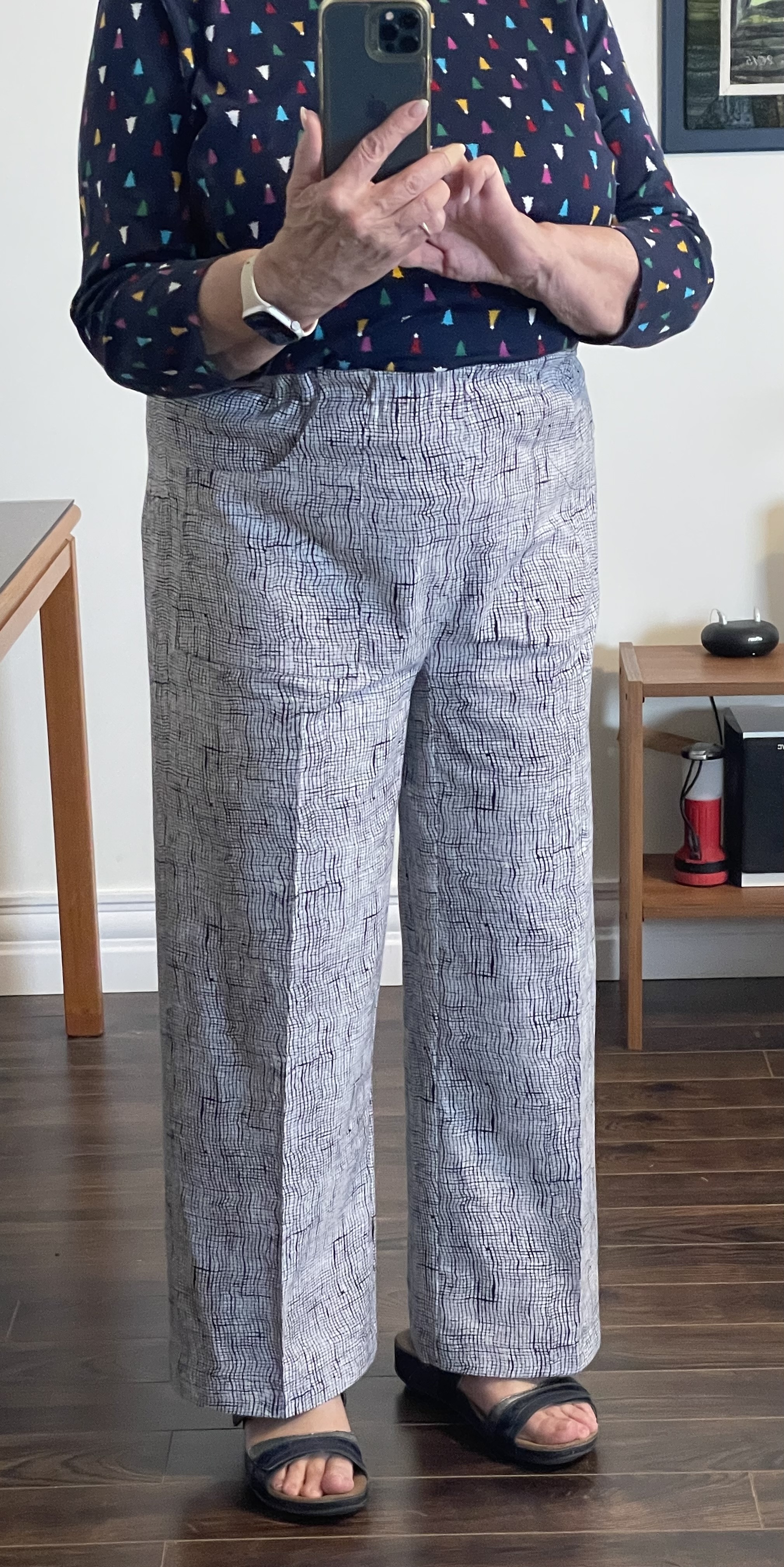
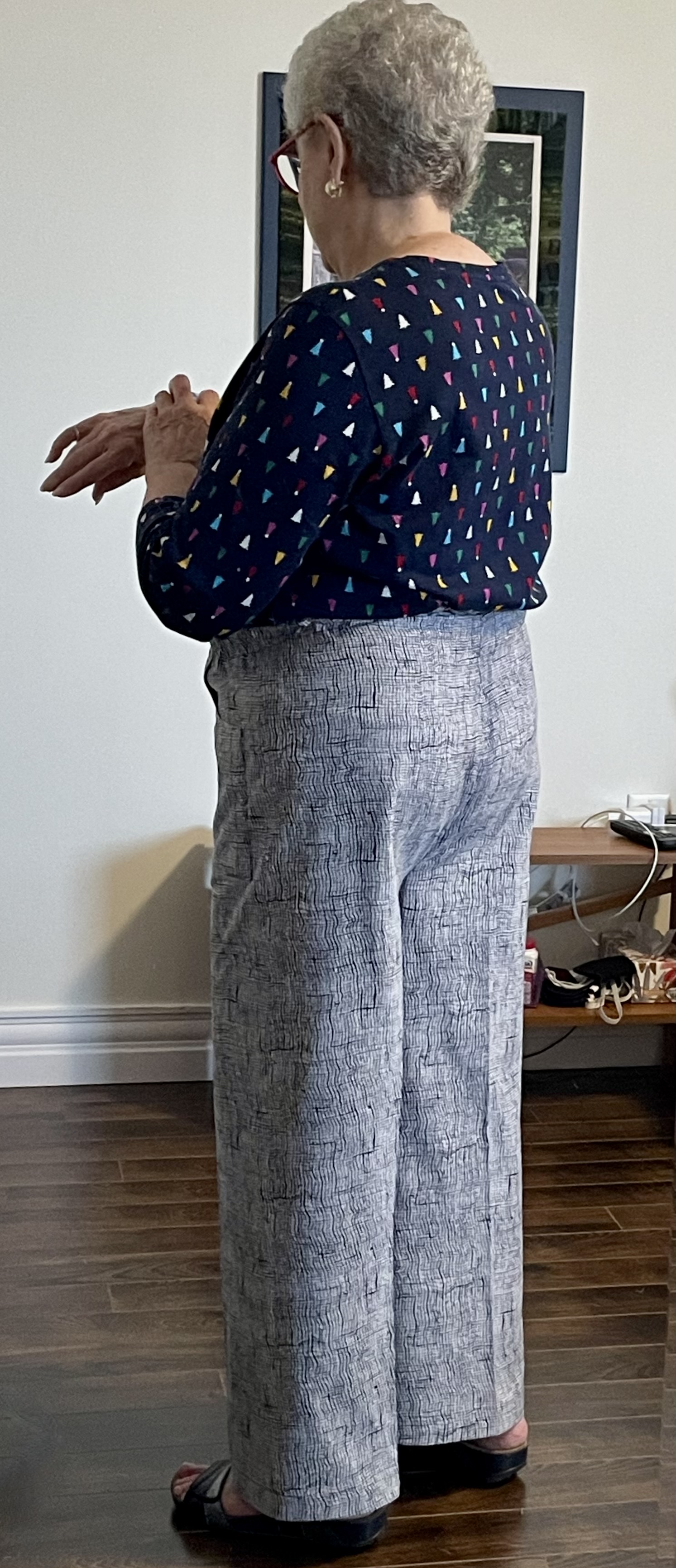
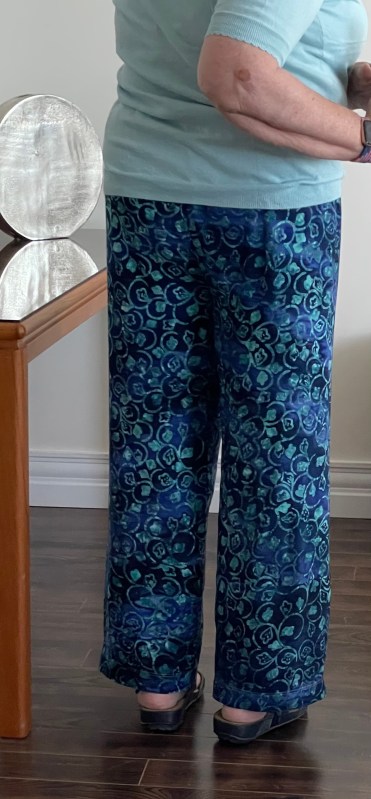
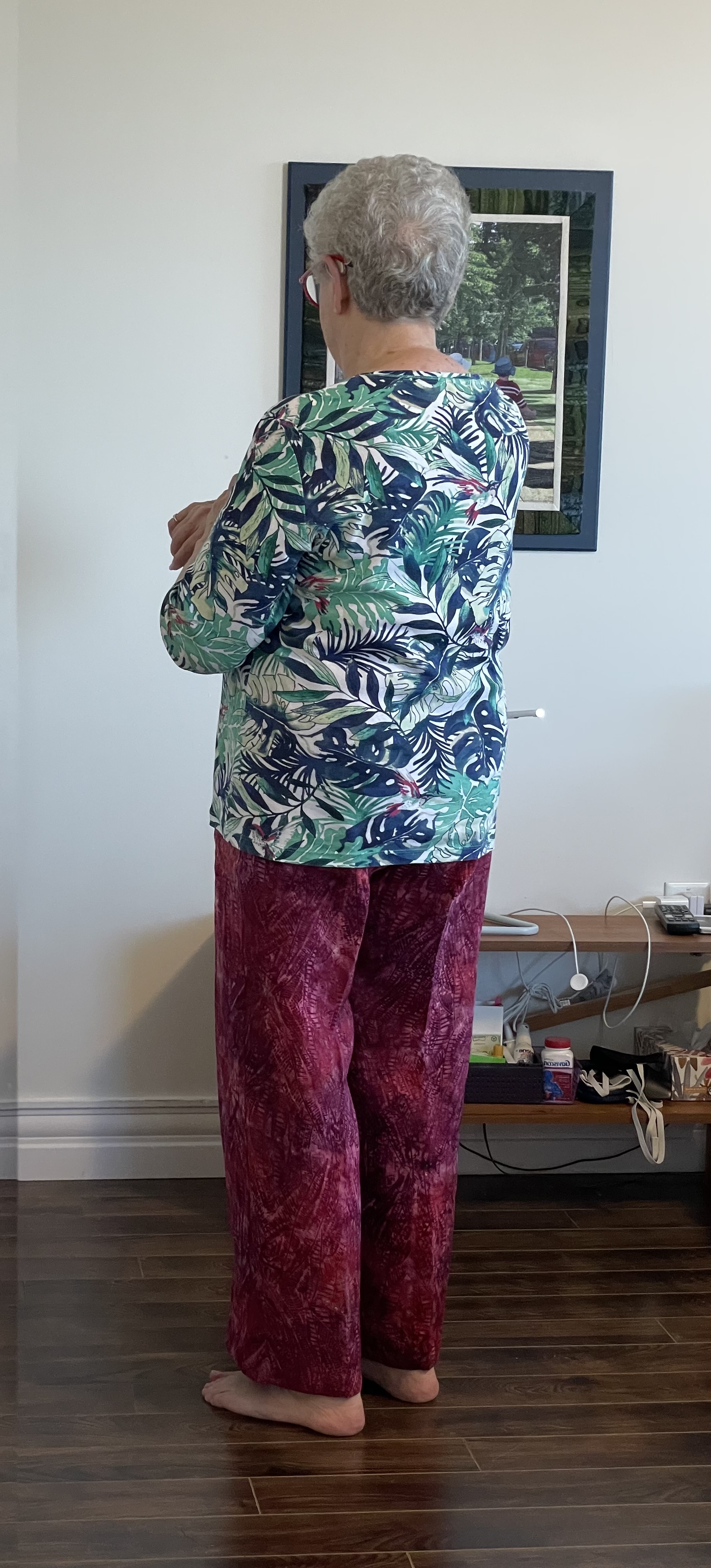
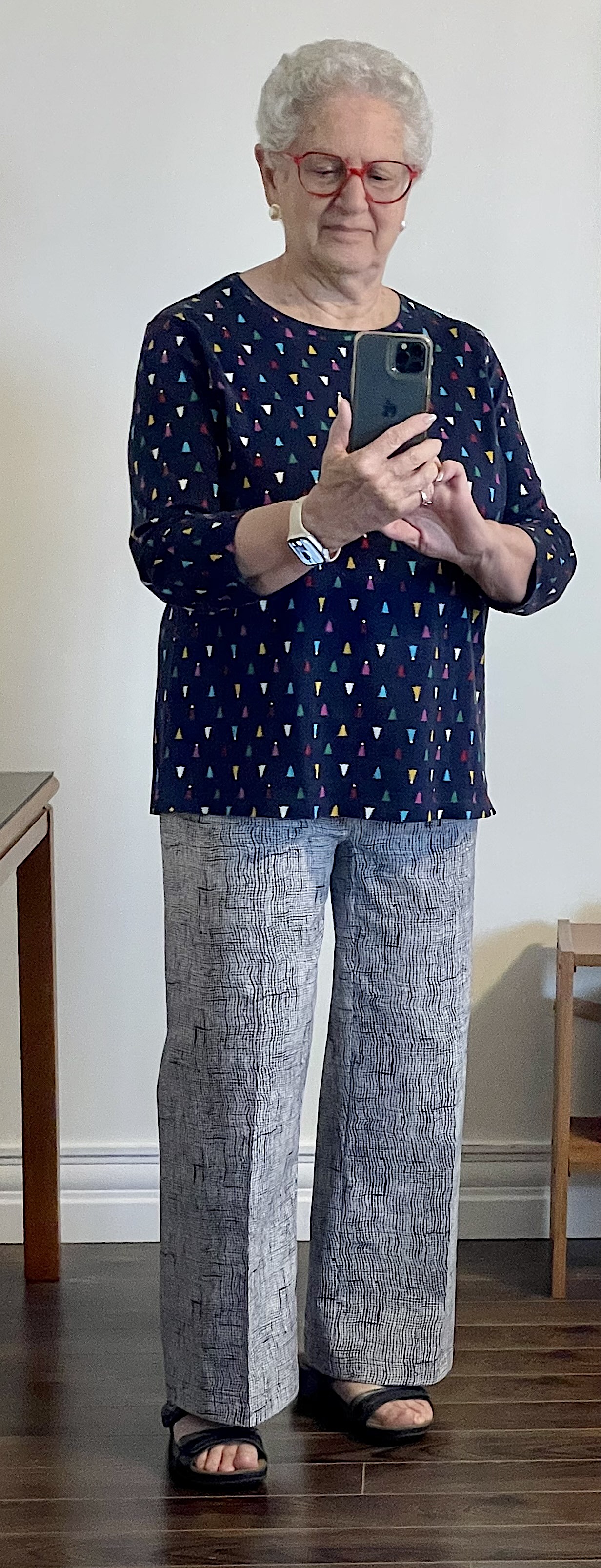
Here is the latest pants iteration – pull-on pants in a rayon batik I bought in Bali in 2014!

I redrafted the pattern again – adding 1/2″ to each side seam (front and back) which has given me a bit more room to sit down in. The crotch is also a bit wider in the back and extends closer to the knee which gives me slightly more fullness on the inner thigh which is helping the fabric fall straight from my bum and the inseam hang correctly.

I had intended to create a fly front on these pants but this fabric is soft and drapey so I folded the fly addition back and cut along the centre seam to make a straight front seam. I did want to shape the sides a bit but the waist on pull-on pants has to be as wide as the hips, so an elastic waist it is.

I made more work for myself with these pants – I basted the four panels together so I could try them on and assess the fit. I set up the waistband, then fit the pants to the waistband and it seemed I was probably close to the fit I wanted. Then I took apart the side seams so I could properly add the front and back pockets to the flat panels, basted them back together, and finally serged everything – in the order I would normally use for constructing pants. Just took longer.

Next time I’m not going to need to do the basting – this pattern is pretty close. For winter pants I am going to want the back to be shaped under the bum somewhat so the back dart will return, as will a fly front opening (which will allow me to taper the sides at the top).

I have to say, after all these years chasing a pattern and strategies for making pants that fit – I think starting with the straight monpei rectangles, building in the crotch triangles, adding a waistband, has got me closer than anything I’ve done before. I no longer have a “shapely” body – I’m straight, and flat, and dumpy! The peasant pants, based on two rectangles, gives me pant shapes on the grain of the fabric, with enough fabric where I need it and that hang straight from the fullness of my bum (given what little of it that I have).

I’ve actually learned more about making pants, particularly pants for myself, from this series of experiments, than I have for the past 30 years. I’ve drafted a pant sloper in the past, but the part that was missing, that I didn’t see, was pants are based on two rectangles based on a hip measurement and garment length from waist to hem (with seam allowances and hem added)! By adding a crotch based on the crotch depth measurement to one side of the rectangle, you get the curved shape around the hips, bum, and between the legs you need. You can add further shaping, if necessary, by removing fabric from beneath the bum with a dart down the back of the leg. You can remove fabric from the centre back and the top of the side seams if you have to to accommodate a curvy body shape. But you start with your hip measurement and crotch depth, which sets you up to draft the rectangular shapes that are the basis of the garment! Didn’t know that before.

My next attempt will be in corduroy (which has a small amount of stretch) – for fall.
Monpei Finished

Just finished the pants. Simple to make, and I can tell these are going to be VERY comfortable!

I was careful to make the crotch gusset long enough that the inseam is straight. The pants are cut from two rectangles; two triangles (which become the crotch gusset) are cut from the top/sides – I couldn’t do that because my waist is the same as my hips. So I cut the two rectangles (leaving them as is) – I merged the front and back leg into a single panel – so no side seam – but making sure the centre of the panel was on the straight of the grain. I also merged the two crotch triangles into a single long triangle with the vertical of the triangle on the straight of grain so I end up attaching a single gusset, rather than two triangles (a narrow one on the front inseam and a wider one on the back). The widest part of the gusset triangle is positioned at the crotch depth position in my case 12″ at the back/11″ at the front. [Click here for full instructions on how to make a montpei. (Click here for the original instructions.)]

When I tried on the basted panels (with crotch gusset sewn in) I could tell the centre back was going to be too short (I could have adjusted it by dropping the crotch gusset but instead I added a back yoke (2″ at the centre back grading out to the sides); I left the front crotch depth as it was. (I also took in the waist 2″ at the centre back – I didn’t need the extra fabric to pull the pants on.)

Because I wanted to add front pockets to the top of the panels I added them at this point; however they should have been sewn on while the panels were flat – to stitch them I measured 3 1/2″ from the centre crotch line marked it with a Frixion pen, turned the pants inside out so I could stitch the pockets with the panel “relatively” flat. Because the monpei have no side seam, I stitched down the side that would have been included in a side seam.

I created a facing for the waistband, attached it, strung elastic through the sleeve that created. I finished by top stitching the doubled over hem.

Done.

Here are the pants with my shirt tucked in so you can see how the top fits and the pocket detail which is hidden when the top is on the outside.

Although these pants have an unfitted straight leg, they fall nicely from my bum. The wider leg is easier to sit in, and the hip, while snug, is plenty wide enough to permit bending over.

BTW, I finally figured out how to get a reasonable photo of myself – I have a tripod which I set up so I didn’t have to focus the camera on my phone, I just had to press the shutter button on my watch – letting the camera remain focused and steady! (Duh… Don’t know why I didn’t occur to me to use the tripod before. Makes getting side and back pictures much easier!)

Because these montpei fit so well, I’m going to take the time to draft a sloper with the two crotch gusset triangles integrated into the inseam thereby eliminating the gusset (as they are on a regular pants pattern). I will adjust the centre back taking it in at the waist and extending the back crotch depth. My inseam seems to be about 26″ in these pants. I will set leg length at 26″ + 1″ for the hem. I’m curious to see how these would turn out in something like a light weight corduroy.

The finished fit is definitely the best I’ve encountered so far! This may be the starting point for any pants I want to make for fall!

On Fitting Pants

Donna DeCourcy wrote me today

“I look forward to your progress on pant fitting. Currently, I make all my own clothes and am frustrated by pants. I enjoy your blog immensely and finally changed my password and made the roundabout route to get back to finally making and leaving a comment!”

I answered her:

  • jmn Donna, pants fitting and making is difficult and frustrating because you’re working from a flat piece of paper and you’re trying to create a garment that is curvy in a number of different locations that are different on every body, and your body changes constantly!
  • You can’t count on a pattern you got to work once to work with a different fabric that has a different weight or a different amount of give (stretch). You can’t know for sure a pattern you made six months ago will fit you today! Unlike a top or a dress or a skirt which fits more loosely, pants (particularly today’s styles) fit closely, so there’s not much forgiveness in fitting – they fit and are comfortable, or they’re not and you start over again. 
  • I’ve been chasing patterns and ideas for fitting pants for at least 30 years! At the moment, the closest I’ve come to getting a pattern to work is “Top Down, Centre Out” which fits the waistband first, then drapes the pants pieces from that, making the adjustments in the toile/musin as you’re making the pants.
  • That’s why I just make “wearable muslins” (prepared to discard the project) because as far as I’m concerned each new pair of pants (from the same pattern) is still a work in progress, never a sure thing.

I added another comment later:

Monpei #2

This pair of pants is a Monpei: Here’s how I made them: https://jmncreativeendeavours.ca/2021/07/25/the-japanese-monpei/

You might want to give this idea a try. It’s surprising how well they hang on me! I’m about to make another pair from some Japanese katagami fabric I’ve had for a couple of years.