I’m conducting a workshop on Saturday with a group of women interested in learning how to do heirloom sewing. In preparation for the day I made a new panel myself (in part because I need a couple of new nightgowns to replace two that are just about to rip apart from long wear).
I started the panel with a lace insert, added pintucks to each side, followed by a row of decorative stitching, then tucks, some hemstitching, more decorative stitching, finishing with a final row of hemstitching. I added an entredeux to the bottom where the skirt of the nightgown will be attached.
This panel is ready to be made into a nightgown.
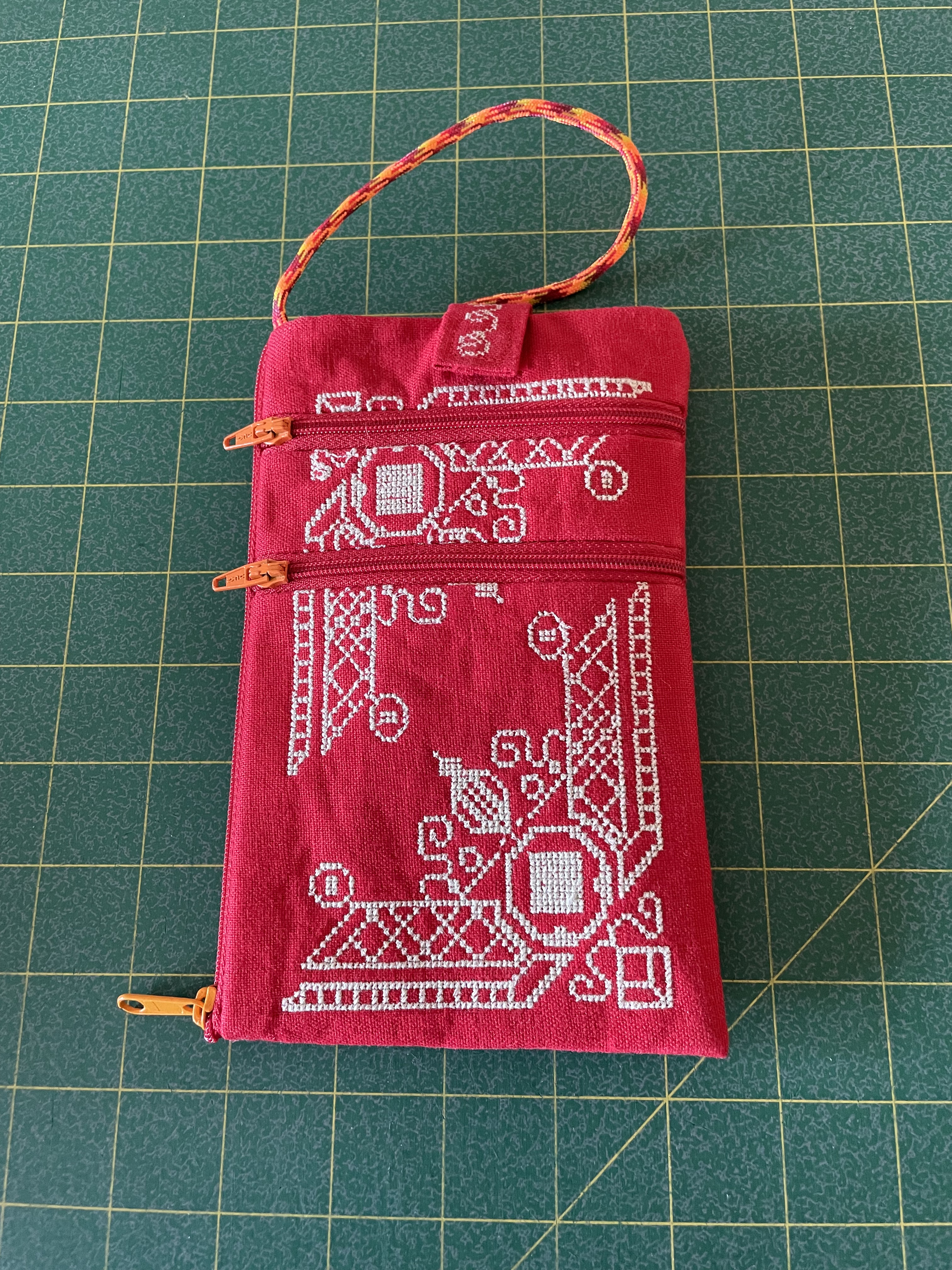
A couple of weeks ago, in preparation for a workshop on constructing a small bag with lots of zippers, I made this embroidered iPhone Case. I used a scrap of linen I had on hand, did a cross stitch embroidery in a contrasting thread, then made the bag. I chose zipper tape that blended with the fabric colour, but added contrasting zipper pulls. Because I have made so many, I can whip up a zippered bag in under a half hour!
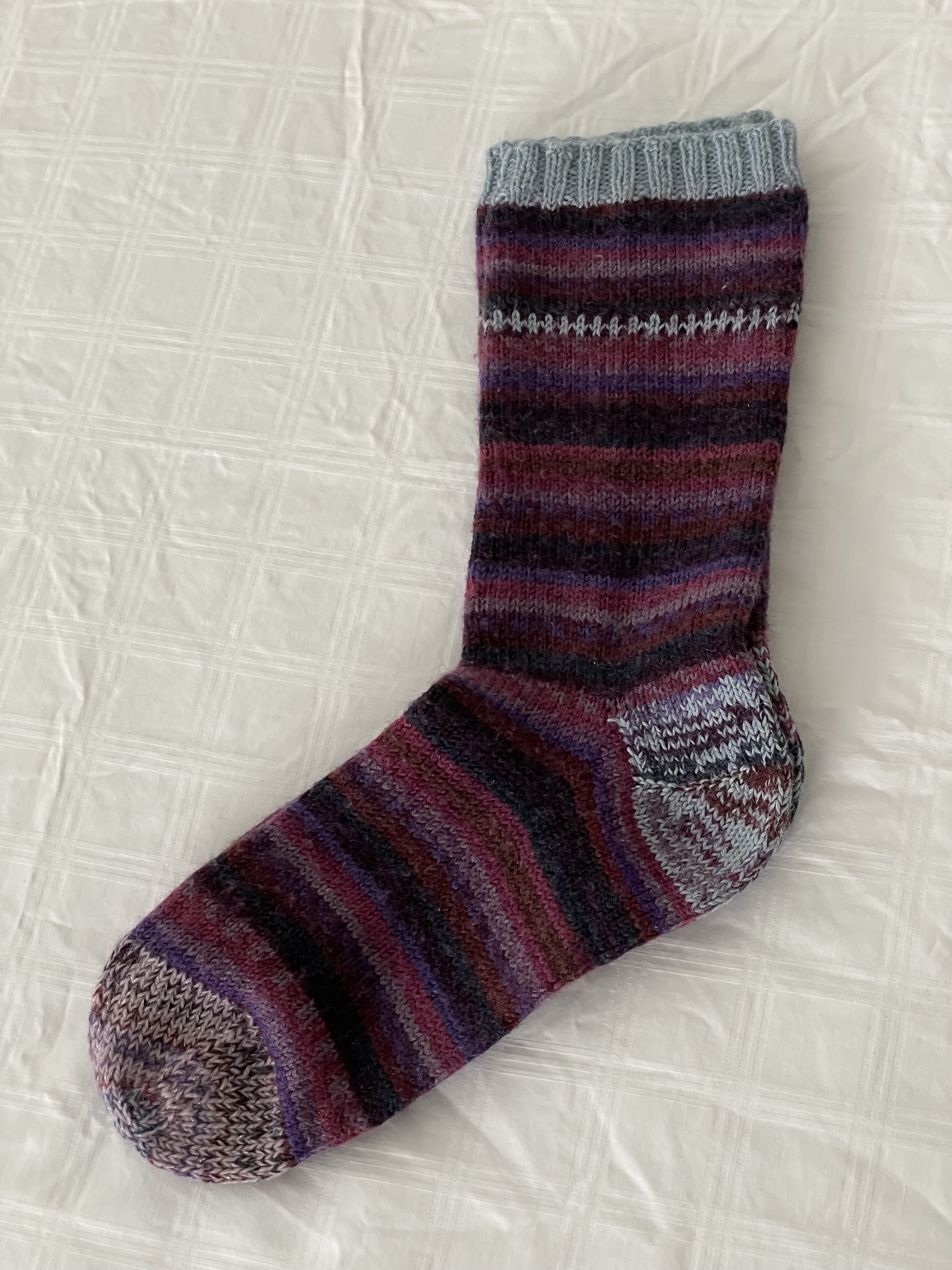
Also, I always have a pair of socks on the go. This pair took at least a week longer than usual because other things kept getting in the way of my knitting time. They are now done.
And last, I had two pair of socks with holes in the toes – first time in 25 years – since I started knitting socks!
New Toes!
It takes me an evening to knit a new toe. These socks are repaired – like new – and back in my sock drawer. I’m working on the second pair – they needed more radical attention – both toes and heels were seriously weakened – I decided to salvage the legs and knit new feet. The first of that pair is getting close to finished.
So Saturday I will be helping the gals with their heirloom sewing. On Sunday I hope to cut out a tailored shirt from a very wild linen print I’ve had in the stash – my intention is to wear it as a light summer jacket.
I’ve been remiss about keeping up with what I’ve been working on; I’ve been busy, nevertheless.
A younger friend is getting married on June 8. She needed a wedding gown. She tried shopping for one but wasn’t enthusiastic about what was available. I suggested she make one.
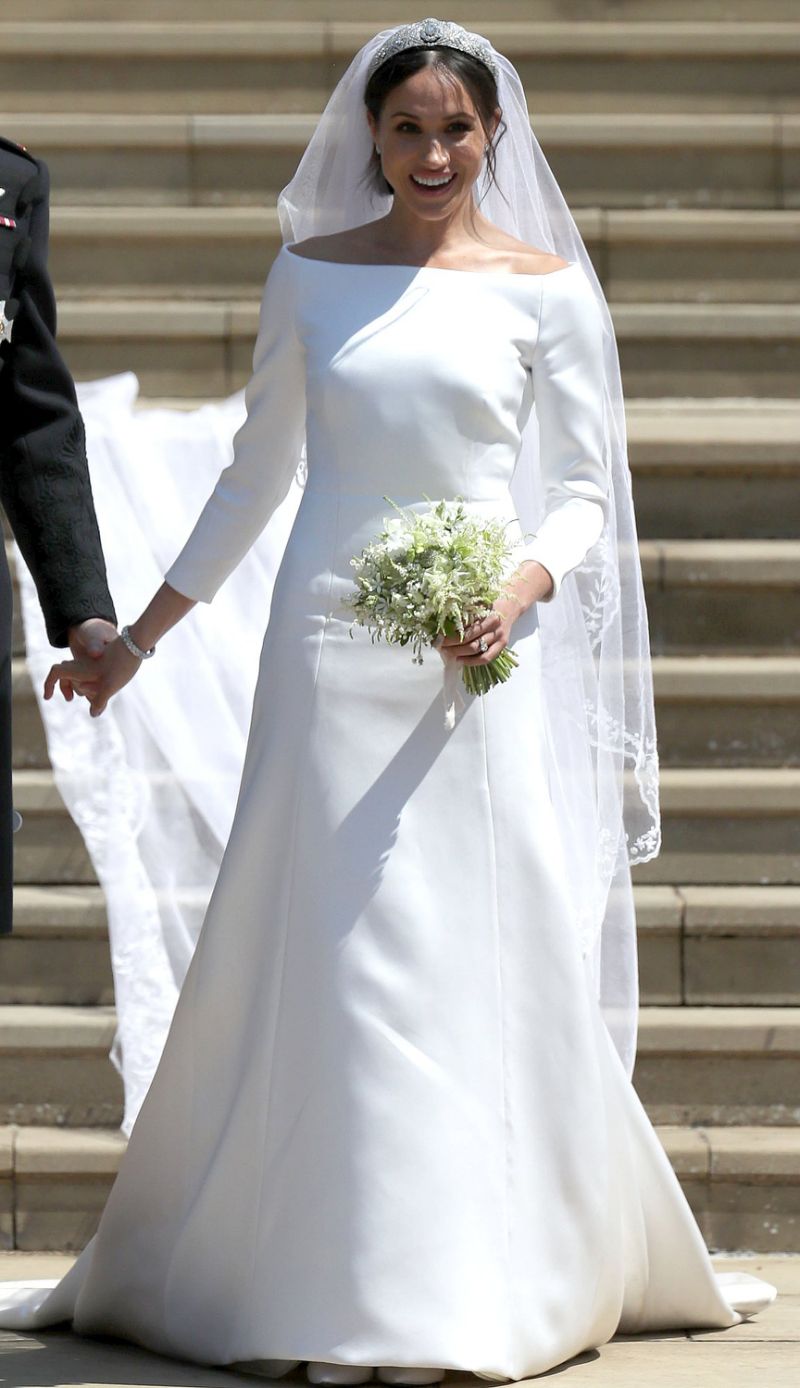
I sent her a photo of the wedding gown worn by Meghan Markle – stunning in its simplicity. Completely plain, a silk organza over a woven silk, princess fitted dress with sleeves and a clean neckline; no lace.
Same thing – clean lines, nice neckline, sleeves, and pleated skirt (which falls gracefully like a princess cut). Then I went to an online fabric store in India specializing in silk – FabricsandTrims. I’ve bought fabric from them before so I knew what we would be getting. I was suggesting an off white silk dupioni which would have a bit of sheen but also some texture and would drape nicely.
Marni a quilter; hasn’t done much garment making, but if I would help her, she was willing to take the risk. So she bought the pattern, we ordered the silk and the interfacing. She picked up thread, and an invisible zipper. We were set to go.
We traced the pattern, made a few small adjustments. Then we worked on a wearable muslin – potentially a light-weight summer dress. As we worked our way through the muslin, which went quickly with each of us sewing different parts of the garment, I made adjustments to the dress which I transferred to the traced pattern. It took us as I recall three sewing sessions to make the muslin which is definitely wearable!
Now for the silk. We’d already applied the interfacing to five of the eight metres of silk so that was ready to be cut. Our challenge was this – the skirt at the bottom was 51″ wide, our fabric was 42″! So I had to make both the front and back skirt in sections. I chose to embed the seam I created on the inside of the side pleat so it would be more or less hidden. We made a mock-up of the skirt using black quilting cotton to check the position of the seam – it was fine. Finally we cut out the dress (which took just 4 1/2m of fabric – better to have too much than not enough!).
Trusting that the adjustments I’d made to the pattern were accurate, and with both of us sewing, we began constructing the dress. First the bodice, next the bodice lining. Marni serged all the remaining edge seams on the sleeves and skirt to keep them from fraying. We added the band to the front and back of the bodice (and bodice lining), and sewed the neckline seam. Next we attached the sleeves. Now we assembled and added the front and back skirt panels. Here’s when the invisible zipper was installed and the back seam finished. Last we stitched the underarm and side seams. In two sewing sessions we had a completed dress.
Today we did the finishing – hemmed the bottom on the machine using a blind hem foot; hand stitched the hem on the sleeves, and finished with a hook and a loop to close the top above the zipper.
Done.
The finished “Upton” dress
There’s one last decision to make – Marni wanted some kind of embroidered embellishment on the band joining bodice and skirt. I made some flowers using two layers of silk organza with a tear-away stabilizer.
Flower Appliqué
Whether to add the flowers or not is her last decision. I prefer the dress unadorned. However, I sent the appliqués home with her – she can decide what she prefers.
A happy bride-to-be. I even wrote Cashmerette letting them know how pleased I was with how well the pattern worked out for us.
We began the project on April 4. It took us 11 sewing sessions to make two dresses.
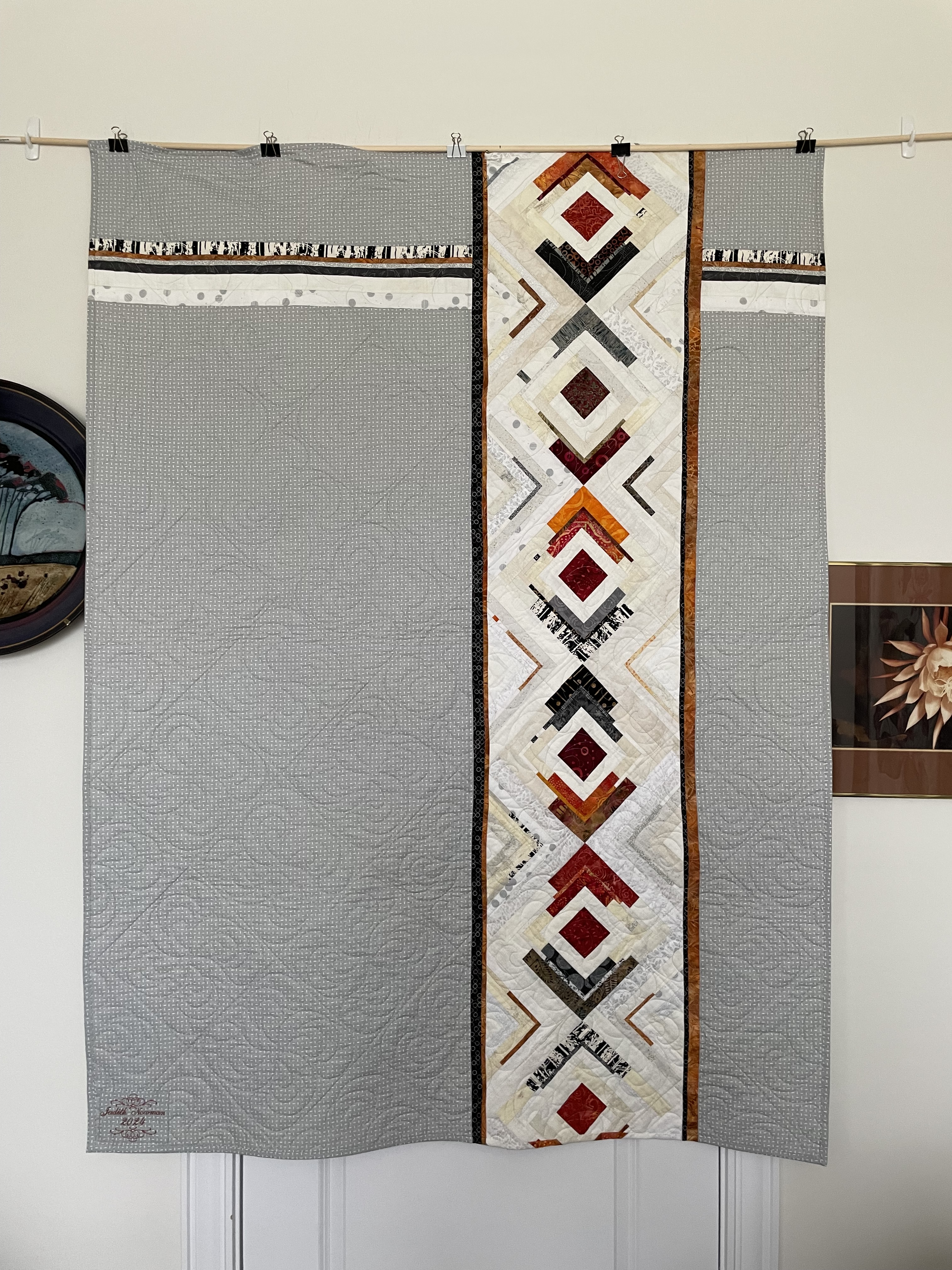
It took longer than I had planned (a variety of distractions took over and slowed the quilt work), but this quilt if finally completed! Piecing the back needed improvisation – I was short about 8″ of backing fabric so I inserted a horizontal strip. In the end I decided to use the trimmings from the back to do a narrow 1/4″ binding which I hand stitched on the back.
I’m pleased with how the quilt turned out. I like the range of shades in the “background” elements and the placement of the strong log cabin blocks (in fact all the blocks are constructed as log cabin, although the dimensions of the background blocks (light coloured ones) is different than the brighter coloured ones – this was necessary to vary the placement of the thin elements in each block.
I still have a box full of strips from this quilt that I’m going to have to do something with – I have no idea what yet, but I think if I start sewing strips together I’ll come up with some kind of block I can use for a new quilt.
Coming weekend I’m working with a group of women on the Zippered iPhone Case. One of the gals wants to use a #5 coil zipper (a standard zipper is #3 coil) on a somewhat larger case. So I figured I ought to try one myself.
Zippered Case with Decorative Zipper
There’s a challenge to working with a decorative zipper! Because it’s placed on top, it’s not simple to attach it to the fabric and lining. The accommodations I made for the front pockets were relatively straight forward, but adding the side zipper made it impossible to slip the open-end lining into the back…
Botched “phone” pocket!
Because of how I applied the side zipper which involved stitching down the lining, it was impossible to slip the phone pocket in behind the zippered pocket on the side!
I have to take this whole project apart and start over – I need to come up with some other way of adding the lining to the zippered side pocket so it lets the phone pocket slip in where it should go.
I set up a couple of embroidery designs to audition for the quilting. The first was a straight line design that more or less followed the log cabin layout of the blocks – the first block stitched reasonably well; the second wouldn’t align with the first! So I carefully unstitched both blocks and returned to the drawing board.
Quilting The Diagonal…
Next I decided to try quilting on the diagonal, more or less following the piecing lines at somewhat unequal intervals… I did quite a bit of stitching before I decided I couldn’t live with it and again carefully picked it all out!
Quilting The Quilt
Third I set up an enclosed embroidery design that fit the 8 1/2″ block size. The problem I ran into had to do with my embroidery machine losing calibration each time I tried precise positioning the embroidery within each block! The issue, I thought, was the belt driving the “y” axis element of the embroidery unit was a teeny bit loose, as a result it slipped when I tried locating the corners of each block. The drag created by the quilt itself was too great for the unit to move the hoop consistently without the belt slipping and losing calibration.
I packed up my machine, embroidery unit, and quilt on Thursday morning; took it into the nearby shop so the repair guy who comes in once a week with the machines he’s fixed that week could see what was happening. I set up the machine on a table in the classroom, started quilting – all went smoothly! When Neil arrived do you think I could make the “slipping” happen? I could not. I rehooped the quilt a couple of times trying to position the bulk of the fabric so it would pull against the embroidery arm when I attempted to locate the corners of a block. I COULD NOT get the embroidery arm to go out of calibration. So I packed the whole thing up and returned home.
Before I set it all back up, I happened to visit my friend Deb who mentioned that the new Husqvarna Epic 3 machine warns new owners to make sure the machine is LEVEL so the embroidery arm works. Maybe I was having a problem with my sewing table having developed a dip and the machine was not sitting level, now. So I pulled out my trusty spirit level and placed it on the bed of the machine in front of the needle. Ever so slightly dipping toward the embroidery unit!
I loosened the feet on the unit to lift it a bit; not quite enough to bring the spirit level to neutral. I placed a small piece of foam core under the feet – that did the job. The machine was now level. Guess what – the embroidery arm hasn’t slipped since (well just once in the 16 embroideries I’ve completed). Whether that was actually my problem, or something else inadvertently fixed itself I’ll never know, but I’m starting to trust the embroidery arm again.
[I won’t bore you with the long story about how I broke the “y” axis drive belt on the embroidery unit; Neil repaired it, and it looks like the arm is now working as it should!]
This is the back insert now sewn together. It’s 6″ longer than the front which will allow me to use the trim for a hidden binding on the quilt back. I’m planning on a narrow rust/golden sashing, next to a wee bit wider black (with circles) strip, with an asymmetrical wider outer sashing in the light grunge fabric. The finished insert will be sandwiched between two soft grey fabrics with different small scale prints. Their colour doesn’t quite blend but I think the insert will override that slight difference.
Time to move on to other stuff – I’ll get this back done tomorrow; maybe I’ll even manage to create the quilt sandwich. Then I have to decide how to quilt the project. Once it’s pinned I’ll have a better idea what would work with the colour and texture flow. I’m anticipating straight stitching that is echoed at unequal intervals will likely look best (starting with some stitching in the ditch to stabilize the layers…).
Just finished sewing the panel. No more mistakes that had to be taken apart! The stitching went smoothly. What I’m liking when I see it like this is the shading within the background – not too in-your-face. That’s probably because the contrast is strong enough to draw your attention away from the background.
Now to start on a backing. I’ve got to make two more bright blocks to create an on-point vertical row and several background blocks to fill in as triangles. I have two suitable light grey print fabrics that work together. With a wide strip between them they’ll work fine. (The point is to use what I have in my stash!).
On-point blocks get sewn together along the diagonal with the end triangles attached to the side of the adjacent block. So what emerges are the quilt edges.
I have to work from one corner to the diagonally opposite one, one strip at a time, making sure I’ve pressed the “matching” seams to the opposite side from the previous row. You’d think it would be possible to work from one corner to the middle, from the other corner to the middle and join the two pieces – but you could find you’ve got the nesting seams pressed wrong! So better to start in one corner and keep going, even though you have to work with the increasing bulk of the growing top!
Another possible pitfall – the one I fell into – was to attach the last row in the wrong direction so the colour flow I wanted didn’t happen! I had to rip that seam, carefully, rotate the row and resew it. You can see, I’m checking position of the next row before sewing it!
The quilt top is finally filled in, although I’m probably going to change the two top corners. I did a kluge, building on a partial block I had left over from the light blocks which I cut on the diagonal. However, the orientation of the corner blocks is obviously out of synch with the rest of the triangle border – I have to build one more large block and cut it into quarters to get the corner orientation I’m after.
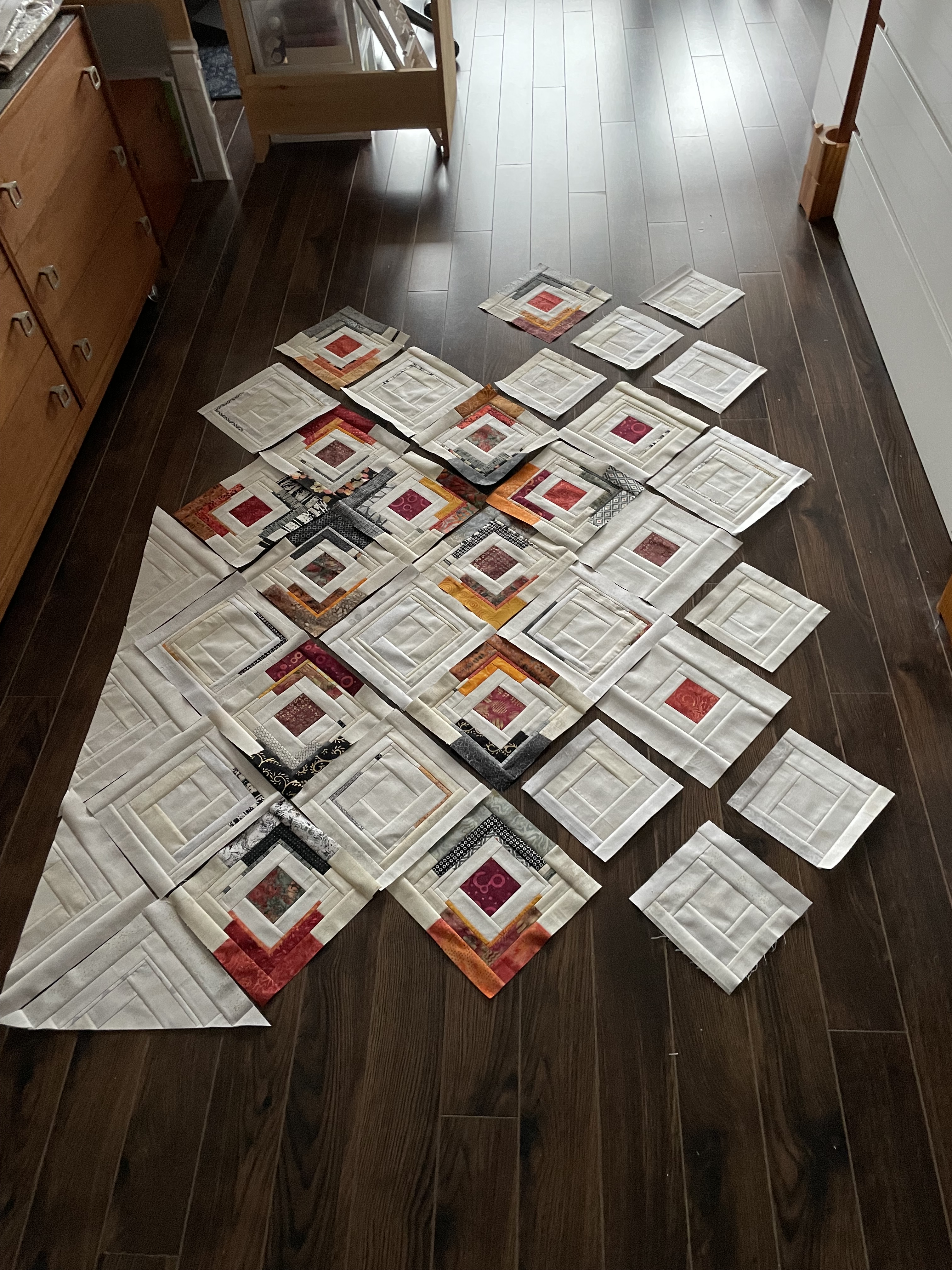
Also this probably isn’t the final block placement – I’m happy with the bright blocks, but the light ones are still place holding. Nevertheless, you get the drift of how the quilt top will look.
I have to clear some of the mess on my cutting table and around the machine I was using to piece these blocks before I can assemble the top. Also I now need to think about what to do with the back! And it’s not too soon to consider how to actually quilt the project. Because the piecing is intricate, I may not get away with an embroidery based on curved elements. I may have to actually do a lot of echo quilting along the diagonals – not sure how my back will stand up to that close work!
For now, I better build two new corner blocks for the upper corners…
An update on the “log cabin” quilt – I’ve been building light blocks to fill in around the coloured ones:
Filling In
Eight of the light blocks are only partially constructed – I hope to complete them today. I think I’m also going to add one more row to the top end which will mean three more light blocks – that addition will add 6″ to the length of the quilt which will give it better balance: ~50″ (width) x ~68″ (length).
To be able to continue making the fill-in blocks I went shopping two days ago to pick up a half-dozen more light fabrics. I wanted a bit more variation in the colour pallet for those blocks than I had. Hard to tell from the photo but I’ve blended those fabrics into the blocks as I’ve been constructing them.
This project is coming along block by block. I’m not pre-cutting pieces, but rather working with the long strips and trimming after I’ve attached each piece to the block. When the blocks are finished, I need to do the triangle elements for the edges – those will be tricky because I want to include narrow contrast elements in them and will have to anticipate placement as I construct each of the large blocks (10 1/2″) from which the triangles will be cut!
When this yarn arrived, I thought I’d never bother knitting it into socks because the black was such a stark a contrast to the red and orange. But as my yarn stash has dwindled (I’m trying to use up what I have) I picked it up and started working on it. The dark red cuff/heel/toe balanced the black nicely. I finished the socks and put them in my sock drawer – perfect to wear with burgundy, or black, or dark grey pants.
JoAnn’s Socks Finished
JoAnn is a member of our Friday afternoon knitting group here in the building. Since everyone is knitting, she wanted to knit, too. Her hands no longer coordinate well enough to work with needles, but she was fine with a knitting “loom”.
Knitting Loom with Stylus
She’s worked away at her socks for the better part of two years, I’m sure. But last week she completed the foot on the second sock. I took over from there, taking the sock from the loom and knitting the toe for her. Then I washed and blocked the socks. I decided to add a row of single crochet to the top of the socks to stabilize that edge (careful not to make it too tight).
[I also knit the heels – I couldn’t figure out how to do that on the loom, so when it came time to turn each heel, I took the sock from the loom, put it on needles, turned each heel, then restored the sock to the loom so JoAnn could continue her knitting.]
JoAnn’s Socks
I was happy with how they turned out. I’m sure she will be, too. The mismatch happened because the pattern didn’t play out precisely the same in each ball of yarn and when she got to the second toe (the one on top), I had to work with a small ball of yarn leftover from the first sock so the pattern didn’t synch. Who cares, right? The toes are inside her shoes.
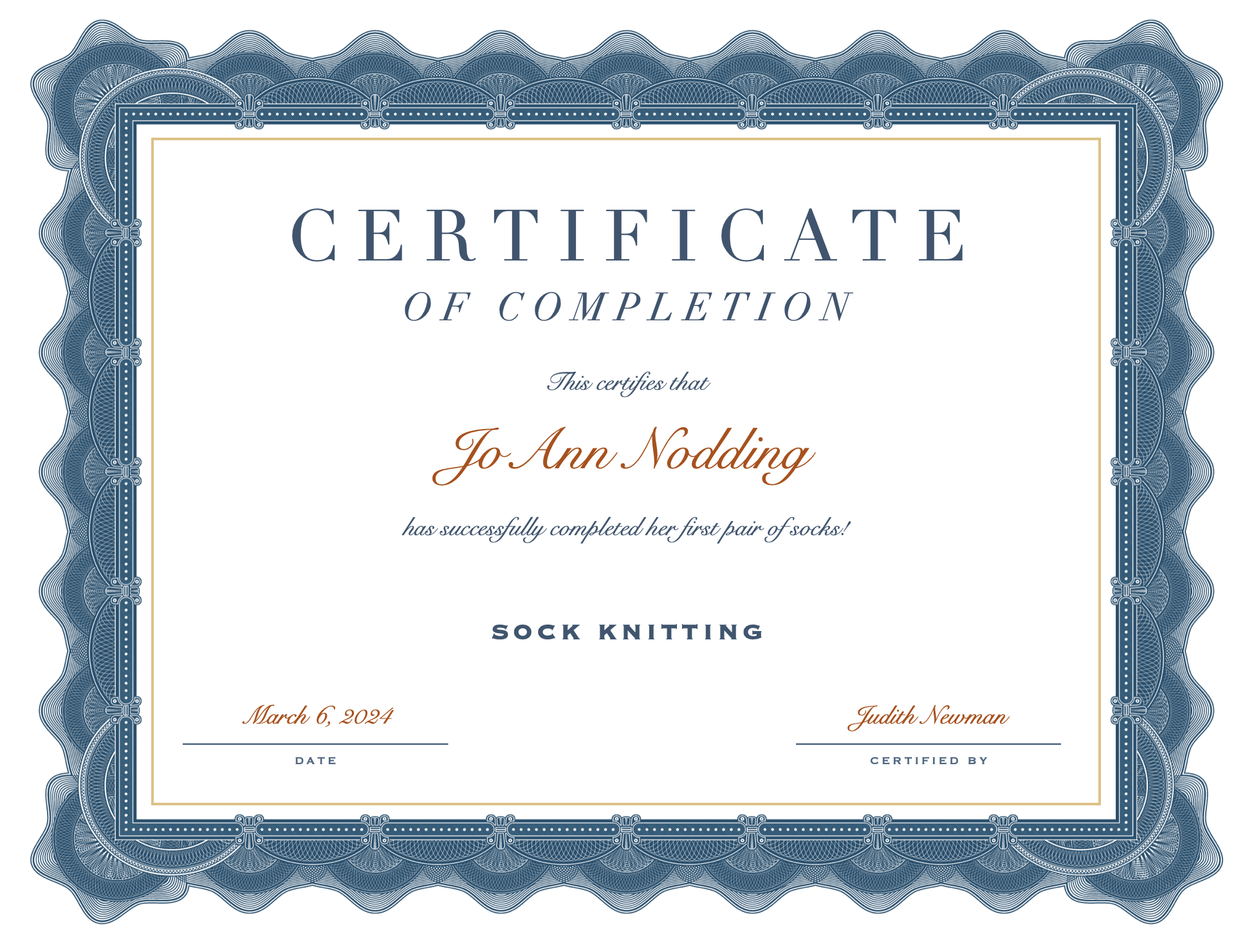
The Certificate of Completion
I even did up a “Certificate Of Completion” to celebrate her accomplishment!
More Sock Repairs
Debbie’s Heel RepairRuby’s Toe Replacements
My friend Ruby slowly knits away making socks but when it comes to repairs, forget it. The socks on the left belong to her daughter Debbie. The heel (of the sock on top) came to me with a very large hole in the heel (why one heel and not both I can’t explain). So I cut out the old heel and knit a new one. I had more yarn like the original (it’s no longer in production), just not in the same colour. Same with the toe replacements on Ruby’s socks – the mismatch is less obvious there because I was able to find a spot in the yarn that kind of matched with the original socks.
I still have one last repair job waiting for me. My very old LL Bean cotton sweater has worn out in one arm – I discovered a large hole the last time I wore it. The question is whether to do a visible repair, or to see what I can find in a matching yarn, to close in the hole. I want to get to it soon so I can clear off the table beside my chair where I knit in the evenings (while watching TV, of course).
One Last Thing
Today my boomerang quilt was showcased in Nancy’s Notions Thursday Newsletter! I submitted the information (with photos) a couple of weeks ago. I’m delighted the quilt will be seen by a lot more people. It may inspire some to improvise from quilts they come across, or at least try to replicate them without a pattern. As a teacher my aim is to help people learn to deconstruct how a quilt is assembled so they can improvise quilts of their own based on traditional quilting techniques. In the piece, I explain how I made this quilt so others can give it a try themselves.
I had time early afternoon to construct five more blocks and set up three more with red centres which will be predominantly white. So try imagining the empty spaces with blocks constructed using just the light fabrics (with maybe a hint of grey, or perhaps a touch of red/orange in one of the layers.
I’ve decided laying the blocks on point lets the colour flow better than having them sewn in straight horizontal/vertical rows/columns. (Although I may try that layout once I have all the blocks constructed.)
I hope to get the remaining coloured blocks sewn tomorrow. Then on to making a bunch of white one.










 jmn
jmn 