An amazing cloud colour – bringing out the colour in the buildings below. Caught the moment quite by chance. A few minutes later the clouds were dark, all orange had disappeared. I haven’t edited the image except to crop it a wee bit. I thought about cropping it further to remove the cars and power lines as much as possible but found I wanted to keep the green foreground for contrast to emphasize the wonderful orange of the sky.
Two hours to prepare the pans (lining with parchement), mix the dry and wet ingredients, add dry to the fruit and mix well, add wet to the whole thing and mix again using a very strong long handled spoon/spatula/whatever you have including hands! I put my lobster pot in one of my kitchen sinks so I can reach inside it easily. I kept licking, then washing, my right hand as I mixed the fruit and batter.
I have 9 two pound loaf pans and 5 small pans now in a 325° oven and it already smells divine!
The small loaves will cook in about an hour/hour and a half; the larger loaves will likely take between 2 and 2 1/2 hours. I’ve set the time on my watch and will keep checking the oven to make sure all is well there.
Because the cakes are all packed in tightly, it takes longer for them to bake – the great thing is this concoction is very forgiving and because I want it baked but moist, slightly underbaking them isn’t a bad thing. I’ll take the cakes from the oven when a wood skewer comes out clean.
I’ll add a photo when I’ve taken the cakes from the oven and put them on racks to cool. It’s a wonderful site. One Christmas thing checked off my list.
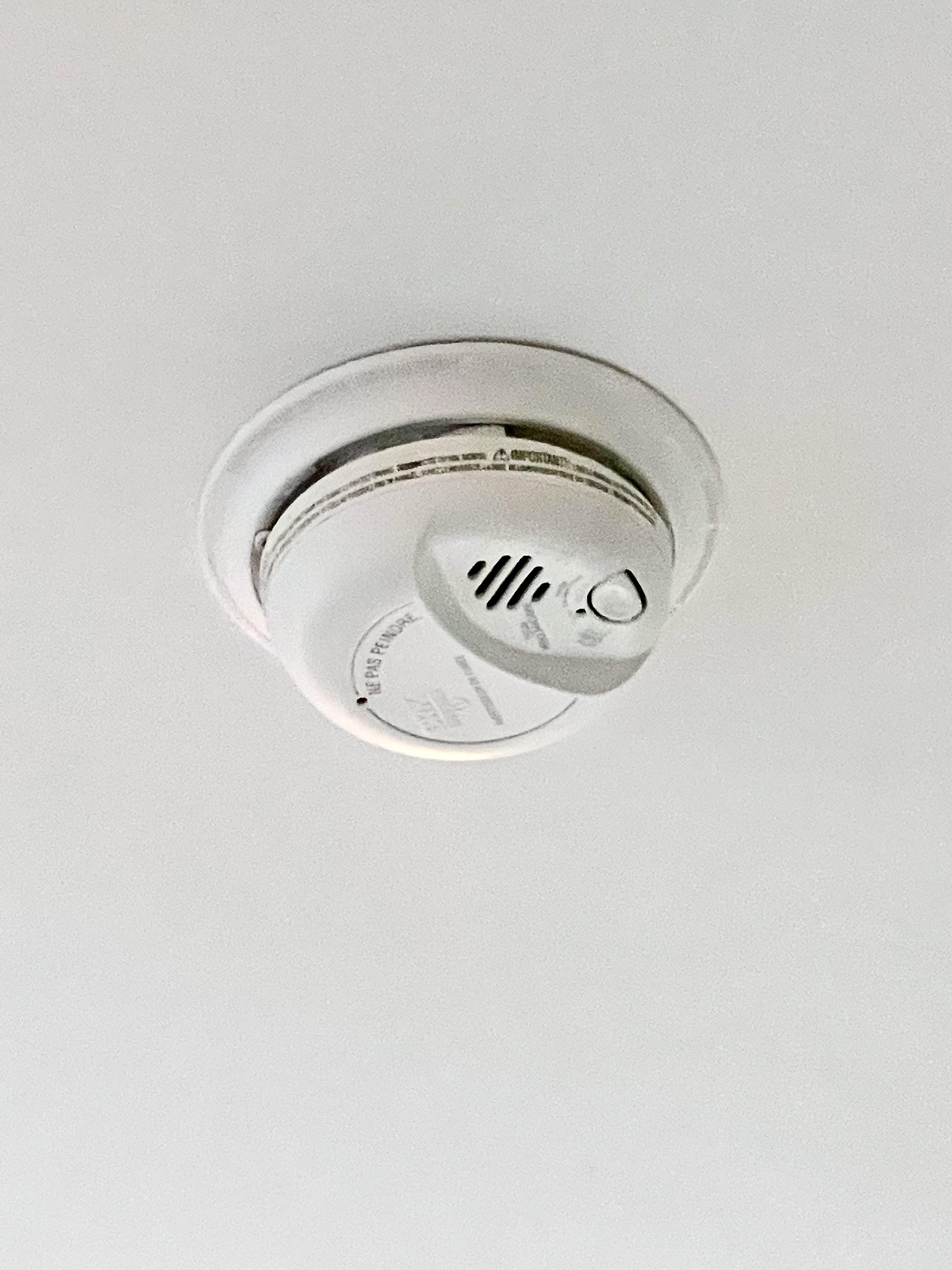
I had an interesting experience about five weeks ago. I needed to change the batteries in the three smoke detectors in my apartment. I change them yearly ( I keep a post-it on the wall in my storage space with the date I last changed them). I don’t want them waking me in the middle of the night screaming when the batteries die.
I had bought batteries. I got out my step ladder, positioned it under the first smoke detector. Climbed to the second step – I’m too short to reach the ceiling from there. I go one step higher – but now there’s not much to grab onto to prevent me from tipping the ladder or losing my balance. I get down, reposition the ladder closer to the doorway, which I can hold as I climb back to the third step to change the battery. I manage to rotate the detector, pull it down, find the battery door, open it, take out the old battery, then fight to put the new batter in. Takes me 5 minutes or so to change that battery. I move on to the second, then the third, both taking less time since by now I have figured things out.
As I descend from the third smoke detector I breathe a sigh of relief – job done. But I also recognize this is the LAST time I am going to do this job myself. I will have to find a younger able neighbour who will do this for me next year!
This was another of those “last time”s I seem to be encountering at this point in my life.
I’m 78. Still exercising three mornings a week at the neighbourhood rec centre. I’m reasonably fit, balance not bad, but after my mattress flipped me onto the floor breaking my wrist and compressing a vertebra two years ago, I catch myself, as I go to do something that could be a bit hazardous, and wonder whether this is the “last” time I do whatever it is, or in fact, was the last time I did it, THE “last” time.
I’ve been thinking about “last” times a lot lately. A year ago I bought an automatic transmission car although I’ve driven a standard stick shift my entire life. I miss shifting gears! But I realized most people don’t know how to drive a standard shift car and were I to be somewhere and find myself not feeling up to driving I’d be stuck unless one or other of the people I’m with can also drive my car. I bought the automatic. It was the sensible thing to do.
I see my world beginning to narrow. I’m probably not going to make that solo drive to Toronto although I love driving long distances on my own; I’ve done many solo long distance trips in my life; but probably not again. Over the past 15 years I’ve travelled to out of way places on my own to join a group interested in textiles without a second thought. The last two times I became ill – fortunately I didn’t require hospitalization, but I know my solo long-distance travelling days are over.
I think this past COVID year and a half has helped me accept how my life plays out from here – taking satisfaction in visiting with friends, enjoying the creative endeavours I undertake, pursuing the iPhone photography in greater depth, making more textile art. I have enjoyed these past 18 months even though there weren’t enough hours in the day to get done everything I wanted to accomplish. I’m getting better at picking up today what I didn’t manage to complete yesterday.
I have longevity in my genetic makeup (at least on my father’s side of the family), so I’m not expecting to wind down anytime soon. However, as Atul Gawande’s “Being Mortal” reminds us, we all need to be thinking about “end of life” long before an actual end of life arrives.
In the past month I’ve had conversations with two younger friends, both have mothers with dementia, both the daughters with responsibility for making difficult end of life decisions for their parent. Both have had lengthy, searching journeys to get to the place where they are comfortable facing and accepting the near end of life for that parent. I’d suggested they watch Being Mortal on PBS – it has helped each of them take control of the difficult conversations they need to have with medical staff at this point.
I’ve begun keeping a record of my “very last time” moments – not with any sense of foreboding but as an essential aspect of my personal adventure. I’m not exactly slowing down, I’m still getting much accomplished every day, but once in a while I notice that I’ve probably done something I would have tackled without a thought for the “last” time.
I feel like Maggie Muggans – “I don’t know what will happen tomorrow”. Although those “last” times will continue to come along, I know new doors will open when others close. Besides, we ARE living in interesting times!
While I’m waiting for the white/black fabric I ordered from Newfoundland to arrive so I can finish the Delft #2 quilt top (should arrive sometime this week), I’ve caught up on a couple of other things: I made a new iPhone carry case and I recovered my ironing board.
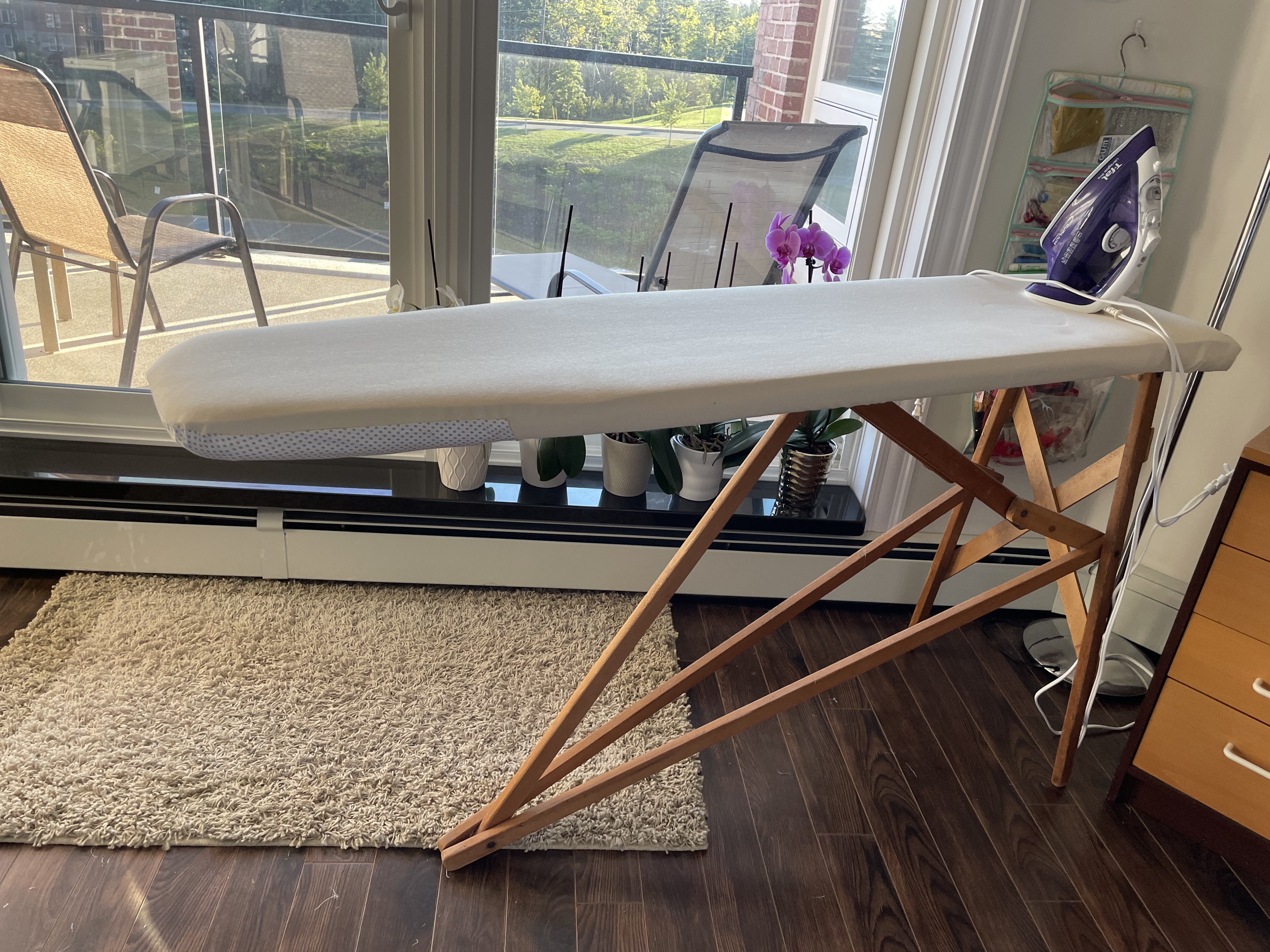
I’ll start with the ironing board.
I don’t recall how I stumbled across an ad for a wool ironing board pressing mat but it was advertised for half-price. I’d never have paid full price, I’d have used batting leftovers under a new cover but the price was reasonable so I ordered one. It arrived promptly, I trimmed the 18″ x 54″ wool felt piece to fit my board (had to use some trimmings to lengthen the pad, I fused the pieces together using fusible tape for joining batting pieces), then recovered the board with an unbleached twill. A nice clean ironing surface with that terrific wool pressing mat underneath it. It works very well – glad I bought it.
It took about an hour to recover the board – I had the piece of unbleached twill tucked away from the last recovering – I serged the edges of the twill, and used my heavy-duty staple gun to attach it to the bottom of the plank (I left two previous coverings beneath the wool pressing mat – that extra padding can’t hurt).
My Ancient Ironing Board
My ironing board has history. I bought it somewhere around 1964 from the Salvation Army Store in downtown Toronto for $1.50. Even then it was a relic – I’m guessing at least 50-70 years old but still solid and serviceable. The board itself was a shaped plank covered with several layers of flannel underneath a cotton covering nailed in place. At the time, I left that original covering in place and recovered the board with fresh fabric. I have recovered it many times since – at some point I removed all previous coverings and started new. The time before this recovering was when I moved into the apartment in 2016 – five years ago. The accumulation of Best Press (a pressing starch) had scorched the twill and I felt it was time to recover the board.
I’ve tried metal ironing boards but they don’t compare with my antique. This board is a comfortable height, slightly wider, and close to a foot longer than a standard metal ironing board. Now that my board has a fresh twill cover with the wool pressing mat beneath I’m in business for at least another five years.
The ironing board itself is an heirloom – it should be passed down in the family; for sure, I should itemize the wool pressing mat in my will – it’ll last generations. However, I don’t imagine anybody will realize the value of this treasure and it will be taken to the dump when I’m finished with it. Sad.
I wanted the case a small amount wider than the one I was using. I’ve stopped carrying a purse of any kind – I’ve consolidated what I carry with me so that it all fits into this small zippered pouch. In its original iteration the case had a single side pocket. I’ve added two more zippered pockets to the last couple I’ve made.
The previous version was a good size for my iPhone with cough candy and gum in the side pocket but when I decided to carry my essential ID – drivers’ license, car permit and insurance certificate, health card, a credit card, as well as a small amount of cash, I needed to add a couple of pockets. However, as I stuffed in those new additions the whole thing was just a bit too small to easily get the ID and other cards in and out. It was time to make a new case.
I had enough leftover kid leather from a skin I bought in New York at a leather warehouse in 2012 to cut a 5 1/4″ x 15″ rectangle. I cut two narrow strips from one end so I could insert zippers for two shallow pockets. It took less than an hour to assemble the pockets, and complete the pouch, but it turned out just a bit too wide, so I opened the lining bottom, and trimmed about 3/8″ from the seam side. Should have been a shade less than 1/4″ – the credit cards and other ID fit in the pockets better, but there’s no comfortable spot for my chapstick! The phone catches on it when I slip it in. Looks like I have two choices – make another just that slightly wider, or leave the chapstick behind!
It’s a lovely day today – another of those bright sunny hint of fall days we get in late August/early September (Alistair MacLeod refers to it as “The Closing Down Of Summer”). Taking a ride with a friend to the Parrsboro shore to pick up farm fresh eggs. Looking forward to the day.
Saturday, a lovely day in town, my friend Deb and I decided to head to Martinique Beach to fly kites. An hour away Martinique is a great location, usually with steady wind for flying large kites. I’d packed kites and reels and gloves and we set off only to encounter dense fog as we approached the beach and the beach road clogged with vehicles belonging to the throngs on the beach. We managed to find a spot to leave our car for a few minutes to take the boardwalk over the dune to the ocean but you couldn’t see much – dense fog and hordes of people. We stood for a few minutes then headed toward home.
Yesterday, I decided to fly closer to home. I drove to the Bedford waterfront and walked down the pier – another good flying spot with wind from a wide range of directions and open space to fly over the basin.
I have no pictures from yesterday because I was flying on my own. I had no trouble getting the kite up – but was the wind ever tricky – coming from different directions depending on altitude so the kite behaved erratically. I was glad I wasn’t trying to help a beginner keep their kite aloft. I flew for perhaps a half hour, controlling the kite was relatively easy as long as I was letting out line but although I reached 250′ in altitude I wasn’t finding steady air so I decided to reel the kite in – that’s when it decided it wanted to dive – let the line out a bit, steady the kite, then slowly pull in some slack. Took me a good 20 minutes to bring the kite back in – with more than 250′ of line now laid out all over the pier. It took another 15 minutes to wind up my line, roll up the kite, before I was ready to return to the car.
The last time I flew was on July 29 2019 with Mattie, my grandnephew at the Bedford waterfront. The day Mattie and I were flying we had a steady 20kph wind coming from the land behind us and Mattie had an easy time controlling the kite.
Mattie Flying
One time before that I was again flying at the Bedford waterfront with my large snowflake – don’t remember who took the picture.
Why heavy gloves you ask? Because if the line goes through your fingers at any speed – it burns! And there are times you just need to let the kite have control.
I must get out again soon. I understand why people love to go fishing – kite flying is very much the same – it takes some close attention but is very relaxing – can’t be thinking of much else when you’re flying a kite.
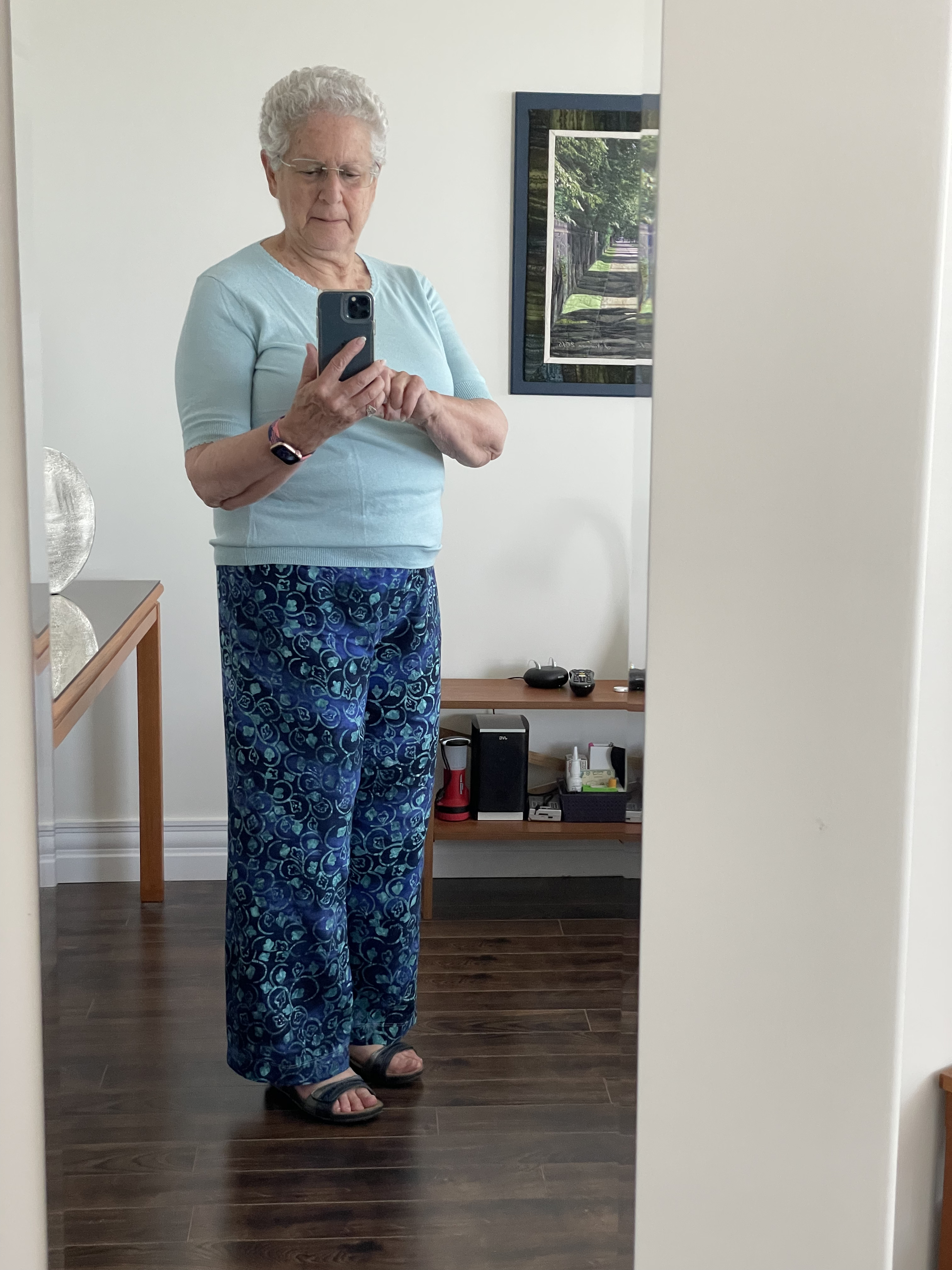
The Japanese monpei are working pants constructed in such a way that there is no waste fabric – you cut triangles from the waist area which you use for the crotch. It works – with a few caveats!
This gives you an idea how the pants are constructed. Click here for a link to the original set of instructions. (I’ve added notes and some numbers to the instructions – click here for my additions.)
Here’s what they look like finished.
The Front
The Back
This is actually my second try – I followed the instructions for the first try – cutting triangles from the “top” of the rectangle panels (3 1/2″ for the back crotch gusset; 1 1/2″ for the front crotch gusset). Because the panels use your hip measurement to calculate the width the waist on my first try was WAAAAY too small.
Fortunately, I had enough fabric left that I was able to start over – this time working with the complete rectangle (because my waist is almost the same as my hips) and cutting a single gusset for each leg (constructed by making the front and back gusset pieces into a single gusset piece). However, I didn’t have quite enough fabric for the legs – I cut 12″ from the bottom of the first try and added them to the bottom of the legs on this second try to give me enough leg length. I was going to do some decorative stitching to make the seam appear to be intentional but in fact you don’t notice the leg lengthening seam so I’ve left well enough alone.
I used rayon fabric I bought in Bali in 2014 (where do the years go!). It’s a lovely weight and drapes nicely. I’d say the monpei turned out rather well. I have to look at some of the other rayon in my stash and see if there’s enough of another piece for a second pair of pants.
I didn’t quite follow the instructions – I didn’t cut fronts and backs of legs separately, I cut single panels for the front/back leg – no side seam. A next pair will have a side seam because I want to add front pockets and they’ll work best if they side of the pocket is incorporated into a side seam.
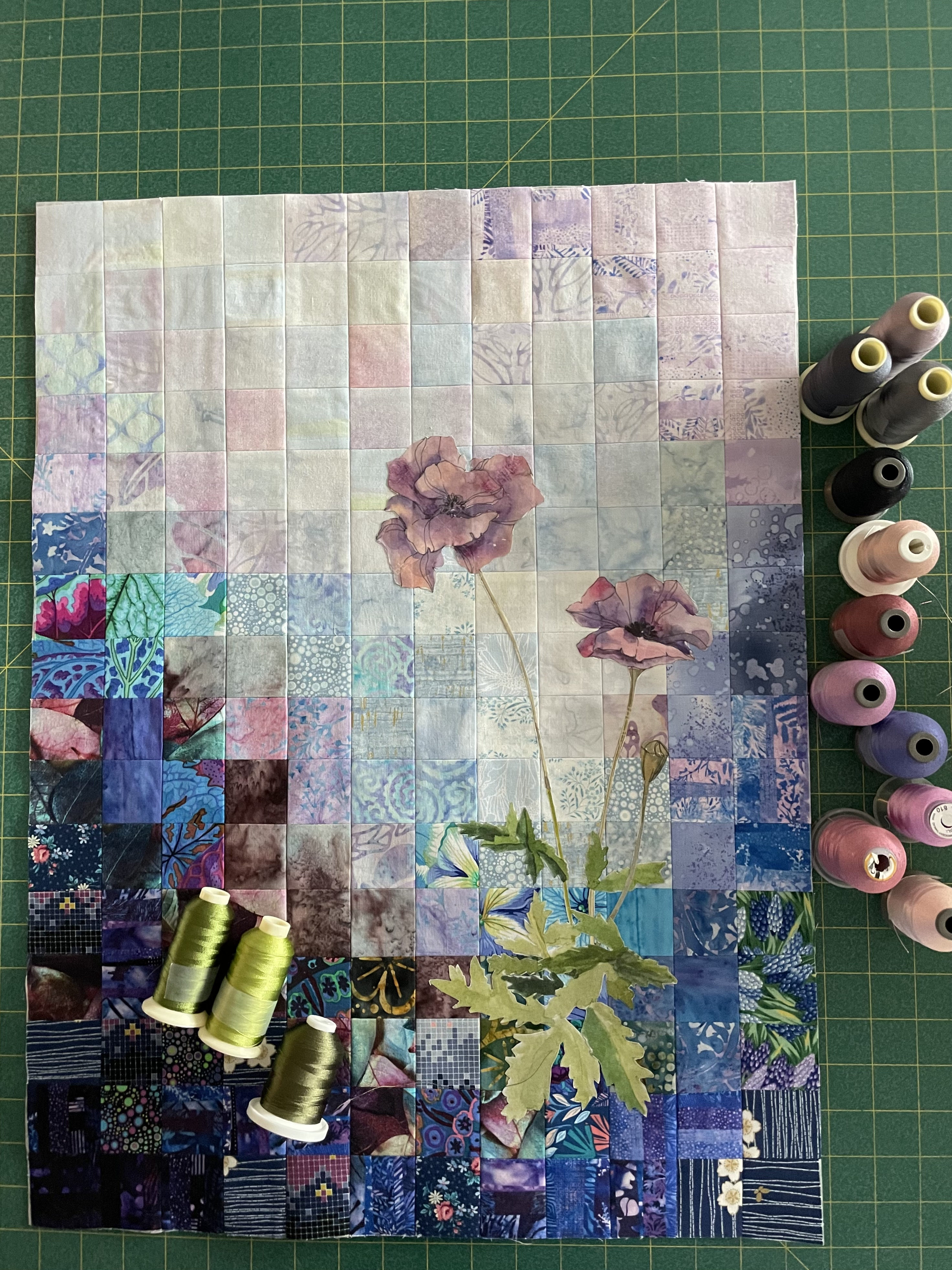
This is the current state of my wall art piece. The purple poppies are pale. I could remove this fused appliqué, print new poppies, darken them with permanent markers, or work with the current appliqué and see whether I can intensify the colour by thread painting. I don’t know which to do yet, which is why I have done nothing, so far. Stopped. Dead.
Immobilized, I spent two days this past week reading “Prediction: A Pandemic Story” by Michael Lewis. While about our current pandemic, he grounds his narrative (as he always does) in presenting the stories of people who were reading the tea leaves based on what they were able to deduce about what happened in the 1918 flu outbreak, the asian flu I experienced in 1957, the impact of SARS in 2003, the swine flu epidemic that didn’t quite happen in 2009, which predisposed them to know another uncontrollable pandemic was inevitable and the steps they began taking to mitigate the anticipated disaster.
I read the book in two days – on my phone (I prefer reading on my iPhone rather than holding a book in my hands). I had a headache from so much reading, but I couldn’t stop.
Having lived through the past 18 months we know about the US government ineptitude but the reality as seen through the experiences of his central “characters” is compelling. “If only…” I kept saying to myself; so many people could have avoided becoming seriously ill, the numbers of deaths could have been so much lower, the impact on the economy would have been so much smaller.
In some ways, it’s too soon to write the book – we have not come to any end point in the pandemic, and Lewis’ “resolution” at the end is weak – of necessity because the pandemic is NOT over. Who knows when the disease will finally die down globally because until it does the virus will continue spreading and mutating.
I have also begun an online course offered by The World Bank: The Hidden Side of Energy Access: Understanding Clean Cooking. Who knew that 4 billion (yup, billion) people lack access to modern clean cooking options that allow them to cook conveniently, reliably, safely, and affordably. The problem is using non-clean energy sources impacts health, gender, climate, and environment. The costs of pollution from cooking with wood and charcoal, in other words, using unclean cooking sources, are enormous.
Not something I’ve ever thought about. I pull some stuff from my refrigerator, prepare it, cook it, without giving it a second thought. So I decided I’d learn something useful from the course. Well, I am, but oh, is it frustrating. This has got to be the most poorly designed learning experience I’ve ever tried. A number of years ago I participated in a World Bank course on climate change which was very engaging. Interesting reading, video, discussion. I gave the course quite a bit of time and learned some useful things. Here, each module consists of a collection of powerpoint slides with a gazillion acronyms (which I can’t remember – even MECS – modern energy cooking services – is stretching my brain. Then there’s MTF – the multi-tier framework for cooking – a tool for assessing the affordability, safety, convenience and availability for cooking). The course is all about memorizing stuff. Even the “discussion” forums are about regurgitating the dense content from the slides. The navigation is completely unintuitive, I’m forever fighting to find my way from one part of a module to the next.
Fortunately, there is a report on which the course is based. Here is a link to Access To Modern Energy Cooking Services. In our current climate crisis it’s probably useful to know something about this particular global factor which in some ways affects us, too.
I may quickly work through the remaining three modules, foregoing the exercises, quizzes and “discussion” to get an idea of the arguments. But I think I will take time to read the report – I have little patience for watching powerpoint slides – I’m a reader – I make sense through reading.
There are just not enough hours in a day to keep up with everything – the political news, learn new stuff, be creative….
I have to decide what to do with the Purple Poppies and then just get on with it!
This story goes back at least 45 years! When I lived on Braeside Lane in the late 70s I found myself experiencing a definitely audible “hum”, particularly in the middle of the night, which drove me crazy. It sounded like a very large diesel truck idling just outside my building.
A low frequency hum, almost a vibration, just on the threshold of human hearing. It’s not particularly loud. In fact, you might not have even noticed it yet – but once you do, you can’t stop hearing it. It sounds like a truck, idling on the street in front your house. Or the atmospheric din of an airplane flying overhead, that never gets further away. You can hear it when you’re outside, but it seems louder indoors, and particularly at night, when you’re lying in bed. Maybe it keeps you awake.
If you do hear it, you’re among the roughly 4% of the world’s population affected by “the Hum”, a frequently reported but little understood global phenomenon.
I struggled with the “hum” for a couple of years before finally I had the brilliant idea to call the acoustic engineers at TUNS (Dal) to see if they were aware of the “hum” and what they knew about it. Not much, it turned out, but they were interested.
Two guys came to my house with some fancy recording equipment for me to use after, say, 2:00am to see if I could capture the noise that for me was so audible and irritating. I recorded the “hum” for a week, after which they came back, collected the microphone and recorder, and analyzed the recordings.
Then they reported back to me. They could definitely detect a low pitch noise (somewhere around 40Hz – they were actually more specific but it’s been so long ago I can’t actually remember the precise number) around 5-10 decibels – loud enough for some people to hear even at that low pitch. They had no idea what the source of the sound was but they assured me it was real.
My Braeside Lane townhouse was constructed on bedrock – a continuation of the Halifax bedrock on which the Fairview Cove Container Terminal was built – so it was not inconceivable that the vibration made by the large cranes or the idling container ships docked at the port, particularly at night, might be transmitting a sound through the bedrock and reaching my house.
No way to prove that theory but I took comfort in knowing the “hum” was a real sound.
I was fortunate, in that I discovered a “node” of that vibration that happened to occur at the foot of my bed, about the diameter of a 15″ platter. Well, that helped a lot – a silent spot in the middle of the thrumming low pitch vibration was a godsend – I was able to sleep comfortably with my head at the foot of my bed and be oblivious to the “hum.” (Although it took some time to feel comfortable/safe sleeping with my head in the middle of the room!)
When I moved to Winnipeg a number of years later, and was looking for a place to live, the first thing on my list of things to watch out for was any “hum”! The realtor and I would visit a place during the day. I’d ask for silence as I walked through the house or apartment trying to listen for any “hum” particularly in the bedrooms. I wasn’t surprised to encounter a variety of “hums” – refrigerators, air conditioners, traffic, railway lines – a city is full of “hums”. I was trying to listen for that unidentified low pitch “hum” I wanted to avoid. I drove the realtor crazy asking to return to a location late in the evening so I could listen to the ambient sound before I’d consider purchasing. I finally found a condo on the Assiniboine River that fit the bill – I was never bothered by the “hum” during the four years I lived there.
When I returned to Halifax in 1997, same thing. House hunting, making sure I wasn’t also buying a “hum” to go along with the house. Again I was lucky. My Chelsea Lane townhouse, although built on the same bedrock as Braeside Lane was further from the container terminal, and “hum” free. I wasn’t bothered by any “hum” for the 20 or so years I lived in it (there was a large CBC radio antenna not far from my place, but I never encountered a “hum” emanating from it).
In August 2016 I moved into an apartment building, 6th floor (top floor), checked for “hums” – thought I’d managed to escape once again. However, on Oct 19, two and a half months later, as I was returning to bed from a trip to the bathroom at 3 in the morning, I was assaulted by a very pronounced “hum” – it persisted for the rest of the night and into the next day. I could hear it – I could feel it thrumming in my head. I could block it out if I turned on the radio, which I did. It wasn’t the highway traffic on the other side of the building – that was intermittent, and besides I really didn’t hear the vehicles, even when standing on my balcony. It might have been the air circulating fans on the roof close to my apartment – but then why hadn’t I heard them when I checked before moving in?
The “hum” was everywhere in the apartment, I could not find a silent node anywhere. I tried identifying the pitch of the “hum” using the keyboard on my iPad. It seemed to blend as a harmonic with F/F#/G two octaves below middle C – I’d lose the “hum” when I played those notes, although I couldn’t pin it down precisely (C1 – three octaves below middle C has a frequency of 32.70 Hz – which is close to the acoustic range mentioned in the Guardian article; it’s also a harmonic with F so it’s possible the base pitch of the “hum” is somewhere around C1 with harmonics further up the scale).
The “hum” never quite subsided, but I discovered an App for my iPad – White Noise – which produced a range of backgrounds to block offending noises. The sound which worked best for me, believe it or not, was the ambient sound of the International Space Station! That, combined with “grey noise” which I was able to pitch closer to F2/F#2/G2 worked to mask the “hum” – so just before turning out the light, I’d turn on White Noise and run it for the night. It allowed me to fall asleep. I used the App nightly for a couple of years and then the “hum” seemed to disappear. I stopped turning on White Noise before getting into bed.
The “hum” returned last evening! At 9:40pm – there it was again – that loud low pitched thrumming – I actually went outside to see if I could see a large diesel truck idling nearby – nope, no vehicles anywhere near the front of the building. Even turning up the volume on the TV couldn’t block the “hum”. I was getting ready to turn on White Noise when around midnight the “hum” subsided. I went to bed and was able to fall asleep.
However, this morning, it was present still, although at a lower level. I can ignore the “hum” during the day – I keep the radio on, listening to CBC or some podcast or other. It generally doesn’t bother me too much in the evening, either, the volume of the TV (to which I knit) generally masks it. And I have discovered that the programs delivered by Brian Cox (professor of particle physics in the School of Physics and Astronomy at the University of Manchester) put me to sleep quite quickly! As does David Attenborough. I’ve recorded a collection of programs by both men, which I set to play for a half hour, to mask any disturbing “hums” which might interfere with me falling asleep.
I’m waiting to see if the “hum” is present again this evening! It was very loud and irritating last night. I have found ways to mask it, making living with it bearable.
A friend of mine is turning 80 and his daughter, planning a collective gift, asked me to share a memory of Gerry. I’ve known him since 1976 – 45 years, not yesterday. I thought about my early days at Dalhousie’s Department of Education where we shared office space and often argued on the same side in department political skirmishes.
Then I remembered one of my trips to Australia – I was on sabbatical, in the country for close to three months. Gerry and his family were then living outside Melbourne where he was headmaster of a private school. It was early in the trip when I visited them. Terrific hosts, I was taken to various significant locations you must see when in that part of the country.
One of our stops was in Mornington – at a gallery which showcased contemporary Australian artists. The art was interesting. One particular piece – a large 21″ ceramic plate called out to me:
Bryan Trueman – Ceramic – Gum Trees
I’d have bought it instantly if I could have figured out either how to ship it back to Halifax so it would arrive intact or how to package it so I could carry it as carry-on luggage for the remainder of my travels.
That was Friday afternoon – I left the gallery without the ceramic. However, I wanted to see it again, so late Saturday morning the whole family and I returned to the gallery and I stood in front of the plate and still couldn’t make the purchase. Once more, I left without it.
That evening, Gerry and his wife and I were at a dinner gathering of friends of theirs and everybody at the party knew the plate. There was a lot of conversation about it and encouragement for me to buy the damn thing and then figure out how to travel with it.
So once again, Sunday morning, Gerry took me back to Mornington where I finally bought the plate. The gallery packed it for me in a huge wooden crate – definitely not carry-on baggage.
I took the crate with me the next day when I returned to Melbourne – by car. I was staying with an acquaintance and we discussed alternative ways I might pack the plate so I could travel with it. Finally decided on bubble wrap and a typically Australian woven plastic zippered shopping bag large enough to hold the bubble-wrapped plate.
Next day I ended up at the post office to purchase bubble wrap. Standing in line I starting kibitzing with the woman in front of me. When she learned what I was looking for she invited me to accompany her home – she’d just had a large parcel arrive from England and had a lot of bubble wrap she could give me.
I went with her, had a nice cup of tea, returned to where I was staying, unpacked the crate, rewrapped the plate, put all my lecture notes and study materials in my checked bag (praying my luggage would arrive with me) and headed to the airport. I kept the plate with me as carry-on when I boarded the small plane to Wagga Wagga. I carried the plate with me on each subsequent flight, and I did finally get it back home in one piece.
The Bryan Trueman ceramic hangs in a prominent place in my apartment, and I think of Gerry and that visit to Melbourne each time I glance at it.
People have been sending me photos of coltsfoot they’ve come across – it’s really the first native spring flower here in NS. Until today, March 31, I hadn’t seen any myself.
These two flowers were lurking in the wooded patch beside my building. I went looking because that location becomes covered with their happy yellow faces. it’s an interesting plant – the leaves don’t appear until after the flowers have bloomed.
So I guess it’s now officially spring here. Last year I saw coltsfoot on May 1. The earliest I’ve previously seen any was on April 14 in 2017. March 31 (actually my friend Marlene spotted some last week in her son’s back yard) is VERY early.
The question now is how soon will we see Forsythia? In the past the first Forsythia has been close to the first of May. It will certainly be earlier than that this year!








 jmn
jmn 