I did get done today what I wanted – adding columns 4 & 5 to the developing quilt top. The two columns went quickly because I now understand what I’m doing – I didn’t when I began and the first few blocks took a bit of time.
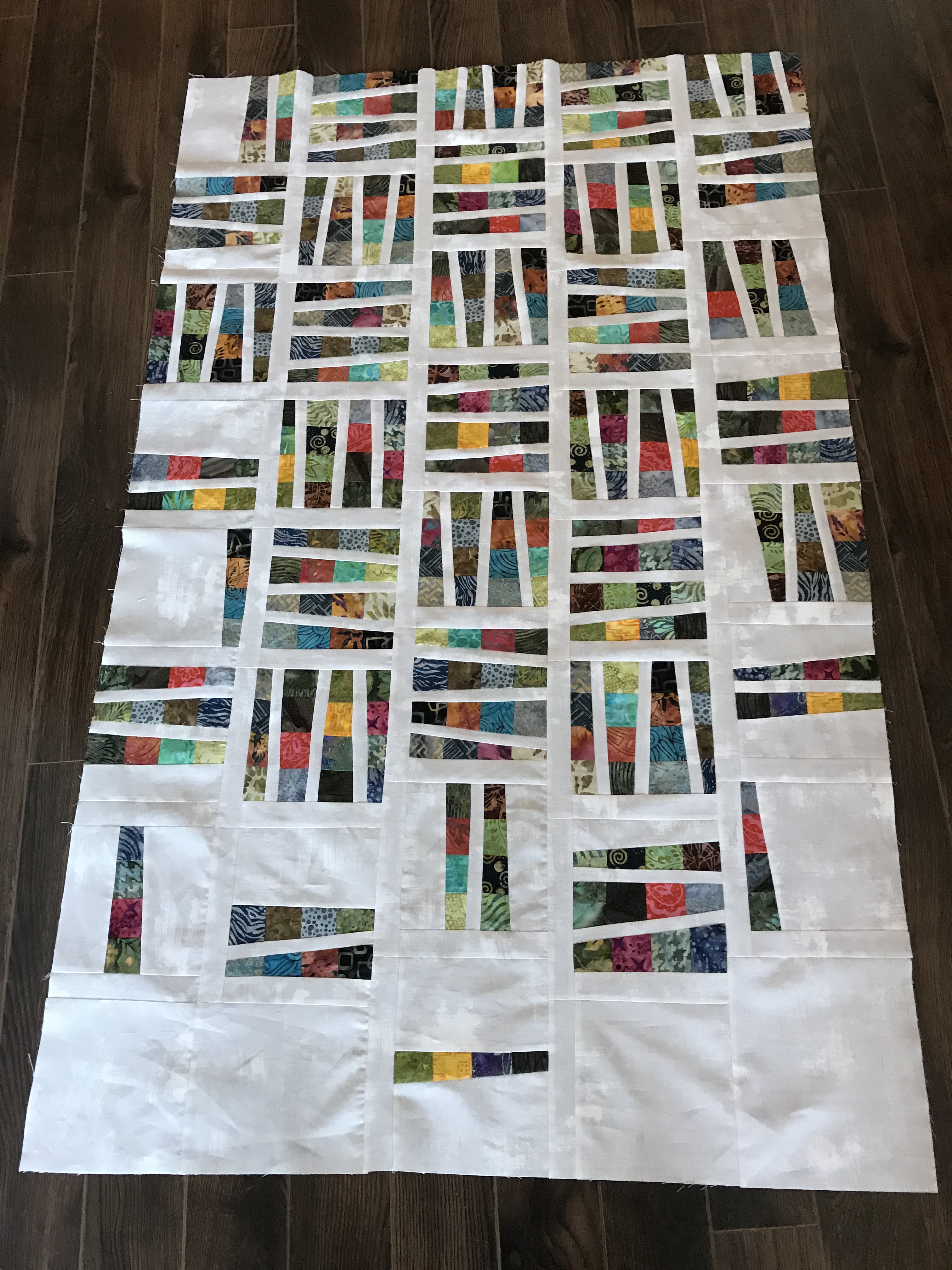
Columns 4 & 5 added
The process is now streamlined – four 6.5″ squares of pieced strips are stacked and cut into four irregular strips, laid out in order for the block, then stacked again so I can chain piece the narrow sashing to three, join the pieces and add the fourth; press, add the bottom sashing, press, add the side sashing then join the blocks in the column – it’s going quite quickly.
I have the cut strips for the sixth column prepared and laid out – tomorrow I will sew them, create the column, and add it to the other five. That will just leave the two narrow borders and the two wide borders to add. The top might be done tomorrow!
Then I have to decide what to do with the quilt back…
The knitting continues as usual. A couple of evenings ago I finished this pair of red/brown socks – they’re in the give-away stash. The next pair of socks got underway.
Red Socks Completed
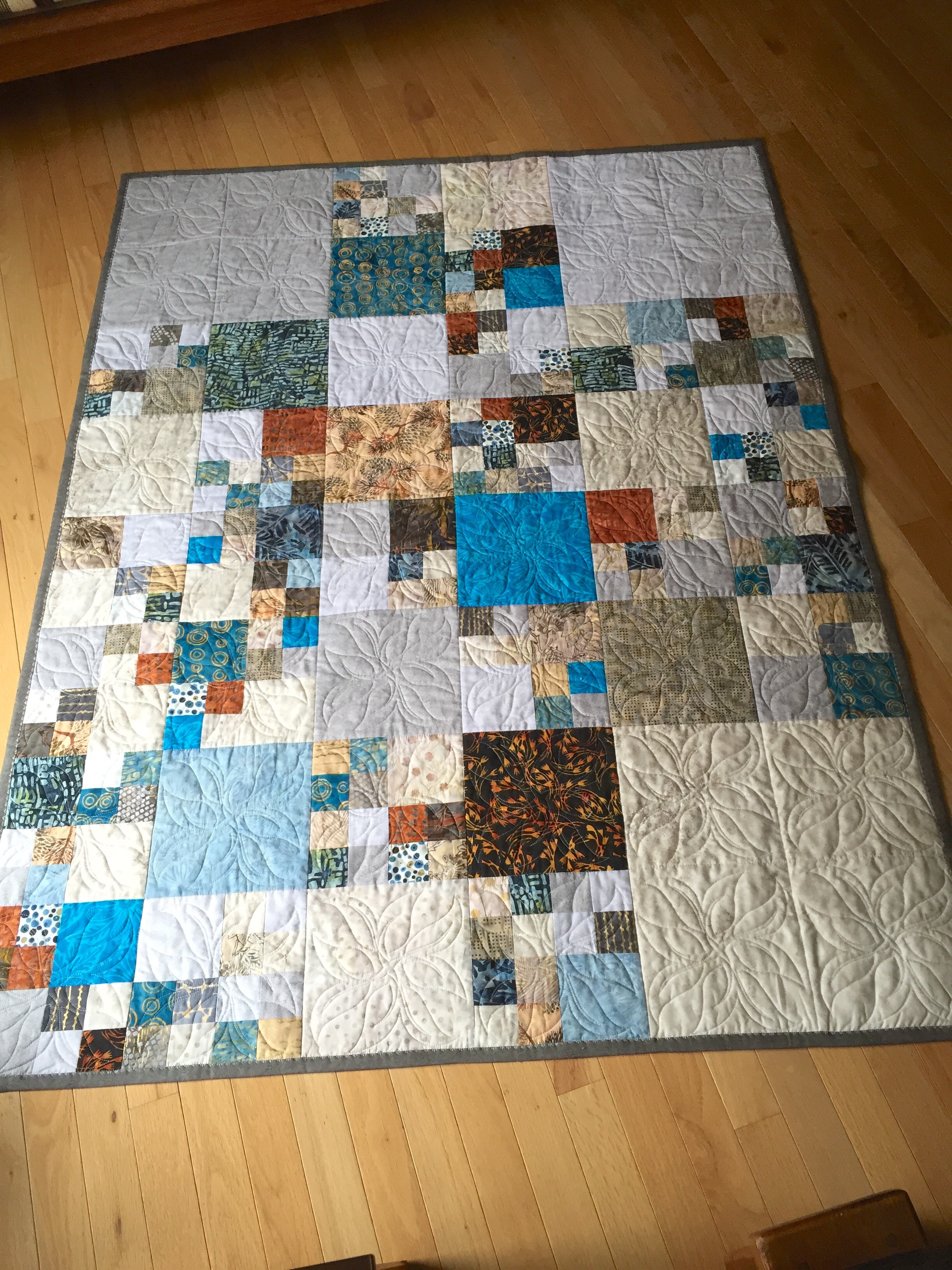
A few days ago, I also started a new quilt. I had a collection of leftover batik jelly roll strips – I sorted through them picking out contrasting lights and darks in a variety of shades (reds, blues, yellows, greens, browns…) and set up sets of four. If I had stitched them together as 2.5″ strips my resulting blocks would have been 8.5″ square which was bigger than I wanted for the quilt I was planning so I trimmed them to 2″ which has given me 6.5″ blocks to which I’ve been adding sashing strips which will finish at 1″ – completed block size = 7″.
First Half of Latest Quilt
As you can see in the individual blocks, I’m alternating asymmetrically cut pieced strips with narrow sashing and alternating the sashing direction when I put them together. I’ve offset the third column against the second – it’s about making it easier to sew the columns together – the sashing joins don’t need to match up. (I’ll match up the blocks/sashing position in the 4th and 5th columns with the 2nd and 3rd.) It’s also making the content of this modern quilt less regular, therefore a bit more interesting.
Also, around the outside (on three sides) I’m using fewer pieced strips in each block (you can see that in column 1) to increase the amount of background toward the outside edges of the quilt. I’m planning a 6 x 8 quilt to which I will then add uneven borders – 3″ on the top and left, 6″ to the right and bottom to extend the background and position the pieced blocks toward one corner of the finished quilt.
I’m half way there – I completed three more blocks for column four late this afternoon, I hope to finish the fourth and fifth columns tomorrow which will leave just one column (with blocks composed mostly of background to complete Monday). I have fabric from the original sewn strips sections to use when I go to make the quilt back – don’t know what I’ll do with them, yet (haven’t chosen a backing fabric either – have to go through what’s in the stash and hope there’s something there that might be suitable).
The background fabric (a pale grey grunge by Moda Fabrics) I did purchase just for this quilt – I really didn’t have a long enough length of anything that would set up a strong contrast between background and inserted strips.
I find it interesting that in spite of the quantity of fabric in my stash I still have to buy fabric each time I go to make a new quilt. I seem to be missing some fill-in colours, or background or backing. The stash just seems to keep getting bigger!
Finally finished, binding and label. I’m much happier with the quilt now that it’s finished. The quilting using a darkish bendable thread tied the Kona cotton elements to the rest of the quilt quite well and I have to admit I did one other thing – I toned them down using a fabric pastel crayon which darkened them a bit and hints at texture in much the same way some of the other fabrics do. Once pressed with a steam iron, the pastel dyes the fabric and will withstand washing.
It has the impact of a modern quilt.
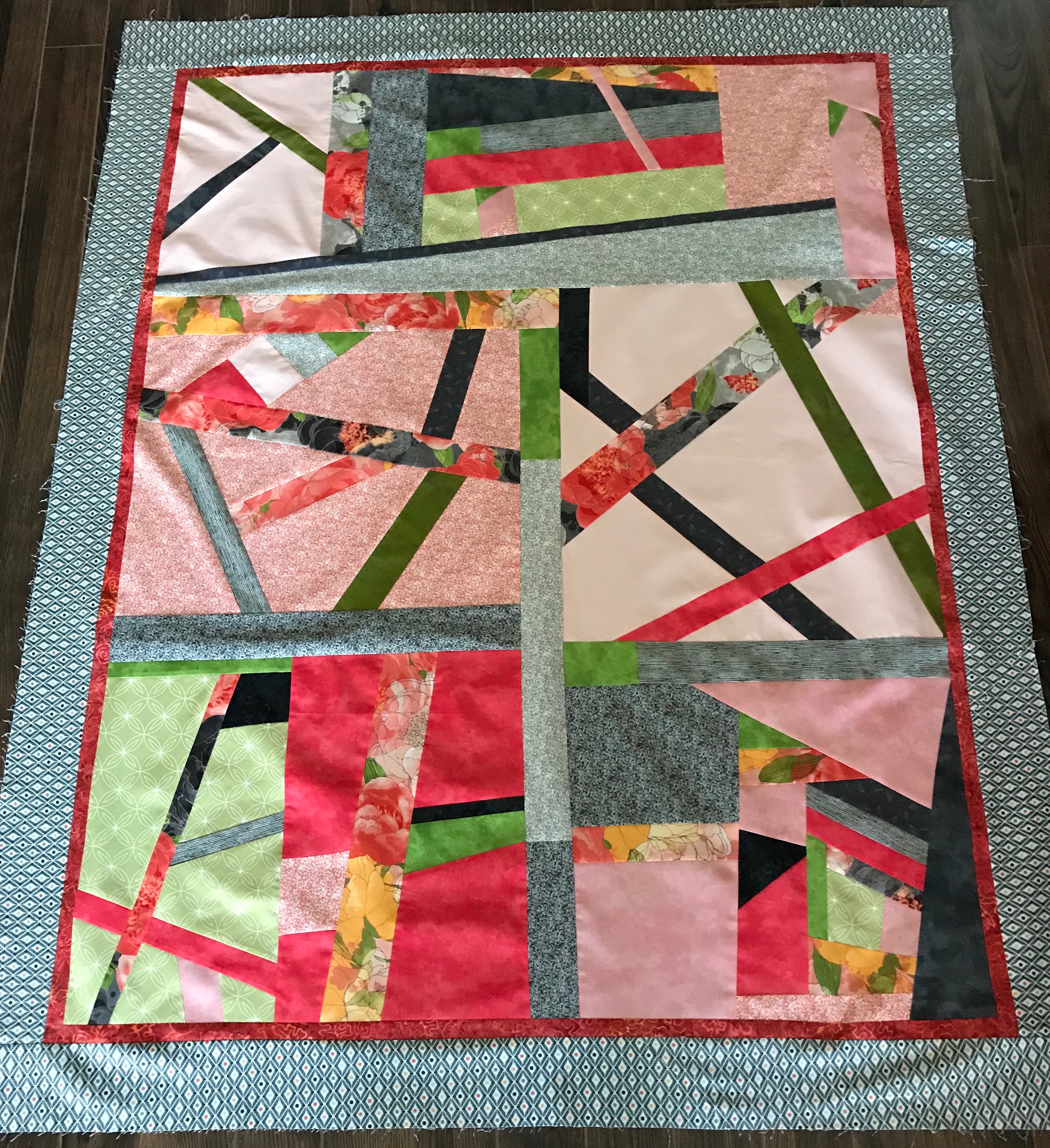
Blushing Peonies II – A Modern Quilt – Top
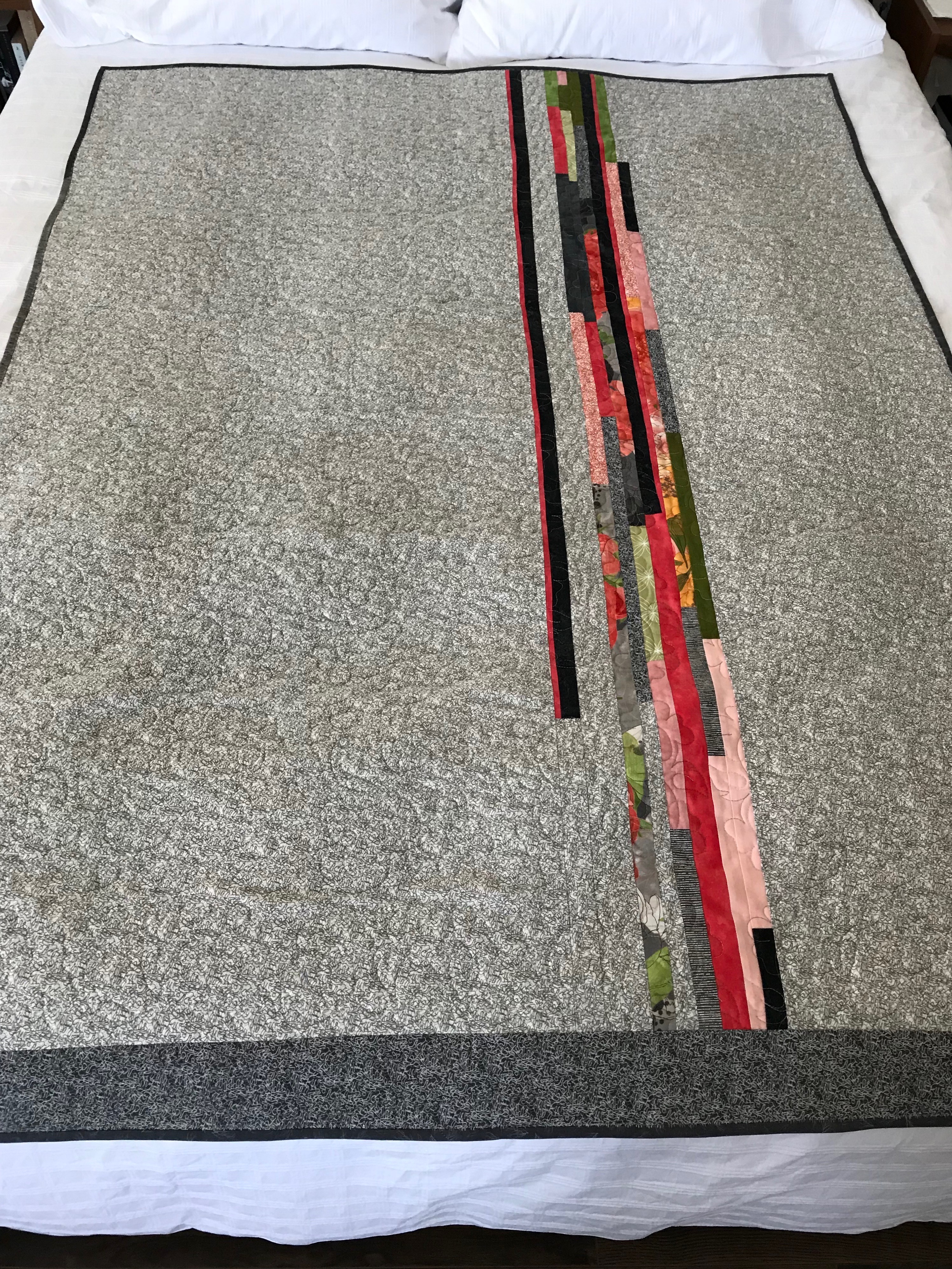
I used flying geese to make a strip to widen the back – they don’t look like flying geese because there isn’t a consistent “background” to highlight the “geese” – however, the pattern created by the large and small triangles showcases the fabrics. The sashing elements I decided to make asymmetrical and I like how they offset the strip and tone down the red backing.
Blushing Peonies II – quilt Back With Flying Geese
After the showing in Parrsboro, my sister Donna expressed interest in the Bordered Diamonds quilt. I gave it to her. She has it hanging in in this bright green room. I love how the green makes the batik fabrics pop and how the colour flow in the quilt ties in with the navy sofa.
Bordered Diamonds – 2012
The other day I was at the physiotherapist – I was at one end of the room and this photo at the other end caught my eye – at the distance a face popped out – two eyes, the left cheekbone, mouth, the suggestion of a blue hat. It’s actually a photo of a waterfall but for me – it’s a face!
I added borders. Changes the look of the piece entirely – contains it (as borders do), but the borders also seem to change the colour focus in an interesting way. The narrow inner red frames the panel and the wider outer border allows the greys and greens to stand out somewhat more.
Quilt Top With Borders Added
I showed the panel to a friend last evening – someone who’s been a close friend for 60+ years! – she tells me the truth. She found something jarring in the panel but couldn’t identify precisely what. I think the problem resides with the pale pink solid Kona sections. They’re flat/dead in comparison with the other parts of the top.
Now, I could take those two parts out and replace them with something else, but given this quilt top is an improvisation, an opportunity to explore and learn, I’m going to carry on. I can do quite a bit to change the texture of those pale pink areas with quilting, particularly if I use a contrasting thread and a more dense quilting embroidery than I was originally planning on using. It would fill up those pale empty areas and provide flow to the other parts of the panel.
So stay turned to see how things progress. Next step is to set up a back panel – it will need an insert as usual to make the fabric wide enough. Not sure what to do – I’m thinking about carrying on with large pieces assembled into a strip using these same fabrics.
Instead of two shorter rows (one on top and one on bottom), this addition turned into a single longer piece I decided to add to one end. For some reason I can’t articulate, that addition feels like the “top” – almost where a pillow would go had this been a twin size quilt. Instead, it will be a largish lap quilt or throw. It still needs a border, maybe it will want a very narrow inner border – not sure yet.
Quilt Top Panel Assembled
Now I need to walk around this for a bit, at the same time I need to go through my fabric stash to find a fabric that could work as a narrow inner accent border, and something for the wider outer border.
And I guess I should be thinking about a name for the quilt – no idea what it might be.
Just added another two sections to this quilt improvisation. It’s now close to a square – in the ballpark for width and still needing another 12″-15″ in length; I’m thinking I’ll add two narrow strips – one to the top edge and one to the bottom.
The Growing Quilt – now a 42″ x 45″ panel
My goals here are 1) to use up leftover fabric from the previous quilt so I don’t have to try to find room in my fabric storage for it, and 2) to set up a new quilt for a class (Slash ‘n Insert Quilt) I hope to be teaching in a couple of weeks.
What I’m trying to construct is a modern quilt based on large sections of slashed fabric with a few prominent insertions rather than a meticulously pieced panel. Before I started I thought this would go quickly – wrong! The deciding where to cut and whether/how to align elements after cutting is proving more time consuming than I anticipated. That’s why I avoided working on this for nearly 10 days! Anyway, back at it finally and closer to a quilt top than I was yesterday.
Hoping to make time in the next few days to add strips to the top and bottom edges of this panel. Then I intend adding a 4″ (or so) border. By next weekend, I would like to have pieced a back and created the sandwich. I now need to start thinking about what kind of embroidery I need to quilt this – likely an edge-to-edge design of some kind.
The start of a new quilt. This is fabric left over from the Blushing Peonies Quilt. I’m working to use it up because my storage drawers and boxes are just about full and there’s really nowhere to put both the large and small fabric pieces.
I decided to use them instead of leaving them lying around gathering dust.
Blushing Peonies – Modern Quilt
What I have so far is this compilation of strips and block sections created by starting with a large piece of fabric, slashing it, then slashing the resulting pieces further, and inserting bits of fabric and recompiling the original block with the insertions included. I’ve done two largish blocks so far, the resulting piece is about 20″ wide x 22″ long – a good start.
I’ll keep adding segments to what I have here intending to end up with a good lap-size quilt 50″ x 65″. What I’m after is large sections with strong insertions – particularly showcasing both blushing peonies fabric – the peach version as well as the darker fabric I used in the original quilt.
Just gotta keep going.
I had originally intended on doing something quite different with the fabrics based on 2 1/2″ strips but the idea I had wanted the central smaller square to be one piece (instead of 4 triangles) using the blushing peonies so the flowers would show.
Garden Trellis – from a jelly roll
Setting up a block like that, however, proved more complicated than I was willing to take on – getting the mitred corners on the surrounding pieces was just too fiddly to bother with. Scrapped that idea for now.
After looking at the finished quilt for a couple of days, I decided, today, to fill in the slightly large unquilted corner where the four embroideries came together. You can see what I did in the photo – I’d set up an embroidery of a single scaled down flower from the original design and stitched in the center of that space.
Quilting, detail
I did all 35 of them although this is really the only one where it actually shows. The other locations were at the junction of 2-4 blocks, or within the large bordered blocks and aren’t as obvious. Nevertheless, I’m happier with the quilting being more uniform throughout the quilt.
Finally done – or I think it may be – I’m still trying to make up my mind about doing a bit more quilting. Having finished the in-the-hoop blocks, I can see the spots where the corners of the embroideries meet – or rather where they leave a slightly smaller than palm-size unquilted area – 35 of them to be exact at the junctures of the embroideries. I’ve pressed both sides of the quilt and those spots are definitely less obvious than they were – but…
Blushing Peonies – Quilt Top
The question is whether I use the scaled down single flower stitch-out I set up from the original quilting embroidery to tie those spots, or to leave well enough alone…. At the moment, I’m predisposed to leaving the quilt as it is but I’ll keep mulling this one over – I may in the end do those embroideries.
Blushing Peonies – Quilt Back
The binding – my original plan was to do a hidden binding but in the end I did a narrow binding the way many people do it – by folding a 2.5″ strip in half, sewing the doubled binding ~3/8″ from the edge, folding it over, sewing it with a decorative stitch. It turned out to be considerably more work than my usual 5/8″ single thickness binding which sews on more easily and folds over and corners with much less effort. However, I didn’t want a prominent binding so I settled for this narrow one. Probably won’t do this again – either a hidden binding or a standard 5/8″ one.
Now my next decision is what to make from the leftover fabric – some kind of simple quilt that I don’t have to fuss over too much. I was thinking “Garden Trellis” would be easy to do – using 2 1/2″ strips of the Blushing Peonies fabrics to set up the HST blocks – BUT I see the centre of the on-point blocks being unpieced squares of the peony fabric – I have just enough to do that. However, the piecing is somewhat complicated – in Garden Trellis II I created the coloured squares by piecing them in after I’d created the dark/light blocks. In this instance I want to showcase intact peonies. The easy way to achieve the appearance I’m after is to log-cabin the central square; but I want the seams of the block to be on the diagonal they way they are with HST blocks. I can see I’m going to have to make some mock-up blocks to work out how to construct them. Again, I’ll probably do a 6 x 8 block quilt which means 48 blocks constructed with somewhat complicated sewing, I think.
Just done – the piecing for Blushing Peonies is completed. Fiddly! More than once I opened seams and rotated/repositioned small 4-patch blocks because a colour was next to the same colour in a larger block. I took apart large sections of the middle portion of the top in order to center the large bordered block. At this point, I have to say I’m please with the colour flow and can live with the symmetrical layout.
Blushing Peonies – Piecing Finished
I now understand why I ended up stuck with the symmetry after looking again at the first 2, 4, 8, 16 quilt and comparing it with this one:
Original 2, 4, 8, 16 Quilt
Same block size – same number of blocks (more or less) – but in this first version, my 16″ blocks were background, neutral, used to showcase the bright 8″ blocks. The strong turquoise block draws the eye to the central portion of the quilt and the large blocks in three of the corners fade away. Your eye moves to the other 8″ blocks in turn and then picks up the colour flow of the small blocks, but not really ever landing on the three large corner elements. So in this quilt asymmetry allowed me to make the 8″ blocks the focus of the quilt.
In Blushing Peonies, having decided to border the three 16″ blocks and make them the focus of the quilt I was forced to arrange them in a diagonal with symmetrical placement. The 8″ blocks don’t capture your attention, and the smaller 4″ and 2″ blocks just fill in colour around the three large blocks.
I could have gone with my original idea:
Quilt Top Laid Out – Sort Of
In this case I managed a viable asymmetry – but the final quilt dimensions were wrong – it wanted another 4″ in the length and if I had put a 4″ row on one end, I would have wanted a complementary 4″ column on the right side – which would have distorted the width/length ratio. So I opted for inserting the 4″ between the middle and the bottom and centering the large block.
Now the question is – do I frame the piecing with a narrow border (in which fabric)? Do I bind it conventionally, or use a hidden binding and allow the pieced edges to border the quilt?
I have enough each of the red mottled and grey mottled fabric to construct a backing with some kind of insertion – not sure yet which to use – it will likely turn out to be the grey to tone down the back in relation to the top. I need to sleep on all of this before doing anything more.
It’s been an interesting exercise – I’ve learned a lot more about colour and design by doing this quilt. I did not anticipate the decisions I’d run into before I started out.
(someone) asked today about a “scant” quarter-inch seam allowance. A variety of responses were given, from “it doesn’t matter as long as your seam allowance is consistent” to “it DOES matter if you want things to fit.” The best answer included a link to this video, which explains exactly why a good seam allowance matters.
This Blushing Peonies quilt top is an example of when it does matter – in order to get all the small 4-patch blocks to fit the 4 1/2″ squares, etc. I needed careful scant 1/4″ seam allowances. There have been instances where I haven’t needed to be so vigorous about the seam allowances but here (and with the Wandering Geese quilt) I had to be meticulous.
Watch the video if you’re interested in what this discussion is all about.








 jmn
jmn 