Layer Cake Quilt II

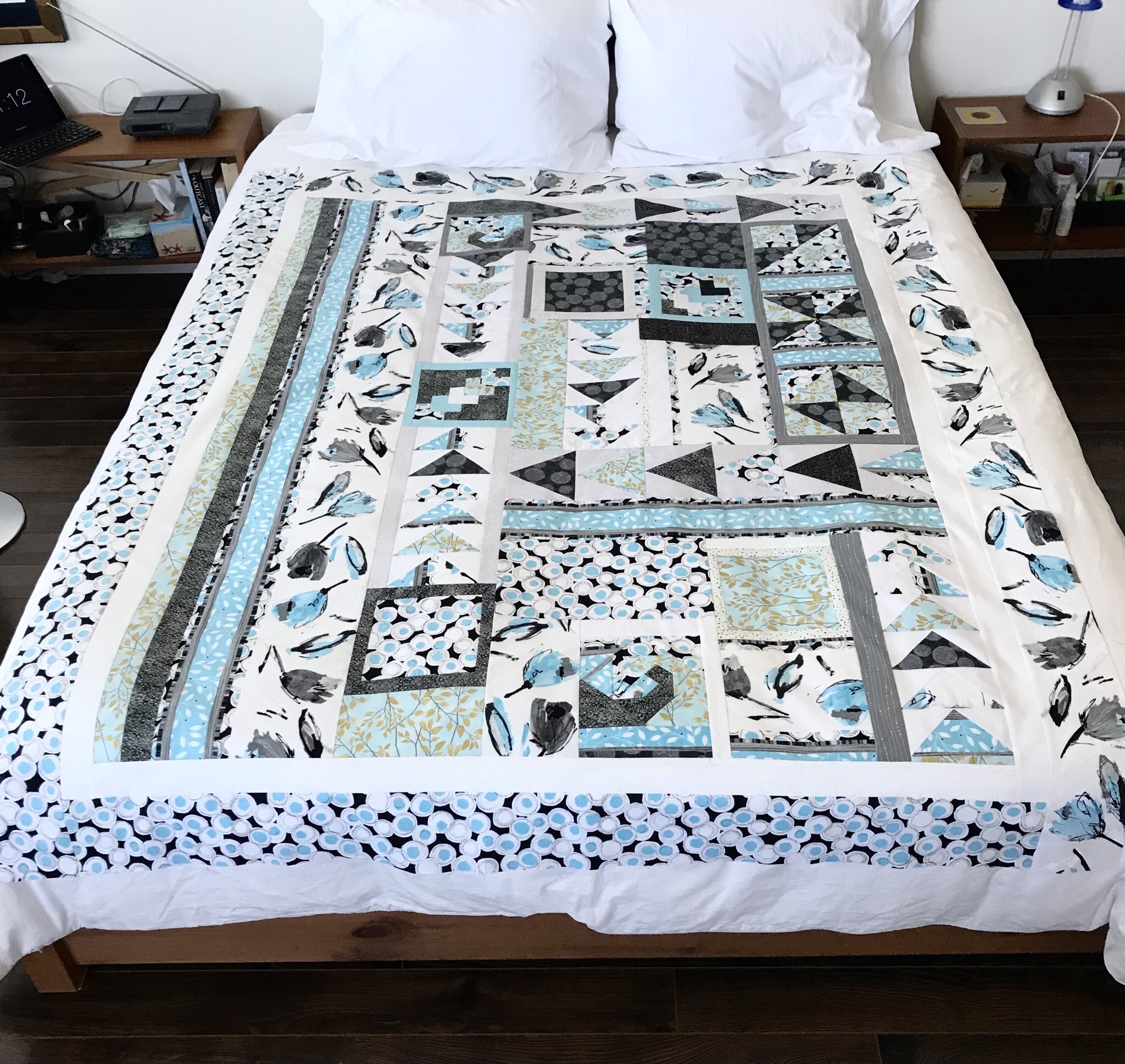
Just finished the central panel of the Layer Cake Quilt. I had two challenges with this quilt – the number of small pieces (408) and making the fabric I had on hand go as far as made sense in the context of this quilt design. Total number of fabric pieces in this 4 x 6 quilt – 600! Given the fiddlely work with the 1 1/2″ white squares I’m surprised that my points work as well as they do! Not 100% perfect, but close enough that when the final quilt is quilted the slight imperfections are not going to be noticeable.

Center Panel

Now I need borders. I want to introduce a contrasting colour. I have some 4 1/2″ batik strips that bring out the rusty/beige colours in the central panel,  but I think a wide border in that fabric will be too strong – I’m thinking a 1/2″ – 3/4″ border will be enough (the question is whether to piece the strip in or to create a narrow flange). The outside wide border will be the white Zen Chic fabric used in the panel itself. My problem is that I have, at the moment, just four 4 1/2″ strips of that fabric! My local shop has none left! I’ve ordered some from the Fat Quarter Shop online (they had what I needed, my other usual sources didn’t) but the fabric hasn’t yet arrived. So I’m on hold for the moment.

I guess I can fill in the waiting time by going through my fabric stash and pulling out something for my next quilt….

Layer Cake Quilt

I’ve been working on this new quilt for the past ten days. I started with sixteen grey batik 10″ squares and eighteen assorted beige/blue/grey 10″ squares – in effect a “layer cake.” I’d had the fabric in my stash for over a year not sure what to make with it. I didn’t have enough of the grey squares to do a whole quilt top so I added some Zen Chic (Fragile, Chalk Stamped) yardage which I also had in my collection. I decided to do an outer “border” with the white, doing the centre of the quilt using the grey batik.

I cut each 10″ square in four and constructed a total of 96 half square triangles, making sure I had enough blocks using the white to build the perimeter of the quilt top. Next I carefully laid out my HST and began sewing them together. Each block has four HSTs separated with a sashing constructed from 4 1/2″ rectangle “snowball” blocks – turns out I had a jelly roll using many of the same fabrics as the mixed batik 10″ squares I began with. I pulled out 12 strips to use for the sashing. To complete the snowballs I needed 384 one and a half inch white squares to add to the four corners of each rectangle.

Assembling The Elements

So far, I’ve assembled half of the inner panel of the quilt top – you can now see the white perimeter taking form and the grey batik interior squares are emerging.

Quilt Top – half pieced

I have two more columns of blocks to construct to add to this half panel. Then I will border the panel with more of the white patterned fabric. I have enough backing fabric that I should be able to add a narrow border of that fabric as well.

In the meantime it’s back to the snowballs – I have 48 more to construct. Once the snowballs are done the remainder of the top construction will go quickly.

Sailboats In The Fog – II

I finally finished Sailboats In The Morning Fog – in time for the Tuesday class this past week. That involved the thread painting on the boats and their reflections in the water,and a bit of movement in the water on the right side of the harbour. Next I added a matte done in white muslin, followed with a dark grey piping, and finally a wide border/frame. I tried several different fabrics, some quite muted but in the end went with this one which brought out the greys of the reflections as well as the wooden insides of the boats. I used the two remaining strips of border fabric to create a hidden binding.

Sailboats

At class the gals all got their work close to finished (except for the hand sewing which they were going to do at home).

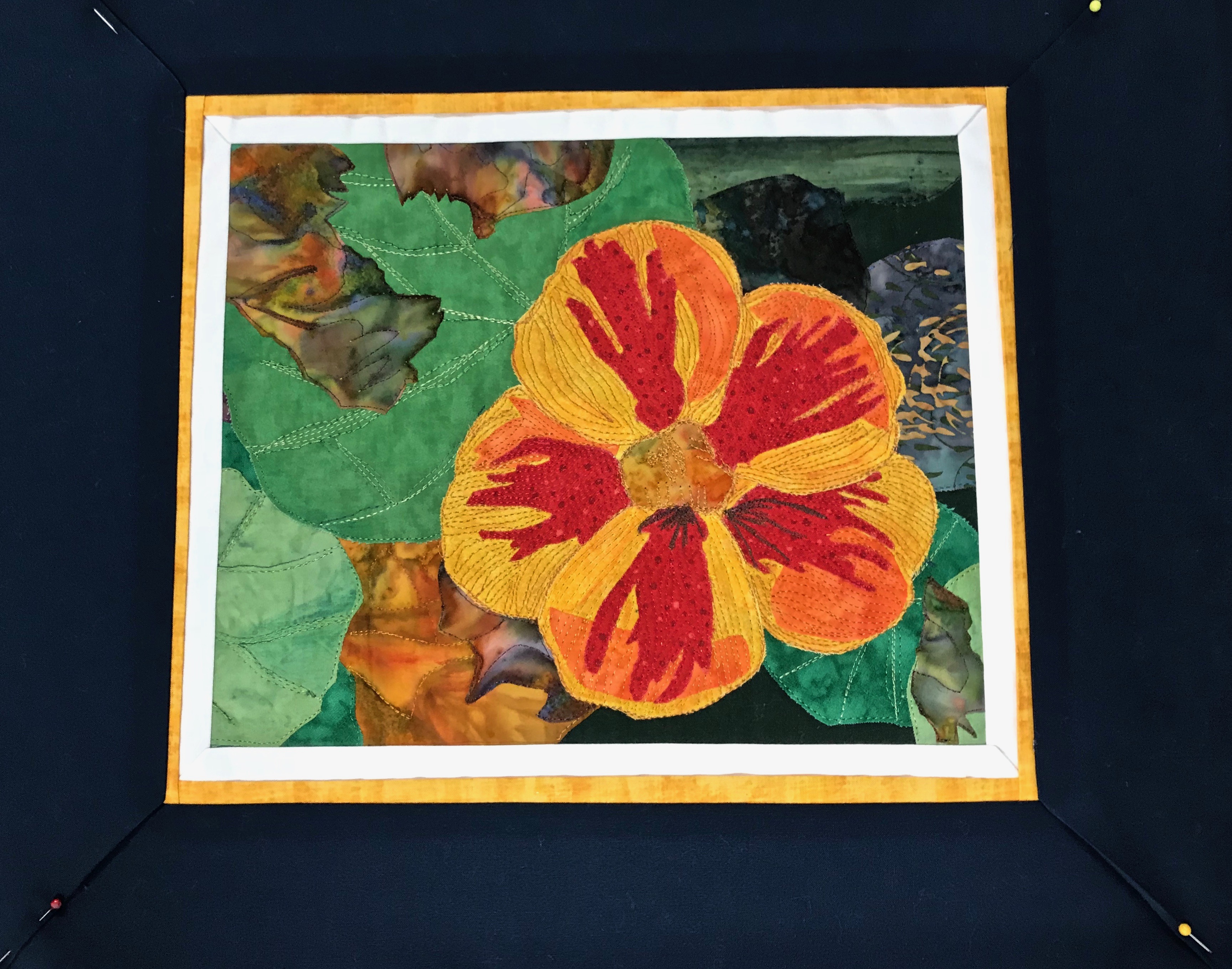
Linda had done the thread painting on her Nasturtium before she came. On Tuesday she added the white inner border, the yellow flange, and then the outer navy border. She added a hidden binding in the navy fabric she used for the outer border.

Nasturtium

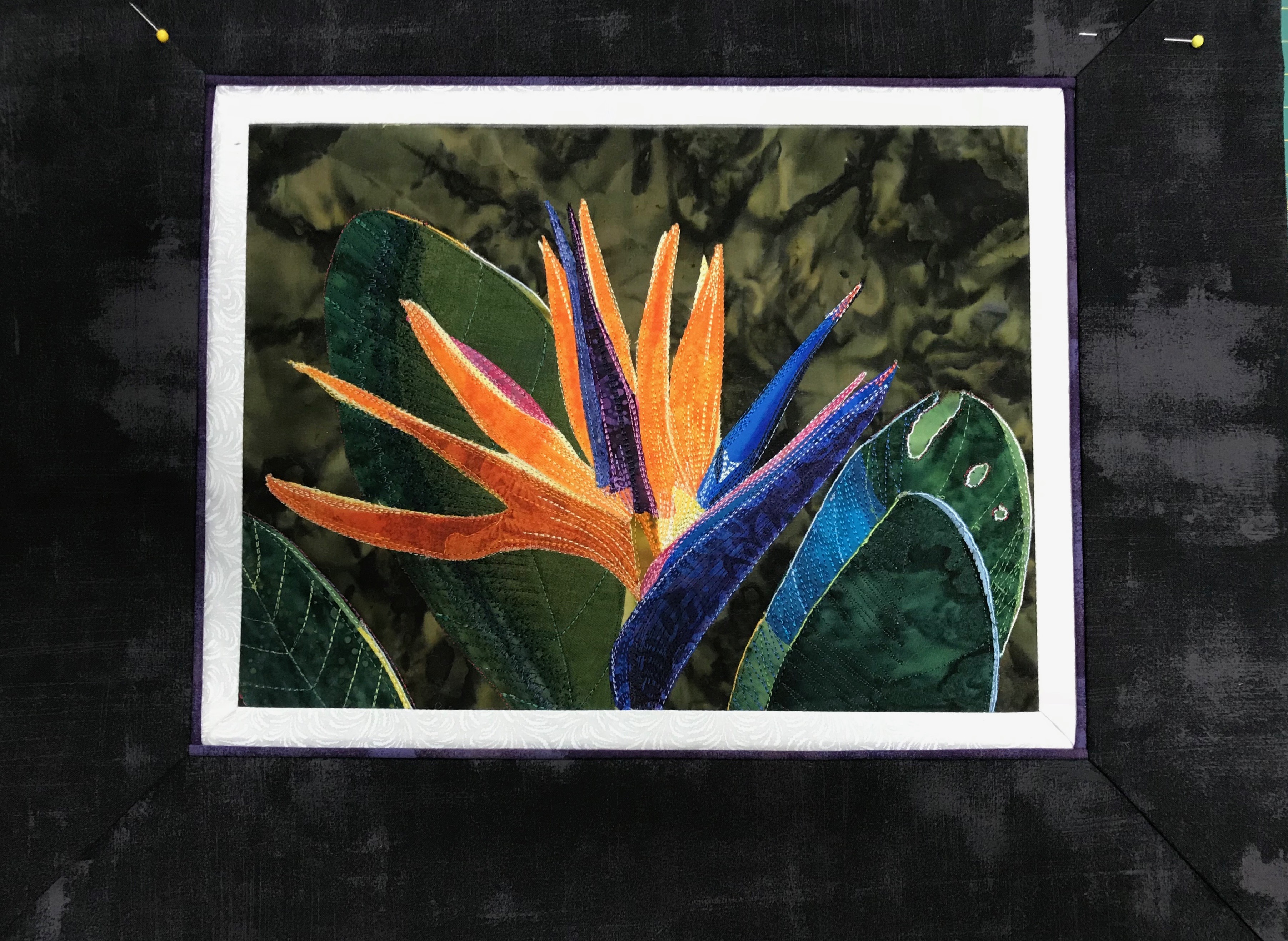
Deb’s Bird of Paradise also turned out beautifully. Although nearly invisible, the purple piping does pick up the purples within the flower and hinted at in the foliage.

Bird Of Paradise

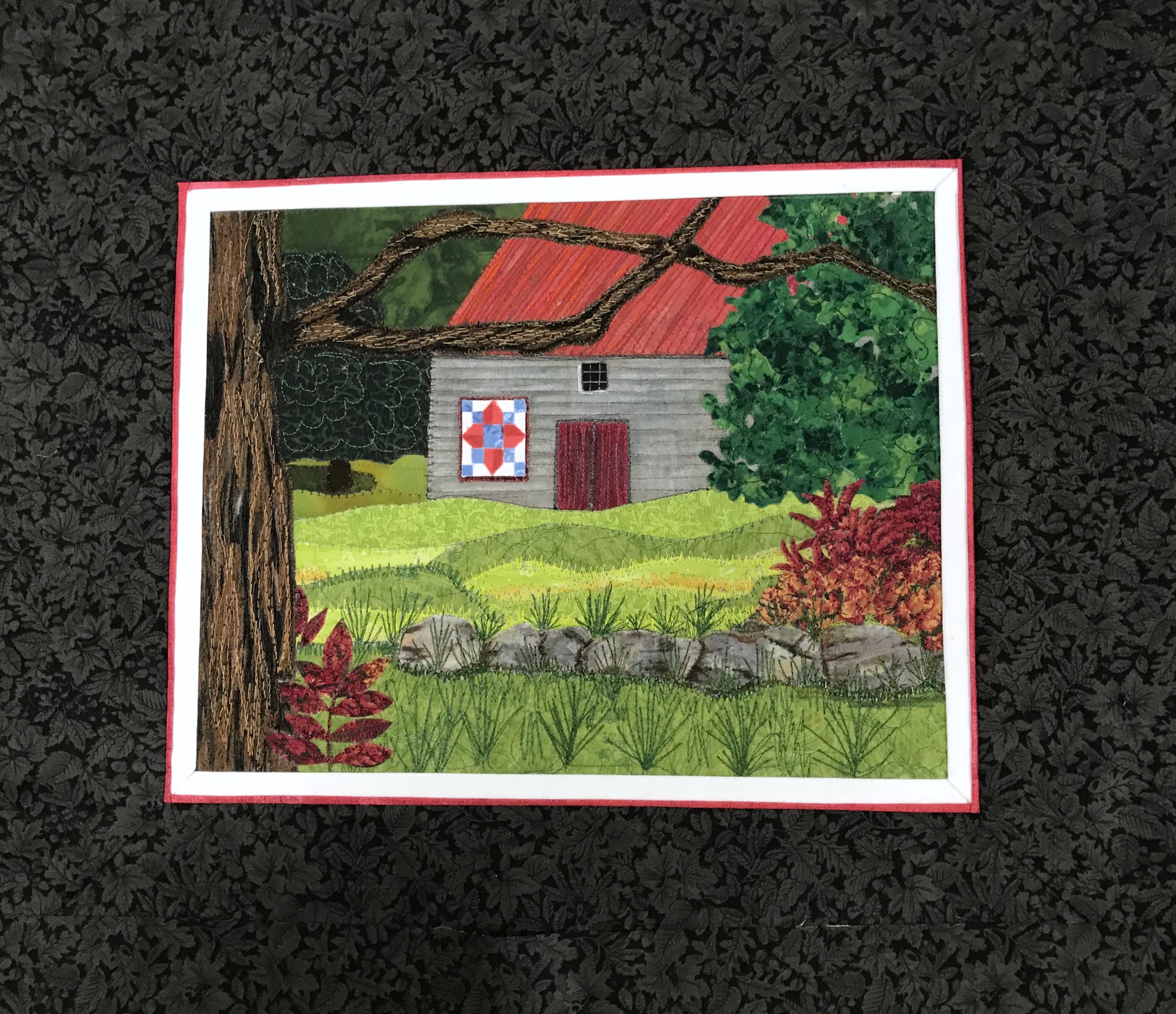
Pam did a lovely job on her wall piece Barn With Quilt – the thread painting, appliqué work on the tree on the left, created a very tactile bark.

Barn With Quilt

Faye’s Fall Walk captures the feel of a cool Nova Scotia fall day. The background was pieced and thread painted, the two figures were printed on fabric and applied to the scene. The red piping draws attention to the woman’s red jacket.

Fall Walk

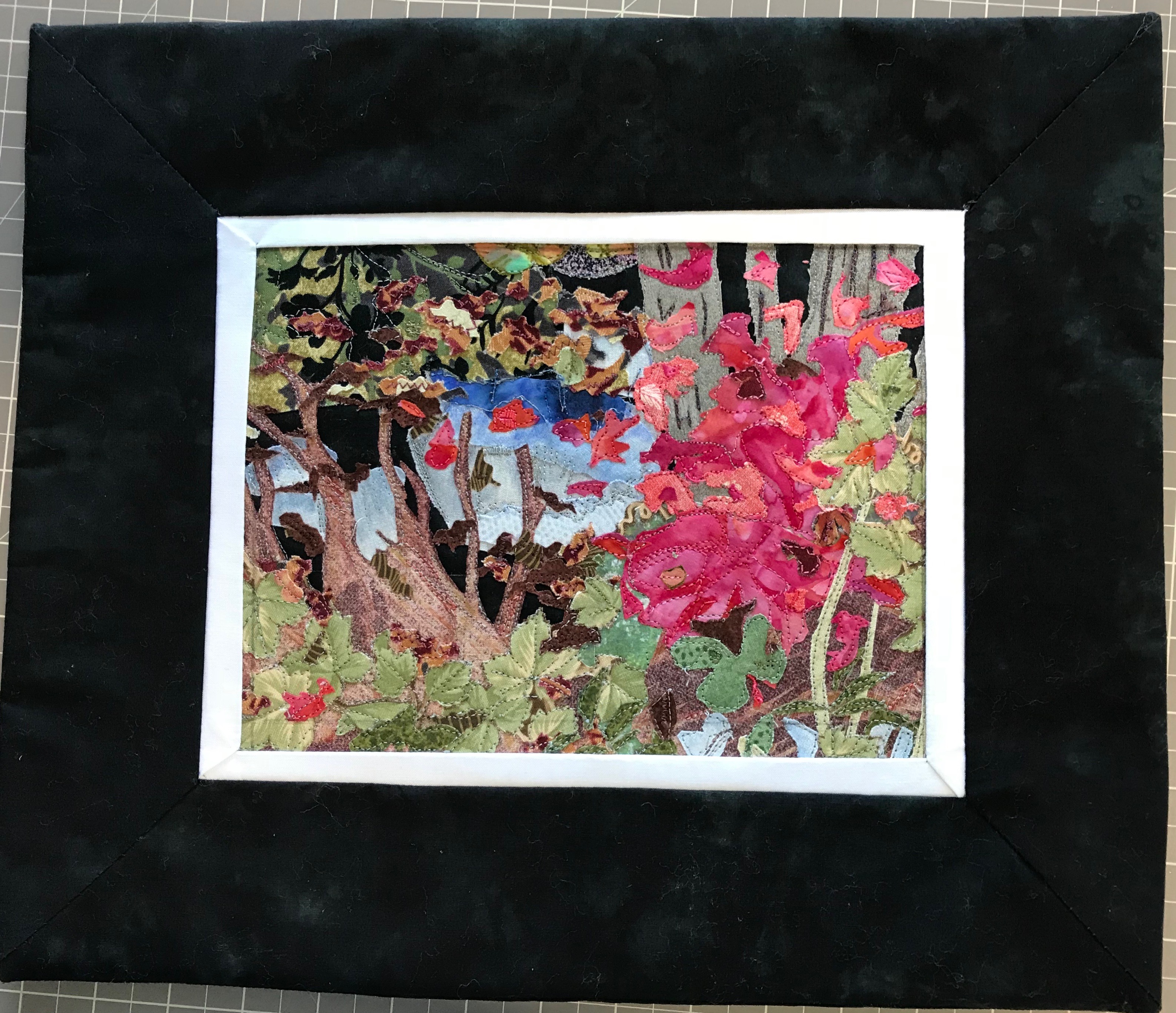
Linda’s A Fall Day In The Woods brings the vivid fall foliage to life. Her framing of the scene strengthens the texture of the fall colours.

A Fall Day In The Woods

The gals were (as was I) delighted with their work. I wanted them to get the finishing touches on their art pieces in class. We didn’t quite make it, but the remaining hand work was going to be no barrier to them completing their projects.

Quilt Backs

Yesterday, Melanie McNeil (Catbird Quilt Studio) posted a piece on pieced quilt backs.

That got me thinking about the piecing I do for quilt backs. She says she prefers a solid back (her quilts are bed size) – I prefer the adventure of piecing (I generally make lap quilts). The challenge for me is to get away with a single length of quilt backing fabric and filling in the width with leftovers from the top, retaining something from the character of the top but at the same time creating a new piecing. Most of my back piecing involves a wide strip, although occasionally I’ll do a block of some sort surrounded by backing fabric – it depends on just how much backing fabric I actually have to work with!

Here are some quilt backs:

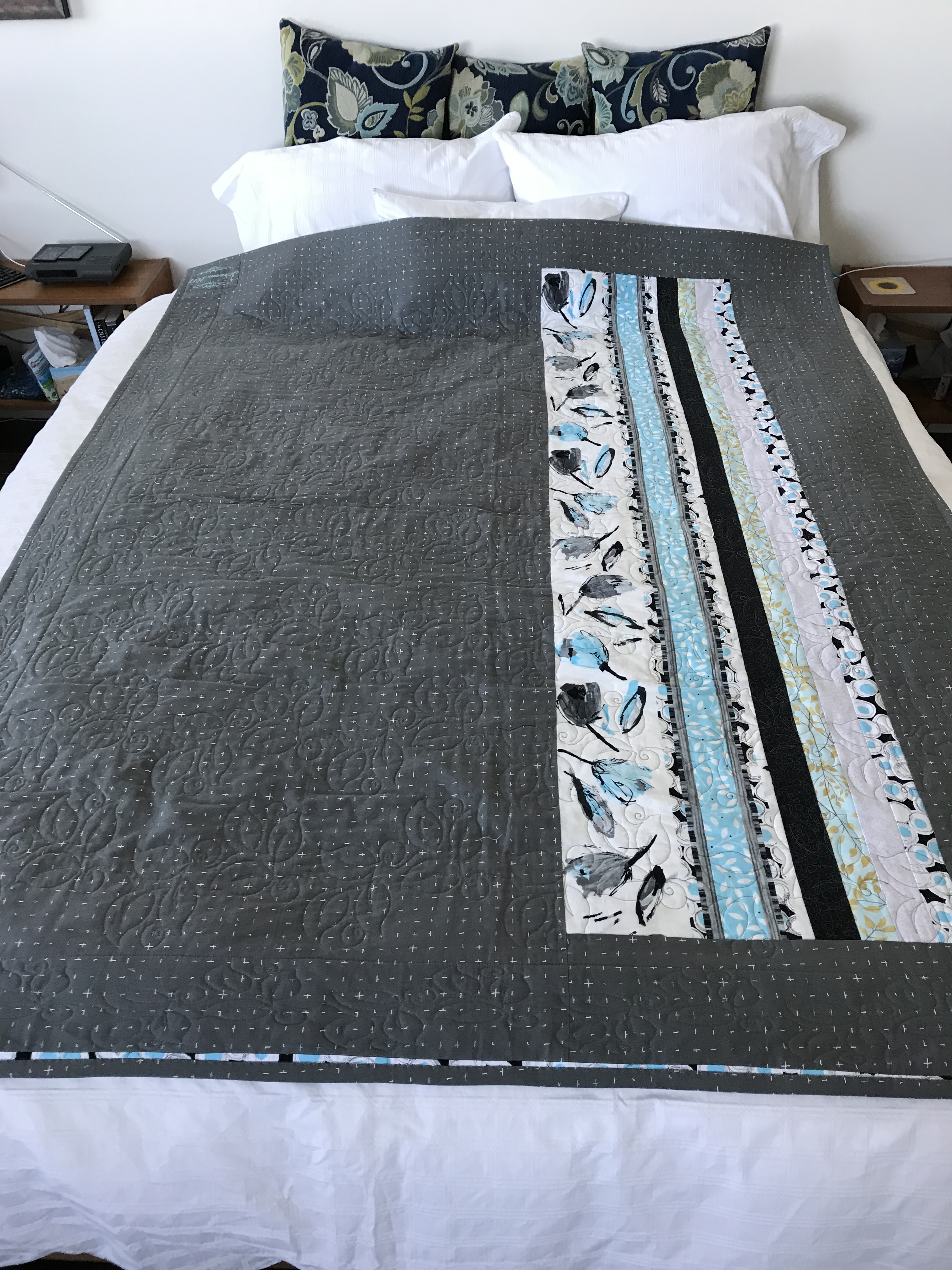
#1 – This is the latest quilt (Improv Quilt) – a strip/block because my strip wasn’t long enough and I fortunately had just enough backing fabric to border the strip converting it to a block.
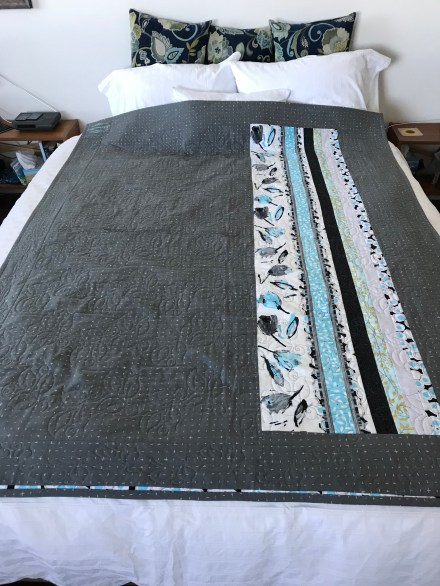
Improv Quilt – Back

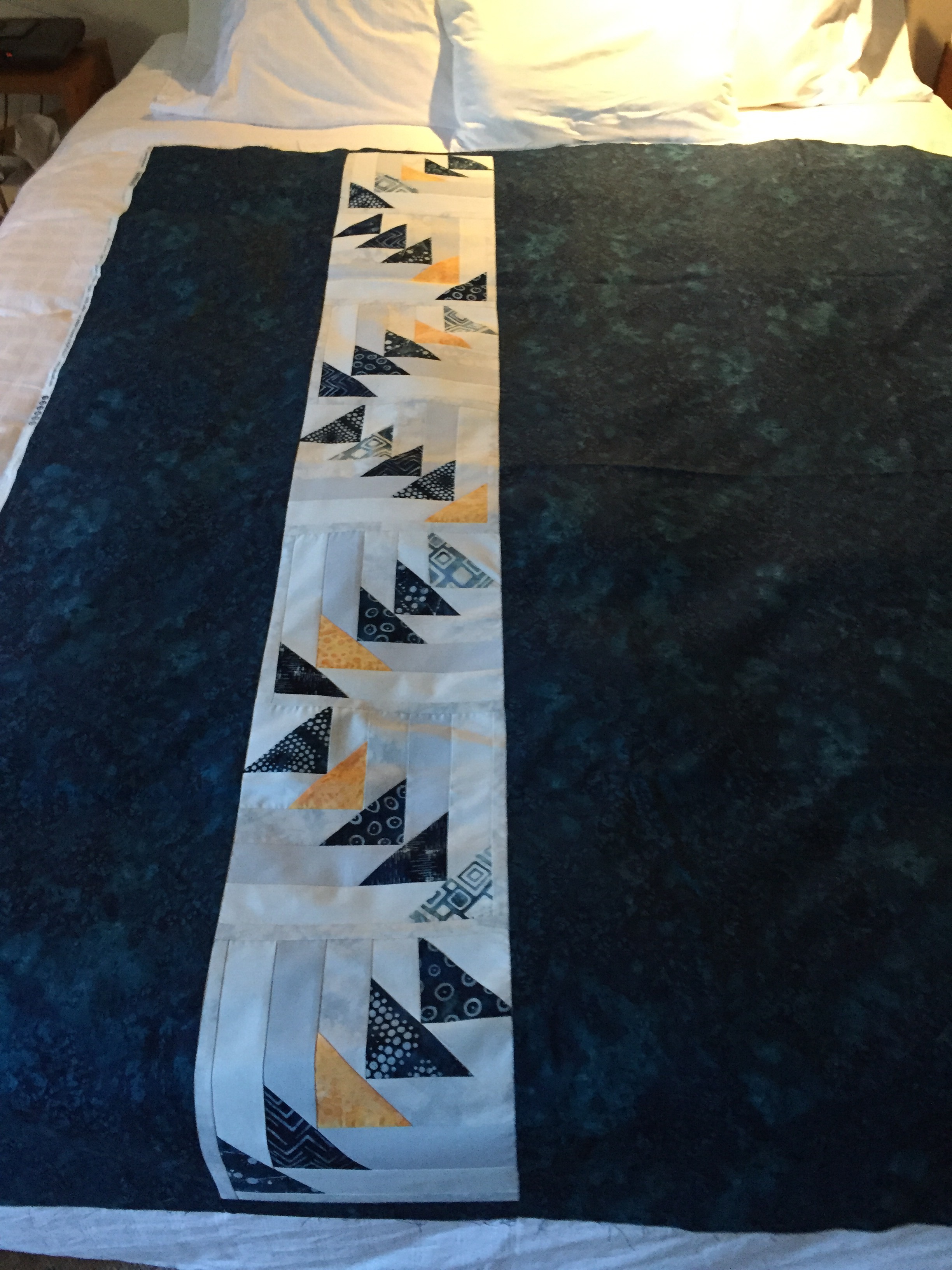
#2 –  An opportunity to try some flying geese. The original blocks were all in shades of indigo but I decided to insert one gold triangle in each and it made a huge difference to the strip.

#3 – From the red/black/white strips quilt. The quilt top looks like three Venetian blinds with a red background. The grey backing reflects the fabrics used in the piecing from the top, with the red accents.

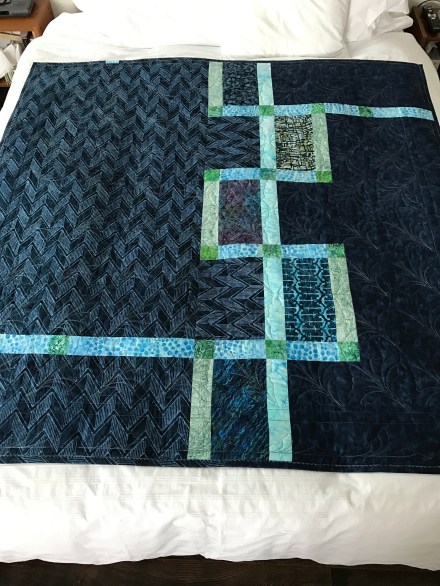
#4 – This back was for the Starburst Quilt: I had no fabric leftover from the quilt top so I decided to use  other indigo fabrics highlighted with the turquoise and green elements.
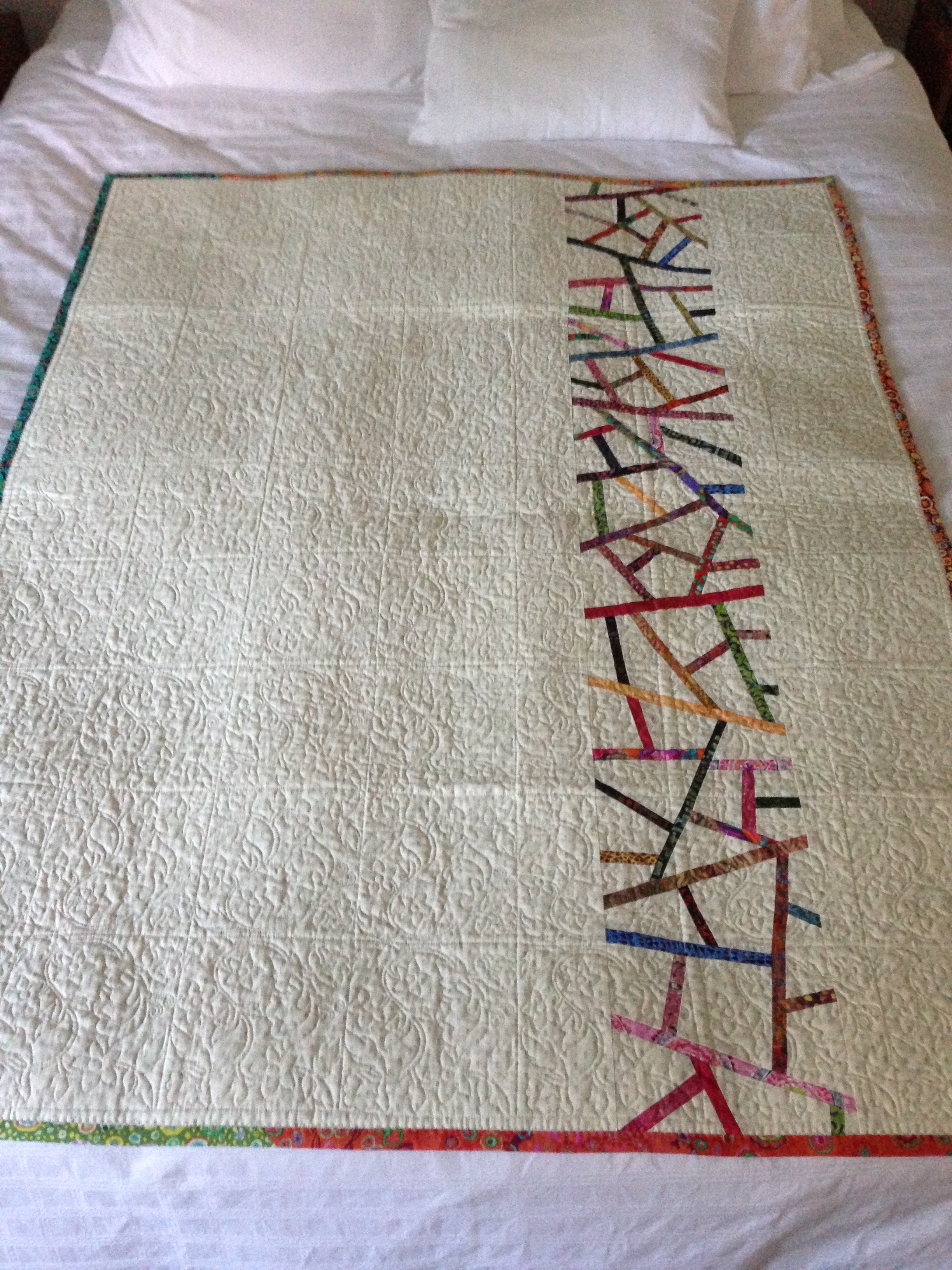
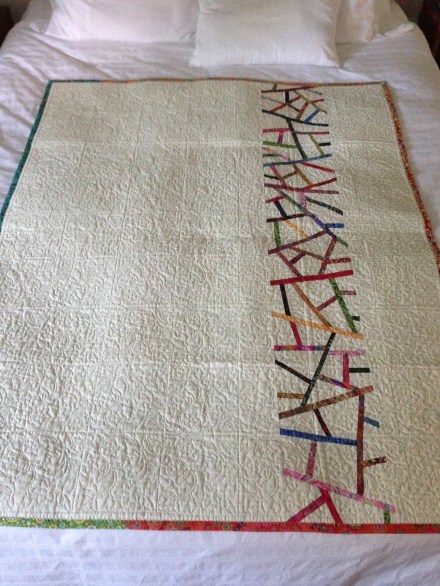
#5 – The inspiration for this quilt back came from a quilt by Weeks Ringle – it backs the Pick-Up-Sticks Quilt:
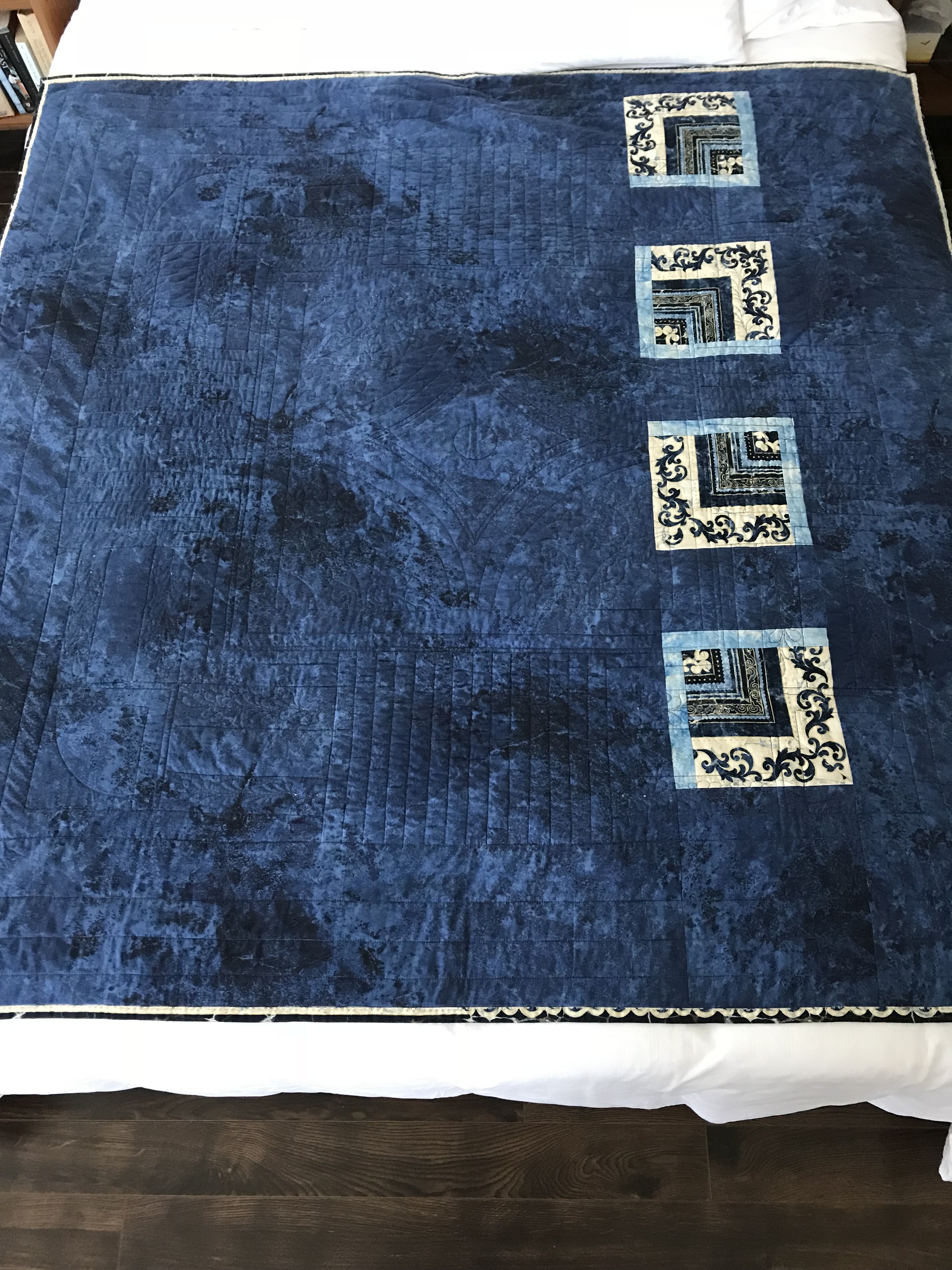
#6 – This is the back of the Medallion Quilt: I had just enough of the border fabric leftover to create these four mitred blocks. I decided to rotate them rather than keep them all facing the same direction. Spaced them out, offset top to bottom, with backing fabric because I had a lot of it.
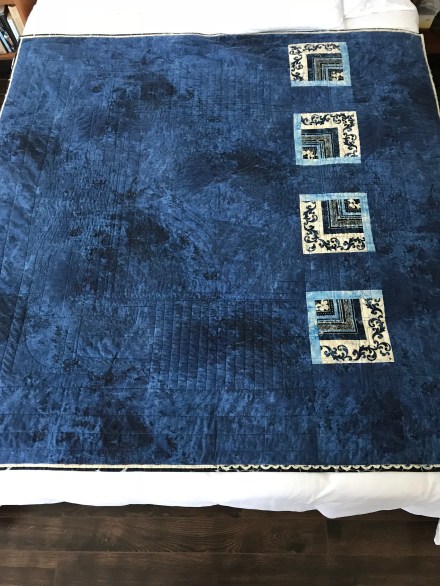
Quilt Back

#7 – This back is from the Grey-Yellow Quilt: I had a lot of half-square triangles left over from the front. I decided to array them as a spiral. The panel is offset top/bottom, and left/right. My quilts are all modern quilts – they need asymmetry to look “right”.

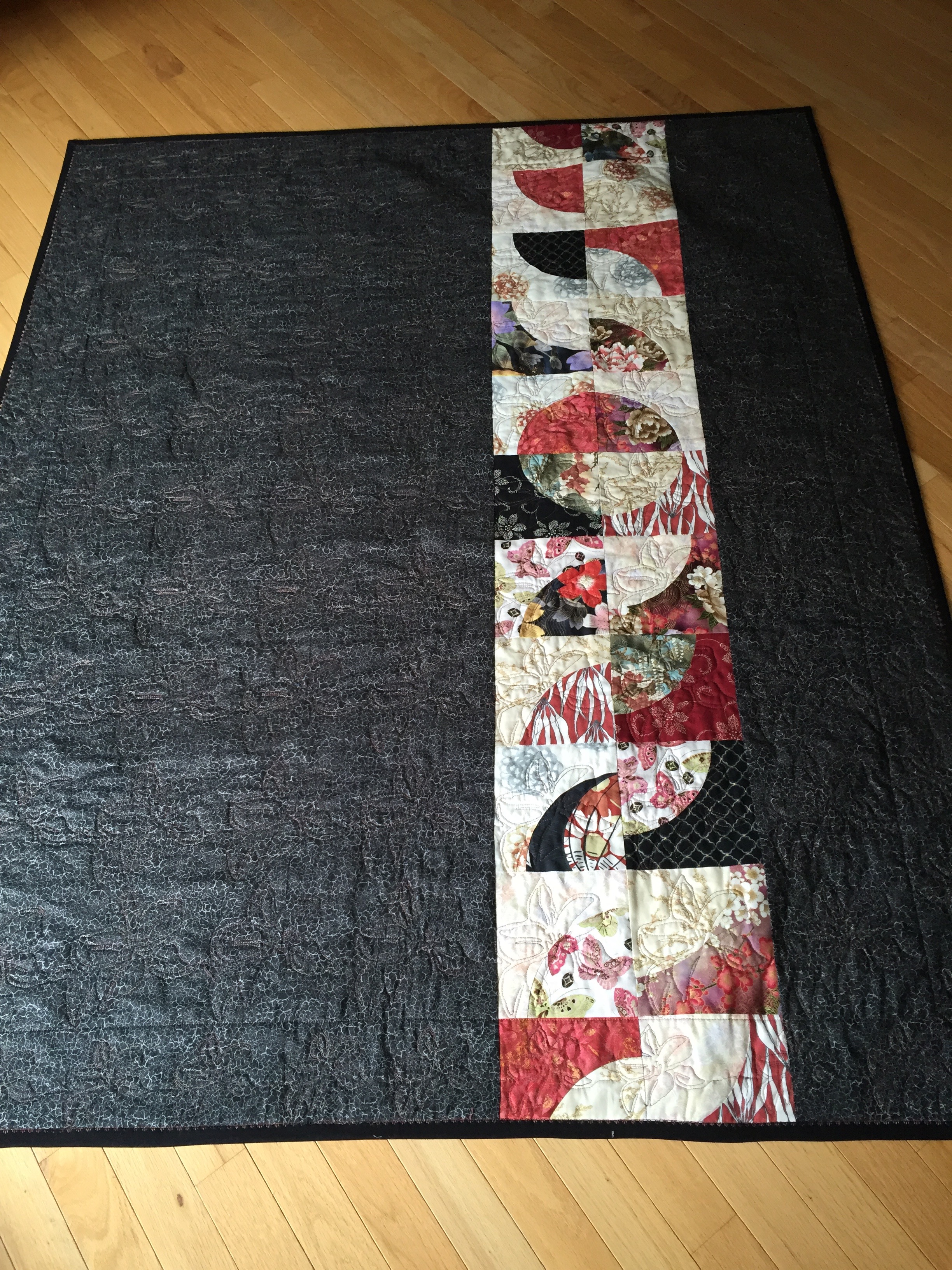
#8 – This back is from Improvisation #6 – Asian fabrics, drunkard’s path quilt. I had several slightly smaller blocks left over. I decided to do a more conventional drunkard’s path layout with single complete circle near the top of the strip.

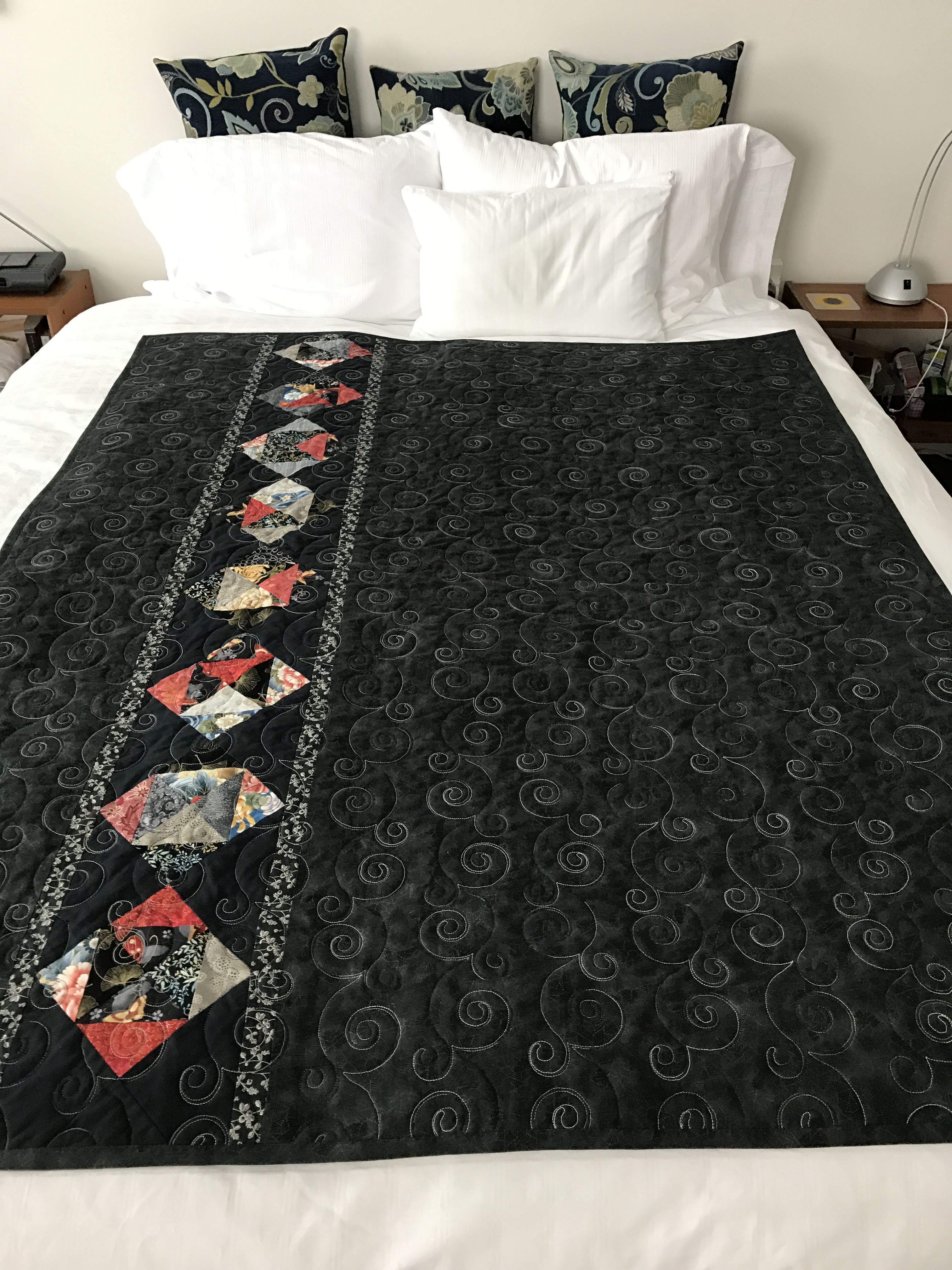
#9 – The back of the Asian Strips Quilt: I did the piecing of the on-point squares, added the filler and realized I still needed border/sashing to offset the insert strip from the backing fabric.
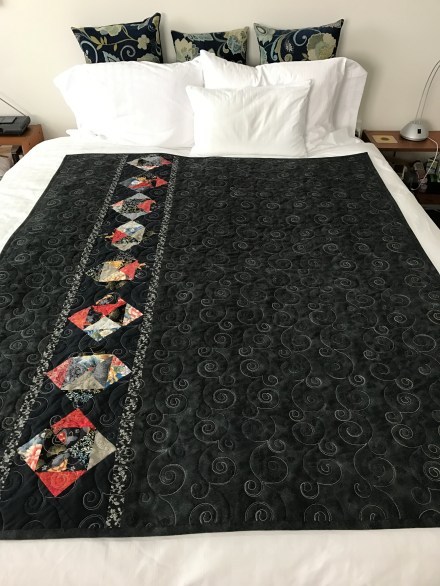

Obviously I have many more quilt backs I could showcase here, but these are enough to illustrate how I see a quilt back. All of my quilts are “double” quilts – they can be used either side – for me, that’s part of the challenge/adventure of improvisational quilt making.

Improv Quilt – Completed

Just done in time for my Tuesday Improv Quilt class. I did edge-to-edge quilting in the hoop on the central panel, then quilted the border separately. The inner section I treated as if it were a 6 x 8 pieced panel (using an 8″ x 8″ design which I set up using my embroidery software). That seemed to be the easiest way to do an overall quilting given that my building blocks were various sizes. I did not do any stitching in the ditch although I thought about it before I started the embroidery quilting.

Improv Quilt – Top

The back was pieced using leftovers from the top. I bordered the strip because it turned out the strip was shorter than I needed (that’s because I had added borders to the strip on the top side and this was all the fabric I had left). I like the effect and fortunately I had enough bits of backing to be able to do that.

Improv Quilt – Back

In the end, I had to return to the shop to buy another 15″ of backing fabric to bind the quilt. One last detail – I added a narrow strip of one of the top fabrics to one end to add another small accent. With label attached, this quilt is completed.

Sailboats In The Morning Fog

I was on a walk along the Halifax Harbourfront at 10am on a July morning in 2010. There were a couple of sailboats moored alongside the Acadia (a WW1 warship, now part of the Museum of the Atlantic collection) with the fog lifting in the harbour and the Dartmouth shore a pale form in the distance.

Moored Sailboats

I captured the moment – recently I added the photo to my collection of potential landscape/art quilts.

Partially Done

With the Art/Landscape class underway for a second time, I thought I’d give the sailboats a try. Sky with a bit more cloudy texture (because I had the perfect fabric), the opposite shore (heavily stitched), the water in a very soft blue-grey. I did some preliminary thread painting and texture building in the water on the left, then positioned the sailboats (printed on fabric, backed with fusible web, fussy cut) and pressed them in place. Now I have to add the reflections in the water to tied the image together. I elected to eliminate the small dock next to the Acadia and the just visible stern of the ship. I preferred just the two lone sailboats for my wall art piece. Although barely visible, I’ve used silk organza on the left of the image to represent the fog, added after the initial thread painting to blur the textile and stitching beneath.

I will work on the piece tomorrow in class so I can show the gals how I solve various technical issues – including creating an inner mat, making piping, and selecting fabric for the framing. They’ll also get to see how I go about thread painting with my feed dogs in the engaged position (I can’t free motion and obtain an even stitch length at all well, but I’ve figured out how to keep my feed dogs in position and do a “free-motion like” sewing). I want them to see how I do that.

I am probably also going to add a bit more movement to the water on the right, but not  until I’ve finished the reflections of the masts, the mooring lines, and rigging on the boats.

More after tomorrow – our second class (one more after that on framing and finishing an art piece).

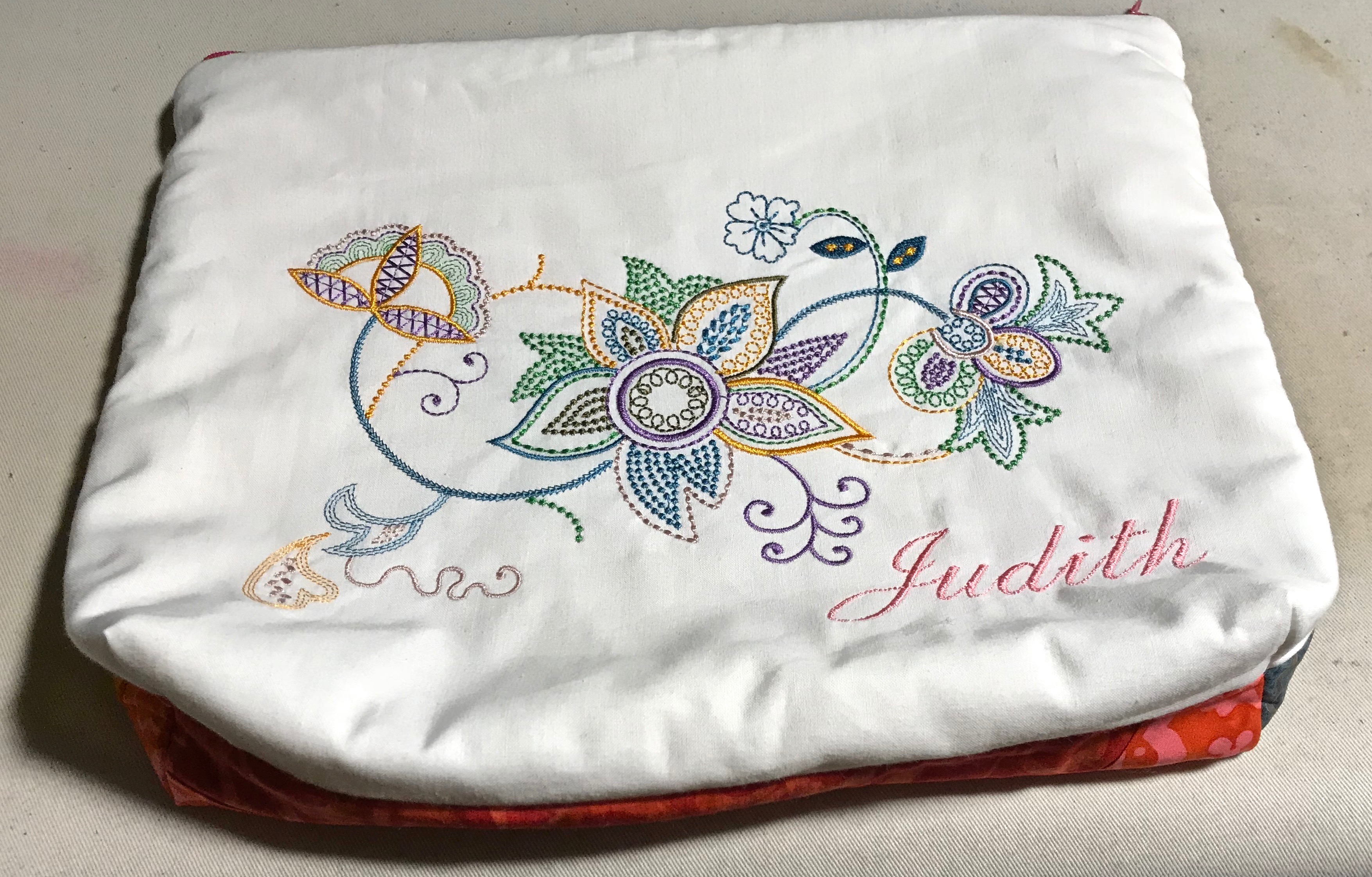
A Foot Pedal Bag

Foot Pedal Bag

I picked up my new Pfaff Creative Icon embroidery machine on Thursday. I knew when I bought the Creative Sensation Pro II a year ago that I would upgrade to the Icon when it became available because of the many improvements. First thing I did after unpacking the machine and embroidery unit was to try it out – without reading the manual! I figure the icons and gestures on the new touch screen on the machine would be relatively intuitive and they were. The manual also happens to be on the sewing machine but I’ve downloaded it from the Pfaff site and installed it on my iPad. I wish I actually had a physical users guide – I like having the manual beside me as I’m trying to figure out how something is done, flipping through the pages and writing notes to myself to remind me about various techniques – I haven’t so far figured out how to add notes to the pages on my iPad.

I found an embroidery design I liked that would be large enough to fill one side of the bag – I chose some rayon thread and stitched it out on a piece of cotton backed with low-loft needle-punched cotton batting as stabilizer using the medium size hoop (260mm x 200mm). Adding my name offered a few challenges but in the end I figured out how to use a built-in embroidery alphabet, scale down the embroidery, and position it where I wanted it without a lot of frustration.

The second side of the bag I pieced using 2″ scrap strips in two directions. I didn’t bother embroidering the resulting pieced fabric. What I did find challenging was using the reverse button – it wasn’t until I was nearly finished the strip piecing that I discovered a small indicator light that let me know when I was “in reverse” – I kept looking for that information on the touch screen. There’s a second indicator light next to the reverse light – I’ve tried finding out what the light is for in the user’s manual but haven’t yet been successful. There’s a small embossed icon above that second light that hints at an end tie-off but I can’t seem to make the light come on…

I added a zipper, lining, and stitched up this bag for my foot pedal and power cord. Very handy to have when taking the machine anywhere or for packing it away (which I never do!).

Today, I worked on the Icon to finish the Improv quilt top and to piece the back (I usually do piecing on my Brother straight stitch quilting machine). The straight stitching on the Icon is very good, and the upgraded IDT (integrated dual feed – a built in walking foot, in other words) does a great job – I stitched five narrow strips together for the quilt back starting at the same end each time – no bowing. The resulting pieced panel was perfectly straight.

I have to say, I’m liking this machine.

Improv Quilt – Borders Attached

Borders Attached

Just finished attaching the borders. The quilt top is now just about twin size – I hadn’t intended making the quilt this large but that’s how it’s turned out.

Now to create a strip for the back – I’m going to need to add at least 12” to the width of the backing fabric (that’s because I’m too cheap to buy a double length of fabric and because there’s enough scraps to assemble a wide strip).

Improv Quilt – Center Panel Pieced

Center Panel Piecing Completed

Just finished piecing the centre panel for the Improv Quilt. I’ve cut some strips to widen the panel another 4″ to balance out the length. I’ve also cut strips for the borders. Yesterday I bought some backing fabric and I’m planning on using the golden leaves for binding.

Because the piecing is random and bold and busy, the imperfections don’t show (only an eagle-eyed quilter would notice them) – there’s just the sense of shapes and colour distributed throughout the panel. With the strips and borders added the size and continuity will be fine for a good size lap quilt which is what I was aiming for.

Once I have the top completed I still have to piece the backing and assemble the quilt sandwich – all before Tuesday, when this class meets again! So I’m under a bit of pressure to keep moving this quilt along.

Improv Quilt – Partially Assembled

Quilt Top – Partially Assembled

I finally got a chance to work on the improv quilt again. I didn’t actually lay it out on the floor, but laid out the wide extended border on my cutting table and began assembling “sections” along one side – starting with one of the  equilateral triangle elements and adding bordered blocks, and plain blocks, and pieced blocks the same width, attached to one another with whatever width sashing make the section come out even. I had to sew some partial seams as I was putting the pieces I’d made together (I got good at that on the medallion quilt), then opened them to attach the next segments. I’d say I got about 3/4 of the quilt top assembled. I still have to make a couple of blocks to complete the improvisation. Not sure what they’ll be yet but some bit of piecing I haven’t tried yet.

I’ve got to go looking for fabric to back the quilt in the next few days. I have to have this quilt top completed over the weekend because the improvise a quilt class meets on Tuesday and I have to have this finished. I’m hoping I’ll be able to have the quilt sandwich assembled so I can demonstrate quilting in the hoop to the gals. The final (3rd) class, two weeks later, will be binding the quilt, and adding a label to the back. In other words I want these quilts DONE and not left as UFOs (Unfinished Objects) which is so often what happens to class projects for these gals.