Kantha Jacket

Last spring in San Francisco, Sheila and I visited Gumps. At the front of the store was a rack of lovely casual bright print jackets by Meiko Mintz constructed out of Indian Kantha cloth. I didn’t bother trying them on – the price deterred me. The jackets were something I could easily make for myself (if I could ever find the quilted Kantha cloth).

A couple of weeks ago, I came across an inexpensive king-size Kantha bedspread on Amazon which I ordered. It arrived amazingly fast – within 10 days. More than enough fabric to make a jacket.
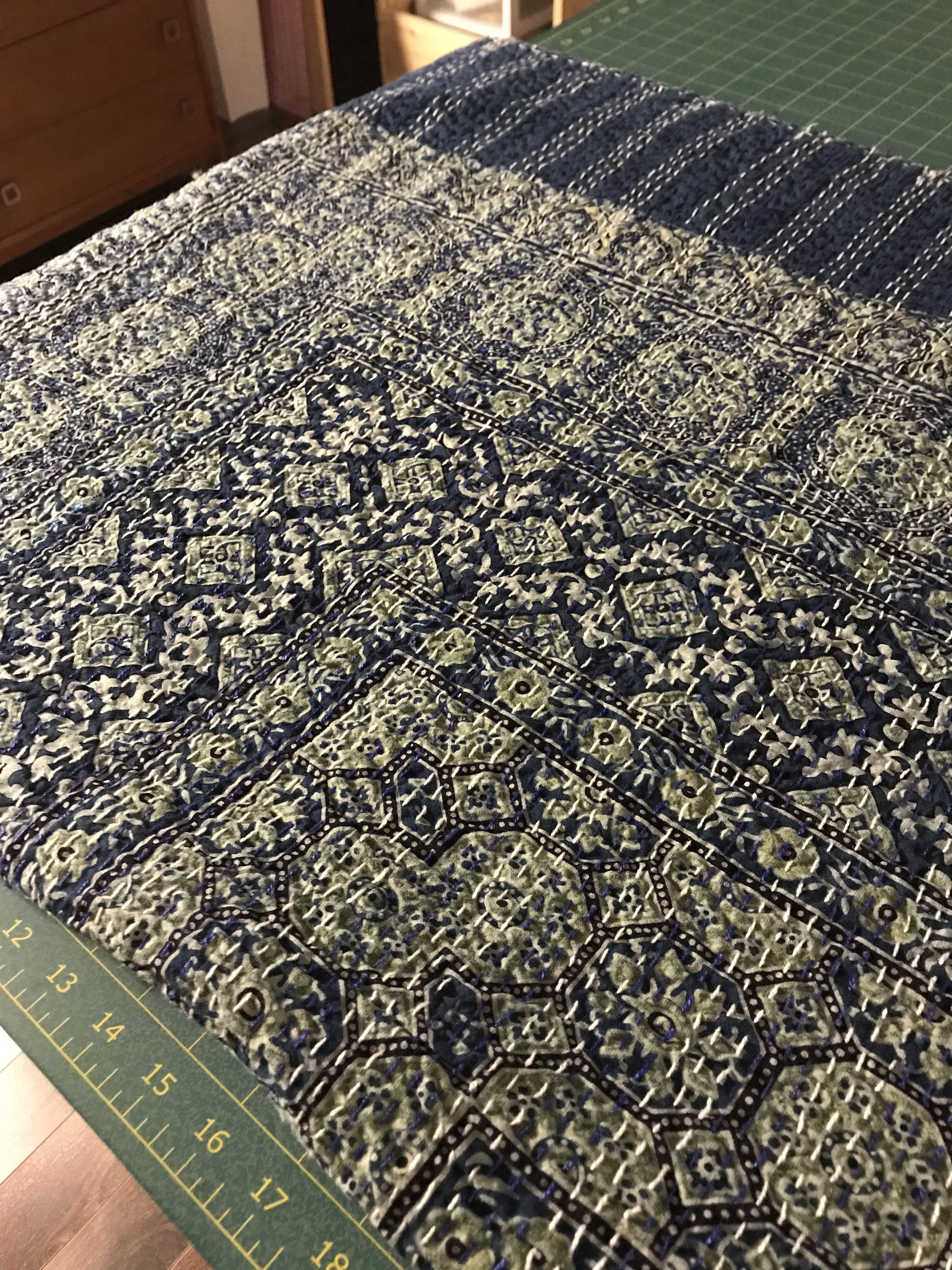
Kantha King-Size Bedspread (folded in half)

First it had to be washed… I thought about the process for more than a week – I knew the indigo (or whatever dark blue dye had been used) would run and likely kill the white stitching which I didn’t want to happen.

I was able to fit the large bedspread in my home washing machine. I added colour collector sheets to the wash.

Colour Collector Sheets

I used four just to make sure I would catch as much loose colour as possible. I added some Oxyclean (to get rid of whatever dirt was in the fabric), and an unscented detergent to cool water. (I probably should have added a cup of vinegar but I wasn’t sure how it would react with the Oxyclean – I will hand wash the jacket with added vinegar once it’s done to stabilize the colour before wearing it).

I caught a LOT of dye:
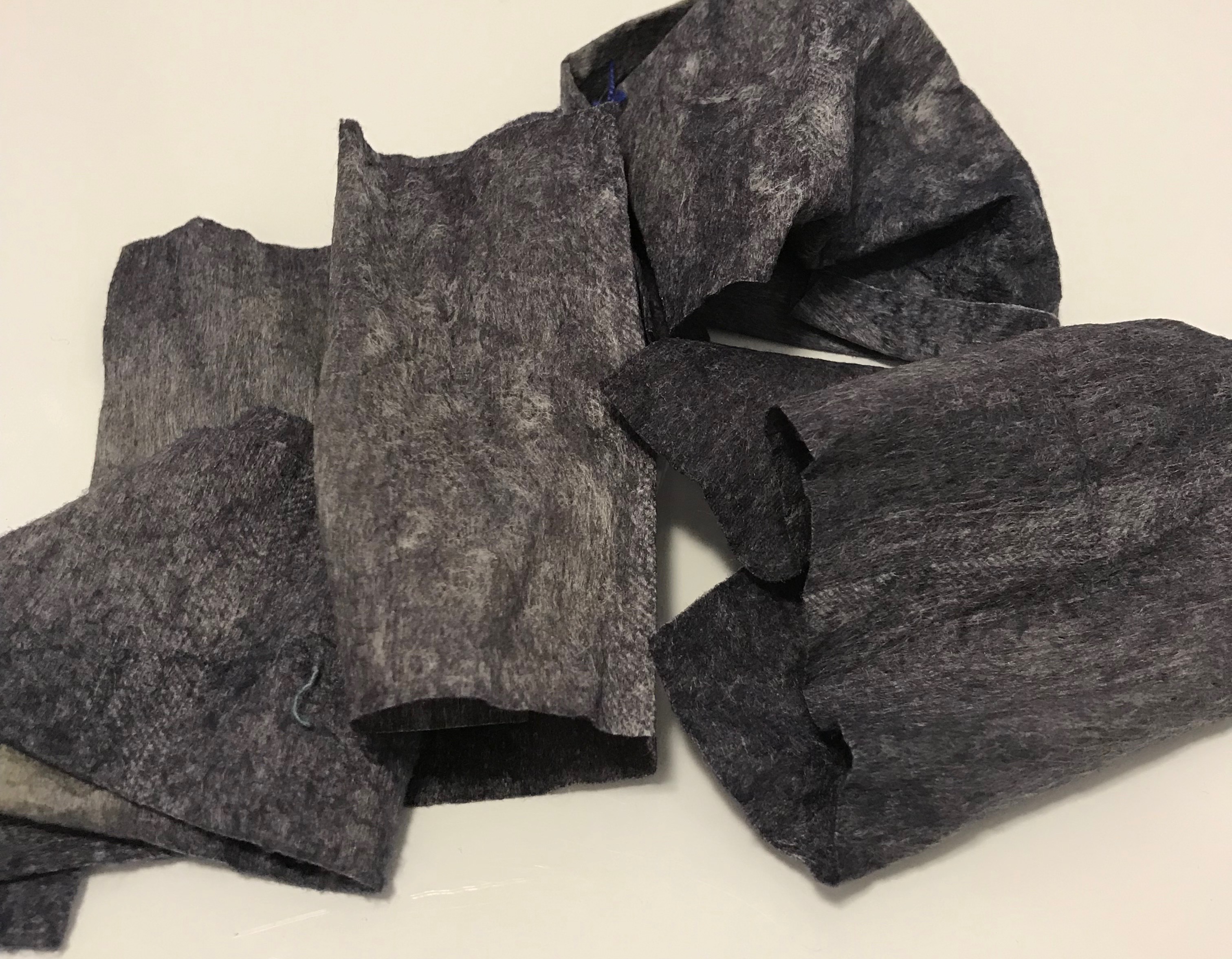
Colour Collector Sheets – After Washing

I started the garment by making a pattern from an existing jacket (which I happen to have bought at Gumps three years ago). A simple style with a Mandarin collar, turned up sleeves, pockets (too small to be useful – mine will be quite a bit larger). The thing about the jacket, which is reversible, is it’s finished with a hidden binding. Because my fabric is already quilted I will do a hidden binding finish using a batik that complements the plain fabric on the back of the bedspread fabric.

Here’s the jacket cut out and ready to begin sewing (I’ve already added the turned up cuffs to the sleeves – I constructed them separately and attached them to the sleeves so the print shows when the cuff is rolled back).

Jacket Front – Cut Out

Because of the way I’ve incorporated the the fabric detail, large patch pockets would obscure the design. Instead I’m going to make double welt pockets and use a single layer of printed fabric for the pocket on the inside of the jacket, blind binding the pocket fabric, then stitching it to the front, leaving just the double welt showing on the outside of the jacket. I’m still not sure whether I want to add a solid, darker blue strip to the bottom of the jacket – I have enough fabric to do that, although it would be an add-on and an extra seam – still thinking about that.

The finished jacket will be just a single layer, with machine stitched buttonholes. I’ve so far not looked for buttons – have to check my button collection before I go shopping.

More as the project unfolds over the weekend.

Sewing Tools Organizer – Finished

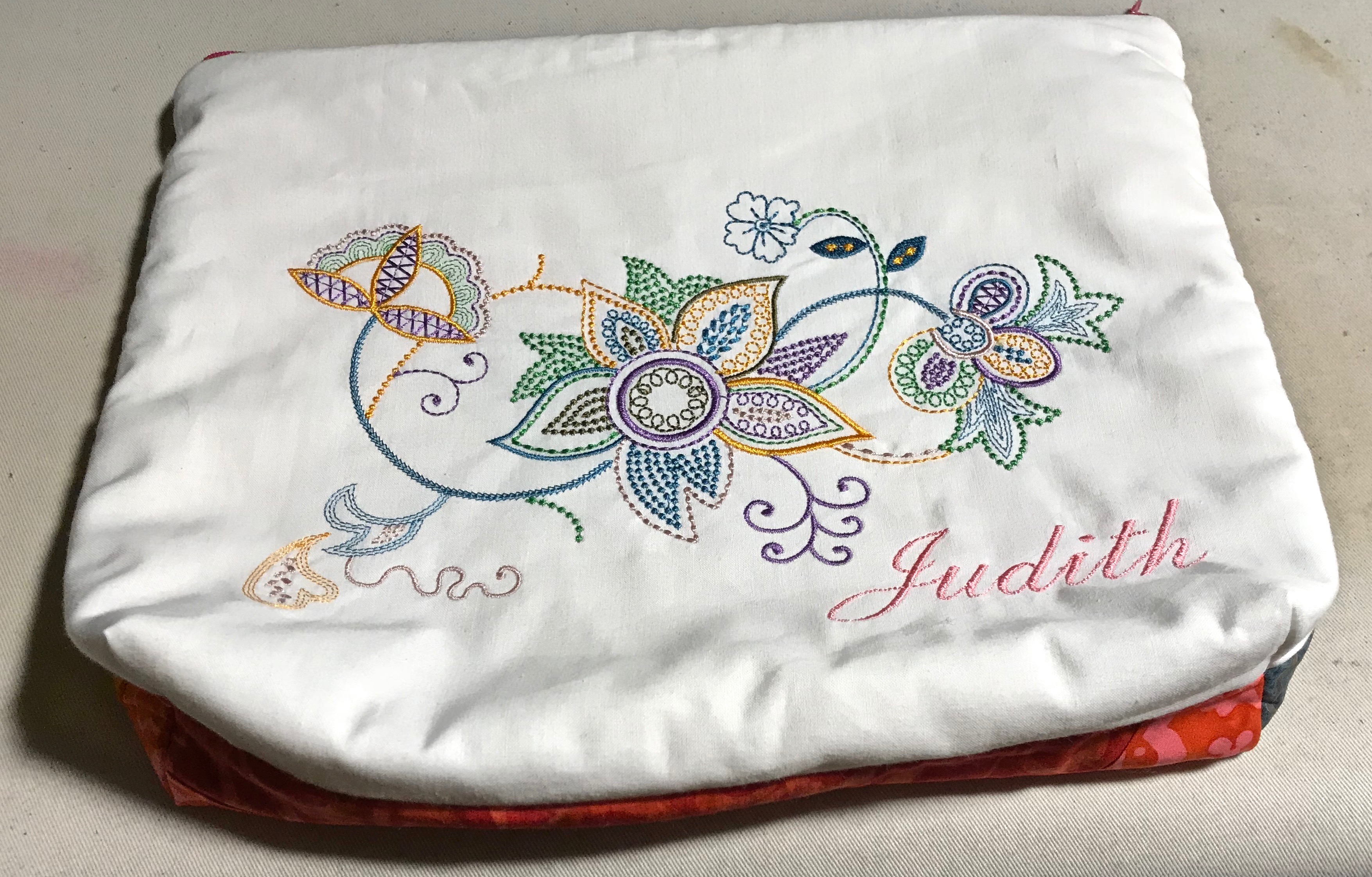
Here it is – just completed. A tiny bit wider than the original tools organizer but I was reluctant to make it narrower since I wasn’t sure how much width I was going to lose when I added in the zipper sides. Big-ish isn’t a problem, too small would have been.

So you can see the welted zipper opening on the front. What isn’t obvious is my name in the lower right – I chose the wrong colour embroidery thread! Instead of the lime green I should have used a golden orange (up close you can see the name, it just doesn’t hit you in the face).

New Exterior Case

The pattern (which I linked to yesterday – scroll down the blog entry) was helpful for dimensions and some overall construction suggestions, but because I wanted elements between outer and inner fabrics I couldn’t quilt the pieces and had to carefully think my way through construction. Not having the outer and lining fabrics on the sides not quilted was a bonus – it helped with zipper installation because I could apply the zipper to the outer fabric, then add the lining enclosing the zipper seams.

Applying the binding was a slow process – having to stitch through anywhere from 8-12 layers of fabric meant I needed to take my time although the machine handled the job perfectly well (with a new sharp universal 90 needle). In the end, I’m happy with how the binding turned out.

Here’s the interior:

Interior With Tool Pages From Original Organizer

The point of this project was to create a new case for the tools organizer – the original “pages” of pockets were fine – they just needed a new cover. Since the pattern has directions for making these pages, I may actually attempt one more – the cover is loose enough to accommodate another. What isn’t visible are the two pockets on the inside of the organizer covers – one zippered, one closed with some velcro.

Although I suspect many of the sewing ladies at Sew With Vision would be interested in making an organizer for themselves I have a feeling the sewing around these small round corners to apply binding is more difficult than many of them would be willing to attempt. I’ll take my organizer into the shop to show it off and ask what that the staff think.

Don’t know what’s next.

Drawstring Bags – Done!

Just finished the last of the drawstring bags for Christmas gifts – eighteen here, twenty-one in all. Just in time for tomorrow’s Friday afternoon knitters get together.

Drawstring Bags – Eighteen Completed

For the most part I was able to fabricate these bags using fabric for the outside and lining, for the drawstring channels, buttons, wooden beads, from the supplies I had on hand. I did have to buy 6mm grosgrain ribbon and a few wooden beads to finish the last few but for the most part I used what I had. That doesn’t mean there was no cost associated with the bags but it feels differently (like free) when I don’t have to go out and buy specific supplies for a project.

Now back to quilting the Layer Cake Quilt. Hoping to finish it this weekend.

Seven Done – Fourteen To Go

Just finished the seventh shoe bag – fourteen to go.

Shoe Bags

Here is this year’s Christmas gift (last year I gave small zippered bags) – a drawstring bag for carrying shoes during the winter. They’re not large enough for sneakers/running shoes, but if it’s a snowy day and you’re wearing boots, then this bag is perfect for bringing along a pair of “lady’s” shoes. It’s also a great size for carrying knitting or a hand sewing project, a book, art supplies, even makeup.

I was originally given a drawstring bag by a Japanese friend and it was immediately obvious the design was better than any I’d ever made – it was lined, made with separate channels for the drawstrings, and a buttoned pocket on one side.

I was limited by the width of fabric strips I was using – I’d pulled from the 9″ scrap bags (Keepsake Quilting puts together sets of coordinating fabrics using twelve 9″ width of fabric cuts of both printed and batik fabrics) fabrics I didn’t think I’d want to use in a quilt. So the final size of each bag was limited to 8 1/2″ x 16″ (don’t forget 1/4″ seam allowances). The drawstring channels are constructed from two 2 1/2″ x 17″ strips of fabric, sewn to form a circle, turned right side out and folded – long, raw edges together – and pressed. Each channel is inserted (raw edges to the opening) between the outer bag and the lining (which is placed right side together over the stitched outer bag). The top edge is sewn with a 1/4″ seam. The lining is pulled over the bag, the bottom end serged and the lining pushed inside the bag. I used narrow grosgrain ribbon for the drawstrings, used some smallish wooden beads (with large holes) to secure the ends. The drawstrings are strung through both channels, one from each side.

The first three bags have already been gifted – they were samples to establish size and production details. They lacked front pockets – didn’t think of adding the pocket until I started cutting the scrap bag fabrics – after cutting the two 17″ pieces for the length of bag I had just the right amount left for a lined pocket!

So now back to the sewing machine to assemble another batch – it’ll probably take me one more day to finish up the twenty-one bags I need.

Moth Holes

Embroidery to hide moth holes

Friday afternoon Joyce showed me the wool sweater she was wearing – a couple of moth holes in the front. She wondered whether they could be repaired. I assured her they could (there were two smaller holes near the first one as well) with a well placed machine embroidery.

I spent some time locating an embroidery design that would sit over the holes, not be too dense, and I could set up to curve toward the shoulder. I turned the sweater inside out, used “Whisper Web” interfacing (a light, cut away), hooped the right front side, chose mauve/rose rayon embroidery thread, then stitched out the design. I added two small sections of close zigzag to obscure the larger hole further, and stitched out a single leaf over a second small hole nearby.

The completed embroidery is subtle but it does the job.

PS: I just returned the sweater to Joyce, she tried it on, and she’s thrilled with it! I’m happy she’s happy.

A Foot Pedal Bag

Foot Pedal Bag

I picked up my new Pfaff Creative Icon embroidery machine on Thursday. I knew when I bought the Creative Sensation Pro II a year ago that I would upgrade to the Icon when it became available because of the many improvements. First thing I did after unpacking the machine and embroidery unit was to try it out – without reading the manual! I figure the icons and gestures on the new touch screen on the machine would be relatively intuitive and they were. The manual also happens to be on the sewing machine but I’ve downloaded it from the Pfaff site and installed it on my iPad. I wish I actually had a physical users guide – I like having the manual beside me as I’m trying to figure out how something is done, flipping through the pages and writing notes to myself to remind me about various techniques – I haven’t so far figured out how to add notes to the pages on my iPad.

I found an embroidery design I liked that would be large enough to fill one side of the bag – I chose some rayon thread and stitched it out on a piece of cotton backed with low-loft needle-punched cotton batting as stabilizer using the medium size hoop (260mm x 200mm). Adding my name offered a few challenges but in the end I figured out how to use a built-in embroidery alphabet, scale down the embroidery, and position it where I wanted it without a lot of frustration.

The second side of the bag I pieced using 2″ scrap strips in two directions. I didn’t bother embroidering the resulting pieced fabric. What I did find challenging was using the reverse button – it wasn’t until I was nearly finished the strip piecing that I discovered a small indicator light that let me know when I was “in reverse” – I kept looking for that information on the touch screen. There’s a second indicator light next to the reverse light – I’ve tried finding out what the light is for in the user’s manual but haven’t yet been successful. There’s a small embossed icon above that second light that hints at an end tie-off but I can’t seem to make the light come on…

I added a zipper, lining, and stitched up this bag for my foot pedal and power cord. Very handy to have when taking the machine anywhere or for packing it away (which I never do!).

Today, I worked on the Icon to finish the Improv quilt top and to piece the back (I usually do piecing on my Brother straight stitch quilting machine). The straight stitching on the Icon is very good, and the upgraded IDT (integrated dual feed – a built in walking foot, in other words) does a great job – I stitched five narrow strips together for the quilt back starting at the same end each time – no bowing. The resulting pieced panel was perfectly straight.

I have to say, I’m liking this machine.

Remodelling t-Shirts

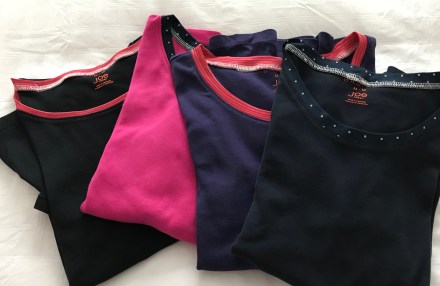
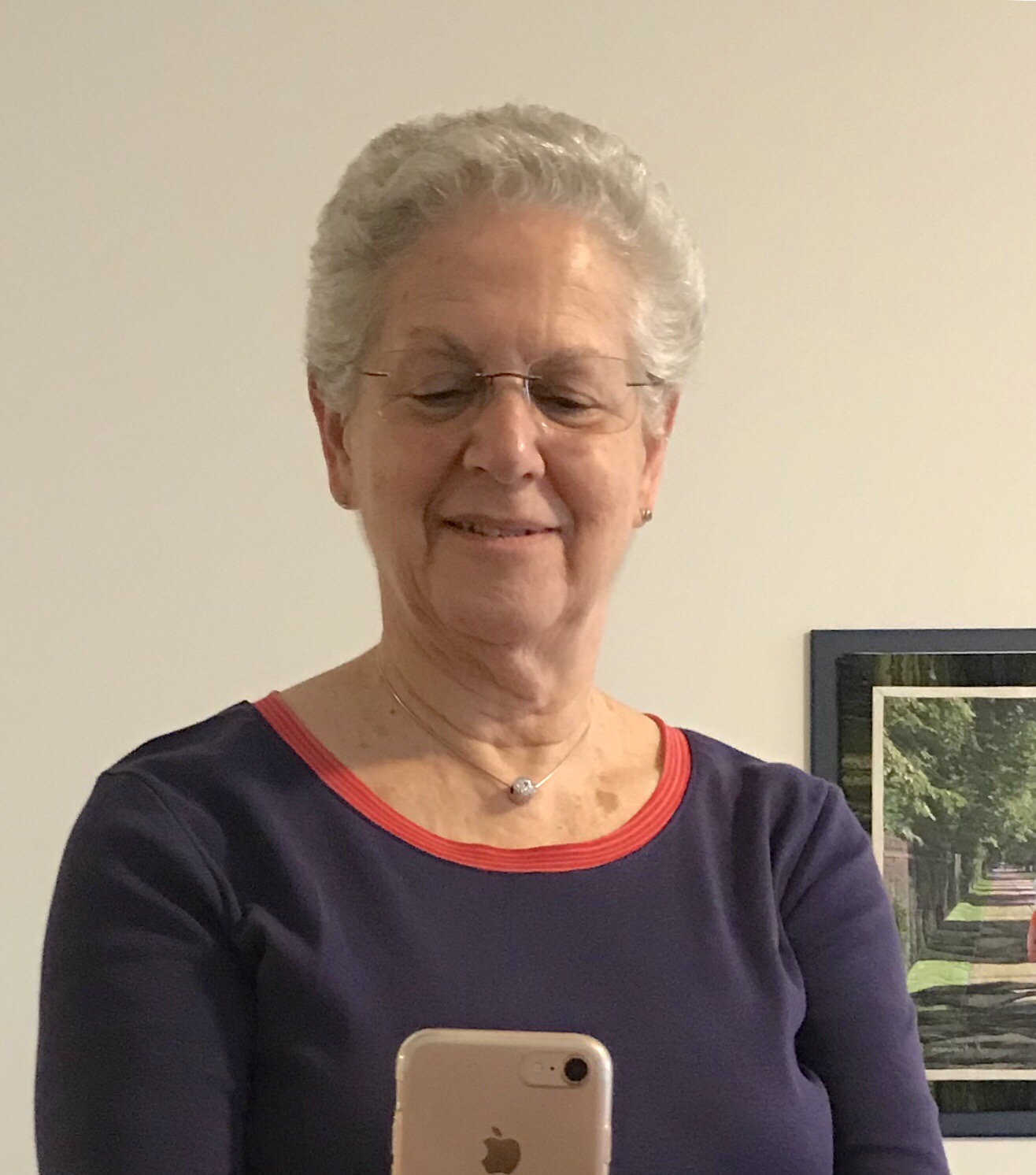
t-Shirt With Lowered Neck & New Neckband

With the medallion quilt completed, today, I turned to clearing up the piles of stuff in my sewing room. At least six weeks ago I pulled four t-Shirts from my closet with the intention of lowering the neckline. The shirts had originally been high crewneck long sleeve t-Shirts which I’d bought so I could shorten the sleeves and end up with sleeves just above my elbow – that’s not something you can purchase, trust me.

I wore them last year, but realized I wasn’t wearing them this year because the neckline was too high. So I moved them from the closet to my sewing space intending to remodel the neckline. Finally got to that today. Started by cutting off the crewneck ribbing and dropping the front about 2″. Then I cut 1 3/4″ x 24″ strips from some t-Shirt fabric I have on hand, serged the folded strip to each t-Shirt neckline. Remodelling complete. The contrasting neckband doesn’t look bad at all. And it lays flat – I tried them on. (I should have used dark serger thread to stitch on the new neckband, but hey, the stitching can’t be seen on the outside.)

Remodelled t-Shirts

It’s true, t-Shirt weather is just about over here in Nova Scotia – maybe one more day warm enough to put on a short sleeve top. But these shirts are now ready for next warm season.

Dropped Neckline

Stretch Cotton t-Shirt

This is actually the second t-Shirt – the first was a disaster (too big and too long – the culprit was the light weight black and white knit I bought in San Francisco – too loosely knit, I think). It went into the trash pile.

I bought the fabric for this shirt at my nearby Pfaff dealer who stocked some very nice stretch cotton knit this summer. This red stripe was the only one of those fabrics that suited my colouring, too bad. 0.8m (60″ wide) was enough for a t-shirt for me. The fabric sewed easily – didn’t have to fight it.

Red Stripe t-Shirt

Given my floppy upper arms, I like a sleeve that comes almost to my elbow so I lengthened the short sleeves. The pattern also uses a facing for the neck edge – nobody finishes a t-Shirt neck with a facing – I serged a doubled (24″ x 1 1/4″) strip to the neck edge (1 1/2″ shorter than the length of the neck so I could ease the neck edge into the seam). I also cut 1 1/4″ from the bottom edge – I’m short, and didn’t need the shirt to come below mid-stomach.

I cut out the shirt a couple of days ago. I was able to sew it up in under 2 hours this morning. I pressed the neck band toward the body and top stitched it 1.5mm from the seam to keep it flat. Cover-stitched the sleeve and bottom hems.

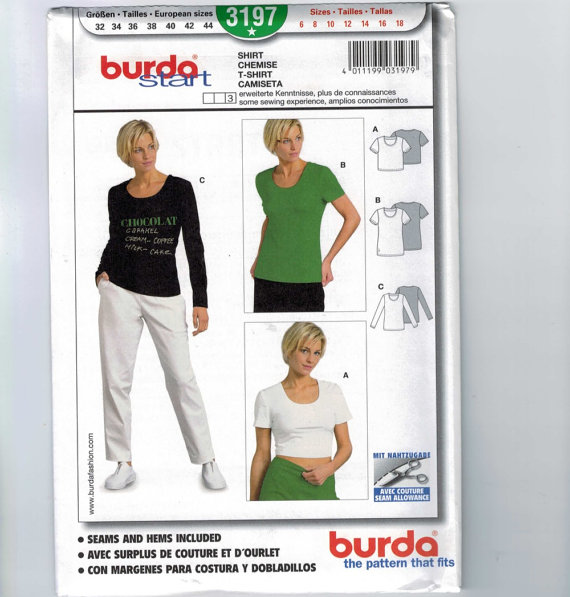
The Pattern is a Burda pattern I’ve had for ages (I tried finding some hint online about when the pattern was first released but came up empty although many people have made it – lots of photos of finished shirts). The size 14 fits me reasonably well. It’s easy to make with the 1/4″ seam allowances included in the pattern – makes fitting sleeve curves straightforward because you don’t have to fight the excess fabric in a 5/8″ allowance.

Burda 3197 Pattern (Vintage)

Now I need to go through my fabric stash and see if I can find another suitable knit to make at least one more of these shirts (then I’ll be able to cull some of the older ones in my closet).

Beige Pants

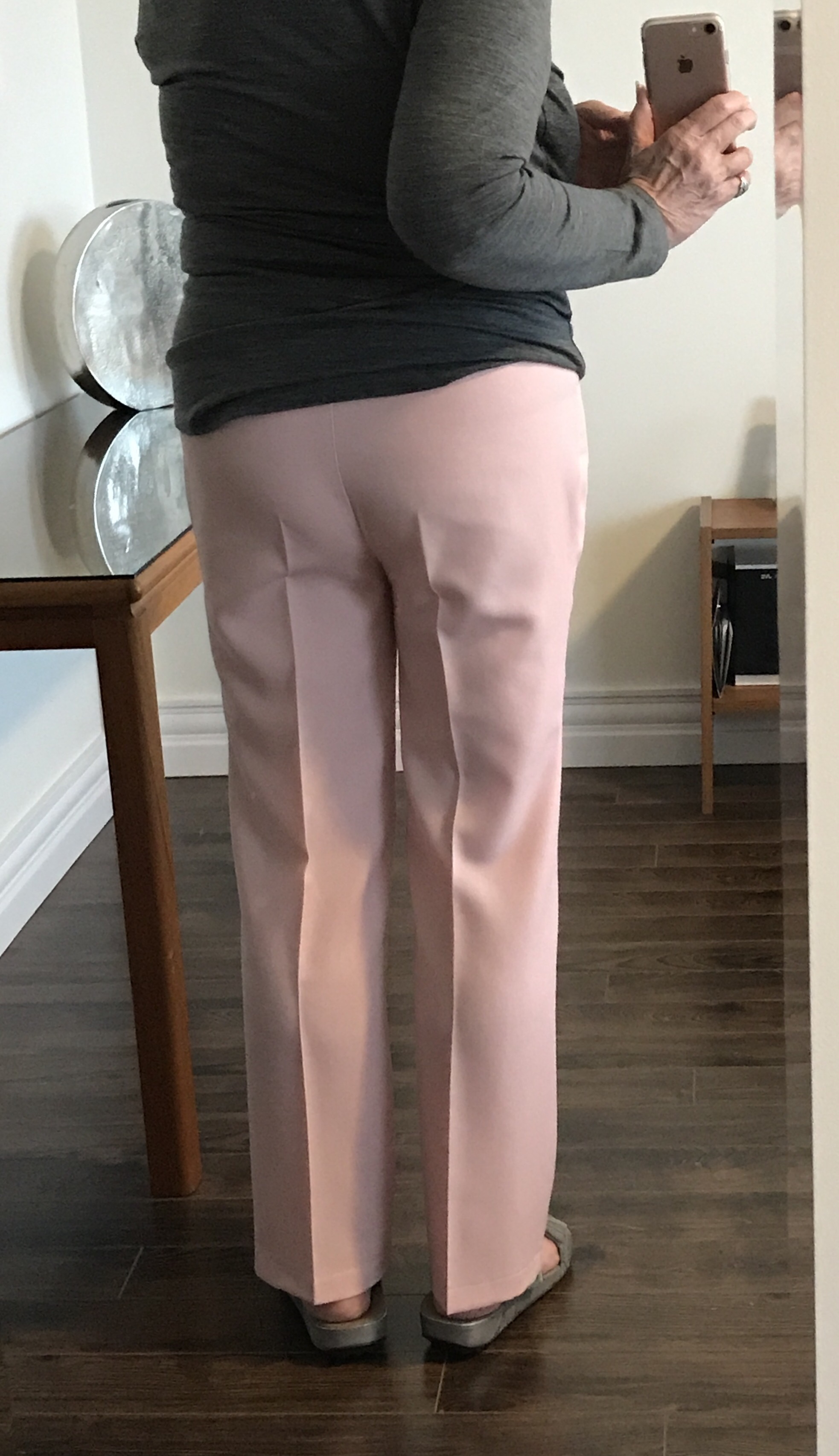
Same pattern, cut out with the same modifications I used with the pink pants, and these came out larger – had to take in the sides 3/8″ at the top and from mid hip to hemline. Obviously the difference is the fabric in spite of the fact there’s no spandex in this fabric either….

The front has turned out fine, happy with that, but below the bum is a wee bit baggy. Not much I can do about that at this point – the pants may tighten up a bit with washing, although I prewashed the fabric. Sitting in them may also round out the backside some.

The pants are certainly wearable. 

This morning I dug out some navy cotton twill (no spandex) that I will wash tomorrow, as well as some prewashed beige cotton twill – both will get made into pants when I get back from Toronto (going to my niece’s wedding coming weekend). I also found a prewashed length of French navy blue light weight cotton/linen blend to use for a loose shirt. Once those garments are done, the pants with the stretched out spandex will go.

Tomorrow, I intend to interface the silk dupion I’ve had waiting to be made into a quilt. I’ll get that project started next.

Pink Pants

These pants were cut based on the modifications I made to my basic pattern in San Francisco – a small addition to the centre front crotch area, a 3/4″ drop in the front waist, and 1/4″ addition to the side seams because the fabric had no spandex.

This is a jeans pattern but I thought this wool/polyester fabric was a bit too “dressy” to turn into jeans so I left out all the top stitching, omitted the back pockets, and used a single seam for a neat hem.

Have to say they turned out pretty well – although everything that could go wrong did! I started by putting the zipper on the wrong side of the fly front, had to redo it, pockets went in fine as did the side seams, but I screwed up threading the embroidery machine and I had to take out a stitched (not yet cut, fortunately) buttonhole not once but twice. After rethreading the machine and doing a practice buttonhole (which I should have done in the first place) the third try was fine. Only then did I cut it open.

I’ve just finished cutting pants out of a beige fabric which I will sew tomorrow. The beige fabric I used for pants in San Francisco turned out to be dreadful – it’s a stretch twill and it now has a permanent stretch across the front where the spandex has failed – very visible. So once these new beige pants (with almost no stretch) are done, the SF pants will get tossed. 

That’s the same fabric I used for the light and dark blue pants I made earlier in the spring – they’re starting to show the same permanent stress marks across the front so they’ll have to be replaced. This time, I’ll use a cotton twill with no spandex in it. The original fabric wasn’t a cheap fabric, either. 

So lesson learned – stay away from fabrics with any amount of spandex – they may be intended to provide a comfortable fit with some give but the quality and durability is variable and pants take a good 5-6 hours of work. Too much time for such a limited result!