In Progress

In April, Ann Williamson blogged about having just made a couple of “hitoe” jacket/blouses from her kimono silk stash. She calls them ‘hitoe’, the Japanese word for a silk, light weight, unlined kimono, because these jacket/blouses are unlined. By chance she discovered they look terrific layered, so often she shows them in pairs, like the two hitoe below (each with contrasting facing fabrics).

double-hitoe

A double hitoe

I love Ann’s work and the garments she creates. After my visit to her studio in Portland Oregon in 2013, I ordered some kimono silk myself from Ichiroya.com.

IMG_8007

Two bolts of kimono silk

Kimono silk comes in 14″ wide bolts with anywhere from 10-12 yards of fabric – enough, I’ve discovered for a single jacket/blouse. The hitch is you have to piece the fabric to make it wide enough to create a garment. Or you can do what Ann does – cut the silk into small bits, piece it into a large swath of fabric from which to construct a garment.

Sharon-trench

Pieced trench coat (using silk from four different bolts)

In this case I decided rather than cutting my silk into bits and piecing it, I’d use a princess pattern – all the pieces would fit on the width of the kimono bolt.

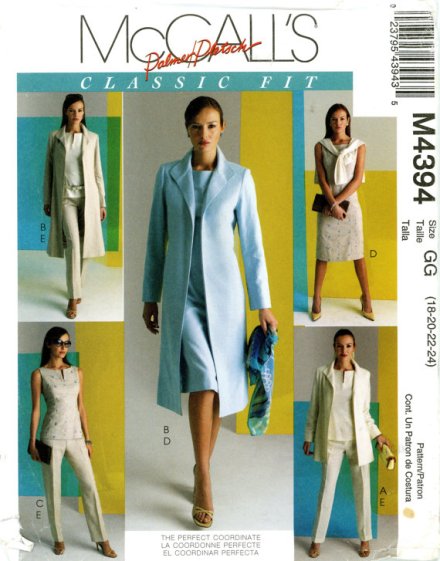
It just so happens I have a princess-based pattern I could adapt to create a hitoe – McCall’s pattern M4394 (out of print but available online from eBay, for example, although I actually bought my copy from McCall’s some time last year). It’s a vintage classic coordinated collection. I’d bought it because of the simple lines and the fact that it actually had fit adjustment markings on each of the pattern pieces!
jacket pattern

Hitoe-like jacket – View A

View “A” (shortened a bit) I thought would work for a hitoe like Ann’s. I selected the pieces I needed for the jacket, traced each, making size adjustments to the tracing. Cut out each pattern piece ready to work on the kimono silk.

This is where I should be making a “muslin” – trying out the garment using some inexpensive fabric first to make sure the fit works. I actually went so far as to prep some muslin from my stash, but thought – why not try the pattern using one of the kimono silk fabrics I’m not especially fond of – if it works (with adjustments, likely) I end up with a wearable garment, If not, I will have learned what I want to anyway before using silk I really like.

I selected the mauve silk with trees in the clouds. The bands of pattern are intended to embellish the kimono sleeves and hem area. I was able to match up the pattern for the front so the design crosses from high on the right shoulder to lower on the left hip, lining up across the center front.

IMG_8005

Partially constructed fronts

I was able to match the center back but the side back pieces had to be solid mauve (no pattern left). One sleeve has an enlarged tree in the center of the upper arm.

So far, I’ve pieced the fronts and backs. Now I’m ready to piece the sleeves (these are two-piece sleeves which I needed in order to have them fit the fabric width – a single-piece sleeve would have been too wide for the fabric).

I thought about doing the facings in a contrasting fabric, but I’ve used the mauve for that purpose in order not to detract from the flowing design in the main fabric.

More to come as this garment develops.


Garment Sewing Again

I’ve finally made it back to some garment sewing. A couple of weeks ago in her Distinctive Sewing Supplies newsletter, Catherine Goetz featured ITY knits (some prints for tops as well as solids in a 300 weight) perfect for making leggings. She included this Jalie pattern as well.


Jalie leggings

Jalie Leggings Pattern

I ordered 1 metre of the ITY knit in black and navy, and the pattern. They arrived early this week. Couldn’t wait to give the pattern a try – very simple: cut out x2 the single pattern piece (no side seam) in the navy, some elastic for the waist, quickly stitch it up on the serger (no hand sewing required). In under an hour I had a finished pair of leggings that fit very well.

Now I needed a tunic length top. A while back I had made a top using Marsha McClintock’s t-Shirt Trifecta pattern – turned out well. So I looked through the garment fabrics I had on hand, found two jersey knits I’d purchased earlier in the spring. Cut out the pattern (had to use some of the leftover ITY knit for the top since I didn’t have enough of the jersey knit), sewed it up. Not as fast as the leggings, obviously, but a couple of hours and I had a finished tunic length top.

IMG_7998

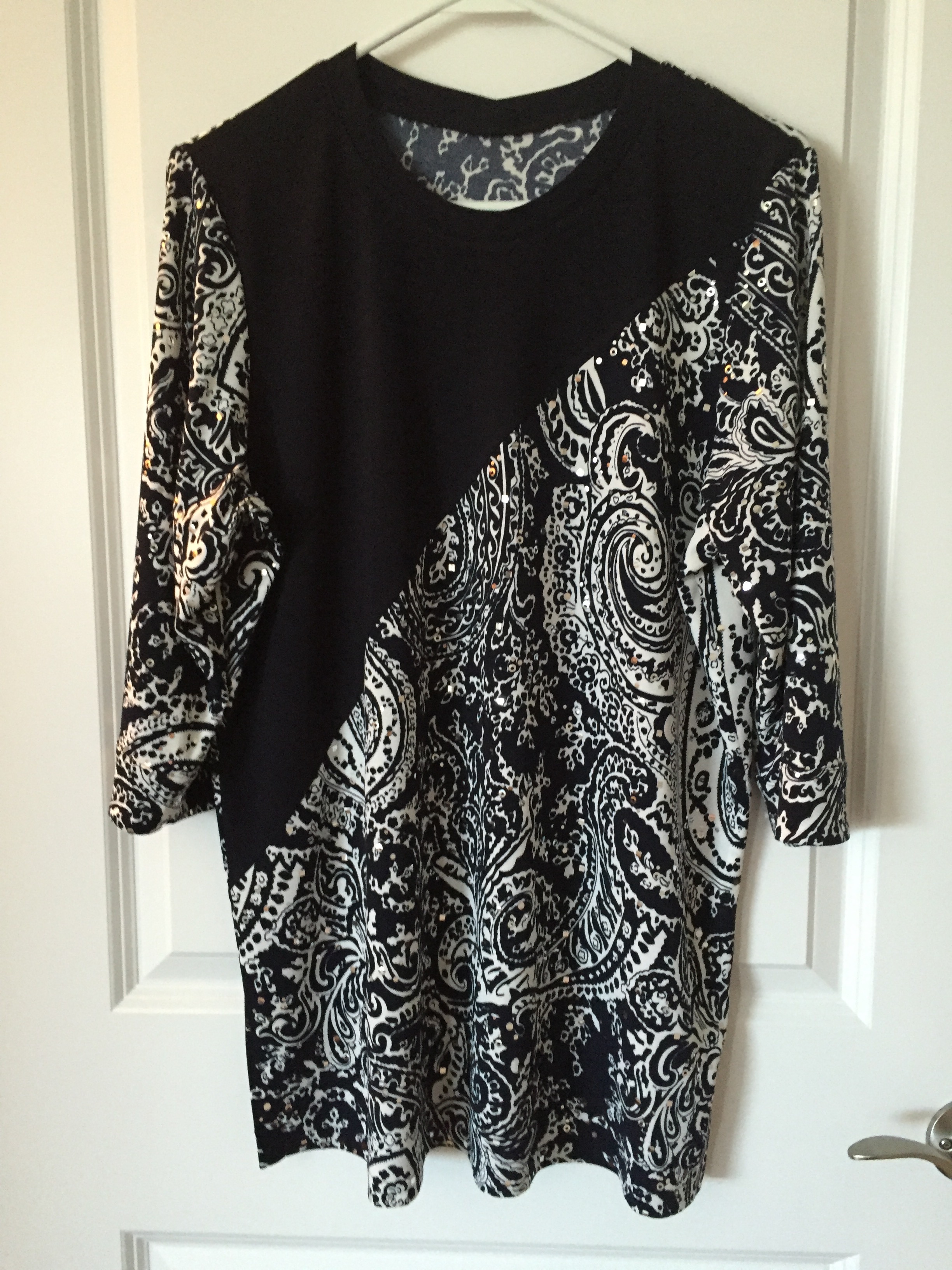
Tunic Top

Top with matching leggings – an outfit I can wear now, and into the winter (with a turtleneck for warmth).
IMG_7996

That was yesterday. I got up this morning and headed directly to my cutting table to cut out the second pair of leggings in black. Those went even faster than yesterday – I knew what I was doing at this point.

Then a second tunic top. Again, I was short on fabric, but this time rather than use the black ITY knit, I had enough fabric to piece the sleeves with a center seam from shoulder to cuff (if I hadn’t mentioned it you likely wouldn’t notice it when I have the tunic top on – and the seams in the sleeves lined up perfectly with the shoulder seams!)

IMG_7997

Tunic Top II

IMG_7995

Outfit #2

Three hours later: another outfit.

I try to keep to the rule – new garment in, an old garment out! I tossed two summer t-Shirts so I could put these two new tunic tops in the closet. I confess, though, I didn’t throw out pants to be replaced by the leggings.

A quick mop up once I was finished and I’m ready to tackle whatever will be my next sewing project – likely a quilt.

Pillow Remakes


I don’t have “before” photos but here are the remakes. I did the needlework about 40 years ago. I was going to toss them out and look for new ones, but when I took a closer look I thought the needlework had held up well even if the velvet backing fabric was definitely showing its age. 

So I very carefully unpicked the seams, discarded the old backing fabric. This time I installed zippers, new backing fabric (on two of the pillows I used some of the leftover upholstery fabric from the sofa), and the pillows look like new – definitely refreshed.

What I find so interesting is that the colours I used 40 years ago are still the colours that draw me today! The pillows go fine with the new sofa and daybed fabrics. Didn’t take long to do, either.

New Sewing Table

The third sewing table arrived Friday morning and it fits the space perfectly! It’s the right height, and the piece on the left is moveable – when I’m quilting, I can position it further to the right so it will take the weight of the quilt I’m working on. The depth of the main span is also greater (2′ 8″) than on either of the other two tables so there’s more push-back space to work with. I know I’m going to be happy with it.

I intend staining and oiling the surface so it blends better with the other furniture in the space, the majority of which is actually my old teak furniture. I’ll stop off at Lee Valley to ask their advice about how best to do that tomorrow.

So now the space is just about complete. Time to get back to sewing – I have a wall hanging piece I’ve been wanting to do for quite a while – I’m aiming for larger than any I’ve done so far. I’ll start by enlarging the photo on which it will be based so I can look at the elements and think about the fabrics I’ll need.

Here’s the sign outside of the Art Lab in Parrsboro – it was lovely approaching the building Friday evening and seeing it there:


The gathering Friday night was small but definitely enthusiastic.

And as I sit writing on my iPad at the kitchen island counter, I’m also watching the Tennis final in Cincinnati on my iPhone. Cilic has taken the first set, although Murray is pushing him hard in the second…. I was disappointed Raonic didn’t win yesterday. On to the US Open coming week. This streaming thing means I can be sewing and keeping an eye on the tennis at the same time. I love this multitasking….

Adding To The Stash

IMG_7684

The other day when I dropped into Sew With Vision (my local fabric shop), the plumeria (frangipani) print fabric called out to me. I admired it, but didn’t buy any. I was back in today and today I couldn’t walk out without it!

I was able to partner it with four other bright fabrics. Now I need to go through my stash to see if I have any other fabrics to go with these – I have a feeling I don’t. I did buy 1/2 m of each so I have lots of fabric to play with as it is. NO idea what I might do with this – I know if I cut it into strips / triangles / squares I’ll lose much of the integrity of the plumeria but the colours will still be strong.

For now, I’ve put them away in a labelled box on my shelf. They’ll call out to me again, once I’m settled. At the moment I have two quilts to finish before I pack up my machines.

The purging is ALMOST complete – just the pantries (I have four food storage locations) to go through, none of them large. That’ll take a morning to throw out long outdated packages and tins and perhaps even storing what’s left in those large plastic tubs I bought the other day. Better than 2′ cubes – the tubs, although smaller, have handles so they are liftable!

Day by day, I’m getting there. Yesterday, 40 years of my professional life was sorted into paper / plastic / cardboard and bundled into recycling bags. Out the door. I had to ask myself – is that all it was? But then I think of the students in those classes whose lives were affected by the experience whether they’re aware of it or not. Those 40 years has a gentle ripple which keeps moving outward….

Sewing Studio – Plan

sewing studio

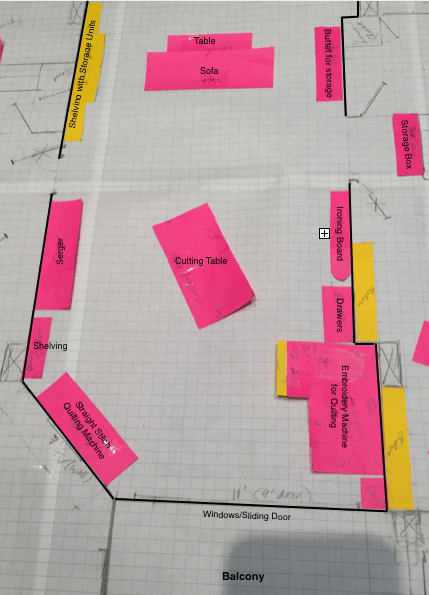
Here is my current tentative layout for my sewing studio. The kitchen/dining room/living room is a large rectangular space: from the kitchen island to the windows/sliding doors/ is 31′. Width at the doors is 11′ – at its widest the room is 15′. It’s a big room! There is a doorway on each side leading to a bedroom, but the overall main space is uninterrupted.

There is enough wall space to accommodate the sewing tables for each machine at the balcony/window end of the room. Because the room is so wide, I envision a kitchen island for a cutting table – the unit 24″ deep, 6′ long, with a 3’x6′ top (this will overhang the base by 12″ and perhaps allow the “back” of the island to have shelving) with a cutting mat surface for rotary cutting. I see something like this:

IMG_7639

(without the granite top) and probably 12-15″ longer to accommodate shelves at the end as well as the back. Since most of my furniture is teak I thought a finish something like this would work – simple and in an approximate colour family.

IMG_7637

A unit like this would compensate for the lack of a closet with shelving in this main space. Right now, my sewing room is very compact and has spilled over into the closets of two other rooms!

IMG_7481

However, I think with this shelving and repurposing my teak shelving storage unit and the dining room buffet to handle fabric and notions I will have plenty of sewing storage. (There is also a “den” – for a “box room” where I can put the overflow if I need to.)

Now I need to be patient and wait until I’m actually in the apartment to place what I do have and then see what kind of space I have for the island – who knows, I might be able to make it even bigger. I want to be able to stand at the cutting table and not be far from the machines, ironing board, and the shelves where stuff is stored. Right now I can do that in my small sewing room (9.8′ x 8.7′).

IMG_7475

While I will have much more space I want things to be close to hand.

Getting this all set up is going to be fun!


House Sold!

IMG_5107

My house sold this week – now my life gets crazy! I’ve got six weeks to sort through my “stuff”, decide what to keep and what to pass on, pack it so I can actually find it when I arrive at the new apartment.

I will actually have more floor space than I have in the townhouse. Before I looked at apartments I thought about how I use the space I have: I spend almost all of my time sewing, doing things at the computer, and knitting/watching TV in my bedroom. I don’t use my living room/dining room space much at all. So I decided I would actually set up a sewing studio in the main area of the apartment. I spent yesterday afternoon with a friend scaling up the floor plan I obtained online so I could think about where to position existing furniture and consider what I might want custom made.

IMG_7644

There will be lots of room for three sewing tables (one for my quilting machine, one for my serger, and one (much larger than the one I currently have which needs to be built) for my embroidery machine which I use to quilt the quilts. There is also going to be room for a cutting table. I had originally planned to use my dining room table with a cutting mat surface for that purpose, but I was in Home Depot yesterday and realized a kitchen island with drawers and shelves in the end sitting in the middle of the room surrounded by machines (and close to the ironing board) would be just the thing. I’m not going to order that until I get the machines set up. So I may end up with room nearer the kitchen island for the dining room table.

I plan on using the smaller second bedroom as a computer/sitting room (with a day bed for an occasional guest).

Now I have to go through all the books (there are books in every room, right now) and get rid of almost all of them – I will just keep those I actually reread: the Dorothy Dunnetts, the Exordium (a si-fi 5 series set which I reread often), and I don’t know what else. The challenge will be figuring out what to do with the discards – I hate sending them to the paper recycling depot, but there aren’t many used book stores left in the city.

Then I will have to go through all the ornaments/dishes on the shelf unit currently in my living room and sort those. I will also need to carefully sort the art so I can easily find the few I’m going to have space to hang.

I have a check-list that I need to dig out and start working my way through it. I’ve also got to keep in mind I’ve committed to having a showing of 10 new quilts end of August through to mid-September. I’ve got 7 completed, #8 is being quilted at the moment, and #9 I’ve just finished piecing the top (borders still to come). So I have to come up with one more quilt and get it stitched before mid July when I have to be out of the house!

And there’s still a possible quilting class June 7 and 28. I know what I’ll be making during the class – a variation of the quilt the participants will be working on.

So my life has suddenly become a lot busier!

Sewing Inspiration

It’s very hard for me to shop because I look at garments and notice the sewing imperfections and remember fabric in my stash and think how easy it would be just to make it. Instead, “shopping” for me is about ideas! 

Yesterday Sheila and I dropped into Desigual – their stuff is interesting although their sizing doesn’t fit me, it’s intended for women 40 years younger and skinnier than I am (I wear a size 12-14!) I actually tried on a black and white shirt in a large (forgot to photograph it) but I’d have needed an XXL (which they don’t make) to hang properly and even then I think the shoulders would have been too narrow.

But there was inspiration galore:

A denim jean jacket with inserts and sleeves in an almost sheer print fabric used in the shirt underneath. I’d never have thought of doing that but now I might.A shirt in contrasting bold colourful prints – I might have considered doing something like this. It’s a reminder to look through my stash of shirt fabric when I get home with something like this in mind.

Inspiration everywhere!

The Comfort Zone

I’ve been engaging in a written conversation with a quilting blogger – her most recent entry was about the physical stresses that are a part of quilting. Most people don’t think about the strain and tension that goes along with quilting – the ergonomics of sewing are critical.

I replied to Melanie with the following:

IMG_7430

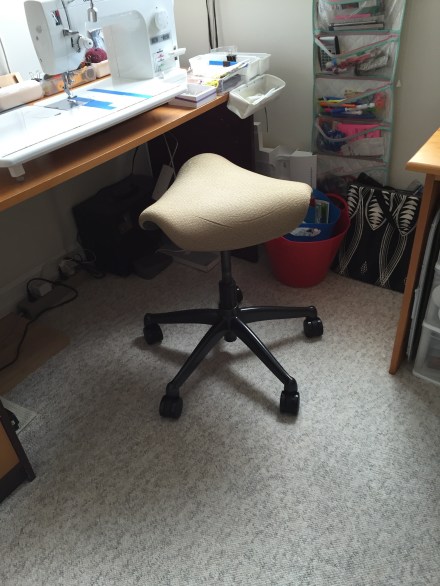
Saddle Chair

For me, the relationship between the height of my sewing machine bed (2 1/2″ above the table top) and the seat height of my saddle seat is critical! Table top – 26″; seat height 22″. That allows me to sit straight, swivel on the seat, support my feet on the wheel supports on the seat, with my arms and shoulders relaxed and elbows at a perfect 90 degree angle. There is no back support on my my saddle chair but sitting on it forces a straight back, neck alignment.

I do big cutting jobs on my dining room table which is too low, but I trim on my ironing board which is 32″ high – a wee bit low but I’m never standing there for long periods of time. Sit to sew, stand to press, trim… I can work comfortably for three – four hours.

IMG_7431

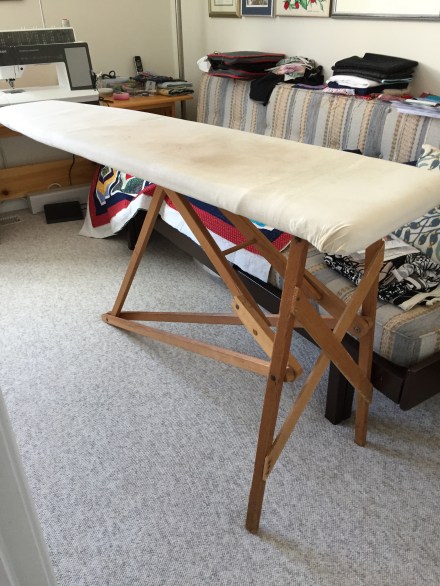
Ironing Board – at least 100 years old!

Melanie then asked:

I haven’t tried a saddle chair. I’ve seen them at shows offered for longarm quilting, which might help when doing very fine work. Is your ironing board adjustable? I feel like I often do a lot of pressing at a time.

My saddle chair is adjustable and I have it set at almost the highest it will go. My ironing board, as you can see is NOT adjustable. I bought this old thing at least 50 years ago at the Salvation Army in Toronto for $1.50! Aside from it’s height, it’s wider and longer than a modern metal ironing board. It also has a solid wood board which now has many layers of padding on it so it holds heat very well. I’ve had new boards but have given them away – this is the best ironing board I’ve ever had. Every year or so, I make a new cover which I install over the old ones. I use an unbleached light weight canvas. At the same time, I tighten all the screws in the legs to keep the board from collapsing when I set it up to press.

There are times, when I’m starting a new quilt that I will have a lot of fabric pressing to do – like today, I just cut out 75 seven inch blocks from a collection of 19 asian inspired fabrics – I’m going to do a drunkard’s path quilt next and I needed to press the fabrics before cutting them so my cutting would be reasonably accurate. The ironing board height, however, seems to be OK. I can press for quite a while before feeling tension in my middle back.

So comfort while sewing – you bet. It’s important to have a working set-up that doesn’t put undue strain on the back and neck, or wrists. It would be awful to end up with a repetitive stress injury and not be able to sew/quilt any more!


Double-Sided Bound Buttonholes

I knew the buttons and buttonholes needed more work. First I fixed the buttons: stitched the larger button using small beads to elevate the button and form a shank, placed a 4mm knitting needle under the second button underneath while I was sewing the pair of button to the coat. I was able to end up with thread button shanks, and the second button was lifted enough that I could get my needle beneath and wind off the threads to form the shank! The buttonholes well that was another story.

First here is the finished coat (with the elevated buttons and bound buttonholes completed) from the front:

coat front

Quilted Coat Front

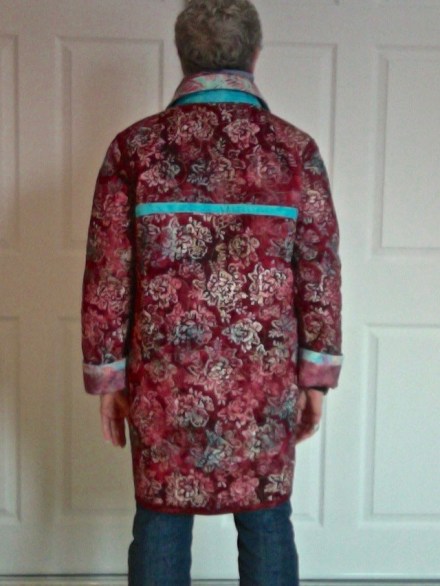
And from the back – fits pretty well.

coat back

Quilted Coat Back

Now for the double-sided bound buttonholes.

I did a bunch of trials to see if I could find a way to end up with a bound buttonhole finished on both sides with a single piece of fabric. Turns out it can be done. Here’s how.

For the coat I cut 3 1/4″ X 2 1/2″ pieces of fabric (I used the contrast fabric from the reverse side, because that’s where the finishing would end up and I thought the binding should match the rest of the contrast elements).

I used a Frixion erasable pen to mark horizontal and vertical center lines, then marked the stitch lines for the buttonhole. Used chalk to mark the distance from the front edge of the coat then placed the piece of fabric so one end of the buttonhole would align with that chalk line.

IMG_7356

Using a 1.25 mm stitch length I carefully stitched around the buttonhole, starting part way along one of the long sides.
IMG_7357

Finished stitching the buttonhole overlapping the beginning by a few stitches.IMG_7358

I cut the center opening and snipped as close as I could get to the corners without actually cutting the thread (remember I have a stitched buttonhole beneath and this binding had to completely cover it – it did).IMG_7359

Pulled the fabric through the hole, finger pressed the ends with the small triangles, folded the top and bottom portions of the buttonhole fabric so the folds meet in the center, pinned the fabric so I could tack the ends of the fold closed, removed pins and pressed.IMG_7360

Stitched across the ends so they would stay in position.IMG_7361

Folded under the top and bottom portions of the fabric, pressed. Then folded in the ends and pressed. IMG_7362

Carefully edge stitched (using a 2 mm stitch length) all the way around the folded buttonhole fabric to secure it in position – I used a matching thread for the top and a dark thread to match the main fabric in my bobbin so the stitching on the front side of the coat shows but blends in. This is how it turned out on the reverse of the coat.IMG_7363

Here is one of the button holes on the front of the coat. You can see I didn’t have a lot of play room between the buttonhole and the front binding – I was able to just align the buttonhole so the stitching didn’t overlap the binding.IMG_7367

Here are the buttons done up.IMG_7369

The whole looks a lot more finished than it did with machine stitched buttonholes. In fact, having the stitched buttonhole beneath stabilized the fabric so I don’t have to worry about anything pulling away!

So there you have it – bound buttonholes finished on two sides using a single piece of fabric.

The Craftsy Blog gives good instructions for constructing a bound buttonhole, but the expectation is that the underside will be finished by cutting the facing fabric and blind stitching it to the back of the bound buttonhole. In my situation with the quilted reversible coat I had no facing so I had to figure out another way of finishing the buttonhole on the reverse. Same basic procedure but I finished the buttonhole on the second side by carefully folding the edges and ends and edge stitching the fabric in place.