Back Garden Cleanup

This morning, on my way into town to have my snow tires removed and my summer tires put on my car I saw a forsythia in full bloom – today is April 27 –  the earliest I’ve seen forsythia in bloom in past years is May 3. A bit further along the road was a long splash of coltsfoot at the base of a fence.

So it’s officially spring here in Halifax (in spite of a snowfall yesterday afternoon/evening)!

When I got home from the car dealership I took a look at my back deck garden. It was warm enough in that sheltered corner to be outside and working. So I donned my garden gloves, picked up my loppers and Japanese knife, my garden waste bin and got to work.

I cleaned out last fall’s dead stuff, pulled out unwanted grass and other volunteers from the pots. Then I swept the deck clear of dead leaves.

It took me about an hour – but now you can see what’s coming along: I’m going to have about 20 blooms on the rhododendron (that’s close to a record), lots of flowers on the PJM rhododendron (that’s the small leaved one), the hosta is very visible, my peony survived and has shoots starting, the chives are well on their way, and lots of coral bells made it through the winter (in a week or two I’ll dig out all the stray coral bells from pots where they’ve started themselves and move them elsewhere). The echinacea lived through the winter (at least 4 of the plants are showing shoots!) so I won’t have to replant it (that’s a first). I love having those large pink daisy flowers in the late summer/fall.
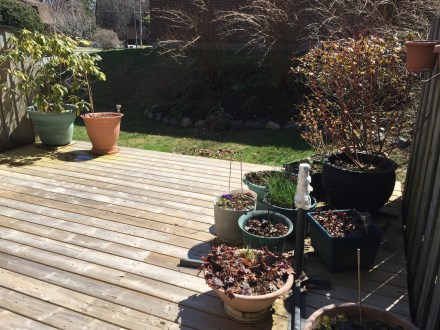
IMG_7503

Nearer the house, the clematis has lots of leaf buds growing, the yellow birch, the nine-bark, and maple are all looking happy with buds swollen almost ready to burst if the warm weather persists. My Siberian iris is back, as is the dusty miller, and the red sedum and the small yellow day lilies will do fine.IMG_7504
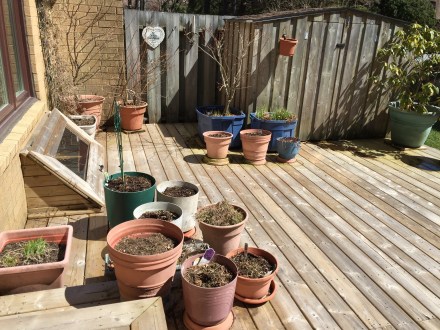
As you can tell, my container garden is predominantly a perennial garden. I’m always amazed at how these plants make it through the winter in pots just fine. Most were volunteers (the maple, the yellow birch, the nine-bark). I noticed a couple of maple seeds had sprouted in some pots – I’ve left one to see how it will do.

Mid-May, I’ll add the annuals to fill in some colour: peach coloured wax begonias, lobelia (dark purple), pansies (purple), some golden canna lilies and for sure some mandevilla – both the red and pink were glorious last summer.

This time of year makes me happy – I just love it when the garden begins to return.
Socks #365+

IMG_7500

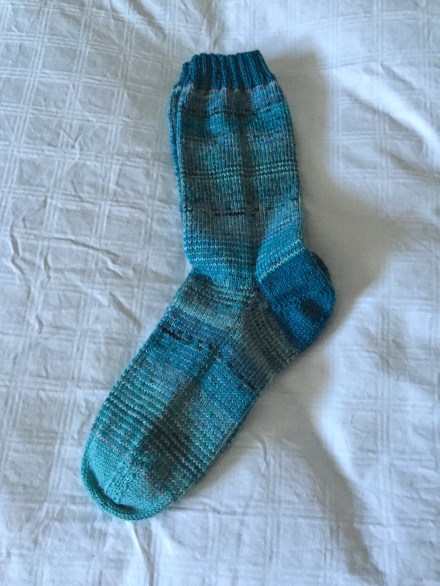
Finished last evening. To make these socks, I bought two 50g balls of Fabel sock yarn – one in shades of turquoise, the second in shades of grey. The variegated pattern in both was subtle, not a lot of change, so I decided to interleave the two yarns throughout the whole sock – that way (with cuff, heels, and toes in a complementary solid Sisu yarn) I’d have enough yarn to make a pair of socks.

Because they go well with my turquoise wool crewneck sweater (from Woolovers) I decided to keep them. I wore them today!

The next pair will be similar using a variegated with a strong pattern in blues along with another ball in subtle shades of blue/grey. This time I might knit whole sections in one yarn, then change to the second, and back again. We’ll see once I get beyond the cuff.

More improvisation!

“Face”

IMG_6601

OK, so what is it?

I got sent this image the other day – an example of a found “face”. I can see the face quite clearly but didn’t recognize that I was actually looking at a crab carapace, probably picked up from the beach sand somewhere in Florida.

I’ve tried tracking down the crab species – the closest I’ve come is it’s likely a smallish stone crab. Many of the Florida crab species have a much wider carapace. Also most don’t have such a profusion of spines along the front (“head”) edge.

Whatever it is, I’ve added the image to my “faces” collection.

Improvisation #6 – Finished

Finished yesterday, label added today.

IMG_7493

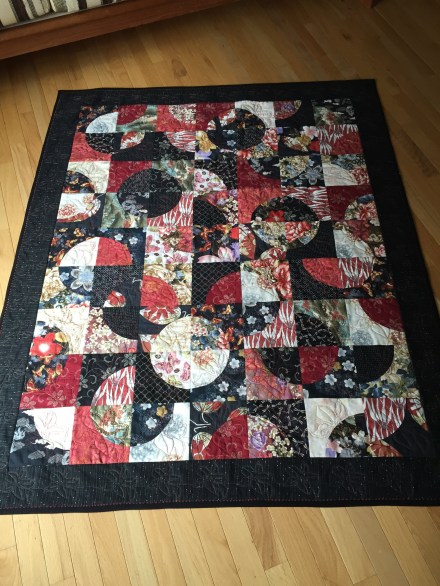
Quilt Top

I’m please with how lively the quilt is and how the full and partial circles turned out. Not a usual layout for drunkard’s path blocks but one that works well with these fabrics – prints with an Asian/Japanese flavour. I like the contrast between the blacks/lights and brick fabrics. The dark border also helps the circles pop.

IMG_7495

Quilt Back

For the back, I used blocks that didn’t quite make it up to size (most of the initial blocks) – I trimmed them by 1/4″ and was able to use them here. Notice, one circle just above the mid point, the rest of the blocks arrayed in one of the more traditional drunkard’s path layout.

To quilt my quilts I usually assemble the whole by pin basting, then stitching in the ditch along the block edges. This time, I stitched only around the border, leaving the pins in place while I quilted each block individually. Quilting this way covers any misalignment of the back strip with the columns on the top – that misalignment does show up if I’ve stitched in the ditch – I’m not usually out by much, maybe 1/2″ from top edge to bottom, but I can see that slightly off vertical line in the quilting on the back.

The design I created for this quilt aligned so the beginnings and ends of each embroidery link up and the whole looks as if I’d done the quilting edge to edge on a long-arm quilter (I’m getting better at this!). The border design is the same design, just downsized so I was able to stitch out two repeats using my grand endless hoop – that hoop makes the whole process go very quickly unlike having to individually hoop each of the 63 blocks in the quilt top. I was able to align each new start precisely with the ending of the previous stitch-out.

IMG_7494

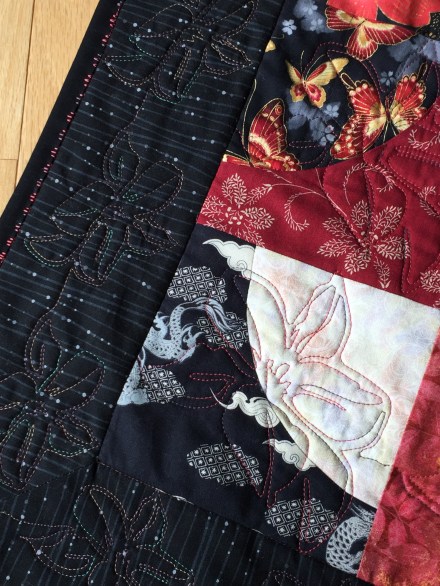
Quilt Detail

I chose a darker Sulky variegated thread for the border (darker than the thread I used for the blocks – a predominantly a brick colour) which still seemed too light, until I fancy stitched the binding in place using the brick coloured thread – that toned down the border quilting so you can see the design, but from a bit of a distance it doesn’t shout at you.

Started piecing the next quilt (I’d already cut the fabrics late last week). No name for this quilt yet.

IMG_7496

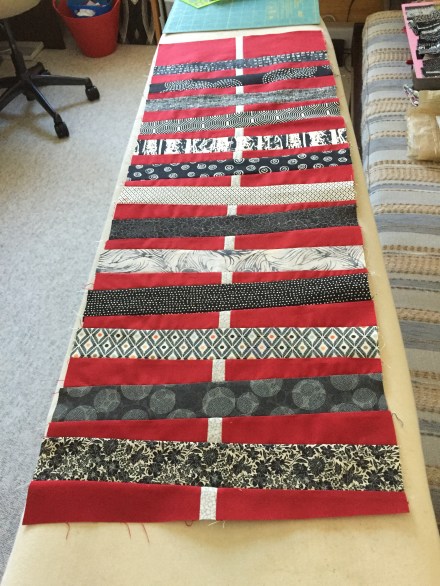
This quilt will consist of three columns of black/white fabrics attached by the midline of the rich red Kona cotton background fabric. The arrangement of the strips will be different in each column. I can see I will need to do a bit of “fixing” near the top of this strip where the center line bows a wee bit to the left – the fix: to shave a bit off the bottom right of background strip #4 – that will straighten the strip.

The columns will be joined with sashing in the red solid fabric, the outer borders will also be 4″ of the red fabric (to match the 4″ top and bottom pieces for each column.

The back piecing? Haven’t thought about that yet!

Spring, Yeah!

A wonderful warm day – 20 C in my part of the city. The first so far. Buds on the trees are fattening, the hosta is beginning to show, and the patch of crocuses that have survived are open!

I will need to plant a whole lot more in the fall in spots that are sunnier than this spot – they make me smile and feel hopeful that the season is really changing.

“Cow” Socks

“Cow” Socks

Here they are. Finished last evening. The yarn was dyed to produce the spiral stripes. Overall, I find the black overpowering the white/pink/rose. So these would be socks to wear with black, rather than pink, say.

Into the give-away pile… (which is growing – I’m going to have lots of socks for Christmas presents, coming December).

Improvisation #5: Finished

Improvisation #5 Top

Finished with binding this morning. In the end I added an outside red small print border. The challenge with this quilt was the quilting. The blocks were too big to quilt in any but the large reversible hoop so I decided to try quilting “edge to edge” using the 360 x 200 hoop. I started the quilting in the upper left corner – the design I’d set up had the start align with the end so I was able to use precise positioning to connect each consecutive embroidery as I worked across the width of the quilt. Four and a half repeats in each horizontal pass; nine passes from top to bottom. I could have nested the embroideries a bit more closely and done ten passes. Another time I will attempt to “overlap” each pass a bit more.

The nice thing about “edge to edge” quilting is all the borders are included in the overall quilting – no separate designs to quilt them.

Improvisation $5 Back

The back used up the five extra blocks I constructed.

Improvisation #6: Japanese Quilt

IMG_7452

Finished dimensions: 52″ X 64″

Just this minute finished this quilt top. I haven’t yet finished quilting the tipsy squares – the fabric for this quilt called out to me and I had to cut the blocks, then the circular portions leaving an “L” shaped piece, and I couldn’t leave the pile of “L” shaped pieces sitting there so I started working on the blocks.

The blocks are what is called “drunkard’s path”. It’s a classic quilt block with a curved bite removed from one corner. There are a gazillion possible arrangements for these blocks, but I thought this fabric collection called out for complete and partial circles – bubbles.

Sewing drunkard’s path blocks is not for the faint of heart! The challenge is to smoothly fit a convex curve to a concave one. Cutting the corner piece was relatively simple – I’d bought an acrylic template that allowed me to cut consistent 5″ circular pieces with my rotary cutter. To end up with a 6 1/2″ block I actually began with 7″ squares of fabric, cut the 1/4 circle, then trimmed the ends of the “L” 3/8 of an inch so when I aligned the two antagonistic curves they would actually match up. I sewed a bunch of practice blocks before tackling these ones for the quilt. By the time I got to sewing this fabric I had pretty good control over the process and almost all of the blocks could safely be trimmed to 6 1/2″. My finished block size is, therefore, 6″. It took some fiddling to get the block to work – 1/4″ seam on the curve was essential – actually just a tiny bit shy of 1/4″ worked best. The instructions I read recommended using 5 pins along the curve – I found I just needed two – one in the middle of the curve, the second at the end – then carefully fitting the “L” to the 1/4 circle (the latter on the bottom) allowed me the best control. I was surprised how quickly I could construct the blocks.

While I was making blocks I did enough for an insertion in the backing. That strip is also assembled. Tomorrow, I’ll construct the backing and set up the quilt for quilting. THEN I have to get back to the tilted squares to get the quilting on that quilt done.

I have four more quilt ideas waiting their turn. I have fabric for some of them – the difficult part is being patient and not starting anything else until these two quilts are finished.

Lufthansa Socks

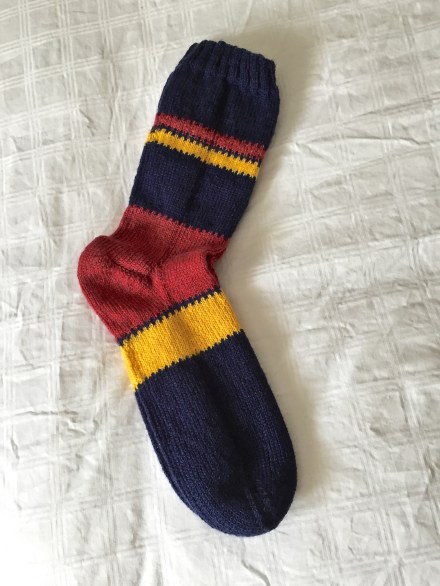
IMG_7450These are the socks for my friend Sab (who works for Lufthansa). She asked me for a pair of socks she could wear with her uniform – indigo and red – but Lufthansa’s colours are indigo and a golden yellow, so I incorporated both the red and yellow into the socks, making sure there was a reasonable amount of navy at the cuff end so she can wear them in her boots without the colour showing! At least I hope that’s what will happen.
Now to pack them up and get them in the mail to her. That’s for tomorrow.

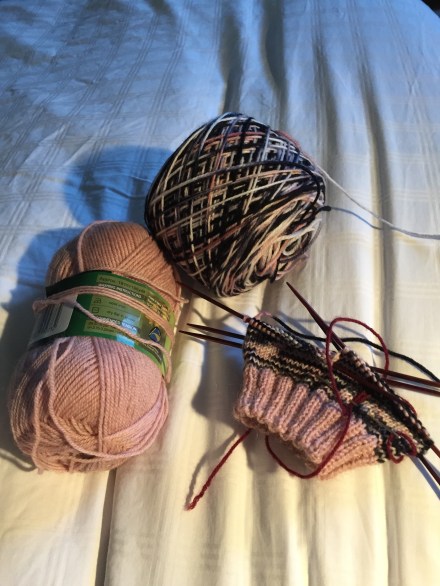
The pair I started last evening I’m calling black/white cow – the yarn colours are white/black/grey with some pink – they just remind me of a cow. The yarn seemed so silly I couldn’t resist it. IMG_7455See what I mean – at the moment I’m knitting on 68 stitches – the “pattern” will change when I reduce to 64 in another 10 rows or so. Then I suspect there will be a set of spirals that appear. That’s the pleasure of knitting with variegated yarn – I love seeing what pops out as I knit!
The Comfort Zone

I’ve been engaging in a written conversation with a quilting blogger – her most recent entry was about the physical stresses that are a part of quilting. Most people don’t think about the strain and tension that goes along with quilting – the ergonomics of sewing are critical.

I replied to Melanie with the following:

IMG_7430

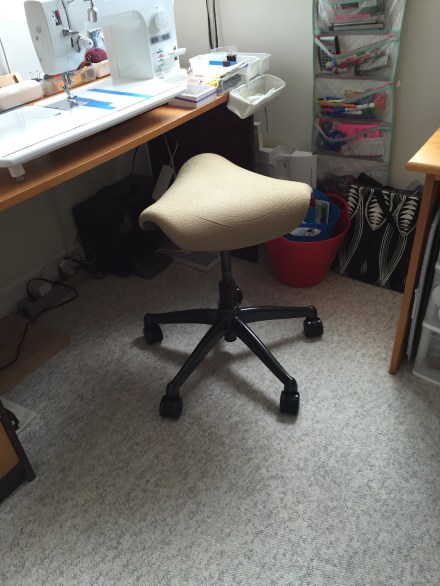
Saddle Chair

For me, the relationship between the height of my sewing machine bed (2 1/2″ above the table top) and the seat height of my saddle seat is critical! Table top – 26″; seat height 22″. That allows me to sit straight, swivel on the seat, support my feet on the wheel supports on the seat, with my arms and shoulders relaxed and elbows at a perfect 90 degree angle. There is no back support on my my saddle chair but sitting on it forces a straight back, neck alignment.

I do big cutting jobs on my dining room table which is too low, but I trim on my ironing board which is 32″ high – a wee bit low but I’m never standing there for long periods of time. Sit to sew, stand to press, trim… I can work comfortably for three – four hours.

IMG_7431

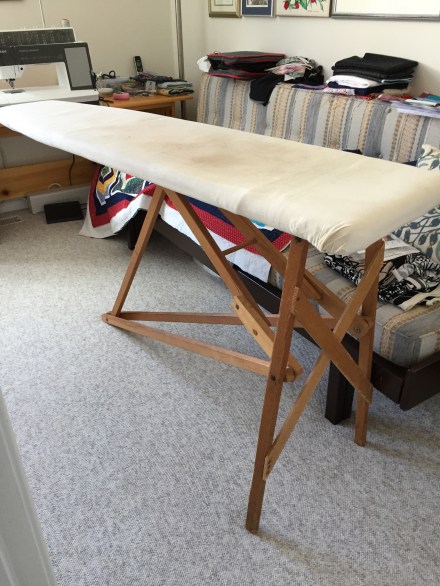
Ironing Board – at least 100 years old!

Melanie then asked:

I haven’t tried a saddle chair. I’ve seen them at shows offered for longarm quilting, which might help when doing very fine work. Is your ironing board adjustable? I feel like I often do a lot of pressing at a time.

My saddle chair is adjustable and I have it set at almost the highest it will go. My ironing board, as you can see is NOT adjustable. I bought this old thing at least 50 years ago at the Salvation Army in Toronto for $1.50! Aside from it’s height, it’s wider and longer than a modern metal ironing board. It also has a solid wood board which now has many layers of padding on it so it holds heat very well. I’ve had new boards but have given them away – this is the best ironing board I’ve ever had. Every year or so, I make a new cover which I install over the old ones. I use an unbleached light weight canvas. At the same time, I tighten all the screws in the legs to keep the board from collapsing when I set it up to press.

There are times, when I’m starting a new quilt that I will have a lot of fabric pressing to do – like today, I just cut out 75 seven inch blocks from a collection of 19 asian inspired fabrics – I’m going to do a drunkard’s path quilt next and I needed to press the fabrics before cutting them so my cutting would be reasonably accurate. The ironing board height, however, seems to be OK. I can press for quite a while before feeling tension in my middle back.

So comfort while sewing – you bet. It’s important to have a working set-up that doesn’t put undue strain on the back and neck, or wrists. It would be awful to end up with a repetitive stress injury and not be able to sew/quilt any more!