Zippered Gift Bags

Zippered Bags

Zippered Bags

It’s that time of the year when I need to replenish my stash of zippered gift bags. I always try to have a supply on hand to use as gifts. Sometimes the gift is the bag itself, other times it may hold a surprise. Today I sat down to make 15 bags as gifts for the gals in the Friday afternoon knitting/sewing group here in the apartment building. There are 11 women who attend regularly to knit/sew for a couple of hours each week. I made some extras – just in case…

I started with two fabric collections like the one below – samples from fabric suppliers – I had three sets on hand from the day-long quilting workshop I attended a couple of weeks ago. There isn’t enough fabric to make much of anything – maybe a pieced place mat, sometimes a small table runner. But there is enough to make a bunch of bags.

Fabric Samples

Fabric Samples

I laid each fabric collection on my cutting table, used my ruler and rotary cutter to divide each collection into 4-6 triangular / quadrilateral shapes – enough to mix and match using a stitch and flip technique. Next I cut out thirty (15 x 2 for front and back of a bag) pieces of batting (from leftover pieces) 6″ x 8″. I also cut out thirty pieces of lining fabric from my leftover stash (same dimensions) in preparation for the bags. The last bit of set-up was to create 15 zippers from some zipper tape I had on hand, adding slides and cutting the zippers two inches longer than the bag width – in this case 10″ (I also stitched both ends across the tape to prevent the slides coming off while making the bags!).

Tip #1: It’s very helpful to use a zipper 2″-3″ longer than your bag – that way you can position the slide to one end, let it hang beyond the bag edges while attaching the zipper – no worry about hitting the zipper slide with your needle or having to veer around it while you’re sewing!

Tip #2: Take a  piece of batting and cover the surface by laying down a piece of cut fabric, place a second piece at one edge right sides together, stitch and flip, and press open. Keep adding pieces of fabric until the batting surface is covered. Press and trim to the size of the precut batting. 

Because my batting pieces were relatively small, to took me about an hour and a half to do all thirty pieces (two sides for each of 15 bags, right?). Working in production mode, I matched up two sides, two lining pieces, and a zipper and stacked all 15 bags beside my machine and began assembling the bags. I’m not going to give detailed instructions about making the bags, there are lots of helpful bag-making tutorials around but let me say one thing – lots of people bind the ends of their zipper, I don’t bother with the extra work. I find my zipper is fine incorporated in the bag side seams, but I will mention a couple of techniques that will make the bag-making go smoothly.

Tip #3: You’ve got one side of your zipper attached to one piece of the outside (fabric/batting) – align your lining piece face down on the zipper tape (not the batting side), making sure the sides are matching up with the sides of the fabric. Now add the second side of the zipper to the second side of the bag – and again place lining face down on zipper tape, sew.

You can see I do two seams to attach each side of the zipper – first sewing it to the main fabric, then stitching a second time to add the lining. A little more work, but it makes it much easier to attach the zipper within the seam. I find something always moves out of position when I try sewing main fabric, zipper, and lining in a single pass.

I now have the zipper attached to both sides of the bag (with the lining also attached). I open the bag flat and press the zipper seams on both the outer side and the lining side. Next I separate the lining from the fabric/batting, lining up rights sides of lining and rights sides of fabric. The next step is critical:

Tip #4: Start by sewing the side with the closed/back end of the zipper, starting at the lining (the slide is at the opposite side), stitch toward the zipper, folding the zipper down toward the fabric/batting pieces, stitch carefully over the zipper, finish seaming the fabric/batting. When everything is finished and you turn the bag right-side out, the zipper will be beyond the fabric/batting, not tucked inside.

Tip #5: Reach between the fabric/batting pieces and open the zipper all the way to the seam you’ve just completed! (If you make this routine, you won’t find yourself in the situation where you go to turn the bag right-side out and the zipper is closed!)

Now I sew the second side seam, again starting with the two pieces of lining right sides together, past the folded zipper which is pushed down toward the fabric/batting (zipper seams are up toward the lining), and on to the fabric/batting pieces. Now you have both sides stitched.

Next seam is along the bottom of the fabric/batting outside of the bag (remember, you’ve already opened the zipper before you sewed the second side so you can get into the bag later). Finally I sew a little distance in from each side along the bottom of the lining to form corners when I turn the whole bag right-side out – this lets me fold in the seam allowance easily so I can top stitch a needle width from the bottom edge of the lining before pushing it into the bag.

Tip #6: I use a 1/4″ seam allowance on the outside (fabric/batting) portions of the bag, but I use a 5/8″ allowance at the bottom of the lining – the bag itself is bulky and this makes the lining just that much smaller to fit inside the bag without a lot of bulk. 

Carefully reach inside the opening in the bottom seam of the lining, pull the fabric/batting through (remember, your zipper was opened after you sewed the first side seam!). Push out the bottom corners of the bag, as well as the end of the zipper where the slide is currently sitting, close the zipper, press the bag.

You’re done.

And I’ve got 15 new gift bags in my stash ready to give away!

img_8370

Completed zippered bags

(Actually I used the third fabric collection and some quilted fabric from a coat I’d made last year to make 14 more bags so I finished 30 in all.)

Starburst Quilt – Finished

It’s called “Starburst” (pattern from the Missouri Quilt Company)  but with this combination of fabrics in this particular layout you don’t really see the starburst, unfortunately. I’ve also mentioned earlier that the background fabric didn’t set up enough contrast, particularly with the paler batiks to highlight the starburst effect.
img_8184
However, I’m happy with the finished quilt. The dark narrow border and binding help strengthen the contrast and the quilting design used draws a bit of attention to the diagonal lines.

The back, on the other hand, I think has stronger contrasts:

img_8185

While the dark elements blend into the backing, the lighter “framing” makes the whole design come alive. So on the whole, I’d say the quilt worked out quite well. It’ll get added to the collection.

Now back to “Wind Waiting” – the pilots need quite a bit of thread painting – that’s up next.

Death By Chocolate Brownies (Gluten Free!)

brownies

This is what they look like – VERY chocolatey and moist.

Here’s the recipe from Delicious Obsessions (click on recipe to see an enlarged image you can print):

brownie-recipe

Here’s how I make them:

In blender put: cut up banana, vanilla, 2 eggs, maple syrup and 3 tbsp of coconut (or almond) milk and blend thoroughly

In a medium size bowl: measure out the cocoa powder and baking soda (I use 1 tsp).

Add wet to dry and mix well. I add raisins, sometimes coconut, ground pecans. (You could also add candied ginger bits if you weren’t worried about cane sugar…)

Pour into a parchment lined 8×8 or 9×9 cake pan, bake for 25-30 minutes or until knife comes out clean.

This is important: let brownies cool for at least 10 minutes before removing from pan.

The brownies freeze well. I get 16 servings from one pan – they’re so rich that I quarter the brownies, then quarter them again.

I serve with Hagen Das Limoncello Gelato (which contains, of course, diary):

lemon-gelato

Yum! The tanginess of the lemon with the intense chocolate is very satisfying. You can even go further and splash some Bailey’s Irish Cream over the whole thing but then, of course you’re adding more sugar and diary! But who really cares, right?

The recipe (without the additions) can be gluten, dairy, and grain free!

New Boring Socks

img_8182

A couple of weeks ago I was in Wolfville for a Food/Film Festival. We wandered the main drag and I came across a yarn shop. My supply of variegated sock yarn was down to leftovers so I picked up four 100g balls of yarn. I knew they were subdued by looking at the balls but when the stash is as low as mine was I thought I should pick up one of each colour. Actually a mistake because the socks that knit up are so boring.

I tried livening up this pair with the light grey stripe and rose cuffs/heels/toes but no matter – what I got was a boring sock! I have three more balls left to work on. I gotta come up with some way of making the socks more interesting otherwise I’ll be bored to death working on them! And this was a women’s large size, for a friend who wears a size 10 shoe, so it took even longer to knit than my universal size for a 7/12-8 shoe size.

Starburst Quilt Back

Yesterday I collected a bunch of fat quarters and large leftover pieces in the colour families used on the front of the Starburst quilt. I bought two dark navy fabrics planning to use one on one half of the back, the second on the other side. I found an image of a simple quilt, planned it out so it would fit the dimensions of the Starburst top. Today, I cut out the pieces, sewed them together and stitched up the back.

Starburst Quilt Back

Starburst Quilt Back

I also managed to assemble the quilt sandwich – top, batting, back – and now I’m ready to create some kind of simple single run design for quilting the whole thing. The blocks on the top are 6″ square – I’d like something that fills each block and brings out the diagonal of each half-square triangle. Don’t know what that is, yet. But I’ll come up with something tomorrow, I’m sure.

Starburst Quilt

Friday, I attended a day-long quilting/sewing session with 19 other women to raise money for an ailing quilter in Newfoundland. The quilt kit was for a HST (half-square triangles) quilt – Starburst. I just finished piecing the top with borders.

The quilt uses 16 batik/print fabric 10″ squares and 16 “background” 10″ squares as contrast. My problem was the background fabric in my kit didn’t offer enough contrast – a very pale blue, I think would have worked better than the mid-turquoise batik I had.
img_8178

I did one quadrant on Friday then stopped. On Saturday I took apart what I’d sewn and rearranged the squares trying to get a better flow of colour because I didn’t like the colour distribution I’d started with. I also trimmed all 64 squares to 6 1/2″ hoping that would make my points all work without a lot of fuss. However, I finished piecing the squares only to discover the bias edges produced a “wobble” at the outer edge – I needed to remove about 1″ from the length of each edge. Today I began by taking 1/8″ off quite a few of the joins at the outer edge in order to make the top lay flat. Then I measured all the outer edges to make sure I ended at 48 1/2″. Finally I cut the binding fabric in the kit to 61″ length (to be sure I had enough to mitre the corners).

Just finished adding the binding – a fight to get the mitred corners to press flat but in the end I won that battle. I warned the top it was going straight into the garbage if it didn’t cooperate! It finally acquiesced.

So now I need to come up with an idea for the back and I will need backing fabric to complement the pallet used in the top. Off to the fabric shop to see what I can find.

The Solution…

img_8167

Stitched Foreground

Michael Fuller wrote me yesterday

Go with the detail and time consuming fussiness. It’ll be superior to the photo copy model….”

‘OK,’ I though to myself, ‘I’ll give it a try.”

That’s where I started today – I began by printing out the black and white outlined image of Brian, the figure on the left, on some Heat ‘n Bond printing paper in order to use the outlines as templates for the fabric – BUT, here’s a glitch: the technique requires a ton of cutting with small fine scissors and for the last six weeks my arthritic right thumb isn’t working – the muscles to “open” the scissors are too weak to let me cut with any precision.

I decided to try fighting through that problem but a second issue presented itself: I cut out the entire jacket in a light fabric intending to use that as the base and building toward the darker tonal qualities until I had the jacket assembled. I fused some Heat ‘n Bond to the wrong side of my lightest fabric, cut out the overall jacket shape – that worked out OK, but when I started to build the left sleeve it became immediately obvious the slight differences in weight of fabric (although all quilting cottons) was going to create an imbalance and because each tiny piece of the puzzle is so small I would be left with a  slightly fraying “raw” edge in spite of the fact that I’ve fused some Heat ‘n Bond to the wrong side of each small piece before cutting it out.

pilots-detail

Detail of Figures

The final thing that was obvious was how “lifeless” the construction would be. The very subtle differences in shade intensity wasn’t achievable with the fabrics I have.

I gave up after about an hour of finicky cutting and fusing and decided to use the fabric photo images after all and fused them to the background.

What I will do tomorrow is begin the process of edge stitching each figure and then stitching in the colour/shading boundaries. That is also fussy work but my wonky right hand doesn’t interfere with being able to do careful machine stitching.

Here’s The Question…

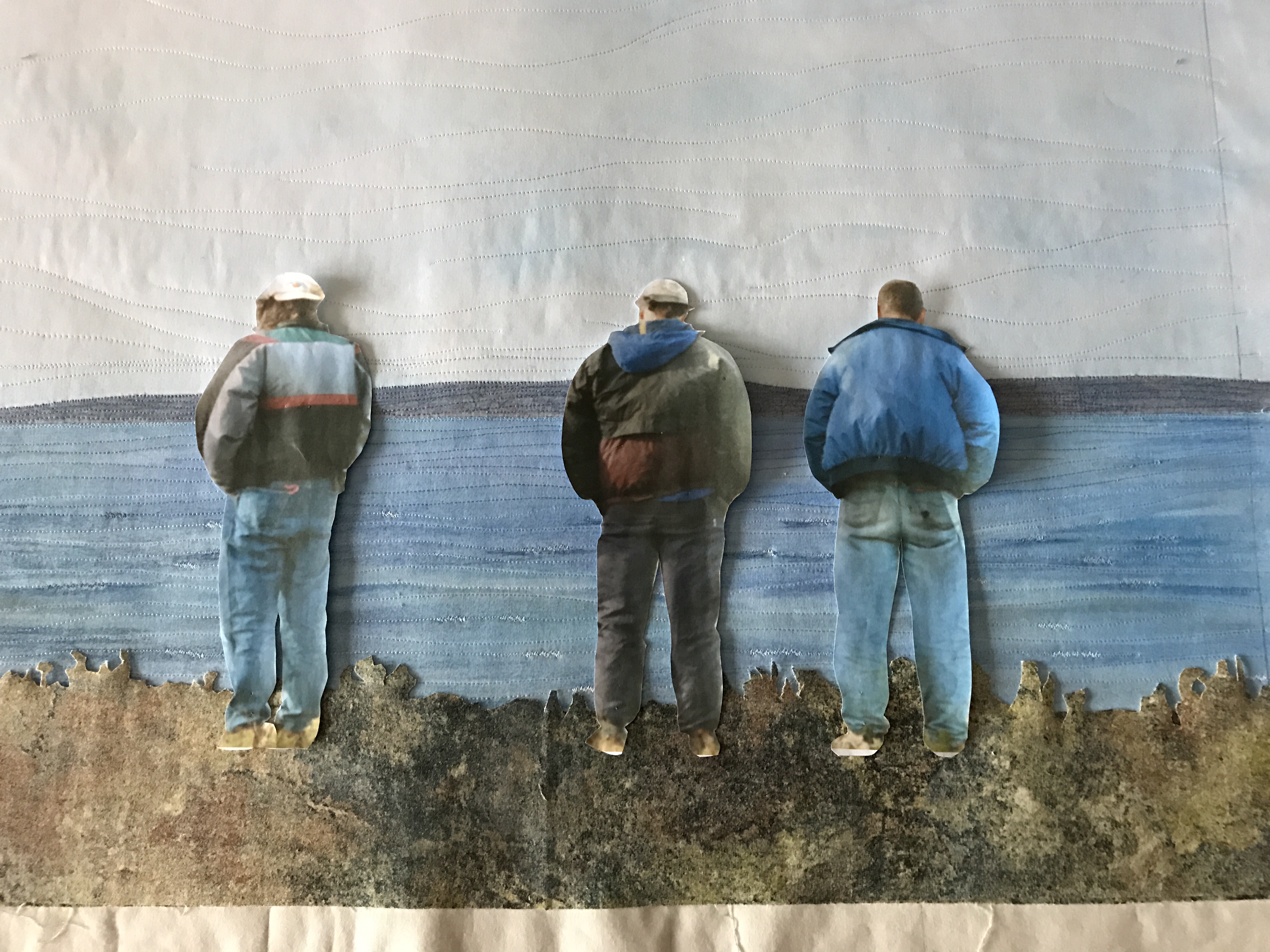
Pilots: Printed on Fabric

Pilots: Printed on fabric, laid on background

Here’s the question – I’ve been looking at the art piece and wondering how might it look if I printed the figures on fabric, fussy cut them and fused them to the scene instead of trying to create them (shadows and all) from different fabrics?

pilots-detail

Here’s the detail, right? Lots of little pieces to be very fussy cut and fused to a base fabric – very time consuming. Doing the appliqué work will also be time consuming because I will want to stitch in all those colour demarcations, but what I get is a more realistic look to the figures which are the focus of the piece.

All I’ve done so far is print each pilot on EQ Printables Fusible Fabric and carefully cut each. I haven’t yet fused them to the background. The way we see the sun on their clothing gives the viewer a sense of the light – some brightness but not full sunshine. I can’t achieve that through piecing, even if I’m extremely careful with fabric selection.

I guess what I have to do is try one of the guys and see how he turns out – maybe Brian (the one on the left). Whichever way I do this, I think it makes sense to refrain from filling in the grasses/shrubs until after I’ve got the figures in place, that way I can build up the grass around their shoes as I go along and not as an afterthought.

In case you hadn’t noticed – this fabric wall art requires a gazillion decisions and unlike oil/acrylic painting there’s no going back – you have to live with whatever decision you choose to execute.

Experimenting…

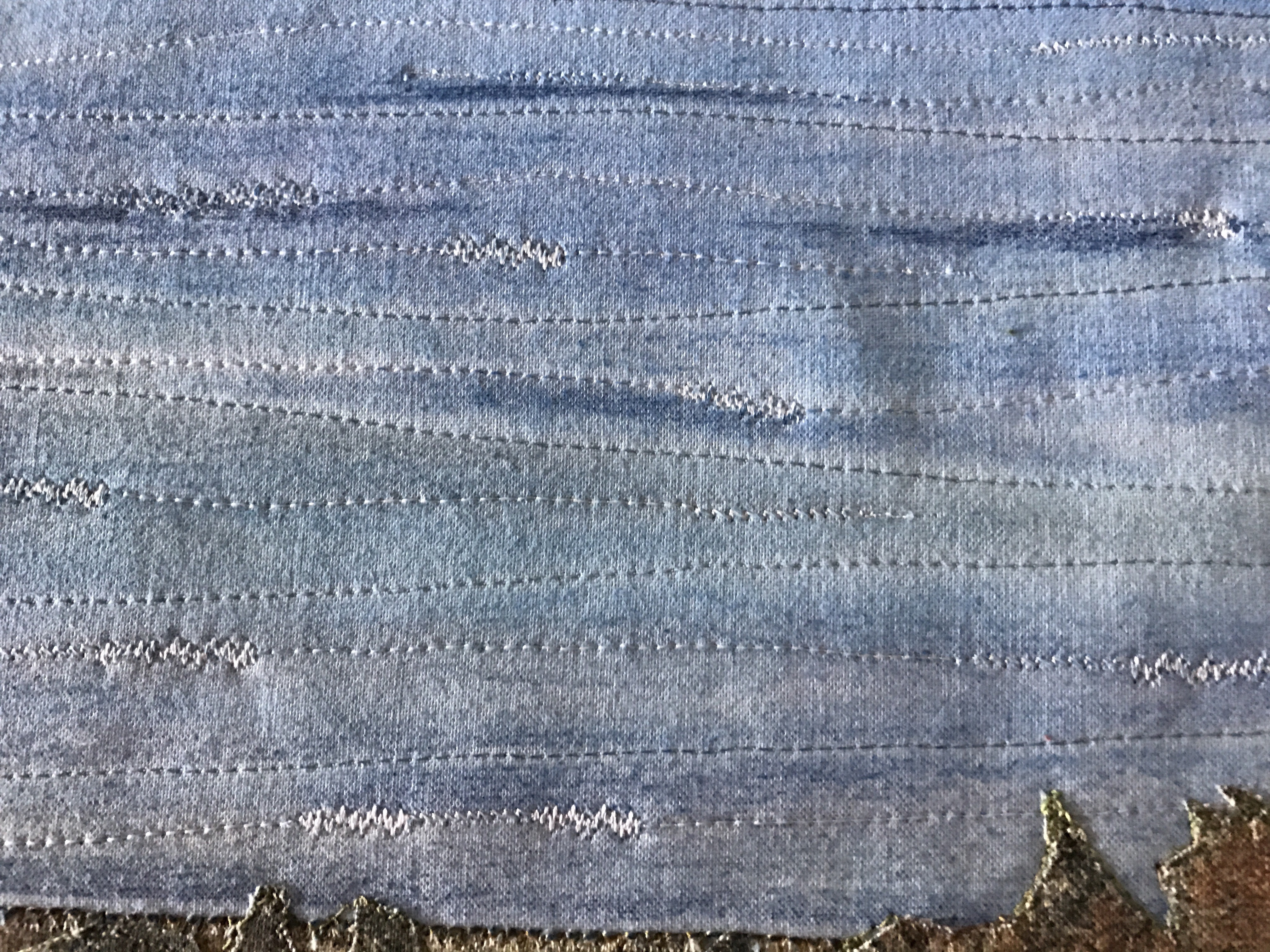
Yesterday I worked on the water of the bay. I wanted to suggest the white caps but not to cover the entire surface. I played around with stitches on my sewing machine – several provided possibilities. My machine allows me to modify and create actual stitches so that’s what I did. I tried a couple; in the end I modified the “grass” stitch – I made it narrower and removed several stitches from the single repeat to give me a short burst.

White Caps

Then I used Neocolori Wax Pastels to hint at the roughness of the sea.

Wind Waiting: Current State

It’s all about experimenting with the stitching before actually attempting it on the piece itself. I have just one chance at “getting it right”. Once I start stitching I have to continue, can’t take it out because the needle marks will show, so I try out different threads and stitch settings before actually working on the piece.

Experimenting

Looks a mess, but in my head I can see the effect of each experiment. Underneath are my tests for the water; on top I’m working on the grassy foreground – I need two effects: first, I need to imply the texture and height of the grasses and small shrubs on the bank – that will take the form of rows of horizontal stitching using three or four different variegated threads; second, I want to create a rough edge against the water – the pilots aren’t on the edge of the sandy beach (the landing zone below), they’re at the edge of the bank 89-100 ft. above the water (the launch zone). The edge of the bank, therefore, should show some grasses and twigs against the sea.

Last night I spent a couple of hours modifying some built-in stitches that will hint at that texture. (Once the pilots are constructed and appliquéd in place I will add grasses to cover their shoes because the vegetation at the edge of the bank wasn’t mowed.

So now I have to take a deep breath and start in. This is it!

Wind Waiting II

IMG_1685.JPG

Wind Waiting – Foreground, Sea, Sky…

This morning I painted the fabric for sea, land across the bay and sky. I will accentuate the grey tone using a pale grey thread for the thread painting. The sky has come out a hazy, cloudy day. The sea is also greyish. The foreground is likely too wide, will have to try masking an inch or two to see how that looks. It will get thread painted with golden, brown threads in short vertical stitching to simulate the grass at the top of the bank.

Still using my paper cutouts of the three men.

Next step is to set a fusible stabilizer to the four background pieces and fuse them in turn on the muslin. Once that is done, I will work at the thread painting – it will take a couple of days, I’m sure.

To paint the fabric I used a mixture of a small amount of medium blue, pale yellow and strong red acrylic paint to create a muddy grey, added white to lighten it, then a bit of a darker blue to bring the mixture to a bluer grey. I wet the turquoise/white fabric for the sea then spread the paint on it using horizontal strokes with a wide sponge brush. Next I wet the solid white fabric and applied a very diluted wash of the same paint I used for the sea. The coast across the bay is a thin strip of grey fabric with a subtle print (crackle) – I used a bit of the same wash as the sea to end up with subtle hint of blue to help it blend with the sea and sky.

I laid the wet pieces of fabric on a layer of newsprint topped with paper towel to get rid of the excess paint, then hung them to dry using pants hangers in my laundry room. Turned on the fan I keep in that room and the painted fabric was dried within a short while. I press it and then laid each piece on the muslin. I’ve played with proportions trying to keep the horizon off the center line and have moved the men around so the central figure will also be slightly off the vertical midline. In my original photo the men are standing equidistant but I’m going to position the two figures on the right a bit closer together with the one on the left just a bit further to the left – that will affect the vertical positioning and draw the eye away from the center line.

So on to the next step – fusing the background fabrics to the muslin. Actually, I will first have to fuse the muslin to a stiff, heavyish stabilizer just so I have some heft to work with when I go to thread paint.

img_7264

Background Fabrics Fused in Place

Now to the thread painting.