I have just completed this series of twelve 6×6 wall art pieces. You may remember the previous efforts in 2022 and 2023. Early in the spring Brandt Eisner sent out an invitation to participate in another “pop-up” 6×6 show. I agreed to participate and decided to play with “flowers” one more time.
An Original 6×6 Wall Art PieceSecond Iteration of 6×6
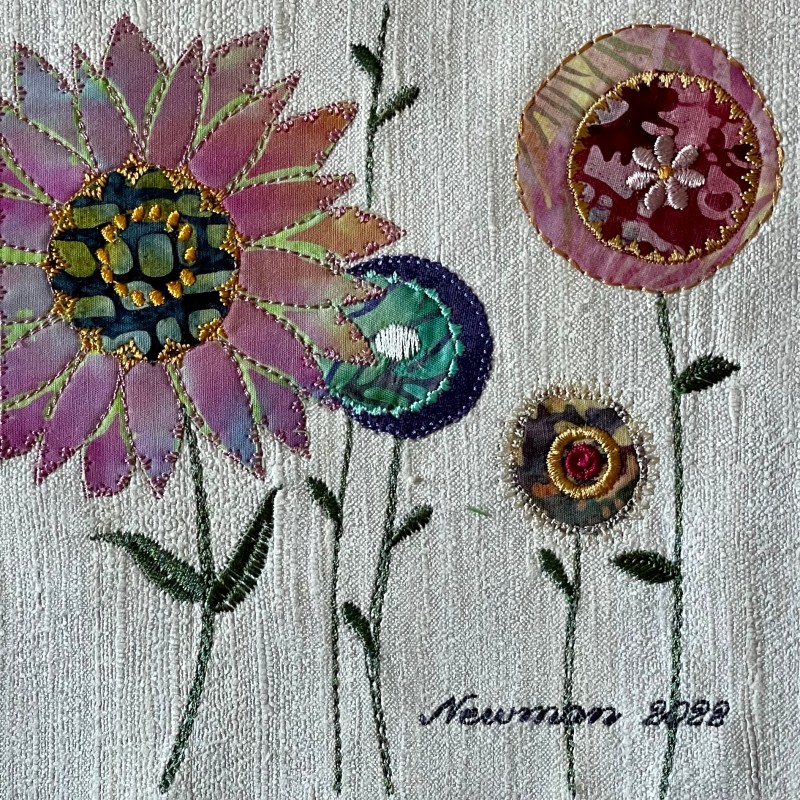
This time I decided to make the panel more abstract – one or two fabric circles appliqué with an embroidered abstract flower stitched on top, filled in with some leaves that I’d thread paint. I did several mock-ups.
I’d managed to get the construction of four pieces done (with four more partially assembled) when Brandt sent a note that the show was being cancelled. That stopped me dead. It was the middle of June – I was working toward an early July deadline – and I stopped. Just couldn’t get going again.
Two weeks ago, I finally picked up the silk background squares I’d prepared, pulled out the box of circles, and began assembling some 6×6 arrangements. Once underway, I was able to keep working on the project and this afternoon I finished the pieces, completely mounted on blank canvas frames, with paper backing and saw-tooth hangers.
This project is ready for the November Craig Gallery solo show!
I finished up the panel I was working on yesterday and completed a second today. I’ve got a better handle on how to make the outline flower stand out by how I position the underlying circles and setting the leaves so they appear to be under the flower petals. I also downsized the signature a bit so it’s less prominent. I think this idea is now working.
An Original 6×6 Wall Art PieceSecond Iteration of 6×6
Remember my 6×6 wall art pieces? Brandt Eisner was in touch again a couple of months ago with an invitation to join his summer “Squared Away” Pop-up show mid-July. Again, “the only requirement is the work should be 6″x6″ in total and be hangable on the wall”.
So, OK. I need to come up with another idea. I’m still stuck on floral interpretations.
First Attempt
Ignore the black framing. My idea was to create a machine embroidery in the shape of a free-motion flower outline, which I stitched over an offset fabric circle fused to a raw silk background fabric. I liked the overall placement of the embroidery but the flower centre wasn’t strong enough, and I wanted some leaves, so I free-stitched some then coloured them in with water soluble Inktense coloured pencils. The leaf colour isn’t strong enough, I need to come up with a way of adding appliqué leaves. Also the blue thread on the blue fabric is very dull. I need stronger colour to create a better contrast.
Second Attempt
Definitely more colourful, but the floral print overwhelms the flower outline! Here I tried two overlapping circles, with some leaves I cut from scraps in a box where I store leftovers, but neither are effective. I tried calming the detail in the print fabrics with the Inktense coloured pencils which helped obscure the detail of the fabric but then the flower outline disappears! And I don’t like the leaves.
Third Attempt
This version is closer to what I see in my minds-eye. The silk background fabric gives an overall subtle texture to the piece. The dark, small patterned fabric sets up a background, the flower outline is a good contrast and stands out. I used a small fabric circle as background for the embroidered flower centre (using the precise positioning capabilities of my embroidery machine to position the embroidery). I overstitched the flower centre elements to emphasize them. I added some leaf shapes cut from fabric scraps backed with fusible web (glue) although I haven’t yet stitched them, I will do that tomorrow. I also tried out the position of the signature which is a bit too large. I have to scale that back a bit.
I’m getting closer to knowing what I’m doing.
Brandt asked for up to eight pieces of art. I will create eight pieces for the show. I have a month to make them; I expect I’ll have them done in a couple of weeks. Then I can move on to the next project!
The show was hung on Friday morning after our two hour drive from Halifax to Parrsboro. I’ve shown in the gallery enough times that knowing what I wanted to hang, where, required little deliberation. I knew I’d brought exactly the right number of pieces to display.
The show consists of eight lap size quilts, accompanied by two panels each with an array of 6×6 pieces – a total of thirty pieces of textile art. A respectable amount of work.
As you enter the gallery space
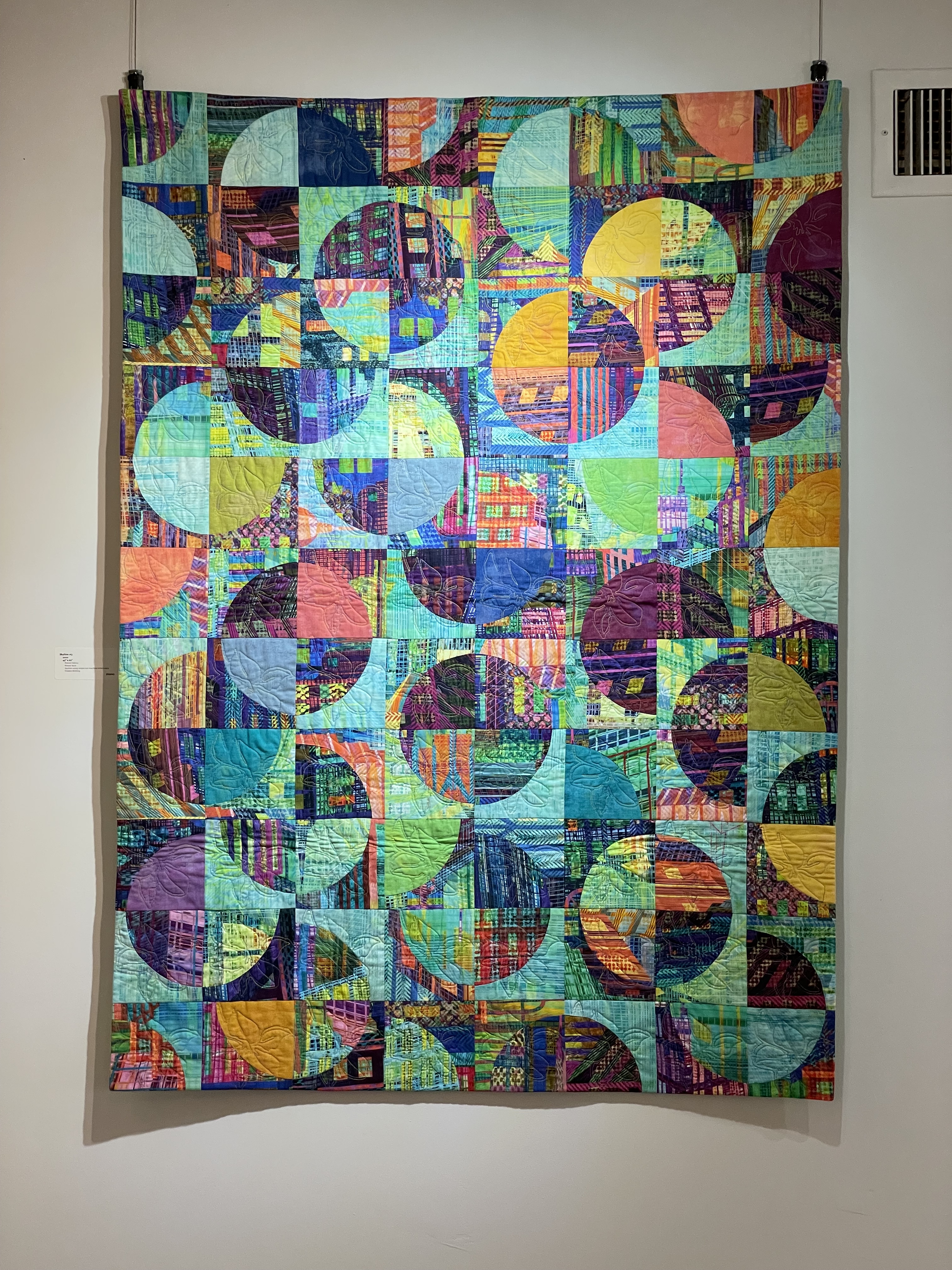
On your right as you enter the Community Gallery you find the four Drunkard’s Path Blocks quilts: Let the Trumpet’s Sound, Drunkard’s Path #5, Skyline #3, and Planet’s With Moons (from right to left). It doesn’t immediately strike you that all four quilts are built using the same block construction, but if you look closely you see the basic quilt block is the same in each.
The “Modern Flower” Pieces
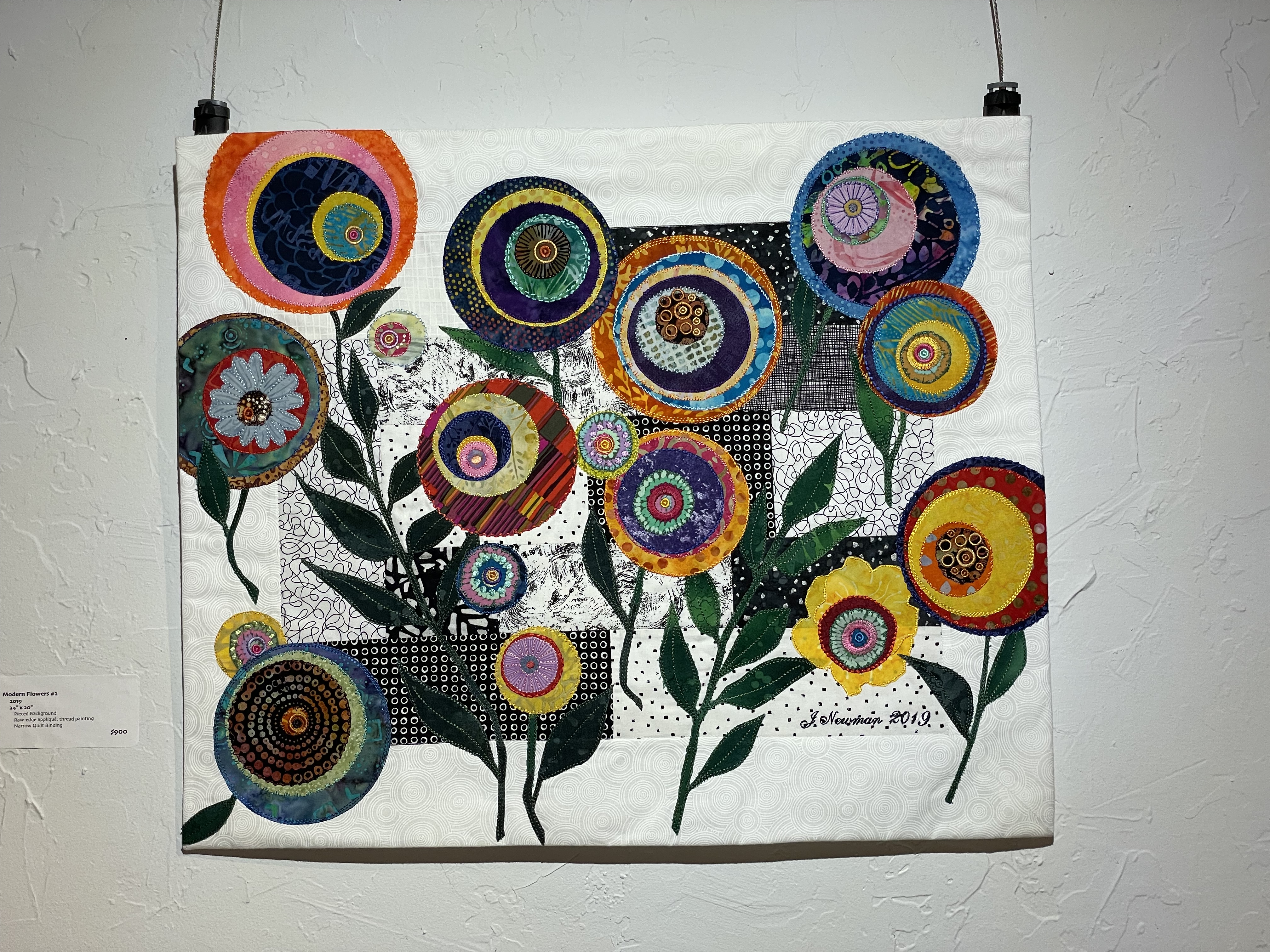
Turn to your left and you see the “Modern Flower” pieces – a couple of larger raw-edge appliqué works with the 6×6 pieces on a panel in between. On the end wall (on the left) I chose to hang the Asian Strips piece, showcasing the use of the asian print leftovers I used to assemble that quilt.
The “Convergence” Quilts
Again, turning to the left you see the “Flower” 6×6 panel above the horizontal post (three have sold so far!), followed by the Convergence quilts – Convergence Quilt #4, #3, and #2.
It always amazes me to see the quilts and small pieces hung in the gallery – the collection has such a different impact than seeing the art one quilt at a time. The technical work slips into the background as the visual impact takes over.
I spoke to a number of people at the opening during the afternoon, all of whom were interested in the decision-making that goes into each work, whether a lap quilt or a small 6×6 piece. People always want to know how long does it take – it’s an unanswerable question – there’s no way to account for the “thinking about it” time that goes into each textile work. The execution, the cutting out, the piecing, the quilting, the embellishing, the binding are all straightforward aspects of making this art. I can predict reasonably accurately how long each phase will take; but the thinking about it is out of my control – it takes as long as it takes.
The show is hanging in the Art Labs Community Gallery (121 Main Street) in Parrsboro NS until late afternoon on Thursday, June 15. If you happen to live near Halifax, or near Parrsboro, do drop by. In addition to the Community Gallery the four resident artists display their work as well. It’s worth a visit.
If you make it a day trip from Halifax, I’d recommend leaving around 9:00 am, driving straight to Parrsboro, visiting the gallery, then having lunch at the Harbourview Restaurant. After lunch mosey your way back, stop at the Five Islands Lighthouse Park to take in the ocean view. Further down the road visit Lowland Gardens – they always have some unusual plants there. You can’t drive back to Halifax without stopping at Masstown Market – fresh produce, great ice cream, good chili if you’re hungry. Depending on how long you take at each stop you should make it back to town between 6:00 – 7:30. You’ll have enjoyed the day.
PS – all of these pieces are for sale. If you’re interested in knowing more about any of them, email me: newman.judith@gmail.com.
I’ve been working away frantically to finish the last quilt. the show at Art Labs in Parrsboro opens a week tomorrow at 2:00 pm! That’s a month to six weeks earlier than I was hoping for so it’s been a crunch to complete everything and get it all ready to hang. I’ll make the deadline but there’s still quite a bit to get done.
As far as the final quilt is concerned, I have the centre panel quilted, the sashing and inner border seam stitched-in-the-ditch. That leaves two more border seams to stitch all the way around, the wide outer border quilted, and the facing and a label applied to the back. I have time, but the minutes are slipping away!
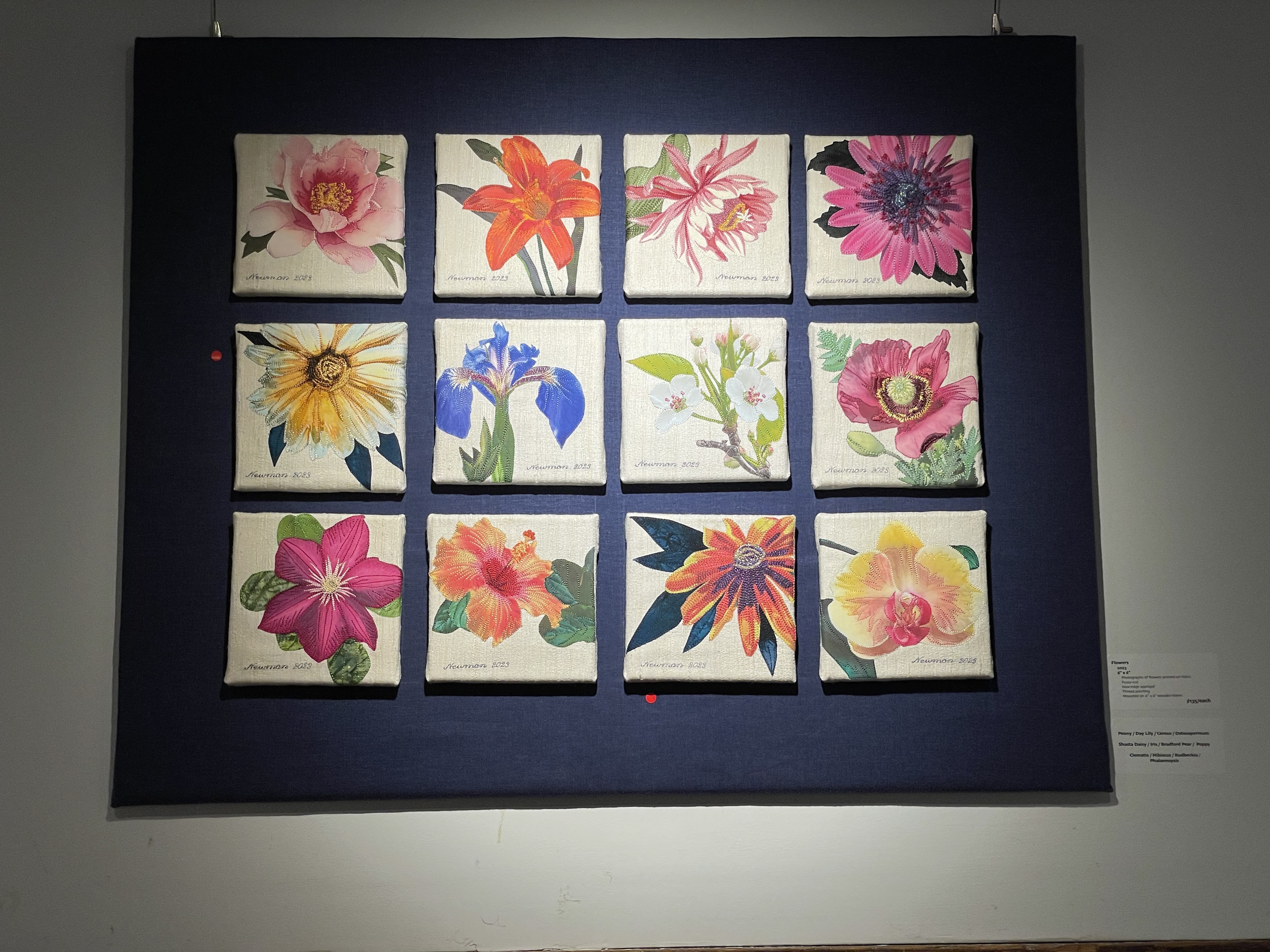
I just finished adding the sawtooth hangers to the back of the flowers, carefully measuring the hanging position for each on the linen-covered panel, adding small nails to hang each piece on. With a little aligning they’ll be fine.
Flowers Hung on Navy Linen Panel
I still have to figure out some way to hang the panel itself – I’ve got an idea for how to do that, but whether it will work or not remains to be seen.
I’ve finished the Modern Flowers panel, as well. Last week I stopped into Sew With Vision to see whether I could find a fabric to cover the hanging panel because I didn’t have enough navy linen to cover it. I came home with a metre and a half of Moda Basic Grunge in Peacoat Navy. It shows off the small pieces beautifully.
Modern Flowers on Grunge Background
Because the navy Grunge worked so well, I thought I’d recover the Flowers panel to match. I went back to the shop this afternoon hoping to find another metre of the navy grunge – no luck – none left. I bought some dark teal fabric but it was worse than the navy linen – it has lighter blue elements which fight with the Flowers. I decided to stick with the navy linen. I did some browsing to see whether I could find a couple of yards/metres anywhere – looks like this particular Grunge fabric is out of stock just about everywhere, and even if I had found some, it wouldn’t have come for a couple of weeks and I have just one week to get everything finished.
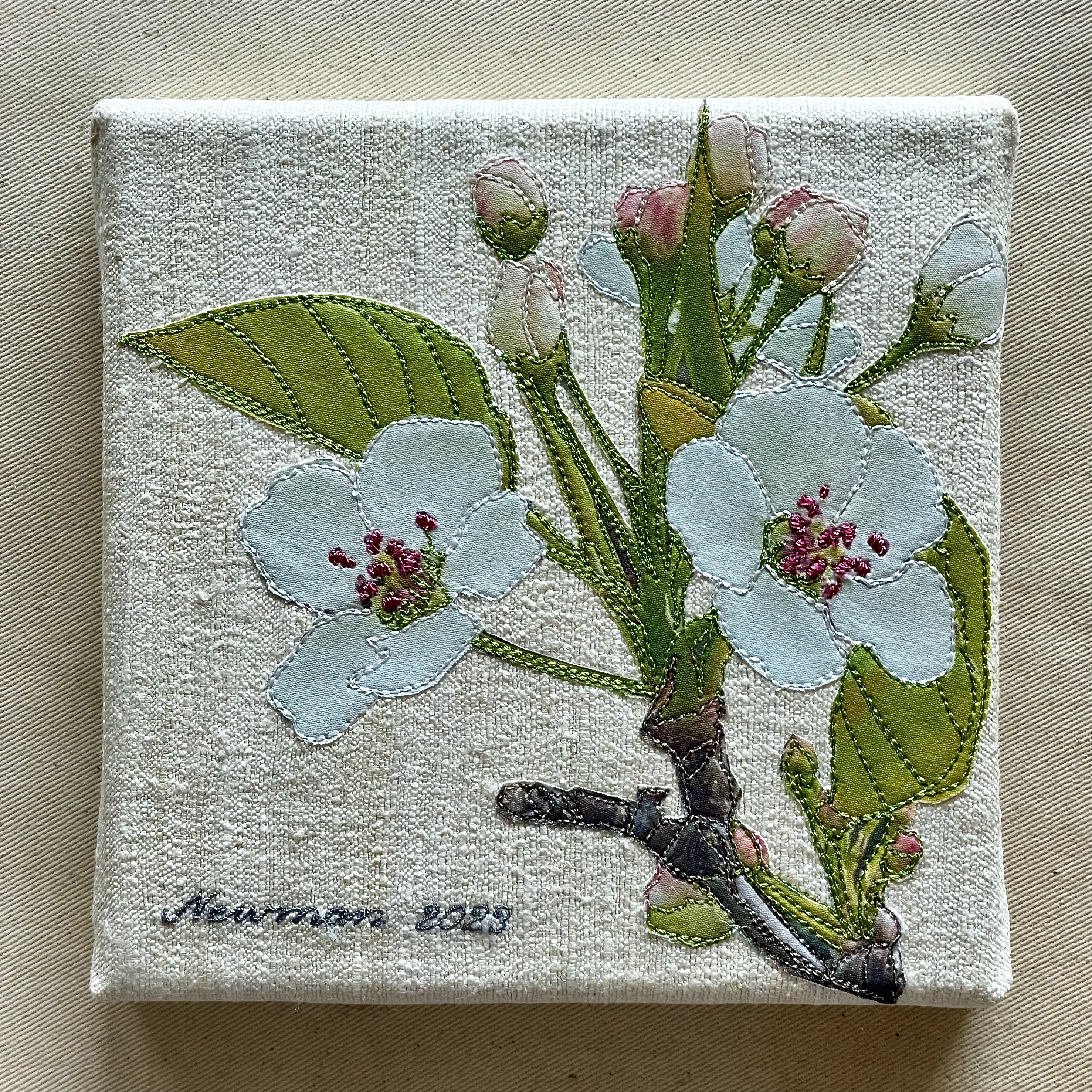
Along my street we’ve got Bradford Pear trees which are filled with lovely “apple/cherry” like blossoms early in the spring. They last maybe a week/ten days and that’s it. I’ve photographed the trees and the flowers each spring I’ve lived in my apartment (going on seven years). I’ll take pictures – of the same trees – again this year.
I did a bit of research to learn more about Bradford Pear trees and discovered they aren’t the best choice although they’re used widely to line streets. One writer identified several reasons why you should avoid them: they grow tall – 40-50 feet, the flowers have a strong, somewhat unpleasant fragrance, often have weak branches – sometimes falling apart after 20 years (!), and they cross pollinate with related trees causing problems if fruit pears are growing anywhere near. Nevertheless, I love how the flower clusters look which is why I decided to include one in this floral collection.
I decided to do very little stitching on the flowers, thinking the detail on the stems, leaves, buds and branch would more than offset the spare flower detail. A good decision, here.
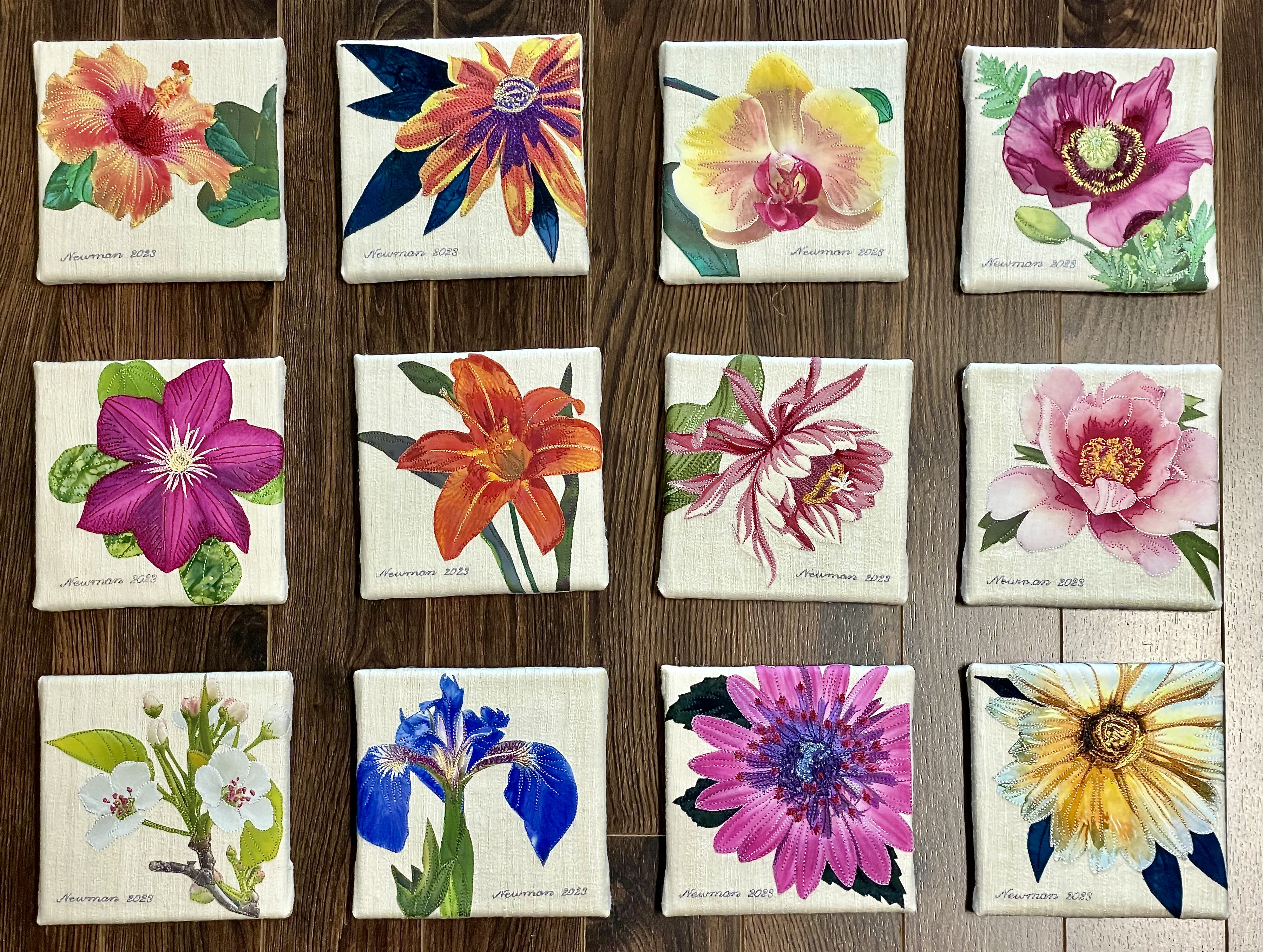
This is #12. The series is now complete.
My Floral Collection
I’ve laid them out on the floor to think about the display arrangement. I still have to add paper backing, a label, and a sawtooth hanger on the back of each before I can say they are finished. I’ll get that done over the weekend. I plan on showing the full set in Truro, I think. Brandt will only want ten for the December show in Tatamagouche this year – I will have a difficult time deciding which two to hold back! I’m happy with all of them.
Now I can move on to a new quilt, along with some clothing I want to make for the summer.
This flower isn’t from a photo. My friend Elayne gave me a bundle of four 1-yard pieces of Hawaiian barkcloth a number of years ago. It has lovely tropical flowers very sharply printed on a 100% medium weight cotton fabric. I’ve made a couple of wall art pieces from it by carefully cutting out flowers and leaves and mounting them on a raw silk background, then thread painting the resulting image.
I’ve shared the fabric with participants when I’ve done workshops on raw-edge appliqué with thread painting. I still have a lot left. I liked this printed Cereus bloom so I chose it to be one of the flowers in this 6″x6″ project.
This particular fabric had a lot of grey in the leaves and in the centre of the flower – I chose to obscure it with the thread painting. The challenge with this fabric is the weave is somewhat loose so the raw edges are “raw.” I do my best to tame them with edge stitching. I can see a few loose threads in the photo – I will use my very fine pointed tweezers to pull those threads out, and trim what I can’t remove with very sharp, fine embroidery scissors.
When I’ve finished the last flower – Bradford Pear (which grows just down the street) – I’ll decide which of the twelve pieces will go into the final collection of ten. This one may just stand out as different enough to be eliminated. I’ll see.
#10 – almost there, just two more flowers to go. Then I can move onto the final quilt I want to get done before summer (I want to do a quilt based on the Drunkard’s Path back insert I created for the Moons & Planets quilt).
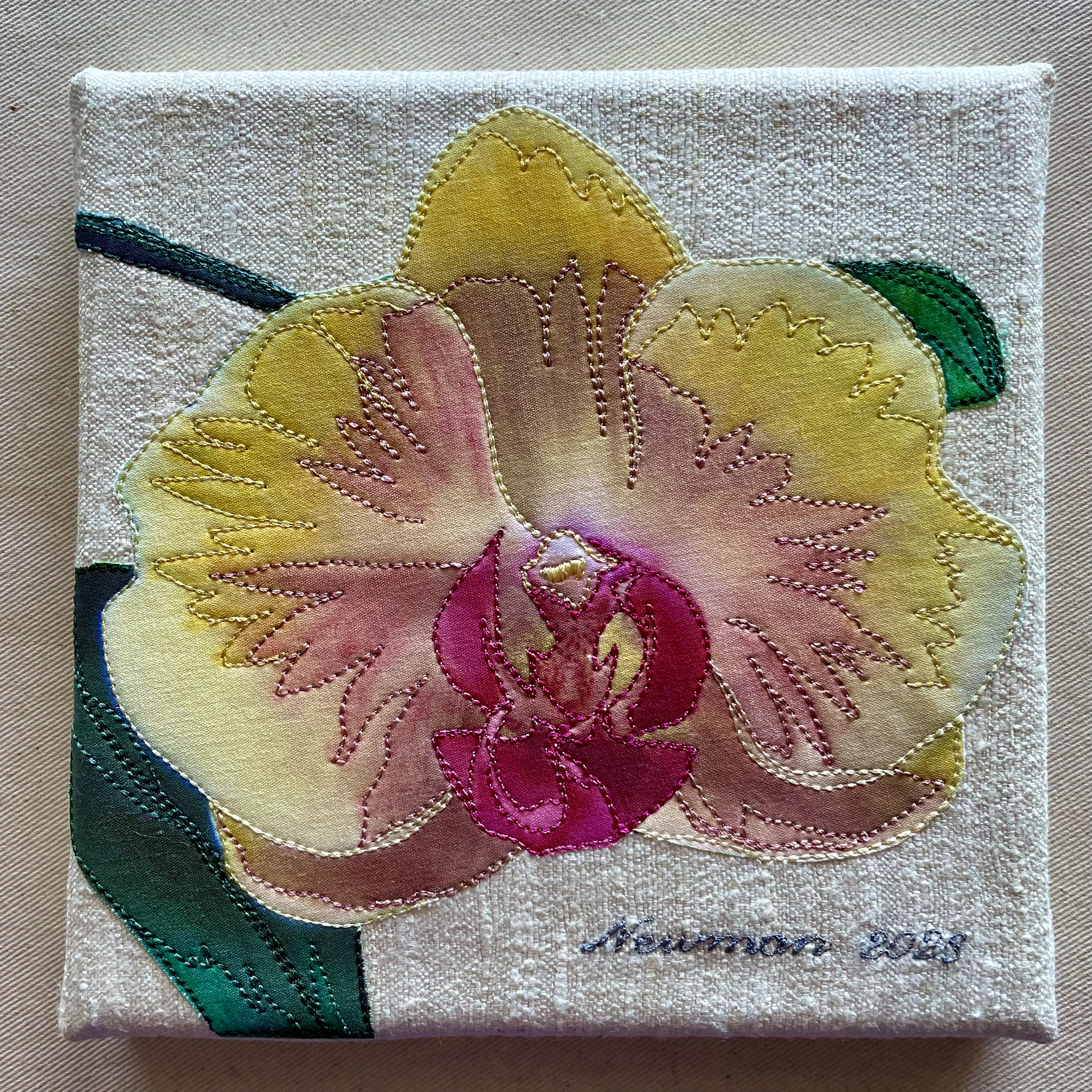
Lots of thread changing involved in stitching this flower. You’re not aware of the changes because they mirror the shading of the petals and sepals.
Again, the difficult decision – how much to stitch and what to leave open. I’ve enhanced the brightness of the flower colours using the Inktense watercolour pencils – just enough to make different areas stand out a bit more. Overall I’m happy with the detail I’ve managed with this flower.
I took the eight completed pieces to the knitting group yesterday – the reaction was favourable – I guess I’m not wasting my time on this 6×6 project.
What was clear, however, is the women had no sense of the complexity of the work – that for ten of the pieces I’m doing a fabric/threadpainting rendering based on my own photos (the remaining two I adapted from fabric floral prints).
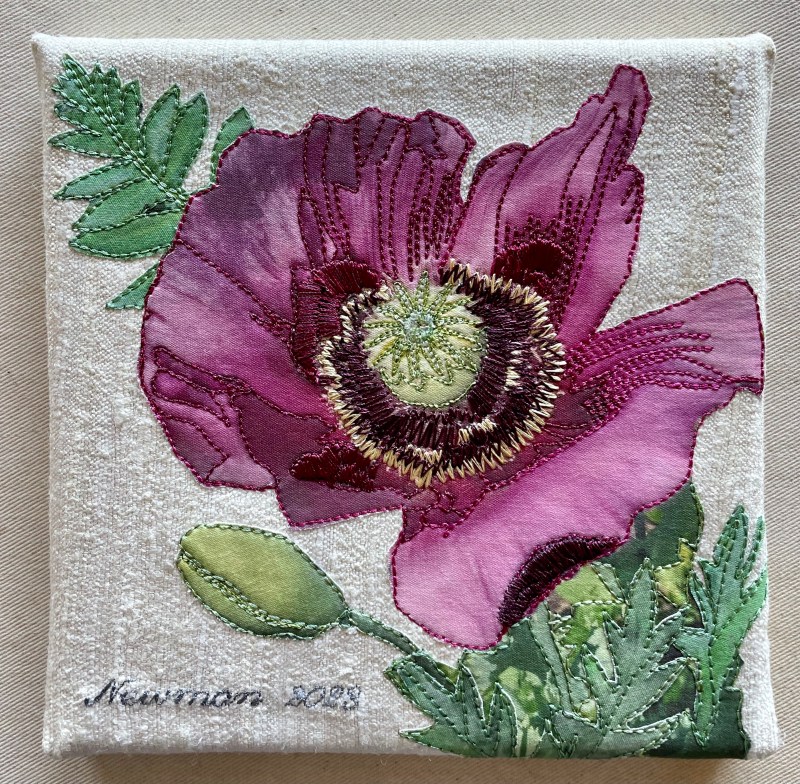
I explained to the gals that I started by going through my photos setting aside any I thought might be turned into a 6×6 piece. Next I edited them, adjusting the colour and cropping them to a 6.2″ x 6.2″ square so when I print them they are the right size for mounting and the colour strong enough to permit me to embellish them. Then I print each photo on a letter size piece of cotton lawn fabric (which is backed with plastic so it can move easily through the printer). After the print dries for a day or so, I removed the plastic and back the fabric with a fusible paperbacked glue sheet before I carefully “fussy cut” each flower.
At the start of the project I had prepared myself a dozen 9 1/2″ x 91/2″ squares of silk tussah which I’d backed with Sewer’s Dream stabilizer to keep the silk from fraying. I marked the position of the 6×6 square using a heat-erasable pen so I’d know where to place the flowers. After each flower was cut out I carefully positioned it onto the silk background, and fused it in place. On some flowers I added extra leaves before the final fusing.
Before doing any thread painting I use a heat-erasable pen to suggest the colour boundaries to be stitched. I might also intensify some colour with Inktense colour pencils or permanent markers. Then I begin sewing.
First I pull spools of thread from my thread stash (which at this point is quite large – a couple of hundred spools in every colour imaginable, a mixture of rayon and polyester – on this project the fibre content doesn’t matter, the colour does, so I mix and match). I constantly change thread (and bobbin) colour as I outline or infill aspects of each flower. For some flower renderings I’ve had to create machine stitches. After finishing each flower, I add my signature.
As I explained my process to the women they found themselves looking at the pieces differently, examining the detail more carefully. At first glance these pieces aren’t necessarily complex but the process of arriving at a finished 6×6 textile wall art piece takes me anywhere from 6-7 hours over a couple of days – likely longer than were I to simply paint the flowers on the 6×6 canvas!
Yesterday when I stopped working on the Iris it didn’t feel done to me. There wasn’t enough detail on the leaves. I wasn’t sure whether I wanted to colour them a bit more or just add a bit of stitching – in the end I did both. I shaded both the cluster of leaves on the left as well as the leaves beside the stem. Then I thread-painted the shading. Because the leaves are darker they blend into the whole, not drawing attention to themselves. I’m much happier with this piece now.











 jmn
jmn 