I thought this piece would be easy and straightforward – not so. The first thing I had to do was tone down the reflection both in the flower and on the leaves – I used Derwent Intense watercolour pencils to shade away the white. That gave me better overall colour to work with.
I started thread painting by outlining the leaves and leaf veins. Then onto the flower. Using a strong yellow I stitched the highlights on the petals. Next came the dark red at the throat, then the brighter red of the centre. I wasn’t intending to fill the entire centre area but an edge stitching at the red/pink boundary was jarring and left the red centre very dull so I took it out and reworked the area – filling it in. After that, I added the pink, and stitched the pistil. I needed to create a stitch for the stigma (of the pistil), and another for the stamens, I filled in the style of the pistil in a darker red.
Up close there is more stitching than I’d prefer, but when the piece sits next to the other 7 completed pieces, the flower shading stands out and the piece fits in with the others.
I finished this piece a few days ago, just forgot to post the image. I decided to represent a simple peony rather than a many-petaled double flower. With this one I had relatively few petals to deal with and the centre of the flower is better exposed.
The question is always, how much stitching, how little? Whether to create a new stitch or can I adapt something already on the machine. In this case, I took one of the “flower” machine stitches, and edited it so that all I had were six small overstitched dots. I used and reused the stitch, filling in the stamens. I then created a second stitch for the multitude of stamen filaments, stitching that in dark rose thread. Finally I used a machine stitch for the stigma, which stands out from the stamens.
The finished, mounted piece has the illusion of depth I was after.
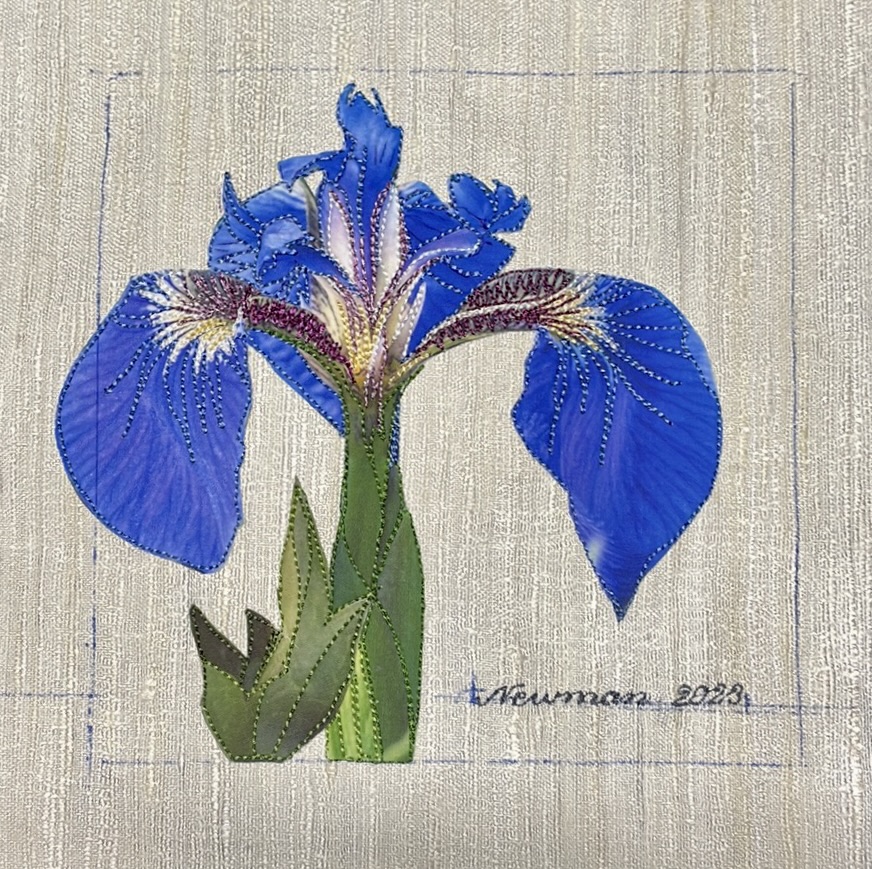
Then I went on to the Iris.
Iris
I haven’t mounted this piece yet – I think the flower has enough thread painting, but I’m not sure about the leaves on the left. I have to do one of two things there – either more stitching, or I have to create more texture with permanent markers or coloured pencils. I’m still thinking about it – I don’t want to do too much to those leaves – I don’t want to draw attention to them but they need something more. So Iris isn’t quite done.
Today I intend to work on Hibiscus.
Hibiscus
I’m going to soften the “white” highlights to make them less prominent, I will embellish the stamens along the side of the pistil, I will emphasize the pistil head – just not sure what I’m going to do with the leaves. The white highlights there also have to be toned down – I likely will do that with markers.
One more piece done – #5. This purple oriental poppy was growing in a friend’s garden several years ago. I’ve kept the photo in my library and from time to time I have thought about what I could do with it. I decided to include it in this 6″ x 6″ collection.
I’m reasonably happy with how the flower turned out – you get a sense of the depth of the bloom. The flower centre was challenging – the oriental poppy has a gazillion feathery stamens with long filaments. The pistil is elaborate, too. I had to do quite a bit of practice sewing to find a way of representing the fullness of these floral elements. When you stand back from the rendering (where you no longer can see the stitching), it looks remarkably like a vibrant oriental poppy!
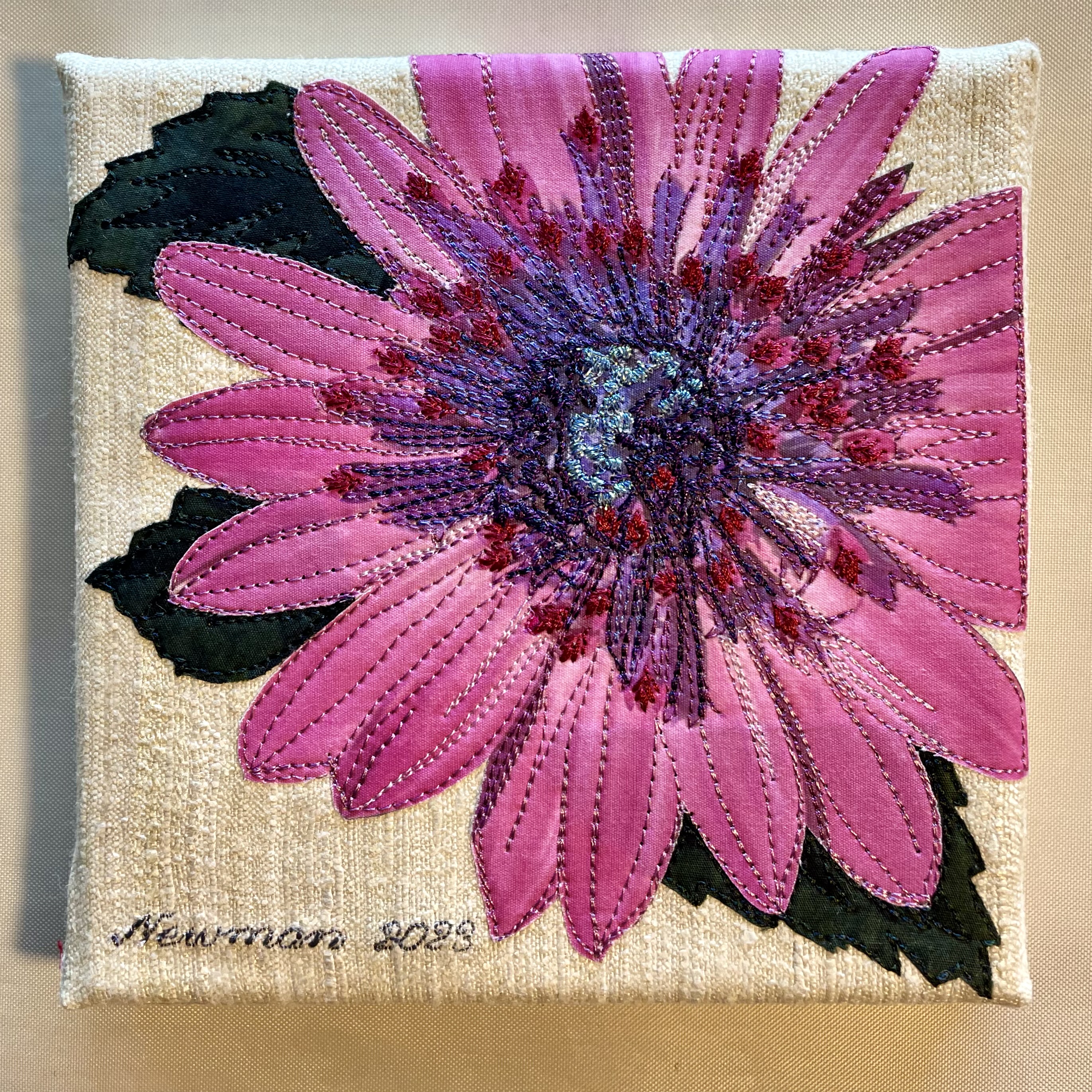
Last summer I stayed at The Maple Inn in Parrsboro while I was doing the Cyanotype workshop. Their garden was lovely – lots of different flowers in bloom, among them this Clematis climbing the side of a small out building. I took a couple of shots of it. I was taken by the magenta of the flower (here we see mostly purple Clematis), and the rich detail of the flower centre. I decided to include it in this collection.
I thread painted the markings on the petals, the stamens and pistil, and outlined the leaves and the veins. The first attempt had three fewer leaves – the outcome looked unfinished, so I added three more leaves. I’m happy with this flower rendition; #4 so far for the 6″ x 6″ collection.
I’ve spent the morning, fussy cutting the flowers, laying them out, fusing them to the raw silk background, redrawing the finished block size, positioning where I want the signature to go on each. The remaining nine are now ready to thread paint.
I’ve tidied up the top of my cutting table, putting fabric scraps back where they live. Stacked the rules in the ruler holder. Put my rotary cutters where they’re normally stashed. Now I have to start selecting thread for the stitching.
It’s a lovely sunny day out – no clouds at the moment. So once I’ve got myself organized it’s time to get out of the apartment! I’ll start sewing on these tomorrow morning.
This one is #3. I finished it yesterday. A surprising number of thread changes involved in this one. I’m pleased with how the flower centre turned out – I didn’t feel it needed a metallic thread; the dark brown/black set up enough contrast with the golden yellow to make the flower lively. The challenge is deciding how much stitching and where. The flowers look better when there is some unstitched space but there still needs to be enough thread painting to give the flower texture.
More To Come
This is what’s on my cutting table (anti-clockwise starting at the bottom left) – a purple poppy (needing to be fussy cut), a Blue Flag iris, Bradford Pear, a clematis, a peony, a day lily, and a hibiscus I cut from some Hawaiian bark cloth which I’m not going to use. Instead, I added a few more printed photos to the collection – a yellow/pink phalaenopsis, a more vibrant purple iris, and a golden/red hibiscus. That gives me the ten flowers I’m hoping to complete for this set.
I’m waiting now for my latest order of 6×6 mounted canvases to arrive so I can mount these pieces when I’ve finished thread painting. This project will take me another ten days or so to complete.
Osterspermum are African daisies. I first noticed them at garden centres maybe 20+ years ago. They come in a range of colours from off white to a lovely purple, red, orange. I started planting them in the container gardens on my back deck. Over the years I took lots of photos of them.
Osteospermum
I decided to include an Osteospermum in the set of ten pieces I’m working on.
Again, on a raw silk background, I fused the fussy cut flower printed on cotton. I selected a variety of rayon and polyester embroidery thread to use for the thread painting. Then I started stitching – first the flower edges with a dusty pink thread, then I spent about an hour designing a stitch to use for the small central florets – I stitched each one separately. Then I worked my way into the centre. wanted to catch the viewer’s eye at the centre – I used a metallic thread paired with a rayon to stitch the unopened florets at the very centre. Last came the leaves.
A second 6×6 piece finished.
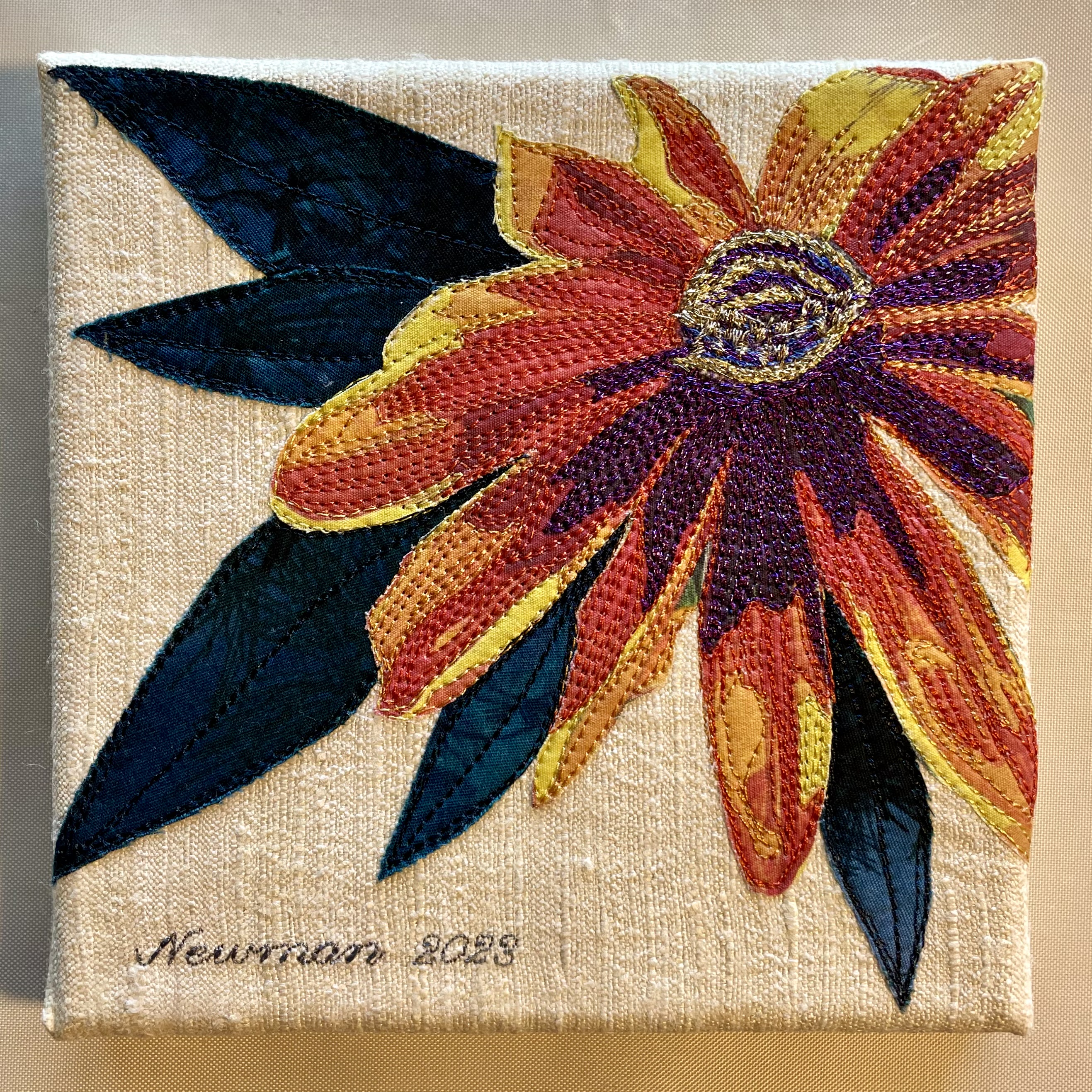
Then I went back to Rudbeckia II – I wasn’t happy with the flower centre. I removed the piece from the canvas backing, pressed it lightly and reworked the centre and dark purple areas thread painting with metallic thread.
Rudbeckia II – Reworked
You can just see the glint of the metallic thread at the centre and in the deep purple areas. The thread painting with metallic thread gives more depth and texture at the flower centre. The slight glint of purple metallic thread livens the whole flower.
This is my second go at the Rudbeckia. This time I printed the flower on fabric, pulled off the plastic backing, added fusible web, then fussy cut out the flower. I dug through dark green scraps, added fusible web, then cut leaf shapes. I fused leaves and flowers to a 9″ x 9″ raw silk square of fabric which I’d backed with Sewer’s Dream interfacing to stabilize it.
Then I began stitching! It took several hours to thread paint the flower – constantly changing thread and bobbin colour – using the “hover” function on my machine to simulate free motion sewing.
This time, I left myself enough space on the background to apply a signature. Having used fusible web, my raw edges are relatively smooth, not fraying as was the case with the first Rudbeckia.
I think I’m rather happier with this version than I was with the first prototype.
I’ve had a couple of ideas rattling around in my head for a new series of ten 6″ x 6″ pieces. I can use them at the summer showing at the NovelTea Cafe in July/August and whatever doesn’t sell there (I’m not expecting much will) will be ready for the 2023 Christmas show in Tatamagouche at the Ice House Gallery (I know Brandt is planning on doing 6 x 6 for a second year – last year’s show looked terrific!).
I have an interesting collection of seascape photos I’ve taken over the years. I have pulled them from my digital photo collections and stuck them in a folder on my desktop. The idea would be to crop each photo to 6.4″ x 6.4″ (that would allow the print to just come sightly over the edges of a 6 x 6 canvas), print each photo on fabric, back it will fusible interfacing to stabilize it so I can thread paint the image. I haven’t tried that yet – but it’s on my to-do list.
Green Bay, NS
I also have a collection of interesting flower photos. At first I thought I’d try printing those on fabric as well, but the paper print I did the other day wasn’t vibrant enough to stand as a background for thread painting. Instead, I decided to try a single flower image, cropped, from which I could piece a flower on a pale background.
Today I cut a 9″ square from some pale linen I had in my stash. I used a heat erasable pen to mark a 6″ square at the centre. I selected some fabrics, then started cutting. I arranged the pieces of fabric, pinned them in place and began thread painting.
Rudbeckia Flower
This piece took me about five hours to make. I took a couple of shortcuts since I was just playing around. I didn’t bother putting fusible web behind the fabric before cutting it out – a big mistake! I’ve ended up with fraying edges because there is no glue to secure the layers to one another. Next, the leaf at the bottom is in a bad location – I must remember to keep enough space free on the background for a signature. Also, the beige linen background is too “flat,” too “dull.” I definitely want to use to what I have left of the light coloured raw silk I used for the previous 6 x 6 works.
I also want to expand the flower to 7″ – a half inch more on each side so the petals and leaves wrap around the sides of the canvas. In this prototype I cropped the flower and leaves at 6″ – which makes it difficult to get a clean line at the canvas edge. I also need to think about embroideries specific for each flower centre. By the time I got to adding an embroidery here I knew I was just trying out the overall idea and didn’t worry too much about placement. I am going to have to be more precise with whatever I do at the centre of each flower.
I mounted the finished flower on a 6 x 6 canvas, then took the finished piece to show my friend Deb. She thought the idea was definitely worth pursuing. Because I like Rudbeckia flowers I will do another one for the collection.
Nothing on for tomorrow – I intend to do a second prototype taking into account what I learned today.
The Ice House Gallery show, in Tatagamouche, went up on Dec 3. All of the wall art conformed to the 6×6 challenge – amazing the diversity of the offerings, the show as a whole was stunning. I didn’t actually get to Tatamagouche but Brandt posted photos of the show and of individual pieces (mine are near the bottom of the posting) – you can get a feeling for what you’d experience were you to walk into the gallery.
The show will get taken down coming week, I imagine. Brandt was pleased with sales in the first couple of days. I have no idea whether any of my work actually sold. Brand will bring my pieces back to town sometime soon.






 jmn
jmn 