Comet Quilt

I’d seen a photo of the Comet Quilt some time ago and thought it would be fun to try creating something like that – a light centre against a dark background. I went through my fabric stash and pulled out a pile of light batiks, a bunch of medium, and a few dark.

I was wondering what to actually use as the dark background fabric when I happened upon the Moda (Ruby Star Society) Comet Quilt pattern.

The Comet Quilt (Moda)

I discovered the actual background fabric used in the quilt and was able to find some online so I ordered 2 yards.

And then the fabric pile sat there while I worked on the three Skyline quilts. I was intending to work on a wall art piece next but the fabric pile started calling to me – I looked at the Moda pattern to get an idea of how I wanted to work on this. I wanted a throw size (~50″ x 70″) – quite a bit smaller than the pattern was describing. So I had a couple of choices – fewer blocks, or smaller ones. I decided to duplicate the 18 x 23 blocks using 3 1/2″ half-square triangles (finished size 3″).

This is where the whole process becomes quite complicated. I’m using a set of my own fabrics (not those in the pattern) so as I read through the pattern to guesstimate of how many HST I would need I realized I was not going to be able to manage any kind of match-up to the blocks in the pattern. I cut the same number of light blocks, medium blocks, dark blocks. I matched up some light/light light/medium, light dark, medium/dark, dark/dark combinations, marked the stitching lines, sewed the blocks, cut them apart into HST, pressed them, and trimmed them carefully to 3 1/2″.

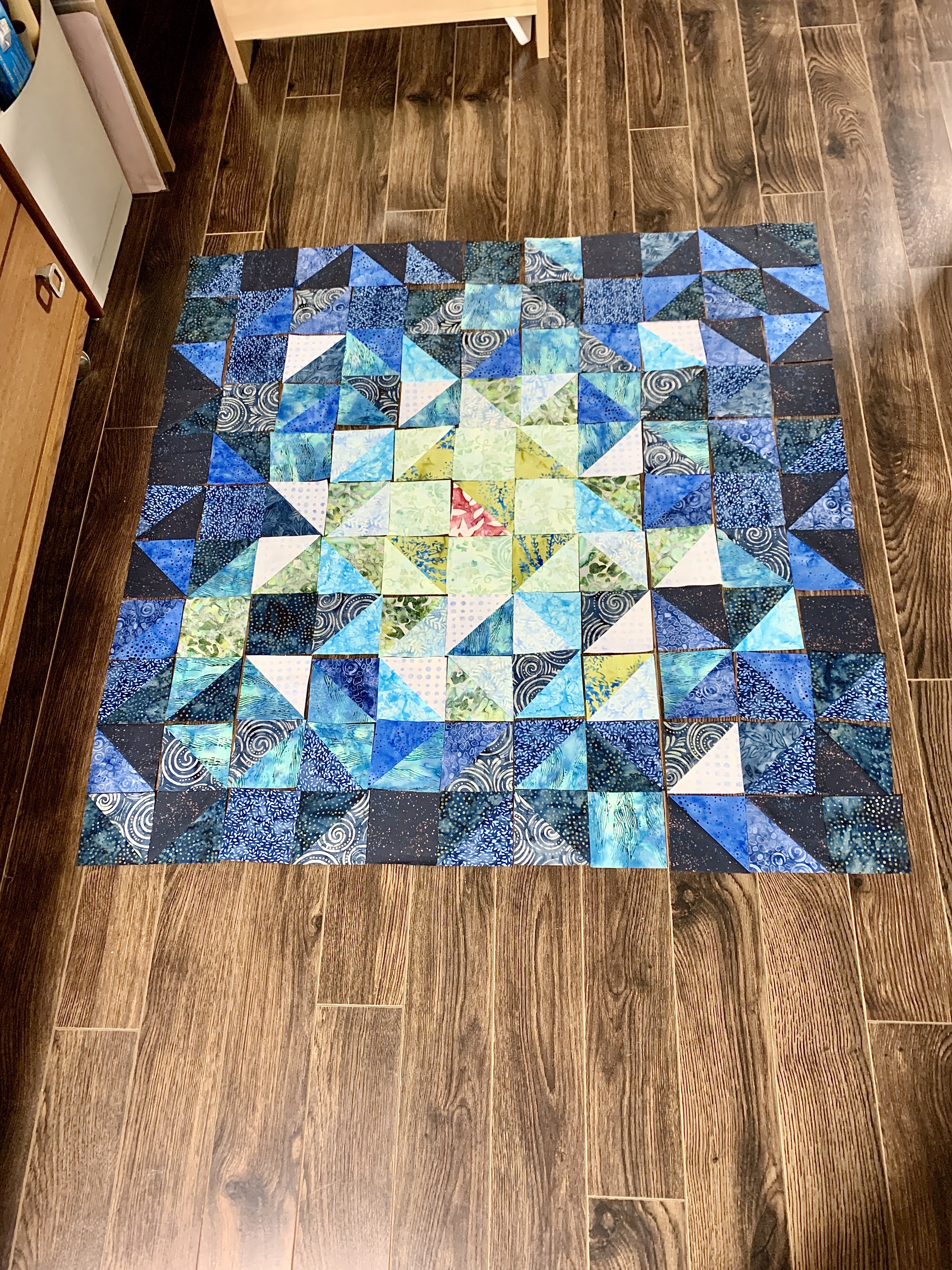
Then I cleared a space on my studio floor and began laying them out:
The Comet Quilt (Moda)

I put the Moda instructions with photos aside and just played with the blocks trying to create the “startburst” for the quilt centre.

I’ve been taking photos, moving blocks around, taking more photos, moving more blocks. this is where I am at the moment – the central 11 x 11 block centre panel. I’m sure when I see this tomorrow morning in the daylight I’ll move blocks again.

In some ways this improvisation is easier than trying to follow the pattern layout! I can just make decisions based on the blocks I have and see how the panel turns out.

What’s obvious is that my “medium” colour tones are brighter than the fabrics used for the original. So my quilt, overall, will be brighter than the Moda original.

Once I’m satisfied with a layout for this panel, I will sew the blocks together, first into rows, then stitch the rows. I have to do that, because I will need to plan the outer panels based on the size this panel works out to be. The Moda pattern will give me an idea about how I will want to use my dark/background HST squares but I can’t cut my background fabric yet because I don’t know the size required for the remaining elements!

That’s just what it’s like when you improvise.

Small Projects

Last week Ruby handed me the sleeve from an old Persian lamb coat – wondering whether I could make a small zippered handbag for her.

I cut a strip from the sleeve, discovered some original lining inside (still usable), added a bright red zipper and a bit of leather lacing for a handle – and there you have it: a small Persian Lamb handbag – finished size close to 7″ x 9″. I also put a small zippered pocket on the inside! (I used a leather needle and ordinary polyester thread – the machine handled the stitching just fine.)

Persian Lamb Small Handbag

She should be happy with that.

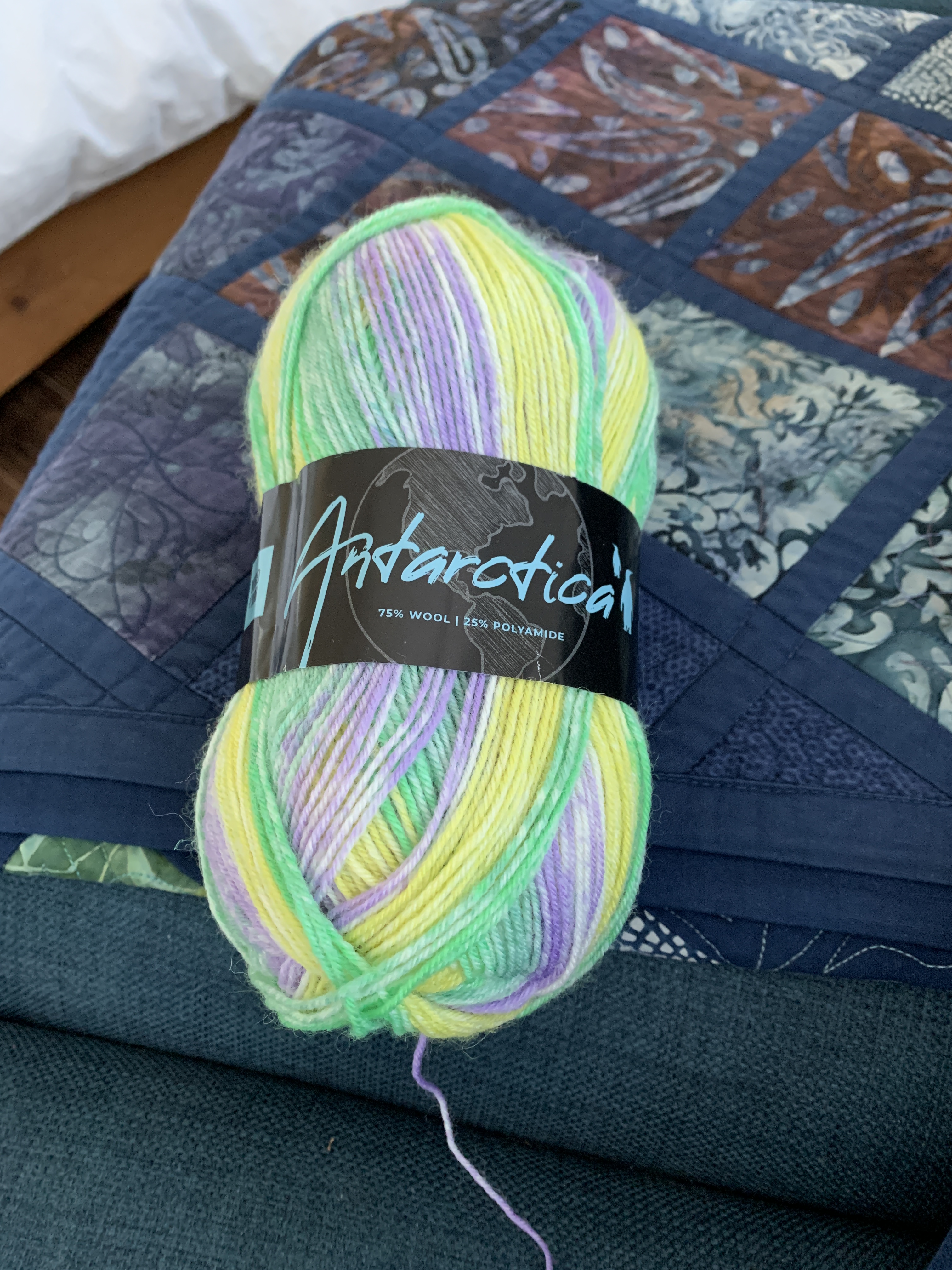
After finishing the last pair of socks I picked up this ball of Antarctica yarn which came in a “mystery bag” of sock yarn I ordered from Hobbii (in Denmark).

It’s one of those balls you want to use up quickly but I realized I’d be more than bored knitting this yarn…

Ugly Yarn

It’s a lovely texture yarn, nice to work with, but the colours are so bleh! So I added a bright leftover that I intended to interweave through the Antarctica yarn:

Ugly Yarn + Bright Leftover

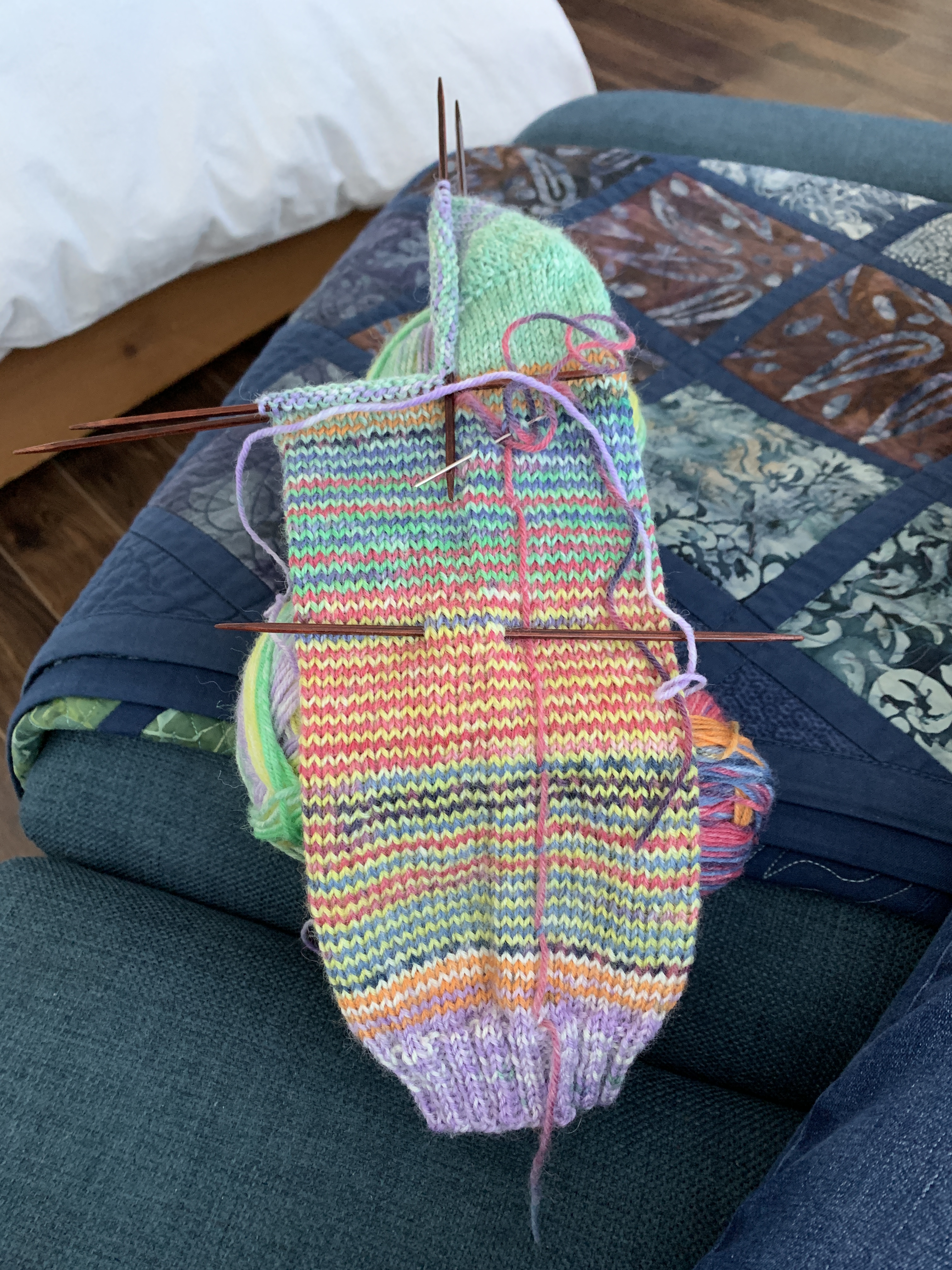
This is what the sock is turning out like. By chance, the heel more or less fit in the green section, almost the whole heel, so I decided to keep knitting with just the original yarn.

Developing Sock

Right now my plan is to continue the foot in the Antarctica yarn, introducing a bit more of the leftover somewhere past the instep for a short distance – mainly to extend the yellow section (which will knit 20 rows – I counted that in the leg).

If I’m lucky, I’ll be able to end the toe in mauve to match the cuff –

Skyline #3 – Completed

Finished the third quilt a few days ago. It didn’t take as long to quilt as I’d anticipated in large part because instead of quilting single blocks I was able to quilt two at a time using the 360 x 260 hoop. I probably could have quilted 4 at once using the large “Garden Dream” reversible hoop (360 x 350) but it was just as fast to re-hoop blocks as it would have been to fight to take the hoop from the arm and turn it around and hope the positioning was close. The problem with that large hoop is getting the second side to align with the first. So I rarely use it for quilting.

Skyline #3 – Top

I am happy with how the layers on layers of circles turned out. There are actually five complete circles but they’re not obvious in part because the four quadrants are all different. But that’s also what helps with the layered effect.

To quilt it, I used a floral design I’d created for another quilt doing my best to overlap the stop/start positions where the design ended and began in adjacent blocks. Overall, the effect is to appear to have been done using a long-arm quilting machine.

Skyline #3 – Quilting Detail

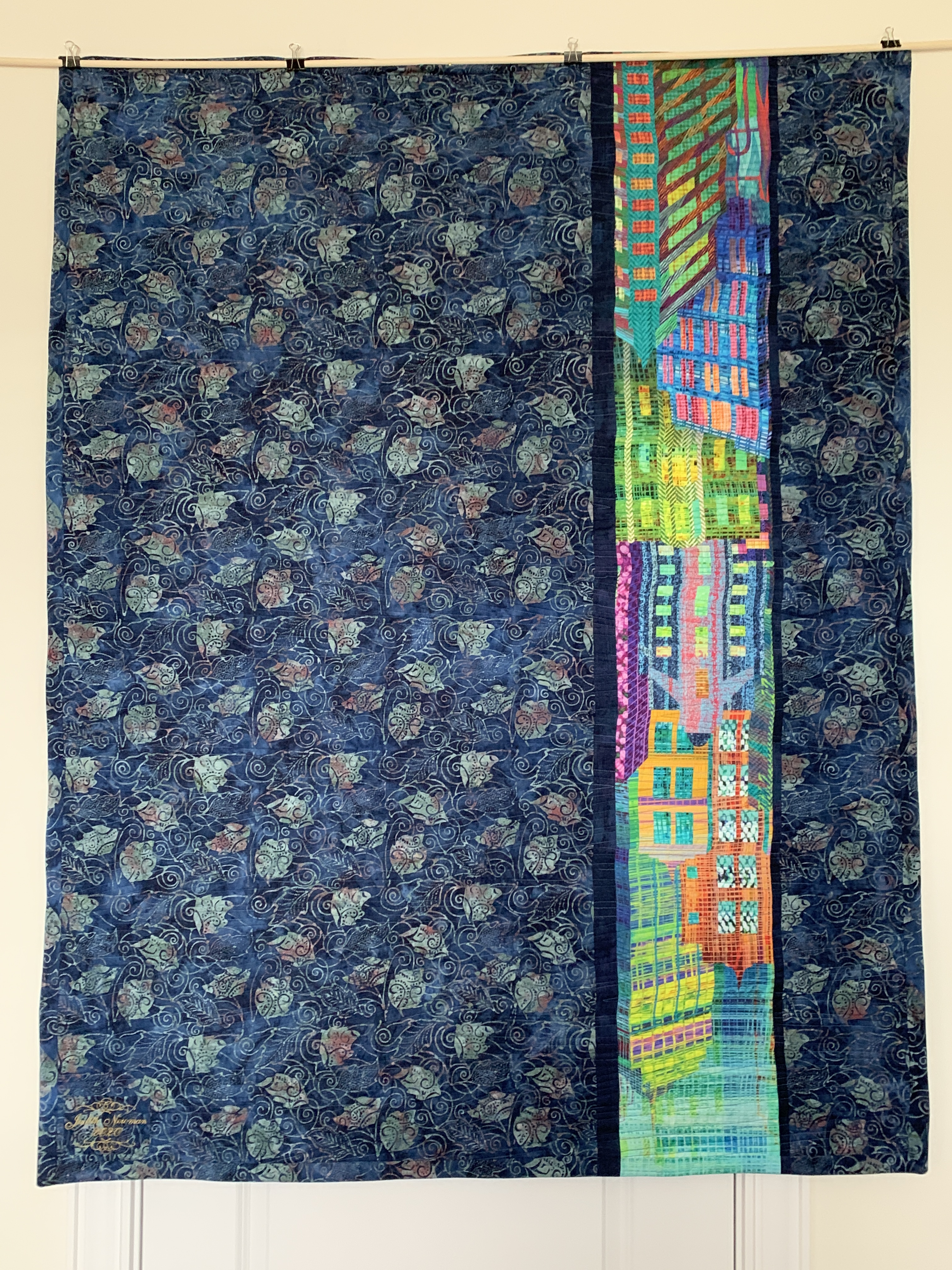
Again, I used a strip from the original Hoffman “Skyline” fabric as a strip in the back – making sure I had it right side up in relation to the front of the quilt.

Skyline #3 – Back

The three quilts together as a set I’m calling “The Sisters”!

Skyline #1
Quilt Top Skyline #2 – Quilt Top
Skyline #3 – Top

Three very different quilts all from the same fabric.

Now on to something else.

Skyline #3 – 3 / Christmas Fruit Cake

Skyline #3

This morning I managed to complete 24 more blocks (14 left to get me to 63 which I’ll get done tomorrow).

49 Blocks – 7 x 7

I’m not going for a traditional drunkard’s path layout – I want a relatively random layout with probably 5 complete circles (at the moment I have three) and the rest partial circles which creates the illusion of layers of circles. The colour flow is working out but I won’t be satisfied until I have all 63 blocks on the floor and I can photograph them and move them around.

If I stay with a 7 x 9 array (63 blocks) I will end up with a 40 1/4″ x 51 3/4″ panel. Since I want the final project to be close to the size of the other two quilts – 48″ x 64″ I can either do a narrow 1″ sashing with the dark blue grunge I used on the wedges and a 3″ border strip from the Skyline fabric. That gives me the width (40 1/4 + 2 + 6 = 48 1/4″) but short on length (51 3/4 + 2 + 6 = 59 3/4″). If I were to add a 10 row to the bottom, I’d end up at 57 1/2 + 2 + 6 = 65 1/2″.

Or another way to solve the size problem is to add two more rows and a column to make an 8 x 11 array (46″ x 63 1/4″), a wee bit shy on width and length but close enough to the other two that I could live with that. In this case I’d need 25 more blocks. I have the fabric to do that – I bought the end of the bolt, another 1 1/2m of the fabric, so I have more than enough to create the needed blocks.

What I’m liking about this latter idea is that it mirrors the more modern finish I’ve used on the other two quilts. To finish the panel with sashing and a border will make it look more like a conventional quilt even with a hidden binding.

So after I’ve laid out the 63 blocks and stitched them together I’ll audition the sashing/binding idea but I’ll probably take time to construct another 25 blocks….

Christmas Fruit Cake

Christmas Fruit Cake 2020

Canadian Thanksgiving was last weekend. I always make fruitcake just after Thanksgiving so two weeks ago I bought the candied fruit, raisins, dried cranberries, put it in my 27c Tupperware bowl with lid then added a pint of dark Barbados rum and left the mixture to soak for a week.

Today was the day. I’ve ended up with 10 2lb loaves (plus a single small cake) which will get wrapped in waxed paper, stored in a ziplock bag, and kept on the bottom shelf of my refrigerator for the next two months.

Right now, the cake is kind of “cake-y” but in two months time it will be dense and moist from the rum working it’s way from the saturated fruit into the cake. Just in time to give it away for the holiday.

That’s my single big Christmas preparation – all done.

This is my Fruit Cake recipe in case you want to give it a try. A very forgiving cake.

Skyline #3 – 2

Yesterday I completed 25 blocks for this quilt – it’s starting to look like I want it to – circles on circles. Nothing is in place for sure yet – can’t be until I have all 63 blocks stitched and trimmed. I know there will be movement once I get the layout on the floor to audition all the blocks at once.

25 blocks

It’ll be another couple of days before I get the remainder of the blocks done and laid out – then I will photograph the array and think about what I’m seeing before beginning to assemble rows, moving things around as I discover repetitions and some areas that are too light and others that are too dark….

That’s what it’s like when you aren’t working from a pattern – just an idea.

Drunkard’s Path Block

BernieLynn wrote questioning the “L” part of the drunkard’s path block – she wasn’t seeing what I was describing. So here it is.

A drunkard’s path block consists of two parts: a “pie” or quarter circle and an “L” or complement to the circle:

Drunkard’s Path block elements

You can purchase acrylic templates of various kinds; you can make your own.

To construct a template first you need to decide on a block size (remembering to add the outside 1/4″ seam allowance – hence 6 1/2″ (for a 6″ block) or 6″ (for a 5 1/2″ block) etc.).

Draw an outline for your block. Next construct a quarter circle (using a protractor, a plate, …) using a radius between 1/2″ to 2″ shorter than your block size, making sure the arc ends are symmetrical. This creates your “pie” shape. The line you’ve drawn is the seam line. The complement is the “L” shape.

To construct seam allowances you draw another line 1/4″ from the quarter circle arc on EACH side of the arc line (I use a different colour pen to draw these two lines to differentiate them from the original arc line). Using template plastic, trace the quarter circle piece using the arc line farthest from the apex of the arc – this is the “pie” cutting line. Reposition the template plastic and trace the quarter circle using the arc line closest to the “pie” corner – this is the cutting line for the “L” piece (it’s a smaller quarter circle).

Drunkard’s Path Templates

You end up with two quarter circle templates, one a half inch larger than the other.

Drunkard’s Path Templates

To cut the “pie” pieces from fabric, cut a strip the width of the 1/4″ circle radius (the length of one side); to cut the “L” pieces, cut a strip from the fabric the length of one side of the desired pre-trimmed block size – this will be wider than the strip for the “pie” pieces. [For my blocks I cut 5 1/2″ strips for the “pie” pieces; 6 1/2″ for the “L” pieces.]

In my block I’ve made my overall trimmed block size 1 1/4″ larger than the radius of the “pie” piece:

Trimmed Block

When I’ve finished sewing blocks together there will be a 1″ border around each circle or partial circle.

Skyline #3 – Blocks Laid Out

But you can construct drunkard’s path blocks that have no border around the quarter circle. These are a bit trickier to stitch because you are working with just 1/2″ of fabric on the ends of the “L” shaped piece to end up with a 1/4″ seam allowance for joining the blocks:

Drunkard’s Path Block from “Let The Trumpets Sound”

It’s all up to you and how you want your final project to look.

In this case I want the circles to be circumscribed within the blocks rather than touch the edges of each block as I did in Let The Trumpet’s Sound.

In my first drunkard’s path quilt I circumscribed the circles. My circles, this time, will be a bit larger in relation to the size of the block.

My First Drunkard’s Path Quilt

Skyline #3 – Begun

Yesterday I pulled a pile of Grunge fabrics from my stash, looking for bright colours to strengthen the bright elements within the  panel.

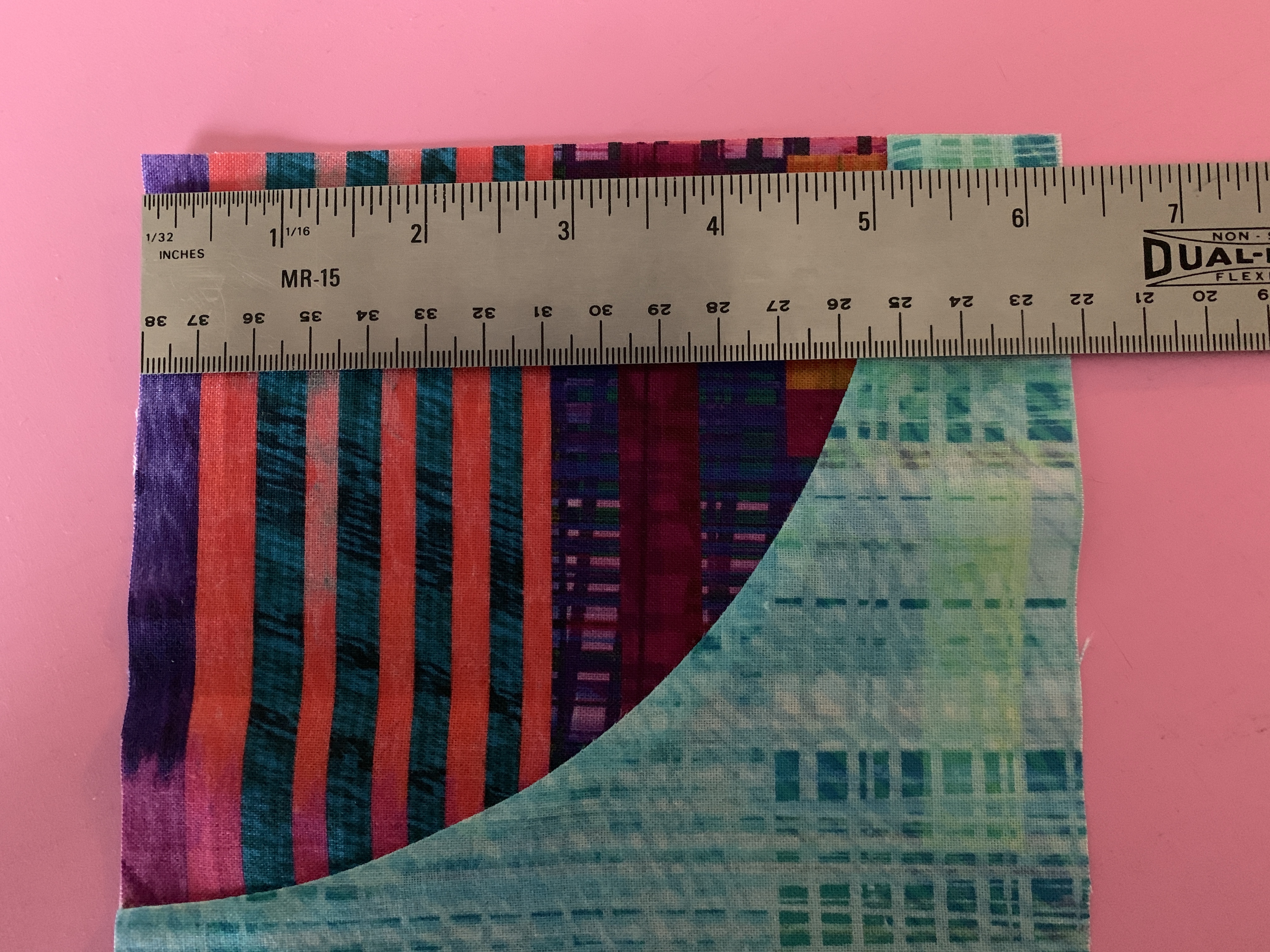
I’m after a final block size of 5 3/4″ (I’ll go down to 5 1/2″ if I have to). I began by cutting 5 1/2 strips from the panel, cut them into blocks, then cut the “pie” shaped pieces from those.

Next I cut 6 1/2″ strips – enough so far for 48 blocks – then cut the “L” shaped pieces from those (that gives me 48 “pie” pieces to use for another project!). Then I cut 2 “pie” pieces from the grunge fabrics.

Cut Blocks

I paired dark to light/light to dark (more or less) and set them into two piles. Then I began stitching some drunkard’s path blocks. Everything you read recommends doing a lot of pinning – I find I get a better block if I do no pinning at all – just align the “pie” element on top at the end of the “L” piece, then using my 1/4″ right guide quilting foot to slowly stitch the curved seam, aligning the edges carefully as I go along. My resulting block isn’t perfect but close enough that I’ve been able to trim them to 6 1/4″ which will give me a finished 5 3/4″ block.

Skyline #3

I’ve finished seven blocks and as I go along I will play with layout. I’m already liking how the buildings in the panel have disappeared and the colour definitely stands out. That was the effect I had in mind and it looks like it is going to work out as I was visualizing it.

Now I need to construct the remaining 41 blocks. I’m anticipating a 7 x 9 array – 63 blocks in all so after the 48 I will still need to cut out and stitch 15 more blocks. I have more than enough fabric from the panel to do that. I’ll cut them out tomorrow.

Skyline #3 is underway.

Skyline #2 – Completed

Done. I was able to quilt the remaining six wedges this morning. I added the hidden binding and  I just finished hand sewing it to the back of the quilt. The label is also sewn in place on the back.

Quilt Top Skyline #2 – Quilt Top

With trimming (in order to make the quilt relatively squared), I managed to end up a bit smaller than the first quilt – this quilt is 47″ x 61″; the first one is 48″ x 64″. I lost size because the dense quilting tightened the fabric, and my edges weren’t straight, and had to be adjusted so the corners would be close to right angles.

I was lucky, I managed to keep the fabric relatively flat – some steam pressing with a bit of Best Press helped eliminate most of the “fullness” in the wedges.

The back turned out flat as well (thank goodness), and the binding matched the backing so the fabrics extend to the edges.

Quilt Back Skyline #2 – Quilt Back

Now on to Skyline #3!

I’ll start that quilt tomorrow. I plan to cut out 8 1/2″ squares from the panel as well as some complementary Grunge fabrics to accent the drunkard’s path blocks. I intend making ~56 blocks – 48 for the top and some for the back. I expect to end up with a 6 x 8 array which should give me a finished quilt at 48″ x 64″ (if I’m lucky and I don’t have to trim the blocks to square them up).

Skyline #2 – Quilting Begun

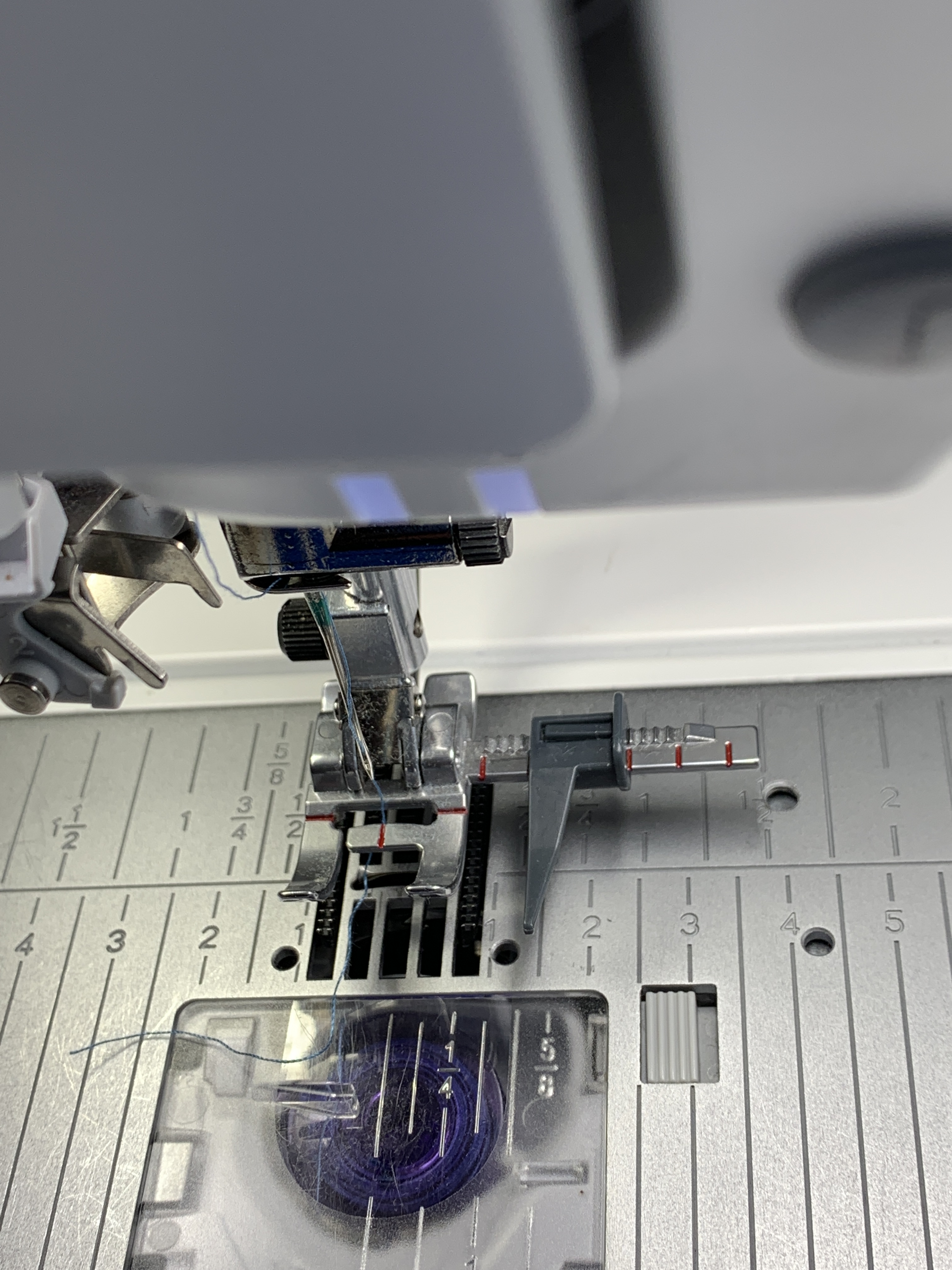
Today, I started “echo quilting” the wedges of the quilt. I decided to use my adjustable guide foot which has markings from 3/16″ to 1 1/8″ – the guide is easy to keep aligned against the right edge of each wedge as I stitch.

Adjustable Guide Foot

I’ve been varying the width of the echo stitching, starting at approximately 1/4″ to 1/2″ and occasionally 5/8″ as the whim takes me. With the guide foot, the stitching is easy to keep reasonably parallel – the only care point is determining the position of the “point” of the wedge as I’m sewing so that it more or less centres in the wedge.

Echo Quilting The Wedges

I managed to quilt 6 wedges today; I stopped when my back, neck and shoulders were telling me I needed a break!

I can see from what I’ve done so far that I will leave the sashing without any further stitching. Quilting the wedges makes the sashing stand out, the colour strong. Were I to quilt the sashing it would cause it to be diminished. So I will leave it stitched in the ditch and nothing more.

I’ll try carrying on tomorrow. At six or so blocks a day I should be finished quilting in another three days. Then I can trim the quilt to 48″ x 64″ and do a hidden binding using backing fabric leftover from trimming the quilt.

I finally feel I have this quilt under control.

Skyline #2 – Top Pieced

The Skyline #2 top is finished.

I took what I’d done apart – I had to because the panel was not laying flat! I didn’t have to take every seam out, but I did have to take quite a few apart. Now it will lay flat on the batting and cling smoothly enough to permit me to quilt the whole.

Skyline #2 – Top Pieced

I still don’t know how this quilt will turn out. I’m happy with the overall flow of colour. The next challenge is quilting the project. The quilting will pull the piece together (or, frankly, it could kill it).

I’m intending to echo-stitch the wedge elements, including the sashing. I expect the quilting will need to be quite close but not evenly spaced. I plan on using the same threads I used for Skyline #1 – a mix of variegated purple / turquoise / red to blend with the print (instead of contrasting with it).

In the meantime, I need to square the piece – tricky, actually, because although the top is relatively flat now, laying it on my cutting table and keeping it in place while I trim edges will need weights to prevent slipping.

The top is still a bit wide and I think 3-4″ longer than I finally want it to be so I do have a bit of wiggle room as I square it up.

The backing will include an offset uncut strip of the original fabric with sashing to border it as I did with Skyline #1.