Delft #2 – Update

35 Blocks Partially Assembled

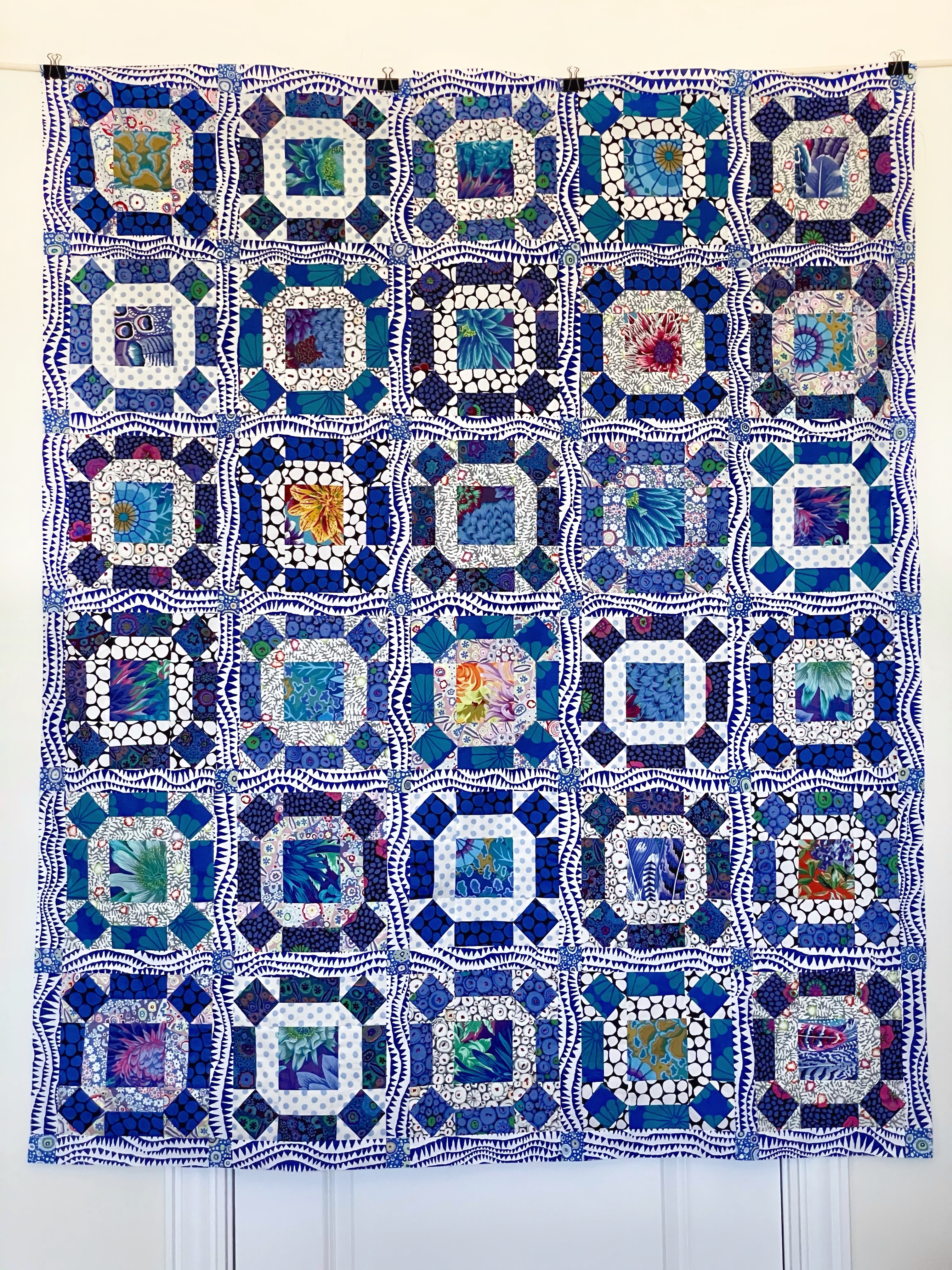
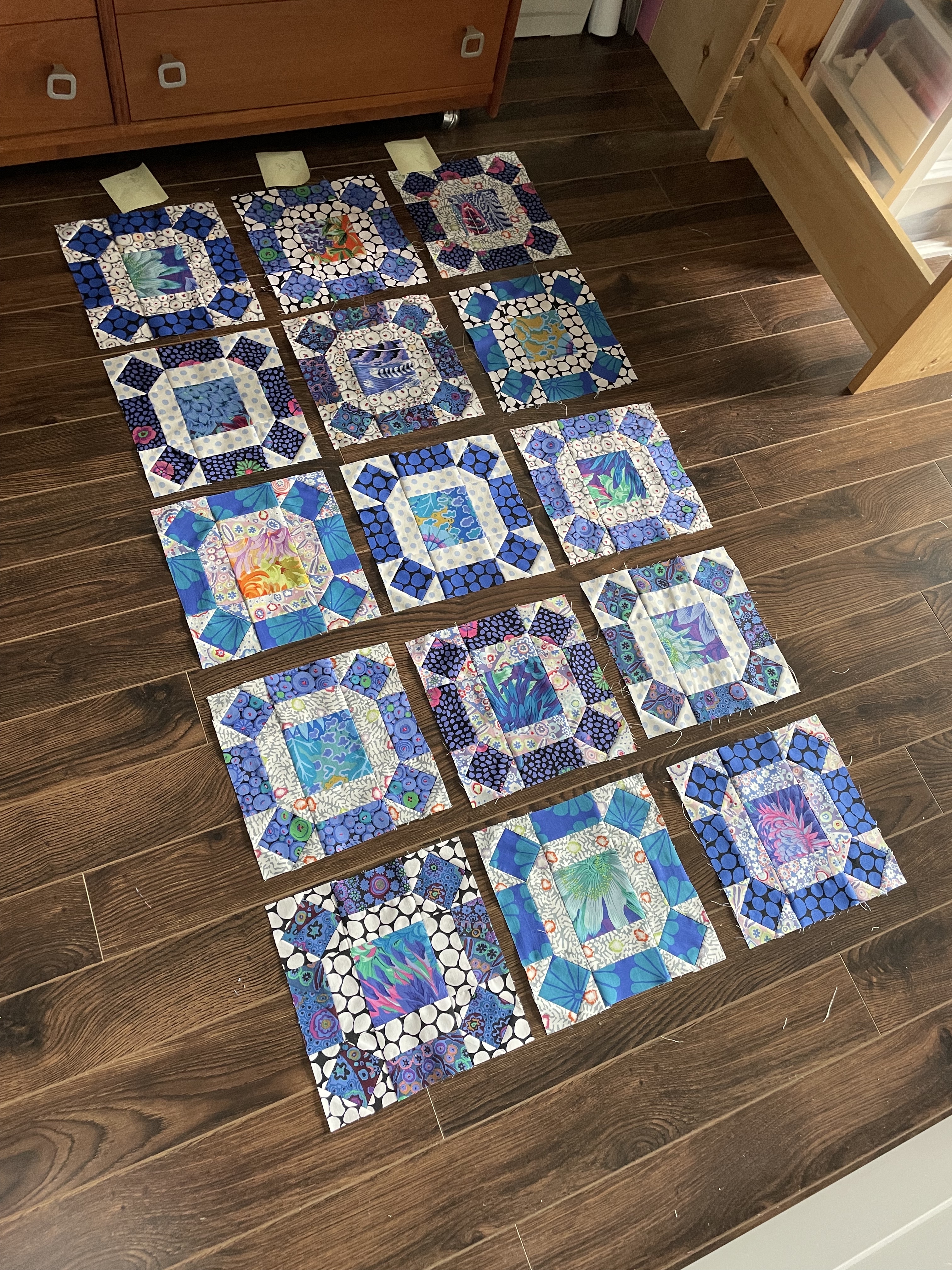
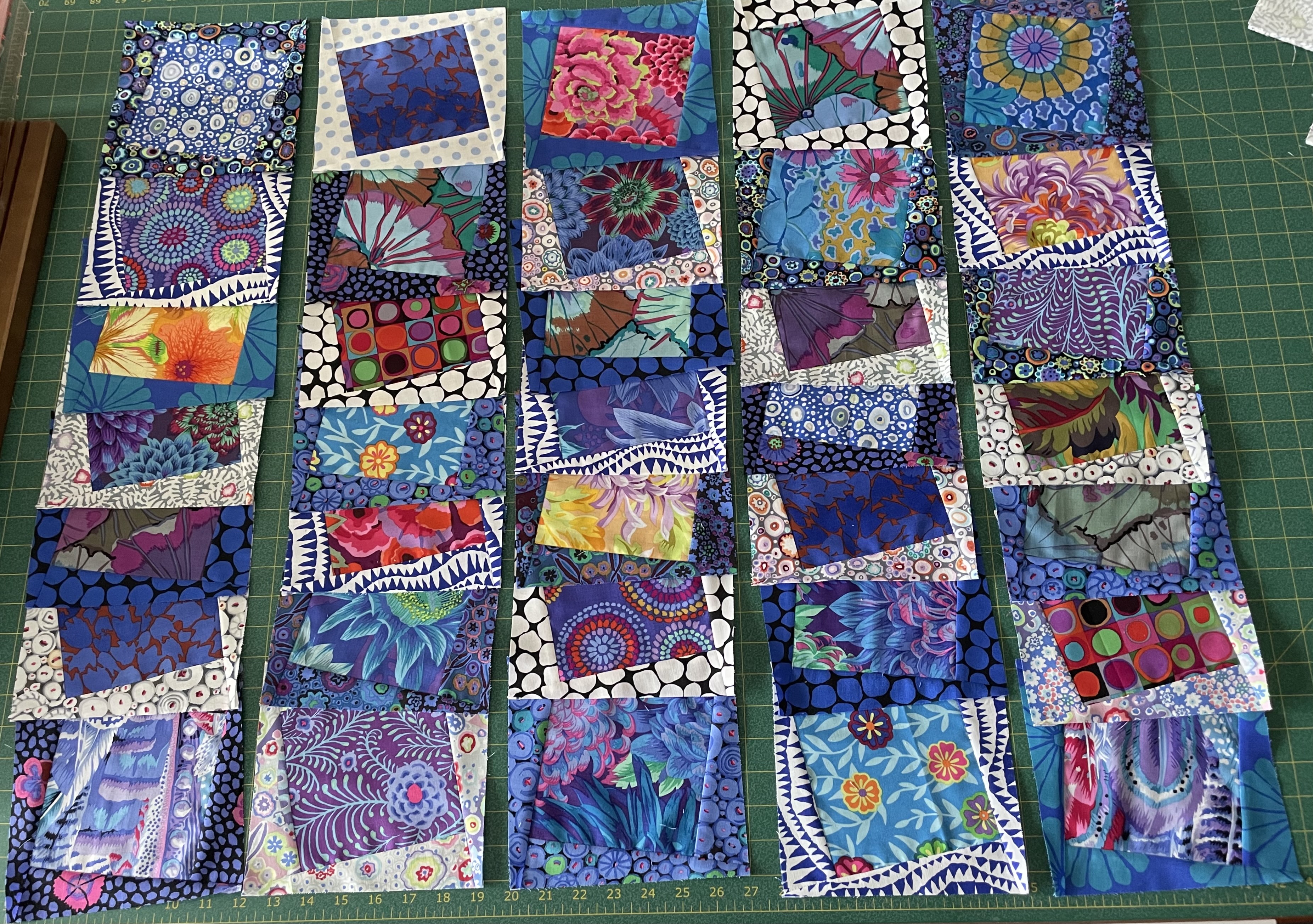
This is where I got to yesterday – all 35 blocks partially assembled with a triangle border on each. Today I began adding the second triangles to each block – I have 14 blocks done.

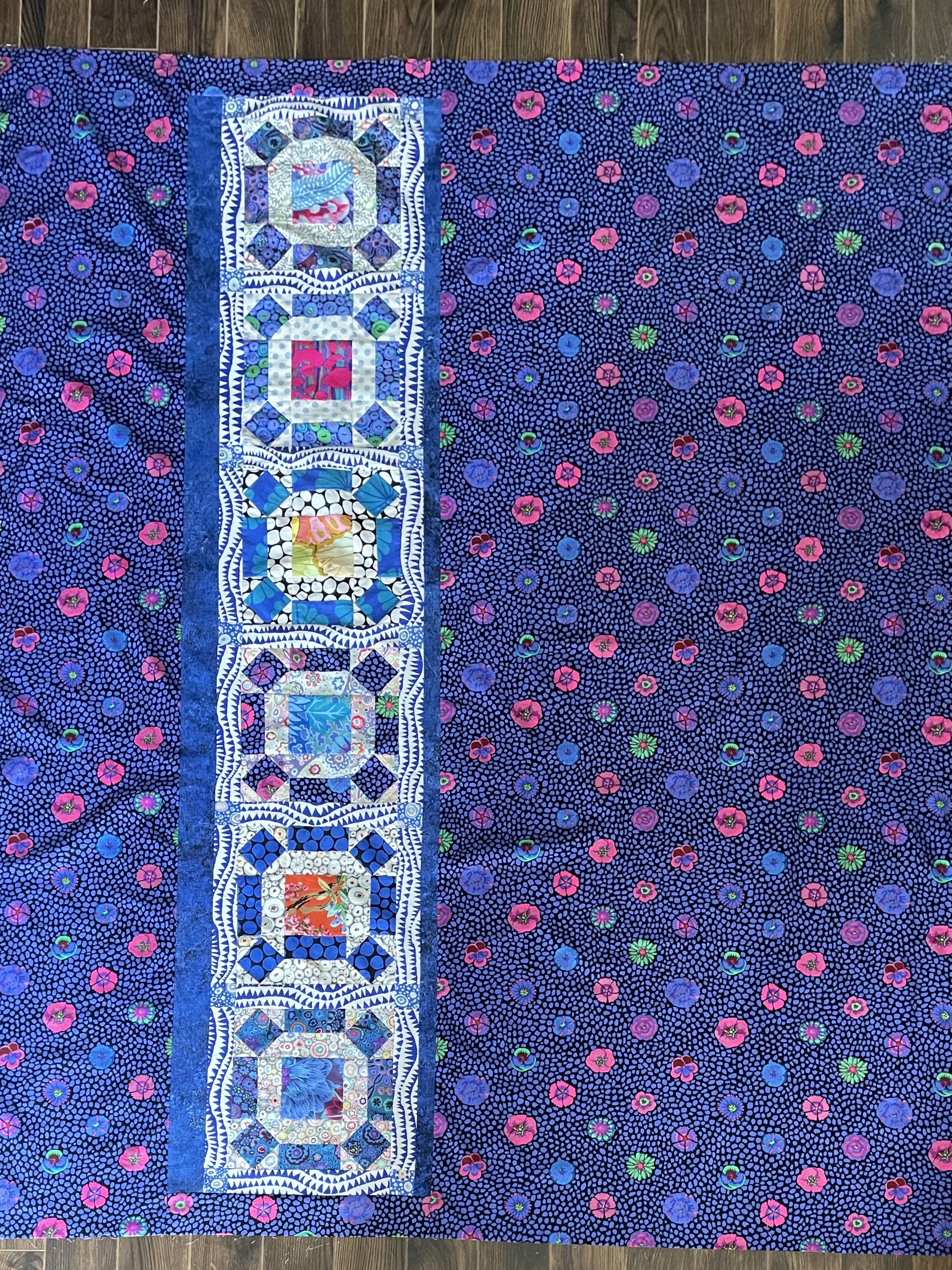
Then I was up early this morning going through my stash looking for something to use as sashing. I found a white fabric with black dots I thought would work but I didn’t have enough to do all the sashing, so after aquafit I went shopping for sashing fabric. I found one very close to the one I’d dug out of the stash. I also had a very small amount of a complementary white with larger black dots and had my fingers crossed there’d be enough in that piece to cut the 48 small squares I needed (I was lucky and there was!).

So here is what the setup is starting to look like:

Block Layout

I’m planning to alternate blocks with dark triangles with blocks with light triangles. That gives me alternating rotation as well since I cut all the light blocks in the same direction, all the dark on the second diagonal.

The sashing will be a wee bit narrower than the placement in the photo and will look fine once I have all the blocks completed and laid out.

So enough for today – back at it tomorrow. I expect the quilt top will be finished sometime on the weekend.

And then I have to start planning for a course I’m teaching in a couple of weeks – Industrial Techniques for the Home Sewer. My plan is to help people work their way through a relatively simple garment of their choosing while showing them some of the technique I’ve acquired over the years from various people I’ve taken classes with as well as other short-cuts I’ve figured out for myself.

I’m going to make myself a jacket from some kantha fabric I bought from Marcie Tilton a couple of years ago.

Kantha Fabric with Binding Fabric

I drafted a pattern from a jacket I bought at Gumps in San Francisco (looks like they’ve dropped the interesting clothing they had in the store) and made it from a kantha bedspread I bought online. I’m not sure whether I will line the jacket or not – quite likely not, but in that case I do need to bind all seams (I did pick up some faux suede to do just that). It’ll be a good example to illustrate details not in a pattern that make a garment more interesting and professional looking.

Delft #2

In the responses I got yesterday there was some confusion about how I cut the triangles for the second Delft quilt. For the inner triangles the rectangles are 8 1/4″ x 2 1/4″ – half cut on the diagonal in one direction, half cut on the opposite.

Inner Triangles – Half in one direction / half in the other

When you lay the two sets of triangles from the same fabric on top of one another they have the 90° angle in the same place. However, as you can see, were you to lay the dark set on the light set the 90° angle is on the opposite corner.

Here is the first set of triangles cut and placed upon the centre square (5 1/2″ x 5 1/2″) – they’re ready to be sewn. I’ve tentatively laid out the squares as they will appear in the quilt top – once the first triangles are attached I won’t have a lot of freedom to move these blocks around because I want adjacent blocks to be offset 90° from each other – the triangles determine that arrangement. In this array, I’ve cut all the light triangles to go in one direction, all the dark in the other.

Squares with Inner Triangles

When I have these assembled and trimmed to 7″ I will add the second triangle to each block – using a dark triangle against a light one, and a light triangle against a dark one.

Here are the rectangles cut for the second set of triangles – 9 1/2″ x 2 1/4″ – I haven’t cut them yet because I figured I’d mix up the inner and outer triangles which are very similar in size; they won’t be cut until the inner triangles are all attached. I’ve laid the rectangles out with the light fabrics face down – both sets of fabrics will be cut the same on the cutting board but because the light rectangles are face down, the diagonal cut will be 90° offset from the diagonal on the darks.

I have to think about this carefully before making these cuts because the light/dark cuts have to be opposite to the light/dark cuts for the first triangles! I think this presentation is correct for making that cut.

Rectangles For Outer Triangles

Now it’s time to begin sewing. If I’m organized about it, I should be able to chain piece the rows by adding one triangle to each square, then the second, etc.

Gathering No Moss – Sashing

I finished quilting the 30 blocks; next the sashing. I figured I had two options: edge stitching or stitching-in-the-ditch. I did a bit of both knowing I was going to have to take out whichever one I didn’t like.

On the left is the edge stitching (on the vertical sashing), on the right stitching-in-the ditch. The difference is subtle but I prefer the stitching-in-the-ditch. So I started taking out the edge stitching. Thank goodness I only did one horizontal row and a bit of the end sashing. That’s a job for working in front of the TV tonight.

I’m quitting for now but I will carry on quilting the sashing tomorrow.

Gathering No Moss – Quilting

I started quilting yesterday – did 6 blocks; another 19 blocks today – 25 blocks done – 5 remain.

A Quilted Block

I’d set up a single-run embroidery (single-run = the design is stitched once) to fit the block within the sashing, coming close to the edges but leaving a small amount of space so when I do something with the sashing (either stitching-in-the-ditch or edge stitching beside the seams) I don’t run into the embroidery.

Tomorrow’s decision will be what to do with the sashing. I’ve thought of other options besides the two I’ve mentioned above like under stitching all the rows of shark’s teeth but I think that would push me past my boredom threshold! And I can’t see a decorative stitch down the middle of the sashing strips – would just clash with the fabric detail. So it’s either stitching-in-the-ditch or edge stitching. I might just try a bit of edge stitching to see what it looks like, being prepared to take it out if I don’t like it! That’s for tomorrow.

Gathering No Moss – Quilt Back

Quilt Backing

I finished piecing the quilt backing this morning. It needed a good pressing with some Best Press (a clear spray starch.

Would you believe it – I see a mistake! I’ll have to take the pinning partly apart so I can get to the spot where I have to rotate one of the rectangle blocks 180°! I didn’t pick up on that – not until just now as I’m looking at the photo.

Damn!

The quilt sandwich is pinned. I’ve been setting up embroidery designs for quilting the blocks – testing them out on scrap fabric to make sure they stitch out correctly. Still haven’t decided which to use. Guess I need to sleep on it a bit. I hope to have made up my mind by tomorrow!

There! The block is fixed – the joins not quite so perfect but nobody, except me, is going to notice.

Gathering No Moss

Quilt Top Assembled

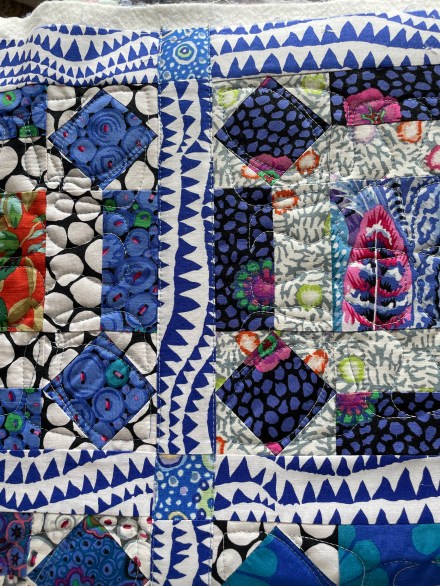
Here it is – the quilt top is finally assembled. All the shark’s teeth sashing is going in the same direction vertically and horizontally (that took a bit of correcting in the first couple of rows until I realized the top would look better with that fabric unidirectional rather than helterskelter. The four substituted square centres bring some life to the quilt and bring out the colour in the others.

Final quilt size is 52 1/2″ x 62 3/4″.

Next step is to create six more blocks for the back of the quilt. Past Friday I went to Mahone Bay to Woolworks and picked up one of the fabrics to use for backing the quilt. One length isn’t wide enough for a backing – I will splice it and insert a column of blocks with sashing.

It’s a lovely colourful quilt top – I like Kaffe Fassett’s sharks’ teeth fabric selection for the sashing – quite unlike the other fabrics, yet the right colour – it creates a very modern feel to what is a traditional block.

And I was right – the many imperfections in the blocks were amended when I added the sashing. I didn’t trim the blocks to a precise 9 1/2″ because I needed to keep the 1/4″ at each corner block point so I fudged the placement while adding sashing and the blocks have ended up as I wanted them.

Gathering No Moss – In Progress

1/2 Done

I have just finished the 15th block for the Gathering No Moss (Kaffe Fassett) quilt. That’s half way. The block, by the way, is called a “rolling stone” – hence Fassett’s choice of name for the quilt.

Once people figured out the “quilt along” on Facebook (a “private” group for those who purchased the quilt kit) was mostly about us commenting on (and sharing photos of) our progress, the traffic has died down. I had decided to purchase the kit and join the quilt-along because I thought Fassett would discuss his decision-making regarding fabric design and choices for the quilt in some depth. Doesn’t appear to be the case. Had I realized that, I likely would have just deconstructed the quilt from the photo and done it in some colour set from fabrics I had in my stash and could pick up from The Woolworks in Mahone Bay. I wouldn’t have bought the kit.

Oh, well, I won’t do this another time. I have a greater sense of satisfaction when I’ve worked out how to construct a quilt from a photo and chosen my own fabrics, as I did with the Escher quilt. That was a real challenge and I was very pleased with the outcome. Here, although the quilt block is an easy one, it is fiddly – the four corners take time to construct – add one triangle, press, add the opposite triangle, press, add a side triangle, press, add final triangle, press – and hope you’re close enough to square that they will assemble with the rest of the block without too much distortion. But overall, there isn’t much challenge to the quilt once you figure out how to construct the block. In this case, I chose to change the block size, which required some testing out to make sure my pieces would match up, and I’ve changed some of the colour selections, but it’s still the “Gathering No Moss” quilt. Far less challenging than most of the quilting I’m used to doing.

Here is the panel at noon – with four rows now completed.

2/3 Finished

This time I worked on an entire row at the same time doing what’s called “chain piecing” – taking great pains to keep the elements in the order I’d planned on them having! At the bottom, second block from the right – not sure about this one. I want that centre where it is but the large blue and white dotted fabrics together are rather loud. Given the symmetry I set up, that pairing was bound to happen since I had five light and five dark fabrics.

Enough for today. On to other tasks.

Kaffe Fassett Quilt Along

In January I did something I have never done – I signed up to do a quilt along – this one with Kaffe Fassett. He (and the rest of the collective) have created a quartet of queen size quilts – same pattern but available in four different colour combinations. The quilt block resembles a cog wheel hence the name of the quilt: Gathering No Moss.

The project began when I received an email from Hyggeligt Fabrics in St, Mary’s Ontario advertising the quilt along. Over the years I’ve collected Kaffe Fassett fabrics – my diamond quilts, the Escher quilt all used fabrics from Free Spirit which produces and sells the Kaffe Fassett Collective collections. In years past, I’ve attended a lecture or two of his which I found underwhelming, but I’ve also watched Fassett lead a weekend workshop several years ago on YouTube from which I learned a lot.

I liked the “Delft” fabric collection well enough that I decided to buy the Gathering No Moss fabrics and join the quilt along. The zoom lectures begin on Wednesday – Aug 4 – on Facebook (why there of all places – I try to stay off Facebook). In any case, my fabric bundle from Hyggeligt Fabrics arrived last week. It’s a lovely collection of fabrics. The instructions are for a 77″ x 92″ quilt – a 5 x 6 array of blocks. I decided to keep the array, but downsize the blocks.

The intended quilt block is a 13 1/2″ square:

The 13 1/2″ block / an 8 1/2″ adaptation

I did a mock-up of the intended block but I wanted to make a smaller throw size quilt so I downsized the blocks which turned into a block a bit smaller than I wanted. [ A finished 9″ block x 5 = 45″ plus 1.25″ x 6 for the sashing = 7.5″ will give me a finished width of 52 1/2″ – a largish throw quilt.]

A 9 1/2″ block

Once I’d figured out the block construction and had dimensions for the 9 1/2″ block I was going to make, I got to work on the Delft fabrics. I simplified the instructions – rather than work with the chart describing what to cut from which fabric, I sorted the fabrics into light/dark and medium. The centre blocks I cut from the small medium colour fabrics; then I cut rectangles and squares for the corner blocks from the darks; finally I cut rectangles and squares (which I cut into half-square triangles) from the lights. The cutting went reasonably quickly.

I carefully laid out the centre blocks in a numerical order – Row 1: 1,2,3,4,5; Row 2: 2,3,4,5,1, etc, until I had six rows of five blocks. While I liked the colour of the Delft fabrics I thought the quilt could use a bit of additional colour – I went through my stash of Kaffe Fassett fabrics picking six bright ones, cut a centre square from each which I then substituted into the array on my table – one in each row.

Next I laid out the pieces from the dark fabrics B,C,D,E,F and the light fabrics G,H,I,J,K in an array and began placing dark/light pairs on top of the centre squares – using a similar shifting pairing so that in the end each block will be unique.

Quilt Construction Begins

You can see the lovely blue and “white” fabrics in the collection. I have so far completed six blocks. The remaining 24 are laid out in position on my cutting table. It takes me about 20 minutes to construct a block so I will need to work on these for the next few days. There’s sashing to insert between the blocks which will tie the whole quilt together – I just haven’t decided what width to use – I’ll make that decision when I have all 30 blocks laid out.

I knew from the beginning I wasn’t likely to follow the instructions. I like the block, so I decided to use it instead of creating something else. Deconstructing the block from the images of the Gathering No Moss quilt was straightforward. I will tune in on Wednesday to see what Fassett has to say – I’m sure I can learn some interesting things from him about colour flow and placement. I’ll report back as I make progress on the project.

Let The Trumpets Sound

I must say when I began this Drunkard’s Path quilt I didn’t anticipate the chorus of trumpets that would emerge!

I had decided to give this quilt idea a go (from a photo I’d seen) because I liked it’s modern quality – two fabrics and stark lines.

Trumpets – Front Of Quilt

39 Drunkard’s Path blocks – the rest is filler to create the overall layout.

Working on this quilt has let me consider all kinds of possibilities for using Drunkard’s Path in unusual layouts. I picked up a panel the other day which I think might turn into something quite interesting were I to cut it into squares and use both the Pie and “L” elements contrasting the dark and light tones.

Hoffman Skyline – Multi

I didn’t buy a full panel – the fabric is 106″ wide! – I bought a metre (40″) which is most of the pattern. Use the multi-coloured buildings cut out as, say, the Pie pieces with some kind of blender – a grunge of some colour – as the “L” pieces with the fillers done using fabric from the panel – I think I’d end up with something quite unusual. That might be my next project… (after a couple of garments).

Trumpets, Back Of Quilt

The back of “Let The Trumpets Sound” – I made several more Drunkard’s Path blocks using the leftover pale turquoise Pie pieces with different leftover red fabrics to complete the blocks. I didn’t use all the blocks I made – I still have four tucked away in a box now. Never know when I might find a use for an already constructed 6″ block, right?

I decided to do a hidden binding for this quilt to emphasize it’s modern qualities. I matched the colours in the binding on the back so it blended in precisely with the back assembly. I like how that turned out – you have to look closely to see the binding on the back.

Charm Quilt – Finished

Finished the quilt last evening. When all the quilting in the hoop was done (it went reasonably quickly), I added the binding. I didn’t want much of a binding but in the end I finished with a 1/4″ binding on the front (3/4″ binding on the back) which had to be hand-sewn. I never do hand sewing if I can help it – but in this case the binding on the back was wider than on the top and I didn’t want a machine stitched seam next to the binding; so hand sewing it was.

Charm Quilt – Finished

I’m pleased with how the back turned out, as well. I was able to use the column of HST I’d taken from the panel on the front, added a few sashing pieces that evoked the colour pallet of the front with a slightly darker grey fabric.

Finished Charm Quilt Back

This could be a quilt top on its own!

Now, I’d intended working on this quilt as a demonstration for the “quilt in the hoop” class – it was cancelled a week ago, the gals couldn’t make it yesterday, so far only three are able to come next week. I just kept working on the quilt and I finished it. So for the class (whenever it happens) I’ll work on my sample muslin piece. For now, I’ll be back to working on the bargello table runner.