Boys From Minerve 2010

Boys From Minerve 2010

Just finished – well I have to hand stitch down the hidden binding (I’ll do that this evening) – but otherwise it’s done. This is based on a photo of two boys watching some men working that I took in Minerve (in the south of France in the vicinity of Limoux) in 2010. I enlarged the photo a bit, enlarged the boys a bit more, printed the resultant image on fabric, cut out the boys carefully and some of the rocks of the roadway, then used fused appliqué to build up the rest of the image. Carefully edged stitched all the bits of fabric, then thread painted the rest. I also darkened the grey fabric of the roadway using some fabric pastels to blend the colour better with the paving rocks.

I wasn’t sure the piece was going to turn out but I’m happy with the outcome. Trying to find a fabric to “frame” it took a bit of looking around. In the end I found this half yard in my stash of batik fabrics – I chose it because the green/grey blended with the roadway, and the hint of pink makes the boy’s shirt stand out. The blue embroidered signature does the same for the smaller boy’s jacket.

I captured the image through a lattice on the porch of a nearby house – the heavy brown bars – I thought about leaving them out but they frame the boys and draw your attention to them.

So another piece finished for the exhibition in Parrsboro at the end of August.

Silk Quilt – Just About Done

I had to take a break from hand stitching the hidden binding on the back. I’ve got it half done, I’ll finish the task later this evening. (My hand stitching isn’t fully back to where it was before my thumb decided to stop working, but I can control the needle much better than I could before the carpel tunnel surgery!).
I had intended doing a pillowcase backing but the backing silk fabric just would not stay flat and in place, so in the end I began the quilting starting in the centre and worked outward toward the sides, doing my best to keep the silk backing from sliding around. I tried pinning the quilt sandwich but couldn’t get the backing layer to lay flat so in the end I removed all the safety pins, just pinned the top and one side edge and then did my best to keep smoothing the backing as I stitched each quilting seam. A much more difficult task than I had expected. To get the unbound look I was after on the finished quilt, I did a hidden binding using some bronze embroidered silk fabric that came with the other two pieces, so it matched. I considered machine stitching the binding in place, but I like this unbound look with the quilting stitching coming to the very edges.

Silk Quilt – Top

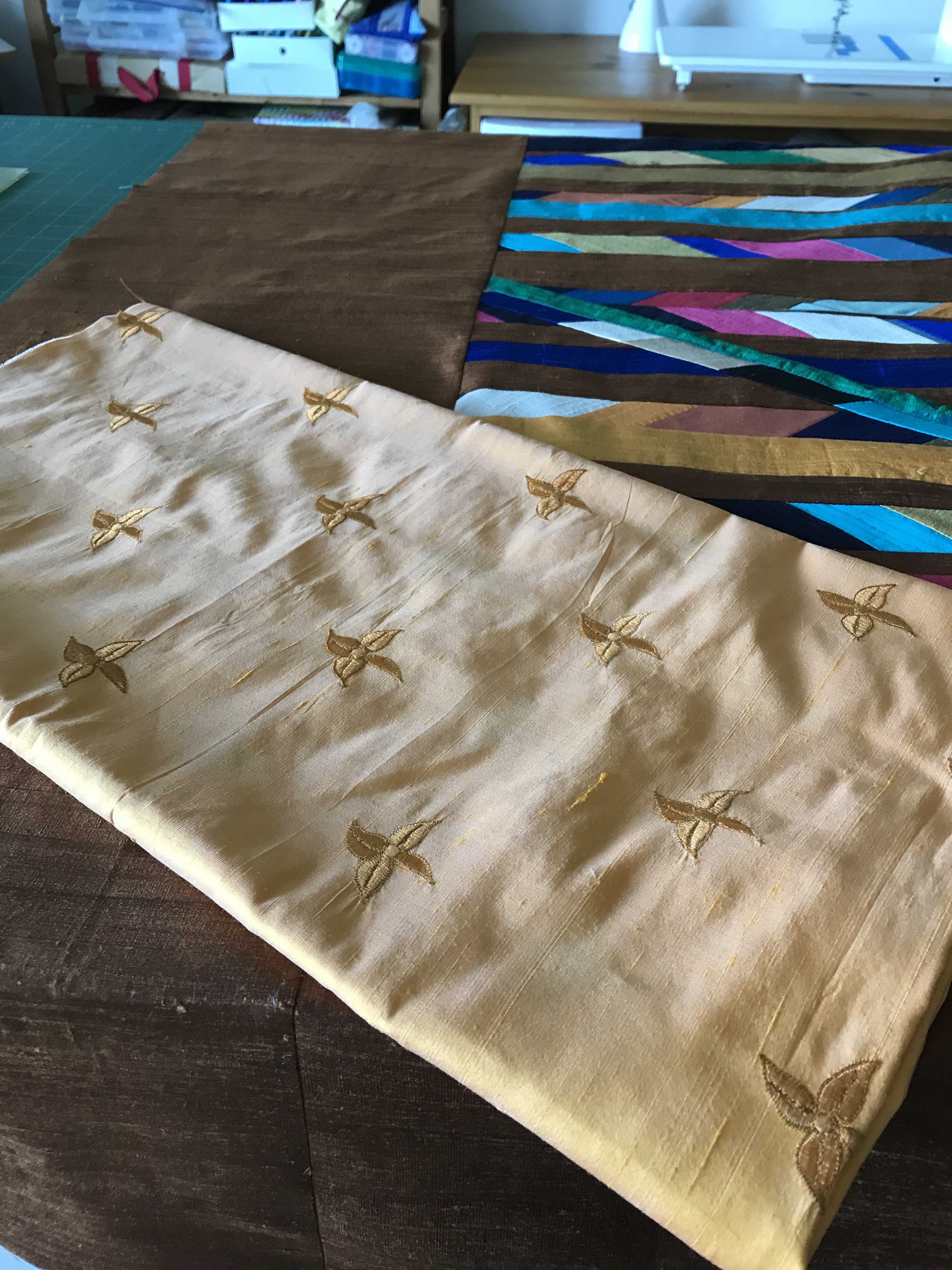
When the quilting was finished the back wasn’t too bad, Still a bit of fullness in spots, but when steam pressed again it will be reasonably flat. And I like the embroidery in the fabric – it provides a bit of visual interest.

Silk Quilt – Back With Hidden Binding

Just two sides left to hand stitch – the label is already sewn in place.
The finished quilt is smallish when compared to most of my other quilts – similar width but shorter (my lap quilts are usually about 5 1/2′ long – this quilt is 55″). It’s still long enough to cover a person (maybe a shortish one), but it would make a nice hanging for a hallway, or bedroom.

Silk Quilt – Top Finished

Many years ago, I was looking after the UNICEF booth at one of our local Christmas Craft Fairs. Across from me was a quilter with a gorgeous silk quilt for sale. She’d collected silk ties and had cut bowtie shapes from the silk she salvaged. I loved it and wished I could have afforded it – but it was too large to be wall hanging and too delicate to use regularly on a bed. I admired it every day I sat there selling greeting cards.

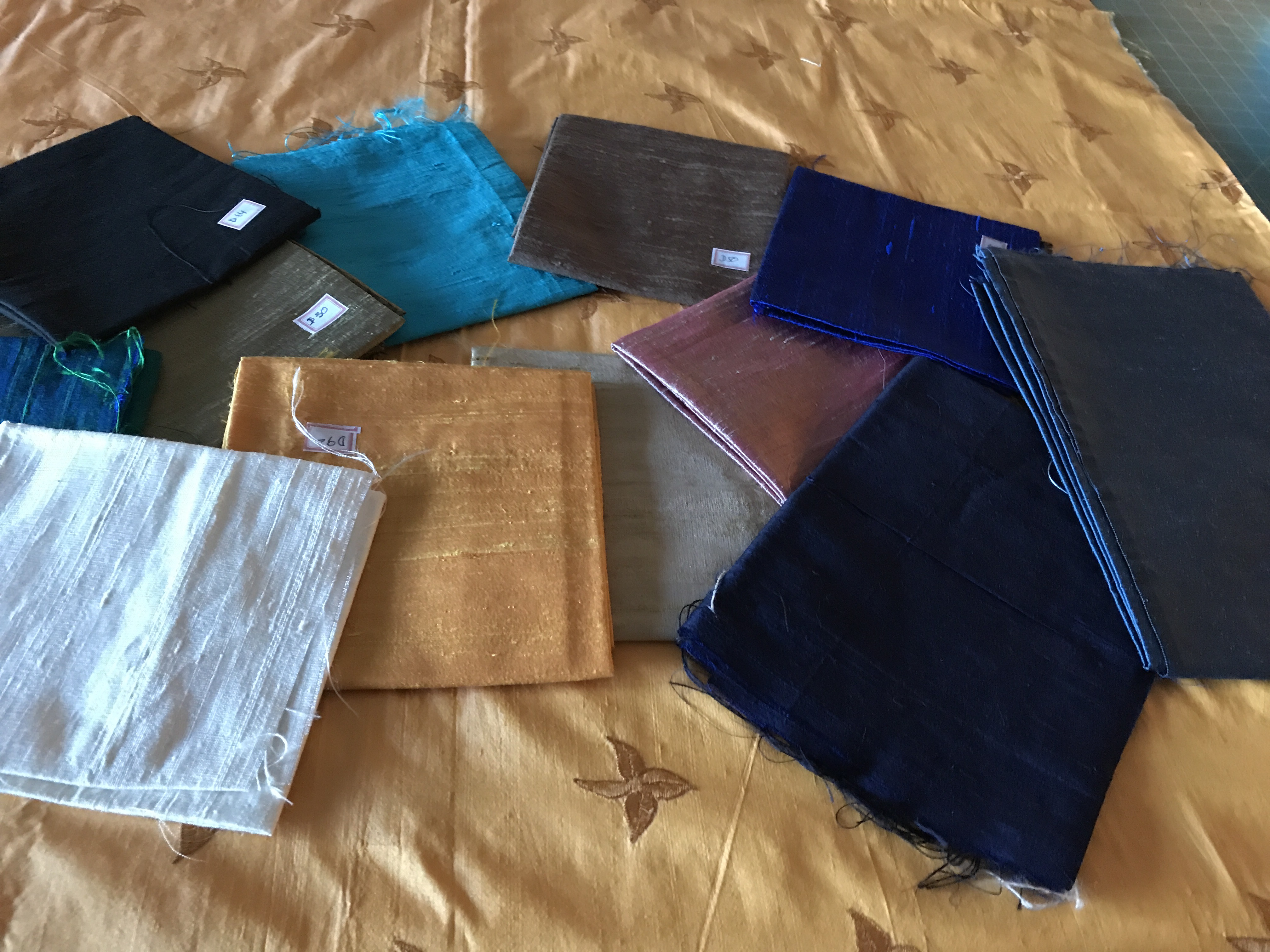
I never forgot it and when a friend gave me a bundle of silk fabric she’d purchased in Singapore and which she had decided she’d never use, I thought, a silk quilt. I decided the bronze silk dupioni would make a lovely quilt background. I ordered a dozen silk fat quarters from Etsy a couple of years ago in colours to complement the bronze.

I wanted to do something modern and decided to mix some small piecing of the coloured silks to form strips on the diagonal and solid strips.

Silk Quilt

Finally finished piecing the top this afternoon. The central panel is offset to the top and left. The finished quilt size: 51″ x 56″. I had wanted to make it more rectangular but I just didn’t have enough bronze silk. I have a few small scraps but in order to keep the grain of the silk running top to bottom I had to piece the top and bottom strips so my size was limited by the amount of silk I could cobble together.

Tomorrow I’ll set up the quilt sandwich. I’m using a second of the pieces of silk fabric. I have enough for the backing, but I will have to piece it horizontally because it isn’t wide enough to do a single running length and I haven’t enough silk left to create a pieced strip. Besides the embroidery in the golden silk is enough detail and I will be careful to cut it between the embroidery designs so the seam, when pressed open, will be relatively unseen.

Embroidered Silk Backing Fabric

I really see this as a largish wall hanging rather than a lap quilt. If I’d had enough bronze silk, I’d have finished the quilt with a narrow binding, but because I don’t I’m going to finish the quilt using a “pillowcase” turn. I plan on quilting it stitching in the ditch from top to bottom and adding some more vertical lines where necessary in the border areas.

First Swim – Completed

Here it is – just done:

First Swim

It always amazes me how much finish work goes into one of these pieces – inner border, wide mitred outer border, backing, hidden binding, hanging sleeve. And a lot of it is hand sewing – I’m getting better at hand sewing, but it’s still awkward; I’m having trouble pulling the needle through with my thumb and first finger, especially if I’m trying to get through multiple layers of fabric!

Now to put the art quilting aside for a while and on to making pants.

Silk Quilt?

I’ve had this collection of silk dupion (Indian silk) for a while – 2 yd of the golden embroidered fabric and 12 fat quarters in various colors. I want to use it up and get it out of my stash! 

I’ve started looking at pictures of quilts for inspiration – I want to end up with a modern, minimalist quilt using the embroidered fabric as background with either half square triangles or narrow strips (or both) for the coloured elements…

I also spent time today going through my personal photos for possible images for the small wall art quilts I need to work on. I still have to go slow – my hand tires easily and I have to listen to it!

Canada’s Big Quilt Bee

The Canadian Quilters’ Association is holding a Canada-wide quilting bee to commemorate our 150th birthday. The women in my building got together yesterday and we made blocks/slabs to contribute to the more than 1000 quilts the association hopes to donate to Ronald McDonald Houses across the country.

Most of the women dug through scraps of fabric, assembling strips and pieces to sew into 12 1/2″ blocks (each block to contain a small piece of “Canada cloth” containing maple leaves) – I was one of the sewers. I must have stitched at least 15 blocks. In all, we assembled 50 blocks – enough for two 4×6 tops, or four 3×4 tops which is what the Association will be making at the “Big Quilt Bee” to be held in Toronto June 14-17. During the four days volunteers will be assembling thousands of individual quilt blocks into quilt tops and making them into quilts.

As we were leaving Avis handed me one more batch of pieces. I made the block this morning:

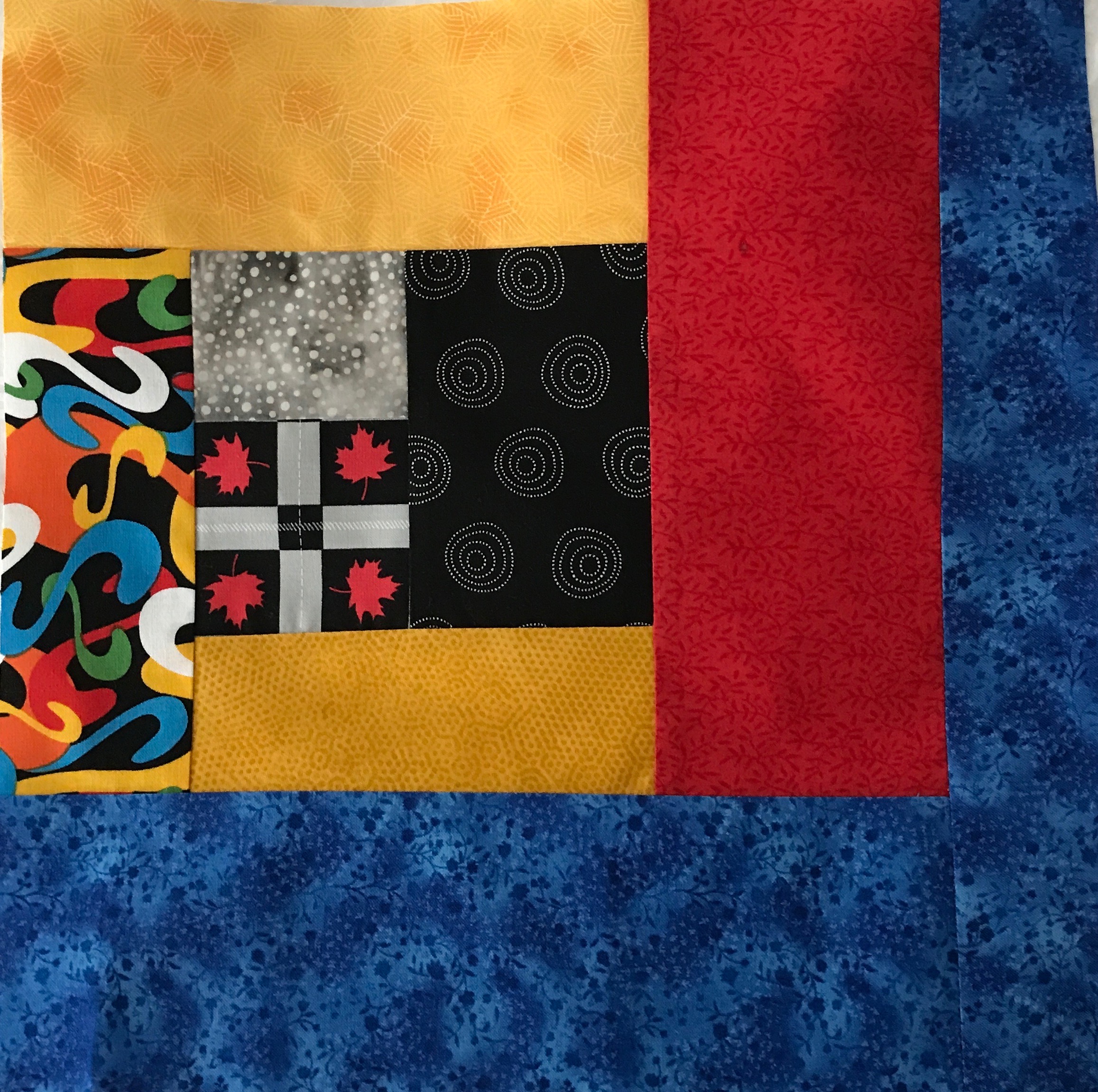
Lobster Block

My lobster block has the requisite maple leaves, along with some Nova Scotia tartan and colours representing the forests, sea, sun and sky of Nova Scotia. I completed the block with a multi-coloured scrap. I hope it tickles the fancy of some recovering child.

As of March 31: “STATUS UPDATE on the Big Quilt Bee
300 finished quilts, 143 tops and 1,000 blocks (which will make 83 quilts) for a total of 513 quilts to date!”

The Canadian 2017 Quilt Bee

The Canadian Quilters’ Association has invited quilters across Canada to be part of The Canadian 2017 Quilt Bee to commemorate Canada 150. The quilting bee will actually take place in Toronto June 14-17, but those of us who can’t get there can participate by making 12 1/2″ slab blocks (even quilt tops). The goal is 1000 quilts for kids at Ronald McDonald Houses across Canada. The requirements: 1 small piece of Canada fabric inserted into each quilt slab. No specified quilt block design, just include a piece of Canada cloth and make the slab 12 1/2″.

Local fabric shops are participating in the event – holding slab making days. The Friday afternoon women, here in my building are joining in, too. A week tomorrow we’re planning on spending the day making 12 1/2″ slabs.

I stopped off at my local shop this afternoon and picked up a half-dozen pieces of Canada fabric and came home and quickly turned out 3 slabs!

Improvised Slab #1

Improvised Slab #2

Improvised Slab #3

As you can see my slabs are improvised – started with a bit of Canada fabric, surrounded it with something colourful, and continued to build out the slab until I had enough to trim to 12 1/2″. They’re wild! Nothing subdued about them. I’m sure they’ll coordinate with slabs sewn by other women. I figure 1000 quilts will require close to 25,000 slabs! That’s a lot of piecing but with many willing hands I bet the Association will meet its goal.

There was one horrendous mess on my cutting table by the time I’d finished these three  – I’ve just tidied up. I have three more pieces of Canada fabric so over the next week I’ll probably build another three slabs. I’ll do another couple when the women get together next week.

12 X 12 Quilt

I mused about the teal/indigo fabrics I had for a couple of days and decided in the end to limit the quilt to just the set of twelve fat quarters (I put the rest away). To use my set of twelve indigo fat quarters, I decided to make a 12 x 12 quilt based on Elizabeth Hartman’s “Low Volume Tiles” quilt from her Craftsy Class: “Inspired Modern Quilts“).

I based my quilt on Hartman’s design but had to adjust the sizes of my small blocks because once I cut the first 13″ square I knew I had to fiddle to cut a second set of 12 blocks – there wasn’t enough fabric for a second 13″ square. So the dimensions of my small blocks are a bit different than hers in order to be able to use the fabric I had – there was just enough with a 5″ x   8″ leftover piece of each fabric which I used in my side borders.

The idea behind this quilt is to take 12 fabrics, cut 13” (or whatever large size) blocks you want by stacking and cutting them into the same 12 sections. Next you sort them shifting fabric #1 to the back of the stack for the second small block, fabrics #1,2 to the back of the stack for the third small block, fabrics #1,2,3 to the back of the stack for the fourth small bloc…. You get the idea:

12 Blocks – Stack ‘n Whack – Sorted

When you’ve done the setup, each stack has 12 fabrics, arranged so that a different one of the 12 fabrics is at the top of a stack before you begin laying out the large blocks and the fabrics in each stack are in the same sequence, just shifted by one so when you sew the blocks, each block has all 12 fabrics with no repetitions!

I intended to end up with 10 1/2″ blocks (having started with a 13″ square) – I trimmed my stitched sections to 11″) and assembled them into a 3 x 4 array:

12 X 12 Stitched Together

That’s a small quilt, however. I had cut a second set of 12 small blocks from the residual fabric from my indigo fat quarters – so I stitched together the second set of twelve blocks. It turns out that I was lucky to have chosen 13″ as my starting size because I wouldn’t have had enough fabric to create the second set of 12 blocks had I started with 14″!

One other thing – I removed one of the light fabrics from the collection before I began cutting, substituting a bright green for block #12. I wanted one colour to pull the other fabrics together.
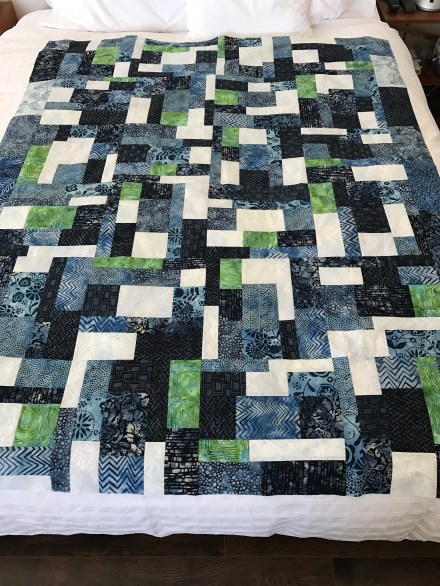
My Finished Double 12 x 12 Quilt With 4″ Borders Added to the Sides

My finished quilt top is a 4 x 6 array with added 4″ side borders to give me a final width more in proportion to the length. Finished quilt: width 50″; length 64″. I lost a tiny amount from both width and length with the trimming I did in order to able to fit the blocks together. But in a design like this you can’t tell where the trimming occurred. You really aren’t able to see the “blocks” or where the main joins are.

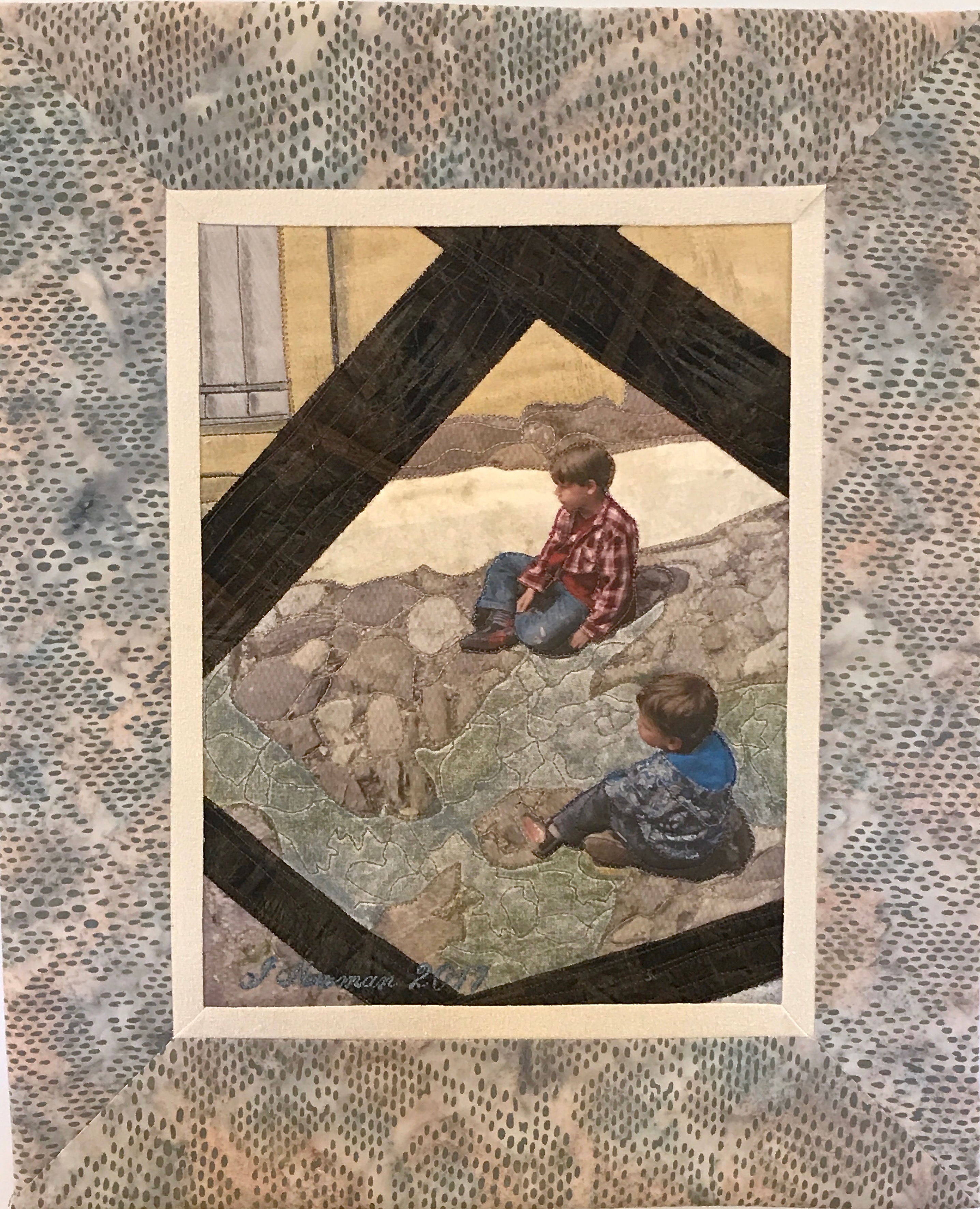
Now to come up with an idea for the back. Yesterday I bought some backing fabric and 1/4 m of four teal/indigo batiks to add to some others I have but didn’t use in the quilt top. I had to do that because I didn’t have a single scrap left from the original fat quarters I started out with.
From My Fabric Stash

Fabric Stacks

Nearly two years ago I returned from a road trip to Toronto via Center Harbour Vermont so I could visit the Keepsake Quilting shop. I’ve been buying fabric from the online shop for years. This was a chance to actually see the entire selection.

I was looking for green batiks to make a quilt for Noah. However, once I’d made my choices, I couldn’t help looking around and ended picking up two different fat quarter collections of indigo/teal – eighteen pieces of fabric in all.

Having just finished the Japanese Strip Quilt, I was looking through my stash and decided it’s time to use these indigo fabrics so I opened the packages, spray starched and pressed each piece. I realized I didn’t have enough light coloured fabrics so I made the rounds of my nearby fabric shops and bought several 1/4 m selections.

Now the prepared fabrics are sitting on my cutting table – along with a 1/2 m length of a bright green to use as an accent.

I just have to decide what to do with them! I want something “modern” but probably constructed using traditional elements. Can’t make up my mind, is the problem.

For example I could set up half-square triangles and recut them:

Disappearing HST

I could cut squares, stack them three/four at a time, wonky cut them, and sew, mixing and matching to create blocks.

Wonky Log Cabin

I could just make 4 HST at a time and cluster them:

HST Clusters

I could cut rectangles and arrange them somewhat randomly:

Japanese Blocks

Or I could just cut and sew, improvising as I go along!

Don’t know where to start yet.

A Note on Binding My Quilts

I bind my quilts using 2 1/4″ strips cut from the width of fabric to provide a bit of give as I attach the binding (given the large lap quilt size of my quilts I need six strips). I join the strips using a mitre – the reason is the angled seams don’t attract the eye and often they are nearly invisible.

Sometimes I press the long strip in half lengthwise, but lots of times I don’t bother. I attach the binding first to the back of the quilt starting 10 inches or so from one end (to allow me to create a mitre join when I get all the way around) – no pinning, just stitching in short sections, aligning the binding against the quilt edge (with a hint of stretch), and stitching a smidgeon more than 1/2″ from the edge. When I get near to the join I stop sewing, lay the quilt flat on the cutting table, cut one end of the binding then overlap the second end, measure 2 1/4″ from the end of the first binding edge, and cut. Now I create a mitre to join the two overlapping ends of the binding – I make sure the binding is the tiniest bit short (1/8″ – 3/16″) so I can stretch the joined binding to fit the quilt (that way I don’t get a bubble in the binding). (I haven’t said anything about creating mitred corners – click here to get more or less an idea for how  I do it.)

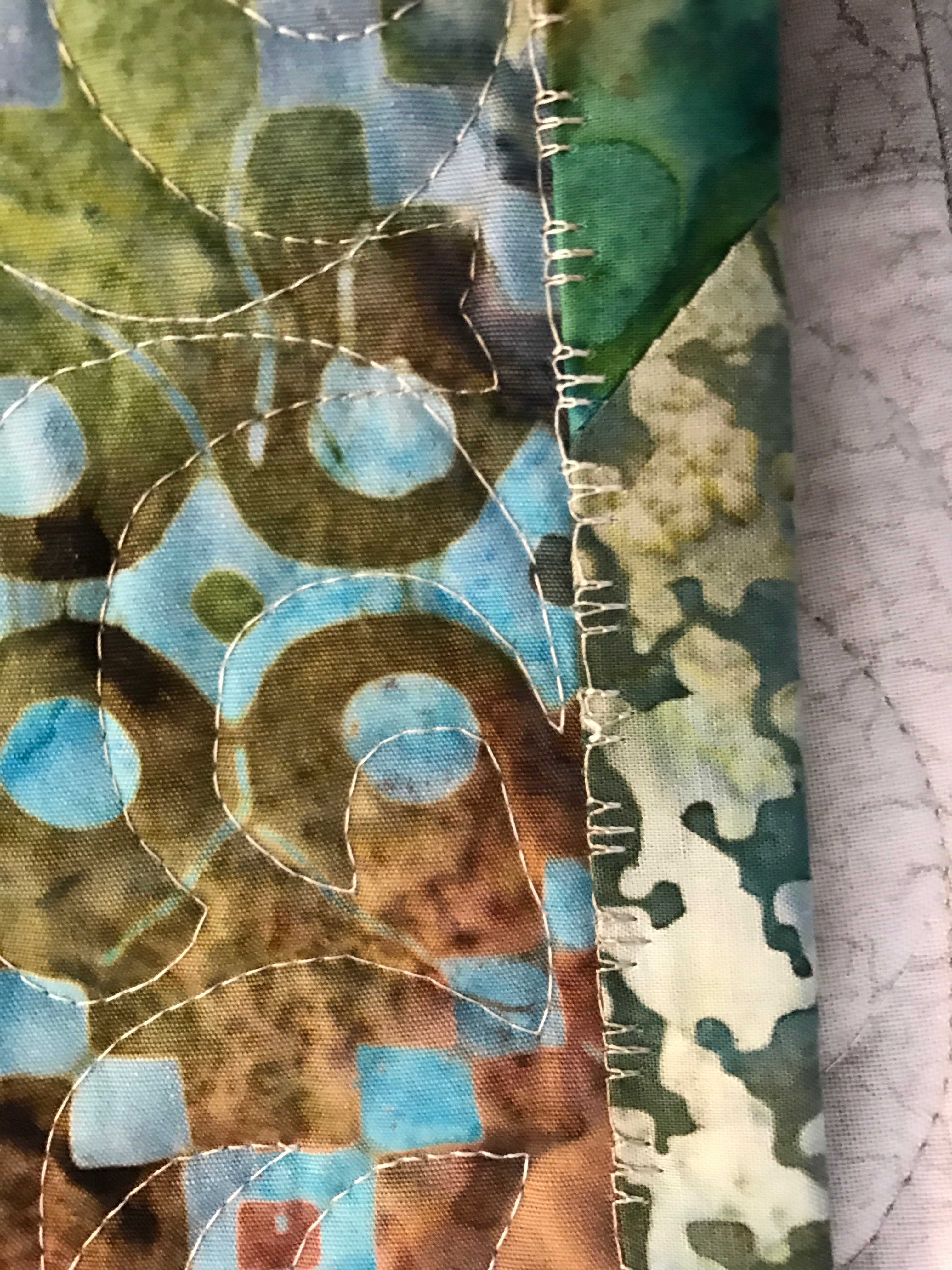
Now I turn to the front of the quilt, fold over the binding, turn it under and pin so the turned under edge just meets my stitching from the back. I have used a number of decorative machine stitches to attach the binding on the front. Here’s the one I use most often:

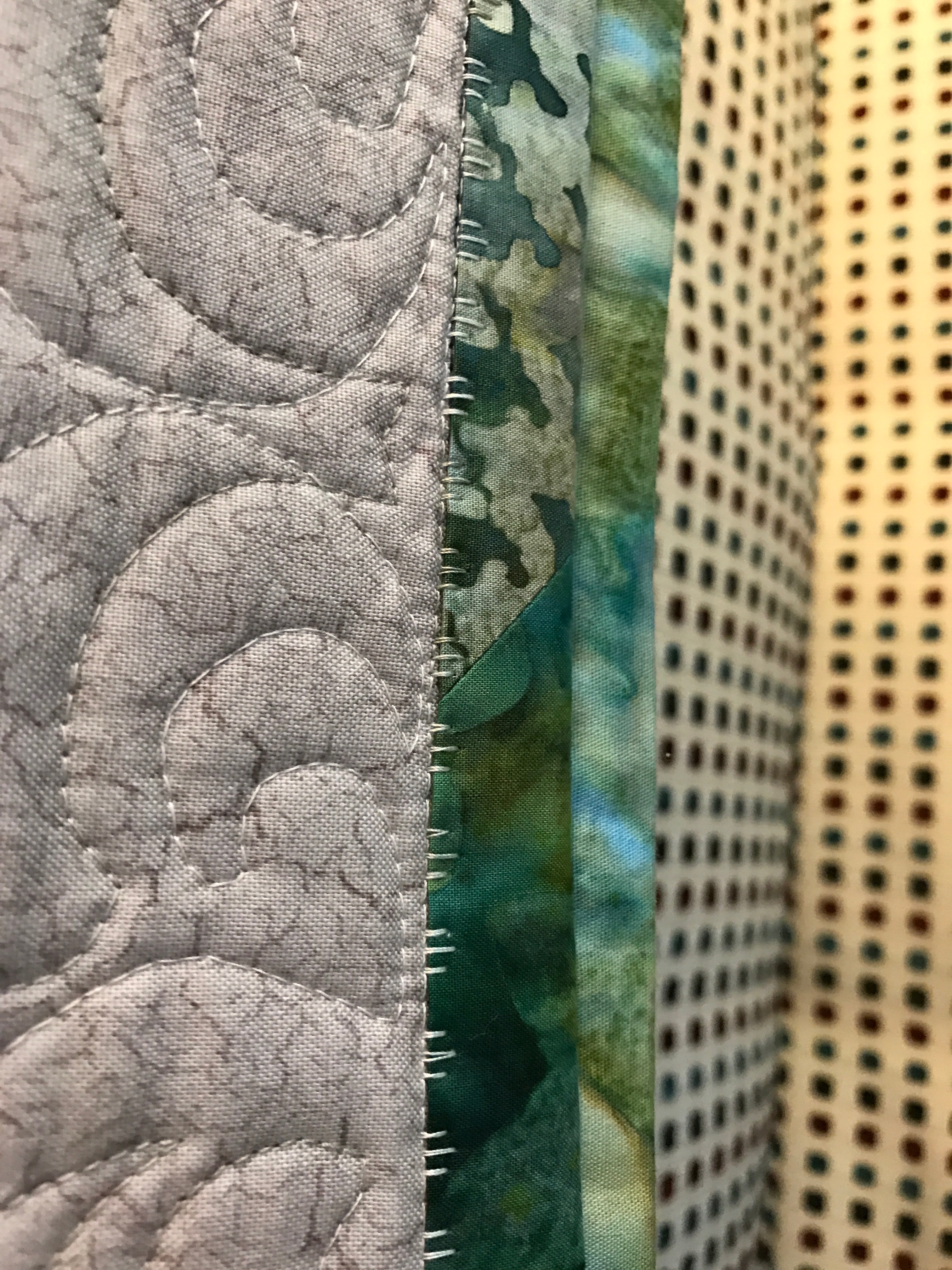
Binding From The Front

It’s a modification of one of my machine stitches – I am careful to keep the straight stitches along the edge, the stitching to the right and back overlaps the binding and holds it securely.

Binding On The Back

And because I’ve been careful to make my fold align with the stitching, the stitching is pretty much aligned on the back of the quilt (although my stitch tension isn’t always perfect – I don’t worry about that, it is the back of the quilt, after all.)

I’ve done this so many times that it doesn’t take long to bind a quilt.