KnitPicks & Hobbii Silly Socks

Made With KnitPicks Yarn

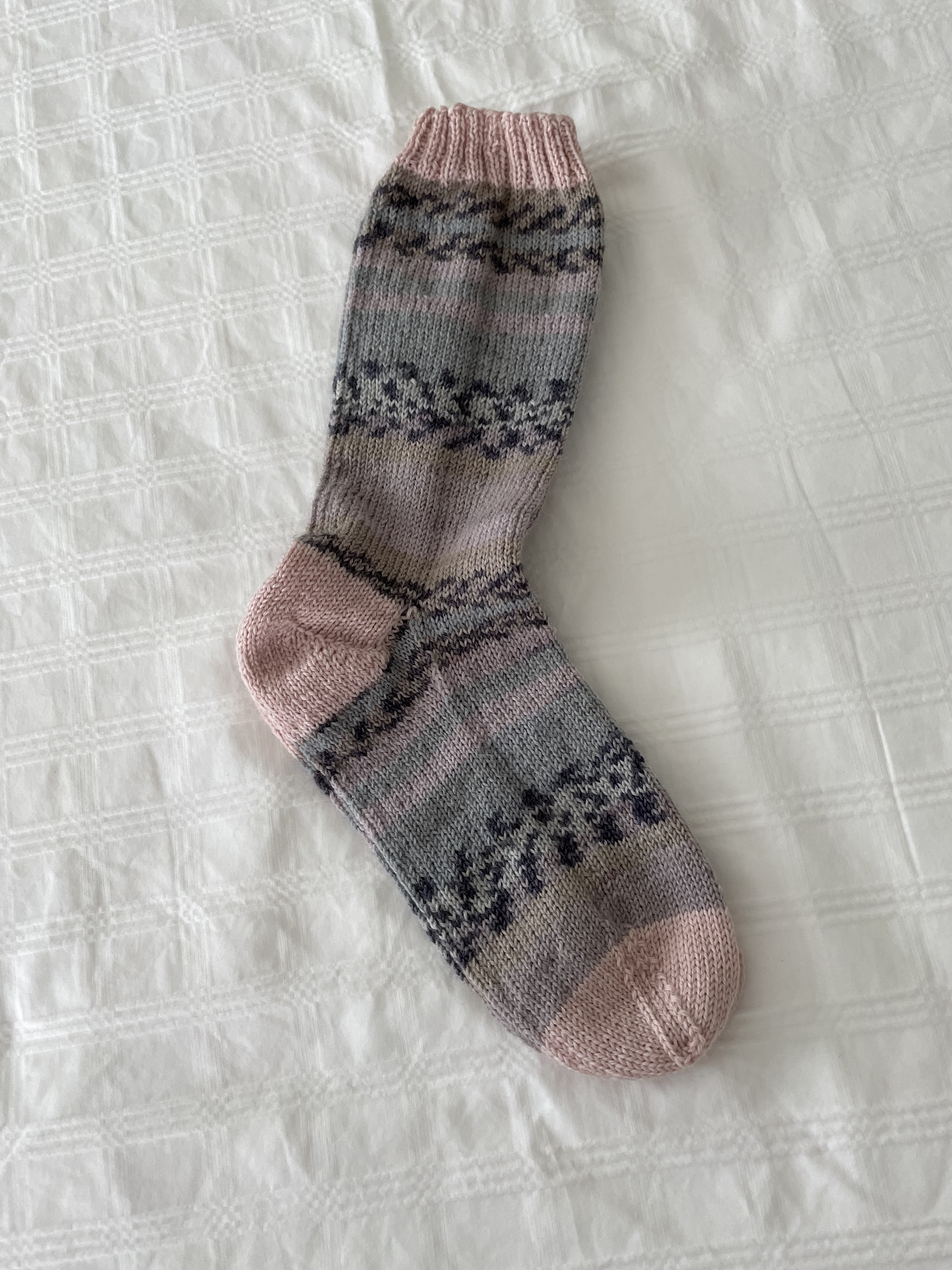
A while back I placed an order with KnitPicks for three/four skeins of sock yarn (I can’t now remember how many I bought). This is the second pair finished (the other is in the sock stash). The repeat is the length of the leg (just about) – longer than most other sock yarns. You end up with an extended interesting pattern. I still am adding contrast for cuff/heel/toe. I prefer how adding a solid brings out the colours in the yarn.

I had finished these socks a couple of weeks ago, taken them to show at our Friday afternoon knitting group. One of the gals was working on some rather bland socks. I pulled up the Hobbii Yarn Website / Sock Yarns to show her some colourful alternatives. Found the “Silly Socks” yarn on sale! While we were sitting there I ordered four balls/skeins of the yarn.

Hobbii Yarn (Denmark)

I’m currently working on the second sock on the first of those balls/skeins and liking the resulting sock. The yarn is a great sock weight and soft although it’s the conventional superwash of 75% wool and 25% polyamide. It knits up well and feels nice in the hand. Another couple of evenings and the pair will be done.

I bought one skein of the rainbow yarn shown in the photo – they should be fun to knit up – although I’m not sure what solid I’ll add to it. Maybe I’ll even keep the resulting socks.

Still knitting every evening in front of the TV!

Other Mothers

Watch this video of a mother raccoon teaching her baby to climb – it has lots to say about how we might think about learning and teaching, ourselves!

Watch the mother problem solve, watch the kit figure out how to climb the tree.

Mother Raccoon can’t actually “teach” the kit to climb – she supports the young one, she positions and repositions her, supporting the kit’s efforts so the young one can figure out she has to use her claws to hang on. Mother’s persistent, she doesn’t give up; the kit finally gets the hang of it and starts climbing the tree on her own.

It’s how my grandmother taught me to make bagels, and how to knit, when I was very young. I was invited into her activity, shown how to participate. I learned to watch and try myself, figuring out what was essential in the process, what I could ignore.

Making bagels, I learned what the dough should feel like when it had been kneaded enough, how to shape the bagels by rolling a small piece of dough into a “snake”, picking up one end, rotating my hand, bringing the other end to the first, then rolling my hand to make the join. I learned how to tell when the bagels were ready to come out of the pot of boiling sugar water, what they look like when they’re baked enough. I don’t recall her teaching me these things directly, but I certainly learned them.

Knitting, the same thing – in the end I became a right hand knitter (my grandmother knitted “european” – left-handed) but the principles of how to cast on stitches, how to hold the needles, how to bring the yarn around the needle push it through a stitch and bring it back through to form a new stitch, I learned from her. After I developed carpel tunnel syndrome in my right hand, I actually switched to knitting as my grandmother did, with my left hand – it wasn’t difficult – I’d learned the technique by watching how she’d done it. I came to understand that our relationship had always been a mentoring one – I was invited to participate in her world and to learn from her many important life skills!

Interesting, I don’t remember my mother engaging with me in this way. She never shared her natural ability to play piano (which I always envied). I took piano lessons but I never learned to improvise the way my mother could. I didn’t learn to sew from her. I taught myself to cook. She aborted my passion for ballet when she refused to let me replace lost ballet shoes. I don’t remember her ever having an encouraging word for any challenge I took on.

I do remember her allowing me to read whatever novel she was reading (which transitioned me from children’s books to adult literature at an early age). The first grown-up novel I remember was “Peyton Place” – The “novel tells the story of three women who are forced to come to terms with their identity, both as women and as sexual beings, in a small, conservative, gossipy town. Metalious (the author) included recurring themes of hypocrisy, social inequities and class privilege in a tale that also includes incest, abortion, adultery, lust and murder.” (https://en.wikipedia.org/wiki/Peyton_Place_(novel))

At eleven I certainly didn’t understand a lot about what took place in the novel but I knew there was something illicit about this book which my mother and my aunts whispered and giggled about. My mother and I never talked about the book. She never talked about any of the books we actually both read over the years. She went to the library; I read the books after she finished them.

Consequently, I looked for other women to help me become an adult – my Aunt Helen (who lived in London, ON), Mrs. Milligan (my friend Marlene’s mother), Bobby Ballentyne (my friend Marion’s mother), Ruth Marks (whom I regarded as a big sister), many others, all who shared their lives, inviting me into an adult woman’s world. I referred to them as “my other mothers”. I actively sought out mentoring when I wanted or needed to learn something new.

Today, I frequently turn to YouTube as a source of information and technique but it’s not quite the same – the two way act of sharing is absent. There is no subtle feedback letting me know whether my approximation is getting better or not. I’m pretty much on my own as a learner.

Fortunately, I have a lifetime of trusting I can tackle something new and find a way to become reasonably proficient. I attribute that to the many mentors who have shared what they were able to do and supported my explorations along the way.

The reason I reminisce about this, is an article I read recently in the New York Times: He Lives in the Double Helix of My Cells, but I Do Not Know Him (by Zach Gotlieb). Gotlieb, a child of artifical insemination who has never met his father although he discovered he has 20+ half-siblings, writes about Father’s Day. He says he “realized that I’d had fathers all along — dozens of them. There were teachers, coaches, other people’s dads, family friends, my beloved grandfather. For me, these father figures are a collage of wildly diverse personalities and perspectives giving me more fathering combined than an individual dad could possibly provide. Biology is strong, but it’s also easy. The people who father me do it for no other reason that that they choose to.

He made me remember my “other mothers” – the women who took me under their wing, shared their lives with me, encouraged me to be intrepid, audacious, undaunted, adventurous. Because of them I cultivated talents and expertise I would otherwise never have discovered and honed.

I know lots of people who resist wading into unfamiliar territory – they’ve learned to avoid the new and subsequently miss the experience of expanding their horizons. I’m guessing the absence of good mentoring either at home or school accounts for their reticence. Failure, without support to continue trying, can make it difficult to take risks.

I’m always open to tackling something unfamiliar. Recently one the Afghan immigrants I’m spending time with helping learn English was applying for a job that required a knowledge of WHMIS (what’s WHMIS? – Workplace Hazardous Materials Information System – I searched for a way to explore the training myself so I could coach Ahmad through the certification. Turns out he didn’t need the certificate right now, maybe later).

I’m always interested in learning new stuff. I’m not afraid of taking on a challenge. I learned that from the women who took an interest in me.

Gotlieb says: the word “father” has evolved for me, from a noun to a verb.”

The same is true for “mother”!
Being Prepared

Last evening, while knitting in front of the TV as I always do, bedroom window open (that’s where my TV is located), I became aware of the smell of smoke. Not sure of the wind direction – could it have been smoke from the Quebec out of control forest fires?

In any case, I thought about a couple of weeks back and the fires in my backyard – the day the Tantallon fire began I was able to see smoke from our apartment building (that night neighbours on the other side of my building could see flames above the trees); the fire was close – no serious danger that it would come closer to us here, but a very real presence none the less for many days. I had friends who had to flee that fire and the Bedford fire as well.

From CBC News – Upper Tantallon Fire

The notion of “being prepared” was something everybody locally had on their minds. What do you take with you if you have fifteen minutes to leave here quickly? How do you even get out if you have to feed into a single exiting road with hundreds (maybe thousands) of other people also trying to get to safety and traffic at a standstill?

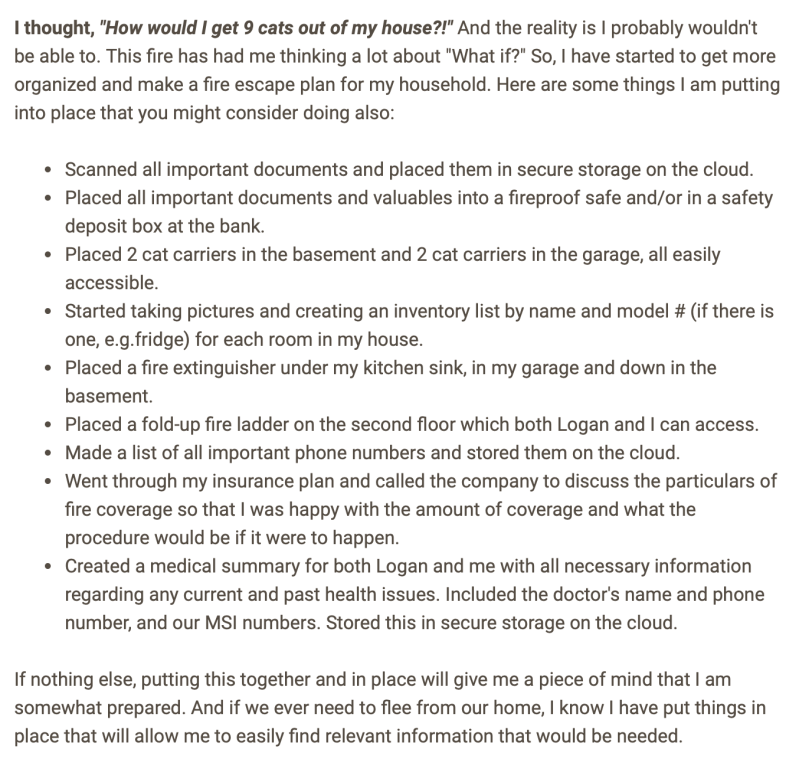
Daphne Calhoun, my massage therapist, wrote in her recent newsletter a summation of what I was considering myself.

Pretty much my list – except for the fire extinguishers (we have hard-wired smoke detectors with a sprinkler system in the apartment building, although a fold-up fire ladder might be worth considering if I could find one six stories long) and the cats. I’d already done what Daphne was organizing – my important documents are digital, I’ve got photos of the rooms in my apartment showing what I own, my contacts list is on my phone and backed up to the cloud, my emergency medical information is on both backup hard drives.

While I didn’t actually pack a bag I knew I would grab my passport, make sure I had my iPhone case (which has my health card, driver’s licence, car insurance papers, etc.) with me. Grabbing a few changes of clothes, my medications, a couple of cosmetics, toothbrush wouldn’t take long (my suitcases are in the apartment storage space, not in the garage six floors below).

Was there anything else I’d want to take? My computer backup hard drives (both of which are the size of my iPhone) – not the computer – that can be replaced, the information on it would be useful to have even if the critical stuff is already stored in the cloud and accessible. I have a gazillion password stored in a password manager on my phone – didn’t need a paper copy. Family photos? On the backup drives. My will is in the safe deposit box at the bank with the insurance papers (and my insurance agent has that information, anyway).

Art work? If I can’t get out by car because traffic is going nowhere and I have to start walking – a small bag on wheels and a backpack is all I’m likely to manage. I thought about my impending art show in Parrsboro – if at all possible, I would have taken the large suitcase already filled with those quilts and wall art pieces. I’d certainly have packed them in the car (at least that much of my art work might have been salvaged), but the rest of the art I own (and there’s quite a bit on my walls) I’d have to abandon.

That’s about it. I was mentally prepared to walk away from everything I couldn’t easily transport on foot. If necessary, what’s important can be packed in a carry-on bag and a backpack. The rest, as George Carlin says, is “Stuff!”

On Display

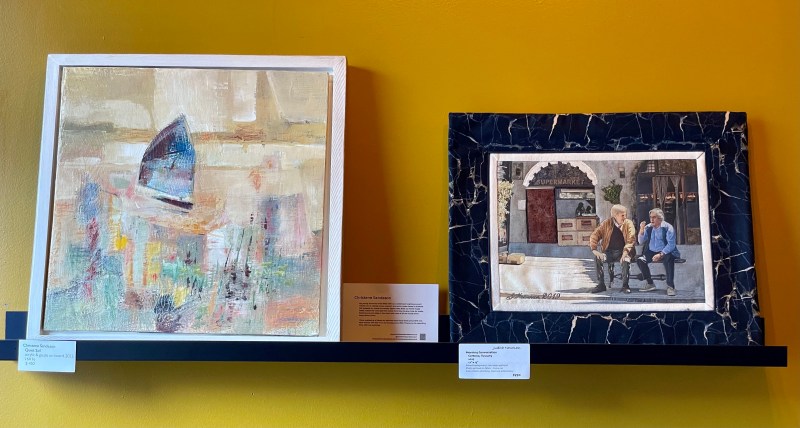
I left for Truro around 4:30. The drive took just under an hour. I’d taken a friend with me – conversation always shortens the trip. We had time for coffee (and a sliver of peanutbutter cream pie – yum!) before Christene Sandeson, the person with whom I’m sharing the gallery space for July/August at NovelTea Cafe, arrived.

We got work straight away – each of us laid out the work we’d brought, tentatively placed it on the various display shelves then moved pieces around to better balance size and colour against one another and against the background walls. Didn’t take long – we were finished in less than 45 minutes.

Without discussion we intermingled our work – it just seemed to look better with Christene’s and my pieces side by each rather than trying to cluster each of us separately. We were both happy with how the final hanging looked.

We’ll meet again at the end of August when we arrive to take down the art. Perhaps we’ll make time then to have coffee or a meal together!

[These pieces are for sale – contact me: newman.judith@gmail.com for a price list]

Where Does Time Go?

I see it’s been three weeks since I commented on what I’ve been working on – that’s because I’ve been busy with all kinds of stuff, including a short trip to Toronto (more about that tomorrow), picking up the quilts in Parrsboro, knitting socks, and I don’t know what else. Time has disappeared on me.

On the way back from Parrsboro last Saturday I stopped at the Joy Laking Gallery in Portapique. As always, her paintings are worth a stop. What also caught my attention was her front porch – gorgeous iris beside the path:

Blue Flag Iris

This flower will likely become a 6×6 piece in the near future. And on her front stoop:

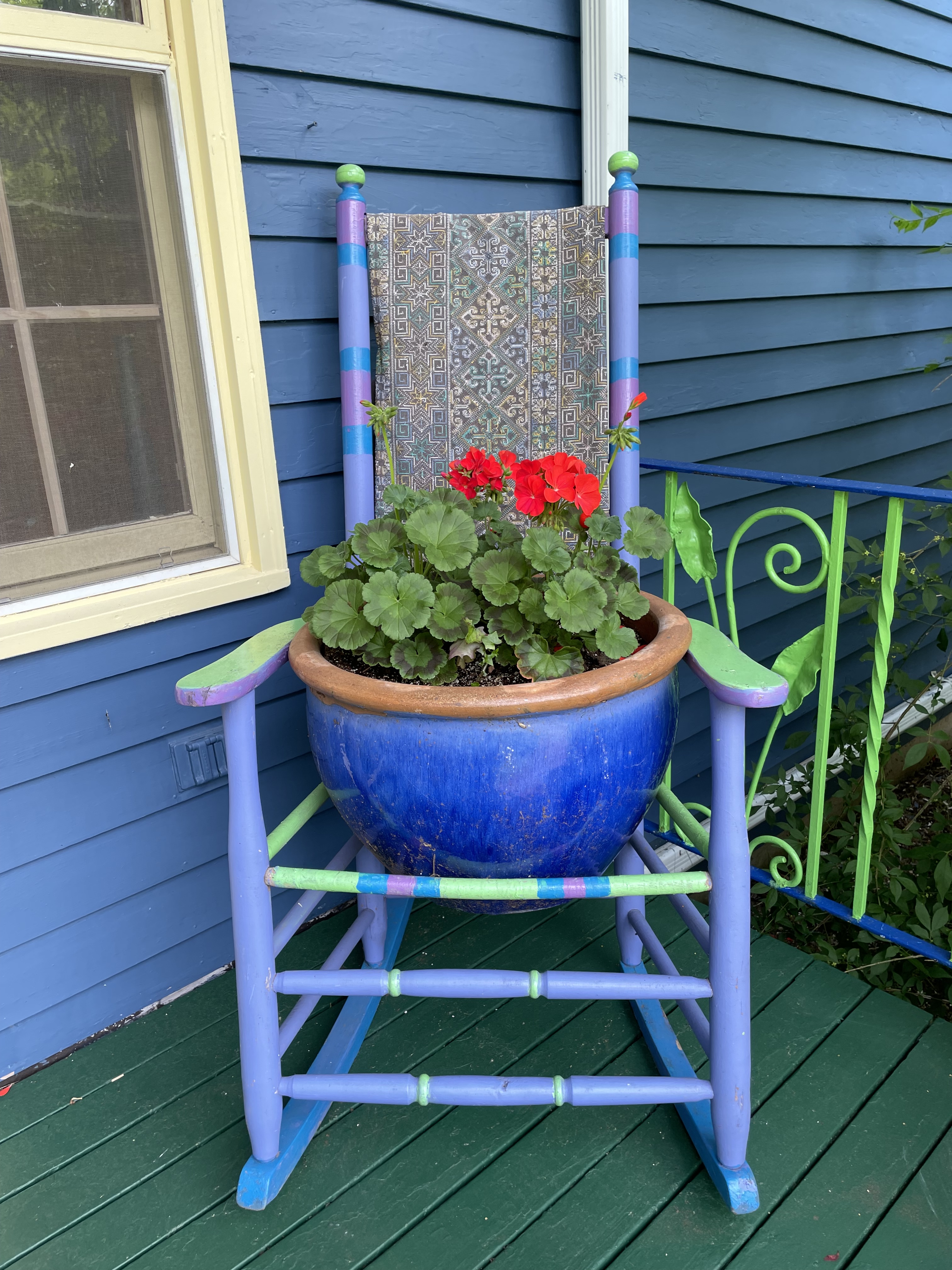
Geraniums

Love the colour composition. I can see this photo becoming a photographic hanging (without the downspout in the background).

In about an hour I leave for Truro to hang nine photographic wall art pieces (plus three others) for the next two months in the NovelTea Bookstore and Cafe on Prince Street.

Ready For Showing

I stabilized each hanging with a piece of foamcore that extends 1/4″ below the hanging so that it can sit on a shelf without impacting the lower edge of the hanging. I’ve put a note on the foamcore saying it’s a temporary solution so I can display the piece, it can be removed for hanging (or not). Textile hangings are, of course, soft not rigid. To display them on shelves I had to improvise a solution. This seemed the easiest way to accomplish that.

I’ll post picture of the show in the Cafe Gallery when I get back.

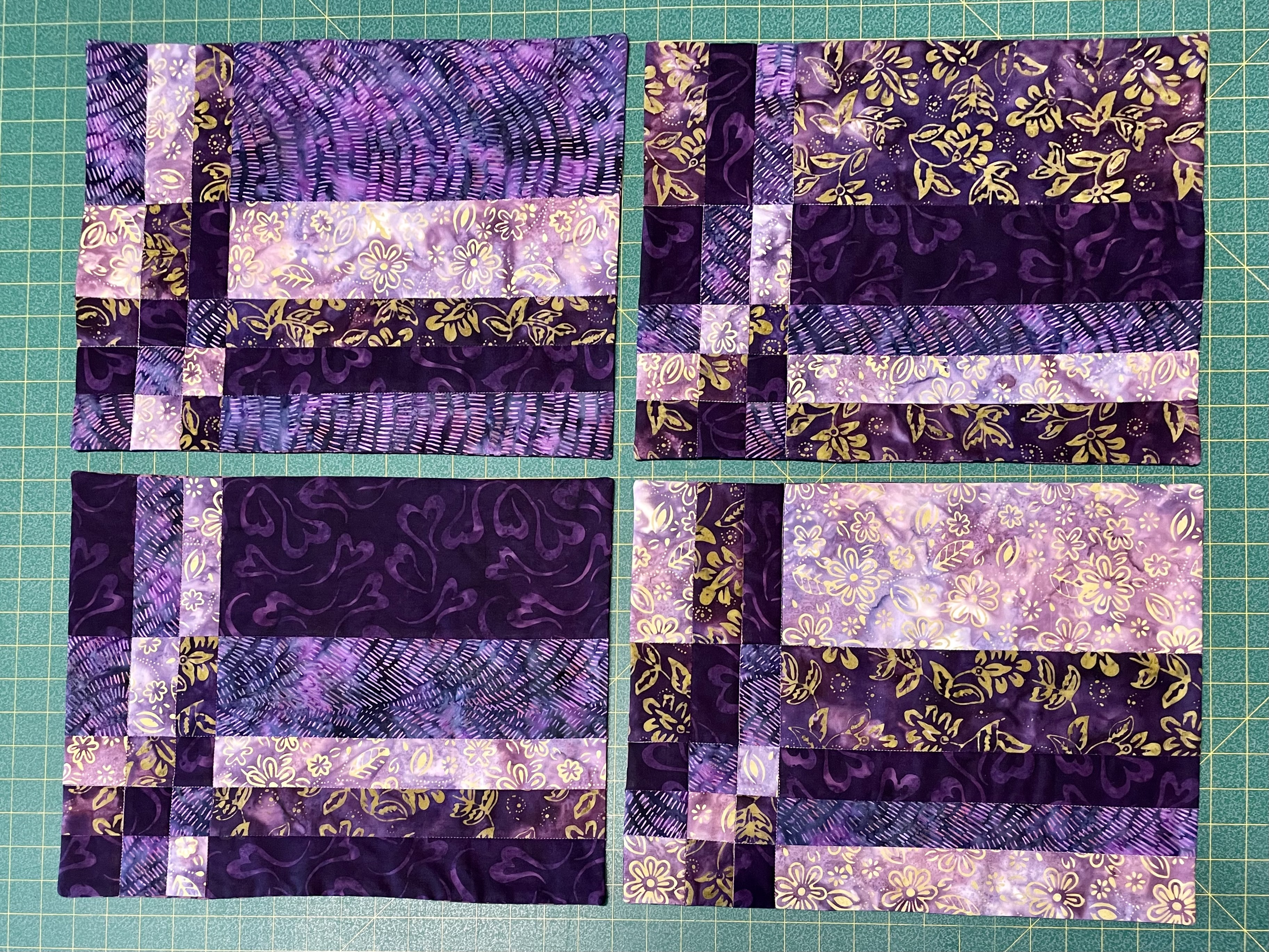
Fat Quarter Placemats #2

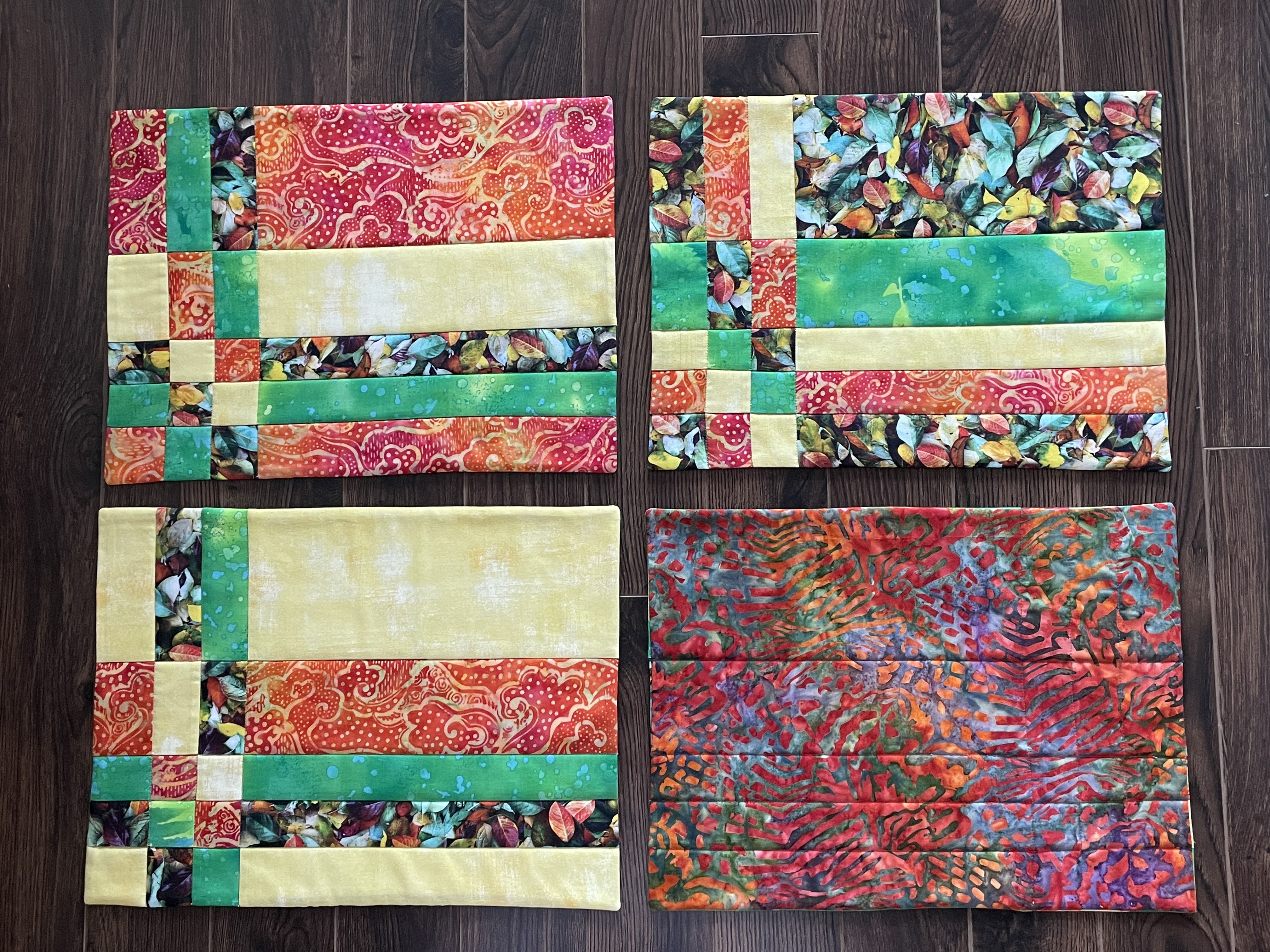
“Bright” Fat Quarter Placemats, Assembled

I wasn’t sure, yesterday, whether the purple fat quarter placemats counted as “Bright”. Today I decided to try wild – I selected an orange batik from one drawer of my stash, paired it with the leaf print, chose a green “fossil fern” piece, ended with a medium yellow “grunge”. They go together – definitely colourful. Probably not “dining room” but certainly “kitchen”, wouldn’t you say?

I’ll show the two sets to Sally next week and see what she thinks. This set would definitely catch someone’s eye hanging on the wall in Sew With Vision!

For cutting and sewing instructions: Stack ‘n Whack Fat Quarter Placemats

Stack ‘n Whack Fat Quarter Placemats

I don’t need another set of placemats, but yesterday I took several quilts and other projects to Sew With Vision to show the new owner, Sally, so we could talk about classes for the summer and fall. The set of placemats I took with me I made several years ago and they wouldn’t catch anybody’s attention. They’re pretty dull.

Original Placemat Tops

These stack ‘n whack fat quarter placemats are a novice quilter project. I decided to make a new set to display in the shop to entice some novice quilters to take a class to learn some basic quilting technique – precise cutting (with rotary cutter), sewing precise 1/4″ seams, chain piecing, pressing seams to nest joins and sewing the nested seams.

I picked four batik fat quarters from my stash (who knows, maybe these are also dull!). I started by pressing each fat quarter then I stacked all four, cut the pieces all at the same time, last evening. It probably took me an hour to press, stack and cut the fat quarters.

Fat Quarter Placemats

This afternoon, I laid out the pieces for each placemat, making sure my layout was the same for each one. Next, I laid adjacent pieces together and pinned them, then I piled the pinned pieces on top of one another. To sew, I used a “production” technique. I chain pieced as much as I could in the first pass – I stitched the adjacent pairs of pieces in the “rows”, pressed the seams to one side, then sewed the two parts for each row.

When I finished sewing and pressing all the rows, I laid out the placemats. I picked up the rows for one placemat, making sure the seams in adjacent rows were pressed in opposite directions so I could nest seams as I joined the rows. As I stitched, I made sure the joins did nest as I sewed them.

I pressed each placemat when the sewing was finished.

Now I need batting and backing to complete the placemats. I’m still deciding whether to quilt them just by stitching-in-the-ditch along the seam lines, or whether to quilt them in the hoop with a simple design.

These placemats could be sewn together to make a table runner. Or you could use the idea to make a quilt top. The placemats are simply an excuse to hone technique. As I explained to Sally, I don’t teach a project, I teach technique – I use projects as a vehicle for becoming a more experienced sewer or quilter.

For cutting and sewing instructions: Stack ‘n Whack Fat Quarter Placemats

Hanging Quilts / Wall Art

The other day, Pamela commented on my quilt exhibition at Art Lab Studios and Gallery in Parrsboro and asked how I set the quilts up to be displayed. I explaining how I make a sleeve from inexpensive muslin, baste it to the top of the quilt, insert a dowel with a bulldog clip on each end so the hook from the hanging wires has something to slip into. A simple solution, really.

Sleeve On Quilt Back

Here’s a link to my full description of how I hang quilts and wall art pieces: https://jmncreativeendeavours.ca/wp-content/uploads/2023/06/hanging-quilts-and-wall-art.pdf

What’s The Story Here?

This afternoon, with my sister Donna, I visited the newest Afghan arrivals sponsored by the Jubilee Group here in Halifax. We spent a lovely hour engaged in conversation – I was trying to asses their English capabilities so I might know how to help them out. As Donna and I were leaving their downtown apartment (just off Gottingen Street), we saw these shoes just “standing” there.

How do you suppose they got there? Why would someone just step out of their shoes in the middle of the street? There is an intriguing story here, for sure.

Art Lab Studios and Gallery 2023

The show was hung on Friday morning after our two hour drive from Halifax to Parrsboro. I’ve shown in the gallery enough times that knowing what I wanted to hang, where, required little deliberation. I knew I’d brought exactly the right number of pieces to display.

The show consists of eight lap size quilts, accompanied by two panels each with an array of 6×6 pieces – a total of thirty pieces of textile art. A respectable amount of work.

As you enter the gallery space

On your right as you enter the Community Gallery you find the four Drunkard’s Path Blocks quilts: Let the Trumpet’s Sound, Drunkard’s Path #5, Skyline #3, and Planet’s With Moons (from right to left). It doesn’t immediately strike you that all four quilts are built using the same block construction, but if you look closely you see the basic quilt block is the same in each.

The “Modern Flower” Pieces

Turn to your left and you see the “Modern Flower” pieces – a couple of larger raw-edge appliqué works with the 6×6 pieces on a panel in between. On the end wall (on the left) I chose to hang the Asian Strips piece, showcasing the use of the asian print leftovers I used to assemble that quilt.

The “Convergence” Quilts

Again, turning to the left you see the “Flower” 6×6 panel above the horizontal post (three have sold so far!), followed by the Convergence quilts – Convergence Quilt #4, #3, and #2.

It always amazes me to see the quilts and small pieces hung in the gallery – the collection has such a different impact than seeing the art one quilt at a time. The technical work slips into the background as the visual impact takes over.

I spoke to a number of people at the opening during the afternoon, all of whom were interested in the decision-making that goes into each work, whether a lap quilt or a small 6×6 piece. People always want to know how long does it take – it’s an unanswerable question – there’s no way to account for the “thinking about it” time that goes into each textile work. The execution, the cutting out, the piecing, the quilting, the embellishing, the binding are all straightforward aspects of making this art. I can predict reasonably accurately how long each phase will take; but the thinking about it is out of my control – it takes as long as it takes.

The show is hanging in the Art Labs Community Gallery (121 Main Street) in Parrsboro NS until late afternoon on Thursday, June 15. If you happen to live near Halifax, or near Parrsboro, do drop by. In addition to the Community Gallery the four resident artists display their work as well. It’s worth a visit.

If you make it a day trip from Halifax, I’d recommend leaving around 9:00 am, driving straight to Parrsboro, visiting the gallery, then having lunch at the Harbourview Restaurant. After lunch mosey your way back, stop at the Five Islands Lighthouse Park to take in the ocean view. Further down the road visit Lowland Gardens – they always have some unusual plants there. You can’t drive back to Halifax without stopping at Masstown Market – fresh produce, great ice cream, good chili if you’re hungry. Depending on how long you take at each stop you should make it back to town between 6:00 – 7:30. You’ll have enjoyed the day.

PS – all of these pieces are for sale. If you’re interested in knowing more about any of them, email me: newman.judith@gmail.com.