Peony

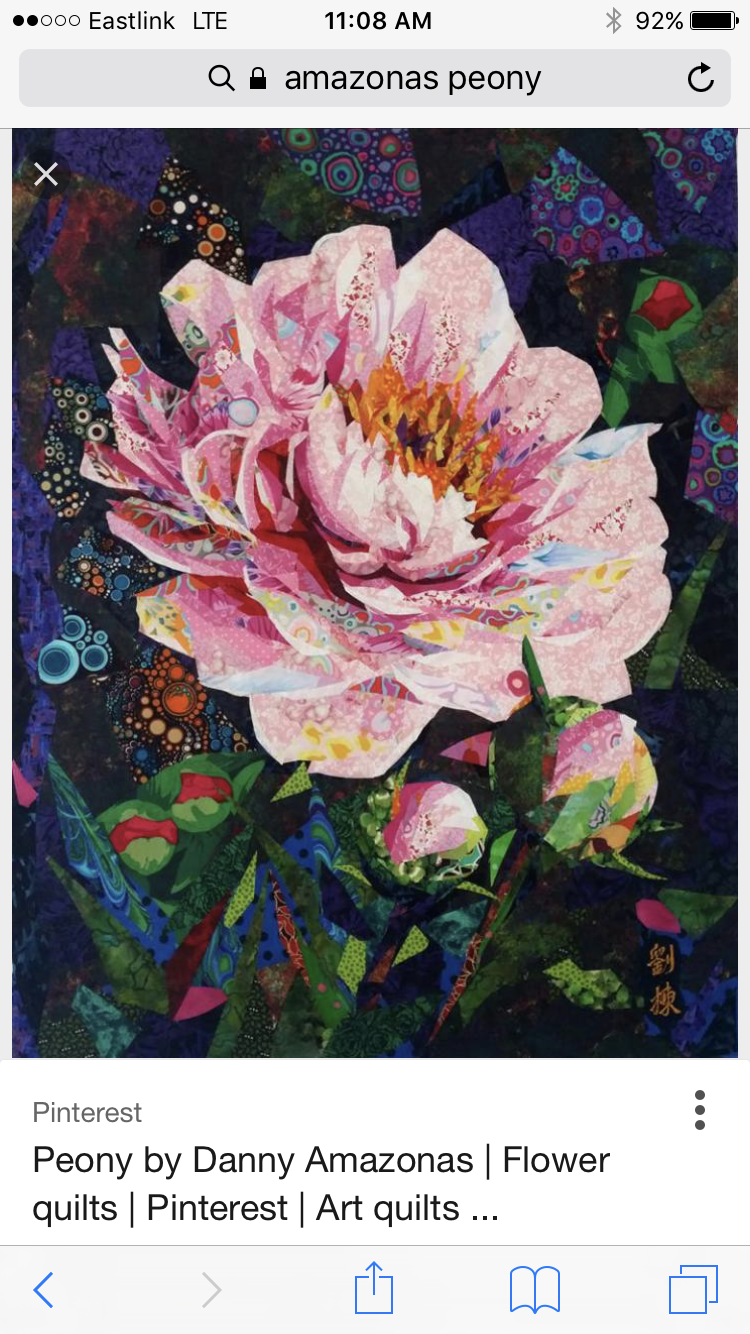
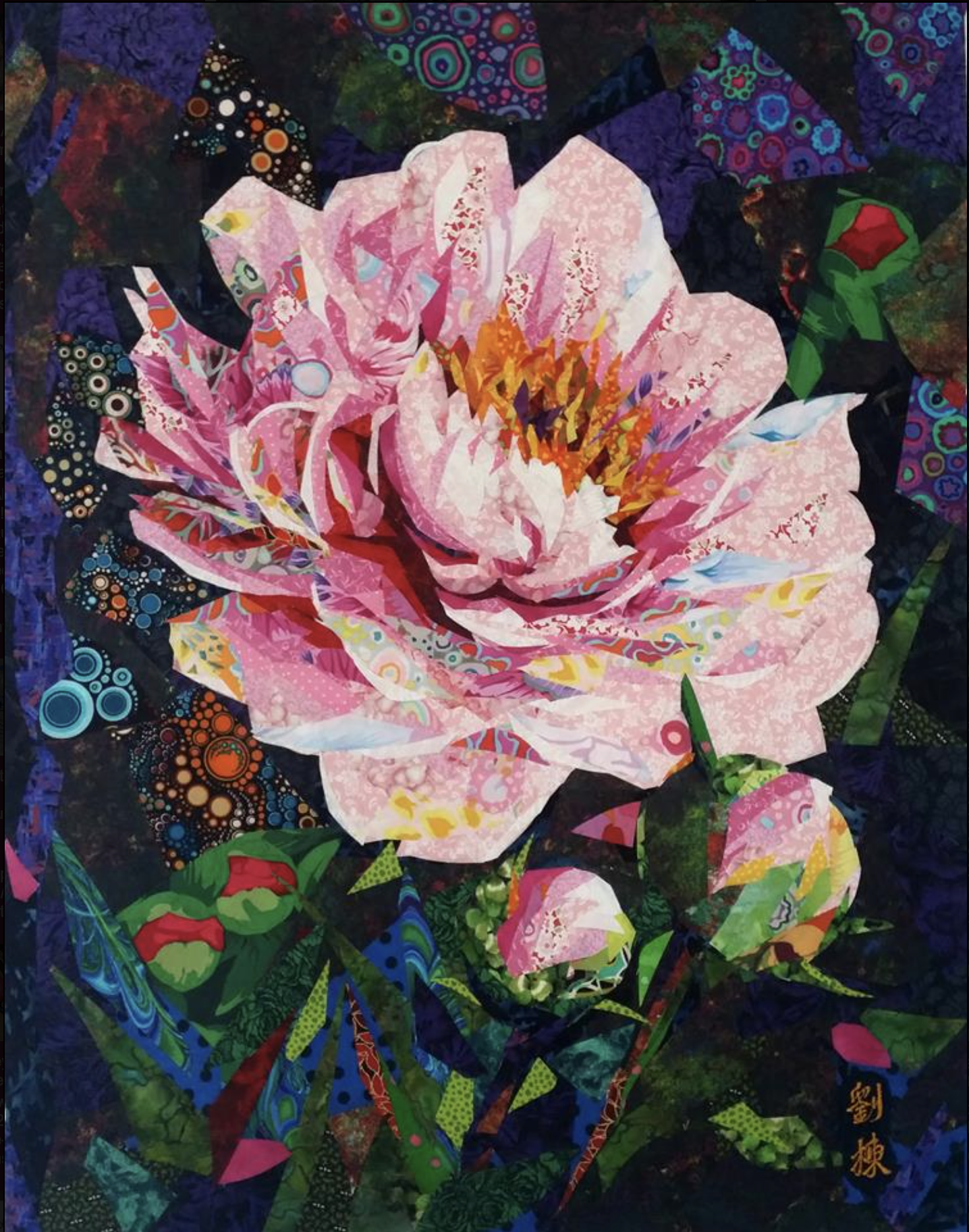
With the Peony, I’m playing around with Danny Amazonas’ fused appliqué technique – a collage of small pieces of fabric fused on top of one another to create depth and detail for both the background and the main subject.

I began by preparing 20″ x 26″ pieces of muslin and batting and sewing them together along the 9″ x 12″ dimensions in the center of the quilt – this marked my outside boundary. Then I pencilled in the approximate location for the focal element – the peony. That gives me an inner boundary for the background appliqué collage.

Backing Prepared

One of the things I’ve learned from looking carefully at Amazonas’ textile art is the background is livelier when there’s visible small pattern elements in the fabrics. The overall effect is a shaded dark support for the focus element which sets up the contrast for the finished art work.

I cut pieces from the fabrics I’d collected and auditioned them to see how I might establish a colour flow within the background.

Auditioning Fabrics For The Background

I applied “wonder-under,” a paperbacked fusible web to my complementary and contrasting pieces of background fabric. Then I cut small pieces from each and arranged them filling the space from outer to inner boundary.

Background Fused In Place

At this point, the background looks lighter in overall tone than it will once the light fabrics are added in the center to create the very pale pink flower. If the background still seems too light when the peony is added, I will apply a wash using acrylic paint to tone down the brighter colours.

As far as I can tell, Amazonas doesn’t sew on top of his constructions. My plan is to do the same in this demonstration piece. However, when it’s assembled I may feel it wants more detail and add some thread painting. I’ll have to see how it turns out.

That’s it for today.
Rudebeckia II

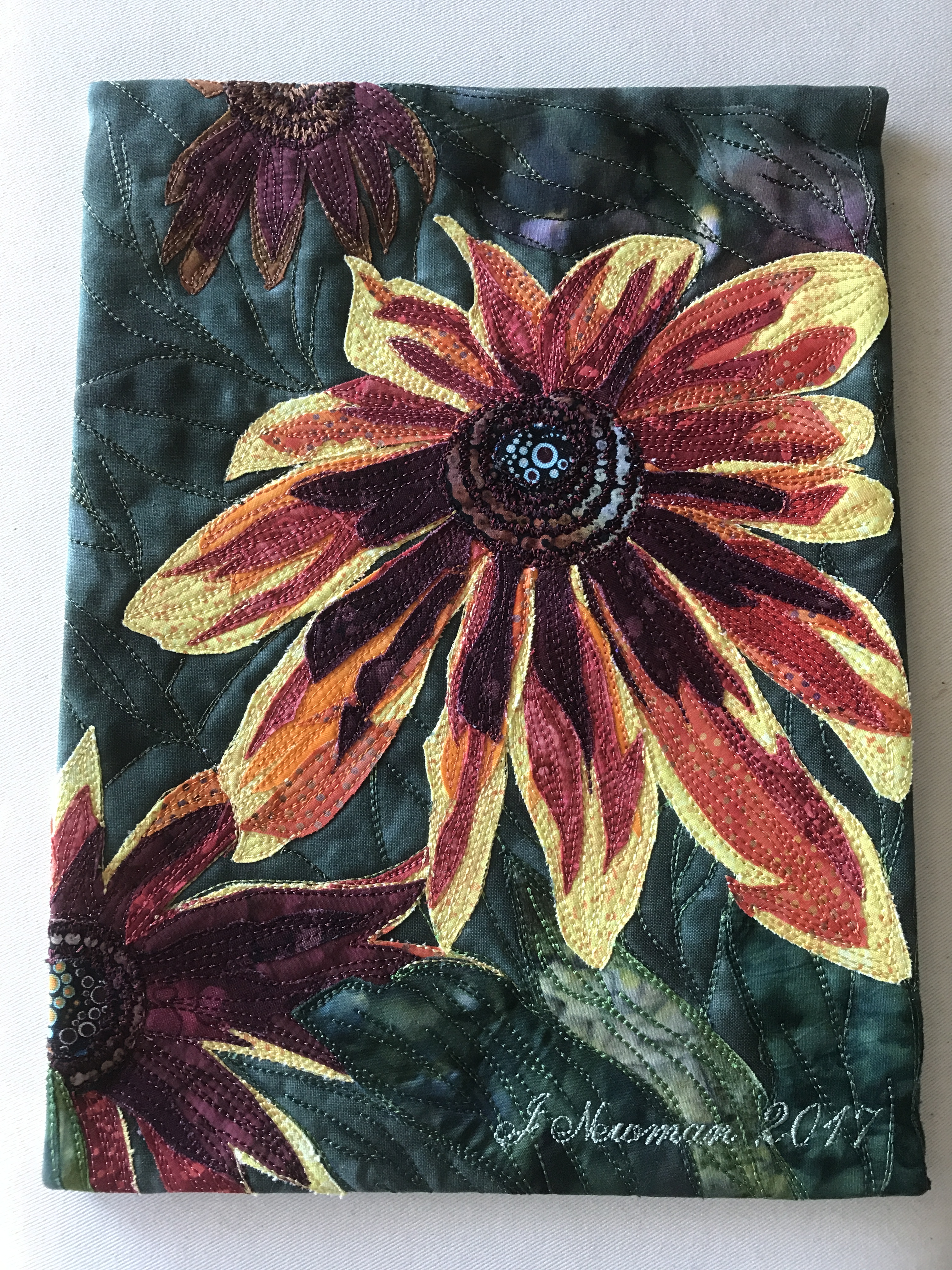
I’ve been working away at the Rudebeckia piece all this week. Tons of decisions to make, this fabric or that, cut using a traced template or free cut, where to position the elements, how much detail to use in the background, what colour thread…. Every decision is a final one as well – there isn’t much that can be undone as the work grows. It’s how it is.

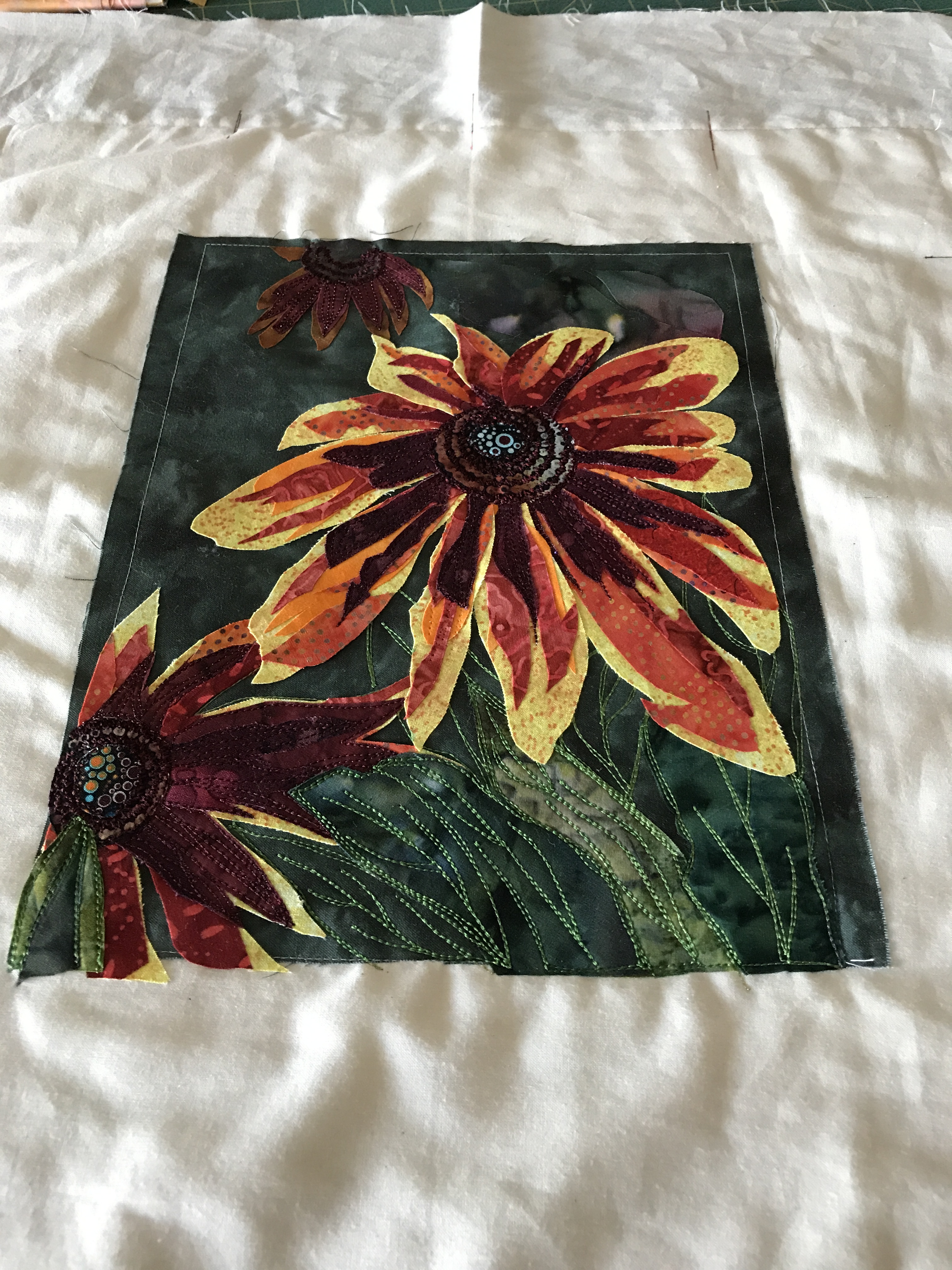
Here I’ve partially stitched “leaves” in the background (I’ll finish that stitching when I’ve done the thread painting on the flowers). The central flower is all assembled and fused in place as are the other two flowers.

Applique Fused, Partially Stitched

And then the thread painting began. I started in the middle of the main flower and worked my way out from dark thread to the light. I worked at my machine for a couple of hours each day until I finished the detail stitching this afternoon.

Here is the back of finished piece – you can see how much stitching it required to complete the work.

Thread Painting From Back

Final decision – the piece is a work of art, it needs a signature and date. I set up an embroidery on my computer, transferred it to my embroidery machine and used my metal hoop (which uses magnets to hold the fabric in place). I carefully measured where I wanted my signature to go, then holding my breath hit the embroider button. It came out fine.

This is the finished piece (I still have to hand stitch the invisible binding in place which I’ll do this evening). Final dimensions: 9″ x 12″ – it’s a small piece but a lot of work.

Rudebeckia Completed

That’s one piece completed and three more to go before June 6.

Rudebeckia

Rudebeckia

I’ve started this appliqué piece from a photo of a large textile art piece by Kate Themel. Mine is going to be small – finished size ~ 9″ 12″. I’m doing it as one of several examples of textile art for a class I’m teaching in June. I decided to use this image because it’s obvious where the colour demarkations are – they are often hard to see when you’re not used to looking at photos for that detail. To emphasize the colour layers I often print my photos (or enlarged photo elements) in black and white so I can distinguish contrasting tones. I will do that in another of the examples to illustrate how that is done.

Here, I began by tracing the main image areas thinking about the fabric layers I’d need. Then I pulled lots of scraps from my stash in the range of colours I wanted to use, making sure I had lots of contrast.

Rudebeckia 1

Next I set up my working background – a piece of muslin 20″ x 26″ (much larger than the finished art piece just in case I might want to add borders, binding…) backed with Warm ‘n Natural batting. I marked both the horizontal and vertical centres, then marked the dimensions for my finished piece, and stitched along those lines. Although the piece has to built from the background up, I focused on the main flower to begin with, cutting out the petals and the darkest accent from templates I created from the photo.

Rudebeckia 2

Next I added a dark background, fused and stitched it in place. I’ve done some dark leaf cutouts which will be fused in position later. At the moment I’m building up the layers of each petal of the main flower – four to go (I’ve kept each template pinned to the fabric so I know where the petals go later when it’s time to fuse the flower in place). I’ve also chosen fabrics for two background flowers which will be darker, less prominent, than the central one.

Before I can add the main flower, however, I have to thread paint the dark background to suggest foliage, then add the background flowers and thread paint them, add leaves and thread paint them, and finally the main black-eyed susan.

The next small example will be based on Peony by Danny Amazonas:

Peony

I’ve chosen this example to illustrate his fused appliqué without thread painting. Again, Amazonas’ piece is quite large, mine will end up a similar size to Rudebeckia – 9″ x 12″, so I won’t be able to include quite as much detail as Amazonas but I will be able to show the building up of the image from background to central focal point.

The example after that will be based on a photo I took a number of years ago:

Fence

This piece will illustrate how to create the effect of light by setting up extreme contrasts – the fence rails will be done using off-white fabric, heavily stitched with both blending and contrasting  thread to suggest the shadows. Also I will construct the background at the top of the image using pale fabrics but cover  it with one or more layers of pale grey silk organza to suggest the fog and the foreground will require a LOT of thread painting over carefully fussy-cut layers of fabric.

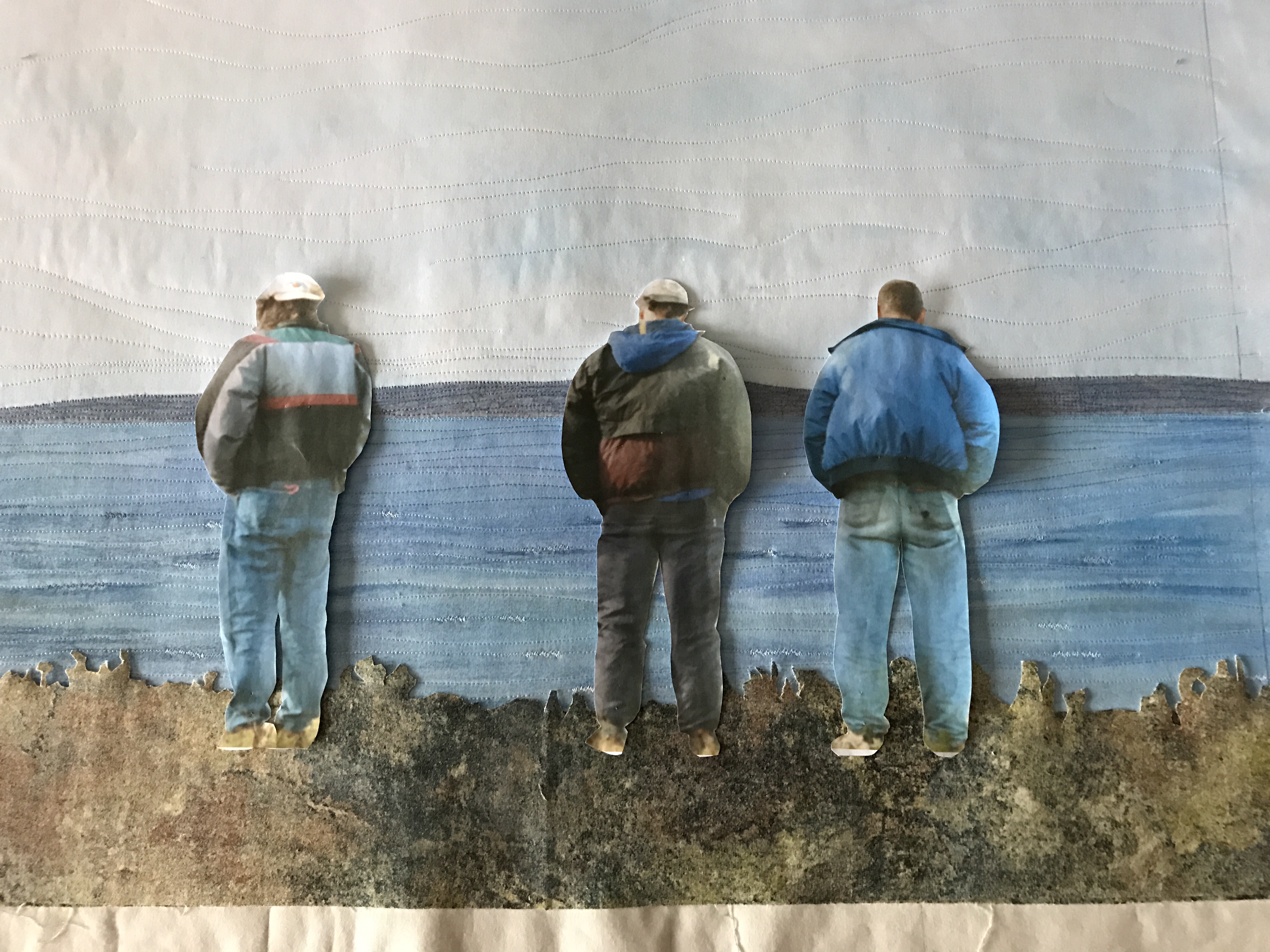
Watching the World

My fourth example may well be based on this photo (with boys positioned to the right rather than the left) to illustrate incorporating photo elements printed on fabric into a textile art piece.

I’ve got my work cut out for me for the next month!

Silk Quilt?

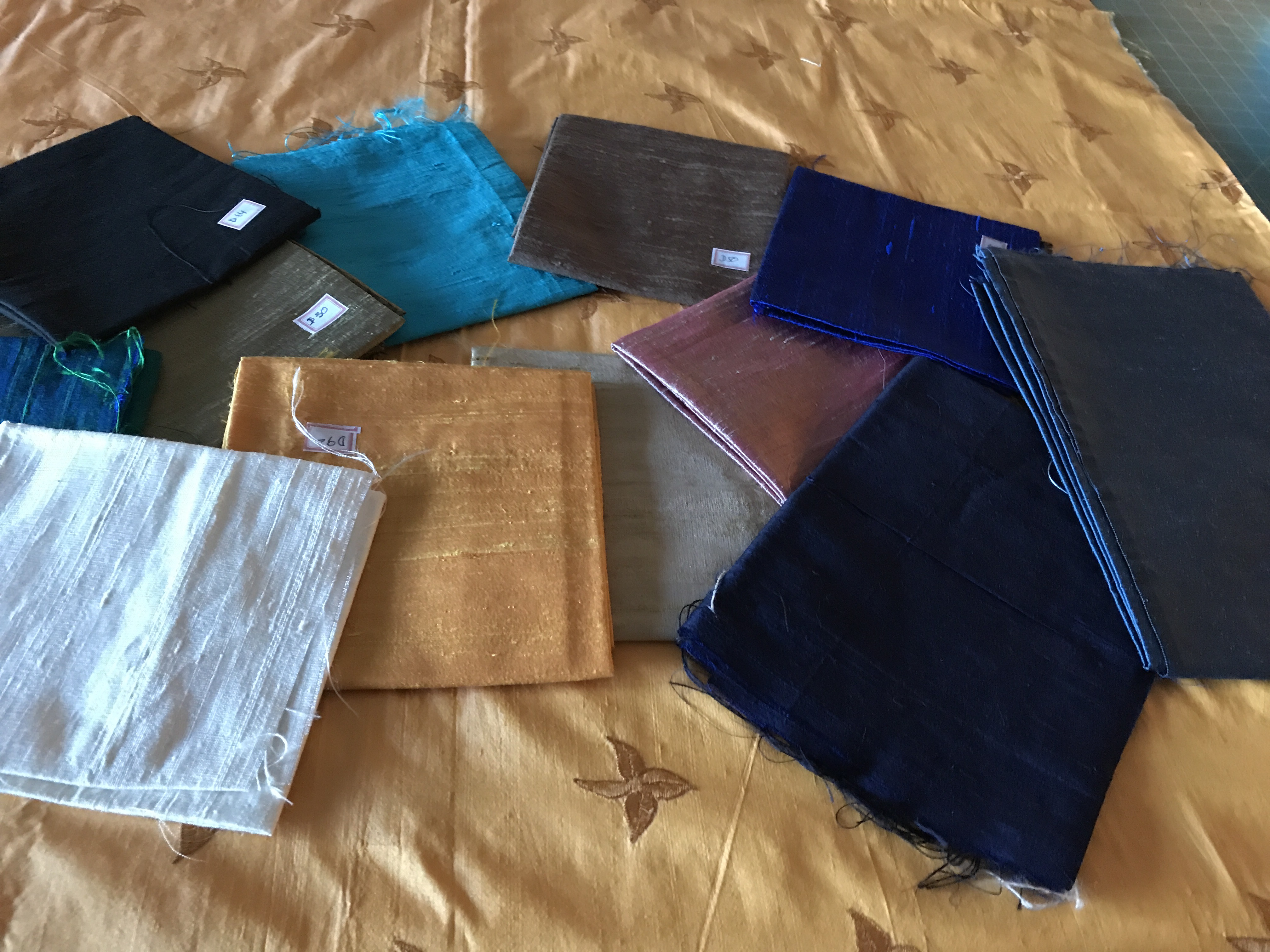
I’ve had this collection of silk dupion (Indian silk) for a while – 2 yd of the golden embroidered fabric and 12 fat quarters in various colors. I want to use it up and get it out of my stash! 

I’ve started looking at pictures of quilts for inspiration – I want to end up with a modern, minimalist quilt using the embroidered fabric as background with either half square triangles or narrow strips (or both) for the coloured elements…

I also spent time today going through my personal photos for possible images for the small wall art quilts I need to work on. I still have to go slow – my hand tires easily and I have to listen to it!

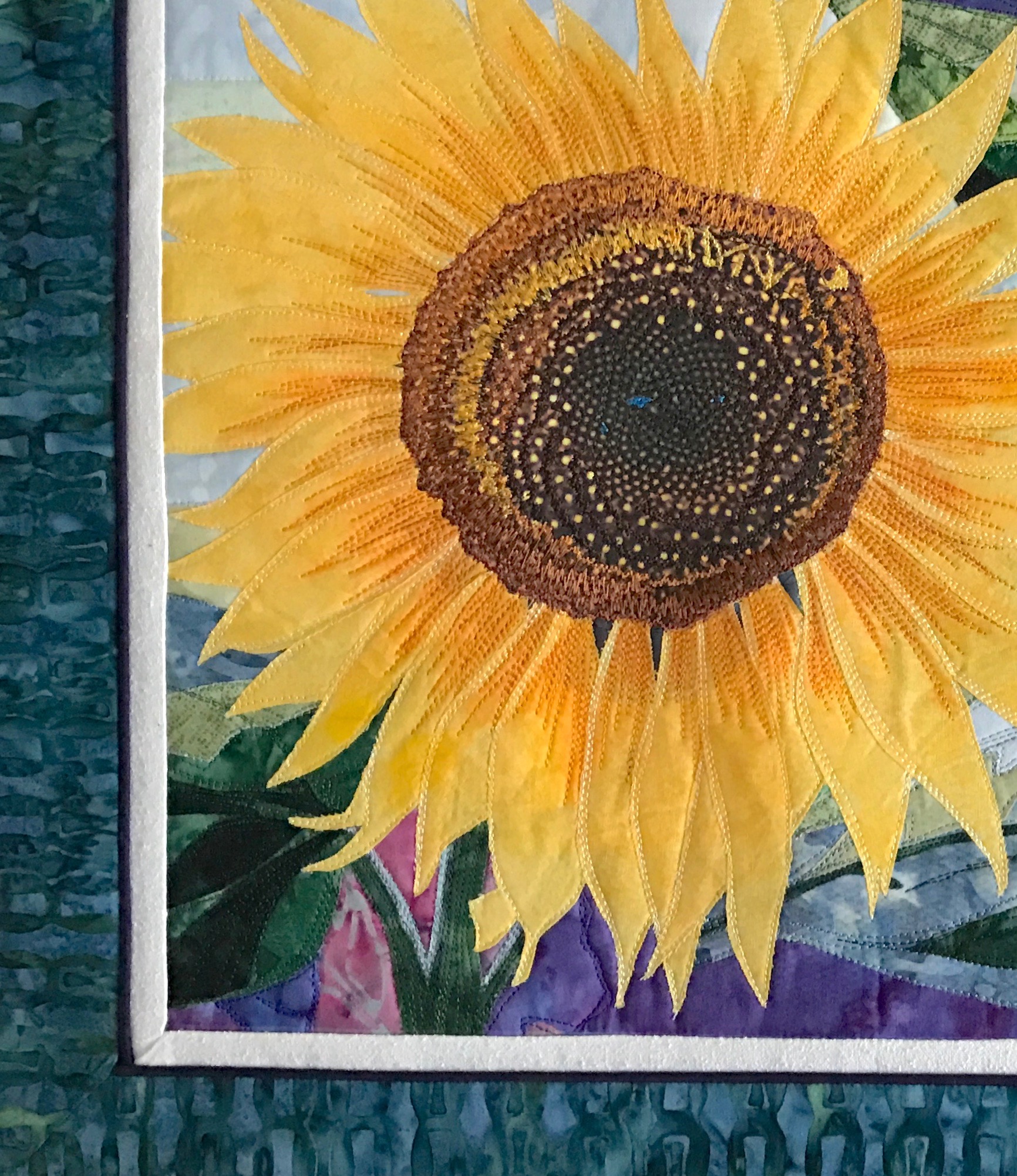
Sunflower – Completed

img_8309

“Sunflower”

Just finished!

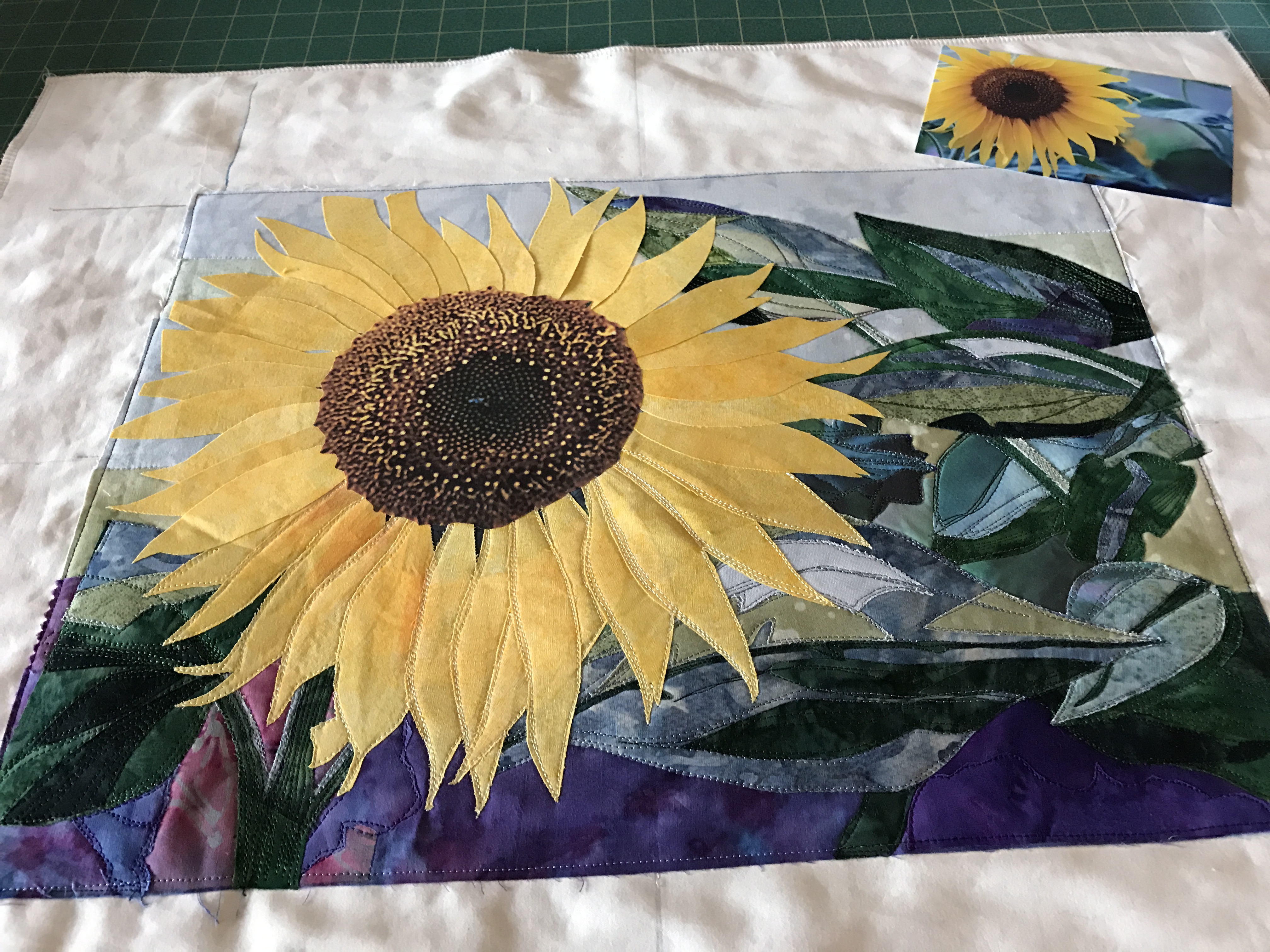
I started working on this piece two weeks ago. I began with the original photo – cropped it, enlarged it, then printed out sections, taped them together, traced individual petals using tissue paper, planned out the background and traced the shapes…

img_8310

“Sunflower” – paper template to enlarged size

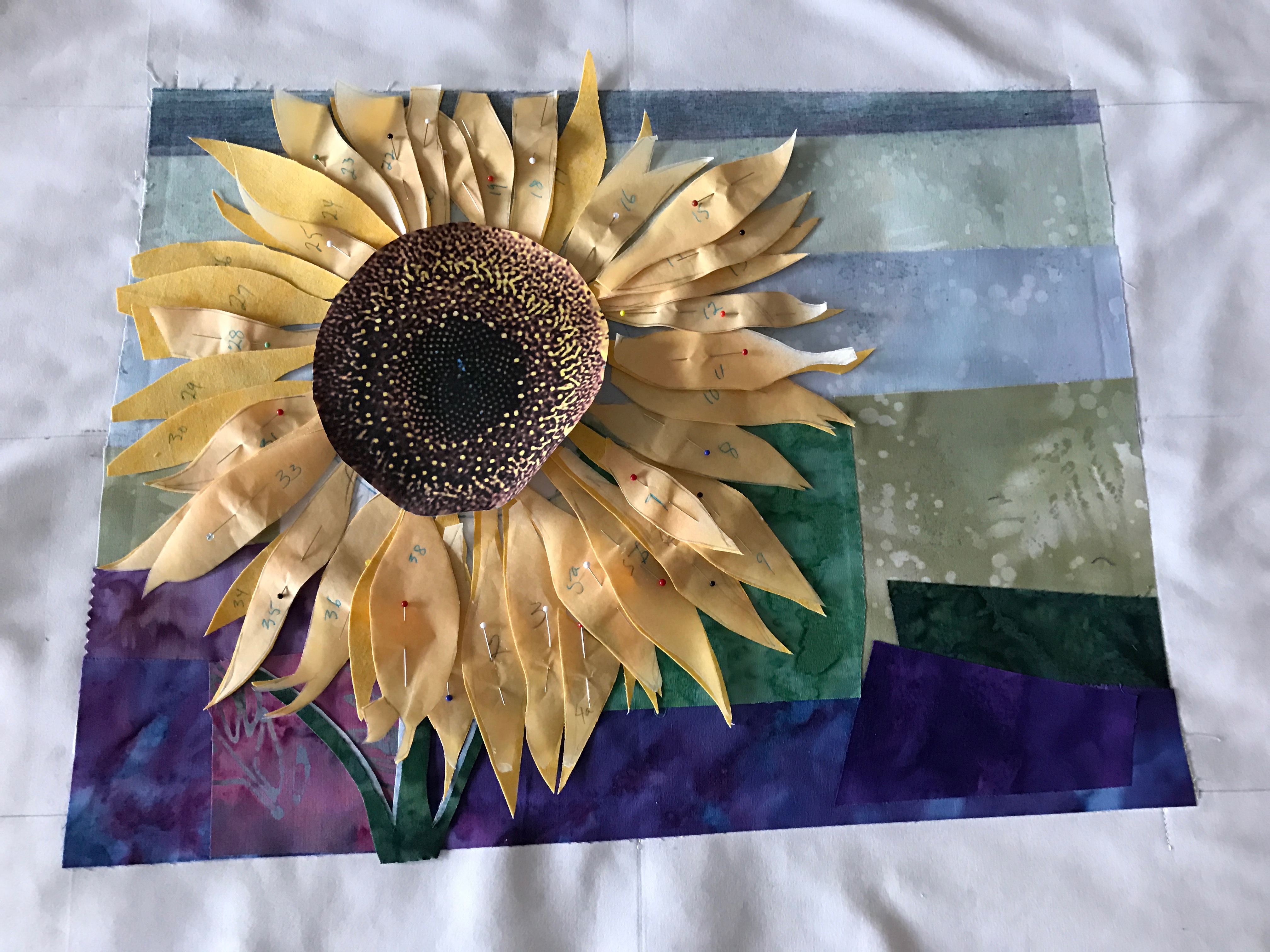
Next I collected fabrics from my stash, bought some new pieces, started building the background, cut out the petals and arranged them in place,

img_8298

“Sunflower” – the elements cut out and positioned

then started stitching: I laid down four horizontal strips of fabric from top to bottom, stitched them in place. Then added the leaf elements, edged stitched them – I didn’t “free motion” because I wanted more precision so, instead, I slowly freely stitched with my feed dogs in place – that allowed me to stitch very close to the edge of the appliquéd pieces. Next, I added a bit of detail and fill.

img_8300

“Sunflower” – background stitched

Once the background was completed, I laid out the flower petals, fused them in position, then began carefully stitching them, first using a light thread at the edges, then more golden/orange threads for the centre of each petal. Finally I stitched the centre of the flower – my goal was to bring out the spiral pattern of the florets (the centre of the flower was printed on fabric to retain the natural detail of the floret arrangement, as well as the few small bursts of blue – too small to add using cut bits of fabric).

To finish the piece, I added a 3/8″ inner border of raw silk, mitred at the corners, then a purple piping, and finally a 3″ batik frame also mitred at the corners.

Version 2

“Sunflower” – stitching detail

The whole piece I backed with muslin, including a sleeve for hanging at the top.

Now I’m walking around the apartment trying to find a place to hang it – there doesn’t seem to be one, without taking something else down! I’m really going to have to think about where to display it.

"Sunflower" without frame

“Sunflower” without frame

Sunflower I

I’ve been working on the “Sunflower” art quilt for the past few days. I pencilled in the layout on the prepared muslin backed with batting, traced the flower petals from a photo enlargement on to tissue paper then placed tracing paper beneath to retrace onto the muslin, fused some Heat ‘n Bond to the back of a piece of subtly printed bright yellow fabric, cut out all 38 petals and have so far put them aside because before I can fuse them in place I need to do all the work on the background! For the moment, I’m placeholding the centre of the flower with a paper printout to scale.

img_8291

Petals Pinned In Place

I decided to create the background working from the original photo because the detail was sharper and showed the elements in the background more clearly. I fused a pale green printed fabric to the top of the image area on the muslin (having darkened the top edge using fabric pastels – very little of that band will show when the piece is finished). Below that a soft blue. I laid in a purple/blue/pinkish batik strip as background at the bottom of the piece – leaves will be overlaid on that fabric and very little of it will be visible. I filled in most of the remaining background with pieces of greens and purples. These, too, will be mostly covered. Again, I’m using tissue paper for my templates so I can see through it to the photo enlargement, and when cut out I can see the fabric pieces beneath. I want to cover all the raw edges of the background with the foliage so that only a sense of colour peeps through.

sunflower3

Original Sunflower photo taken in 2002

Once I sorted out what fabrics I wanted to use for the foliage, I returned to working from the cropped enlargement to help me retain proportions.

Version 2

Enlarged, Cropped Image

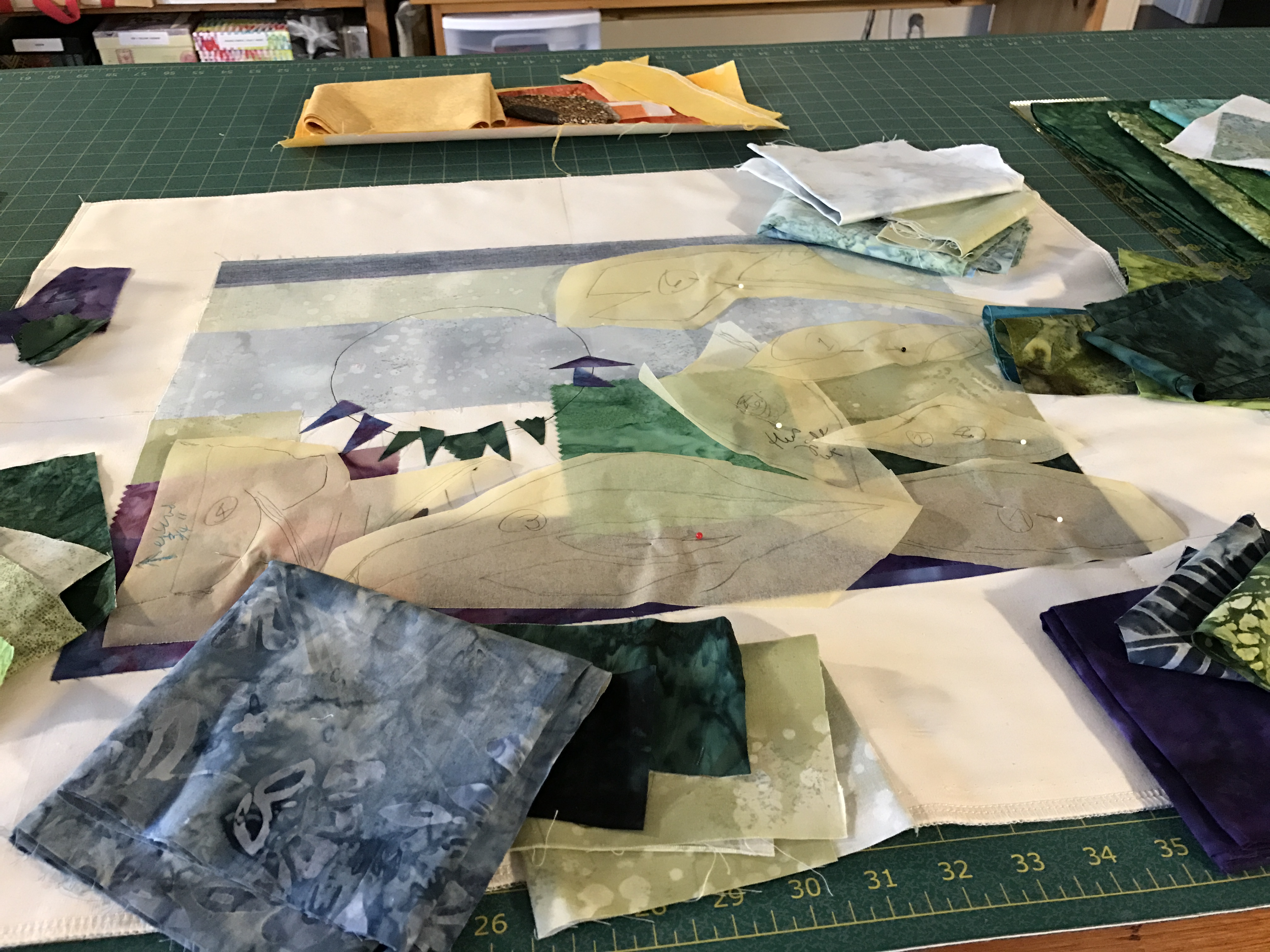
I traced the leaves and have pinned the tracings in place on the piece. I’ve selected mostly batiks here because the colour variation in it will help with the subtlety of shading I’m trying to create. In the photo, the leaves are predominantly a very light colour reflecting the sunlight. The challenge will be achieving a realistic look to the piecing of the foliage. If, in the end I don’t like what I’ve got, I may print the foliage on fabric, fussy cut the leaves and stems, fuse that printed fabric in place and thread paint it.

Planning Out Leaves and Stems

Planning Out Leaves and Stems

I’m calling it quits for today – tomorrow I’ll begin crafting the leaves and stems hoping they will turn out as I imagine them.

Art Quilts: Flowers

Danny Amazonas is a Taiwanese textile artist who makes amazing art works (many of them quite large!) by sketching an image on blank fabric then using bits of fabric (with fusible interfacing on the back) as if it were brush and paint. I can see how the work is constructed from the background up. What I can’t tell is whether he top stitches any of the elements (although I’ve seen photos of him sewing on a large piece so perhaps he does some stitching). Here’s a recent video interview of Amazonas in Tokyo where he’s describing his art quilts.

The reason for my interest in Amazonas’ work is I’d like to try it on a piece of my own. I’ve been scouring my photo collection for images of flowers that a might make a strong visual image when constructed from many bits of fabric.

Version 2

Sunflower

I took this photo of a sunflower it’s gotta be 15 years ago – I have a copy of the photo hanging in my apartment. But I’d love to enlarge it somewhat and have a go at piecing the image. I love the detail of the flower, but I also love the soft green/mauve background which sets off the yellow of the flower.

Other artists piece their work but also clearly top stitch/thread paint their creations:

black-eyed-susan

Kate Themel – Rudbeckia

zinnia950

Barbara Olson – Zinnias

zinniadetail1

Zinnias Detail

I have a couple of other images that would work as floral panels as well – I guess I could always do a series of hangings:

phael3

Phaelanopsis

img_2072

Strelitzia reginae

both of which would make spectacular images. I’d crop both to make the bloom more prominent. If I were to try panels 14″ x 10,” a series of three would be interesting.

In any case, my next step is to cut a piece of muslin about 20″ x 20″ (to give me lots of area to work with), sketch out elements of the sunflower, go through my stash pulling every bit of yellow/orange/brown I have (small scraps are going to be useful), collect some blues/greens/pale mauves/ for the background. I will need to add fusible interfacing to pieces of fabric then start cutting, placing and pressing…

It’s like facing a blank canvas with some paint on my palette, taking a deep breath and just starting.

The Solution…

img_8167

Stitched Foreground

Michael Fuller wrote me yesterday

Go with the detail and time consuming fussiness. It’ll be superior to the photo copy model….”

‘OK,’ I though to myself, ‘I’ll give it a try.”

That’s where I started today – I began by printing out the black and white outlined image of Brian, the figure on the left, on some Heat ‘n Bond printing paper in order to use the outlines as templates for the fabric – BUT, here’s a glitch: the technique requires a ton of cutting with small fine scissors and for the last six weeks my arthritic right thumb isn’t working – the muscles to “open” the scissors are too weak to let me cut with any precision.

I decided to try fighting through that problem but a second issue presented itself: I cut out the entire jacket in a light fabric intending to use that as the base and building toward the darker tonal qualities until I had the jacket assembled. I fused some Heat ‘n Bond to the wrong side of my lightest fabric, cut out the overall jacket shape – that worked out OK, but when I started to build the left sleeve it became immediately obvious the slight differences in weight of fabric (although all quilting cottons) was going to create an imbalance and because each tiny piece of the puzzle is so small I would be left with a  slightly fraying “raw” edge in spite of the fact that I’ve fused some Heat ‘n Bond to the wrong side of each small piece before cutting it out.

pilots-detail

Detail of Figures

The final thing that was obvious was how “lifeless” the construction would be. The very subtle differences in shade intensity wasn’t achievable with the fabrics I have.

I gave up after about an hour of finicky cutting and fusing and decided to use the fabric photo images after all and fused them to the background.

What I will do tomorrow is begin the process of edge stitching each figure and then stitching in the colour/shading boundaries. That is also fussy work but my wonky right hand doesn’t interfere with being able to do careful machine stitching.

Here’s The Question…

Pilots: Printed on Fabric

Pilots: Printed on fabric, laid on background

Here’s the question – I’ve been looking at the art piece and wondering how might it look if I printed the figures on fabric, fussy cut them and fused them to the scene instead of trying to create them (shadows and all) from different fabrics?

pilots-detail

Here’s the detail, right? Lots of little pieces to be very fussy cut and fused to a base fabric – very time consuming. Doing the appliqué work will also be time consuming because I will want to stitch in all those colour demarcations, but what I get is a more realistic look to the figures which are the focus of the piece.

All I’ve done so far is print each pilot on EQ Printables Fusible Fabric and carefully cut each. I haven’t yet fused them to the background. The way we see the sun on their clothing gives the viewer a sense of the light – some brightness but not full sunshine. I can’t achieve that through piecing, even if I’m extremely careful with fabric selection.

I guess what I have to do is try one of the guys and see how he turns out – maybe Brian (the one on the left). Whichever way I do this, I think it makes sense to refrain from filling in the grasses/shrubs until after I’ve got the figures in place, that way I can build up the grass around their shoes as I go along and not as an afterthought.

In case you hadn’t noticed – this fabric wall art requires a gazillion decisions and unlike oil/acrylic painting there’s no going back – you have to live with whatever decision you choose to execute.

Experimenting…

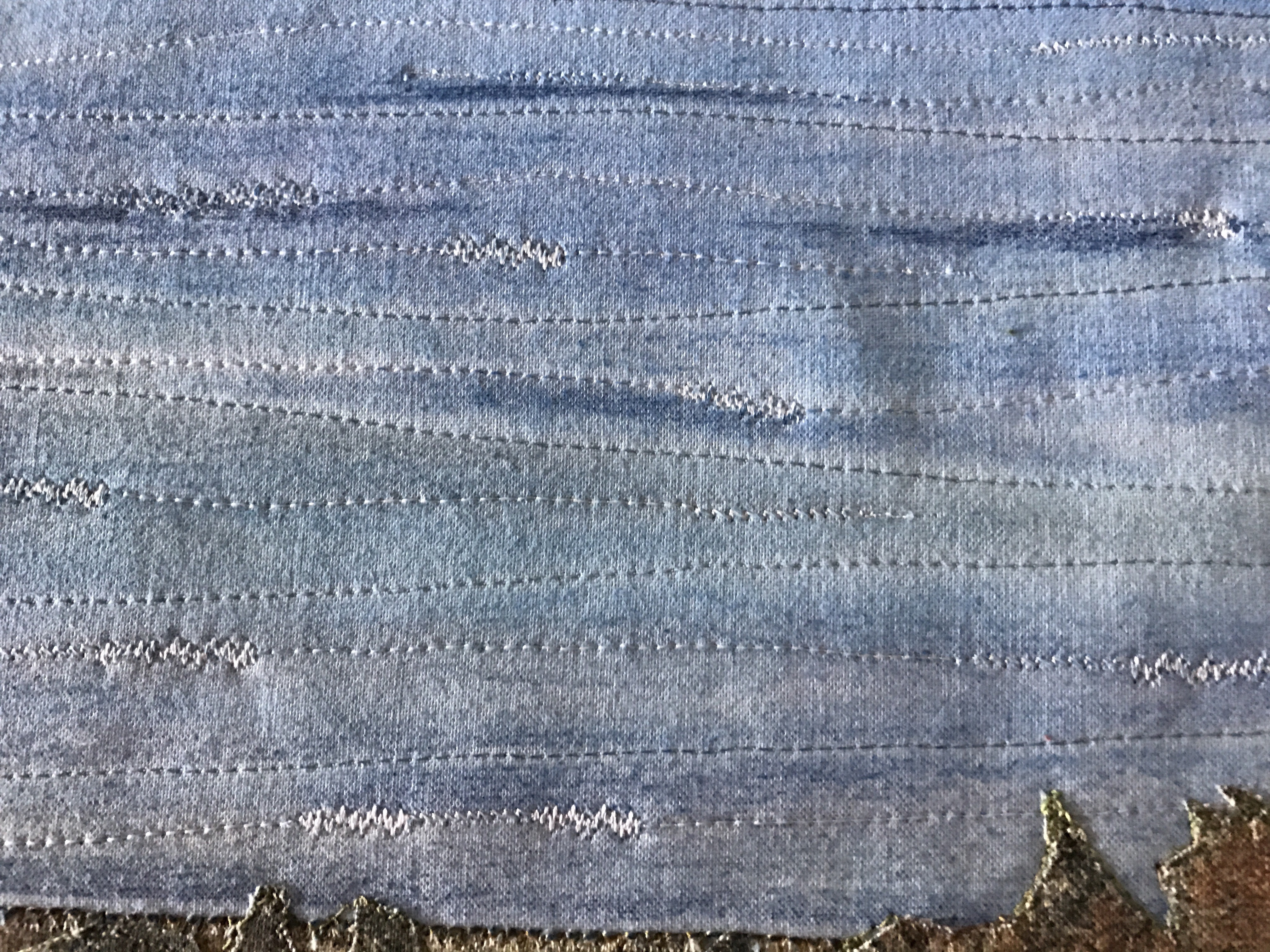
Yesterday I worked on the water of the bay. I wanted to suggest the white caps but not to cover the entire surface. I played around with stitches on my sewing machine – several provided possibilities. My machine allows me to modify and create actual stitches so that’s what I did. I tried a couple; in the end I modified the “grass” stitch – I made it narrower and removed several stitches from the single repeat to give me a short burst.

White Caps

Then I used Neocolori Wax Pastels to hint at the roughness of the sea.

Wind Waiting: Current State

It’s all about experimenting with the stitching before actually attempting it on the piece itself. I have just one chance at “getting it right”. Once I start stitching I have to continue, can’t take it out because the needle marks will show, so I try out different threads and stitch settings before actually working on the piece.

Experimenting

Looks a mess, but in my head I can see the effect of each experiment. Underneath are my tests for the water; on top I’m working on the grassy foreground – I need two effects: first, I need to imply the texture and height of the grasses and small shrubs on the bank – that will take the form of rows of horizontal stitching using three or four different variegated threads; second, I want to create a rough edge against the water – the pilots aren’t on the edge of the sandy beach (the landing zone below), they’re at the edge of the bank 89-100 ft. above the water (the launch zone). The edge of the bank, therefore, should show some grasses and twigs against the sea.

Last night I spent a couple of hours modifying some built-in stitches that will hint at that texture. (Once the pilots are constructed and appliquéd in place I will add grasses to cover their shoes because the vegetation at the edge of the bank wasn’t mowed.

So now I have to take a deep breath and start in. This is it!