Monpei Finished

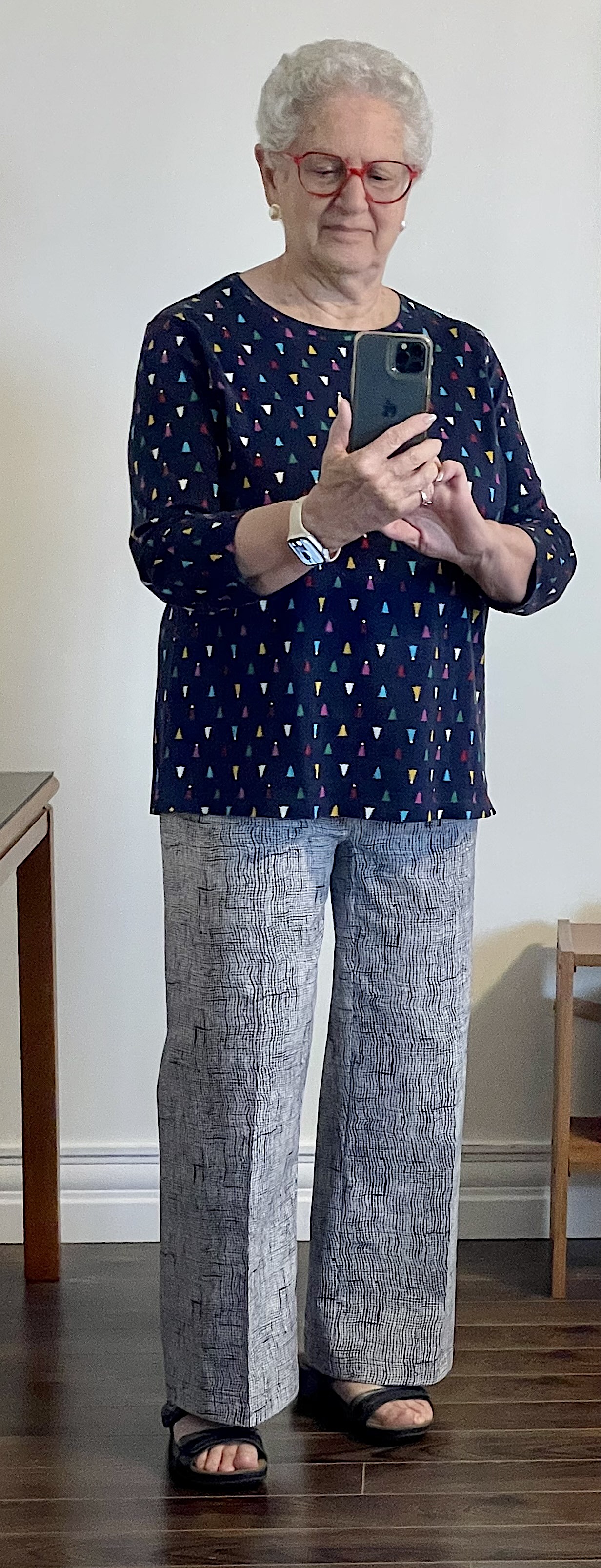
Just finished the pants. Simple to make, and I can tell these are going to be VERY comfortable!

I was careful to make the crotch gusset long enough that the inseam is straight. The pants are cut from two rectangles; two triangles (which become the crotch gusset) are cut from the top/sides – I couldn’t do that because my waist is the same as my hips. So I cut the two rectangles (leaving them as is) – I merged the front and back leg into a single panel – so no side seam – but making sure the centre of the panel was on the straight of the grain. I also merged the two crotch triangles into a single long triangle with the vertical of the triangle on the straight of grain so I end up attaching a single gusset, rather than two triangles (a narrow one on the front inseam and a wider one on the back). The widest part of the gusset triangle is positioned at the crotch depth position in my case 12″ at the back/11″ at the front. [Click here for full instructions on how to make a montpei. (Click here for the original instructions.)]

When I tried on the basted panels (with crotch gusset sewn in) I could tell the centre back was going to be too short (I could have adjusted it by dropping the crotch gusset but instead I added a back yoke (2″ at the centre back grading out to the sides); I left the front crotch depth as it was. (I also took in the waist 2″ at the centre back – I didn’t need the extra fabric to pull the pants on.)

Because I wanted to add front pockets to the top of the panels I added them at this point; however they should have been sewn on while the panels were flat – to stitch them I measured 3 1/2″ from the centre crotch line marked it with a Frixion pen, turned the pants inside out so I could stitch the pockets with the panel “relatively” flat. Because the monpei have no side seam, I stitched down the side that would have been included in a side seam.

I created a facing for the waistband, attached it, strung elastic through the sleeve that created. I finished by top stitching the doubled over hem.

Done.

Here are the pants with my shirt tucked in so you can see how the top fits and the pocket detail which is hidden when the top is on the outside.
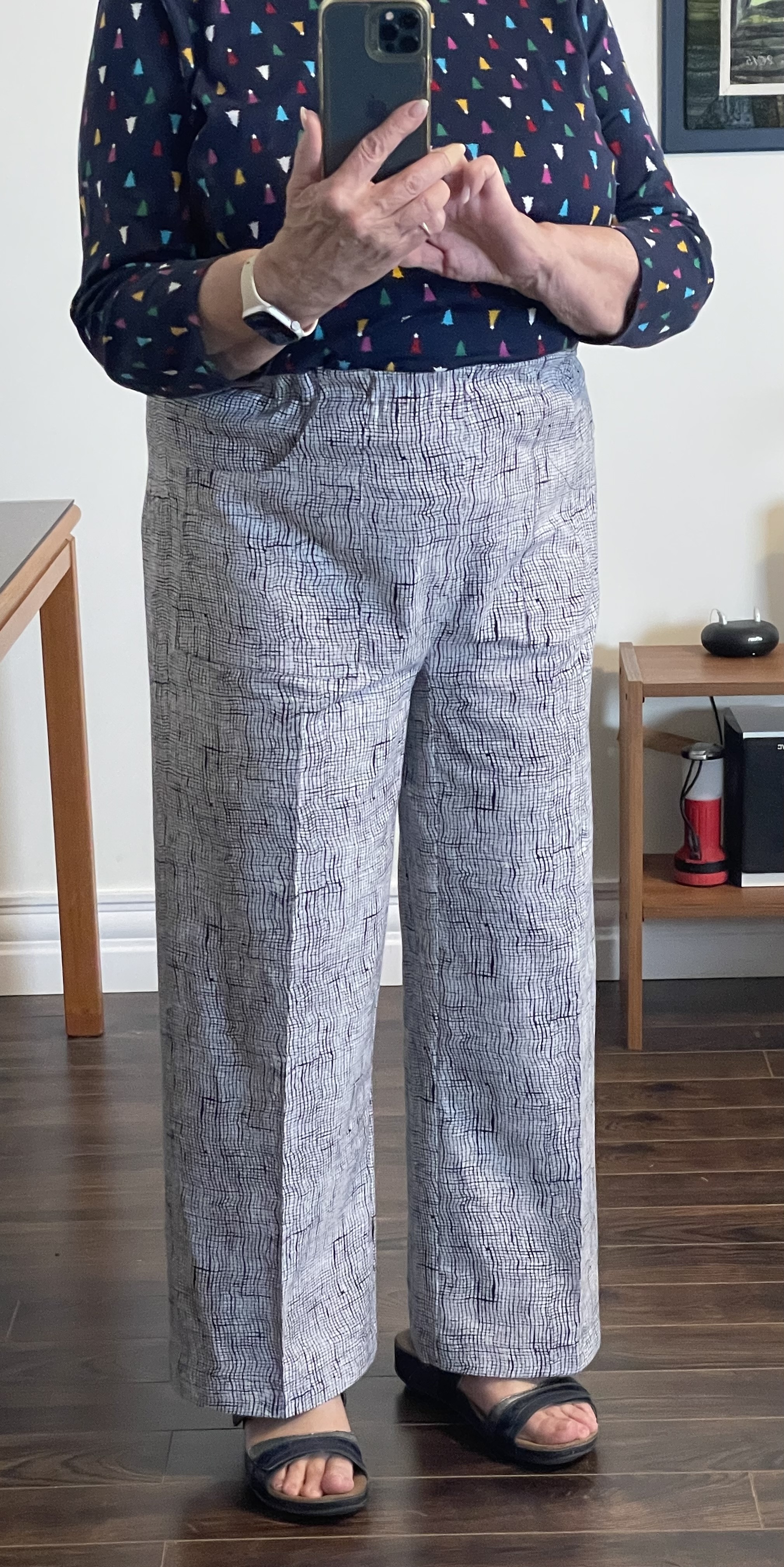
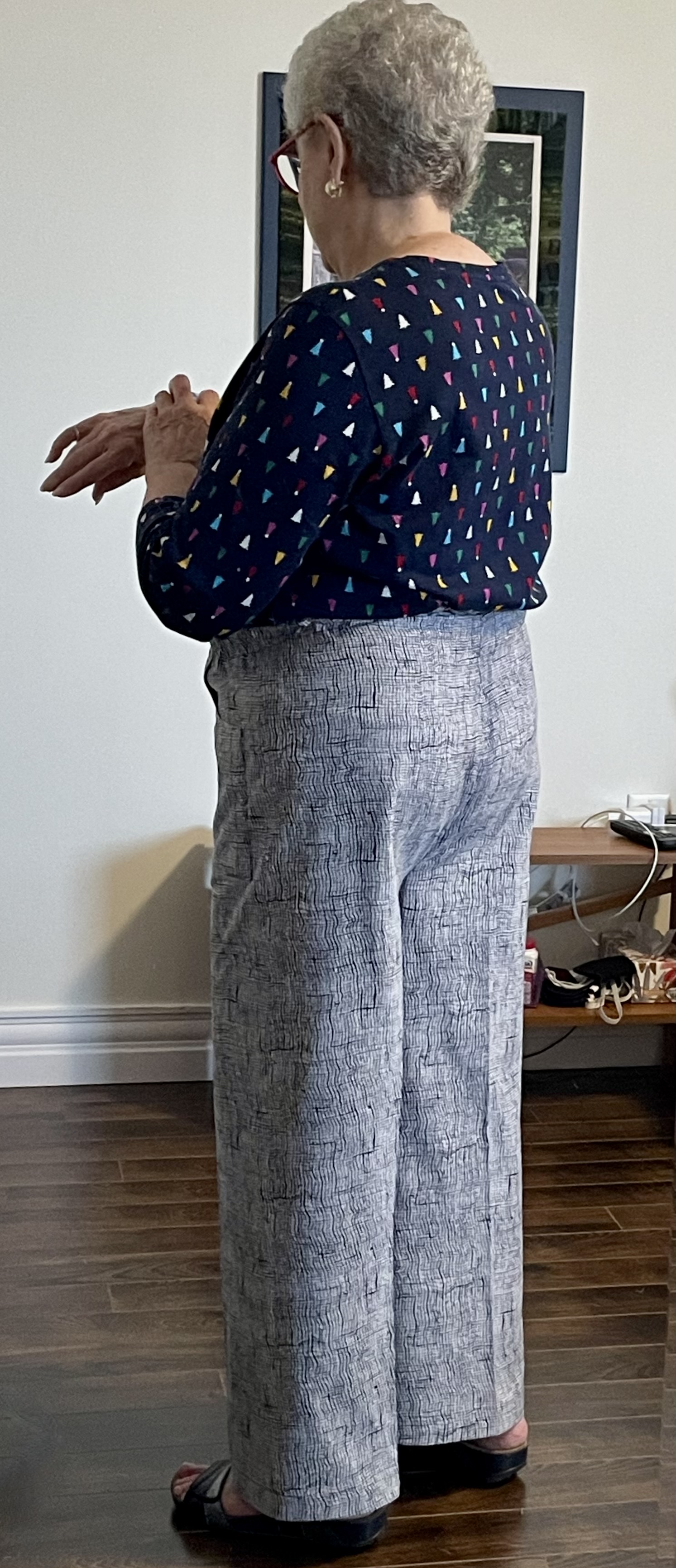
Although these pants have an unfitted straight leg, they fall nicely from my bum. The wider leg is easier to sit in, and the hip, while snug, is plenty wide enough to permit bending over.

BTW, I finally figured out how to get a reasonable photo of myself – I have a tripod which I set up so I didn’t have to focus the camera on my phone, I just had to press the shutter button on my watch – letting the camera remain focused and steady! (Duh… Don’t know why I didn’t occur to me to use the tripod before. Makes getting side and back pictures much easier!)

Because these montpei fit so well, I’m going to take the time to draft a sloper with the two crotch gusset triangles integrated into the inseam thereby eliminating the gusset (as they are on a regular pants pattern). I will adjust the centre back taking it in at the waist and extending the back crotch depth. My inseam seems to be about 26″ in these pants. I will set leg length at 26″ + 1″ for the hem. I’m curious to see how these would turn out in something like a light weight corduroy.

The finished fit is definitely the best I’ve encountered so far! This may be the starting point for any pants I want to make for fall!
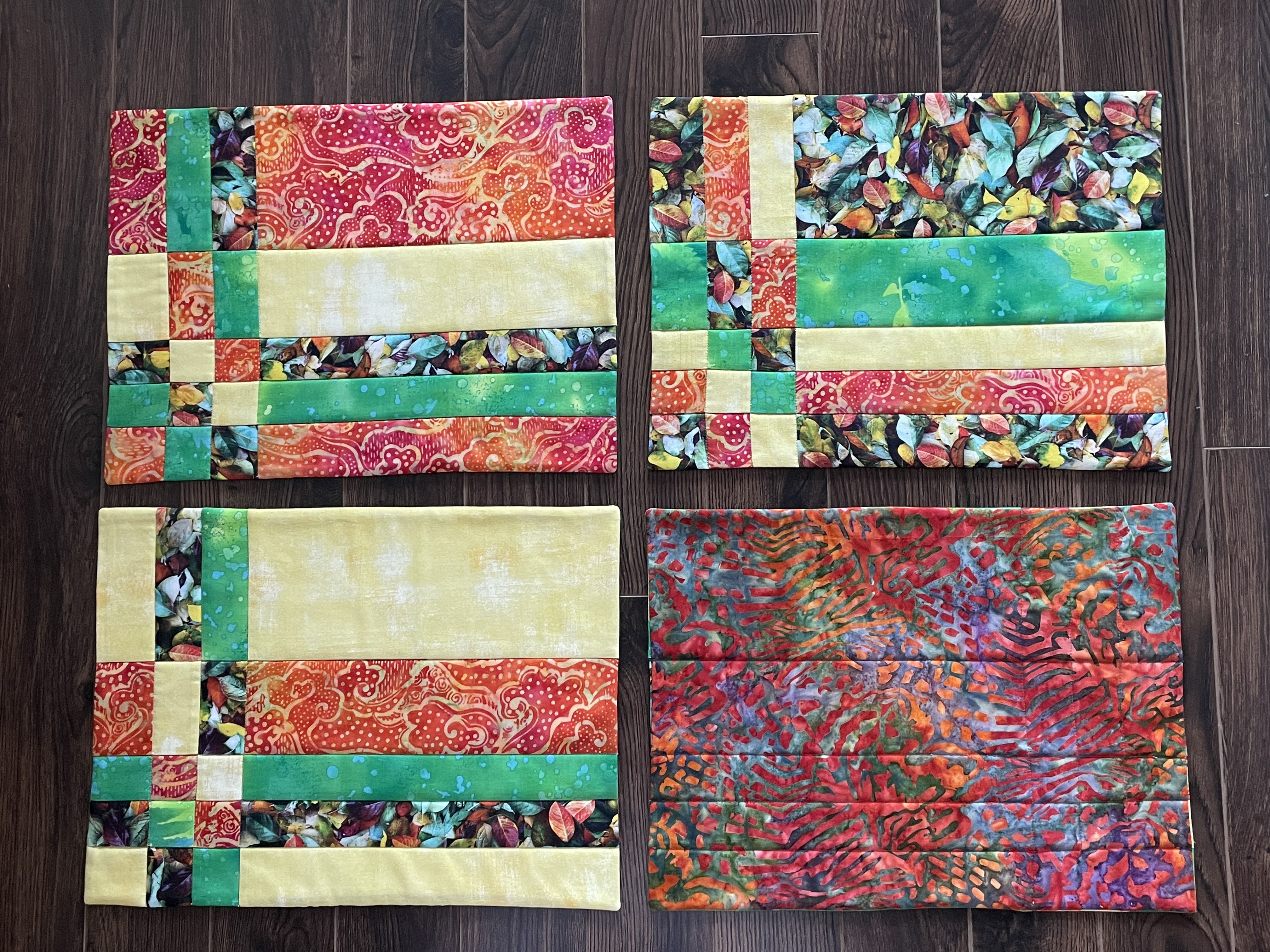
Place Mats – First Set Finished

Finished Set of Placemats

This morning I decided to finish the two sets of placemats – adding batting and backing, and quilting them. I was lucky – I found this multicolour batik in one of my drawers and there was enough to back all four placemats (actually I did have to fudge a bit – I discovered I’d cut a corner from one end of the fabric for some other project and had to patch it on one placemat! Nobody is ever going to notice).

I realized when I began stitching in the ditch I could “chain piece” the seam by following one placemat after the other without cutting the thread between. The sewing went fast that way. Must remember to do it on the second set which are set to assemble!

I still think these are particularly “loud” although my sister assures me they’re just fine. For sure, they will be noticed in the shop when I take them to put them on display. Maybe people will sign up for the class. Never know.

Fat Quarter Placemats #2

“Bright” Fat Quarter Placemats, Assembled

I wasn’t sure, yesterday, whether the purple fat quarter placemats counted as “Bright”. Today I decided to try wild – I selected an orange batik from one drawer of my stash, paired it with the leaf print, chose a green “fossil fern” piece, ended with a medium yellow “grunge”. They go together – definitely colourful. Probably not “dining room” but certainly “kitchen”, wouldn’t you say?

I’ll show the two sets to Sally next week and see what she thinks. This set would definitely catch someone’s eye hanging on the wall in Sew With Vision!

For cutting and sewing instructions: Stack ‘n Whack Fat Quarter Placemats

Stack ‘n Whack Fat Quarter Placemats

I don’t need another set of placemats, but yesterday I took several quilts and other projects to Sew With Vision to show the new owner, Sally, so we could talk about classes for the summer and fall. The set of placemats I took with me I made several years ago and they wouldn’t catch anybody’s attention. They’re pretty dull.

Original Placemat Tops

These stack ‘n whack fat quarter placemats are a novice quilter project. I decided to make a new set to display in the shop to entice some novice quilters to take a class to learn some basic quilting technique – precise cutting (with rotary cutter), sewing precise 1/4″ seams, chain piecing, pressing seams to nest joins and sewing the nested seams.

I picked four batik fat quarters from my stash (who knows, maybe these are also dull!). I started by pressing each fat quarter then I stacked all four, cut the pieces all at the same time, last evening. It probably took me an hour to press, stack and cut the fat quarters.

Fat Quarter Placemats

This afternoon, I laid out the pieces for each placemat, making sure my layout was the same for each one. Next, I laid adjacent pieces together and pinned them, then I piled the pinned pieces on top of one another. To sew, I used a “production” technique. I chain pieced as much as I could in the first pass – I stitched the adjacent pairs of pieces in the “rows”, pressed the seams to one side, then sewed the two parts for each row.

When I finished sewing and pressing all the rows, I laid out the placemats. I picked up the rows for one placemat, making sure the seams in adjacent rows were pressed in opposite directions so I could nest seams as I joined the rows. As I stitched, I made sure the joins did nest as I sewed them.

I pressed each placemat when the sewing was finished.

Now I need batting and backing to complete the placemats. I’m still deciding whether to quilt them just by stitching-in-the-ditch along the seam lines, or whether to quilt them in the hoop with a simple design.

These placemats could be sewn together to make a table runner. Or you could use the idea to make a quilt top. The placemats are simply an excuse to hone technique. As I explained to Sally, I don’t teach a project, I teach technique – I use projects as a vehicle for becoming a more experienced sewer or quilter.

For cutting and sewing instructions: Stack ‘n Whack Fat Quarter Placemats

Hanging Quilts / Wall Art

The other day, Pamela commented on my quilt exhibition at Art Lab Studios and Gallery in Parrsboro and asked how I set the quilts up to be displayed. I explaining how I make a sleeve from inexpensive muslin, baste it to the top of the quilt, insert a dowel with a bulldog clip on each end so the hook from the hanging wires has something to slip into. A simple solution, really.

Sleeve On Quilt Back

Here’s a link to my full description of how I hang quilts and wall art pieces: https://jmncreativeendeavours.ca/wp-content/uploads/2023/06/hanging-quilts-and-wall-art.pdf

Whew – I Made It!

I finished Drunkard’s Path #5 last night. I got the facing/hidden binding hand stitched down, the label added. It just needs a sleeve for hanging which I will do sometime today.

Quilt Top

Because the quilt was so wide (60″ x 71″) I had to add a wide insert into the backing fabric. I used corners I cut from the borders when assembling the front, adding in two of the leftover drunkard’s path blocks along with large cuts of scraps in the colour family I used for the top. I finished the quilt with a facing/hidden binding. It was a close thing – I had to fudge the fabric for the top binding with another scrap that kind of blended with the fabric there, and managed to salvage just enough from one of the side cut-offs to finish the top facing.

Quilt Back

I didn’t have enough backing fabric left over to make a label! I had to scrounge through my box of grey scraps to find something in the same colour tone to use. So, unfortunately, the label stands out, rather than seem part of the backing.

I just have a couple of small preparations to finish up (labels to print, dowels to cut to size for hanging, packing everything up for travelling) and I’ll be set for Friday morning’s departure to Parrsboro.

Deadline Looming!

I’ve been working away frantically to finish the last quilt. the show at Art Labs in Parrsboro opens a week tomorrow at 2:00 pm! That’s a month to six weeks earlier than I was hoping for so it’s been a crunch to complete everything and get it all ready to hang. I’ll make the deadline but there’s still quite a bit to get done.

As far as the final quilt is concerned, I have the centre panel quilted, the sashing and inner border seam stitched-in-the-ditch. That leaves two more border seams to stitch all the way around, the wide outer border quilted, and the facing and a label applied to the back. I have time, but the minutes are slipping away!

I just finished adding the sawtooth hangers to the back of the flowers, carefully measuring the hanging position for each on the linen-covered panel, adding small nails to hang each piece on. With a little aligning they’ll be fine.

Flowers Hung on Navy Linen Panel

I still have to figure out some way to hang the panel itself – I’ve got an idea for how to do that, but whether it will work or not remains to be seen.

I’ve finished the Modern Flowers panel, as well. Last week I stopped into Sew With Vision to see whether I could find a fabric to cover the hanging panel because I didn’t have enough navy linen to cover it. I came home with a metre and a half of Moda Basic Grunge in Peacoat Navy. It shows off the small pieces beautifully.

Modern Flowers on Grunge Background

Because the navy Grunge worked so well, I thought I’d recover the Flowers panel to match. I went back to the shop this afternoon hoping to find another metre of the navy grunge – no luck – none left. I bought some dark teal fabric but it was worse than the navy linen – it has lighter blue elements which fight with the Flowers. I decided to stick with the navy linen. I did some browsing to see whether I could find a couple of yards/metres anywhere – looks like this particular Grunge fabric is out of stock just about everywhere, and even if I had found some, it wouldn’t have come for a couple of weeks and I have just one week to get everything finished.

Now back to work on the quilt!

Quilt Top

Panel With Borders Added

I’m working away on this quilt. The top is now complete. I had to buy a 1/2m of fabric for the dark narrow inner border – there was nothing bright enough or strong enough in my stash to complement the panel. A quick trip yesterday afternoon to my local fabric shop and I was able to set up and attach the borders.

I cut all three border strips at one time, sewed them together, then added them to the panel, finally mitring the corners – much easier than trying to mitre each border strip individually and then struggling to get the mitres to align. Took less time, as well.

I’ve pulled out fabrics for the backing – I’m going to do a wide strip (24″) using large blocks of fabrics comparable to the scraps I used for the blocks. I have a couple of nice soft grey prints that will blend with the bright colours to finish the backing.

Quilt Panel

Finished Quilt Panel

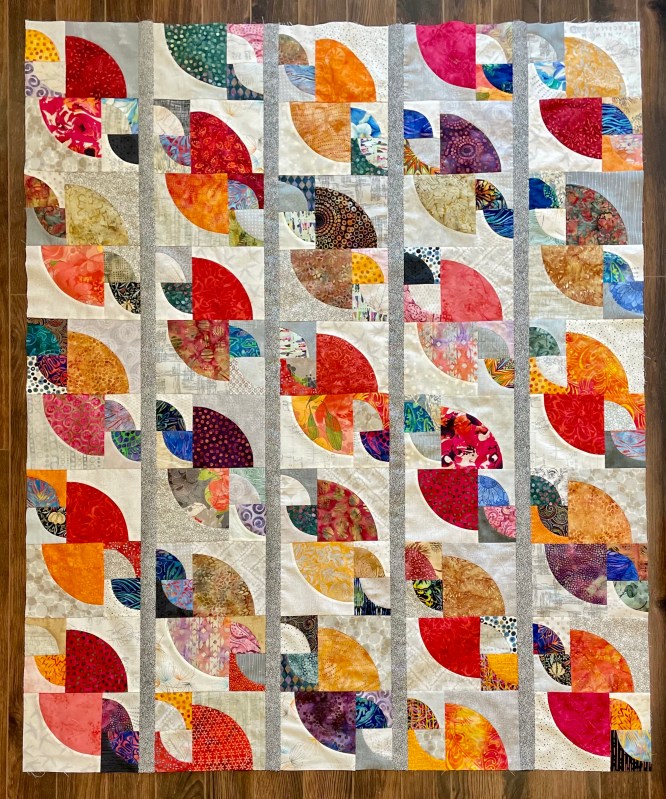
Interesting and several surprises. The overall “redness” of the panel is coming through – I intended that. I wasn’t anticipating the diagonal lines – the top left/bottom right “rope” like lines popped out when I laid out the blocks – I could have eliminated them by rotating the position of the blocks in columns 2 and 4 to replicate the orientation in columns 1, 3, 5 but that layout was uninteresting ( didn’t take a photo). I knew I was going to use sashing to join the columns – I thought it might interrupt the diagonals – it hasn’t.

The colour distribution is pretty good – no block jumps out saying “I shouldn’t be here!”. However, I laid the panel on the floor, took a photo, and the placement of four small drunkard’s path blocks smacks me in the face – you’ll have to look hard to find them all in the same column adjacent one another! Didn’t see it before sewing the panel together. I was focused on the large pie pieces, not paying attention to the small ones. Not taking the panel apart. I bet if I say nothing, nobody will notice.

Now the borders. This quilt is growing larger by the minute – with the planned borders added the top will finish at 62 1/2″ x 73″ – close to a double bed size! I will have to carry through, though, because were I to simply add an outer border using the sashing fabric, the panel will be diminished. I have to end with a lighter fabric on the outside, with a coloured element between.

I’m feeling the pressure to get this quilt done before the end of May – I want to include it in the Parrsboro show – so my goal is to finish the top today, construct the backing on Saturday, set up the quilt sandwich Sunday, then spend next week quilting. I lose Wednesday – I’m doing a workshop on making a Fidget Quilt – but maybe by a week Sunday I will have the quilting done – that leaves me a day or two to bind it.

BTW, I just googled “Drunkard’s Path images” and could find no picture of a quilt top that uses this array for the block. I guess it’s an original improvisation!

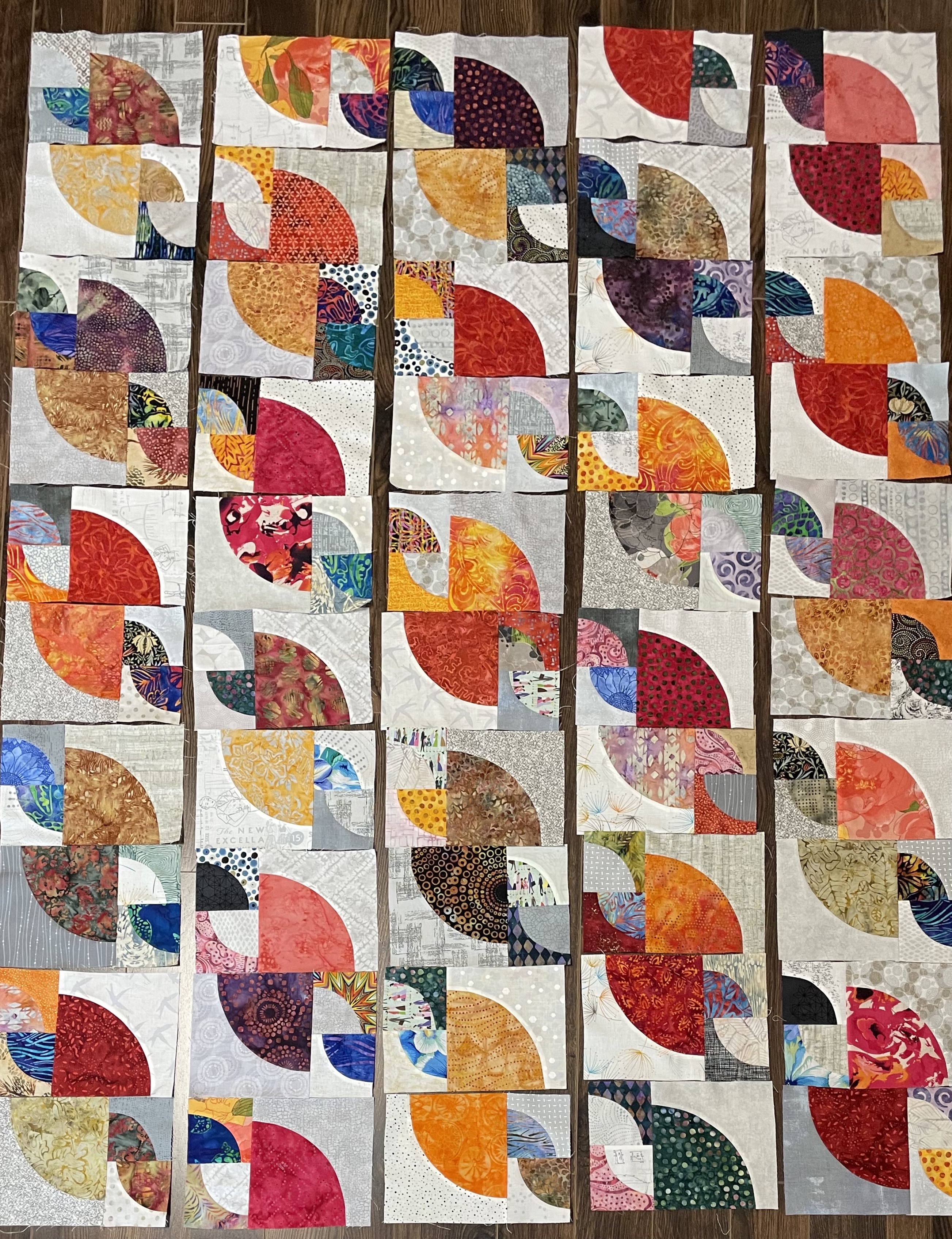
50 Blocks

50 Blocks Assembled

I’ve just finished sewing and trimming the last of the small blocks, attaching them to the larger blocks, trimming the resulting blocks and auditioning them on the floor. (I don’t have a flannel hanging wall in my apartment – there isn’t a spare wall to set one – so I use the floor space beside my cutting table for laying out quilt blocks. Good thing I can still get down on my knees and back up again!)

Before I laid out the last column, I removed the palest yellow blocks – they stood out as weak. I had enough large blocks assembled that I could draw in stronger ones. Having arranged all fifty, I began moving them around. I’m trying to avoid duplication in both columns and rows.

here are two diagonals happening here – completely unanticipated when I started out. There are the “top left – bottom right” diagonals – I’m also trying to avoid duplication along those rows. The large pie shapes on the “top right-bottom left” diagonals also stand out – not as obviously as the other diagonals but they’re visible, so I have to take time tomorrow to examine the array closely for duplication and colour flow.

I’d say, I’m about on schedule for this quilt. Once I’m happy with the layout, assembling the top won’t take long – sew the columns, add sashing between the columns – 3-4 hours.

I’m already thinking about the back panel. The temptation would be to add a bordered strip of Drunkard’s Path blocks (which I did in the previous quilt), but I want to come up with something different, yet complementary. I’ll sleep on that. It shouldn’t take more than a day or two to get the backing done.

I expect quilting the quilt sandwich (once it’s set up) should take about a week. I have 2 weeks before the Parrsboro exhibit. I’ll be cutting it fine, but I should be able to finish this quilt so I can include it in the collection.