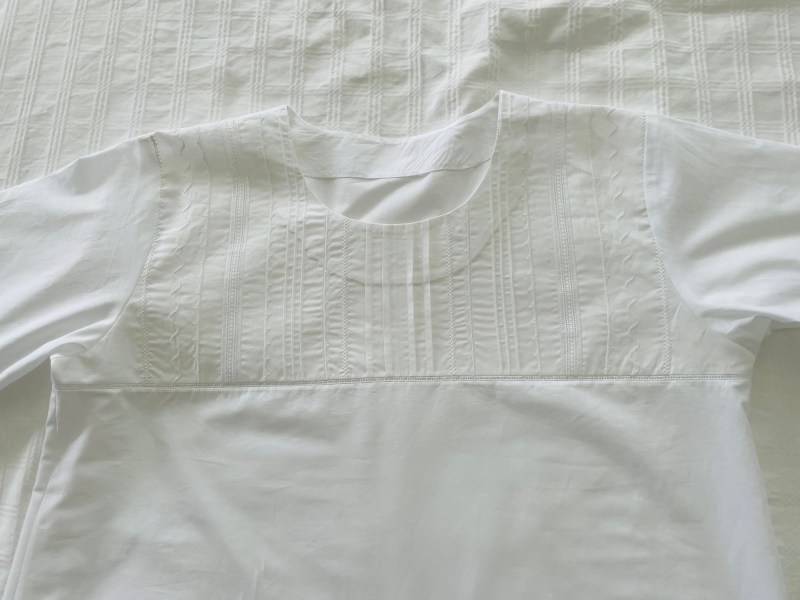
I also finished the latest pair of socks (added to the give-away stash) and the pull-on shirt I made using the heirloom panel I created a couple of weeks ago. I’ve since added five small mother of pearl buttons to the centre of the heirloom embroidery to draw attention to the stitching. It’s a light, loose hot summer day shirt. The only problem – the fabric I used for the heirloom panel is a slightly yellower colour than the rest of the shirt. Nobody will notice it. And I’m hoping a washing or two with oxyclean will whiten so the panel will blend with the rest of the shirt!
My patience and perseverance were tested yesterday. The other day, I pulled out some Marcy Tilton t-Shirt fabric I’d bought last year – time to use it to make up a couple of shirts. I went through my collection of t-Shirt patterns and decided to try out the Connie Crawford’s “Perfect Knit Sloper” that I’d picked up a couple of months ago. When the sloper arrived, I opened it, and drafted a sloper on Swedish cloth, using my measurements. This is the first time I’m trying out this sloper so I know I’m making a muslin.
I cut out a t-Shirt – using Janet Pray’s technique for turning a t-Shirt into a “swing” shirt (a shirt that is flared at the bottom)(15:25 – 21:55 on the video). Cut a couple of pieces of grosgrain ribbon a bit longer than the shoulder seam (to stabilize the shoulder), then serged the shoulder seams. So far so good. Next comes the neckband. I cut out the neckband the size suggested in the sloper pattern and serged it to the neckline. First problem – I had a couple of spots where I didn’t have the neckline and band aligned perfectly – I opened those spots and restitched them.
Tried on the garment to see how the neckline looked – dreadful – the band stuck out in the front – the band was too long. I thought the neckline was a bit higher than I liked, so I carefully removed the neckband (being extremely careful not to cut or pick the fabric), recut the neckline 1 1/2″ lower in the front, then reattached the neckband. The band was still too long, so I carefully removed it (being extremely careful not to cut or pick the fabric), shortened it by 2″, distributed the fullness of the garment neckline (stretching the band as I attached it to make it fit), basted the two together this time, then once I was sure I had the band and neckline aligned, I serged the seam! Finally the band laid flat and the fabric edges matched. I pressed the band seam toward the garment and top stitched it (to hold the seam allowance flat on the t-Shirt) 1/8mm from the seam using a narrow-edge foot.
Now to attach the sleeves. I carefully aligned the right sleeve with the sleeve opening on the t-Shirt, sewed it in place – didn’t like the sleeve header – the top of the sleeve stood up rather than lay flat. I unpicked the serged seam, flattened the top curve of the sleeve an inch, reattached it (this time basting it first) then serging the seam. I recut the second sleeve and serged it.
I serged the side seams; they were fine, until I tried on the shirt – too much flare! So I removed a wedge from bottom portion of the side seams.
Last, I used my coverstitch machine to do the bottom and sleeve hems (stitching a wee bit narrower than the fold and trimming back to the seam using my handy duckbill scissors.
Wearing the Finished t-Shirt
“Why?” you might ask do I bother making t-Shirts – because I can’t buy t-Shirts with sleeves long enough to cover my old lady arms.
This t-Shirt turned into a L-O-N-G project. I was determined not to give up and throw the whole thing in the garbage! But constructing it – a muslin, I kept reminding myself – definitely pushed my patience and perseverance to the limit! I wore it today and got complements on it.
Sewing the second t-Shirt was simple and straightforward – I made the adjustments to the sloper pattern, cut it out, basted, then serged the seams. The neck band lays flat, the sleeves headers are smooth, it’s not too full at the bottom.
I said to myself, before I started these alterations, if I ruin the dress, I’ll replace it! That gave me the courage to proceed.
The GownThe Front OpeningThe Cut Inner Skirts (2)
I started with the front opening. Michelle is tall, very thin, with a small bosom. So when she moved, the front gaped and she felt exposed. I wanted to stitch the opening closed but she was adamant the opening remain.
I shopped for a bit of nude mesh which I found at Fabricville. I cut a triangle long enough to support the gap further toward the neckline, pinned it in place then hand stitched it (very small stitches with Aurifil 50wt thread in white). Can’t see my stitches. I stitched the edges of the triangle on the inside as well. Then I added a sheer white polyester bias tape across the top edge to prevent the mesh from stretching much. That should do the job.
Second, I took up the shoulder straps an inch. I though I’d have to carefully remove beads and pearls, but I got away without having to do that – I was able to fold the strap 1/2″ and stitched the fold securely to itself. You have to look very closely to see where that join is. That adjustment should help with how the neckline fits as well.
Finally the two nude inner skirts. First, I had to figure out the length of the innermost skirt at the front, mark that length around the whole thing then cut it being VERY careful not to cut the lace and tulle layers. Next, measure the second skirt 2″ longer and cut it. I think the two skirts are still bit long in the centre back (that’s because at the waist the inner skirts dip down about an inch and a half below the centre front) but I was afraid to cut the skirts too short – we can always cut more – I can’t add back what I cut off!
I’ve decided not to hem the bottom edge – this dress will be worn once, the fabric doesn’t fray, and no point in doing a turned hem if I have to cut off more.
So far, I don’t think I’ve ruined the dress. I’d say, it’s done until Michelle tries it on. If I’m lucky she’ll be happy with my alterations – my wedding gift to her.
Yesterday, I spent the greater part of the day teaching a class about heirloom sewing; passing on what I’ve learned about creating delicate Victorian detailed embroidery techniques using my sewing/embroidery machine by helping others create a sampler which they can now use as part of a garment (likely a nightgown) or some other decorated textile project.
Heirloom Sample #1
It’s that time of year – I had a class of one. While my student was working, I had a bit of time to work on a sampler of my own – not particularly precise since I was distracted showing her techniques to help her with the precision that makes this work so lovely. I’ve put my sampler aside as an example of what you’re trying to avoid – my rows aren’t straight, the spacing isn’t exact and the panel is too narrow for the garment I want to make.
However, I still intend to make a light weight, flowing summer top embellished with heirloom work. So after aquafit this morning I started another stitched piece to serve as the yoke for this garment.
Finished Heirloom Panel – 24″ x 12″
Today, I decided to use a crisp paper as stabilizer, pulling it away from the stitching as I finished each row. I also took the time to draw lines with a heat-erasable pen to follow as I stitched. Unlike yesterday, my rows are evenly spaced and straight.
I began with 4 rows of tucks in the centre, since the neck opening of the top I plan on making has a slit I want to replicate, I decided not to put a lace piece down the centre. Now that I’ve drafted a pattern for the front yoke from my existing top I have a feeling I may not have left enough space at the centre to make the slit and face it properly (Oh, well). Next some hemstitching, followed by a row of decorative stitching, a grouping of pin tucks, another row of decorative stitching, an entredeux insert, ending with more decorative stitching and an outside line of hemstitching. The panel is symmetrical and the lines do match up on both sides.
Over the next few days, I’ll cut out the garment and begin assembling it. The top on which I’m basing this creation has an embellished front without a seam joining top and bottom. I’ll have to add a strip of entredeux to join top front to top bottom. I’m still thinking about style here and may in the end just use the same pattern I used for the nightgown and simply sew a hip-length top from it. I’ll make that decision tomorrow.
I’m doing an Heirloom Sewing class on Tuesday. The plan is to create a sampler using a range of heirloom techniques on a piece of lightweight cotton fabric (voile, batiste, lawn) large enough to become a yoke on a pull-on shirt, or a nightgown, a piece that can be used to make some kind of garment.
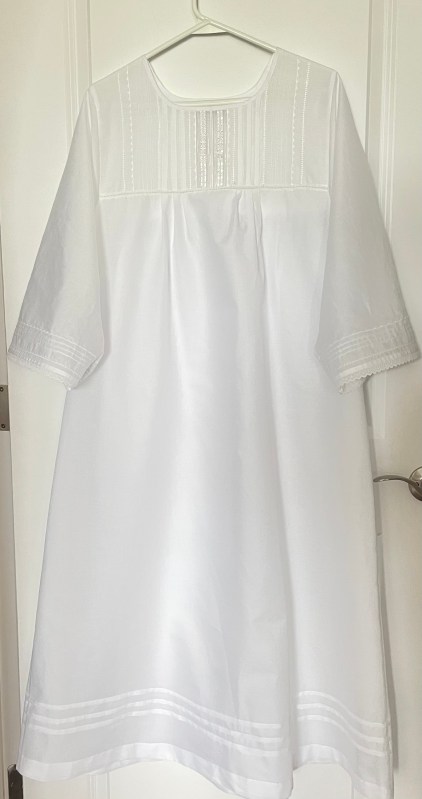
I needed to make something to show a finished product. A number of years ago I created several heirloom samplers intending to use them to make nightgowns. My supply of these lovely cotton nightgowns has continued to be serviceable for more than 10 years – I haven’t needed to replace any. However, I needed a new garment to show the class so yesterday I chose one of the samplers, pulled some batiste from my fabric stash, and cut out the nightgown. Today, I sewed it together.
First I had to put a bias binding to finish the front neckline. Second, I had to embellish the ends of the sleeves. I have a supply of beautiful lace edgings I bought quite a while ago and decided I should use one. I put it on the sleeve edge, did a row of hem stitching using a wing needle, then three rows of pin tucks using a 1.6mm twin needle and a pin tuck foot, finally a single row of decorative stitching. Together it makes for a pleasing sleeve edge.
I constructed the gown with French seams by sewing wrong sides together first, pressing the seam, folding it along the seam edge and stitching the seam again 1/4″ from the edge encasing the raw edges within the second seam. It’s a strong seam finish and there can be no fraying.
Once I had the gown made up, I double folded the hem and edge stitched it, then I added three rows of tucks along the bottom edge. I might still add a bit of decorative stitching but for now I’ve stopped.
Along with the original panels, I now have a completed nightgown to take to class!
I ordered another silk kantha bedspread ten days ago – it arrived day before yesterday. It’s a dark, rainy afternoon and the overhead light floods the quilt with yellow light. It’s actually more off-white/light beige with red and purple accents. It has red and white quilt stitching. It’s going to be perfect for a colourful summer jacket – this time with more flow and more contrasting colour to bring out the red in the silk blocks.
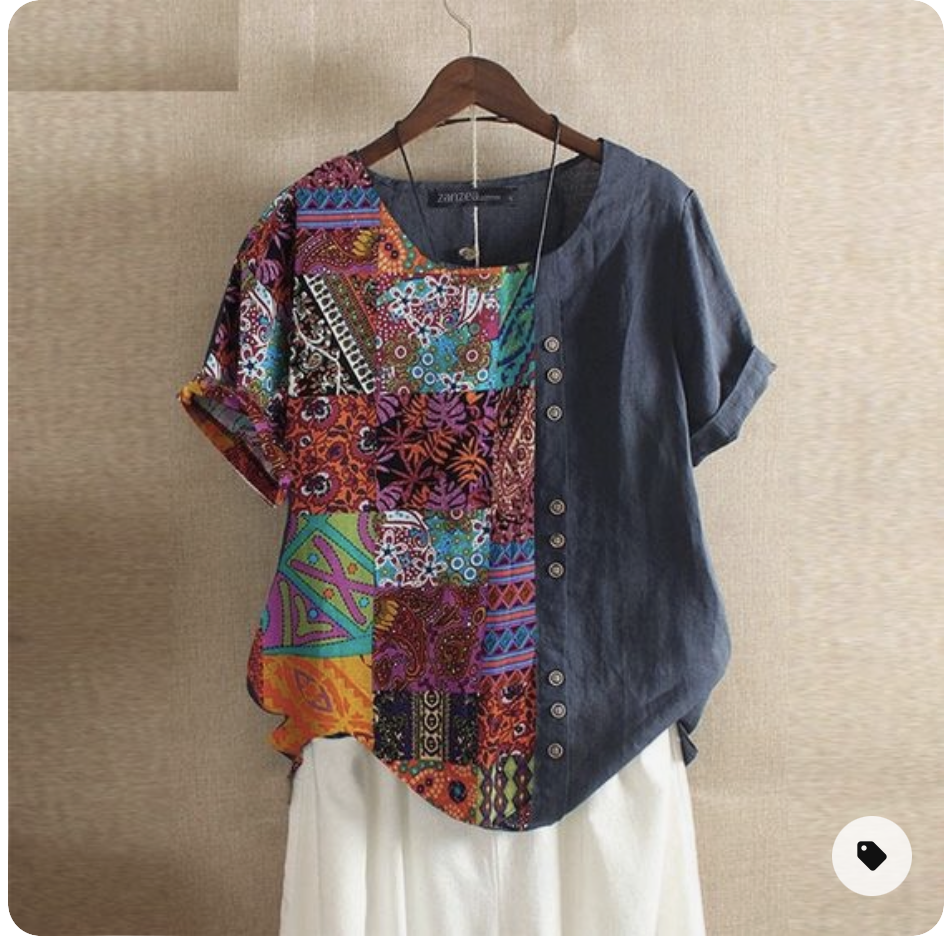
I bought a 90″ x 108″ quilt – that’s a ton of fabric – more than enough for two jackets! I’ll do one for myself first, then who knows what I’ll do with what’s left. A friend sent me a Pinterest photo of a summer shirt yesterday – this might work nicely done with some of the kantha.
Summer Shirt Idea From Pinterest
She’s right about that – it wouldn’t take much kantha fabric to do half a front, half a back and one sleeve! I’d use red linen for the other half of the shirt. Simple to make – a facing on the front neckline, a small binding on the back. It’s hard to tell from the photo whether the bottom of the shirt is actually scooped or just tucked into the bottom. I’d make mine straight with side slits.
Finished, except for hand stitching the hidden binding to the back. It’s hard to tell from the image how much quilting I did. I decided to leave the narrow strip unquilted to act as a separation between the two pieced strips. That meant I had to free motion quilt the light elements stopping precisely at the separator and make sure I did a tie off at the back. The darker elements required a different technique – I created embroideries to fit the size of each of the dark elements and stitched them in the hoop as I would any embroidery. You can see the detail below:
Quilting Detail
I wanted a “wave” like flow to the “sea” elements so I set up a couple of different embroideries for each section. I used a “stippling” stitching in the embroidery on the hibiscus fabric. I created “grass” for the green/blue fabric, etc. I made sure each embroidery fit the dimensions of the bit of fabric I was quilting. In the end I was pleased with the outcome.
I added the gulls once I’d stitched the “sky” portion of the hanging – they are cut from black raw silk, fussy cut, fused, then edge stitched in place. My initial idea had been to print images of gulls on fabric but when I did that with the paper cutouts they didn’t show up well. In the end I thought silhouettes of the gulls worked better against the “Sky” background.
This evening I’ll do the hand stitching to finish off the piece.
I have the panel assembled – two pieces joined off-centre with a narrow strip. It was obvious the resulting panel needed something more – gulls! So I searched for silhouettes of gulls online. There are lots of them. I downloaded a bunch in various sizes and flight positions. I need both right-flying and left-flying birds.
What I have in place at the moment are paper cutouts so I could judge position and size. I need to make two of the birds smaller – the one in the centre needs to be a bit bigger. Otherwise, I think three is all I want or need. My plan is to print them on fabric, fussy cut them, then fuse them in place.
In the end I chose to join the fabric pieces with straight lines – I’m intending to do quite a bit of thread painting particularly through the “sand” and “sea” elements with gently curved lines (using doubled rayon thread for emphasis) which I’ll stitch over the seams to obscure them a bit.
I did another stitch sampler – this time horizontal rows of embroidery stitches (of which this machine has MANY – particularly when you consider you can modify both length and width of each of the 500+ stitches). No ribbon or lace – just the stitches themselves in rayon embroidery thread.
Then I turned the panel into a drawstring bag large enough to carry a pair of shoes, or my knitting, or whatever I need a bag for. Finished size: 10″ x 13″.
What’s different about this drawstring bag is the way the channels are formed. Many years ago I was given a Japanese drawstring bag made with such channels. It’s a more refined way of finishing a drawstring bag. So I’ve been making mine this way for a long time.
I’ve used the same pattern (Jalie 3243 – Pull-on Pants) I’ve used for several other pairs of pants. My weight and shape have been relatively constant for the past year so once I worked out the details I had a pattern for pants that fit so I just keep making them.
The best part of the project is I can cut out the pants, sew them up, and wear them without any fussing. I know the length of elastic for the waist, the inseam measurement. Gain or lose weight and the measurements will change. However, right now I have a cut/sew pattern that works.
You can’t see the details – two jean-shaped pockets sewn to the front, two back pockets, an elasticized waist. That’s all there is to these pants.
I cut them out on Thursday. Got most of the construction done yesterday morning. Finished them this morning and I’m wearing them this afternoon.







 jmn
jmn 