Monpei – Revisited

The Start Of A Drafted Pattern

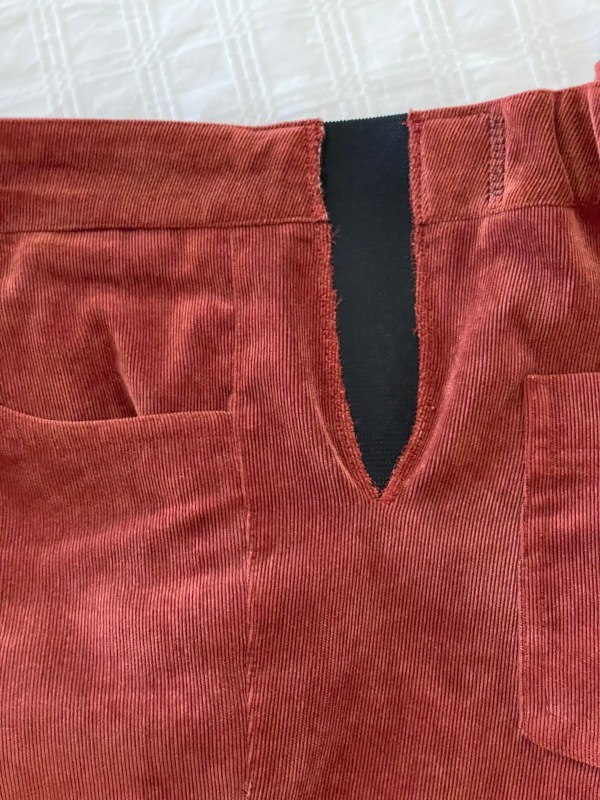
I decided to take the Monpei idea further and create a “pants” pattern from it – two rectangles – one each for the leg front and leg back. Instead of the triangular gusset I grafted the crotch triangles onto the rectangles (10 1/2″ x 40″), curved the crotch additions using a French curve, raised the centre back by 1″, took the centre back in by 1 1/4″. I also added “jeans” pockets. The waist I finished with a facing and elastic at the top.

At some point in the past I had bought this Sandwashed Cupro Blend fabric online from Blackbird Fabrics.

Cupro is a ‘regenerated cellulose’ fabric made from cotton waste. It is made using the teeny tiny silky cotton fibres, known as linter, that stick out of the cottonseed and are too small to spin. The linter is dissolved into a cuprammonium solution, which is a mixture of copper and ammonium, dropped into caustic soda, then spun into fibre. Much like Tencel and Modal, cupro is a plant-based material that is chemically processed to produce the resulting fabric.

Cupro is said to have all the positive qualities of silk: it’s silky-smooth and drapes just like the luxurious material. 

https://goodonyou.eco/what-is-cupro-fabric/
Top Tucked In

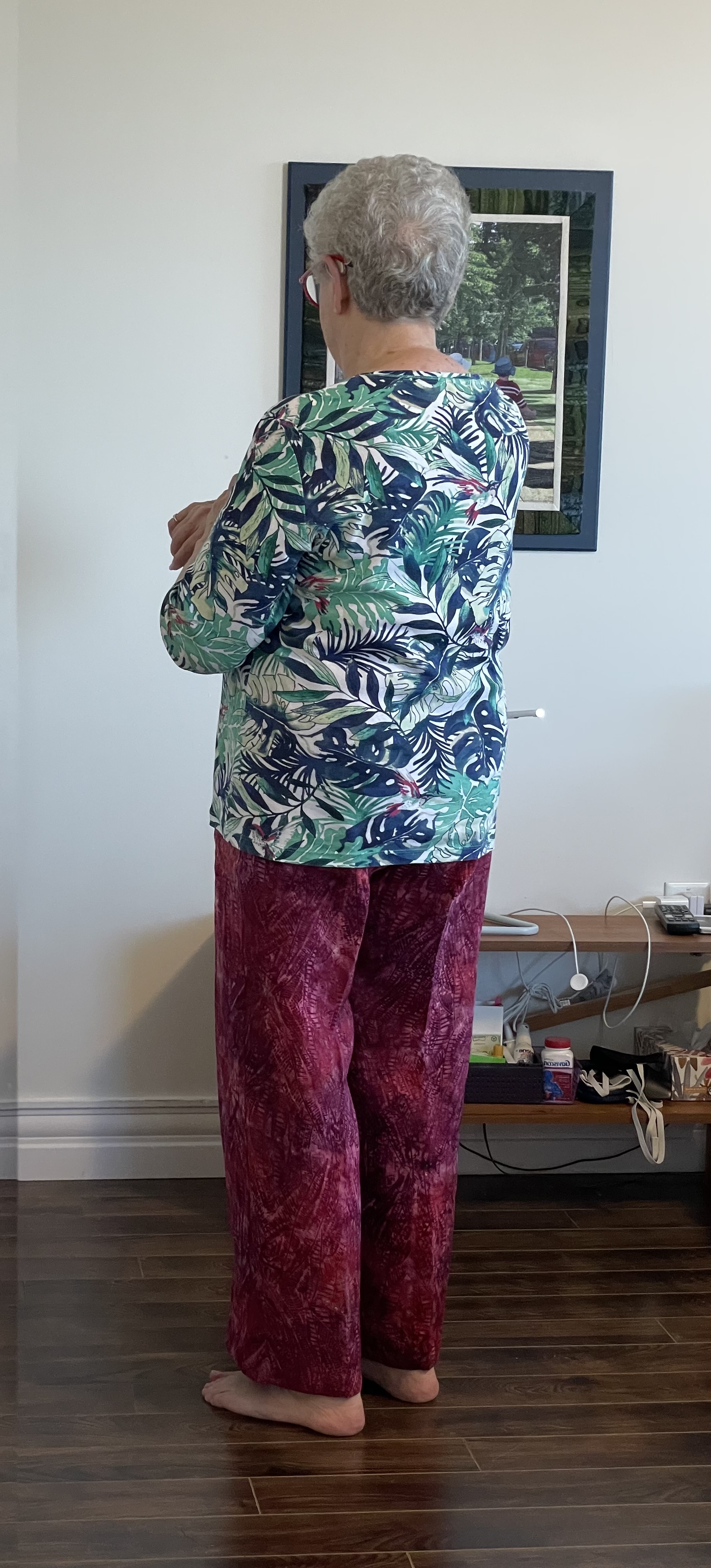
Not the most flattering photo but I wanted to show more of the top of the pants and how they fit – I tucked in the t-Shirt. The pants fit rather well both front and back.

The finished pants hang/drape quite well – no pulling at the front crotch, the side seam is straight, the back hangs nicely from the bum. I purposely hadn’t pressed the centre front/centre back to allow the drapey fabric to fall where it wanted. However, it turns out there is absolutely no give to the cupro fabric so when I sat in the pants they pulled tightly across my lap and wrinkled a lot.

This is, after all, just another experiment – I’ve ended up with a wearable muslin (although I can only wear the pants one day then they have to be washed – pressing alone doesn’t eliminate the wrinkles).

So how do I change the pattern to reduce that amount of wrinkling? Obviously by adding a bit of fabric across the front. That’s what I plan on doing next – I will add 3/4″ to the body portion of each side seam, along with a fly front as well as shaping the side seams so the top fits without elastic (although I may still want/need elastic in the back).

I’ve already pulled from my stash a piece of rayon I bought in Bali in 2014. It’s another drapey fabric which should result in a comfortable loose-ish garment. What I’m aiming to accomplish is a reasonable fit so I can make corduroy and wool (yes I have several gorgeous lengths of flannel I bought at Britex in San Francisco in 2015!) pants for winter.

On to the next experiment.

Half A Pair Of Socks

This has probably been the most labour-intensive sock I’ve ever knit!

The lovely dark blue and canary yellow ball of yarn caught my eye when I saw it at LK Yarns a couple of weeks ago. What I couldn’t know was the rest of the colour pallet was dull. I knit the yellow cuff then I pulled out the yarn from the centre of the ball (which I always do), found a medium blue yarn and started knitting. I expected the colour to change within a reasonable number of rows – didn’t happen – 25 rows into the sock I was still knitting medium blue – no yellow or dark blue in sight! When I peered into the centre of the ball, I could see a range of pale greens, but it was clear the last colours I’d get to would be the yellow and dark blue.

This particular ball of yarn turned out to be exactly two pattern repeats – each pattern intended to be a single sock – there was a white segment in the centre of the ball to mark the end of the first repeat. So I was going to end up with a very dull sock!

I unravelled the medium blue back to 9 rows, then picked up the dark blue from the outside of the ball and started knitting. The leg turned out mostly bright blue/yellow – just turning into the soft green as I began turning the heel. But then I ran into more green and more green. A sock for a size 7 1/2-8 shoe was going to finish on a pale green and never get to the medium blue. So I started splicing the yarn. I knit small amounts of the various greens until I got close to the toe, the I picked up the blend into a pale blue, then spliced it again to get to the medium blue to finish.

One sock done. Now I have to watch closely while knitting the second sock – carefully counting rows, so I can work up a colour match for the second sock.

Not gonna buy that yarn again!

Monpei Finished

Just finished the pants. Simple to make, and I can tell these are going to be VERY comfortable!

I was careful to make the crotch gusset long enough that the inseam is straight. The pants are cut from two rectangles; two triangles (which become the crotch gusset) are cut from the top/sides – I couldn’t do that because my waist is the same as my hips. So I cut the two rectangles (leaving them as is) – I merged the front and back leg into a single panel – so no side seam – but making sure the centre of the panel was on the straight of the grain. I also merged the two crotch triangles into a single long triangle with the vertical of the triangle on the straight of grain so I end up attaching a single gusset, rather than two triangles (a narrow one on the front inseam and a wider one on the back). The widest part of the gusset triangle is positioned at the crotch depth position in my case 12″ at the back/11″ at the front. [Click here for full instructions on how to make a montpei. (Click here for the original instructions.)]

When I tried on the basted panels (with crotch gusset sewn in) I could tell the centre back was going to be too short (I could have adjusted it by dropping the crotch gusset but instead I added a back yoke (2″ at the centre back grading out to the sides); I left the front crotch depth as it was. (I also took in the waist 2″ at the centre back – I didn’t need the extra fabric to pull the pants on.)

Because I wanted to add front pockets to the top of the panels I added them at this point; however they should have been sewn on while the panels were flat – to stitch them I measured 3 1/2″ from the centre crotch line marked it with a Frixion pen, turned the pants inside out so I could stitch the pockets with the panel “relatively” flat. Because the monpei have no side seam, I stitched down the side that would have been included in a side seam.

I created a facing for the waistband, attached it, strung elastic through the sleeve that created. I finished by top stitching the doubled over hem.

Done.

Here are the pants with my shirt tucked in so you can see how the top fits and the pocket detail which is hidden when the top is on the outside.

Although these pants have an unfitted straight leg, they fall nicely from my bum. The wider leg is easier to sit in, and the hip, while snug, is plenty wide enough to permit bending over.

BTW, I finally figured out how to get a reasonable photo of myself – I have a tripod which I set up so I didn’t have to focus the camera on my phone, I just had to press the shutter button on my watch – letting the camera remain focused and steady! (Duh… Don’t know why I didn’t occur to me to use the tripod before. Makes getting side and back pictures much easier!)

Because these montpei fit so well, I’m going to take the time to draft a sloper with the two crotch gusset triangles integrated into the inseam thereby eliminating the gusset (as they are on a regular pants pattern). I will adjust the centre back taking it in at the waist and extending the back crotch depth. My inseam seems to be about 26″ in these pants. I will set leg length at 26″ + 1″ for the hem. I’m curious to see how these would turn out in something like a light weight corduroy.

The finished fit is definitely the best I’ve encountered so far! This may be the starting point for any pants I want to make for fall!

On Fitting Pants

Donna DeCourcy wrote me today

“I look forward to your progress on pant fitting. Currently, I make all my own clothes and am frustrated by pants. I enjoy your blog immensely and finally changed my password and made the roundabout route to get back to finally making and leaving a comment!”

I answered her:

  • jmn Donna, pants fitting and making is difficult and frustrating because you’re working from a flat piece of paper and you’re trying to create a garment that is curvy in a number of different locations that are different on every body, and your body changes constantly!
  • You can’t count on a pattern you got to work once to work with a different fabric that has a different weight or a different amount of give (stretch). You can’t know for sure a pattern you made six months ago will fit you today! Unlike a top or a dress or a skirt which fits more loosely, pants (particularly today’s styles) fit closely, so there’s not much forgiveness in fitting – they fit and are comfortable, or they’re not and you start over again. 
  • I’ve been chasing patterns and ideas for fitting pants for at least 30 years! At the moment, the closest I’ve come to getting a pattern to work is “Top Down, Centre Out” which fits the waistband first, then drapes the pants pieces from that, making the adjustments in the toile/musin as you’re making the pants.
  • That’s why I just make “wearable muslins” (prepared to discard the project) because as far as I’m concerned each new pair of pants (from the same pattern) is still a work in progress, never a sure thing.

I added another comment later:

Monpei #2

This pair of pants is a Monpei: Here’s how I made them: https://jmncreativeendeavours.ca/2021/07/25/the-japanese-monpei/

You might want to give this idea a try. It’s surprising how well they hang on me! I’m about to make another pair from some Japanese katagami fabric I’ve had for a couple of years.

Barbie “Pink” (& other stuff)

Pink Outfit

It was sunny earlier today. Warmish. I pulled this pair of pants and this t-Shirt from my closet to wear. I stopped at a friend’s house for iced tea during the afternoon and her comment,

“Oh you’re wearing your “Barbie Pink” outfit!” stopped me in my tracks.

Barbie Pink! Really!

I’m never going to be able to wear either of these garments again. I’m not a “Barbie” fan. I didn’t grow up with Barbie. I was 16 when Barbie was released – well past the playing with Barbie age. Barbie is simply not part of my cultural heritage.

I have no interest in seeing the film – although I’ve read reviews describing the feminist underpinnings of the movie. I just don’t see myself showing up in public again in what others obviously identify as a “Barbie Pink” outfit!

Another Face

I pulled up behind this convertible yesterday afternoon – the “face” was unmistakeable. I grabbed my phone and took a photo – not a perfect image but the face is definitely visible.

More Shoes

What do you suppose went on here – both socks were stuffed into the right sneaker. Both covered in mud, left on the grass.

The Gals

Two of these gals are 89, one is 92! We were taking a leisurely Sunday afternoon drive along the Noel Shore yesterday. Visited Burntcoat, sat at the lookoff for a bit.

Noel Shore

Stopped for ice cream in Kennetcook (good ice cream, BTW). One of those just moseyin’, taking side roads, not worrying about “getting lost” day trips. We had a nice time. Lots of laughter (I’m the “baby” in this group.)

Yard Sale

We encountered this old fashioned yard sale. Someone had emptied the house, and EVERYTHING was sitting out for the taking – there was a small locked cash box (a slit in the top) and hand-written sign above saying “Pay Here!”. All on the honour system (nobody about). We weren’t the only curious visitors.

I found a box of power line insulators – I have owned one for years – I use it as a weight to hold patterns in place when I’m cutting fabric – been looking for more. I picked out three small size ones, left a toonie (a Canadian $2 coin) in the box. They’re in my dishwasher waiting to be cleaned. (Bernice picked up a small toothpick mug for her collection.)

Ahead Of The Curve

I’ve been making clothes for myself for decades. I stopped being able to buy pants that fit without alteration since my early 40s; hence my long-term quest for pants patterns and techniques for fitting pants that would yield me something that fit me. My top measurements are closer to a single size although for the past decade I’ve avoided fitted shirts, t-Shirts, etc. because my waist has slowly, but surely, increased and that affects how any top I might make will fit.

I was laughing a couple of weeks ago with MaryAnn (a sewing pal) about a FBA (Full Bust Adjustment), saying what I need more is a FTA (Full Tummy Adjustment). She got up, went into her sewing room and returned with a book:

Book Cover

Everything you want to know about fitting patterns is here and if your question isn’t answered in the book, it will be found in Jenny’s blog: Cashmerette Sewalongs + Tutorials. Her foray into garment making for largish women is very informative. Her learning to make garments for herself led her into pattern making for curvy women. She’s recently introduced pattern sizes from 0-16 (the original sizing was 12-32). These simple, generally unadorned garments are suitable as a place to start for anybody. She wants women to look good in their clothes and to feel somewhat stylish.

While the book explains the complete range of adjustments in great depth, Jenny starts by describing “grading” – how you use today’s multi-size patterns to fit the different parts of your body. My challenge is I’m right between her smaller sizes and the larger sizes. With a size 12 bust, a size 20 waist, a size 8 bum, I can’t actually work within a single size range. I’m about to write Jenny to ask her advice concerning which size range I should be working in. I’m guessing because I’m a smallish person she’ll recommend working in the 0-16 range and grading my waist beyond the pattern rather than working in the 12-32 range and grading beyond the pattern to fit my bum. I’m going to take the basic pants pattern from the back of the book and size it to fit me (it’s a 12-32 pattern) to see where I get with it. If I’m able to get a fitting muslin using a graded sloper based on this pattern, I’ll be able easily to design whatever features on want on my pants from there.

Let you know how I get on!

Denim Pants

Trying to take photos of the pants I’m modelling is so difficult. Not great photos but adequate to show how the pants fit.

I finished the denim pants (made from the same pattern drafting I used for the white linen ones this morning. This was a test run to see whether I could use the pattern sloper without making any further adjustments. I could. The nips in the waist I’d taken worked out fine. The length was good. The front fits in the crotch without pulling, the side seam is perpendicular to the floor, the back falls straights without being baggy. I can sit in them confortably. The back crease is really a seam incorporating a dart under the bum (which is now in the right place).

I did add elastic to the back yoke because when I sat down the back pulled down. With the elastic the pants seem to be staying in place.

I’ve ended with a cross between Jeans and Trousers – I’ve used a jeans pocket (not a slant or inseam pocket used for trousers), incorporated the back yoke used to fit jeans at the waist, a fly front for easy access; but I’ve added the back dart down the centre of the pants, a straight leg, with limited top stitching that’s de rigueur for jeans, finishing the hem with a single top stitching, giving me a simple look more like trousers.

With my fingers crossed, in a couple of months, I will use this sloper to make some corduroy pants for the fall. That will let me purge some of the winter pants in my closet; some of which have been fitted and refitted many times as the years pass and my shape changes. This fit should last into the fall.

Let you know how I get on!

The Story Here?

My sister Donna knows I’m interested in stray shoes/boots. A couple of months ago I came across a pair in the middle of the sidewalk. She came across these on her morning walk in Point Pleasant Park the other day.

The Story?

What’s goin’ on? The boots were small, in good shape, Donna thought about trying the on – she didn’t – she just took the photo.

My theory: the boots hurt; the owner wasn’t walking one more step in them; left them for another walker/hiker (of which there are many in Point Pleasant Park) that they might fit.

The remaining question, of course, is how did the owner get home? The paths in the park are gravel – pretty difficult to walk on in bare feet, even in sock feet! So how did that person get back to the parking lot and their car? No idea!

The Thing About Pants

The thing about making pants is the fit changes over a six month period – my weight distributes just a bit differently so the pattern that worked last year won’t quite fit now even though my weight hasn’t changed much.

I bought some white linen and a medium weight denim several weeks ago. I decided I had to get those white pants done because it’s almost August and I have nowhere to store the fabric till next spring!

Finished pants draped over a chair

I didn’t want to make another pair of pull-on pants. I wanted a fly front which is actually a lot easier to get into. I pulled out my Sandra Betzina jeans pattern Vogue 7608 which I’ve been using since 2015.

My challenge is I have a very flat bum, skinny thighs but a full belly which makes my waist measurement close to my hip measurement. I last used the pattern in May 2019 (the date I noted on the draft) so I wasn’t prepared to trust the sizing of my draft – I figured I should at least lay it against my pull-on pants pattern (most recently used in Feb 2022) and was surprised how close the two actually were. Then I did what I needed to do – I took my body measurements yet again: waist, high belly, hip (at fullest), thigh, and checked them against the pattern. On this pattern I’m a size A through the bum in the back but I need a C from hip to waist. In the front I’m a C from crotch to waist. I checked the grading on my draft against the original pattern to make sure I was close to a working size.

I intended making the dart adjustment in the pants back but I needed to make sure I was getting it centered so I balanced the pattern, front and back, then added the dart to the centre back. This pattern has a back yoke (no waistband), with a waistband in the front. The smart thing was to start by working “Top Down/Centre Out“. I cut out the 2 yoke pieces, the two front waistband pieces, sewed them together, then tried it on. The fit wasn’t bad, a reasonable amount of overlap in the front, so I decided to go ahead and cut the fabric.

I was using my white linen fabric to make a muslin – if the finished garment fit I’m ahead of the game, but as usual, I was prepared to throw out the whole effort if it didn’t work.

I did all the prep work – fused interfacing where it was needed: back pocket facing, front pocket facing, waistband, yoke, both sides of the fly. I serged edges where I wanted to prevent fraying. I made up the pockets, added them to the front (I simplify the pockets by adding them to the top, rather than inserting them from behind the fronts). Now here’s where I deviated from Top Down/Centre Out construction. If this was going to be a wearable garment, I needed to set up the fly front. So I went ahead and put in the zipper, added the fly facing and top stitched the fly in place (Here are instructions for this simple fly front) (Here’s a link to a video.) With the fly completed I added each front waistband piece.

With the front done, I worked on the backs. I sewed the yoke to each back side, then sewed the back dart in each back piece, serged it (1/4″ seam allowance). Added the back pockets to each side. Now I returned to the Top Down/Centre Out technique – I sewed inner leg seams (no serging), sewed the outer leg seams (no serging), stitched the crotch seam( no serging), then tried on the pants. I could see I wanted to take in the side seams 1/2″, I wanted to remove about 1/2″ from the back crotch inner leg to flatten the bum a bit more, I also wanted to bring the back dart higher so it would finish under the pocket, finally take in the centre back 3/8″ at the waist.

I made those adjustments (marked them on my pattern draft), then I serged the seams. Tried on the pants again. I was satisfied with the fit, so I added the waistband and yoke facings (having matched them to the waistband and yoke on the pants), top stitched around those elements on the right side of the garment. I marked the inseam (27″), folded and pressed the hem, then finished the hems with a cover stitch. Last I added a button hole on the front waist tab, and a button and tried the pants on again. Overall the fit was good – but the pants were too long.

I took out the hem, shortened the legs by 1/2″. Cover stitched again – still a smidge too long. I shortened them another 1/2″.

The front fit is close but the added length interferes with how the legs fall – this was before I shortened, and reshortened the pants. The back is close – I just need to raise the dart to remove the slight bit of fullness under my bum. I’m not going to do that with these pants, by the time I’ve sat in the linen for a few minutes the back will be stretched out – I marked that adjustment on the pattern for the denim which I will make next.

All in all, after shortening the legs, I have a pair of wearable pants. A good couple of days effort.

Silly Socks

Silly Socks (Happy Clown 09)

These were fun socks to knit! I bought the yarn from Hobbii in Denmark a couple of months ago. I’ve purchased yarn from them for a couple of years and found it a nice weight and texture. The patterns have for the most part turned out interesting socks. These were the brightest I’ve ever knit!

The only challenge was the ball of yarn had some knots where during the winding process the yarn broke and it was joined manually – distorting the pattern. I ran into both knots while knitting the first sock. The first happened between the green and blue transition – I had to unwind quite a bit of yarn to find an approximate location for a match. The second knot happened just after the heel where the solid yellow was abruptly ended and joined to green. At that point I cut out the knot, threaded one yarn into the other knit 5 stitches, trimmed excess yarn and carried on.

I had to be careful on the second sock to match the location when I got past the heel. I was pretty successful making an approximate match – my two socks turned out the same! I didn’t encounter any further knots, thank goodness. It was also a good decision to knit the cuff in yellow (I didn’t know at that point I’d lose most of the yellow solid section). It gives a colour balance to the finished sock.