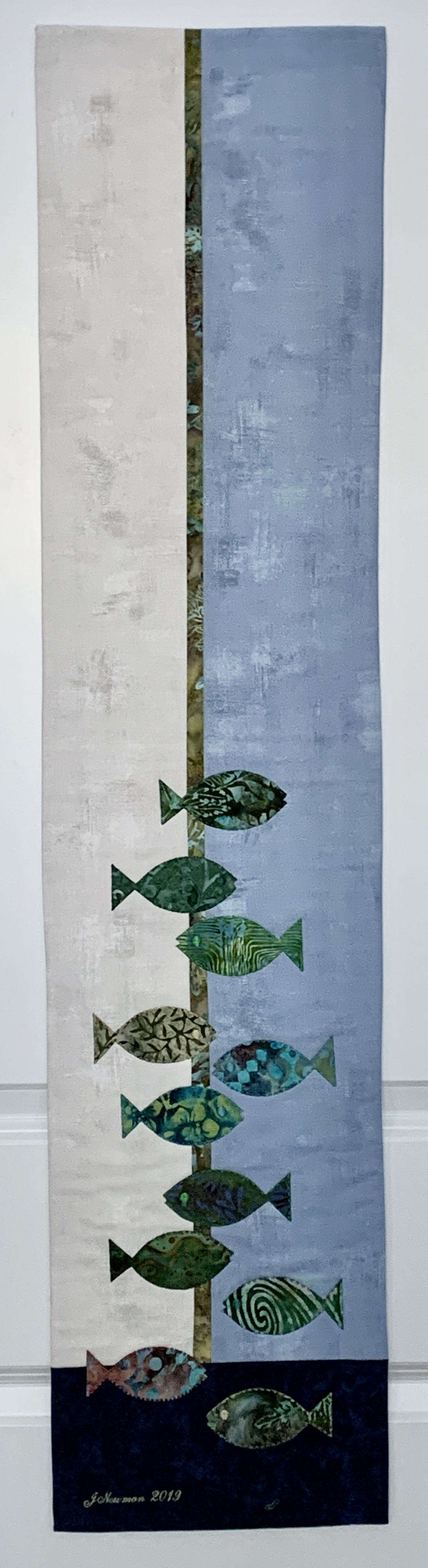
I wasn’t intending to carry on with the “fish” but I’m stuck with the quilt I started so I went to work on another “fish” piece.
Fish #4
Because I’d cut bindings from the leftover piece of purple ombre, the leftover piece was a bit shorter than I wanted it to be, so I added some batik to the dark bottom end of the purple and filled in with seaweed-like shapes.
Not so many fish this time, they’re more spaced out, with one behind the seaweed (which meant I had to stitch it in place before fusing the seaweed to the panel. The other fish are just laying in place for now – I don’t know precisely where I will put them, I’ll know that after thread painting the seaweed elements.
I worked away at my machine yesterday, edge stitching the seaweed then adding three seaweed embroideries for texture. Late last evening, I fused the remaining fish in place.
Seaweed stitched
Next will be to edge stitch the remaining fish and add an eye to each. Again, I think I’m not going to do any background stitching, I like the water-like flow in the ombre print and don’t want to interfere with it.
OK. This really is the last of the fish pieces. REALLY.
I taught a class this week on “Skinny Quilts/Wall Banners” – on constructing simple, fast and easy quilted fabric art pieces. I’d worked on two much more complex pieces recently.
Sky / Sand / SeaBlue Flowers
I wanted something simple to show the women in the class. I wanted whatever they tackled to be pieced/stitched in a day. Hence the “Fish”.
The night before class, I pulled the ombre pieces I had in my stash (from a Ryan McKenna kit I’d bought but never used five or more years ago), chose the purple one because it was an uncut 1/2 yd piece and cut an 11 1/2″ piece WOF. Next I gathered together the last of the “fish” scraps I’d saved from the Double Vision quilt – A Study in Blue and Green I’d made in 2019.
Quilt Top – Double Vision 2019
I positioned a dozen fish on the ombre fabric (they already had fusible web on the back), pressed them into position, cut a piece of batting and took it to class along with eight other banners I have in my closet so the gals could see a range of possible appliqué work.
Yesterday, I edged stitched the fish and added an eye to each. I thought about embroidering some seaweed at the bottom of the panel but the ombre fabric has a soothing “water” movement to the pattern and I decided that rather than embellish the background, I’d leave well enough alone.
I sewed on a hidden binding and added a backing muslin this morning, pinning the binding in place. I still have to add a hanging sleeve and hand stitch the binding in place but the hanging is now complete.
The women managed to piece a background (as I had done on the two banners above), cut out appliqués, fuse them in place (we discussed matters like colour, value, complexity of pattern, etc when choosing both the background and appliqué fabrics), then began the edge stitching.
I usually do this class as a two day affair but we were doing it on a single day. Had it been a two day class, I’d have had the gals practice edge stitching on curves but there wasn’t time so they went at it on their banner pieces. One had an open toed foot, luckily we were able to find another in the shop for the second machine – what a difference being able to see where your needle is in relation to the appliqué fabric! It takes a bit of practice to get the eye/hand/foot coordination to sew accurately at the fabric edge. Then the issue of editing the various decorative stitches to get a suitable width/length so the stitching shows, but doesn’t dominate the work, arose. Stitch selection and editing takes practice and judgement as well. We didn’t have time to develop a stitch sampler with notations – that would have required another couple of hours – we went with what was expedient.
The gals made significant headway and their technique improved significantly as they went along. Toward the end of the afternoon we stopped and examined how I’d done the finishing work on my textile pieces. I’ve sent them the directions for completing their wall hangings. Now it’s up to them. I’ve asked for photos of the completed work.
That’s the last of my “fish”; I still have a bag full of circles in many sizes waiting to be used.
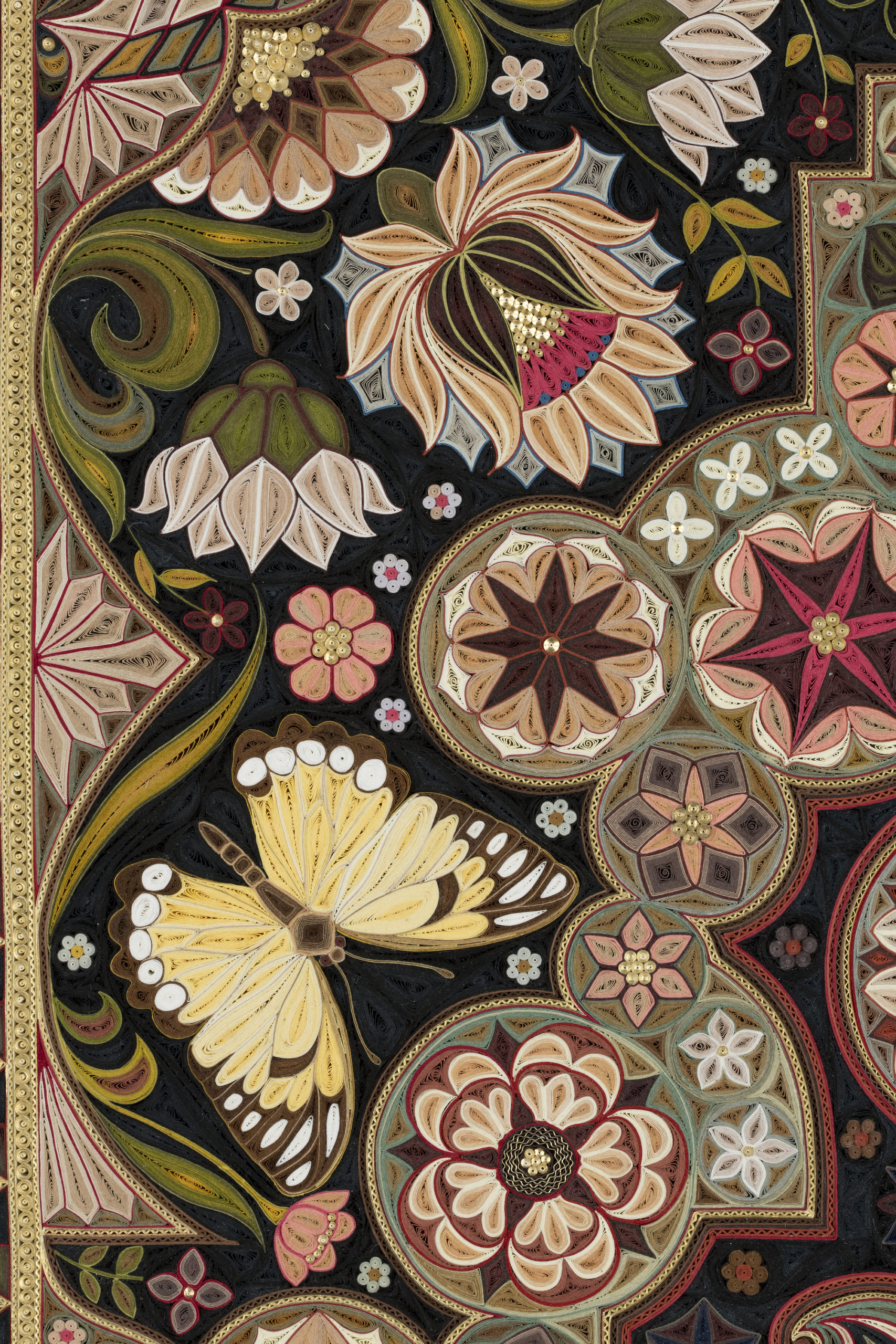
I’ve dabbled in paper quilling but I don’t have the patience to do much with the tiny twirled results. But Lisa Nilsson makes spectacular art works using the technique.
This work, which took her six years to create (!) is an amazing work of art. You have to see some of the details to appreciate what she’s done:
I’ve filled in the upper right corner, but I’ve run into another issue – my strips aren’t long enough to extend along the diagonal!
Corner Filled In
So what can I do? I decided to bring the dark blue into the top and use it to fill the left corner so I can bring the strips further down on the right side.
I have to say I don’t like the points, although I’m sure I wouldn’t have liked straight joins either. It’s a matter of just carrying on and seeing what happens.
I had a second set of Bali Poppies strips – Poppy Field – which I held back from the previous quilt. With this quilt top I’ve started laying out strips – the plan is to have the strips on an angle across the width of the quilt top. I started with a long strip – at the moment I’m working my way into the top right corner, then I’ll pick up and work my way to the bottom left. I want the quilt to be about 46″ wide by whatever length it turns out to be.
I’ve elected to do mitre joins (rather than blunt ones) – that may not have been the best decision in this situation. I’m also alternating the direction of the joins – which means some are almost vertical and the next horizontal. I’m not sure the visual effect I was hoping for is going to materialize – I won’t be able to tell until then top is nearly assembled.
I’m having to piece this project one strip at a time, making sure I get the join direction correct and the join position somewhat interesting.
As I get further along I’m planning on inserting “diamonds” into the dark blue background. I may have to appliqué them in order for them to look like diamonds. I have a hunch that if I piece them into the background with mitre joins they’re going to look quite odd!
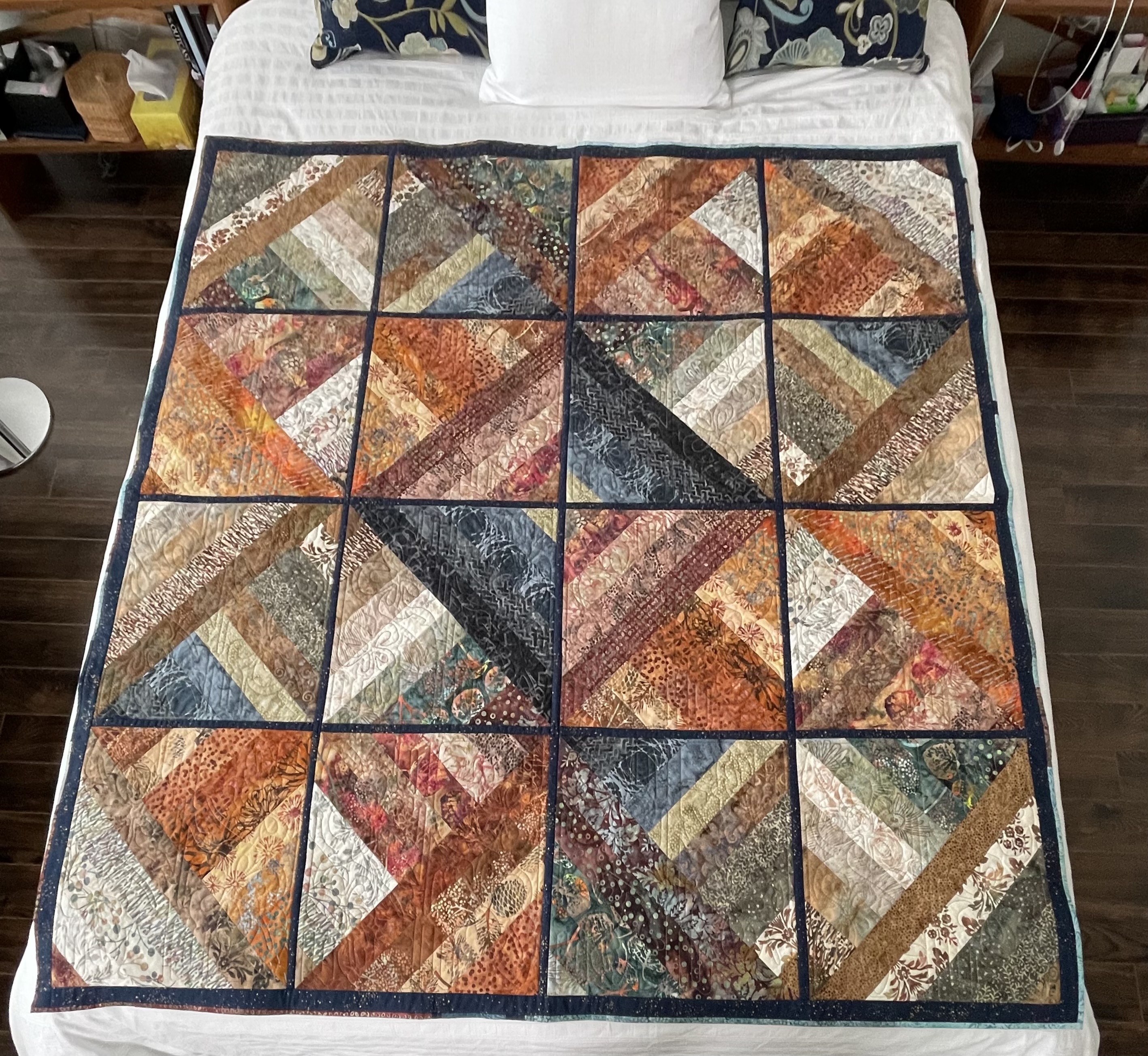
Once I got rolling again on piecing the quilt back, the quilt went reasonably quickly. I’d already set up an embroidery (320mm x 320mm) to quilt the project – using my “grand dream” hoop – 360x350mm. The hoop is “reversible” – the machine stitches out the right half of the embroidery design, then you rotate the hoop to stitch out the second half. So all I needed was to execute 16 repeats of the design. The quilting turned out quite nicely.
Poppy Field #1 – Top
Then I stitched the sashing “in-the-ditch” using a navy 50wt thread adjacent the dark blue so the stitches are barely visible. After I trimmed the backing, I had enough leftover fabric to use as binding. I’d initially thought I’d turn the binding completely to the back, but in the end I liked having 1/4″ showing – it added interest to the quilt top. Then I hand stitched the binding to the back. It blended in perfectly; you hardly notice it at all.
Poppy Field #1 – Back
Now I have the choice to display either side of this quilt – I’m almost tempted to show the back of the quilt in Parrsboro!
Just finished piecing the quilt back. I managed to get it a bit longer and a bit wider than the quilt top which will allow me to position the vertical pieced stripe further to the left a wee bit when I assemble the quilt sandwich.
I’m not sure how I feel about the unequal sashing on the pieced stripe – I suspect it ought to be symmetrical – the question is whether it wants both sides 1″ or both sides 1/2″? I’ll probably leave it as it is. Nobody looking at the finished quilt will even wonder about that possibility! They’ll accept whatever decision I made.
Now I have to think about binding fabric – I intend a hidden binding which will show only on the back side of the quilt; I suspect it should be pieced – I may be able to salvage enough from all four sides, after quilting, to make the binding strips which will then match (more or less) the four sides of the quilt! Wouldn’t that be nice. I’ll keep my fingers crossed.
BTW the quilt back is actually square. I’ll be able to ease out the wobbles visible in the photo when I place it against the batting. That’s one of the things I like about Warm & Natural batting – the cotton fabric clings to it so I don’t have to use a spray glue when I assemble the sandwich. Also, I’ll be able to smooth each section when I place the quilt in the hoop to quilt it. The slight excess of fabric will disappear. I’m not going to fuss about at this stage. A good spraying with Best Press will shrink the fabric and eliminate a good bit of the fullness.
I’ve been pondering the quilt back for many days – I have the four long strips assembled from the 2 1/2″ batik pieces which I’d originally intended using on the front and I wanted to incorporate them in some way on the back. I picked up what could have been some batik backing fabric at Atlantic Fabrics on Friday – there wasn’t quite enough of it for a single length but I thought it brought out the colours in the small strips so I bought what was there. I also picked up this blue batik on Sunday at Heidi Wulffrat’s shop in Mahone Bay – just enough for a single strip. However this quilt (because it’s a square) needs ~60″ in width – close to 20″ needed to augment this strip I’ve assembled so far.
I’ve attached one of the long strips to the right side, the second is sitting on the floor beside it. I’m going to intersperse something between those two long strips and I intend using a third but I also want to integrate the fabric I bought on Friday which also needs to be broken up in some way.
I’ll just keep working at this. I’m thinking about this – if I get it more or less pieced in an interesting way – as possibly the front of the quilt! I have to see how it all turns out.
I also don’t have a name for this quilt, either! Maybe something will come to me when I get it completed.
I’ve just added a 1″ border to the panel using the sashing fabric. My intention was to add another 3″ border built from 2 1/2″ cuts of the panel fabrics. I have the assembled strips, I’ve added one to one end – don’t like it at all!
The backing fabric I ordered arrived – the same navy sparkle that I had – whew! – I could now cut a wider outer border from the dark sparkly fabric but I’m not sure that’s what I want, either! I might be fine with this narrow outer border and consider the panel done.
I know my local fabric shop down the street from me has no batik that would work as an outer border (I want something darker rather than lighter) so I guess it’s a trip to Atlantic Fabrics and hope I can find something there.
I ordered another silk kantha bedspread ten days ago – it arrived day before yesterday. It’s a dark, rainy afternoon and the overhead light floods the quilt with yellow light. It’s actually more off-white/light beige with red and purple accents. It has red and white quilt stitching. It’s going to be perfect for a colourful summer jacket – this time with more flow and more contrasting colour to bring out the red in the silk blocks.
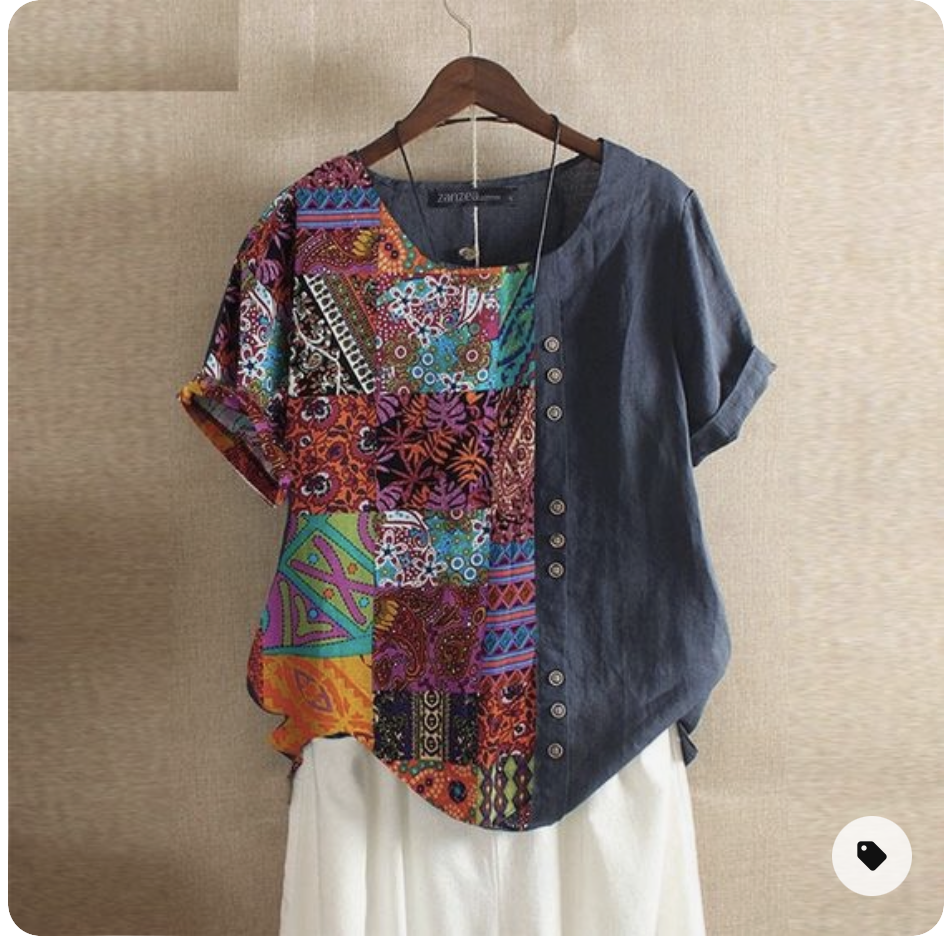
I bought a 90″ x 108″ quilt – that’s a ton of fabric – more than enough for two jackets! I’ll do one for myself first, then who knows what I’ll do with what’s left. A friend sent me a Pinterest photo of a summer shirt yesterday – this might work nicely done with some of the kantha.
Summer Shirt Idea From Pinterest
She’s right about that – it wouldn’t take much kantha fabric to do half a front, half a back and one sleeve! I’d use red linen for the other half of the shirt. Simple to make – a facing on the front neckline, a small binding on the back. It’s hard to tell from the photo whether the bottom of the shirt is actually scooped or just tucked into the bottom. I’d make mine straight with side slits.