Nightfall

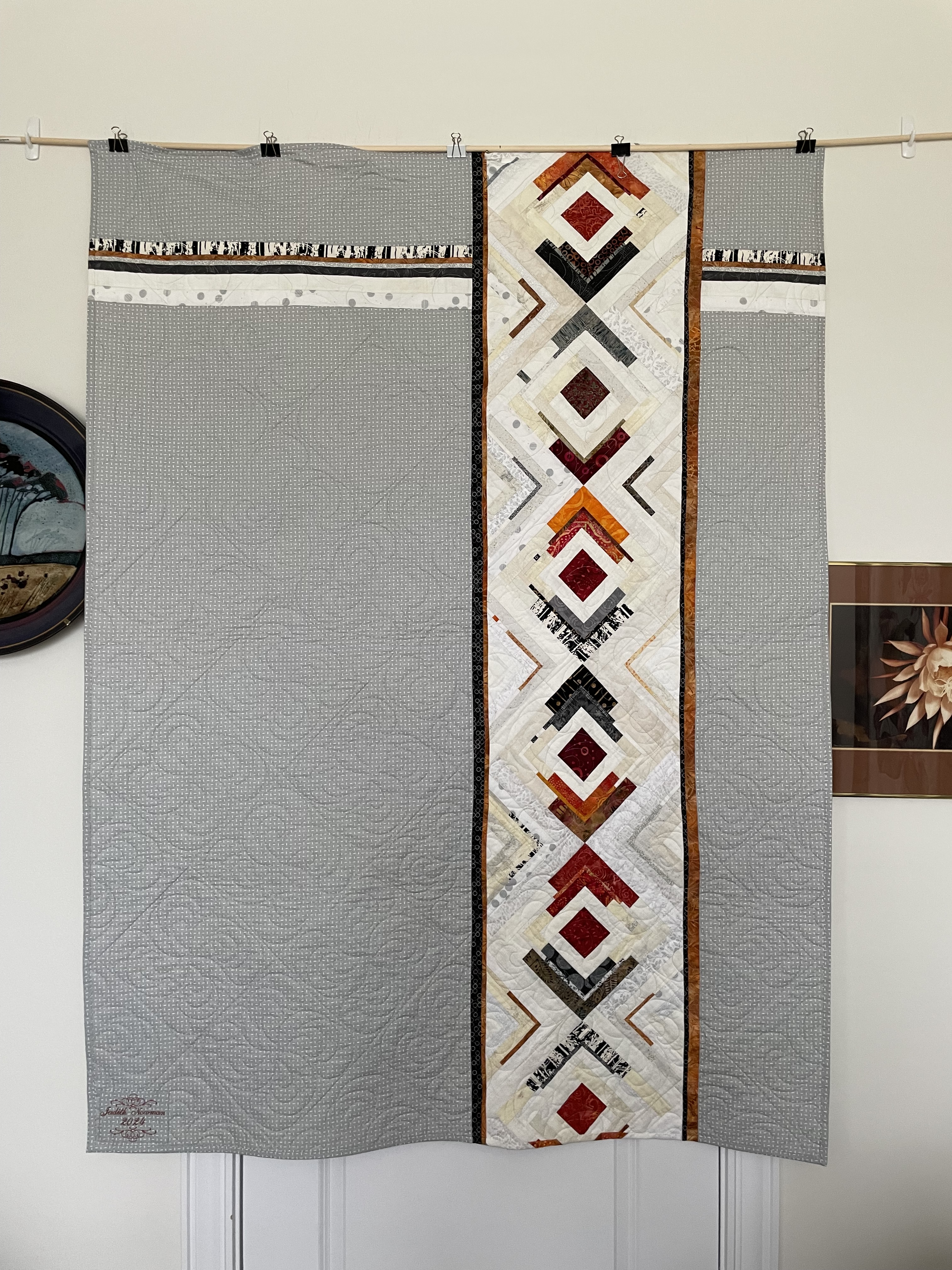
I finally finished this quilt this past week. It turned out to be a lot more work than I anticipated. I thought I was making a simple quilt block – square-in-square but that didn’t work out because of the colour flow I was after. In the end I had to construct each triangle element from scratch! Which took a lot longer.

The back took a lot of “walking around” time – I just couldn’t settle on an idea. One Tuesday evening when my friend Neha was here sewing with me (that’s another story) I made up five square in square blocks from leftover bits – that broke the log-jam and I was able to sort out a 15″ strip to insert in the backing fabric.

Then there was the matter of layout – I sewed most of the dark blocks together to begin with but then had to disassemble the partial panel because the colour flow wasn’t working. To get a decent colour flow, I ended up pinning triangles, and trapezoid pieces on top of the developing panel on a design wall I improvised in order to get a clearer colour placement. Then I had to take blocks apart to insert the new required piece.

I put the layers together. I created two possible block patterns using my out-of-date Pfaff Premier 2+ software (it still runs on my Mac but not for much longer I’m expecting – then I don’t know what I’ll do, because the cost of a subscription for the software on MySewnet is crazy expensive!):

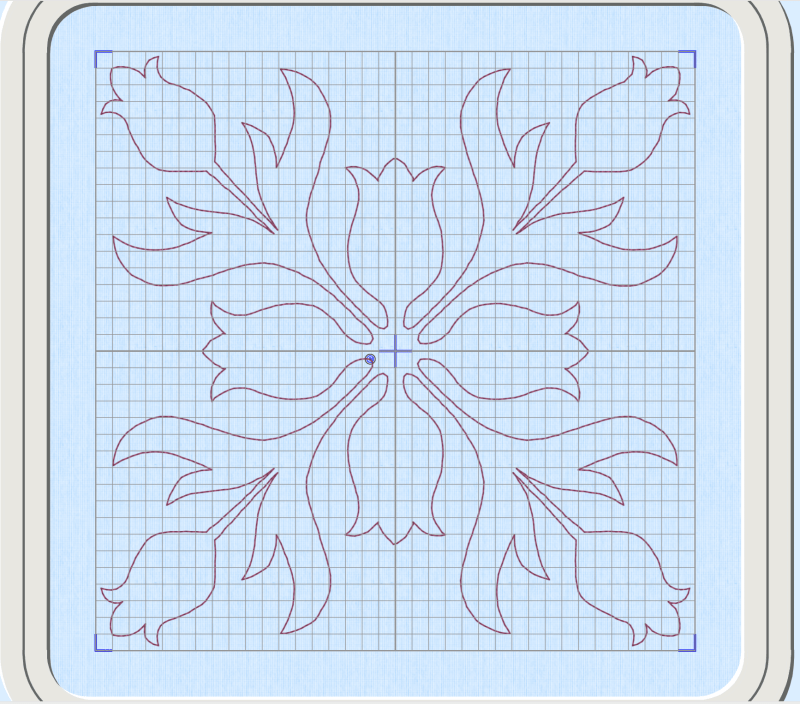
I chose Block 1 after doing a test run with some muslin and batting. I wanted the simplicity of the curves in the first design; I will use the Block 2 design on another quilt sometime.

Because the blocks were placed in the quilt on-point, I had to quilt on the diagonal. When all 44 blocks were filled in, I still had 18 triangle half blocks along the sides with 2 quarter blocks at one end to complete the quilt.

I also changed thread colour to match the colour gradation – I stitched the dark corner with an almost black variegated thread, the top left corner I quilted using white; in between I used three different grey variegated threads to blend with the changing colour. I used a light variegated grey on the back throughout.

I used the off-cuts from the backing for binding – which allowed me to match up the design on the back. I finally added a label.

I finished yesterday by hand basting a hanging sleeve at the top so I can display the quilt. (I still have 8 quilts that need hanging sleeves – gotta get those done over the weekend.)

I’m just about ready for the Craig Gallery Show:

If you’re in the vicinity do drop in!

Minimalist Quilt – Finished

It took longer than I had planned (a variety of distractions took over and slowed the quilt work), but this quilt if finally completed! Piecing the back needed improvisation – I was short about 8″ of backing fabric so I inserted a horizontal strip. In the end I decided to use the trimmings from the back to do a narrow 1/4″ binding which I hand stitched on the back.

I’m pleased with how the quilt turned out. I like the range of shades in the “background” elements and the placement of the strong log cabin blocks (in fact all the blocks are constructed as log cabin, although the dimensions of the background blocks (light coloured ones) is different than the brighter coloured ones – this was necessary to vary the placement of the thin elements in each block.

I still have a box full of strips from this quilt that I’m going to have to do something with – I have no idea what yet, but I think if I start sewing strips together I’ll come up with some kind of block I can use for a new quilt.

Coming weekend I’m working with a group of women on the Zippered iPhone Case. One of the gals wants to use a #5 coil zipper (a standard zipper is #3 coil) on a somewhat larger case. So I figured I ought to try one myself.

Zippered Case with Decorative Zipper

There’s a challenge to working with a decorative zipper! Because it’s placed on top, it’s not simple to attach it to the fabric and lining. The accommodations I made for the front pockets were relatively straight forward, but adding the side zipper made it impossible to slip the open-end lining into the back…

Botched “phone” pocket!

Because of how I applied the side zipper which involved stitching down the lining, it was impossible to slip the phone pocket in behind the zippered pocket on the side!

I have to take this whole project apart and start over – I need to come up with some other way of adding the lining to the zippered side pocket so it lets the phone pocket slip in where it should go.

Quilting The Quilt

After I finished the backing using the strip I created from the leftover blocks, I assembled the quilt top/batting/backing, pinned it all together.

I set up a couple of embroidery designs to audition for the quilting. The first was a straight line design that more or less followed the log cabin layout of the blocks – the first block stitched reasonably well; the second wouldn’t align with the first! So I carefully unstitched both blocks and returned to the drawing board.

Quilting The Diagonal…

Next I decided to try quilting on the diagonal, more or less following the piecing lines at somewhat unequal intervals… I did quite a bit of stitching before I decided I couldn’t live with it and again carefully picked it all out!

Quilting The Quilt

Third I set up an enclosed embroidery design that fit the 8 1/2″ block size. The problem I ran into had to do with my embroidery machine losing calibration each time I tried precise positioning the embroidery within each block! The issue, I thought, was the belt driving the “y” axis element of the embroidery unit was a teeny bit loose, as a result it slipped when I tried locating the corners of each block. The drag created by the quilt itself was too great for the unit to move the hoop consistently without the belt slipping and losing calibration.

I packed up my machine, embroidery unit, and quilt on Thursday morning; took it into the nearby shop so the repair guy who comes in once a week with the machines he’s fixed that week could see what was happening. I set up the machine on a table in the classroom, started quilting – all went smoothly! When Neil arrived do you think I could make the “slipping” happen? I could not. I rehooped the quilt a couple of times trying to position the bulk of the fabric so it would pull against the embroidery arm when I attempted to locate the corners of a block. I COULD NOT get the embroidery arm to go out of calibration. So I packed the whole thing up and returned home.

Before I set it all back up, I happened to visit my friend Deb who mentioned that the new Husqvarna Epic 3 machine warns new owners to make sure the machine is LEVEL so the embroidery arm works. Maybe I was having a problem with my sewing table having developed a dip and the machine was not sitting level, now. So I pulled out my trusty spirit level and placed it on the bed of the machine in front of the needle. Ever so slightly dipping toward the embroidery unit!

I loosened the feet on the unit to lift it a bit; not quite enough to bring the spirit level to neutral. I placed a small piece of foam core under the feet – that did the job. The machine was now level. Guess what – the embroidery arm hasn’t slipped since (well just once in the 16 embroideries I’ve completed). Whether that was actually my problem, or something else inadvertently fixed itself I’ll never know, but I’m starting to trust the embroidery arm again.

[I won’t bore you with the long story about how I broke the “y” axis drive belt on the embroidery unit; Neil repaired it, and it looks like the arm is now working as it should!]

Quilt Back Panel Assembled

Back Insert Assembled

This is the back insert now sewn together. It’s 6″ longer than the front which will allow me to use the trim for a hidden binding on the quilt back. I’m planning on a narrow rust/golden sashing, next to a wee bit wider black (with circles) strip, with an asymmetrical wider outer sashing in the light grunge fabric. The finished insert will be sandwiched between two soft grey fabrics with different small scale prints. Their colour doesn’t quite blend but I think the insert will override that slight difference.

Time to move on to other stuff – I’ll get this back done tomorrow; maybe I’ll even manage to create the quilt sandwich. Then I have to decide how to quilt the project. Once it’s pinned I’ll have a better idea what would work with the colour and texture flow. I’m anticipating straight stitching that is echoed at unequal intervals will likely look best (starting with some stitching in the ditch to stabilize the layers…).

Top Done!

Finished Quilt Top

Just finished sewing the panel. No more mistakes that had to be taken apart! The stitching went smoothly. What I’m liking when I see it like this is the shading within the background – not too in-your-face. That’s probably because the contrast is strong enough to draw your attention away from the background.

Now to start on a backing. I’ve got to make two more bright blocks to create an on-point vertical row and several background blocks to fill in as triangles. I have two suitable light grey print fabrics that work together. With a wide strip between them they’ll work fine. (The point is to use what I have in my stash!).

Assembling The Top

Partially Assembled

On-point blocks get sewn together along the diagonal with the end triangles attached to the side of the adjacent block. So what emerges are the quilt edges.

I have to work from one corner to the diagonally opposite one, one strip at a time, making sure I’ve pressed the “matching” seams to the opposite side from the previous row. You’d think it would be possible to work from one corner to the middle, from the other corner to the middle and join the two pieces – but you could find you’ve got the nesting seams pressed wrong! So better to start in one corner and keep going, even though you have to work with the increasing bulk of the growing top!

Another possible pitfall – the one I fell into – was to attach the last row in the wrong direction so the colour flow I wanted didn’t happen! I had to rip that seam, carefully, rotate the row and resew it. You can see, I’m checking position of the next row before sewing it!

I hope to have this assembled in about an hour…

Filled In…

Filled In…

The quilt top is finally filled in, although I’m probably going to change the two top corners. I did a kluge, building on a partial block I had left over from the light blocks which I cut on the diagonal. However, the orientation of the corner blocks is obviously out of synch with the rest of the triangle border – I have to build one more large block and cut it into quarters to get the corner orientation I’m after.

Also this probably isn’t the final block placement – I’m happy with the bright blocks, but the light ones are still place holding. Nevertheless, you get the drift of how the quilt top will look.

I have to clear some of the mess on my cutting table and around the machine I was using to piece these blocks before I can assemble the top. Also I now need to think about what to do with the back! And it’s not too soon to consider how to actually quilt the project. Because the piecing is intricate, I may not get away with an embroidery based on curved elements. I may have to actually do a lot of echo quilting along the diagonals – not sure how my back will stand up to that close work!

For now, I better build two new corner blocks for the upper corners…

Whew – I Made It!

I finished Drunkard’s Path #5 last night. I got the facing/hidden binding hand stitched down, the label added. It just needs a sleeve for hanging which I will do sometime today.

Quilt Top

Because the quilt was so wide (60″ x 71″) I had to add a wide insert into the backing fabric. I used corners I cut from the borders when assembling the front, adding in two of the leftover drunkard’s path blocks along with large cuts of scraps in the colour family I used for the top. I finished the quilt with a facing/hidden binding. It was a close thing – I had to fudge the fabric for the top binding with another scrap that kind of blended with the fabric there, and managed to salvage just enough from one of the side cut-offs to finish the top facing.

Quilt Back

I didn’t have enough backing fabric left over to make a label! I had to scrounge through my box of grey scraps to find something in the same colour tone to use. So, unfortunately, the label stands out, rather than seem part of the backing.

I just have a couple of small preparations to finish up (labels to print, dowels to cut to size for hanging, packing everything up for travelling) and I’ll be set for Friday morning’s departure to Parrsboro.

Quilt Top

Panel With Borders Added

I’m working away on this quilt. The top is now complete. I had to buy a 1/2m of fabric for the dark narrow inner border – there was nothing bright enough or strong enough in my stash to complement the panel. A quick trip yesterday afternoon to my local fabric shop and I was able to set up and attach the borders.

I cut all three border strips at one time, sewed them together, then added them to the panel, finally mitring the corners – much easier than trying to mitre each border strip individually and then struggling to get the mitres to align. Took less time, as well.

I’ve pulled out fabrics for the backing – I’m going to do a wide strip (24″) using large blocks of fabrics comparable to the scraps I used for the blocks. I have a couple of nice soft grey prints that will blend with the bright colours to finish the backing.

Quilt Panel

Finished Quilt Panel

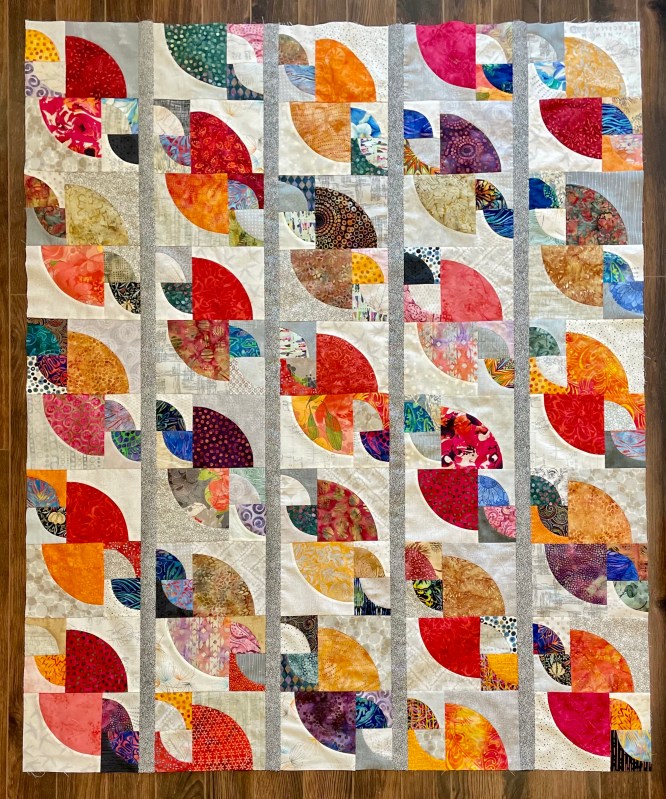
Interesting and several surprises. The overall “redness” of the panel is coming through – I intended that. I wasn’t anticipating the diagonal lines – the top left/bottom right “rope” like lines popped out when I laid out the blocks – I could have eliminated them by rotating the position of the blocks in columns 2 and 4 to replicate the orientation in columns 1, 3, 5 but that layout was uninteresting ( didn’t take a photo). I knew I was going to use sashing to join the columns – I thought it might interrupt the diagonals – it hasn’t.

The colour distribution is pretty good – no block jumps out saying “I shouldn’t be here!”. However, I laid the panel on the floor, took a photo, and the placement of four small drunkard’s path blocks smacks me in the face – you’ll have to look hard to find them all in the same column adjacent one another! Didn’t see it before sewing the panel together. I was focused on the large pie pieces, not paying attention to the small ones. Not taking the panel apart. I bet if I say nothing, nobody will notice.

Now the borders. This quilt is growing larger by the minute – with the planned borders added the top will finish at 62 1/2″ x 73″ – close to a double bed size! I will have to carry through, though, because were I to simply add an outer border using the sashing fabric, the panel will be diminished. I have to end with a lighter fabric on the outside, with a coloured element between.

I’m feeling the pressure to get this quilt done before the end of May – I want to include it in the Parrsboro show – so my goal is to finish the top today, construct the backing on Saturday, set up the quilt sandwich Sunday, then spend next week quilting. I lose Wednesday – I’m doing a workshop on making a Fidget Quilt – but maybe by a week Sunday I will have the quilting done – that leaves me a day or two to bind it.

BTW, I just googled “Drunkard’s Path images” and could find no picture of a quilt top that uses this array for the block. I guess it’s an original improvisation!