Who’d Have Thought…

Yesterday I pieced and attached the border for the circles panel. I had originally intended bordering the top using an almost black and an off white printed fabric. But when I opened out the border fabrics and laid out the panel on them, it looked all wrong. So I decided to try a border of graduated colours.

I auditioned the fabrics and thought it could work. Next I cut 3 1/2″ strips and placed them adjacent the panel. I cut pieces, mitred them together (including the corners) and attached the border to the quilt panel. But something didn’t feel quite right. I took some photographs. And when I looked at them I could see my problem: the bottom border had the mitres going in the wrong direction – your eye is pulled immediately to the yellow bottom left corner:

img_8096

First Bottom Border

I was going to live with it, but this morning when I got up I decided to fix that border. I knew I couldn’t just realign the joins – my border would be too short. So I started from scratch, cut new strips (or used what I had leftover from the first border), sewed them together and attached the border to the quilt,

img_8099

Second Bottom Border

It’s really quite interesting how that mitre direction makes such a difference. Now the colour story flows from top left to bottom right and the eye moves around, sees the shades of pale greys fading into the medium greys, into the darker greys/black at the same time the yellow blends with the oranges and reds rather than standing out.

Wouldn’t have thought it would make such a difference.

I have my embroidery machine set up with rayon thread (I have selected several shades of red), a new embroidery needle (an embroidery 75), my sewing star foot (which has an open toe), and a narrow blanket stitch. The quilt top has been pinned to batting and I’m now ready to stitch around all the raw appliqué edges. I won’t get to that until Thursday – tomorrow I have to return to Parrsboro to pick up the two quilts I left behind for the art exhibit featuring all the artists who had shown during the season.

“Double Vision” Quilt

A while back I purchased and downloaded a quilting book by Louisa L. Smith: “Double Vision Quilts“. She makes interesting quilts by “layering” – using raw edge appliqué on structured pieced backgrounds to create an illusion of shapes such as curves without having to do curved piecing which is an advanced sewing skill!

double-vision-book

Her quilts are all quite lovely – beautiful colours, interesting ideas. The one that caught my eye was a quilt she calls “Circular Anomaly” – the quilt has a pieced under layer which shades from black to white (bottom to top and from left to right). The top appliqué layer uses dark red to a golden orange from top to bottom – starting with “X” shaped pieces at the top in dark red on the light under colours to the golden orange on the darkest colours beneath. The finished quilt is intended, I’m guessing by its size, to be a wall hanging.
anomolyI liked the idea but wanted to make a full sized lap quilt so I increased the number of background blocks as well as the block size – my finished panel ended up at 41″ X “54” – which means I will also want to add a border of some sort to make the quilt 47″ X 60″.

I considered other colour combinations: blues for the background with green appliqué elements or green background with purple-blue appliqué, but in the end I decided I really liked the colour combination Smith used so to start the project I scoured my fabric stash (scraps, largish pieces, fat quarters, other quilting fabrics) pulling out all the black-grey-whites I had. There were quite a few although not quite enough for the  under panel so I bought 6 more 1/4m fabric pieces in greys. I had a lot of reds – from very dark to golden orange; I’ve gone with what I have:

img_9653

Fabric for “circles”


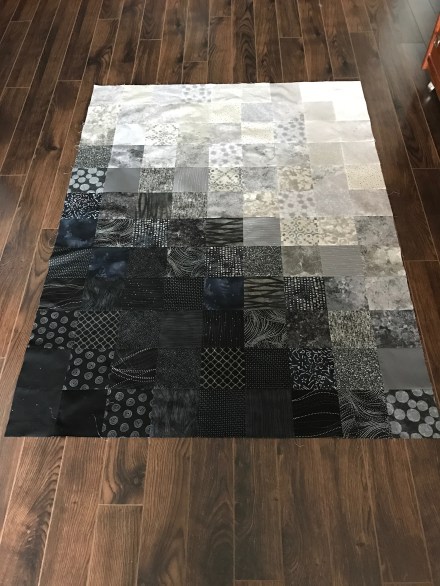
I cut out one hundred twenty (I needed 108 but wanted to have extras so I could control the colour flow) 5″ squares from the black-grey-white fabrics and assembled the 9 x 12 base layer:
img_9010

Background layer

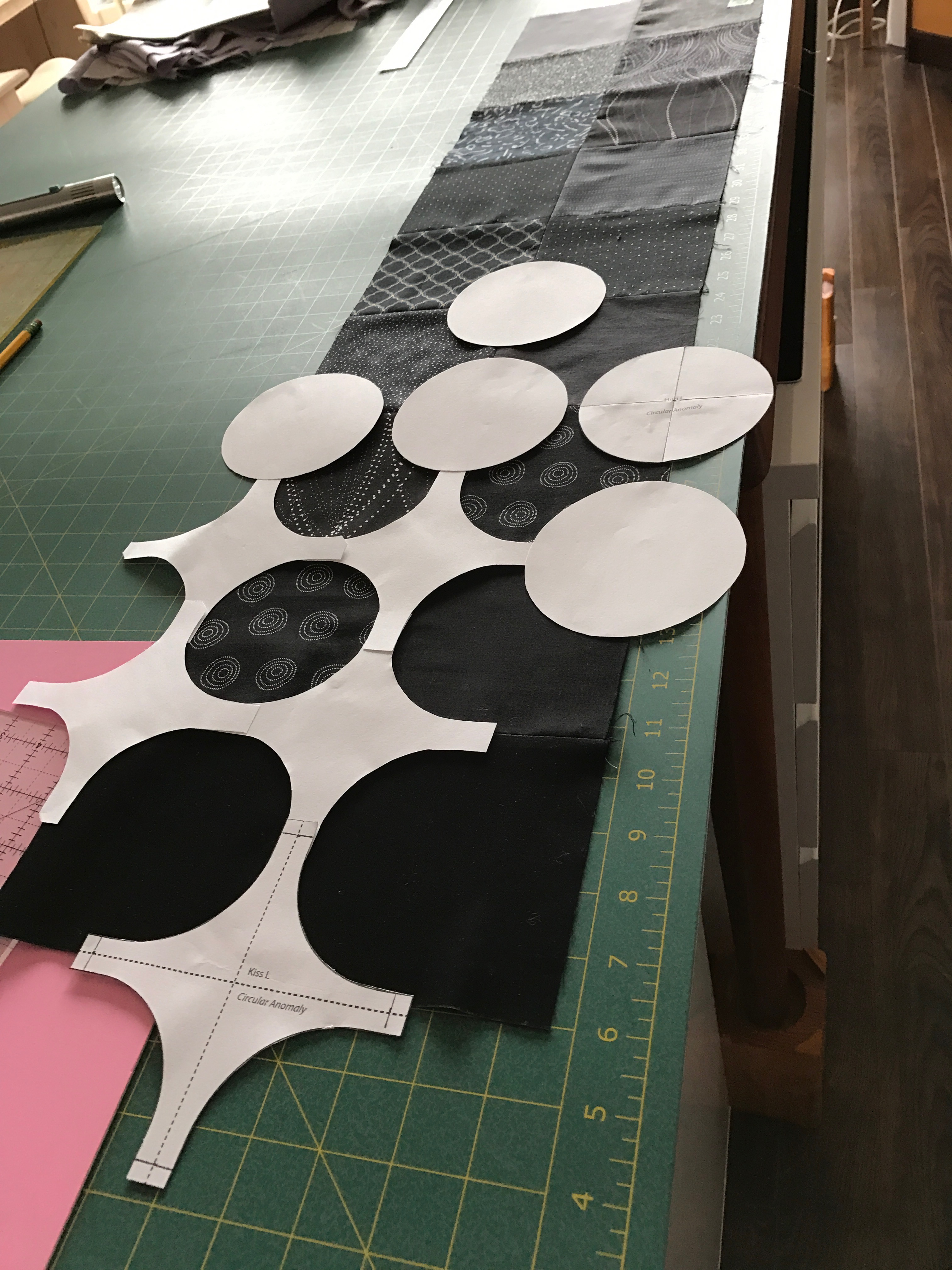
Next I had to figure out what size “X” and “circle” elements I’d need and how many (I’m not following Smith’s directions, right? So I had to calculate this for myself). I began with Smith’s templates but upsized them by screen-capturing the two elements, then printing them at 115% which, in the end, gave me the size I was after.

img_6170I decided a finished circle of 4″ would work; the “X” ended up with a 2.5″ arm length from the center to allow a bit of overlap.

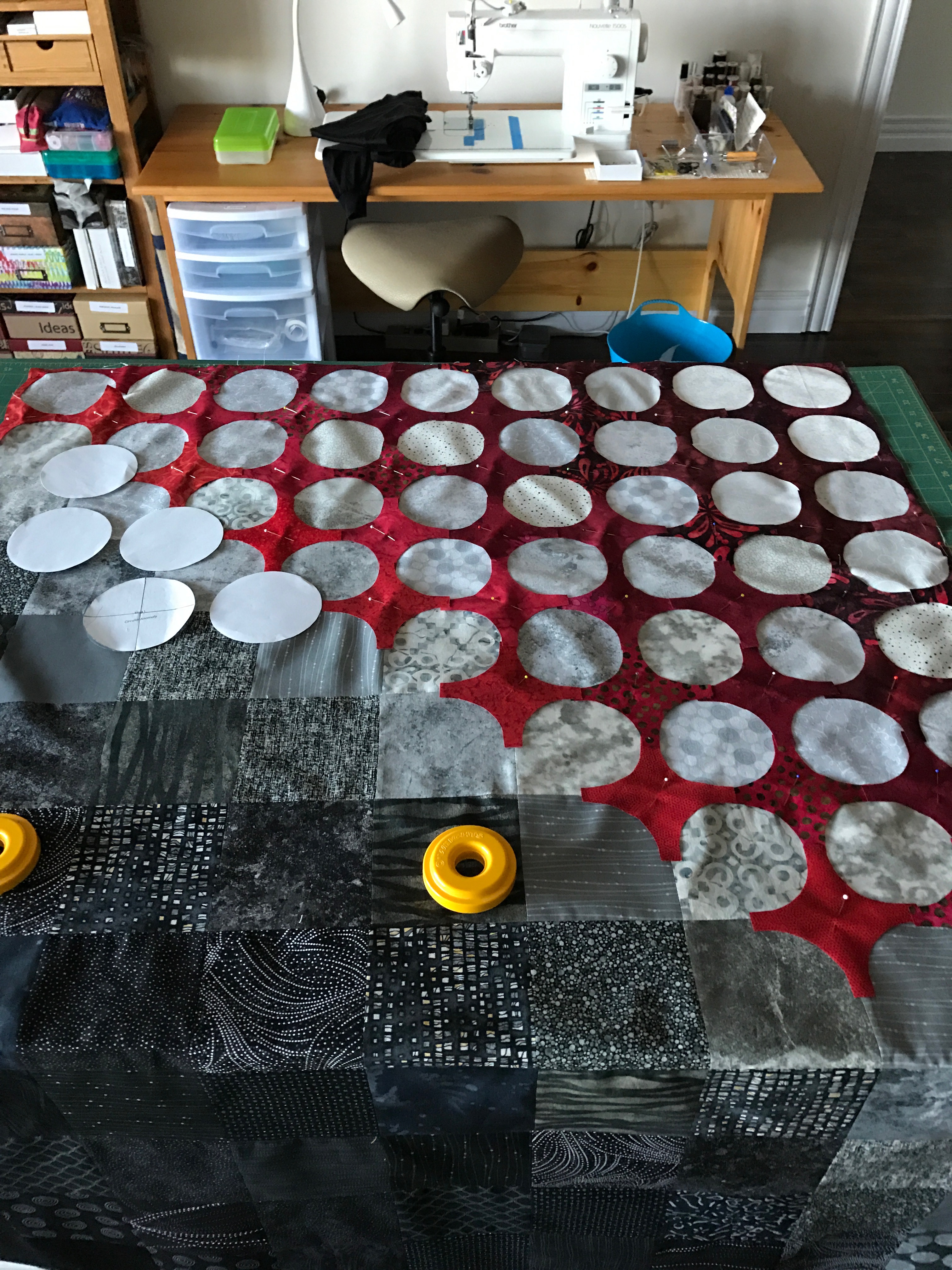
I cut 4 1/2″ strips of “Wonder Under” – Pellon’s 805 light weight fusible paper backed iron-on adhesive, drew the circles and “X”s on the paper side of the strips, then fused the strips to the back of the red fabrics. So far, I have carefully cut out the “X”s and pinned them to the background being careful with the colour gradient from dark in the right top corner to medium red along the diagonal :
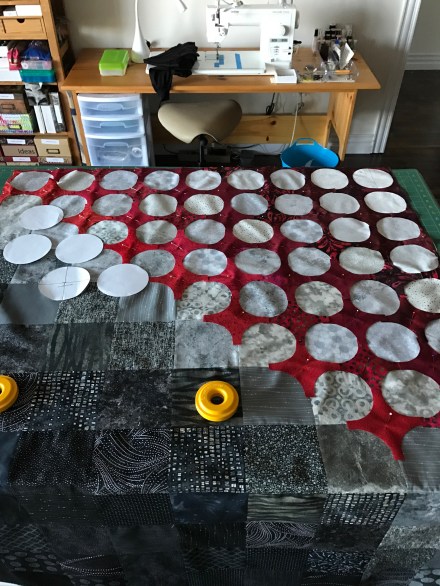
img_6161

“X’s pinned in place

Next step: carefully fuse the X-shaped pieces to the background before creating and cutting out the circles. I’m aiming for asymmetry here, so there will be more circles than “X” pieces. Once all the pieces are fused in place I will need to edge stitch them to the background. To do that I’m intending to cut my batting and apply and pin it beneath the background to bypass the interfacing step. The batting will provide enough stability (the cotton sticks to it nicely) that I should be able to control the stitching process. I’m planning to use a small blanket stitch rather than satin stitch which I think will be heavier than I want (Smith did use a satin stitch in her quilt).

Once the top stitching is done, have to think about some kind of quilting to hold the top-batting-backing together. The design does call out for some kind of stitching within the circles and the “X” pieces rather than an all-over quilting design but I haven’t yet figured out how to do that – I want to try hooping the quilt as 9″ blocks (4 background squares at a time) and embroider within the circles and “X”s. I will have to see what single-run design I can come up with to fill the positive and negative spaces in an interesting way.

More later as I progress further.


I’m Back – Show at Art Lab 2016

I’m finally settled into the apartment! There are still a few things to do but for the most part it’s now home.

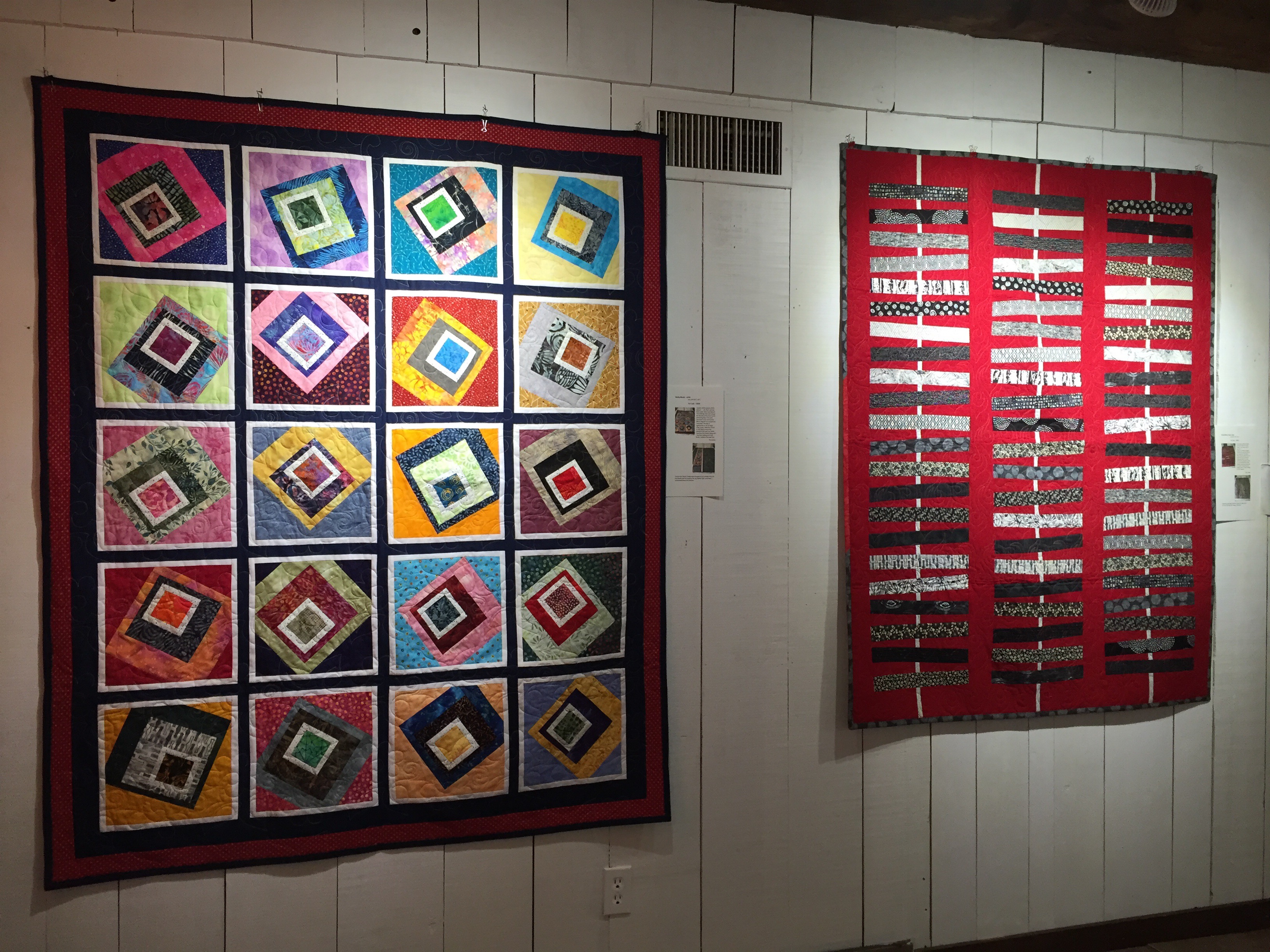
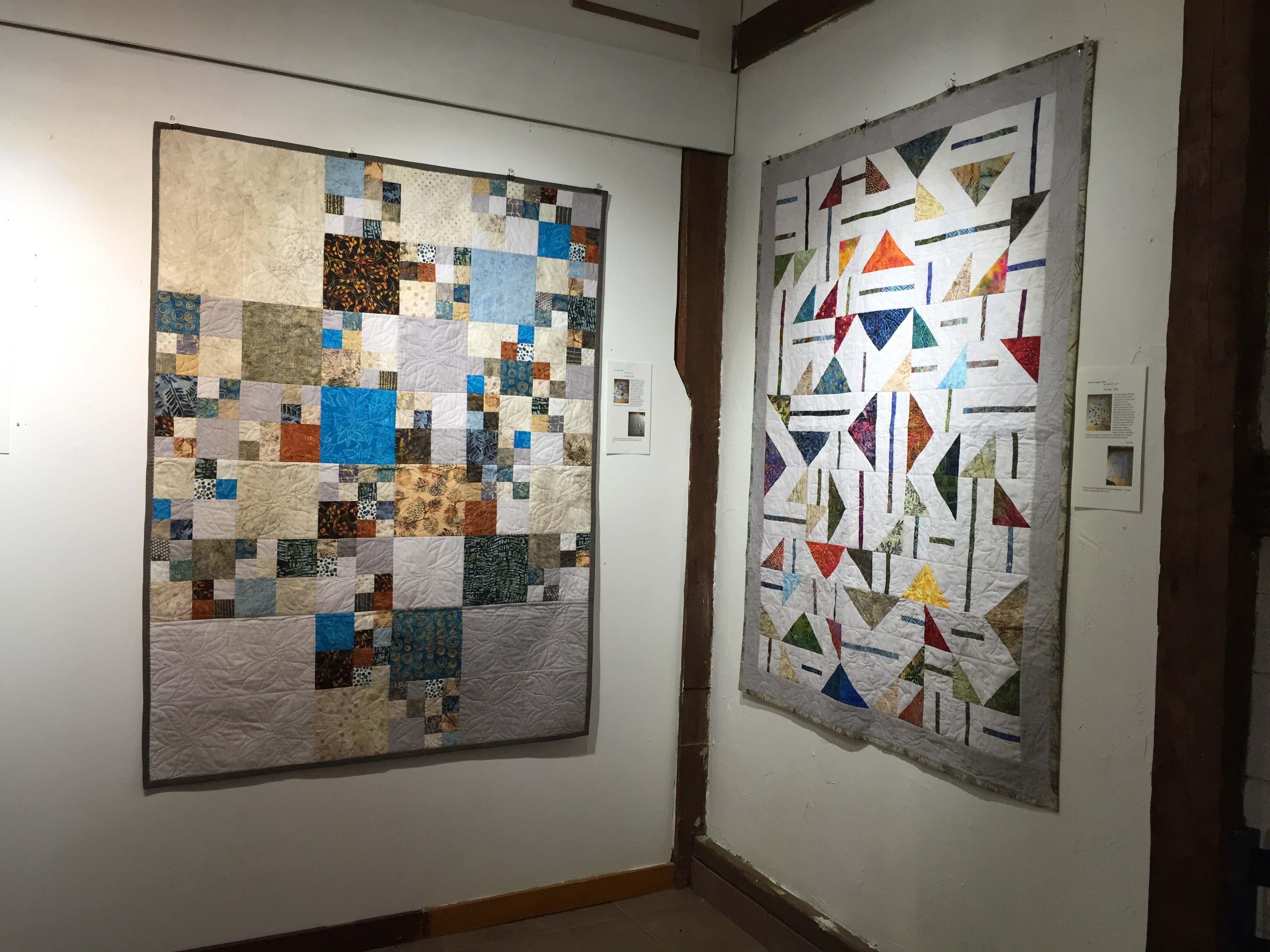
Yesterday I traipsed to Parrsboro with 10 new quilts and 3 wall art pieces. They’re on show at Art Lab till Sept. 7. We spent the afternoon hanging the exhibition and I was delighted with how well the pieces all show.

Improv #7 – Quilt Back

Flying Geese – corner to corner

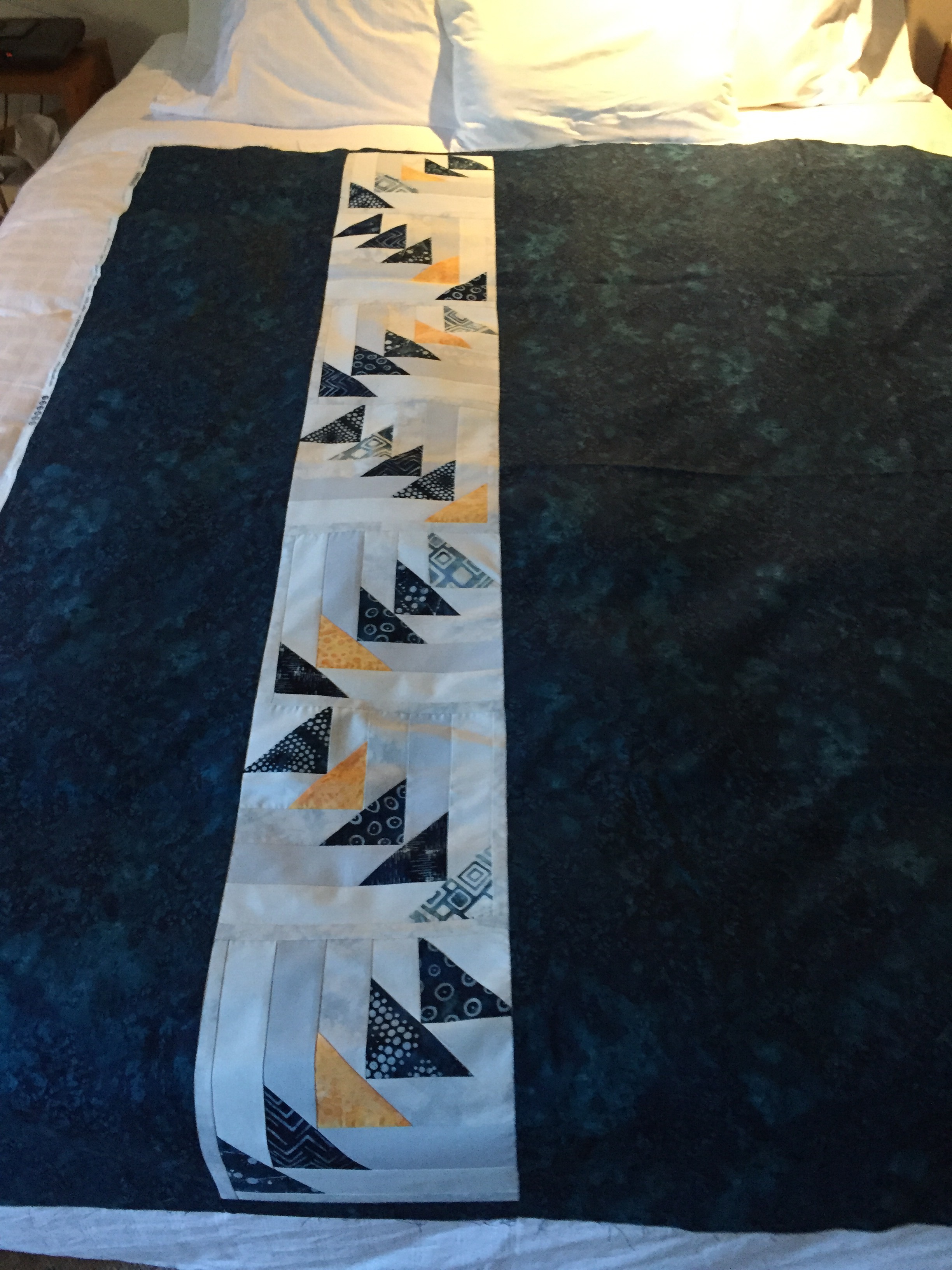
I made just eight blocks for the back (needed only seven) but I want to do a whole quilt top using fabric from my scrap box. I think I can arrange the triangles in some interesting random array.

You can see I did add a bit of golden yellow in the insert – I thought the teal hues alone were a bit drab given that the top used a limited colour palette.

I’ve now pinned the top, batting and back together and am ready to quilt the sandwich. I’ve set up an embroidery design for the 360 x 200 hoop – by my calculation it should take 35 (5 x 7 array) repeats to edge-edge quilt the whole thing.

Quilting Again

Finally finished the clean out of my townhouse on Friday. There’s still stuff to be given away and put in the trash, but the big purge is done!

So yesterday I was able to resume quilting. This quilt was about half done – I had 16 design repeats left to embroider; I did 10 after fighting with my embroidery machine for an hour: it was refusing to sew with the cotton variegated thread I had been using without breaking it repeatedly. 

I did the usual things: rethreaded both top and bottom thread, change the needle, cleaned lint from top thread path, cleaned out the bobbin thread area…. I even tried straight stitching on scraps with the cotton thread, with polyester – the problem was the cotton thread, perhaps a weak spot, because eventually I was able to embroider/quilt with it and was able to complete the quilting. Trimmed the excess and bound the quilt.

Quilt Top

Quilt Back


This is Quilt #8 which I’ve completed for the show in Parrsboro end of August. #9 (shadowed blocks) is pin basted and ready to be quilted. I set up a block design and a border embroidery last evening – I’ll begin working on that today. 

I am hoping to create a 10th quilt before the move. I won’t have access to my machines for three weeks and will be busy setting up the apartment early August. I know what I want to create for the top (still pondering what to do with the back). So I’ll get started on the quilting and do the prep work for #10 in the next few days.

Happy to be sewing again!

Jellyroll Quilt Class I

imageThe class came about when I showed Bonnie this jellyroll quilt made from a jellyroll I’d “won” one evening at an event at her shop Sew With Vision. “Good idea for a class she said.” I agreed to do it.
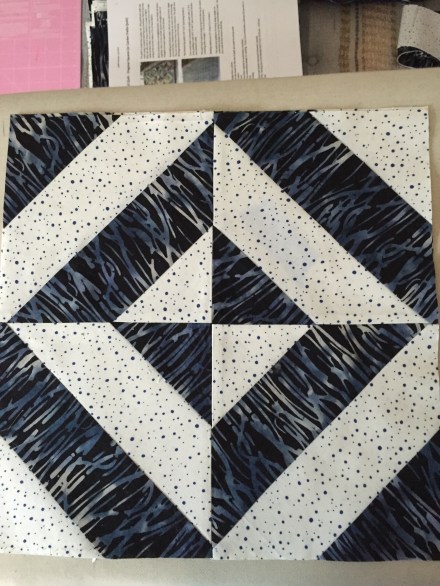
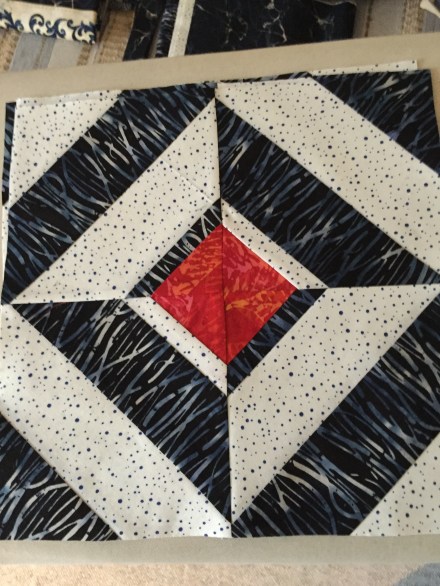
However I had no interest in taking another jellyroll and repeating the quilt for the class so the challenge I set for myself was to create a strip quilt with just two fabrics. I picked out two contrasting fabrics and got to work.

image

I joined pairs of strips – one light, one dark. Cut triangles (8 from each pair of strips), joined pairs of triangles to make 6″ blocks, trimmed them, assembled large blocks from four small blocks alternating colours at the center of the big block.

I’d made five large blocks when I thought I needed a bit of colour to make the quilt work.

image

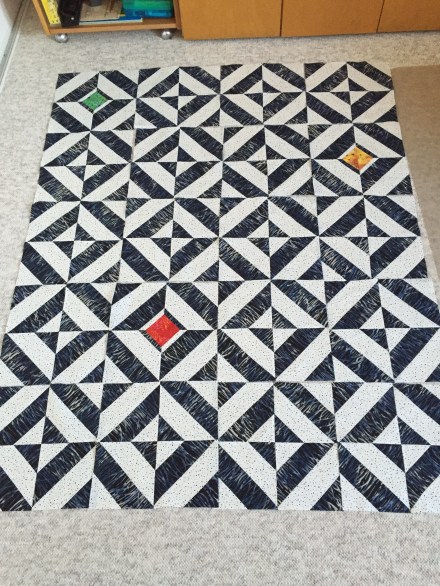
I inserted a colored center into 3 blocks and stopped there. I finished the remaining blocks today and laid them out on the floor:


image

Not enough colour. So I added a bit more

imageThat’s it. I was going to add sashing but I think any sashing will disrupt the improvisation so I think I will leave well enough alone although I will probably lay out a couple of sashing strips to see how they look.

I’m stopping for now.


Modern Quilt II – Improvisation


Saw a photo of a wall hanging on Pinterest based on large “wonky” curves. I’ve never really tackled curves except on the princess seams of a jacket where you have to join a convex edge to a concave one. Curve sewing seemed a good thing to learn to control. The technique is the same here as it was on the jackets except the curve is more exaggerated making the sewing more complicated in order to have the seam lay flat! 

The curves are also improvisations cut with a rotary cutter – no pattern, no templates, just free-form cutting. The first few cuts were nerve-wracking – what shape curve to cut, from where to where,… It took a couple of blocks before I started to get the hang of what I was trying to do. 

I started with 12″ blocks of each fabric, paired them up, and began cutting. I swapped the corner of one block with the fabric beneath – each cut yielded two blocks each consisting of two different fabrics. I realized on the first pair of blocks I needed to insert a thin accent strip in the block – so two curved seams! When I finished each block the outer edges were no longer straight – the blocks needed to be trimmed and squared. The resulting blocks ended up 10.25″ x 10.25″.

To join the blocks I used 1″ sashing giving me 1/2″ separations between each block. The borders are 2″ strips.

I bought backing fabric this morning (before the snow starts falling this evening). Tomorrow will definitely be a sewing day.  I’ll have to think about what improvisation to use for the back – it should be something that suggests curves!