A New Quilt

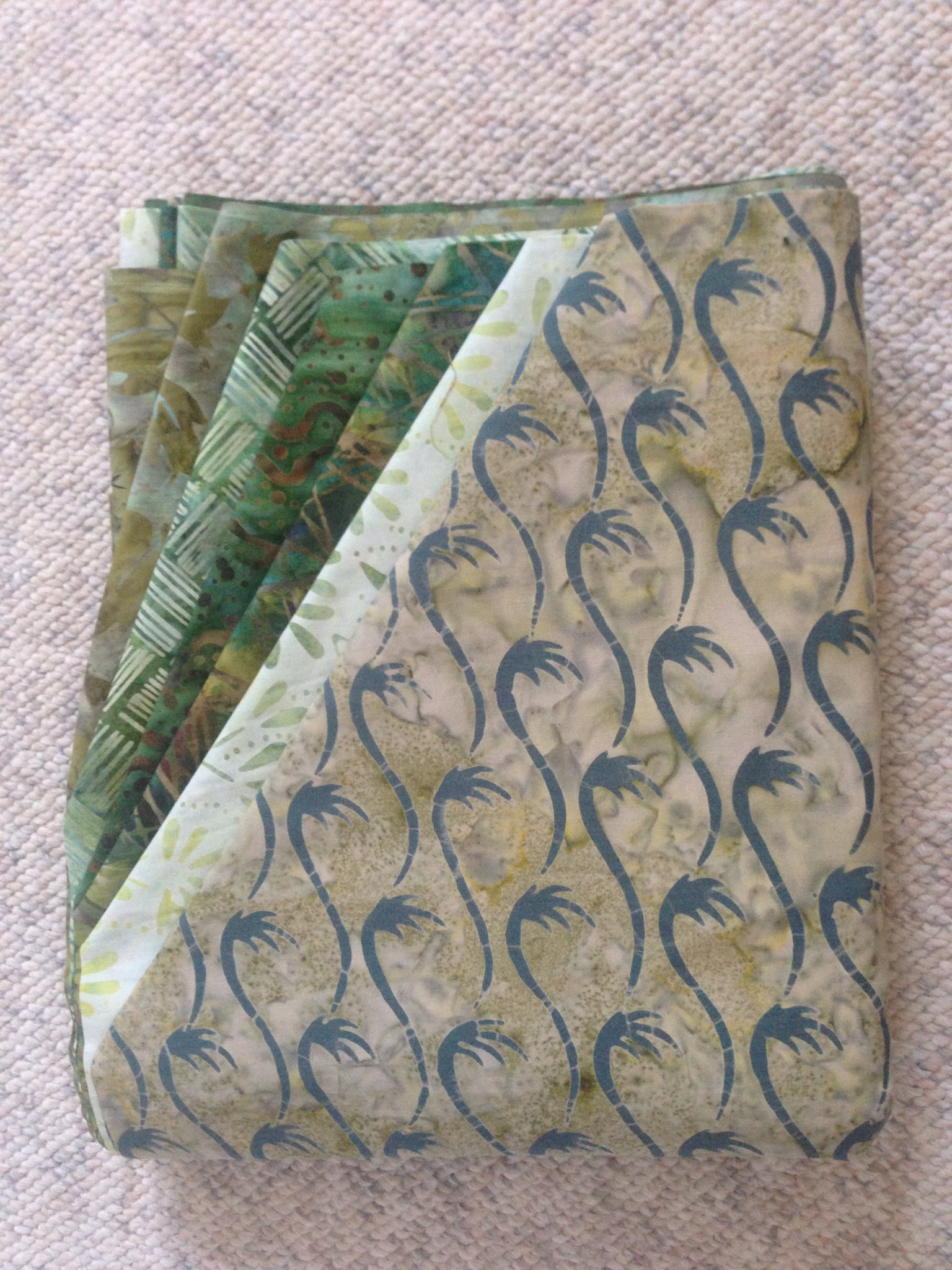
Start with a jelly roll of red batik fabrics from my stash (a jelly roll is a colleciton of 40 strips each cut from the width of a different but coordinated fabric producing a set of 2 1/2″ strips approximately 44″ in length).

Choose 28 strips (making sure to have some light strips, some dark strips and some middle value strips), sew them together in groups of four, then cut into 8 1/2″ blocks. Now what to do with the resulting 35 blocks?

In other quilts I’ve put two blocks right sides together with the stripes at right angles stitched around the outside, then cut into 4 along the diagonals.

This time I simply cut the blocks into halves along the diagonal giving me “half square triangles”. I thought about mixing the striped HST (half square triangles) with light solid triangles and join them without sashing, but the resulting quilt would have been a bit too small. I played with the triangles – decided to sew them together along the diagonal. Next I arranged the resulting blocks into a 5 x 7 array – what emerged were strong diagonal lines that I didn’t expect. Add sashing and a border and the quilt top is done.

For the back I made a few more blocks, bordered them with the light fabric and inserted the strip into the backing fabric.

I finished the quilt this morning. I wasn’t sure it would turn out as I wanted it – the pinned backing fabric wasn’t as smooth/flat as I usually manage to get it but in the end the quilt stitched up nicely.

Modern Quilt II – Improvisation


Saw a photo of a wall hanging on Pinterest based on large “wonky” curves. I’ve never really tackled curves except on the princess seams of a jacket where you have to join a convex edge to a concave one. Curve sewing seemed a good thing to learn to control. The technique is the same here as it was on the jackets except the curve is more exaggerated making the sewing more complicated in order to have the seam lay flat! 

The curves are also improvisations cut with a rotary cutter – no pattern, no templates, just free-form cutting. The first few cuts were nerve-wracking – what shape curve to cut, from where to where,… It took a couple of blocks before I started to get the hang of what I was trying to do. 

I started with 12″ blocks of each fabric, paired them up, and began cutting. I swapped the corner of one block with the fabric beneath – each cut yielded two blocks each consisting of two different fabrics. I realized on the first pair of blocks I needed to insert a thin accent strip in the block – so two curved seams! When I finished each block the outer edges were no longer straight – the blocks needed to be trimmed and squared. The resulting blocks ended up 10.25″ x 10.25″.

To join the blocks I used 1″ sashing giving me 1/2″ separations between each block. The borders are 2″ strips.

I bought backing fabric this morning (before the snow starts falling this evening). Tomorrow will definitely be a sewing day.  I’ll have to think about what improvisation to use for the back – it should be something that suggests curves!

Art Quilt #3 – Toward the Future

IMG_4323

Click on photo to see detail.

I didn’t take a lot of photos along the way – in part because this project has been sitting around since last April – I knew what I wanted to do with the piece, but somehow it just didn’t make it to the top of my list until about 10 days ago when having finished the third pair of pants I thought it was time to do something with this quilt art work.

Finished dimensions: 18″ X 21 1/2″; it’s a “mixed media” piece – the foliage and the boys are photos printed on fabric (the printed foliage cut and pieced to create the canopy), the foreground elements are pieced quilting fabric to blend with the rest of the materials. The “matting” is raw silk; the border – batik. The boys and the background are two different photos – I had to fussy-cut them from the 8 1/2″ x 11″ printed fabric sheet so I could appliqué them into this background – two young lads walking toward the future created an interesting image, I thought.

To begin with I intended creating the foliage using a variety of green fabrics but nothing was successful – the colours were wrong, didn’t blend, didn’t look like leaves/trees. In the end, I opted to do this piece as mixed media, combining photography with appliqué quilting. I was happy with how the foliage turned out.

To enhance the intensity of the colour of the boys outfits I used oil pastels; permanent markers were helpful for blending thread colour into the fabric. The point was to end up with as realistic an image as I could manage using whatever materials let me do that. I decided not to be inhibited by any “rules” for doing art quilts. I did what worked to create the outcome I was after.

This art quilt I’m keeping – now to find a place to hang it. 

———–

March 28 2015

I follow the work of Melody Johnson – an art quilter who backs her “quilts” with a painted MDF board. I thought that an interesting idea and decided to try it on this quilt:

IMG_4516Definitely gives the piece a more finished look. I like how the blue border lightens the fabric “frame” and gives a strong edge to the work.

I have to take another look at “Asparagus Field” and think about whether I want to do the same thing with that.


The Quilt Challenge 1

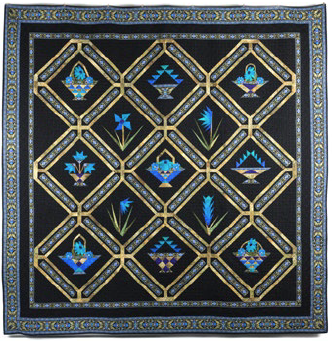
Each year Craftsy offers a BOM (Block of the Month) quilt. I got an email letting me know the 2015 quilt was now available so I took a look at it.

Screen Shot 2015-01-15 at 1.41.44 PM

Can’t say I was particularly taken by the dark background but the block elements were interesting and I’m sure would present a challenge. In any case, I did register (it’s for free) and downloaded the January block but didn’t think I’d do anything with this – until yesterday.

Yesterday, I was at Sew With Vision, doing an afternoon session about my trip to Bali with a surprisingly large group of women (to share a lunch of Balinese chicken curry on rice and to show off the fabrics I brought home). When I arrived Nancy, one of the gals who works at the shop asked me if I’d seen the 2015 BOM quilt – she had decided to try it, not using the quilt kit offered by Craftsy, but using her own chosen fabrics. She was picking fabric bolts from the shelves and I found myself involved in the selection process. When Nancy began cutting 1/2 m pieces I thought, what the hell, I’ll have a go at this, too, so I asked her to cut me a set of the same fabrics, which she did.

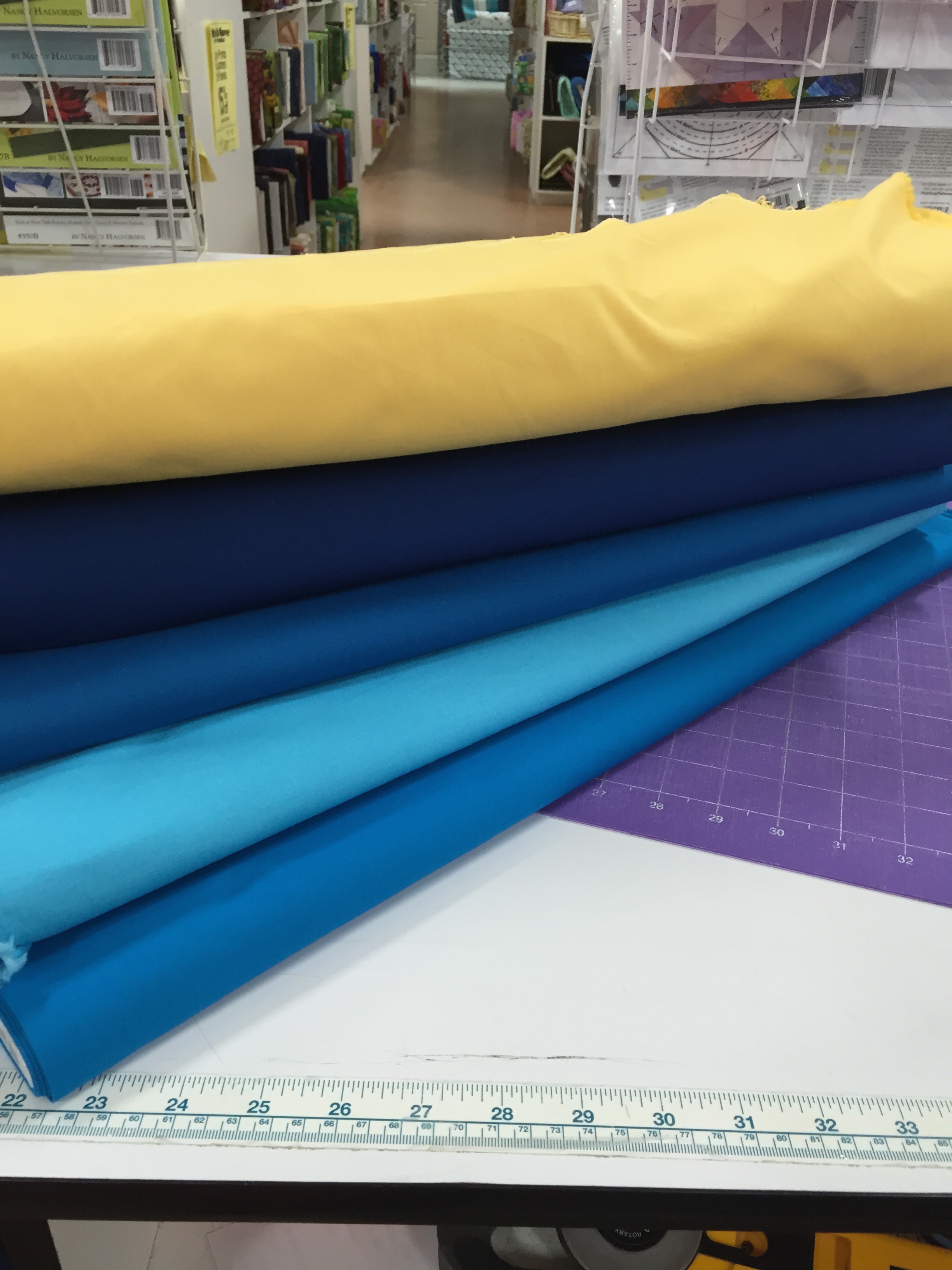
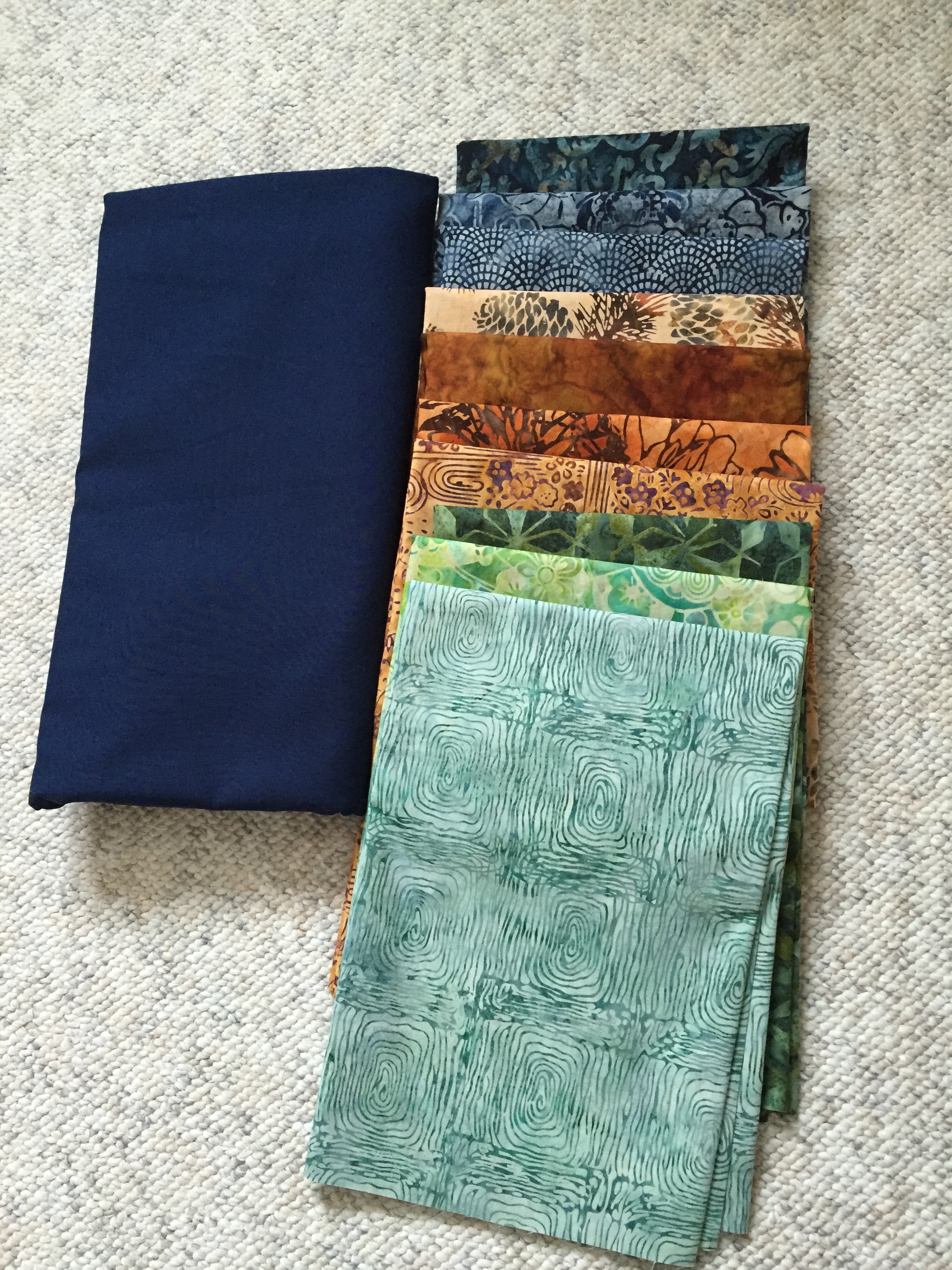
Today I went to Atlantic Fabrics to see if I could come up with a solid fabric (or something with a minimal pattern) to use as background. I started at the Kona cotton collection of solids, pulled out an egg-yolk yellow, then a dark blue/teal, then a slightly lighter blue/teal, then some turquoise. I took all 6 bolts to a cutting table, laid them in an array, then auditioned my batik fabrics on the selections.

IMG_4193

Wasn’t difficult to see that the darkest of the colours I’d chosen would work best with the batiks.

IMG_4198So now to watch the videos on the January block and get something under construction.

That’s the challenge – it’s a personal challenge between Nancy and me to create a quilt based on this 2015 BOM design. Right off the bat, I know I’m not going to make the 90″ x 90″ (queen size) quilt that’s intended. I’ll probably make something smaller like maybe a 60″ x 60″ lap quilt. That will mean adjusting all of the blocks down 1/3 in size. Or I might do a more conventional lap quilt size – 48″ x 64″ which will mean changing the layout of the quilt blocks as well. Not a big deal – I need to get out a pencil, ruler, graph paper (and calculator) and get to work. Once I’ve decided what kind of quilt I want to make, I’ll start drafting the January block and see how it turns out.


Kaffe Fassett/Philip Jacobs Quilt – Finished

2015/01/img_4167.jpg
Just finished the Kaffe Fassett/Philip Jacobs quilt this afternoon. Got the in-hoop quilting done yesterday, along with the border. Today I added binding and a label.

I’m pleased with how the quilt turned out. No name on it yet. For now it will live in the collection.

The back of the quilt includes a strip pieced from scraps – again to make the backing fabric wide enough so a single length would be enough. And I like the added detail on the backs – makes the quilts more interesting!
2015/01/img_4169.jpg

Tipsy Squares

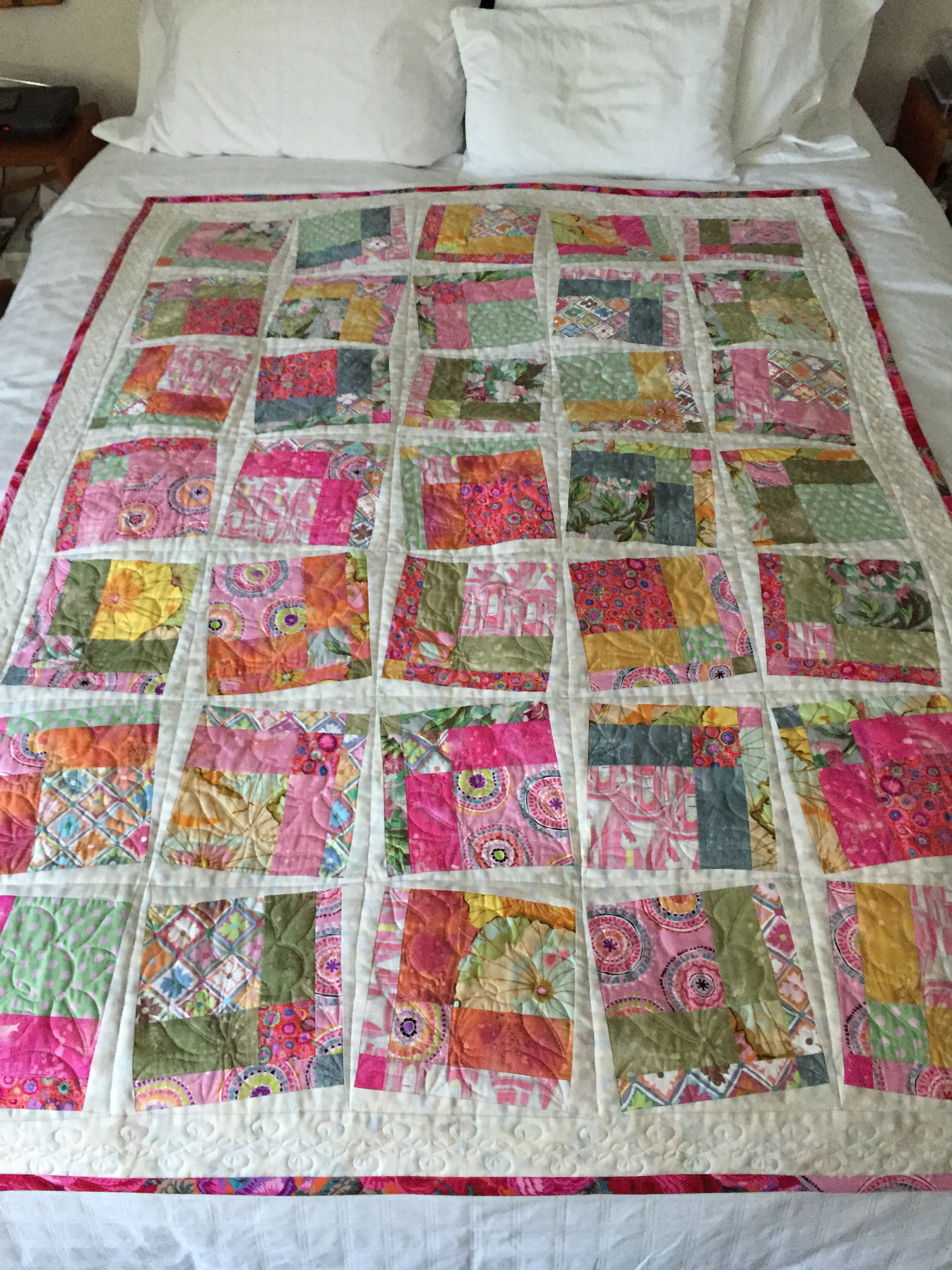
Finally done. I’ve been working on this quilt for a couple of weeks now. It started out as an unequal 4-patch based on an idea for a charm pack (5 X 5 squares). I used the fabrics I bought at the Kaffe Fassett lecture in the spring.

I cut and sewed the 4-patch blocks but they were too small for a 5 x 7 quilt – I needed to add fabric so I added another layer on the edge. BUT I cut the strips too narrow – the blocks were still too small for the final dimensions I was after. So I decided, rather than just add sashing, to add triangles around each block which resulted in a “tilted” block. Seventeen blocks tilt in one direction, eighteen tilt in the other. So I had to lay out the blocks in the order I wanted them and add the correct triangles to each so that the layout I was after would be in the finished quilt top. Finally I added a 3″ border around the outside. The finished lap quilt will be 48″ x 65″.

IMG_4158I worked out the triangles by trial and error – I wanted the tilted block to end up 8.5″ wide – in the end that meant I needed a triangle cut on the diagonal of a 2 1/4″ x 9 3/5″ rectangle. Applying the triangles is tricky – can’t chain the sewing – each block has to be done individually – the first strip is partially sewn on, then the other three sides are added, and then the first side is stitched to the end – that’s necessary to get all the triangles sewn in place equally. In the end, it wasn’t applying the triangles that was difficult, it was sewing the blocks together – I didn’t quite manage to get all the points to align perfectly. But once the top is stitched in the ditch and quilted that isn’t going to show – only a very experienced quilter is going to notice that detail!

These are the blocks before triangles (just the block in the upper left has triangles added).

IMG_4148

Quilt for Noah

I bought the fabrics for the quilt for Noah at Keepsake Quilting in New Hampshire on my way back from the trip to Toronto late August. Six fabrics in shades of green/teal that worked with the photos I’d taken of the paint in his bedroom.

IMG_3190

Next, I looked through my Pinterest collection of quilts but nothing stood out. In fact it seemed that given this was to be for a boy’s bed it ought to be simple without a lot of piecing. So I decided to base the quilt on the lap quilt I’d made for myself:IMG_4072

Noah’s is a double bed – I’d bought the fabrics planning to work with the width so I didn’t have enough length in each fabric to make strips the full width of the large quilt without some piecing.

IMG_4074

So I inserted strips mid way, and at each end to expand the centre area. I wanted the middle to be almost the width of the bed, so the two dark lengthwise strips would frame the edge of the bed. Then I added more wide strips matching the fabrics from the middle, finishing off with narrow strips around the entire edge. The finished top measures 86″ x 86″.

Now to set up the back – I have enough fabric for two pieces of fabric which will give me 86″ in width but in order to quilt the quilt, I need between 92″-94″ in both width and length in the back to mount it on the long arm quilter, so I’ve set up a 5 1/4″ wide strip pieced from 2 1/2″ pieces (made of leftovers from the edge of the front)- those I will insert to one side of the centre of the back – joining the centre back seam using a 1 1/2″ strip of dark green on on either side of the pieced strip. 

I plan to finish the ensemble with two pillow shams, the fronts of which will also be pieced. I’ll do those after I take the quilt to be quilted – I have no room to do this myself – I don’t have floor space to lay out the back and build the quilt sandwich, and even if I did, I don’t have a work space large enough to either free-motion or embroider the quilt! So this time I will have it done for me.

If I’d been planning better, I might have set up the quilt with blocks – then I’d have been able to quilt-as-I-go; but that wasn’t the case here. Perhaps on another quilt.


Some new Kaffe Fassett fabrics

IMG_3039

Last evening I attended a lecture by Kaffe Fassett. Three of the local quilt guilds decided to work together and sponsor his visit to Nova Scotia. His talk was about “colour” – I’ve been following his work for years, beginning with his knitting books. His latest work has been quilts using fabrics he designs for Westminster Fabrics.

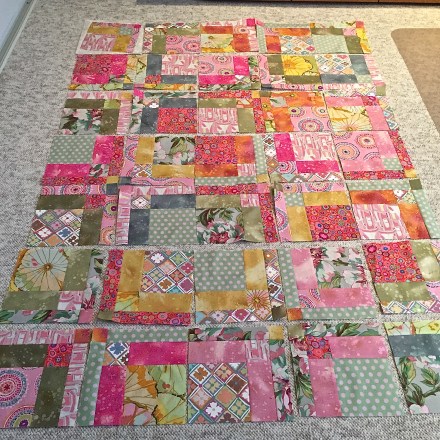
After the purge of my house last week, including the sewing room (I got rid of a lot of fat quarters and scraps I knew I was never going to use), I promised myself I was NOT going to buy any fabric — NO FABRIC, until I saw those luscious flowers in gold, pink, pale green, turquoise. And beside that bolt was the green dots, and then the pink houses… I added in the strong pink circles and a couple of others, bought a half meter of each. Then I came home and went through my Fossil Fern fat quarter collection (I still have about half of them unused) and picked out eight that I thought would work with the Kaffe Fassett prints.

These are more subtle than my usual quilt fabrics in shades I don’t usually gravitate toward, but last evening they called out to me.

I have no idea what kind of quilt I will make with this fabric collection. It might be several months before I think about using them but something interesting will get made.

Celtic Knots Quilt

IMG_2938

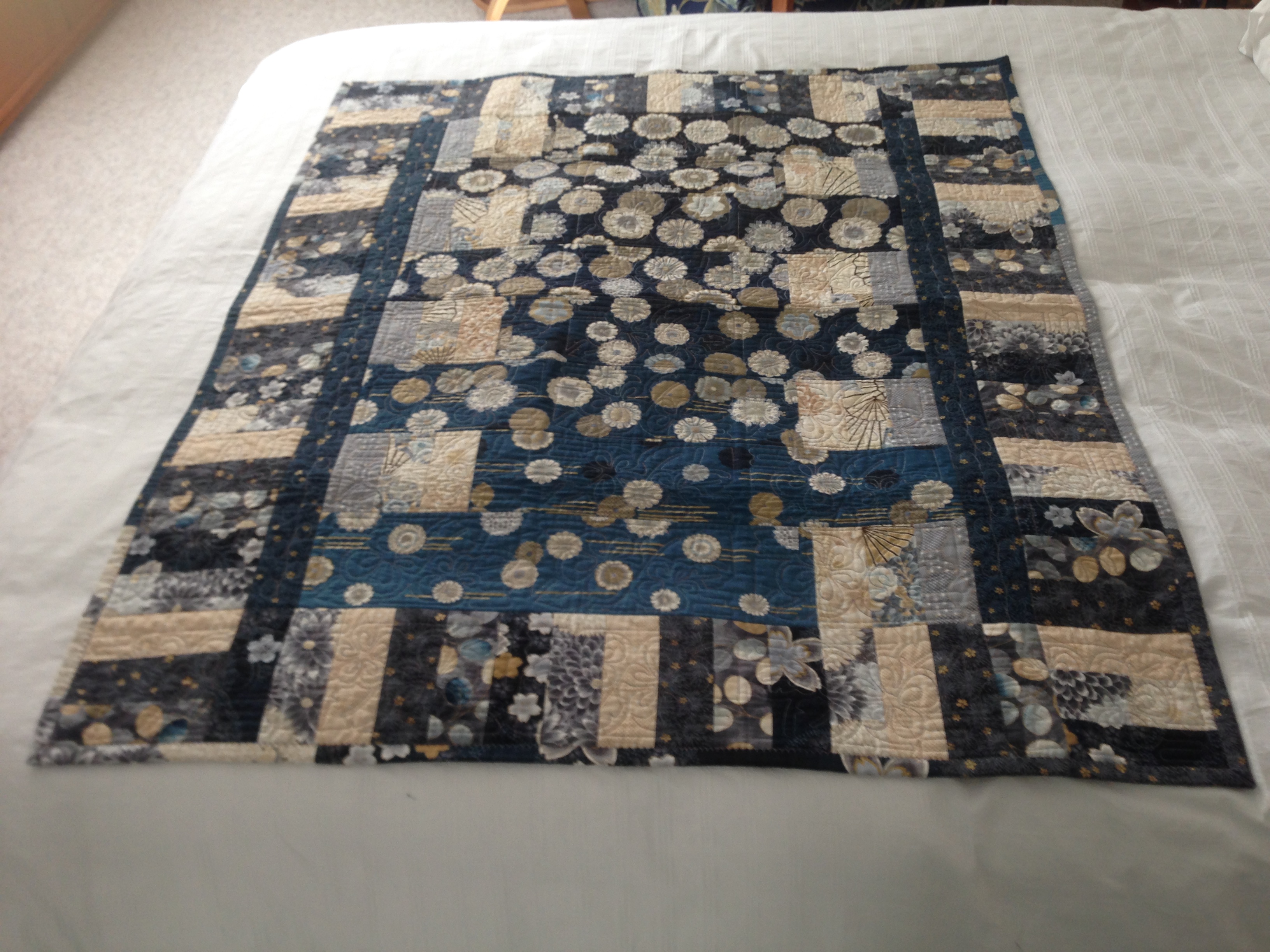
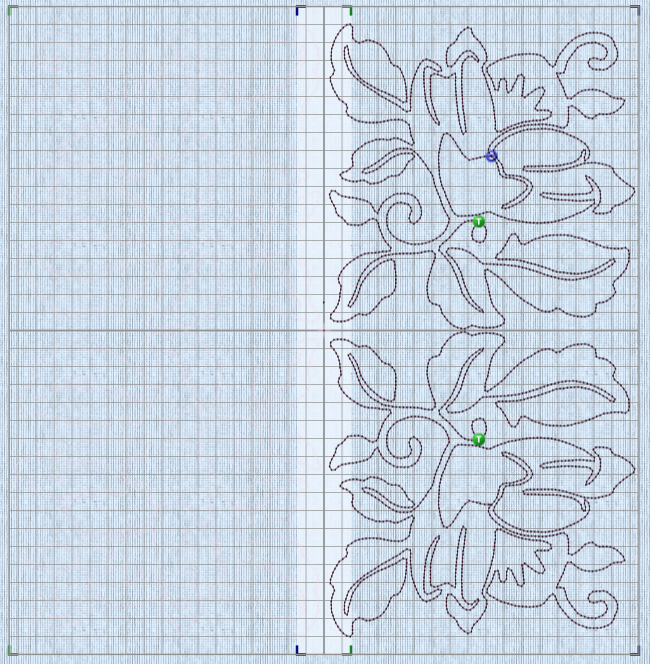
Finished this quilt yesterday. I had a jellyroll of a set of batik strips (Moda) which I’ve had in my stash for a while – when I came across a photo of a quilt like this I thought it a good way to use up that roll. Easy to construct, essentially, the small blocks are a variant of a log cabin, the joining sashing includes blocks of the print fabric and then the outer sashing is solid (although I could have added in small blocks to join up the big squares. In any case, the real challenge was what to do about quilting this quilt because the large blocks were 14″ x 14″ and the largest design I can create in my Grand Dream Hoop is 13.5″ x 13.5″. I set up a design that consisted of 4 smaller elements (there are two difficulties using the large turnable hoop – 1. the design shouldn’t cross over the middle, it won’t likely align when the hoop is turned, and 2. because of the size and weight of the quilt there is drag on this large hoop and so the two sides are never perfectly aligned).

Celtic Knots

The left side of the design replicates the right side. I wanted the design to embroider the background center block, not leave it empty. For the sashing I created a design using one of the machine quilting stitches and fit it within the 360 x 200 hoop so that it would fill the length of the sashing pieces, and then a small single-run flower for the corners of the sashing.

Here’s the quilt back:

IMG_2940

A pieced strip using the small amount of leftovers from the strips plus a 2 1/2″ strip of some fabrics that I thought blended with the original fabrics.

The binding used six strips from the original roll.


Midnight Sun

IMG_2894

There’s a story behind this wall hanging. I first saw a photo for a wall hanging kit by Lonni Rossi: Sunrise in the Garden in the Keepsake Quilting Catalogue:
sunrise in the garden

I was going to buy it except the kit would have cost me over $100 by the time I paid exchange, duty and shipping! I thought that was a bit expensive for the amount of fabric I would be getting. I could see the hanging would be simple to do – wide strips of 7 fabrics with a circle appliqué. I cut out the picture and stuck it in my collection of interesting possibilities but never expected to actually make it.

Until Monday, when I was in my local fabric shop and came across a collection of black/white/red fabrics (Black and White and Current 5) and immediately saw some possibilities. I bought small quantities of each of five of the collection (there are 14 fabrics in the whole collection), came home and quickly created the piece. I pieced the top, added quilt batting and did a bit of free motion quilting to attach the batting to the top, not a lot, though. I did a “grass” stitch around the circle to finish it off.

I wanted to know a bit more about the designer Lonni Rossi, so I googled her. I found instructions for Enchantment at Midnight on her website.

Enchantment at MidnightSo if you happen across some fabrics that would work you can download instructions for making the wall hanging using the link above. I didn’t need instructions for the hanging, but I found Rossi’s instructions for doing a “blind binding” useful. That’s how I chose to finish my hanging:

IMG_2899

Rossi suggested 3 1/2″ strips for the binding – I had already cut 2 1/2″ strips for a conventional binding, so that’s what I used. Worked out fine. I added a label this morning to the back of the hanging – it’s not my design, although it’s my interpretation of it so I didn’t put my name on the front.

One other thing – I slipped a 4″ piece of foam core board into the bottom of the quilt before completing the backing to keep the corners from curling and to add a bit of weight. It made hand stitching the binding a bit difficult but not impossible.

All in all, I though the hanging turned out surprisingly well.