Working With Decorative Zipper

Normally, when you apply a zipper, the zipper tape is hidden within the garment or bag or whatever. But lately I’ve been using a decorative zipper which has interesting tape I want to showcase. How do you apply a zipper in that situation?

Here’s my cork iPhone case which I finished a couple of days ago using the zipper tape as a focal detail:
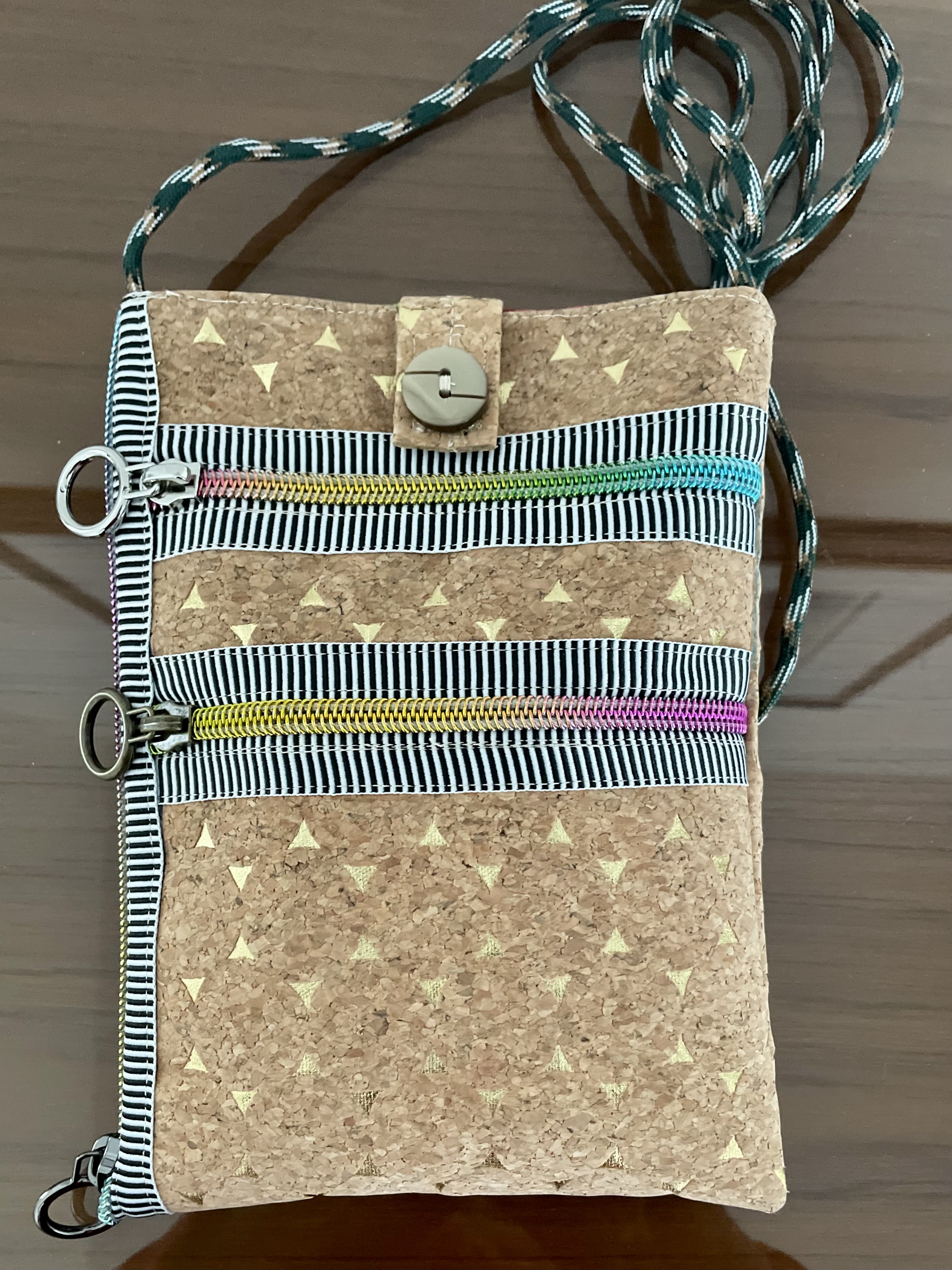
iPhone Case using Cork and Decorative Zipper

Now, that I have finally figured out how to apply decorative zipper tape, I’m about to make another bag – I will take photos at each step so I can prepare instructions.

Step one – prepare all the elements:
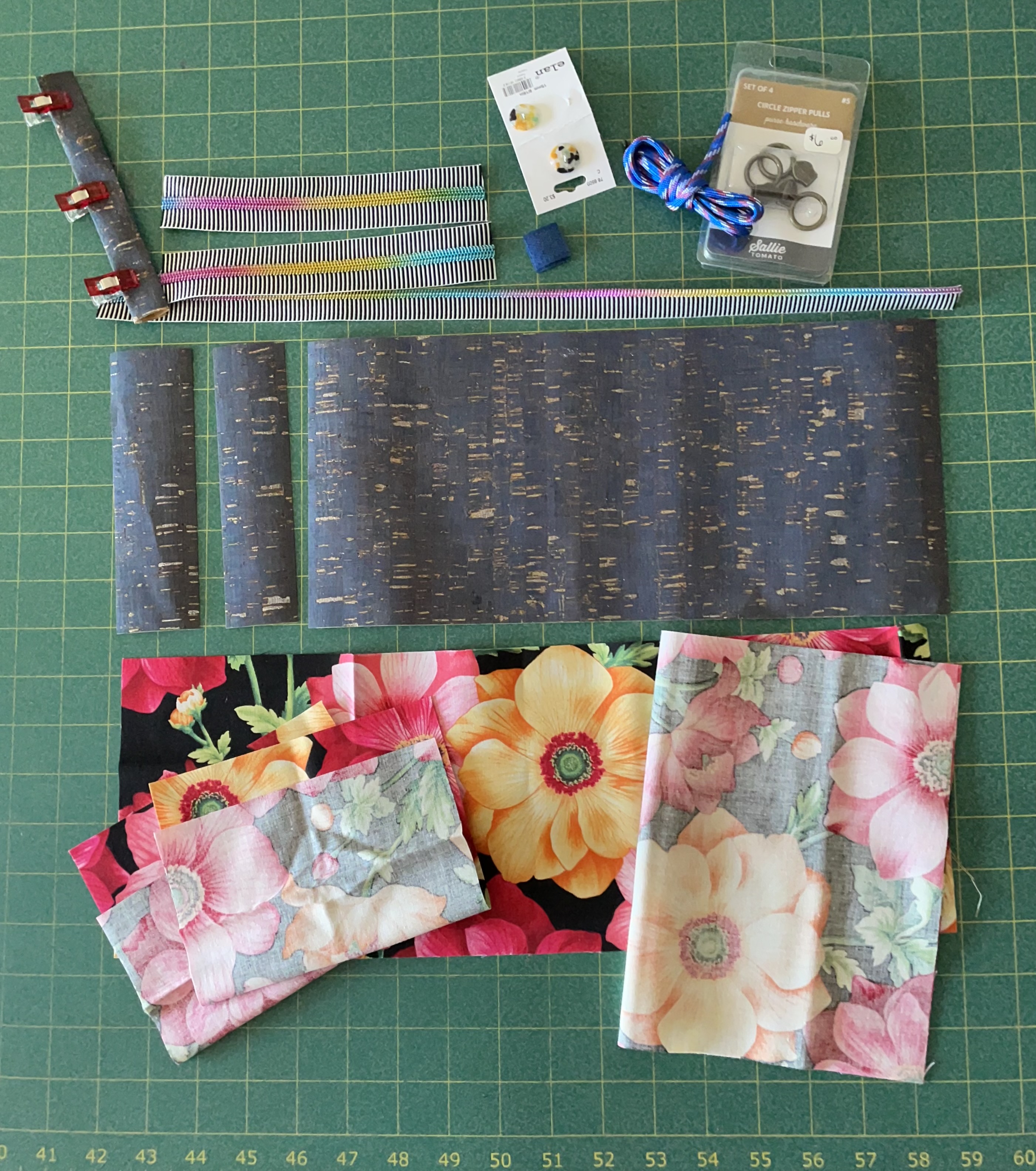
Supplies for iPhone Case

What do I have?

I’ve cut a 6″ x 16″ wide strip from some denim cork fabric;
I cut 1 3/4″ and then 1 1/2″ pieces from one end;
I had a leftover 2″ x 6″ piece which I’ve folded in thirds for the tab (upper left with clips).

I had one 17″ length of zipper tape (the other half of the tape I had used on the completed bag above), I cut two more 7″ pieces of zipper tape (longer than the width of the bag so I have some wiggle room to add the slides); I have three slides.

I cut four pieces of lining fabric:
one piece of 6″ x 16″,
one piece – 8″ x 12 1/2″,
two pieces 6″ x 8 1/4″ (to accommodate the size of a credit card)

A piece of velcro
An interesting button
48″ of parachute cord

With everything prepared, I’m ready to sew.

I will start by constructing the tab – the cork strip is folded in thirds, I’ll use a decorative stitch to hold it together; next, I’ll add the “hooks” part of the velcro to one end; last, I’ll stitch the button to one end (as a decoration).

Step two – the body.
I’ll start by applying zipper tape between the small strips, then along one side….

Now – on to actually making the case. I hope to have the photos by later this afternoon. I’ll write instructions tomorrow and add them here when they’re done.


May 3 2025

I made the second bag two days ago, taking pictures as I worked, only to discover when I went to document the process that I’d created the pockets “top-down” (which works but is too difficult to describe and follow because you’ve got to keep your pocket linings out of the way as you work your way down!).

I should have worked from the “bottom-up” – adding zipper and pocket lining to the “bottom” pocket first, then the upper pocket second. So now I have to make another bag, take pictures as I work, so I can describe what I do.

I’ll get to that when I can. (Here’s where I’d put a “sad” emoji).

Here’s the finished bag:

You can’t tell how I constructed it once it’s done. However, it would have been much easier to describe the process had I installed the bottom pocket first.

Oh, well.
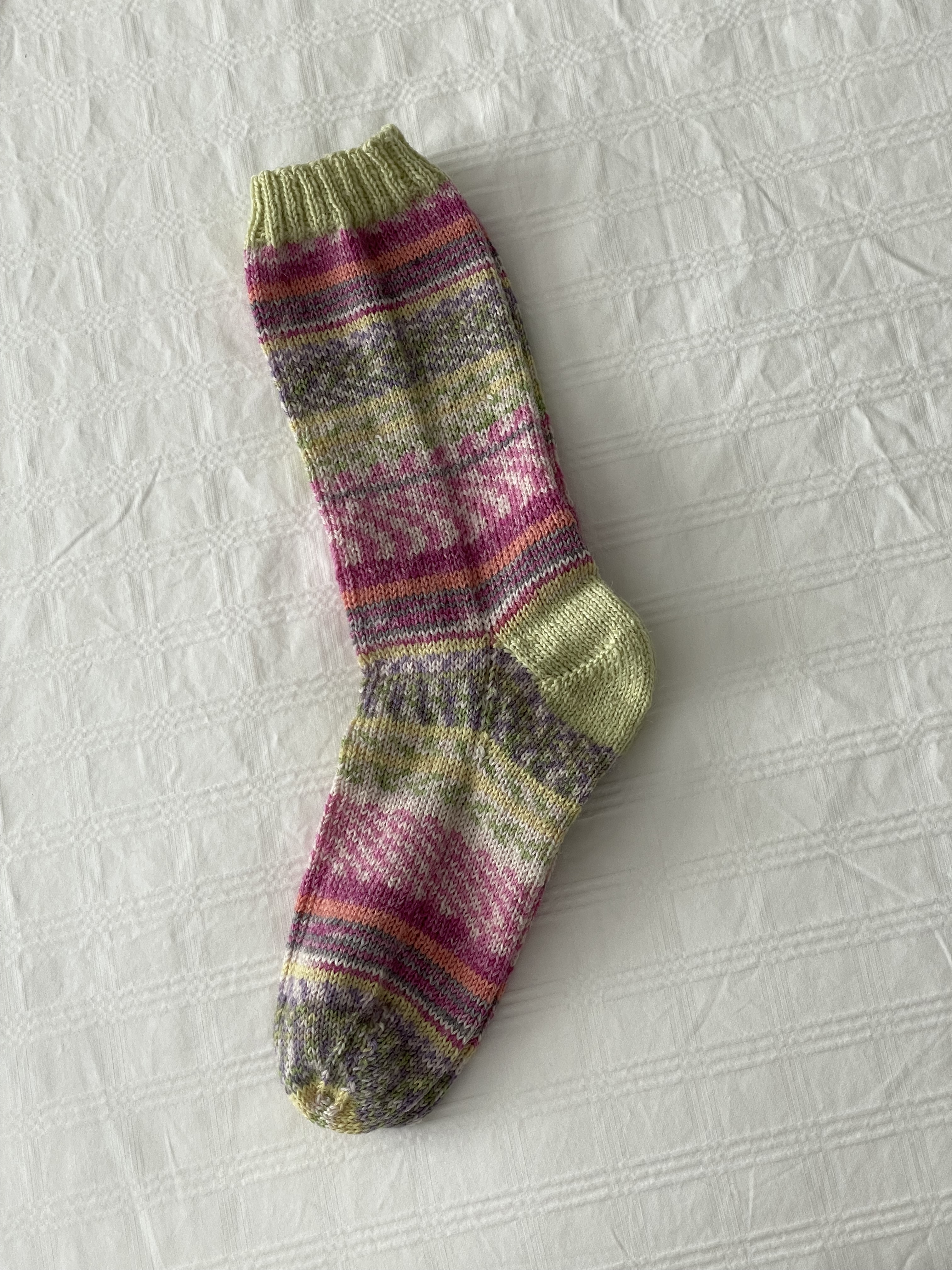
Socks And A Hat

I picked up this ball of yarn at Fabricville. I don’t usually buy yarn there because they’ve mainly sold Kroy and I find it too heavy to knit comfortably and I don’t like the weight of the socks. However, a couple of months ago I noticed they’d stocked a much nicer sock yarn, lighter, softer, so I bought this ball.

The socks turned out nicely. Somebody will enjoy wearing them!

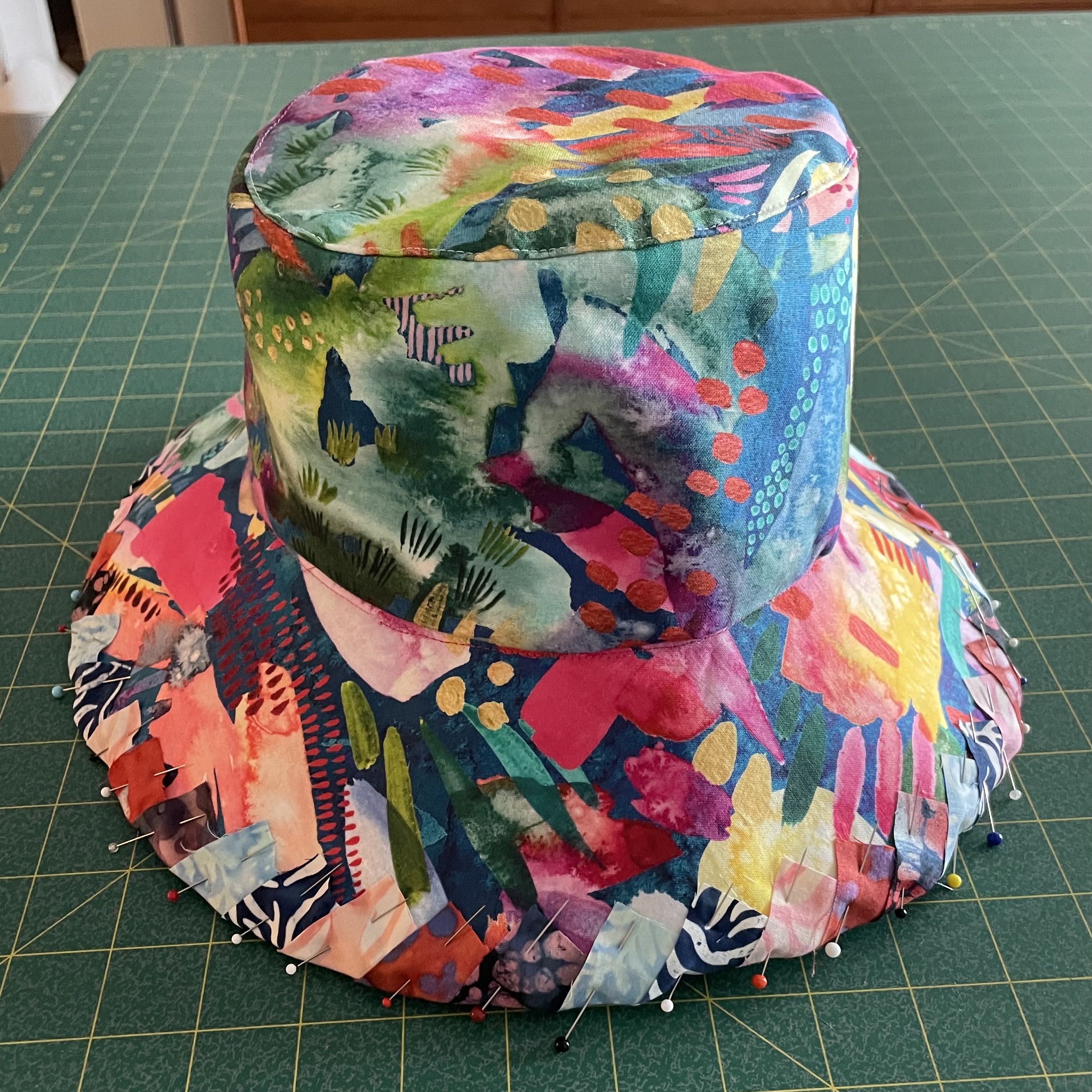
Then this past week I decided to make a new sunhat for myself. My friend Deb was giving a class on the Closet Core Sunhat. It’s a free pattern with instructions and a tutorial. I traced a copy of her size 22 hat, bought some fabric, then got to work. Deb had done some prep work on the pattern – reducing the 5/8″ seam allowance to 3/8″ which made sewing the seams much easier (next time I make it, I’ll reduce the seams to 1/4″).

This isn’t my first sunhat. I wanted a reversible hat – one that I could wear on either side. I didn’t follow the instructions. What I did, instead, was to make an outside hat, and an inside hat, then fit them together with the open edge the edge of the brim. I thought about finishing that raw edge with a binding, but instead used a bunch of small squares I had leftover from some previous sunhats (the colours blended/contrasted with the colours in the fabrics I used). I did some heavy free-motion sewing around the edge, securing the squares, using variegated Sulky thread both top and bottom. To finish the hat, I sewed a spiral, using my presser foot as guide, starting from where the brim attaches to the crown to meet the trim at the brim edge.

What makes this hat work as well as it does is the interfacing! I interfaced both the inside and outside hats with a stiff interfacing I normally use for the front placket of a shirt. That was a bit of overkill – I probably could have just done the outside hat and not the inside hat (that’s what I’ll do when I make the hat for my niece – at least until I see whether it makes the crown stiff enough or not). I also included a heavyweight fusible interfacing in the brim which has made it very stiff which I’m most happy with.

I also came across a very nice wide brimmed summer hat from Spruce Crafts. It comes in S/M/L sizes with separate pattern pieces for each size.

Then there’s my original instructions for drafting your own sunhat pattern.

Summer Shirt/Jacket

Just finished!

I started this garment last weekend. I worked on it during the week; today I added the sleeves (I’d already put the sleeve plackets in using Pam Erny’s 2-piece placket), serged the seams, top stitched them, sewed the sleeve/side seams, serged those seams, serged the bottom edge and stitched up the hem; made buttonholes, and machine sewed the buttons!

Check out the buttons – all different (if small). Just to highlight the many colours in the fabric. The fabric – a raime – has been in my stash for a number of years – I don’t remember when I bought it from Marcy Tilton (lovely fabrics, but expensive).

I lined the yoke, collar, collar stand and cuffs with a teal silk dupioni. It offers a hidden bit of contrast that nobody but a person who sews garments will notice, but I know it’s there.

I always intended making the raime into some kind of shirt. The question was how to position the pattern pieces on the fabric to get the most out of the print. After playing with pattern placement, I decided to cut the shirt using the width as the grainline (the crossgrain). This meant the garment could be symmetrical, more or less. I broke up the symmetry with the pockets and cuffs – largely because I didn’t have another repeat which would let me mirror the print I used for the front. I also positioned the back so the bold elements near the bottom would centre on the back – didn’t look right when off centre.

I still have another Marcy Tilton fabric in the stash – a “denim lace” which just had my name on it. I’ll cut that out soon to make another shirt/jacket. It’ll look very dressy but I intend wearing it with jeans!

Denim Lace

I set up the iPhone tripod so I could take some photos of the shirt. A bit on the big side – more jacket than shirt, but it’ll be fine with a pair of white pants and a t-shirt on a sunny summer day!

What I’ve Been Up To (1)

I’ve been remiss about keeping up with what I’ve been working on; I’ve been busy, nevertheless.

A younger friend is getting married on June 8. She needed a wedding gown. She tried shopping for one but wasn’t enthusiastic about what was available. I suggested she make one.

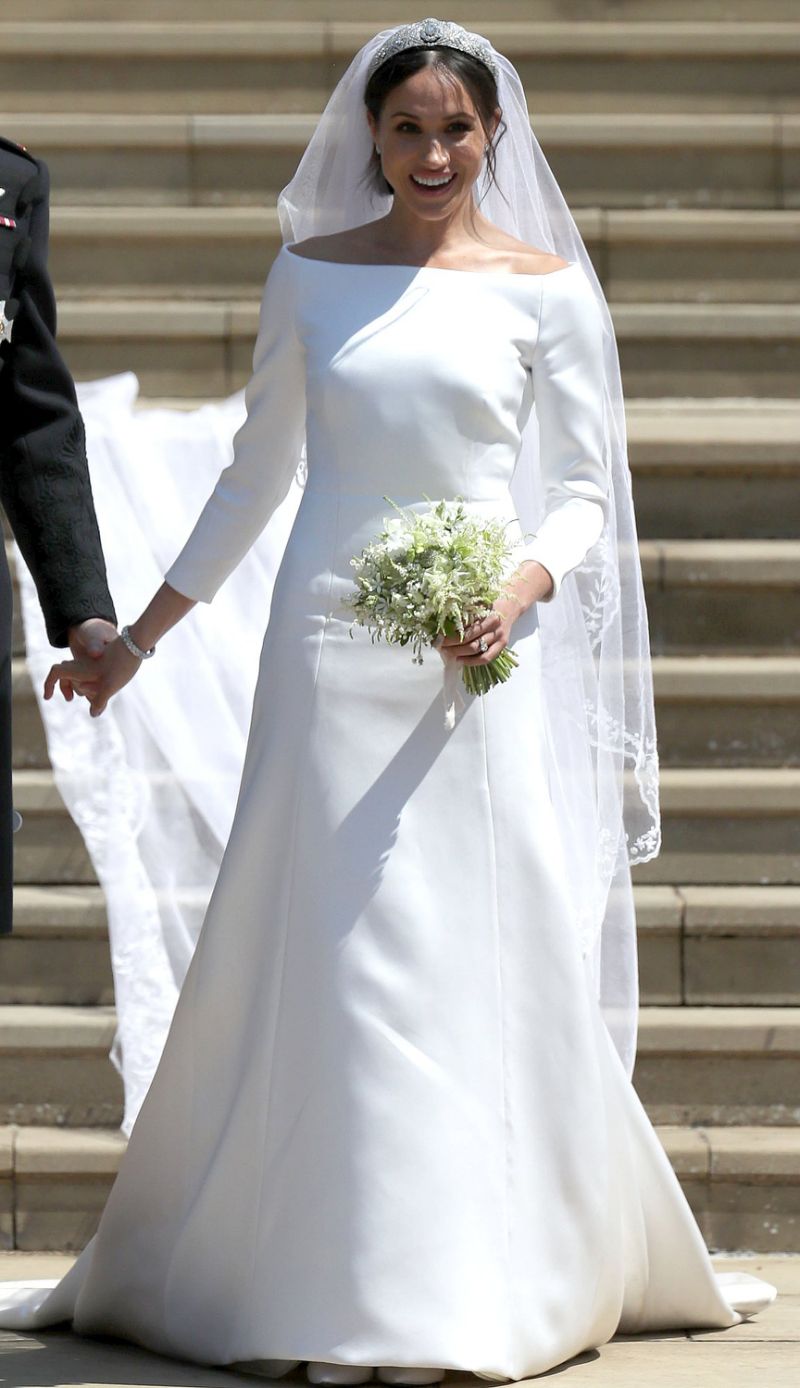
I sent her a photo of the wedding gown worn by Meghan Markle – stunning in its simplicity. Completely plain, a silk organza over a woven silk, princess fitted dress with sleeves and a clean neckline; no lace.

I sent Marni a photo of the Cashmerette “Upton” Dress”

Cashmerette “Upton” Dress

Same thing – clean lines, nice neckline, sleeves, and pleated skirt (which falls gracefully like a princess cut). Then I went to an online fabric store in India specializing in silk – FabricsandTrims. I’ve bought fabric from them before so I knew what we would be getting. I was suggesting an off white silk dupioni which would have a bit of sheen but also some texture and would drape nicely.

Ivory Silk Dupioni

To stabilize it, I thought we should back the silk with a very light-weight fusible woven interfacing. (I ordered this from Blackbird Fabrics in BC.)

Marni a quilter; hasn’t done much garment making, but if I would help her, she was willing to take the risk. So she bought the pattern, we ordered the silk and the interfacing. She picked up thread, and an invisible zipper. We were set to go.

We traced the pattern, made a few small adjustments. Then we worked on a wearable muslin – potentially a light-weight summer dress. As we worked our way through the muslin, which went quickly with each of us sewing different parts of the garment, I made adjustments to the dress which I transferred to the traced pattern. It took us as I recall three sewing sessions to make the muslin which is definitely wearable!

Now for the silk. We’d already applied the interfacing to five of the eight metres of silk so that was ready to be cut. Our challenge was this – the skirt at the bottom was 51″ wide, our fabric was 42″! So I had to make both the front and back skirt in sections. I chose to embed the seam I created on the inside of the side pleat so it would be more or less hidden. We made a mock-up of the skirt using black quilting cotton to check the position of the seam – it was fine. Finally we cut out the dress (which took just 4 1/2m of fabric – better to have too much than not enough!).

Trusting that the adjustments I’d made to the pattern were accurate, and with both of us sewing, we began constructing the dress. First the bodice, next the bodice lining. Marni serged all the remaining edge seams on the sleeves and skirt to keep them from fraying. We added the band to the front and back of the bodice (and bodice lining), and sewed the neckline seam. Next we attached the sleeves. Now we assembled and added the front and back skirt panels. Here’s when the invisible zipper was installed and the back seam finished. Last we stitched the underarm and side seams. In two sewing sessions we had a completed dress.

Today we did the finishing – hemmed the bottom on the machine using a blind hem foot; hand stitched the hem on the sleeves, and finished with a hook and a loop to close the top above the zipper.

Done.

The finished “Upton” dress

There’s one last decision to make – Marni wanted some kind of embroidered embellishment on the band joining bodice and skirt. I made some flowers using two layers of silk organza with a tear-away stabilizer.

Flower Appliqué

Whether to add the flowers or not is her last decision. I prefer the dress unadorned. However, I sent the appliqués home with her – she can decide what she prefers.

A happy bride-to-be. I even wrote Cashmerette letting them know how pleased I was with how well the pattern worked out for us.

We began the project on April 4. It took us 11 sewing sessions to make two dresses.

Amazing Hand Work

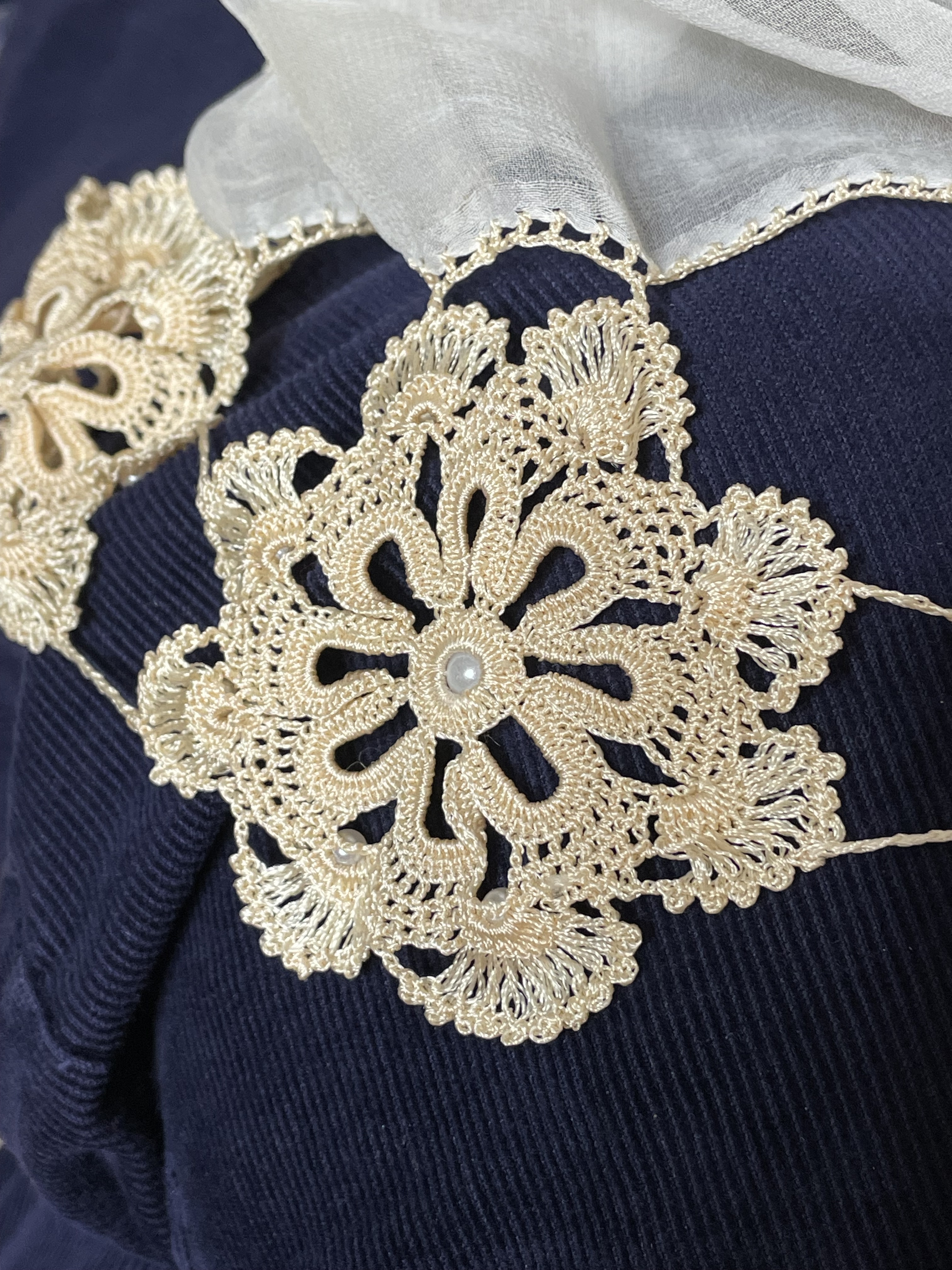
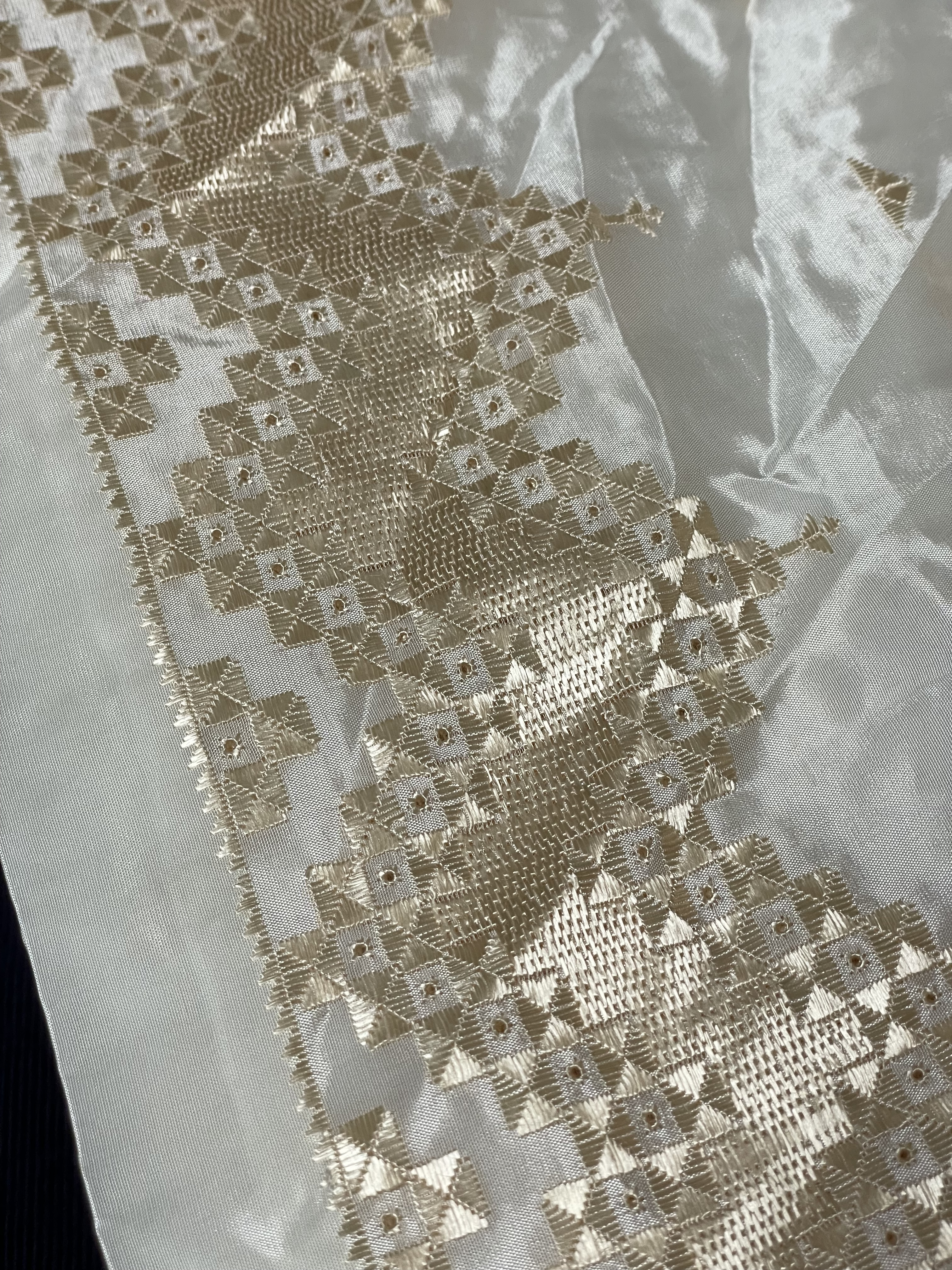
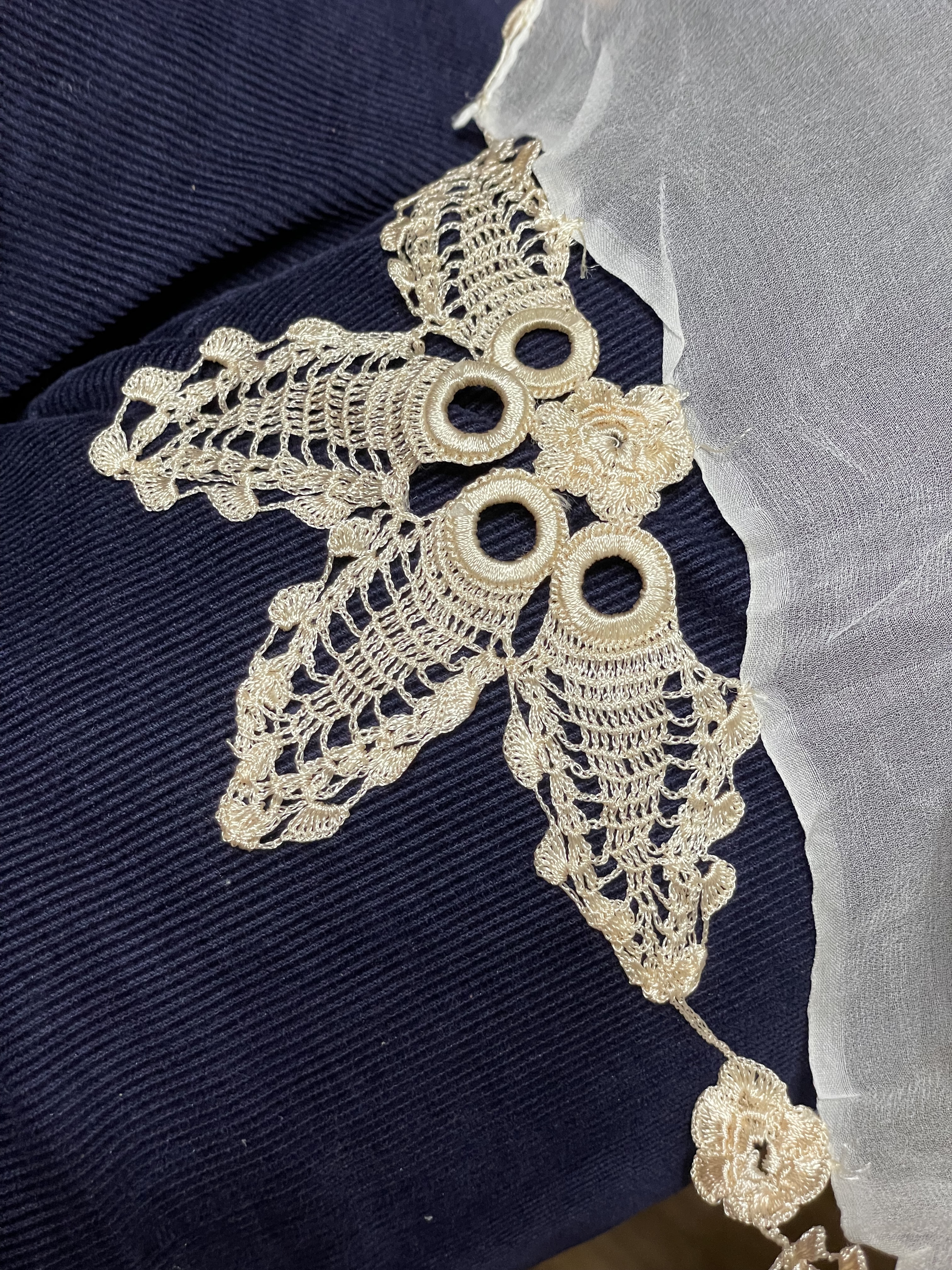
I was visiting Jawad and Shukria a couple of weeks ago. Shukria had just received a parcel from her sisters with hand embroidered and crocheted garments. The crochet embellished the edges of some head scarves; the embroidery enhanced the hem of some pants. Jawad had a tunic done by someone in his family who had taken three months to embroidery the front of it for him – obviously something to wear at a special occasion!

Last night I asked if I could photograph the hand work. What I forgot to do was place a coin on it to show the scale of the work – it’s extremely fine, both the crochet and the embroidery. Incredible precision! Not a hope in hell I’d be able to work with such fine thread (crochet or embroidery) and control it as magnificently as this work. The fabric is also a very fine, closely woven, either a lightweight cotton or a silk. It’s breathtaking!

I just had to share it.

Today’s Project

I’m getting nowhere on the quilt project – I know I’m not going to be happy with the finished outcome and that what I’ll end up doing is making a quilt, then cutting it up to construct a jacket of some sort. So I keep walking away from the strips of fabric sitting at one of my machines.

My avoidance project today, after having put strings of lights on my driftwood sculpture and along my balcony railing, was to make a new iPhone case!

As you an see, my old iPhone case which I made over a year ago has become very shabby. The lambskin (which I bought locally) was very soft and didn’t wear well. I’ve been meaning to make a new iPhone case but haven’t made time to do it. It’s not a big project, I can make one in under two hours. It’s just getting to it. Today was the day.

I used some leather I had bought in New York City in the spring of 2012 at the Leather Skins warehouse. (Check out the lambskins! Yummy! Irresistable! Not outrageously expensive!)

Leather Skins Warehouse

The place was small, on the 11th floor, Suite 1101, 261 W 35th St. The walls were filled with skins from ceiling to floor, sorted by kind, not so much by colour! I was taken with the lamb skins – I bought one in a purple-ish blue. There were actually six matching skins enough to make a jacket and pants – I only took a single skin. I also bought a printed leather skin (rather inexpensive – because a piece had been cut from one end – didn’t matter to me because I was intending to use it used for trim and there was a lot of leather in what remained of the skin). I’ve used small bits and pieces of that printed leather from time to time but most of the skin was still intact. Today I decided to cut a 5 1/4″ strip to make the iPhone case!

Didn’t take long to put the iPhone case together. I grabbed some zipper tape and slides. I dug through my zippered bag fabrics and found one to use for the linings, cut the three pieces I needed for the small pockets, the side pocket and the phone pocket. I looked through my parachute cord stash and picked out one. Finally I cut a small amount of velcro, and chose a button to decorate the closure tab.

I made this bag just a bit wider than the old one – to make room for the credit cards and the cash and the few items I carry in the side pocket. In under two hours I was finished. It’ll be interesting to see how long this one will last. I’m expecting the painted surface will rub off, but the skin is a bit sturdier than the blue leather was so the case may hold up somewhat longer.

In case you’re interested, you can find my instructions for this version of the iPhone case here.

Burgundy Pants / Black & White Top

I’ve finished garment making for now. I just completed (maybe – more about that in a moment) a black and white Ebony T-Shirt top. I took out some of the flare (I could take out more – might do that if I make another one) and widened the sleeves, dropped the arm hole a small amount to relax the sleeves – it worked. Although I lengthened the 3/4 sleeves, I didn’t lengthen them enough! I’m not doing anything about that right now (I have enough fabric to add cuffs, for example) – I’ll wear it a couple of times before deciding whether to change the sleeve length or not.

Black/White Flared Top

I like the weight of the fabric, a knit, but with more heft than a t-shirt fabric. I have no idea how well it will wear – I have a hunch I will be dealing with pilling. It wasn’t a cheap fabric (even though it’s a synthetic without any natural fibre in it) so I won’t be surprised if I have to shave it after wearing it; whereas the fabric in the burgundy top has a slightly polished surface and it shouldn’t pill at all.

No doubt about it, the quality of fabric, even “good” fabric, is not the same as say 25 years ago. The integrity of the weave, the stability of the fibres, have deteriorated. When I make or buy something I want it to last a good while. I hate garments that make it through one season and then look shabby and need to be thrown out.

I finished the burgundy corduroy pants last week. I adjusted the crotch depth (I removed 3/4″ from the back panel which seems to have eliminated the fold that occured on the teal pants).

The reality is, even if I’ve made the pattern before (sometimes many times), each new garment is still a muslin! There are always adjustments to be made. The fabrics hang a wee bit differently. There’s more or less stretch in one fabric which changes the fit. Good thing what draws me to making clothes for myself is the challenge each new garment offers!

Full Tummy Adjustment!

No point in denying it – my pants pattern needed a FTA. There are lots of descriptions for adjusting for a full tummy; here’s one: https://www.tillyandthebuttons.com/2023/06/full-tummy-adjustment.html.

In the pants I just finished I incorporated a FTA in the traced pattern. It has resulted in a good fit at the waist, nicely draping coverage across my tummy, with no pulling when I do up the front fly zipper.

I followed the instructions in Jenny Rushmore’s “Ahead Of The Curve”. I started by putting on an unadjusted pair of pants/jeans, buttoning the waistband but leaving the zipper gaping so I could measure how much I needed to add to make the tummy fit work. Then I drafted the changes she laid out – a horizontal cut connected to a diagonal cut, with a cut from top to horizontal cut to open the waistband.

Full Tummy Adjustment – FTA

I made those adjustments on my pattern (outlined in red – sort of). You can see I needed to open the top close to 3/4″ at the centre front, 1/4″ at the waistband, giving another 1/4″ (a shade under) at the centre front to make the fly flap straight.

My Adjustments

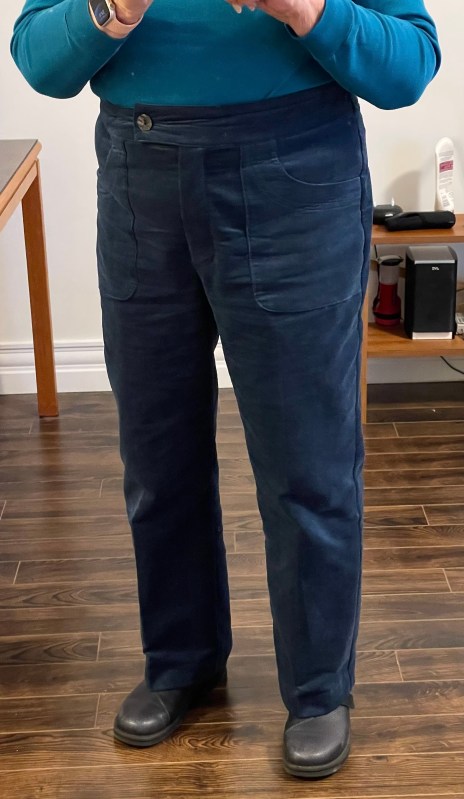
That gave me a nicely fitting front for the pants:

I wore them all day yesterday; I have them on again today. They stay snugly at my waist, they don’t pull down when I sit, and there’s no strain across the tummy. Comfortable. I’m making these same adjustments on the burgundy pair of pants I’m just about to cut out!

Yesterday and Today

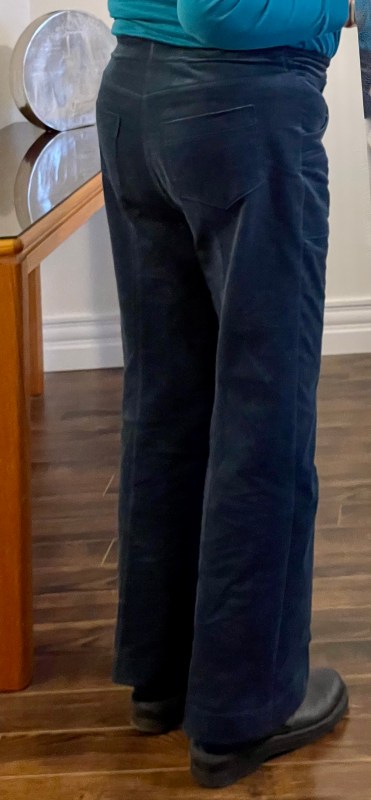
I’ve been busy sewing. Yesterday made this pair of corduroy pants/jeans (which I’ve been wearing all day – they’re very comfortable with a waist that’s large enough but just snug enough with the help of a bit of elastic in the back, they aren’t pulling down which means the crotch depth is good). As you an see I used a fly front which let me shape the sides just a bit (can’t shape them much because I don’t have hips and my waist is almost the same measurement as my hips). I no longer bother with inside pockets – the top pockets work just as well and look OK. There are also two back jeans pockets and as always, the dart down the centre back to give the legs/bum a bit of shape.

Back View

There’s a jeans back yoke to shape the top hip area which works quite well. There is still some bagginess just below the bum which I suspect I could get rid of if I brought in the back crotch about an inch – I’m not going to do that on these pants. The fullness doesn’t show when I wear a tunic length top. However, I will try that with the next pair – a dark maroon to go with the Ebony T-shirt.

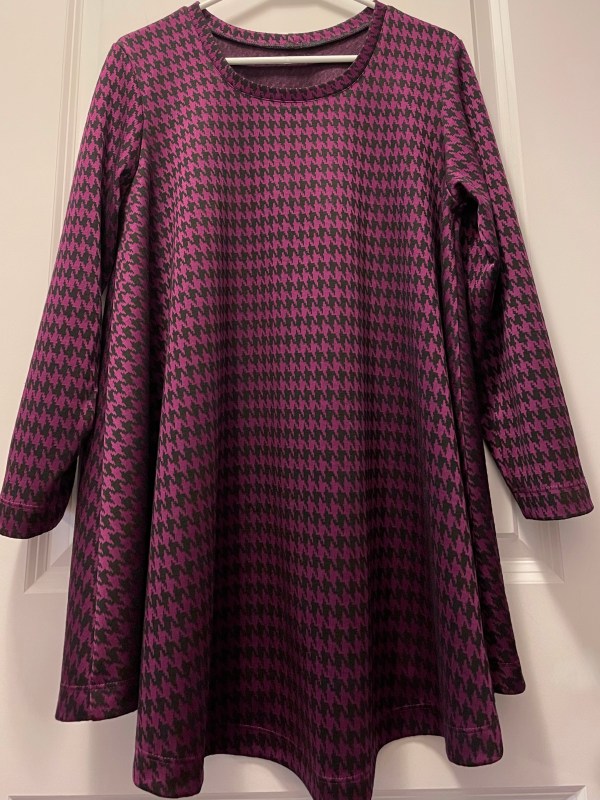
Today, I cut out and zipped up the flowing tunic top. Simple to make – stitch the shoulders, add the neck facing, sew in the sleeves, stitch the underarm and side seams, finally hem sleeves and bottom. Two-three hours work. I lengthened the tunic by 2″ adding an extra 1 1/2″ to the front. In previous iterations of the tunic I found it tended to hang shorter in the front than the back – this time I have managed to even it up.

I love having a dedicated coverstitch machine – it makes hemming garments (and other projects) a snap. That precise double row of stitching which covers the hem edge on the inside gives the garment that commercial finished look and it’s so easy to do. My advice to people who do a reasonable amount of garment sewing is to buy a good mechanical serger without a lot of bells and whistles, and invest in a separate coverstitch machine as well, rather than an expensive serger with coverstitch which takes an annoying amount of time to convert from serging to coverstitch and back again! The two machines will likelky cost lest than that fancy serger. My covertitch machine just needs threading (which is very simple) and it’s always ready to go.

Tomorrow I will cut out the magenta corduroy pants and get those whipped together over the next few days.

Face Masks Again…

New Face Masks

I’ve got a collection of face masks hanging on the door handle of my apartment, more on the coat closet doorknob, a couple in my car. They’ve been dormant for the summer and early fall but I’m putting them on again when I’m going into populated places, or medical appointments (because I’m usually asked to), and sometimes when I join the cribbage group on Monday evening. I’m wearing one more and more; I washed six yesterday when I did the laundry.

This past week one of the card women mentioned wanting a couple of new masks; my naturopath said the same thing to me on Friday. I’d been thinking about making a few new ones anyway. I happened to see a suitable fabric at Sew With Vision last week – I bought a half metre, I found another half metre of a fabric that went with it in my stash (you can just see the red peeking out in the lower mask).

Today I cut out two masks, made them up. I was using a pattern by SeeKateSew and while I didn’t follow her directions, I did use her template. The last time I made a batch of face masks I made her Adult M; this time I made Adult L – a better fit from nose to chin for me (and I’m guessing for other people, too). After finishing the two masks for myself, I cut out six more to sew and give away. (My wrist is still bothering me, rotary cutting is painful, but I put up with the pain to get this done.) I’ll get them sewn together in the next couple of days!