House Sold!

IMG_5107

My house sold this week – now my life gets crazy! I’ve got six weeks to sort through my “stuff”, decide what to keep and what to pass on, pack it so I can actually find it when I arrive at the new apartment.

I will actually have more floor space than I have in the townhouse. Before I looked at apartments I thought about how I use the space I have: I spend almost all of my time sewing, doing things at the computer, and knitting/watching TV in my bedroom. I don’t use my living room/dining room space much at all. So I decided I would actually set up a sewing studio in the main area of the apartment. I spent yesterday afternoon with a friend scaling up the floor plan I obtained online so I could think about where to position existing furniture and consider what I might want custom made.

IMG_7644

There will be lots of room for three sewing tables (one for my quilting machine, one for my serger, and one (much larger than the one I currently have which needs to be built) for my embroidery machine which I use to quilt the quilts. There is also going to be room for a cutting table. I had originally planned to use my dining room table with a cutting mat surface for that purpose, but I was in Home Depot yesterday and realized a kitchen island with drawers and shelves in the end sitting in the middle of the room surrounded by machines (and close to the ironing board) would be just the thing. I’m not going to order that until I get the machines set up. So I may end up with room nearer the kitchen island for the dining room table.

I plan on using the smaller second bedroom as a computer/sitting room (with a day bed for an occasional guest).

Now I have to go through all the books (there are books in every room, right now) and get rid of almost all of them – I will just keep those I actually reread: the Dorothy Dunnetts, the Exordium (a si-fi 5 series set which I reread often), and I don’t know what else. The challenge will be figuring out what to do with the discards – I hate sending them to the paper recycling depot, but there aren’t many used book stores left in the city.

Then I will have to go through all the ornaments/dishes on the shelf unit currently in my living room and sort those. I will also need to carefully sort the art so I can easily find the few I’m going to have space to hang.

I have a check-list that I need to dig out and start working my way through it. I’ve also got to keep in mind I’ve committed to having a showing of 10 new quilts end of August through to mid-September. I’ve got 7 completed, #8 is being quilted at the moment, and #9 I’ve just finished piecing the top (borders still to come). So I have to come up with one more quilt and get it stitched before mid July when I have to be out of the house!

And there’s still a possible quilting class June 7 and 28. I know what I’ll be making during the class – a variation of the quilt the participants will be working on.

So my life has suddenly become a lot busier!

Sewing Inspiration

It’s very hard for me to shop because I look at garments and notice the sewing imperfections and remember fabric in my stash and think how easy it would be just to make it. Instead, “shopping” for me is about ideas! 

Yesterday Sheila and I dropped into Desigual – their stuff is interesting although their sizing doesn’t fit me, it’s intended for women 40 years younger and skinnier than I am (I wear a size 12-14!) I actually tried on a black and white shirt in a large (forgot to photograph it) but I’d have needed an XXL (which they don’t make) to hang properly and even then I think the shoulders would have been too narrow.

But there was inspiration galore:

A denim jean jacket with inserts and sleeves in an almost sheer print fabric used in the shirt underneath. I’d never have thought of doing that but now I might.A shirt in contrasting bold colourful prints – I might have considered doing something like this. It’s a reminder to look through my stash of shirt fabric when I get home with something like this in mind.

Inspiration everywhere!

The Comfort Zone

I’ve been engaging in a written conversation with a quilting blogger – her most recent entry was about the physical stresses that are a part of quilting. Most people don’t think about the strain and tension that goes along with quilting – the ergonomics of sewing are critical.

I replied to Melanie with the following:

IMG_7430

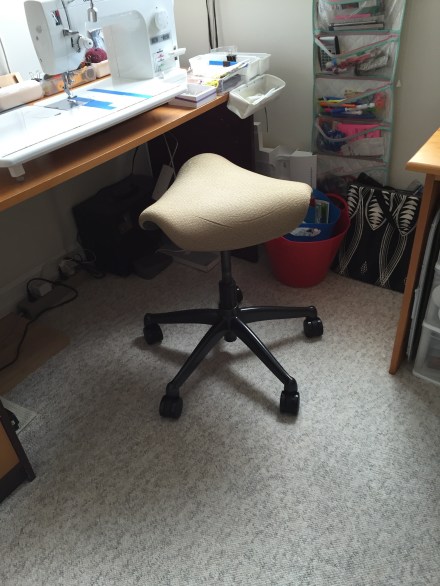
Saddle Chair

For me, the relationship between the height of my sewing machine bed (2 1/2″ above the table top) and the seat height of my saddle seat is critical! Table top – 26″; seat height 22″. That allows me to sit straight, swivel on the seat, support my feet on the wheel supports on the seat, with my arms and shoulders relaxed and elbows at a perfect 90 degree angle. There is no back support on my my saddle chair but sitting on it forces a straight back, neck alignment.

I do big cutting jobs on my dining room table which is too low, but I trim on my ironing board which is 32″ high – a wee bit low but I’m never standing there for long periods of time. Sit to sew, stand to press, trim… I can work comfortably for three – four hours.

IMG_7431

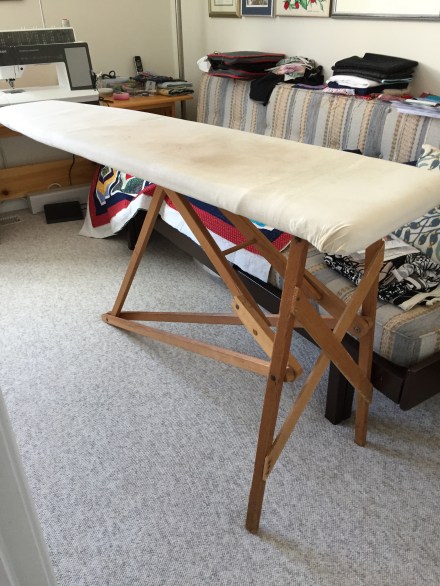
Ironing Board – at least 100 years old!

Melanie then asked:

I haven’t tried a saddle chair. I’ve seen them at shows offered for longarm quilting, which might help when doing very fine work. Is your ironing board adjustable? I feel like I often do a lot of pressing at a time.

My saddle chair is adjustable and I have it set at almost the highest it will go. My ironing board, as you can see is NOT adjustable. I bought this old thing at least 50 years ago at the Salvation Army in Toronto for $1.50! Aside from it’s height, it’s wider and longer than a modern metal ironing board. It also has a solid wood board which now has many layers of padding on it so it holds heat very well. I’ve had new boards but have given them away – this is the best ironing board I’ve ever had. Every year or so, I make a new cover which I install over the old ones. I use an unbleached light weight canvas. At the same time, I tighten all the screws in the legs to keep the board from collapsing when I set it up to press.

There are times, when I’m starting a new quilt that I will have a lot of fabric pressing to do – like today, I just cut out 75 seven inch blocks from a collection of 19 asian inspired fabrics – I’m going to do a drunkard’s path quilt next and I needed to press the fabrics before cutting them so my cutting would be reasonably accurate. The ironing board height, however, seems to be OK. I can press for quite a while before feeling tension in my middle back.

So comfort while sewing – you bet. It’s important to have a working set-up that doesn’t put undue strain on the back and neck, or wrists. It would be awful to end up with a repetitive stress injury and not be able to sew/quilt any more!


Double-Sided Bound Buttonholes

I knew the buttons and buttonholes needed more work. First I fixed the buttons: stitched the larger button using small beads to elevate the button and form a shank, placed a 4mm knitting needle under the second button underneath while I was sewing the pair of button to the coat. I was able to end up with thread button shanks, and the second button was lifted enough that I could get my needle beneath and wind off the threads to form the shank! The buttonholes well that was another story.

First here is the finished coat (with the elevated buttons and bound buttonholes completed) from the front:

coat front

Quilted Coat Front

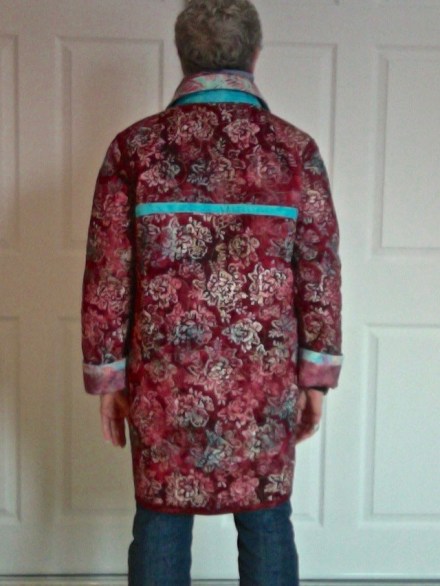
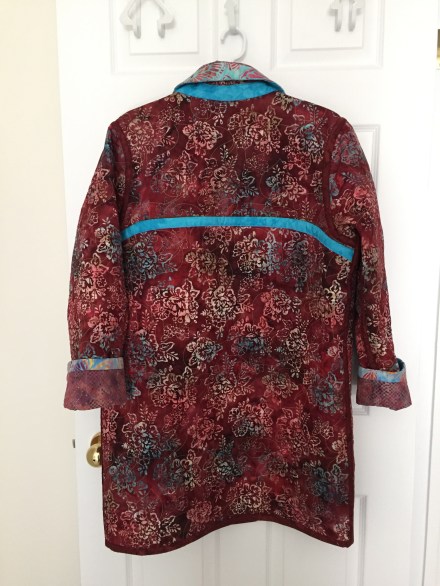
And from the back – fits pretty well.

coat back

Quilted Coat Back

Now for the double-sided bound buttonholes.

I did a bunch of trials to see if I could find a way to end up with a bound buttonhole finished on both sides with a single piece of fabric. Turns out it can be done. Here’s how.

For the coat I cut 3 1/4″ X 2 1/2″ pieces of fabric (I used the contrast fabric from the reverse side, because that’s where the finishing would end up and I thought the binding should match the rest of the contrast elements).

I used a Frixion erasable pen to mark horizontal and vertical center lines, then marked the stitch lines for the buttonhole. Used chalk to mark the distance from the front edge of the coat then placed the piece of fabric so one end of the buttonhole would align with that chalk line.

IMG_7356

Using a 1.25 mm stitch length I carefully stitched around the buttonhole, starting part way along one of the long sides.
IMG_7357

Finished stitching the buttonhole overlapping the beginning by a few stitches.IMG_7358

I cut the center opening and snipped as close as I could get to the corners without actually cutting the thread (remember I have a stitched buttonhole beneath and this binding had to completely cover it – it did).IMG_7359

Pulled the fabric through the hole, finger pressed the ends with the small triangles, folded the top and bottom portions of the buttonhole fabric so the folds meet in the center, pinned the fabric so I could tack the ends of the fold closed, removed pins and pressed.IMG_7360

Stitched across the ends so they would stay in position.IMG_7361

Folded under the top and bottom portions of the fabric, pressed. Then folded in the ends and pressed. IMG_7362

Carefully edge stitched (using a 2 mm stitch length) all the way around the folded buttonhole fabric to secure it in position – I used a matching thread for the top and a dark thread to match the main fabric in my bobbin so the stitching on the front side of the coat shows but blends in. This is how it turned out on the reverse of the coat.IMG_7363

Here is one of the button holes on the front of the coat. You can see I didn’t have a lot of play room between the buttonhole and the front binding – I was able to just align the buttonhole so the stitching didn’t overlap the binding.IMG_7367

Here are the buttons done up.IMG_7369

The whole looks a lot more finished than it did with machine stitched buttonholes. In fact, having the stitched buttonhole beneath stabilized the fabric so I don’t have to worry about anything pulling away!

So there you have it – bound buttonholes finished on two sides using a single piece of fabric.

The Craftsy Blog gives good instructions for constructing a bound buttonhole, but the expectation is that the underside will be finished by cutting the facing fabric and blind stitching it to the back of the bound buttonhole. In my situation with the quilted reversible coat I had no facing so I had to figure out another way of finishing the buttonhole on the reverse. Same basic procedure but I finished the buttonhole on the second side by carefully folding the edges and ends and edge stitching the fabric in place.


Quilted Coat – Finished

I got up this morning determined to finish the coat. I’m heading to San Francisco on the 31st for a week-long sewing retreat with Sandra Betzina and I want to take the coat with me (to show off, of course, but also because it will be a good weight for the San Francisco early April weather).

First: figure out a way to carry the contrast band to the finished edge – I accomplished that by inserting precisely the right width of contrast fabric into the binding, carefully pinning it so it would align with the stripe, then stitching the full binding to the fronts. If you didn’t know that was a problem I had to solve, you’d never notice how I solved it. Second, add collar and contrast binding to right side (can’t see it in the image because it’s behind the folded down collar). No problems with that set of operations. Third, set in second sleeve, bind underarm and side seam, add wide binding to cuff. Done. Fourth: finish binding along the bottom including mitred corners at the fronts. Went fine.

Next: buttonholes. W-e-l-l that took some consideration. Because the collar is way too tall for me I realized (rather than cut it down two inches and rebind the top edge which I could do) I’ll probably wear the coat with the collar open and use a scarf if I need more warmth. So I didn’t want a button in the collar. I marked the location for the top button at the point where the collar folds. Then 6 1/2″ lower I marked the second (in line with the top of the pockets), and 6 1/2″ below that I added a third to keep the front closed. Bound button holes or machine stitched? I decided to stitch button holes (at least for now – I am seriously thinking about binding them – not a issue, the stitching will just stabilize the cut edge while I’m doing the binding). I checked the sewn button holes before cutting them open (I can always take out the stitching and restitch, but once cut that’s it!). All good.

Last, buttons: I had four buttons I picked up in Bali – actually they are “rounds” created by Jon Anderson the Polymer Clay artist we visited. I could visualize them as buttons so I drilled two holes in each when I got home. The colours are perfect for this fabric. I sewed the buttons on the outside at the same time sewing slightly smaller turquoise buttons on the reverse. Now I have a problem – the buttons are VERY difficult to button up – the buttons on both sides are large and there is no movement room. Because of their size I wasn’t able to build shanks for each side (I couldn’t get the needle through just one of the buttons without creating a very long thread shank) so they are relatively closely sewn. I’m thinking of taking them off and permanently sew the buttons on the main fabric to the button holes and putting large snaps underneath – one set of snaps would work for both sides of the coat.

For now, however, the coat is done and my sewing room tidied up.

IMG_7351

Main Side Front

IMG_7352

Main Side Back

IMG_7353

Reverse Side Front

IMG_7354

Reverse Side Back

IMG_7355

Buttons

Quilted Coat

A year and a half ago I made a reversible quilted jacket. I’d had the fabric quilted on a long-arm quilter, cut out the pieces, sewed up seams, bound them with a complementary fabric. The challenge was to figure out a way of creating a faux pocket on the reverse side to allow access to the real pocket on the outside. I achieved that by improvising with a zipper.

Last spring I bought Sandra Betzina’s coat pattern thinking I could use similar techniques I used for the jacket. I liked the tall collar and the contrasting bands. I thought it wouldn’t be too difficult to accomplish the look.

So I had more fabric quilted. Last week I cut out the pieces with some modifications: I cut set-in sleeves from the jacket pattern instead of raglan used in Sandra’s coat; I cut the body a half inch wider on both fronts and the back at the side seams. I decided not to make the welt pocket in the pattern but to recreate the patch pockets (with zipper on the inside) used in the jacket.

I started, following the instructions, by joining yoke and body (front and back) with a contrasting strip. (This was my first mistake – I should have ignored the pattern instructions and thought the assembly through on my own – I should have bound the front edge in the dark fabric before sewing in the contrast!) I’m going to have to take the contrasting join apart, bind the front edges, then restore the contrast band. I constructed and attached the pockets to the outside. 

I inset a bound zipper on the second side first, however, to allow access to the patch pocket, covering the zipper with the patch pocket on the outside. (That substantially reduces the bulk of the fronts.)
The contrast in the back works fine. No need to redo that.

Setting in the sleeve and binding the armhole, underarm and side seams went without a hitch. Tomorrow I’ll inset the second sleeve.

The collar is ready to be attached – I figured out how to apply the appropriate contrast to each side. I can’t add the collar, however, until the fronts are bound because I want to bind that neckline seam with the appropriate contrasts to each side for the second collar contrast used in the coat pattern!

Buttonhole placement will take some thought – I couldn’t easily include them in the contrast seams like Sandra does. I will have to make bound buttonholes like I did with the jacket (covering the construction with a facing using the side two contrast fabric).

I’ll share more after I finish the garment.

Jeans Makeover

Too bad I didn’t remember to take a before picture – you’d have seen jeans that were very baggy in the bum with upper legs that were WAAAAY too wide!

So here’s how this goes: I go to a local thrift store and buy a pair of jeans that fit nicely in the waist and high hip. That’s my starting point. The jeans cost me $5! There’s no point in buying new expensive jeans retail because they fit no better than those from the thrift store.

Get the jeans home and wash them a couple of times to get rid of the smell (and to shrink them if they haven’t been worn a lot).

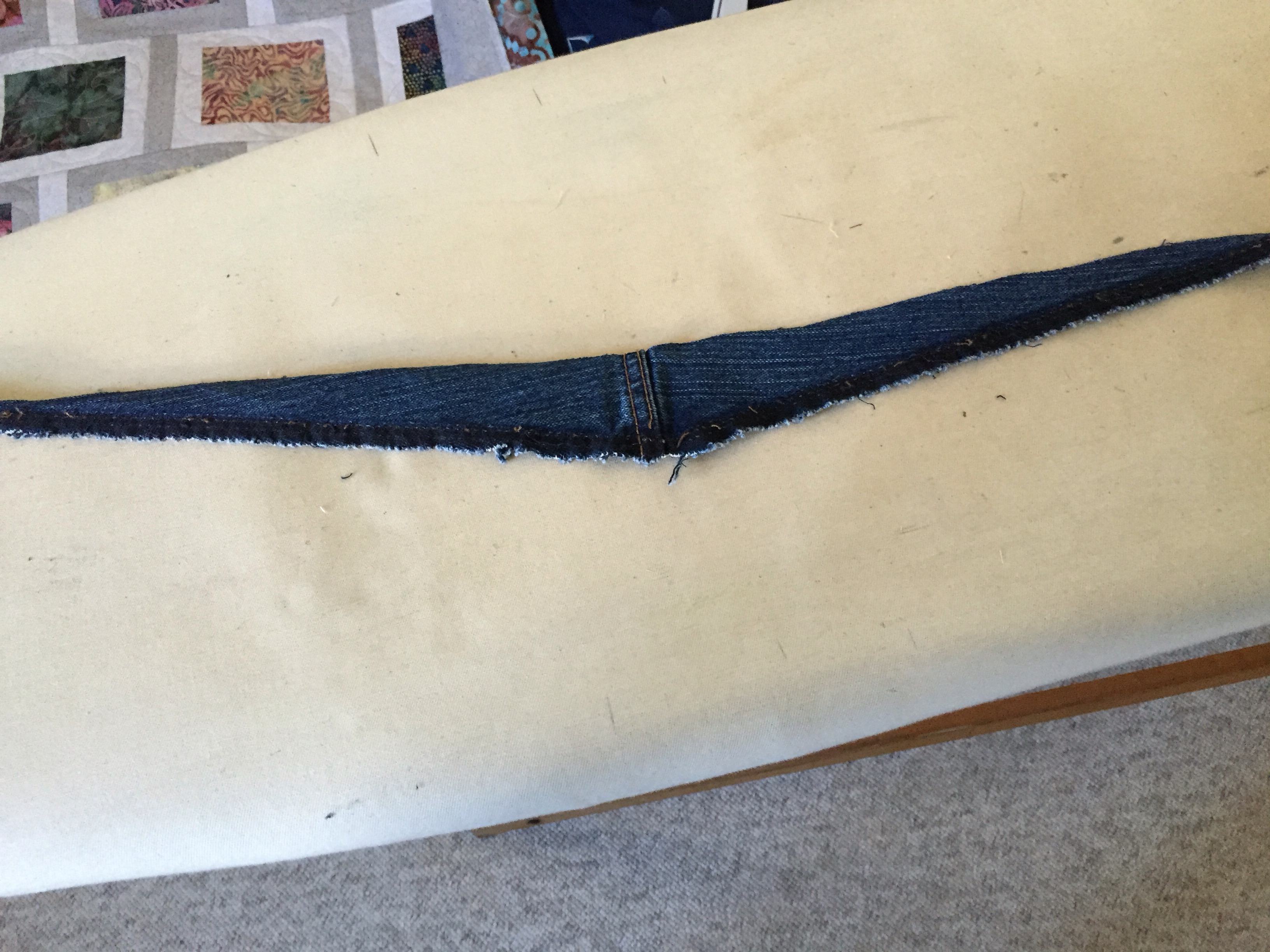
I open the inner leg seam from knee, through crotch, to knee. I pin, then straight stitch, front to back through the crotch making sure I am cutting out about 2 1/2″ at the back crotch seam area tapering the alignment along the inner leg till the front and back match at the knee – I don’t cut anything at this point because I want to check fit before cutting. The fabric eventually removed from the back crotch and back inner legs looks like this – sort of triangular.

Once I’m sure of the fit (I may want to remove a bit more from the back crotch and back inner leg – a smigeon from the front as well) I stitch, cut, and serge the inner legs through the crotch, then edge stitch the seam flat.

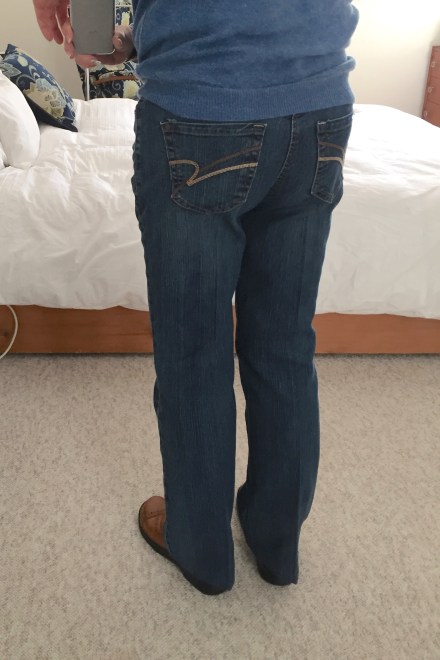
IMG_7251

The back fits reasonably snugly with enough give for sitting. I shorten the legs – cut the length of the leg at the inner seam 28″ (enough to serge the edge and turn up a 5/8″ hem – my inseam is 27 1/4″).

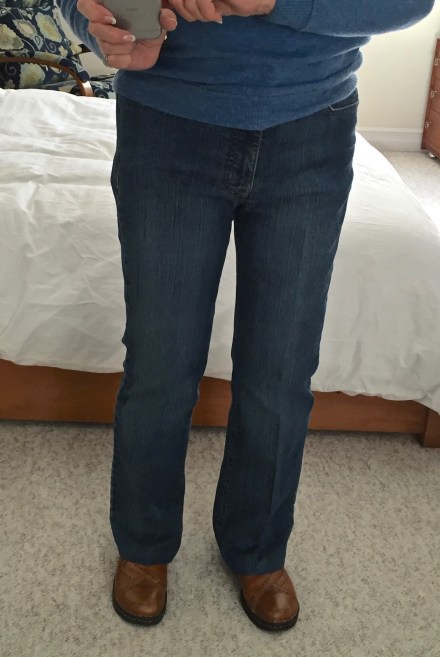
The front fits smoothly, not baggy.IMG_7252

I make two other alterations – I carefully cut out the front grommet – they cut holes in my sweaters – patch, and reinforce the hole, sew on a button; the second alteration is to extend the depth of the right front pocket to hold my iPhone securely.

This is an earlier pair adjusted to fit the same way. I’ve worn this pair a lot – they’re very comfortable.IMG_7255

Velour Housecoats

I have two cotton velour housecoats that I’ve had for close to 40 years. I haven’t replaced them because nobody has made much in velour for several years and because I couldn’t find a housecoat with a zipper front! Lots of fleece tie robes, but few that are long and with a front zipper. So I kept washing and rotating the two.

Last week I was in Fabricville – I needed some 9″ zippers to whip up some small zippered bags using the fabric from Peru – when I came across some velour! It’s polyester and stretchy but I though it would make a decent housecoat so I bought enough for two – some in a deep teal, some in a pale teal.

Here are the two finished housecoats! Just finished the pale one today.

Tricky fabric to work with – hard to keep seams even because of the stretch. The velour is also problematic – can’t press it on the right side! The dark one which I did first had to be recut – I’d got about half way through when I realized the whole garment, but particularly the neck, was too big. I didn’t want to buy more fabric so I actually cut the seams out, downsized the front and back yokes, cut off the zipper and reassembled the pieces.

Inserting side pockets was a challenge — not an easy thing to do using a serger. First I stitched the pocket pieces to fronts and back side seams with a straight stitch, then serged around the pocket, next I serged each side seam (being careful not to catch the front of the pocket in the serged seam.

Hemming the garment was also a challenge – I probably should have used a cover stitch but I didn’t have serger thread anywhere close to the garment colour so I elected to hem using a twin needle. Because the fabric is so stretchy, getting it to feed evenly under the foot took a lot of care (I’d pressed the hem to the desired width before stitching – that helped).

The second housecoat went together much more easily because I knew what I was doing. What I haven’t told you is my “pattern” is a very old Hawaiian muumuu pattern I’ve owned for years.

 I’ve made batiste embroidered nightgowns from it but had never adapted it for a heavy garment like these housecoats. Adapting it meant creating a front opening with an invisible zipper. I had no instruction sheet to direct me – I had to figure out a sewing order on my own. Like the front yokes had to be attached to the front skirts, the back yoke to the back skirt, the shoulders stitched together, the ribbed neck band sewn in place before I could tackle the invisible zipper! That’s because the zipper needed to come about half way up the ribbed neck band. I knew all of that when I started the second housecoat – I didn’t know it when I started sewing the first – lots of trial and error with that one. Good thing I’m a patient sewer – I had to take seams apart repeatedly until I got the garment assembled correctly.

The two old housecoats are now in the laundry. Once they’re clean they’re off to Value Village – they still have some life left in them.

Using The Peruvian Cloth

I bought three pieces of woven cloth (carry cloths) at the market in Ayacucho – a red, a black, and a maroon. The Peruvian women (particularly those from the countryside) use these woven cloths for carrying small children or bundles of goods and produce from and to home.

These particular cloths are woven in factories and are relatively inexpensive (using synthetic fibres). However they are woven using traditional patterns and it was the patterns that attracted me – so I bought one for a friend and two for myself for making something.
Past Monday evening I realized I didn’t have a Christmas gift for the gal who cuts my hair so I decided to whip up some small zippered bags like those I saw in Peru. A 10″ strip from one side of the red cloth was enough to make 4 bags – this one I’m using instead of wrapping the gift inside with paper! This recipient is actually getting two gifts.

This evening I intend to make several more – thank goodness for my zipper stash! It won’t take long and I’ll have small gifts to use when I need something.

Sweater Makeover

For years I haven’t been able to buy a wool sweater locally and I love wearing wool pullovers. About eight years ago I came across WoolOvers online – a British company specializing in fine cashmere, cotton and wool knitwear. I’ve been buying from them merino/cashmere pullovers which are fine enough to wear over a cotton turtleneck and under a jacket, yet warm enough to wear with a turtleneck alone. Over the years, I’ve built up a collection in a range of colours (and I’ve knit socks to “match” so I have an “outfit”).

I get regular emails from WoolOvers – I like to see what they’ve got on sale – and a couple of weeks ago they were advertising a soft pink merino/cashmere pullover – I liked the colour so I ordered one (and while I was ordering I picked out a second in “bluebell”). These crewneck sweaters were in “unisex” sizing – now I know that’s larger than the sizing for the women’s classic crewneck sweater that I’ve been buying but since I liked the colours added them to the shopping cart and finished the transaction hoping the size I selected would be in the ballpark.

Three days ago the two sweaters arrived having been intercepted by Canada Customs – to accept the sweaters I had to pay an additional $52.79! It wasn’t until I’d paid the duty, opened the parcel that I discovered just how much bigger these unisex sweaters were!

IMG_7001

IMG_7004

Pale Pink Unisex Crewneck

Both a lot wider and longer! Not exactly a sweater for a SHORT woman!

I’m now heavily invested in these two crewneck pullovers – so I decide to remake them (before wearing either for the first time) – first by shortening the body and the sleeves, then taking in both body and sleeves so these two pullovers will fit more or less like my others.

IMG_7009

Women’s Classic Crewneck

I measure the body length of my classic crewneck, the length of the unisex crewneck pullover, and carefully pin and baste the bottom of the pink pullover so I end up with a seam adjacent the ribbing at the bottom (taking 9 cm out of the length). Same with the sleeves .

Now, I take a VERY DEEP BREATH. I set up my serger, and carefully stitch a seam along the bottom of the sweater, in the process cutting away the excess from body. Next I tackle the sleeves. I gently steam press the serged seam allowance away from the ribbing. So, yes there’s a seam joining ribbing to body, but when it’s on it’s not too obvious. Then I mark the excess in the width of body and lower sleeve and serge new side seams and sleeve seams.

And voilà – a sweater that fits!

IMG_7007

Next I did the blue one:

IMG_7011

That looks good, too. Nobody is going to notice the seams joining ribbing to sweater!

So, if like me, you love wearing wool sweaters, check out WoolOvers – but be sure you check their size guides – there’s a very big difference between the sizing of the women’s sweaters and the Unisex ones. (The sweaters are machine washable with a gentle detergent and cold water; I dry mine laid flat on the carpet in the spare room.)