Quilting In The Hoop

If you search online for “quilting in the hoop” you get lots of projects which actually piece appliqué quilt blocks within an embroidery hoop, or you get very dense embroideries which are intended to be quilt blocks in and of themselves. What I haven’t been able to find are directions for actually using an embroidery machine instead of a long arm quilter for doing the final quilting. Lots of information on free motion quilting, quilting with a walking foot on a home machine… I’m sure people use their embroidery machines to do the actual quilting but I’ve not found any descriptions.

I have developed a technique for using my embroidery machine in lieu of a long arm quilter because that’s the machine I have. Long arm quilting machines are very expensive and it makes no sense for me to own one – first, because I have nowhere to set one up (except in my basement which has no natural light) and second because I don’t make enough quilts to justify the expense. And I certainly don’t want to use it for a business – the joy of quilting would be gone.

So here’s how I do it. The technique involves creating an embroidery to fill whatever size block I’ve used to construct the quilt. I don’t like a heavily stitched quilt so I set up a single run (the design is stitched just once), open flowing design with a stitch length of 2.5mm. I make the design about 10mm narrower and shorter than the finished block size (to allow for slightly different finished block sizes). I can adjust the size up or down a small percentage once I have it on the embroidery machine.

I start the process by choosing a hoop that’s a bit larger than the block I’m quilting – I want to allow a some wiggle room so I can adjust the position of the design within the block. Step #1: I put a double sided non-permanent craft tape on the underside of the hoop (peel off the protecting paper). I get from 10 – 15 hoopings before I have to renew the tape. The tape is essential for making hoop placement easier – it keeps the top of the hoop in place while I slide the hoop bottom beneath the quilt block. (Non-permanent scrapbooking tape sticks nicely to the fabric but can be a bit difficult to remove from the hoop back. The best tape for the job I’ve found at my local Dollar store – the last time I saw it there I bought 20 rolls to last me a while! It sticks to the fabric very well and peels off the hoop reasonably easily. Double-sided scotch tape doesn’t work at all.)

IMG_7265

I position the hoop around the block doing my best to center the block vertically and horizontally. Notice the tape markings on the hoop – they show me where the top and bottom seams ought to align horizontally (I found their location by using a Frixion erasable pen to draw both horizontal and vertical lines through the center of a block then positioning the hoop and marking the seam lines – this makes it possible to position the hoop without having to locate the center for each block); in this quilt the vertical center falls in the middle of the vertical joining strip so I didn’t need to mark the vertical alignment. (I put small permanent black marks on the hoop to mark the positioning for an 8″ X 8″ block. All other block sizes I mark with tape.) (I have used my 120 x 120 hoop, my 150 x 150 hoop, my 360 x 350 turnable hoop, my 360 x 200 hoop… any hoop will work; the process is the same for all of them.)

IMG_7260

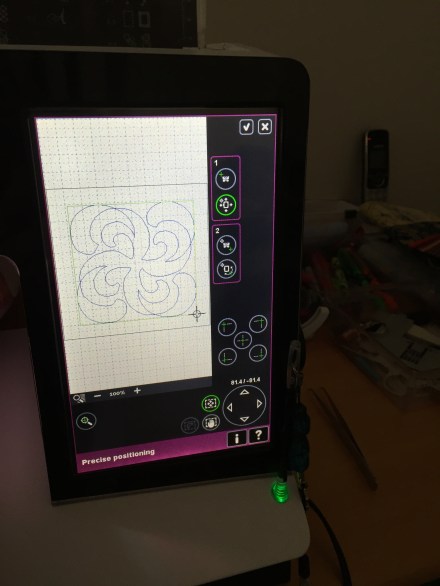
Next I place the hoop in the embroidery unit, bring up the embroidery design on the screen and use precise positioning to check the location of the corners making sure they fall within the block. Notice the cross hairs in the lower right of the embroidery design.
IMG_7261

I check all four corners to make sure the design fits the block. Because the hooping is at best approximate, I use the precise positioning on my machine to fine tune the location of the design within each block. I adjust the position of the design (up/down, left/right) making sure it’s as centered as possible.

IMG_7262

I set the machine to embroider, but before I start, I bring my bobbin thread to the top of the quilt (later I will embed the two threads using a self threading hand sewing needle – picture later). I hold the two threads out of the way so as the machine executes the embroidery it isn’t stitching over these threads.

IMG_7263

I stitch out the design,

IMG_7258

When the embroidery is done (I include a tie off and automatic thread cutting in the embroidery design), I remove the hoop from the machine, and before removing the hoop I pull the starting threads into the quilt. I also embed the cut tie-off threads on the underside of the quilt. I find it easier to handle the self-threading needle in the quilt when it’s still taut in the hoop.

IMG_7264

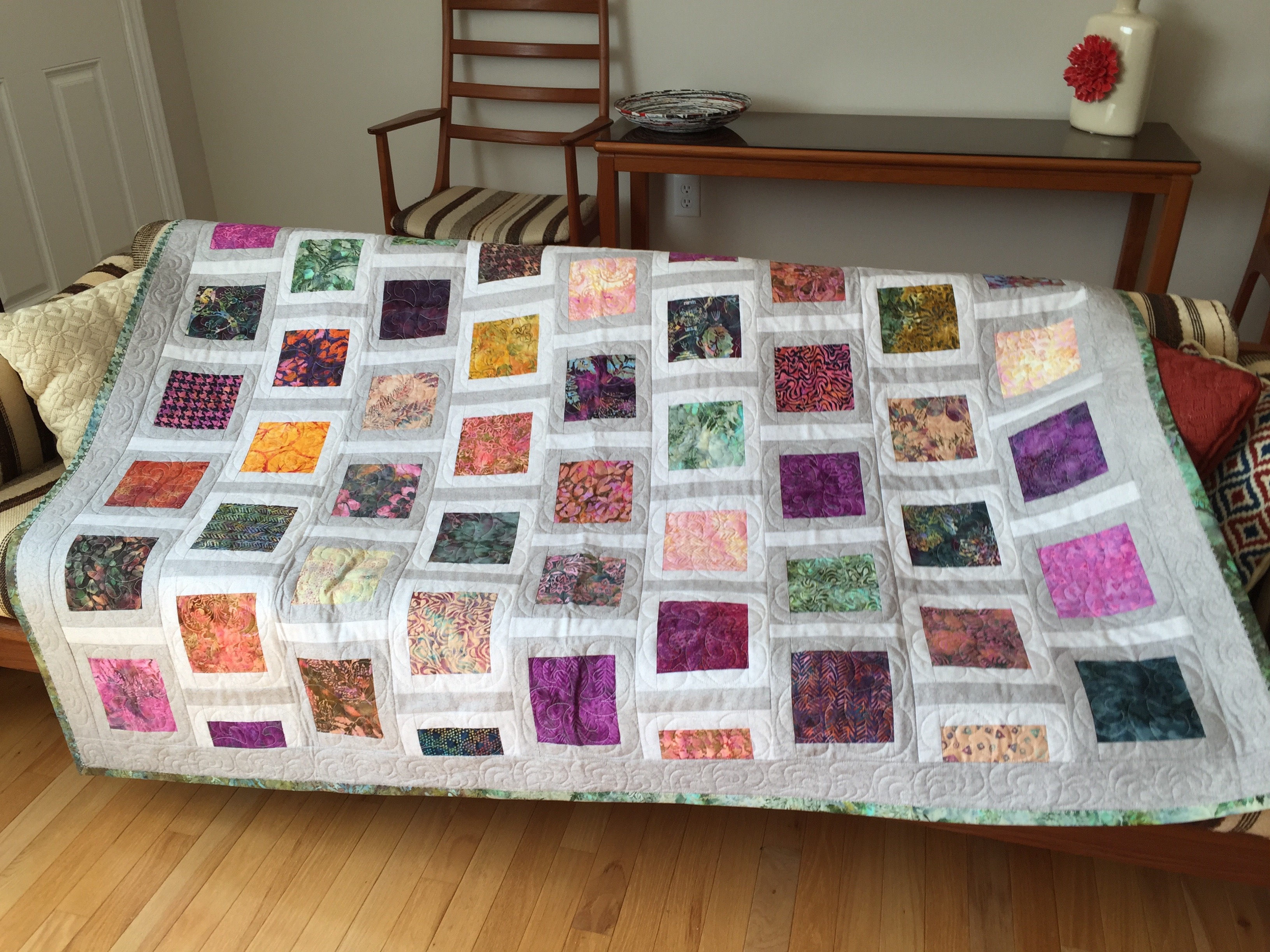
This quilt required 50 repeats of the embroidery design, plus eight half block designs (set up as a separate design) four on each side. It took me a couple of hours a day over three days to complete the quilting of this 48″ X 62″ quilt.

IMG_7268

I used my large endless hoop to stitch out the border (another design I created using the elements of the design I used for the blocks). The vertical joining strips were narrow so in the end I left them unquilted. Before beginning this quilt I stabilized the layers (backing, batting, top) by stitching in the ditch along the horizontal lines – I didn’t do vertical lines because I didn’t want vertical seams through the blocks.

I haven’t tackled a larger quilt – I think the boredom factor would do me in; in addition, I don’t have table space to hold that much fabric while the machine is doing the embroidery. My lap quilts are small enough that I can position the quilt fabric beside and above the embroidery hoop while the machine is doing the embroidery. It’s important not to have too much drag on the hoop – if the quilt hangs down the weight interferes with the hoop movement and the design doesn’t stitch out accurately.

So there you have it: Quilting In The Hoop – a technique for quilting a quilt using a home embroidery machine instead of a long arm quilter! Need more information? Ask for help using comments.

Socks Done

IMG_7326

This is the pair using leftover yarn. I interspersed the variegated with a solid peach for the leg and instep. When I ran out I added a solid light grey. The point is to stretch out the variegated as far as it will go. I suppose I could stretch it further were I to use a third inserted colour.

This was the original pair knit from the variegated with contrasting cuff, heel, toe.Andrea Cook

Improvisation #4


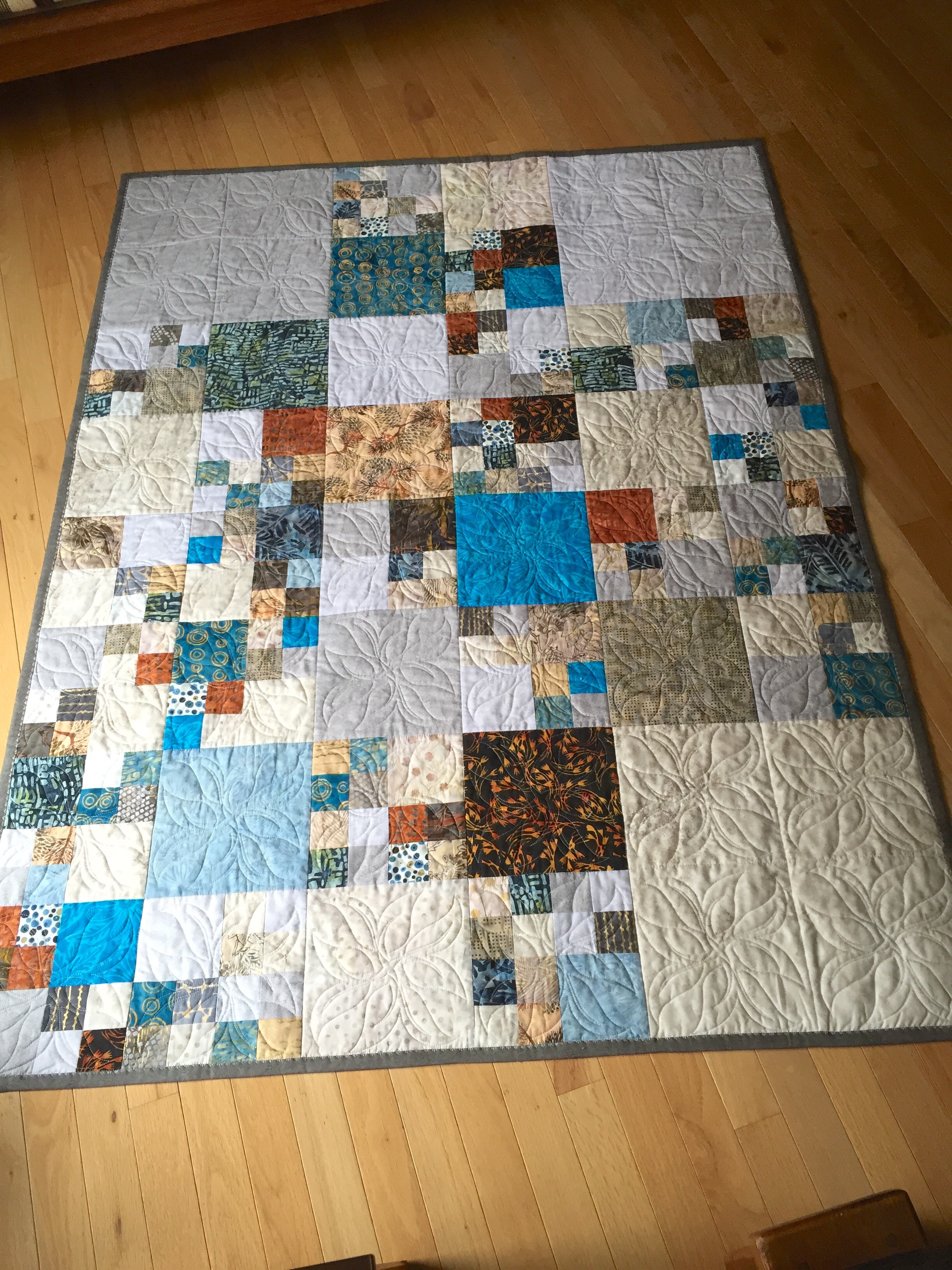
The inspiration for this quilt was simple – start with three predominant neutral colours, then mix in a bunch of coordinated batiks and improvise based on a few (3) large 16 1/2″ blocks, a dozen or so (in the end I had 13) 8 1/2″ blocks, two 4 1/2″ blocks from each fabric, and a large number of 2 1/2″ blocks.

I began by laying out the three large neutral blocks, next the 8 1/2″ coloured blocks, the 4 1/2″ blocks, then the small blocks which I’d created by sewing short strips of two batik fabrics then cutting pieces 2 1/2″ wide block pairs. I couldn’t sew long strips together because I wanted more colour combinations than that would have given me. So I mixed and matched shorter strips to get 4-5 pieces from each. The few small block pairs I had left over were incorporated into the back.

I quilted the whole using a 200 X 200 embroidery hoop with an open flowing embroidery design that just about filled the hoop. Before I did that, though, I gave some thought to simply stitching randomly spaced vertical and horizontal lines across the quilt surface. It may look simple, but stitching those lines is a manual task, quite time consuming, and hard on my neck and back. So in the end I opted to embroider the quilt blocks with an 8″ X 8″ design.

Final dimensions: 48″ X 64″. A good size for a lap quilt. I bound the quilt using the same fabric I used for the accent strips on the reverse side. As usual, this is a reversible quilt.

Finished Last Evening

Just the heel in a contrast colour this time. I wanted to use up as much of this yarn (Opal: Sweet ‘N Spicy) as possible to have the least left over (still probably enough for a pair of legs).

This is the only yarn I’ve used for three pairs of socks – that’s why this pair seemed to go so slowly – I knew what was coming.

That was the last full ball of yarn in my stash. Time to visit LK Yarns in the north end, my local yarn shop.

Winter Wonderland

It snowed here yesterday – quite a bit of light blowing snow. The drifts on my back deck were, let’s say, interesting. I was just able to open my backdoor enough to get out and shovel off the top step. Then captured a picture of the drifting snow.IMG_7290

And today my amaryllis is in FULL bloom – 8 flowers at the same time – never been this lucky before. The red just glows.

IMG_7292

Charms Quilt II

Just finished – the second charms quilt. The goal here was to use up more of the leftover charms from the first charms quilt. I had to add some strong batik 5″ blocks to those I was able to select from the charms packs because I didn’t have enough strong coloured ones otherwise. The strips came from my scrap boxes I didn’t need a lot of fabric (I chose all darker colours) – 1″ x 5″ strips  (70 in all). The blocks were easy to assemble, deciding on an arrangement took a couple of days, first auditioning all 140 on the floor then tweaking the placement over a few days.IMG_7297

The big decision was whether to border the quilt in the off white fabric or to use the darker grey – I obviously chose the darker grey. Glad I did although the quilt would also be interesting with the background fabric as border – in which case, looking at the quilt now, I can see if I had done that I could have stuck one or two triangles in the border along with a couple of strips! Didn’t think of that at the time. Something to keep in mind for my next quilt.

IMG_7299

The back uses some more charm pieces to make “flying geese” blocks. My pinterest feed had instructions for making the blocks – since I’d never tried them I thought this a good opportunity to have a go at some. In the photo you can’t really see the teal colour in the backing fabric but there is some. That was the reason I decided to border the strip with a strong turquoise. It does bring out blue in the backing.

My backing was wide enough that I was able to salvage almost enough fabric for 2 1/2″ binding strips (I had a bit of backing leftover which I also used and incorporated one orphan strip to complete the binding. It blends rather well with the whole).

That’s two completed quilts in four weeks. Now on to a quilted jacket/coat that I want to take to San Francisco in a couple of weeks.

Amaryllis

  
Finally my amaryllis is blooming. I potted the bulb as soon as I got it at Christmas, watered it sparingly – and finally it’s got flowers. It’s a double (the second stalk will be in flower in a few days). So I may actually have eight flowers at the same time – wouldn’t that be grand.

Charm Quilt I – Finished

Just done. Label and all. I’m pleased with how the quilt turned out. I like the contrast between the two muted background fabrics and the individual swatches – each is strong and colourful, yet they blend well.

I wasn’t sure about the bold batik I used for the back – whether it complemented the insertion or not, but now that the quilt is completed I’m happy with the result.

This quilt I think has found a home in my living room- it fits in better than the quilt I had there.

Downtown Halifax


The face of Halifax is changing – another new building under construction. Love the prow shape at this end of the building.

Couldn’t resist taking the photo as I was going into Neptune Theatre this afternoon to see 2 Pianos 4 Hands. The play was well done particularly the Bach duo at the end. Really enjoyed it.

Jeans Makeover

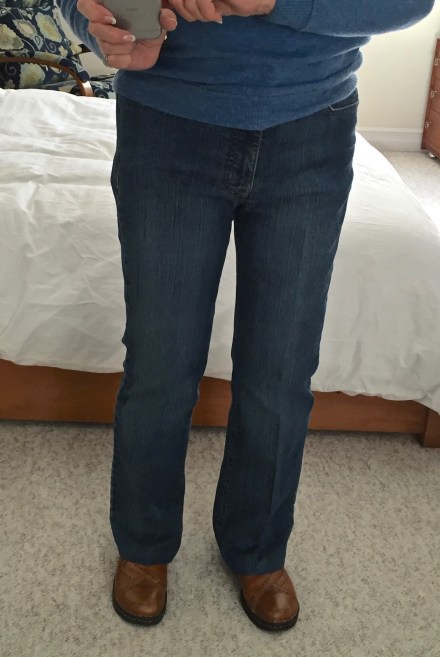
Too bad I didn’t remember to take a before picture – you’d have seen jeans that were very baggy in the bum with upper legs that were WAAAAY too wide!

So here’s how this goes: I go to a local thrift store and buy a pair of jeans that fit nicely in the waist and high hip. That’s my starting point. The jeans cost me $5! There’s no point in buying new expensive jeans retail because they fit no better than those from the thrift store.

Get the jeans home and wash them a couple of times to get rid of the smell (and to shrink them if they haven’t been worn a lot).

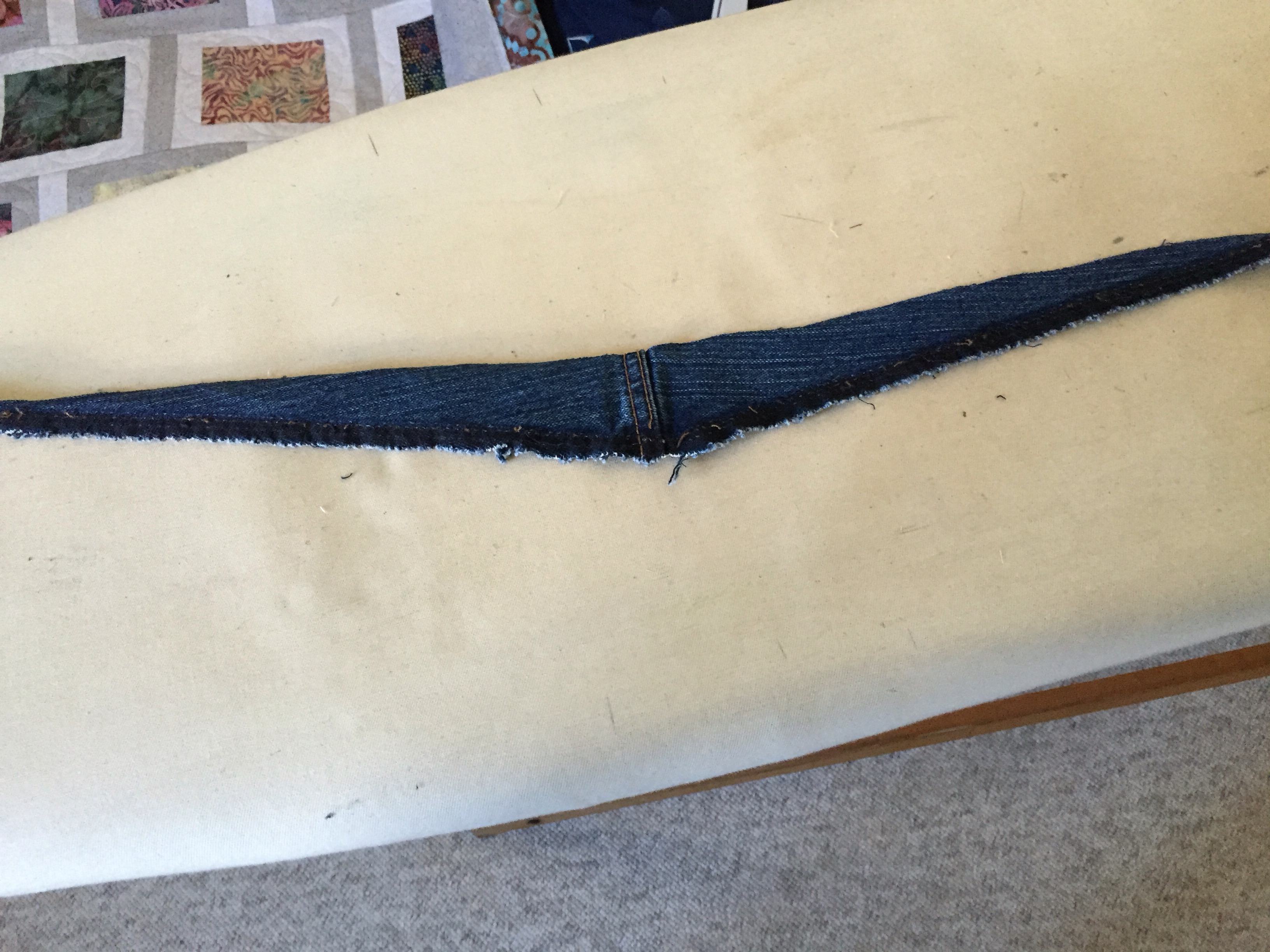
I open the inner leg seam from knee, through crotch, to knee. I pin, then straight stitch, front to back through the crotch making sure I am cutting out about 2 1/2″ at the back crotch seam area tapering the alignment along the inner leg till the front and back match at the knee – I don’t cut anything at this point because I want to check fit before cutting. The fabric eventually removed from the back crotch and back inner legs looks like this – sort of triangular.

Once I’m sure of the fit (I may want to remove a bit more from the back crotch and back inner leg – a smigeon from the front as well) I stitch, cut, and serge the inner legs through the crotch, then edge stitch the seam flat.

IMG_7251

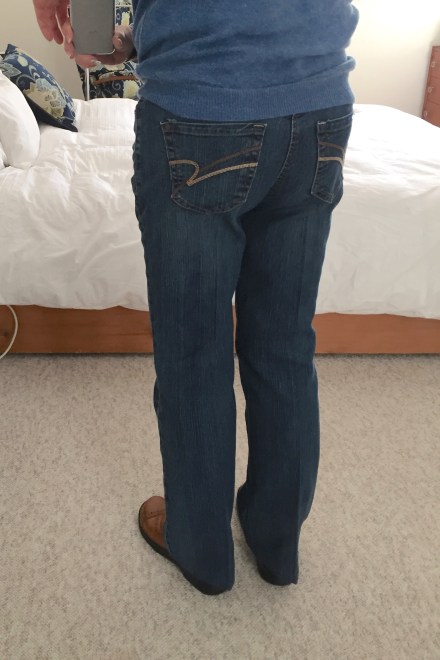
The back fits reasonably snugly with enough give for sitting. I shorten the legs – cut the length of the leg at the inner seam 28″ (enough to serge the edge and turn up a 5/8″ hem – my inseam is 27 1/4″).

The front fits smoothly, not baggy.IMG_7252

I make two other alterations – I carefully cut out the front grommet – they cut holes in my sweaters – patch, and reinforce the hole, sew on a button; the second alteration is to extend the depth of the right front pocket to hold my iPhone securely.

This is an earlier pair adjusted to fit the same way. I’ve worn this pair a lot – they’re very comfortable.IMG_7255