From My Fabric Stash

Fabric Stacks

Nearly two years ago I returned from a road trip to Toronto via Center Harbour Vermont so I could visit the Keepsake Quilting shop. I’ve been buying fabric from the online shop for years. This was a chance to actually see the entire selection.

I was looking for green batiks to make a quilt for Noah. However, once I’d made my choices, I couldn’t help looking around and ended picking up two different fat quarter collections of indigo/teal – eighteen pieces of fabric in all.

Having just finished the Japanese Strip Quilt, I was looking through my stash and decided it’s time to use these indigo fabrics so I opened the packages, spray starched and pressed each piece. I realized I didn’t have enough light coloured fabrics so I made the rounds of my nearby fabric shops and bought several 1/4 m selections.

Now the prepared fabrics are sitting on my cutting table – along with a 1/2 m length of a bright green to use as an accent.

I just have to decide what to do with them! I want something “modern” but probably constructed using traditional elements. Can’t make up my mind, is the problem.

For example I could set up half-square triangles and recut them:

Disappearing HST

I could cut squares, stack them three/four at a time, wonky cut them, and sew, mixing and matching to create blocks.

Wonky Log Cabin

I could just make 4 HST at a time and cluster them:

HST Clusters

I could cut rectangles and arrange them somewhat randomly:

Japanese Blocks

Or I could just cut and sew, improvising as I go along!

Don’t know where to start yet.

A Note on Binding My Quilts

I bind my quilts using 2 1/4″ strips cut from the width of fabric to provide a bit of give as I attach the binding (given the large lap quilt size of my quilts I need six strips). I join the strips using a mitre – the reason is the angled seams don’t attract the eye and often they are nearly invisible.

Sometimes I press the long strip in half lengthwise, but lots of times I don’t bother. I attach the binding first to the back of the quilt starting 10 inches or so from one end (to allow me to create a mitre join when I get all the way around) – no pinning, just stitching in short sections, aligning the binding against the quilt edge (with a hint of stretch), and stitching a smidgeon more than 1/2″ from the edge. When I get near to the join I stop sewing, lay the quilt flat on the cutting table, cut one end of the binding then overlap the second end, measure 2 1/4″ from the end of the first binding edge, and cut. Now I create a mitre to join the two overlapping ends of the binding – I make sure the binding is the tiniest bit short (1/8″ – 3/16″) so I can stretch the joined binding to fit the quilt (that way I don’t get a bubble in the binding). (I haven’t said anything about creating mitred corners – click here to get more or less an idea for how  I do it.)

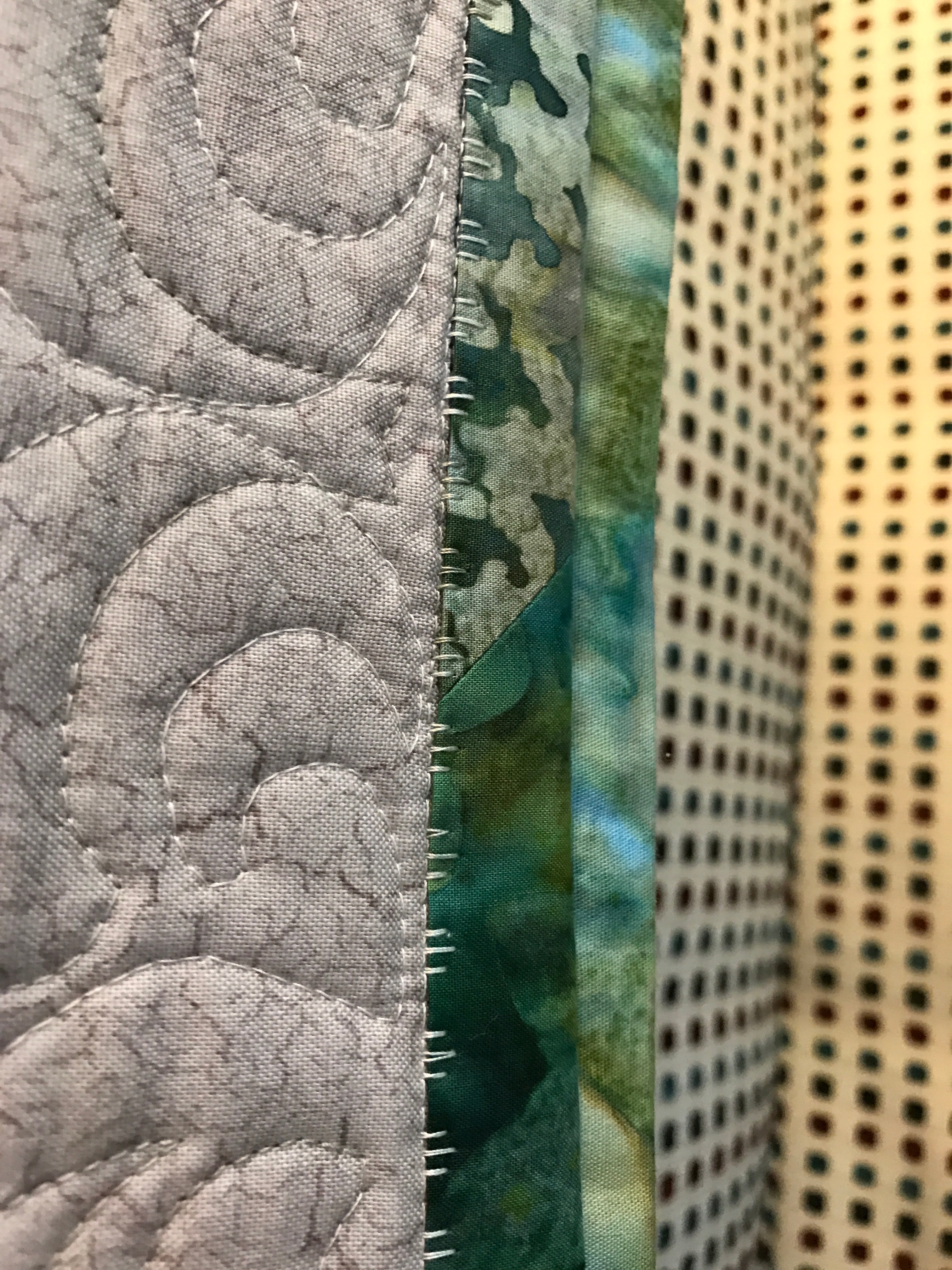
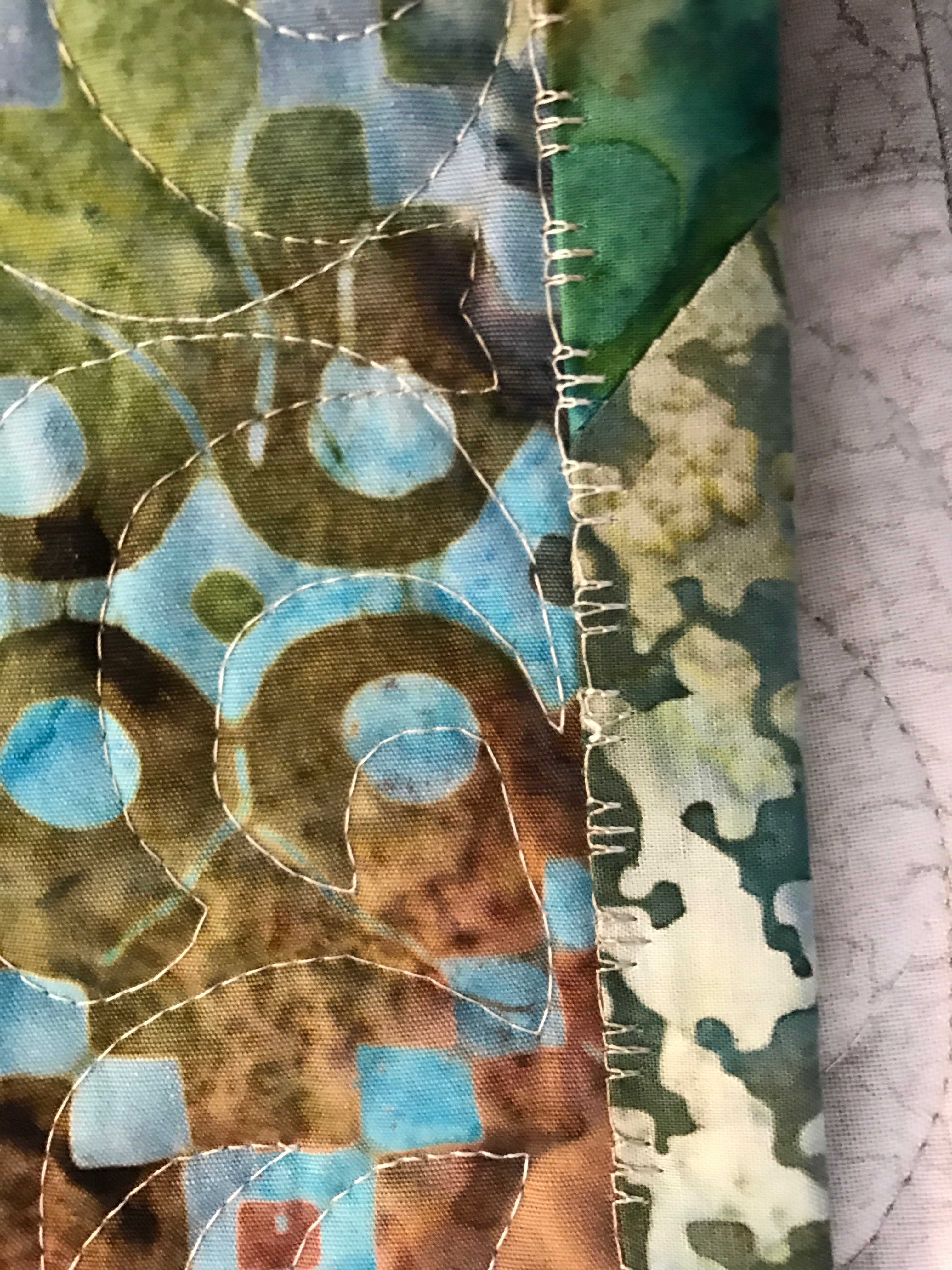
Now I turn to the front of the quilt, fold over the binding, turn it under and pin so the turned under edge just meets my stitching from the back. I have used a number of decorative machine stitches to attach the binding on the front. Here’s the one I use most often:

Binding From The Front

It’s a modification of one of my machine stitches – I am careful to keep the straight stitches along the edge, the stitching to the right and back overlaps the binding and holds it securely.

Binding On The Back

And because I’ve been careful to make my fold align with the stitching, the stitching is pretty much aligned on the back of the quilt (although my stitch tension isn’t always perfect – I don’t worry about that, it is the back of the quilt, after all.)

I’ve done this so many times that it doesn’t take long to bind a quilt.

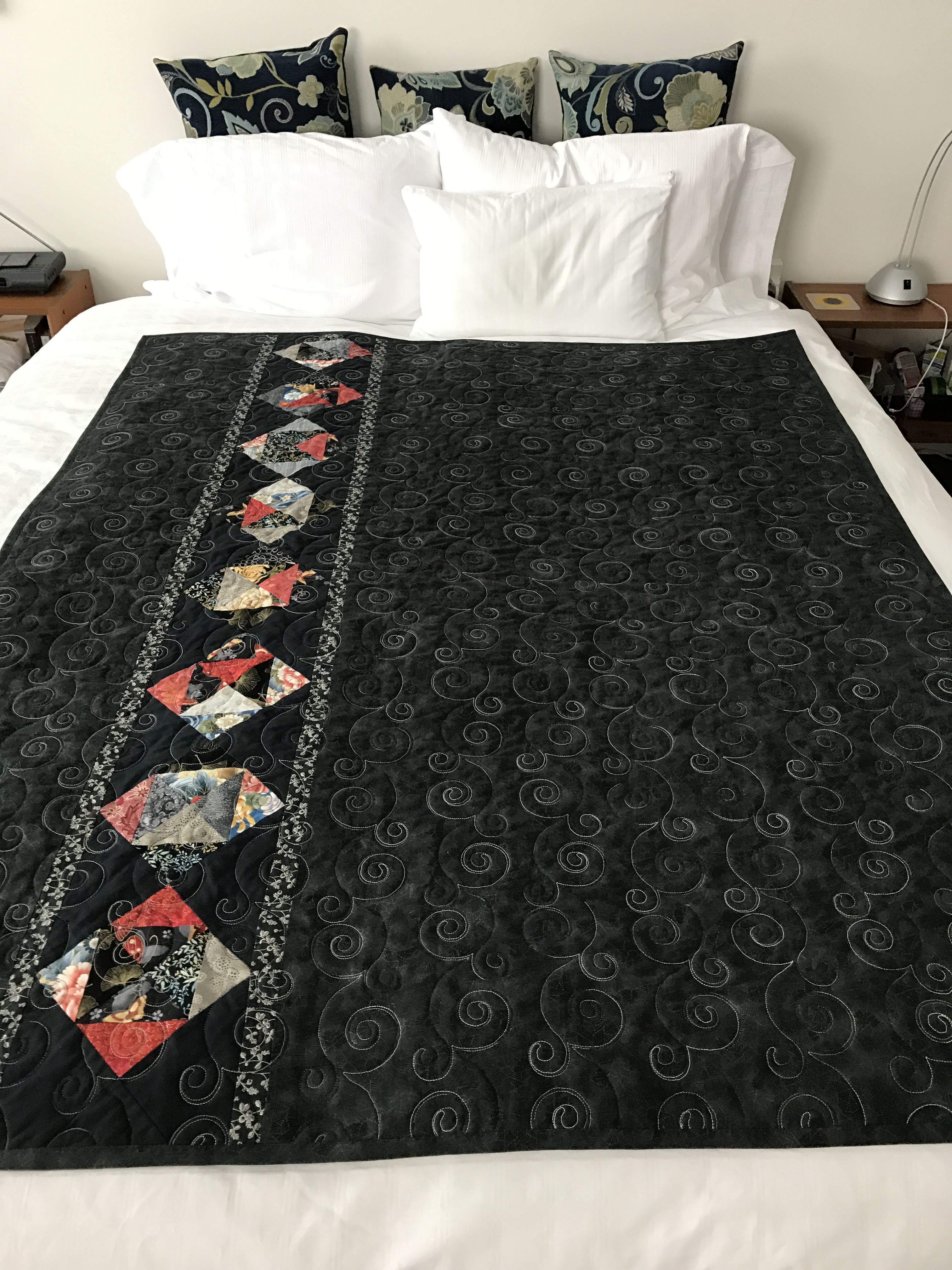
Japanese Strip Quilt – Finished

Here it is – the finished, bound quilt (just a label needed – I’ll do that later this afternoon when I get back from some errands).

Quilt Top

I did the quilting from top to bottom in line with the strips, instead of across the quilt. I wanted to emphasize the flow of the piecing. I was lucky my quilting design was the perfect size for the side borders and fills that space nicely (It was pure luck that I was able to balance the border quilting on each side!). It took a lot of precise positioning to make the embroidery joins work but it would take a hawk eye to detect the slight misalignments I decided to live with. I used a variegated white/grey/black thread, top and bottom and I like how it turned out on the back. On the front, the stitching blended well with the coloured strips. However, I darkened the light stitching in the dark strip ends because otherwise the alternating strip ends were obscured and that was a detail I worked hard to achieve.

Quilt Back

The back has worked out well. The pieced insert brings colour and interest to the back. The side borders of the strip blend well with the backing fabric yet effectively set off the insertion. I used strips of the backing fabric (which I had found in a second shop after I’d pinned the sandwich together) for binding. I’ve finally learned 2 1/4″ binding strips are better than 2 1/2″ – I have less fabric to fold under on the front of the quilt – easier to manage when I’m pinning the binding in place on the quilt front after first stitching it to the back.

I would have liked the quilt to be a wee bit longer but I was limited by my original 66″ length of backing fabric – all that was left on the bolt. The quilt is still a respectable 62″ long.

Failed Attempt

Failed Attempt

I needed to piece an eleven inch strip to insert into the single width of backing fabric I had (that’s the primary reason I piece the back of my quilts – to get the width I need for the quilts). I had lots of small amounts of the Asian print fabrics I’d used for the top so I cut single 2 1/2″ strips, sewed them together in pairs on both edges, cut triangles which resulted in 2 1/2″ squares. I assembled the squares into a central row then filled in the sides with another row of the small squares and edged with a set of light coloured triangles to set off my pieced strip against the dark backing fabric.

I decided to construct the insert panel along the diagonal so incorporating the triangles would be straight forward. Nice idea. However, in spite of the fact that I trimmed the triangles, the further I got into the panel, the more it bent away from the straight! I took tucks in strategic seams only to find my next diagonal row was even further off. With the panel half assembled, I gave up.

Unused Small Half-Square Triangles

I gathered up the unused small squares and triangles, looked at them for a while, paired the small squares, then joined two pairs to create five inch squares – I ended up with nine which I aligned on point down the middle of my cutting table (in the end I needed only eight). I had lots of the Kona solid “pepper” fabric I’d used on the quilt top – I cut 6 1/2″ squares (which I cut along the diagonal) and inserted the triangles in the spaces between the pieced squares. Finally I added two narrow strips of one of the black/white fabrics to offset the panel against the backing fabric.

Pieced Back Using Small Half-Square Triangles

So my efforts weren’t entirely in vain. I have tucked away my failed attempt. I inserted my new panel into the backing fabric (offset twelve inches from one side along the length). I pin basted the quilt sandwich and you can see I’ve begun quilting the quilt. My finished quilt will end up 49″ x 62″. My quilt design (in a 360 X 200 hoop) has worked out to 7″ x 13.7″. I’m quilting along the length of the strips rather than from side to side (to complement the strips rather than stitching across them) – I will end up quilting seven rows, each row requires 4 complete and 1 half repeat to cover the quilt from edge to edge.

So far, I’ve stitched two rows and started the third. It’ll take me another two days to finish the quilting. I plan on binding the quilt with some of the backing fabric I was able to find yesterday in the sister shop across the harbour from where I bought the original backing fabric.

I’m already planning my next project – a spring raincoat using PUL fabric (Polyurethane Laminate used to make diaper covers among other things) in black with bright umbrellas which I came across a month or so ago. Now to find a pattern….

New Zealand Yarn

Socks From New Zealand Yarn

A friend recently brought me a couple of 50g balls of New Zealand sock yarn from Australia – I decided to make it up into socks straight away.

This variegated pattern, as is all of them, dependent on the number of stitches you’re knitting. I started with 72 stitches and got one pattern for 20 rows; I decreased to 68 stitches and got a second pattern; then I decreased to 64 stitches for the lower leg and the foot which resulted in a third pattern. With a yarn like this, dyed in very short segments, the difference in patterns is very noticeable. In most of the other variegated yarns, the dyed portions are of much longer length so the pattern isn’t disrupted by a change in the number of stitches. What emerges in this yarn at 64 stitches is the lime green spiral with blue patches and short red stripes.

The yarn I began with last evening changes colour every 4 rows so the number of stitches doesn’t make a big difference in how the design knits out.

Japanese Strip Quilt

Pieced Strip Top Completed

I finally finished piecing this strip quilt – much more difficult than I expected it to be. Assembling long strips, particularly strips that have themselves been pieced, and consisting of different fabrics, tends to produce a “bow” – so you have to alternate the direction in which each new strip is attached. This means you sew one strip placed on the top, the next the strip is beneath because you want to start at opposite ends of the growing top for alternate strips.

Assembling The Strips

The piecing of the strips themselves was also a challenge. I joined lengths of complementary fabric pieces being careful to alternate the direction of the joins from one strip to the next. Then to assemble the top each strip had to be carefully laid out, the background fabric attached at one end, that end trimmed and aligned, then the opposite background end had to be attached and trimmed.

No chain piecing here – each and every strip is unique with the joins needing to be staggered and in alternating directions. So, of course, the creating and assembling of this quilt top took much longer than piecing say a collection of half-square triangles were it’s possible to mass produce the blocks.

Now I have to come up with an idea for the back. I have 66″ of a single width of backing fabric – I will need to insert close to 10″ in order for the back to be wide enough for the top. Still thinking about what kind of piecing will complement the strips on the top.

Small Zippered Bags – Again

Three Different Fabrics

I made 40 small zippered bags before Christmas. During the holiday season I gave most of them away. Two days ago I went to my bag stash to pick out one to give a friend and realized I was down to just four bags. Time to make more!

Yesterday, I bought three half-meter pieces of bright fabric, raided my quilting fabric for a length I didn’t like any more to use as lining, cut batting from a large piece left over from a recent quilt, cut lengths of zipper tape, and 2 1/2″ pieces of grosgrain ribbon for a small tab on the side. An hour later I was set to go into business.

This morning I went into production – three hours later I had eighteen 6″ x 8″ bright zippered bags. 

I’m getting organized at this mass production thing – I resisted the temptation to do all the steps on individual bags; I completed each production step on all eighteen bags before moving on to the next. The whole job went quickly.

However most of my sewing/quilting is focused on unique constructions so what I’ve learned from bag production line isn’t much help for the other sewing I do.

Second Pieced Demo Pillow Cover

Finished Pillow Cover Top (Starburst arrangement)

Finished Pillow Cover Top (Starburst arrangement)

Here is the second pieced pillow cover as a demo for the gals interested in having a go at some sewing in ten days time. I had finished the 16 half-square-triangle blocks yesterday, I assembled them into a 4 x 4 array this afternoon. Added batting, stitched in the ditch around the “star” elements to quilt the cover top. Found a fabric for the back, cut batting – my original cut was 16″ – I needed 16 1/2″! so I had to cut a second piece of both batting and fabric. Quilted the cushion back along diagonal lines in both directions.

This time I applied an invisible zipper (I’m actually thinking about taking the first pillow apart and inserting an invisible zipper into that one – I bought a second one for that purpose this afternoon).

Back of Finished Pillow Cover

Back of Finished Pillow Cover

I’m about to sit down and write instructions for making a 16″ pillow cover from 10″ fabric blocks (layer cake size).

  • Step 1: Mark both diagonals
  • Step 2: Stitch 1/4″ on each side of both diagonal lines
  • Step 3: Cut along diagonal lines, then again on both the center vertical and horizontal lines which yields eight 4 1/2″ half-square triangles – perfect for this size pillow cover.
Mark Diagonals, sew 1/4" from line on each side

Mark Diagonals, sew 1/4″ from line on each side

Here’s a tip for making a pillow cover – don’t sew the corners square. I happen to own this Dritz Pillow Cover Template (I’ve had it for years!). As you can see, it rounds off the corners removing about 1/4″ – 3/8″ from the corner. This rounded corner looks square when the cover is stuffed with a pillow. You don’t get those pointy “ears” on the corners. I trimmed my corners on both the yellow pillow cover yesterday and the one I just finished.

Corner Shaping Template

Corner Shaping Template

I applied my zipper along the curved edge just fine, when finished the zipper edge looks square as do the other three sides.

Another Pair of Socks

socks-feb-28-2017

Comfort Sockenwolle with Cashmere

Finished last evening. Slow going on these ones. I’d started them just before going to Toronto to have something to work on while I was there. Didn’t spend much time knitting. Resumed working on the first sock when I got back home, but the cold laid me low and I didn’t do much knitting for a number of days. Finally got going seriously about ten days ago, knit my usual 2-3 hours in the evening, finished the first sock and then the second. These socks are sized to fit a man wearing a size 9-10 shoe. I have a couple of recipients in mind.

I loved working with the Comfort Sockenwolle (Sock Yarn) with cashmere – lovely and soft and fine enough to work up with an even tension. The “denim” stripes (next to the darkish brown) invited a denim yarn for cuffs, heels and toes. They’re lively, but not so outlandish that a conservative man wouldn’t wear them.

My needles are empty at the moment but I’ll start the next pair this evening.

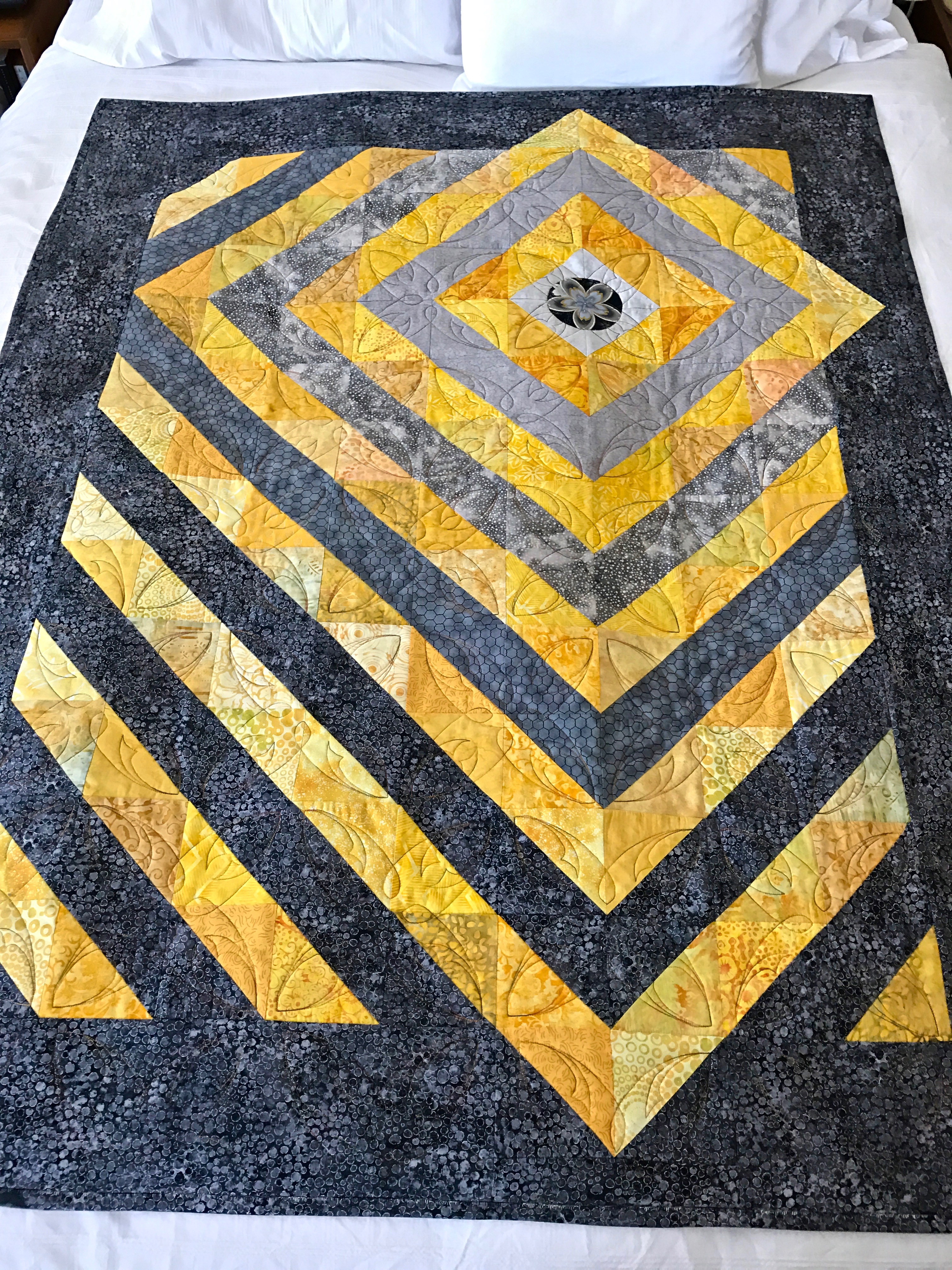
Grey-Yellow IV

The grey-yellow quilt is finally quilted and bound. Before I left for Toronto, I’d assembled the quilt sandwich, pinned the layers, intending to get back to work on it as soon as I got home. Didn’t happen. We had a couple of severe snowstorms, I came home with a dreadful cold that triggered my asthma, so I spent the better part of 10 days doing little other than coughing.

Finally, last Monday morning, I managed to go to the pool for my regular water aerobic class (I coughed quite a bit, but managed to breathe well enough to stay for the hour). Afterward, when I got home, I looked at the quilt and decided it was time to get back to work on it.

img_8519

Quilt Top

I fused and appliquéd the circle detail in position, and quilted the immediate surrounding block but didn’t get much further till the end of the week when I managed to get the rest of the central blocks quilted. Sunday, I quilted the border. This morning, I added the binding and label.

img_8524

Quilt Back

Done!

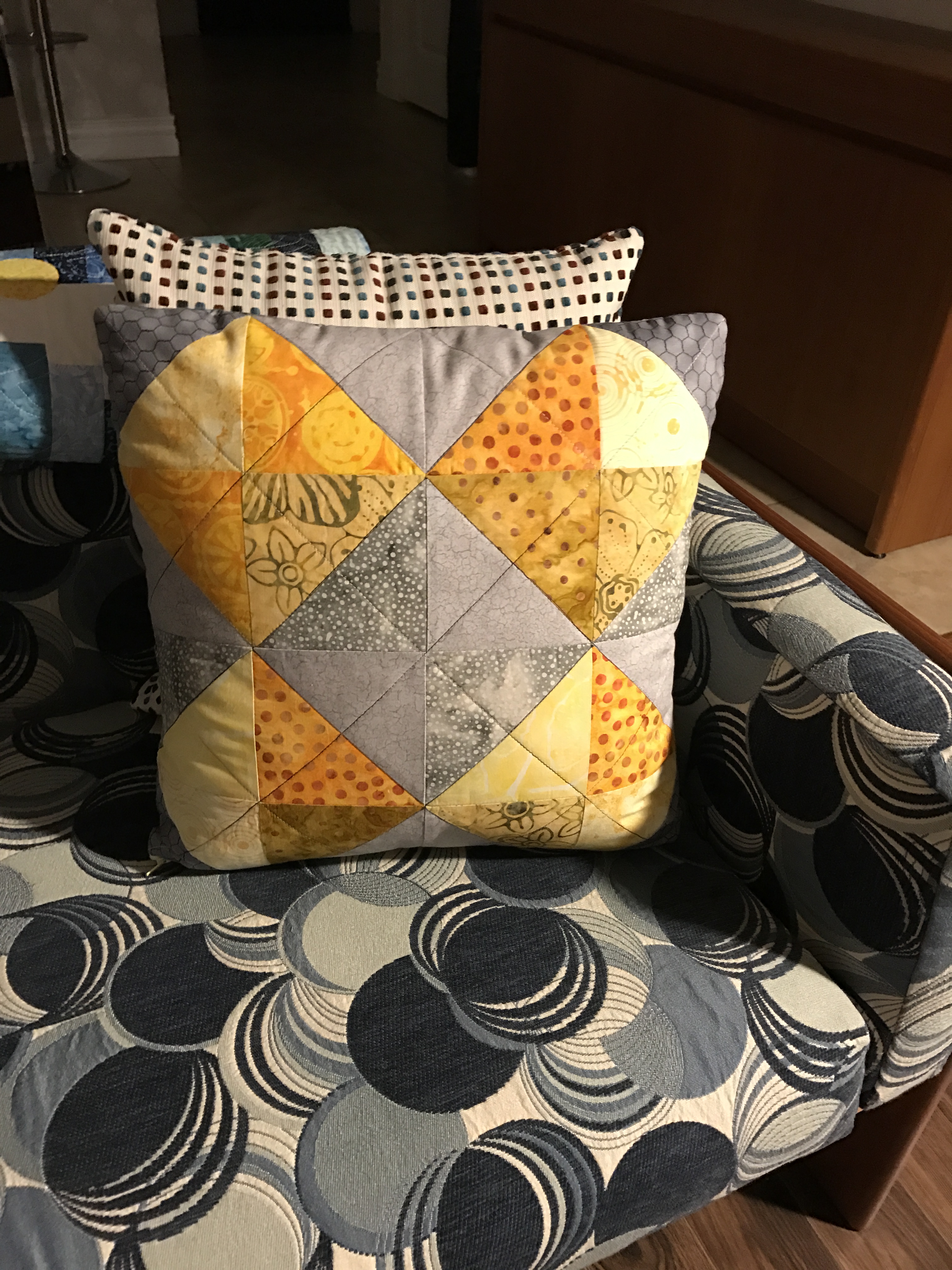
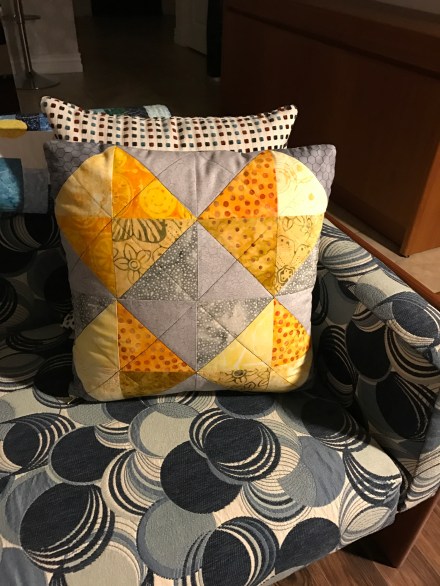
I still had a bunch of half-square triangles left over. I decided to use them for a pillow cover. Last week one of the other sewers in our Friday afternoon knitting/sewing group and I offered to assist those gals interested in making a pillow cover with piecing some half-square triangles into a 4 x 4 block. Five indicated some interest so Debbie and I are planning a sewing Friday in my sewing studio to make zippered, pieced pillow covers.
img_8525

Pillow Top

I started by gathering together all my leftover blocks – I had 13 constructed which I laid out in a 4 x 4 array – I made another four blocks being careful to use the appropriate grey fabrics so I could build some symmetry into my layout. I used my darkest grey in the corners, distributed the other two shades evenly, then sewed the blocks together. I added batting, and quilted along the diagonals to build some stability into the top. Next I cut a 16″ square piece of batik which I also backed with batting and stitched on the diagonal.

img_8527

Pillow Back

I trimmed the corners of both the top and back, slightly rounding them off, to create the illusion of ‘”squareness” when a 16″ pillow would be stuffed inside the cover. Finally, I added a zipper (a regular zipper, not an invisible one) to one end, unzipping it before sewing the two sides and the opposite bottom end.

Our instructions to the women were to purchase just two contrasting fabric from which to construct their pillow top. Here, I’ve used several yellows and three different greys. So, I decided, my next pillow cover had to be constructed from just two fabrics. I dug through my stash and came up with a somewhat dark blue/turquoise batik but I had nothing light to complement it, so back to the fabric store to buy 1/4 m. of a light batik.

I cut each of my two 10″ width-of-fabric pieces into four 10″ squares – paired light and dark blocks, marked the diagonals, placed right sides together and stitched 1/4″ on both sides of the diagonal lines. Then I cut along the diagonals and both the horizontal and vertical mid-lines to get eight 4 1/2″ half-square triangles from just two 10″ blocks! All I need for one pillow top is four 10″ blocks (two of each fabric). I’ve got those done and laid out ready to stitch, which I’ll do tomorrow.

I have already cut fabric for the pillow cover back, and batting squares for both top and back. I still could use an 18″ invisible zipper (I like using zippers that are longer than I need so I can ignore the slide when sewing them in place, trimming them after I’ve completed the side seams). It’s not that I don’t have tons of #3 zipper tape (and slides) from which to make an appropriate length zipper, but if I use an invisible one, you’ll barely see it when I’m finished. Besides, both Debbie and I think the gals will be pleased with themselves for having actually sewn in an invisible zipper which is not difficult to do.

So more tomorrow after I finish my second demonstration pillow.