Skyline #2

So here goes…

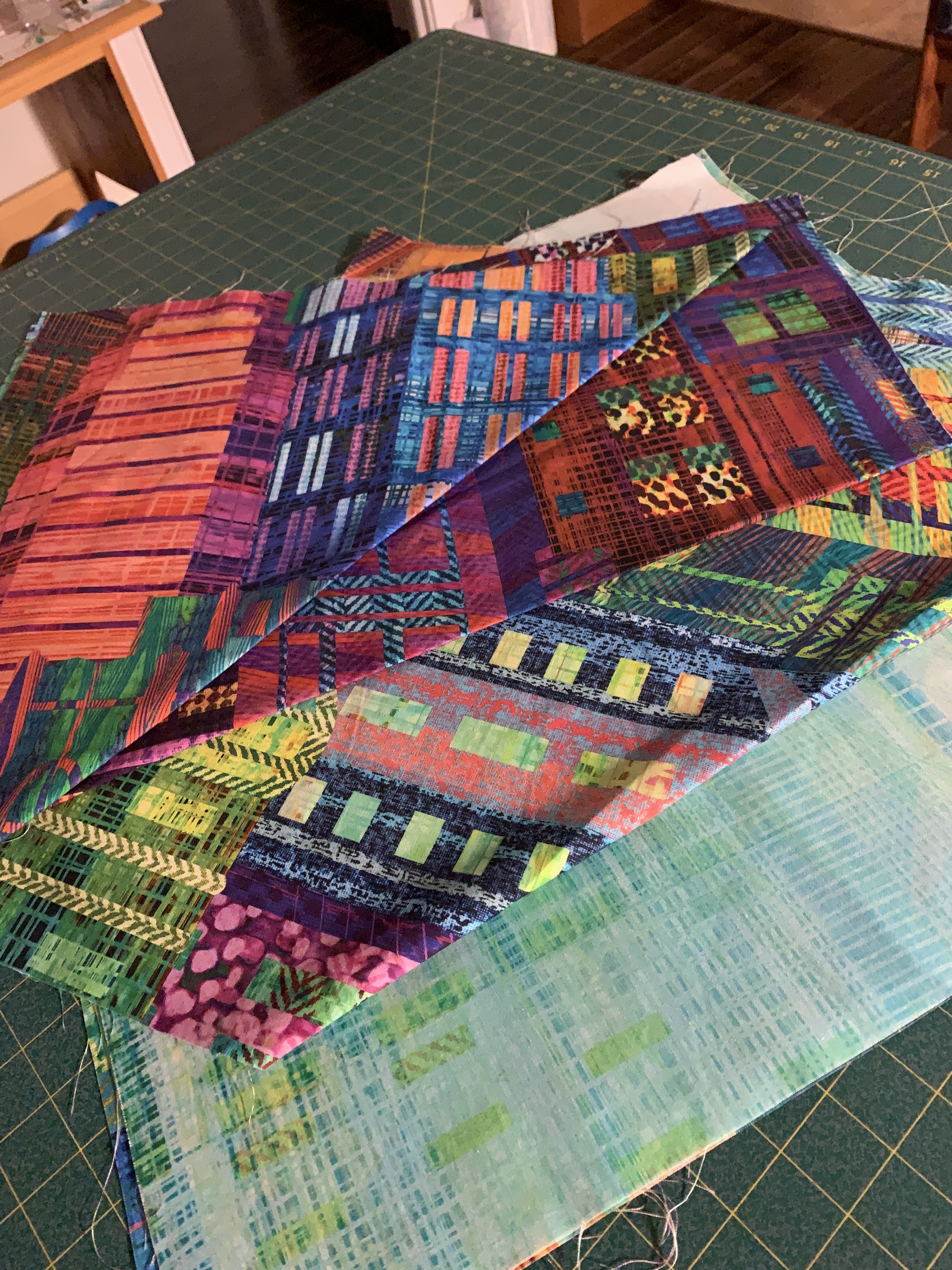
I took my second panel of the Hoffman “Skyline” fabric and cut it into wedges – some narrower than others.

I laid them out on my floor in alternating directions, spreading the array a bit wider than 50″ – close to the width I’d like to end up with (allowing me room to trim after I’ve assembled the panel).
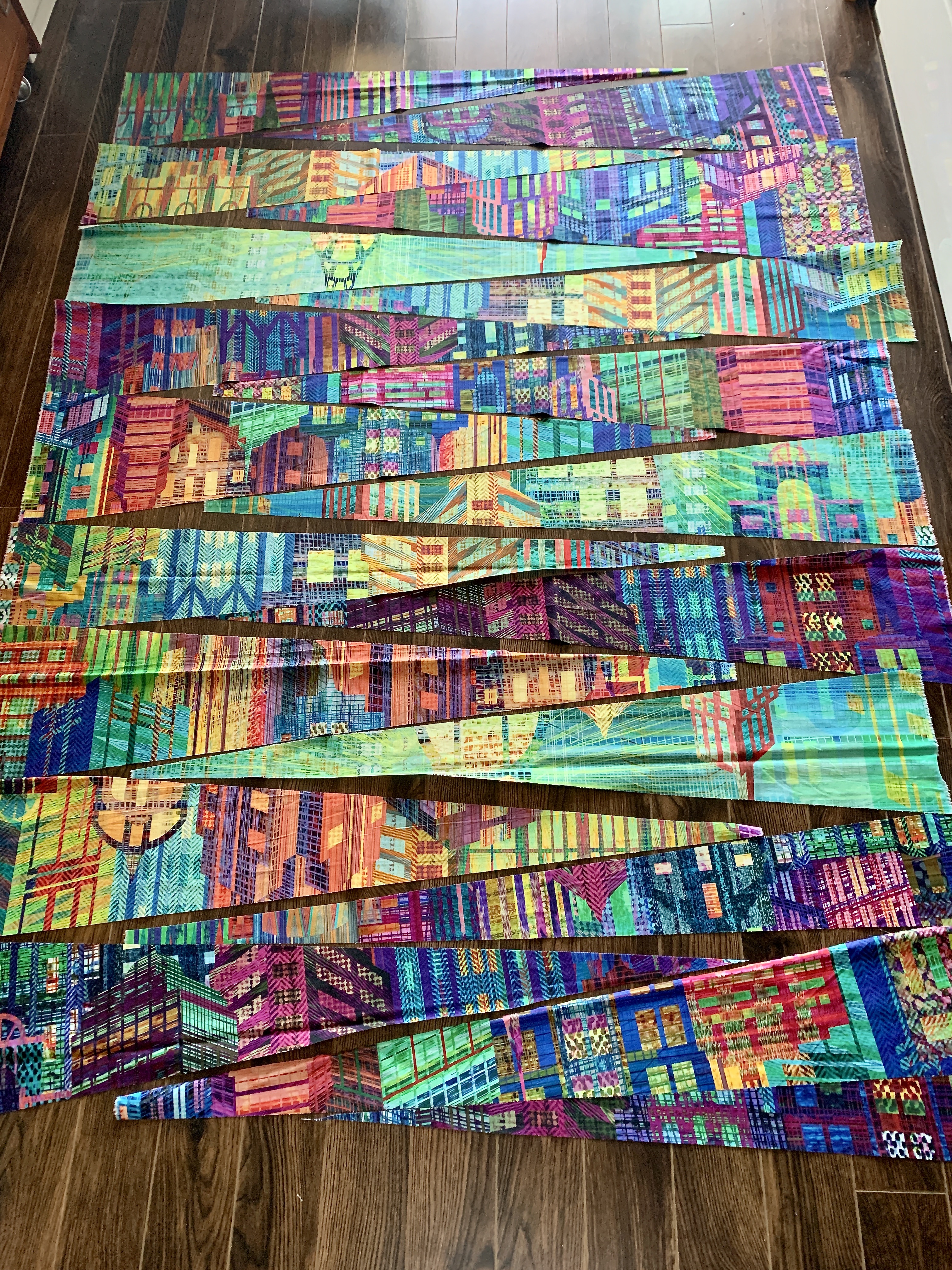
Skyline #2

I didn’t cut the lightest end of the fabric and I see now I may want to include at least one very light wedge in the array. I’ll leave this fabric on the floor and move wedges around over the next couple of days trying to decide on colour flow.

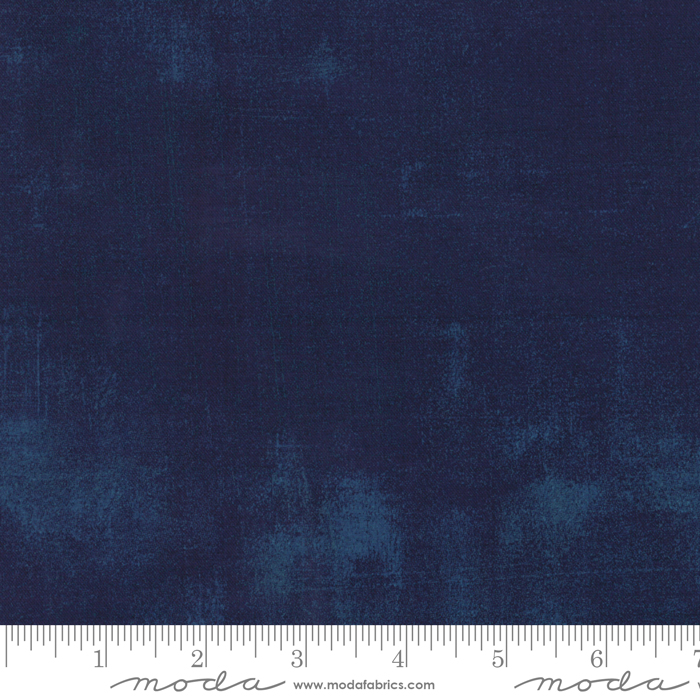
My next step is to cut my dark navy grunge fabric into strips (slightly wedge shaped, maybe) and attach those pieces to one edge of the coloured wedges. That will set up a stronger colour contrast and make the print colours brighter.
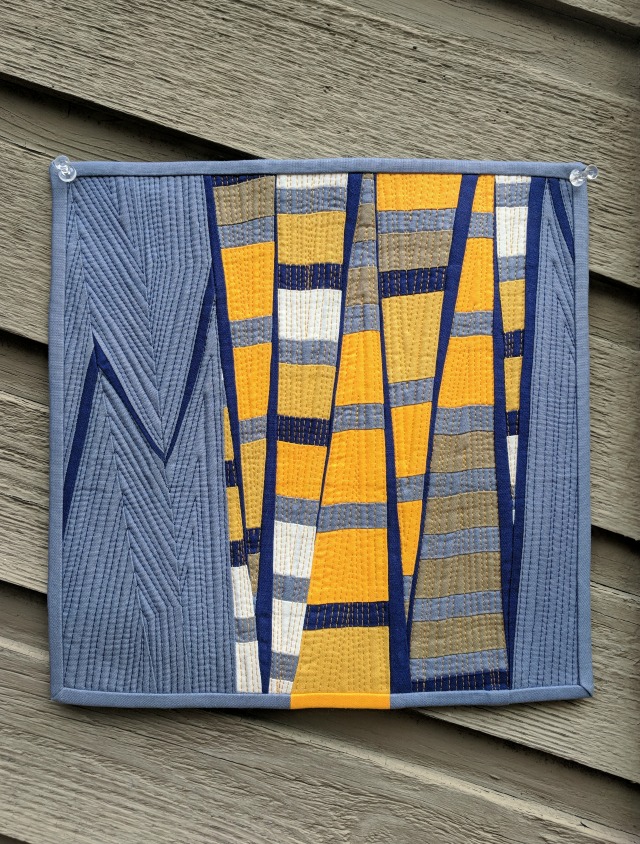
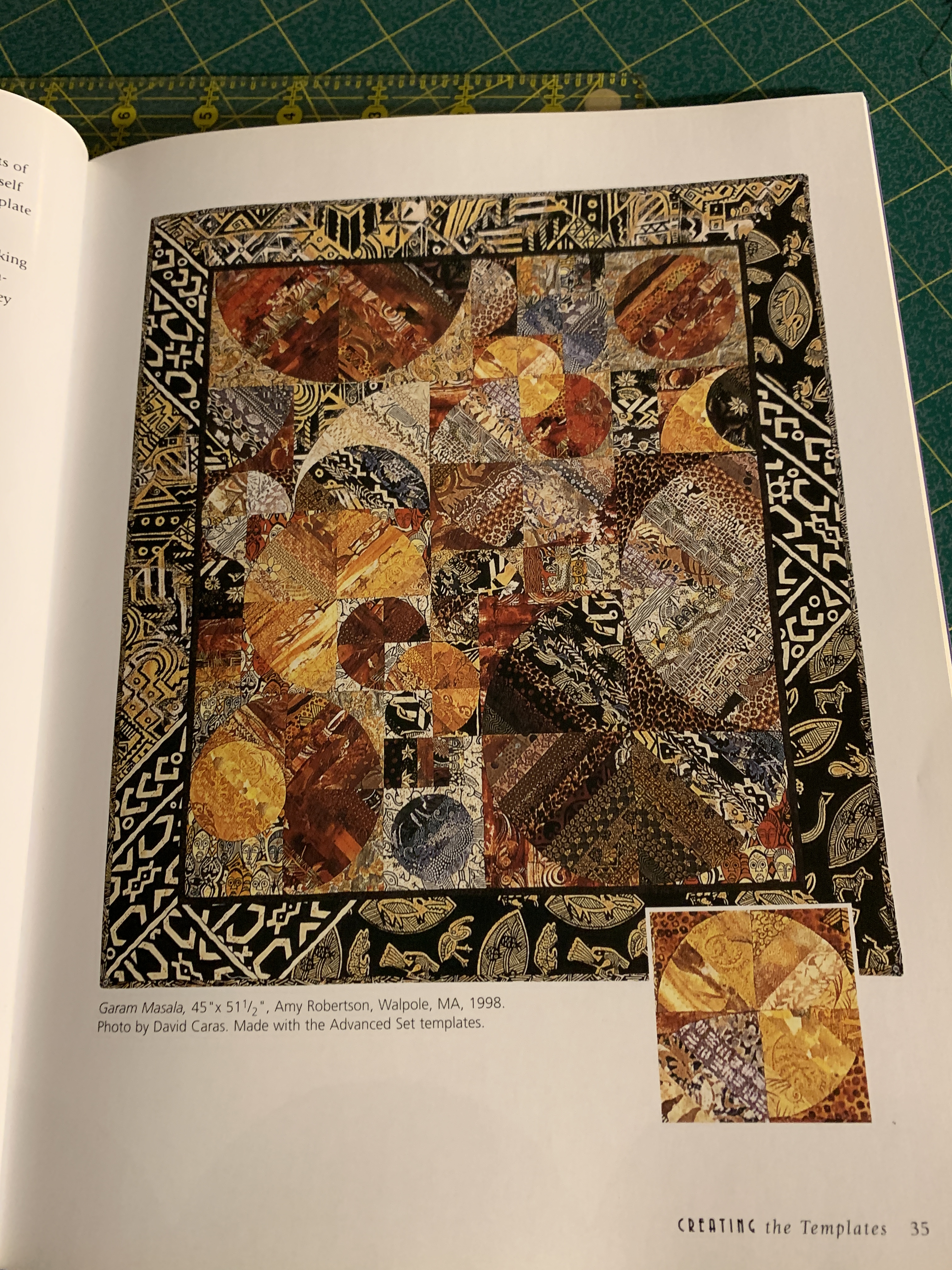
The inspiration for this project comes from Debbie Jeske’s 10″ block “Loosely Connected

Loosely Connected by Debbie Jeske

I’d come across the image on Pinterest after I’d bought the Skyline fabric and thought it was an interesting idea – I wouldn’t need to piece the wedges – just use the colour flow within the print. I’m not planning on solid end pieces, but who knows – once I have a panel assembled I might decide to include a grunge contrast at the ends, even along the sides.

I’m aiming for a finished panel about this same size as “Skylines #1” – 48″ x 64″.

So now to cut the dark blue grunge strips and begin adding them to the wedges….
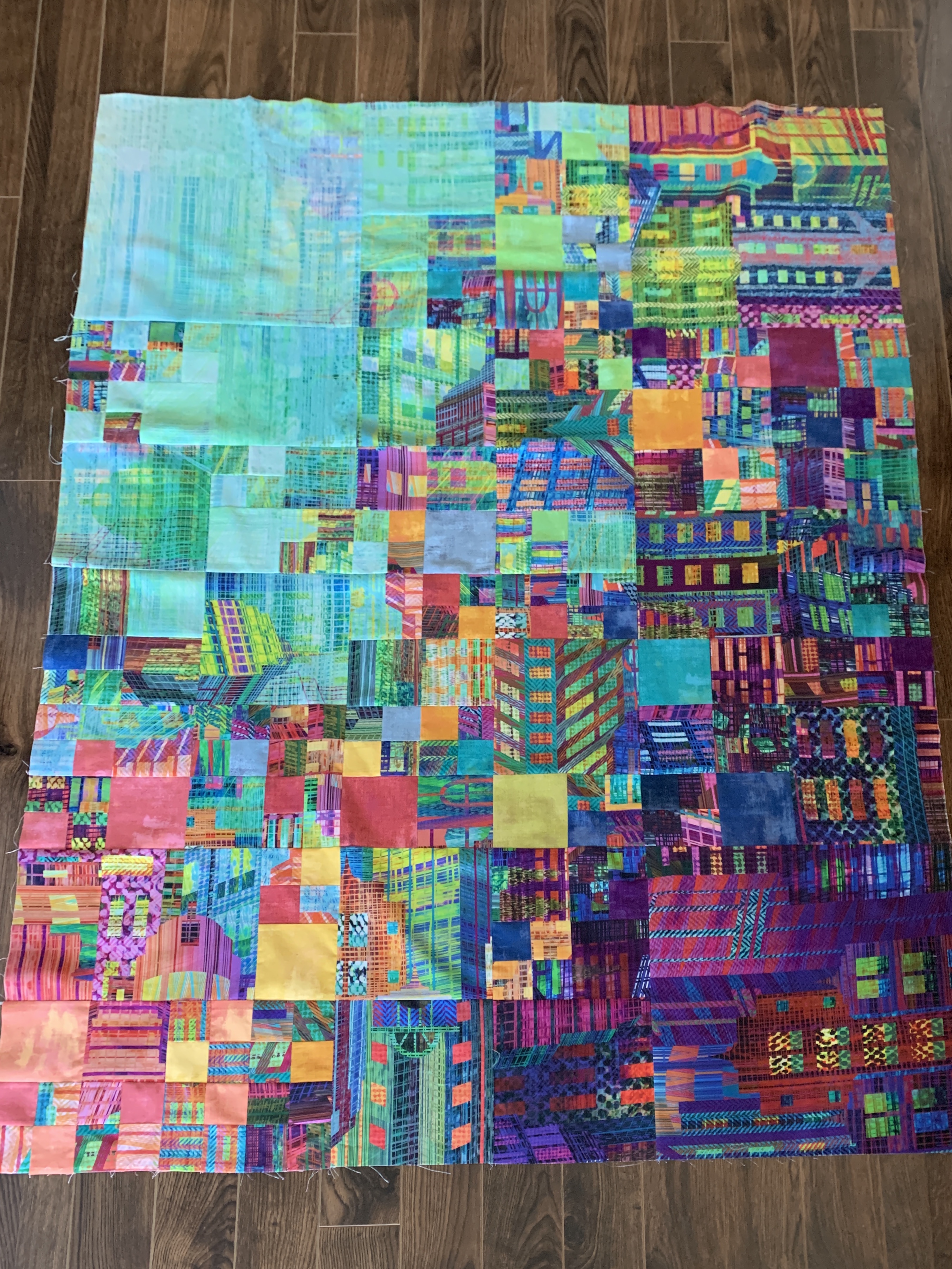
Skyline #1 – Piecing Completed

The piecing of the quilt top is finished. I’m happy with the colour flow.

Skylines #1 – Piecing Complete

Now to assemble the back, set up the quilt sandwich, and quilt it.

That’s it for today. Gotta catch a bit of the lovely weather – you can feel a hint of fall in the air – it’s been there for over a week now. It won’t be long before fall will begin showing itself.

Skyline #1

On July 9, I mentioned the Hoffman’s “Skyline” panel I’d bought – I was thinking about how I might play again with “Let The Trumpet’s Sound” drunkard’s path motif using this multi-coloured fabric.

Hoffman Skylines – Multi

I finally got going on on Aug 10, when I cut my 1m wide panel into 10 different 21″ squares. Then I walked around the fabric for another week!

I took a deep breath on Aug 17 and cut the 21″ blocks into smaller sizes:

  • 3 x 16.6″ – a dark, a medium, a light
  • 14 x 8.5″
  • 36 x 4.5″ and
  • 120 x 2.5″ blocks.

I also cut 32 x  2.5″ blocks from several complementary shades of “Grunge” fabric from my fat quarter stash. I more or less sorted everything by colour, I stitched many of the 2.5″ blocks into 4-patch elements, then I began laying out blocks on my cutting table:

Skylines #1 – First Corner

The large pale block, two 8.5″ blocks, then filled in with a combination of 4-patch and 4.5″ blocks….

Skylines #1 – Medium Tones

Next, I grouped more blocks into medium-toned groupings until I had no more space available on my cutting table, at which point I very carefully moved everything to the floor.

Skylines #1 – Incomplete Layout

I laid out all the blocks I had cut – I still needed the equivalent of approximately 15 x 4.5″ spaces – the few remaining scraps I had left of the “Skylines” were too small so I turned again to my collection of “Grunge” fat quarters, selected a dozen I thought would coordinate well with my layout.

As I was filling in spaces, I moved blocks around until I had a more coordinated colour flow:

Skylines #1 – Completed Layout

Now I had a clear alignment of lights, darks, and medium colours – with a grouping of peach tones in the lower left corner.

Looking at the layout with a friend that evening, the small pale mauve “Grunge” blocks were stand-outs – they had to go; I replaced them with other colours which blended better. And then I began assembling the quilt top into 12 x 16.5″ blocks:

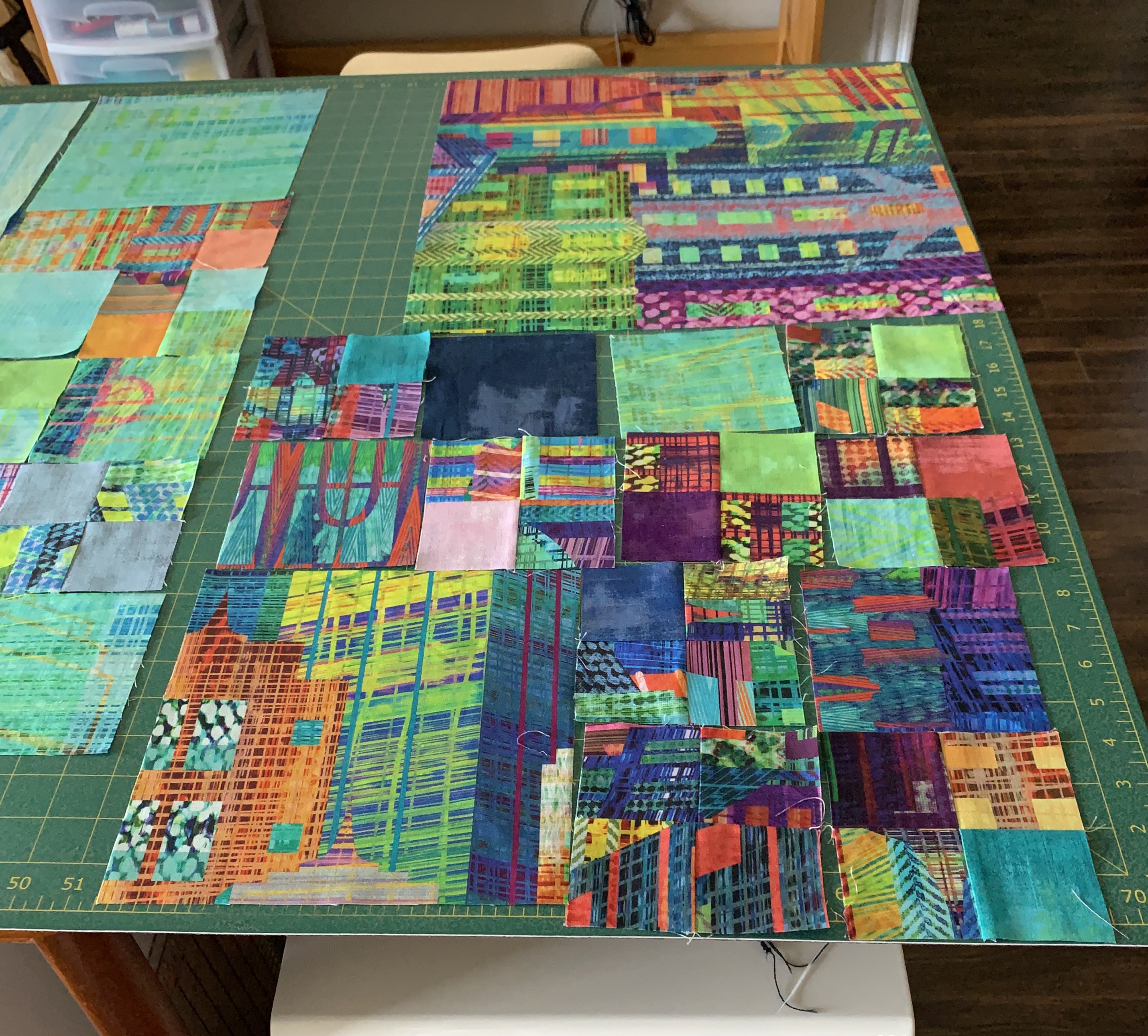
Skylines #1 – Partially Assembled

The top row, the second row, and the bottom row are now sewn together. The layout in the middle two rows used a couple of the 8.5″ blocks staggered across two rows – hence the jog in the second row. The third row is laid out on my cutting board ready to be assembled:

Skylines #1 – Third Row Ready to Assemble

That’s this morning’s work. Once I have all four rows done I’ll put them together. Leaving them separate at this point lets me lay them out, check for colour flow, and replace any “eye-sore” spots more easily – taking apart the smaller strips is much less complicated then replacing blocks in the middle of a large panel!

Oh, and I picked up another metre of the “Skylines” fabric – bringing my total, now, to four panels. I’ve decided to insert an 8″ – 10″ strip in the back of each of the “Skylines” quilts. Did I say I have plans for doing THREE quilts using this fabric? I intend to call the series “Skylines Triptych.”

Another Pair of Socks And Other Stuff

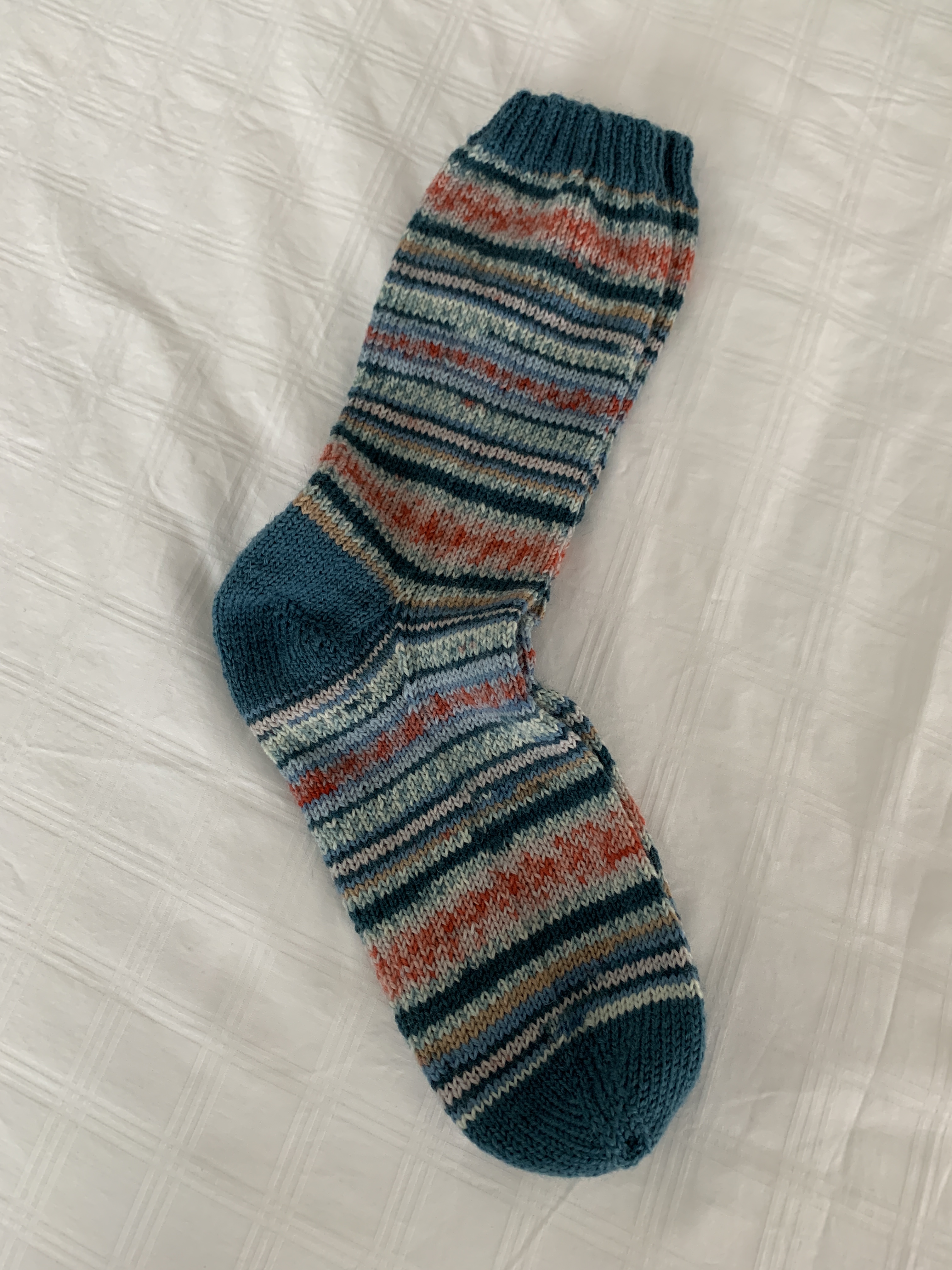
On August 3, I finished yet another pair of socks:

Turquoise Socks

I kinda liked working on them. It was a long repeat so the pattern kept being interesting to work on. They’ve gone into the give-away stash (which is getting large).

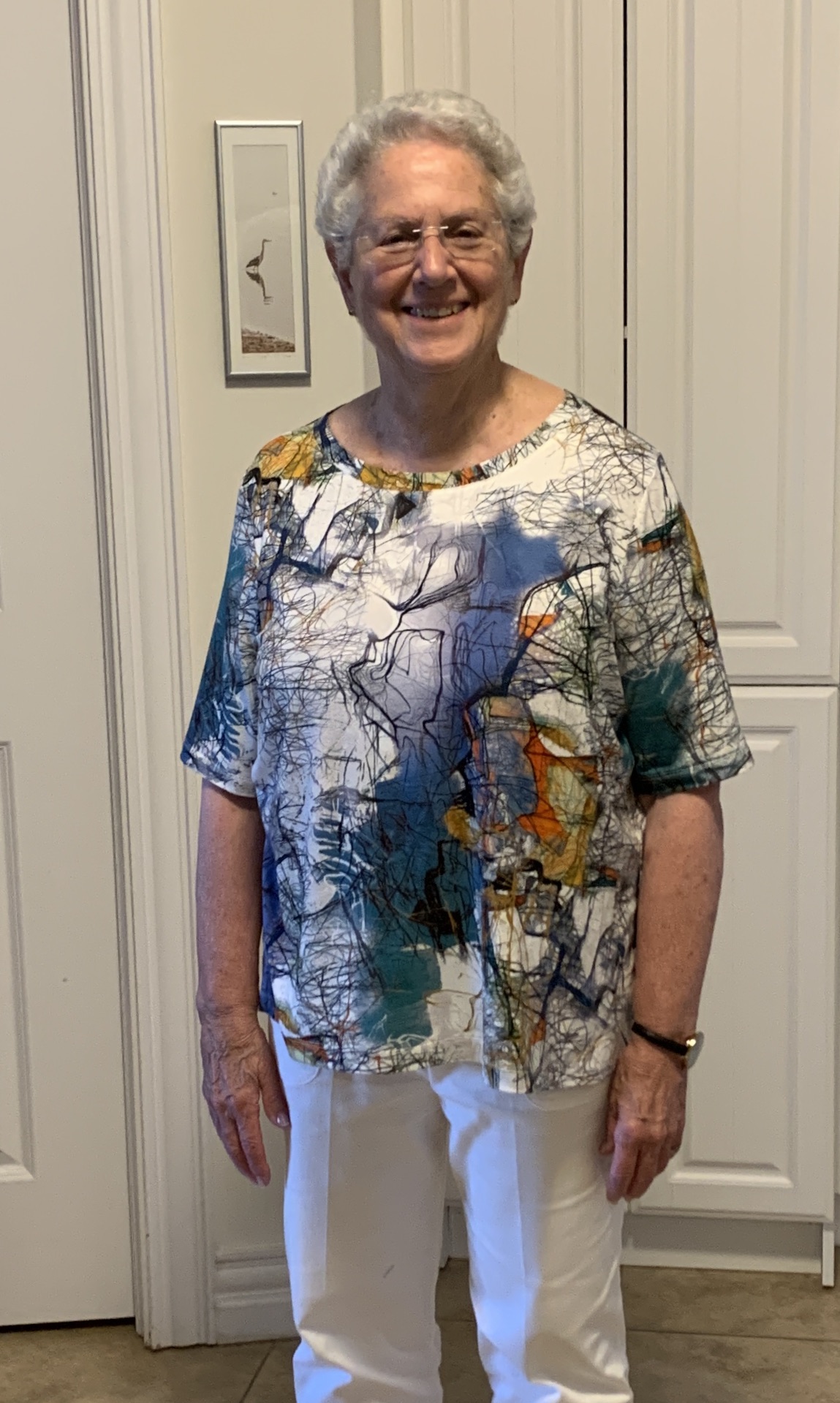
Then I worked on a t-Shirt I’ve been meaning to make for over a year using one of the three gorgeous pieces of Marcy Tilton digital printed French cotton knit I had in my garment making stash.

New t-Shirt

I finished making it yesterday then I wore it – but it was too big (makes me look dumpier than I actually am) – I’d made a pattern from a Talbot’s t-Shirt I’d purchased last year which fits nicely, but the pattern didn’t quite translate to the stretchiness of the fabric. Today, I took 5/8″ off each side and it looks less sloppy. I may still shorten the sleeves as well. I’m happy with the fit of the neck and the shoulders are OK. When I’m satisfied with how this one fits, I’ll make the other two.

Today I had what I think are the last three blooms on my Datura plant. The pot is in the sunniest corner of my balcony but already the shorter day length is affecting the plant. I have no more buds coming along and leaves are yellowing and dropping off.

The Last Of The Datura Flowers

Tomorrow these three flowers will be drooping then in a couple of days they’ll fall off. At that point I’m probably going to get rid of the plant. I’ve enjoyed watching these spectacular flowers unfold. I just wish I had a sunnier spot for it. In the right conditions it would bloom till well into the fall. It’s an annual so there’s no point in trying to salvage it.

On July 9, I mentioned the Hoffman Skylines fabric I had bought.

Hoffman – Skylines Fabric

I’ve been walking around it since then. Last week I finally cut one of the two panels I have into 21″ square blocks. Now you no longer see the print as skyscraper buildings – now the colours pop out. I think I am going to try something with drunkard’s path.

A friend loaned me Louisa Smith’s book “Strips ‘n Curves” – she creates strip pieced fabrics from which she creates a wide range of drunkard’s path blocks. With my multi-coloured Hoffman fabric I don’t have to do any strip piecing, I can use it as it is. So now I have to figure out a  large block size to make the first drunkard’s path block, then scale down from there to work out smaller versions which will fit into an array. I was going to add more solid colours but the jumble of colour in the photo from the book makes me think I may just build my blocks from contrasting portions of the Skyline fabric and let the colour do the talking.

I’ve been dithering about this for a couple of weeks. I think I may be ready to cut the fabric now.

Let The Trumpets Sound

I must say when I began this Drunkard’s Path quilt I didn’t anticipate the chorus of trumpets that would emerge!

I had decided to give this quilt idea a go (from a photo I’d seen) because I liked it’s modern quality – two fabrics and stark lines.

Trumpets – Front Of Quilt

39 Drunkard’s Path blocks – the rest is filler to create the overall layout.

Working on this quilt has let me consider all kinds of possibilities for using Drunkard’s Path in unusual layouts. I picked up a panel the other day which I think might turn into something quite interesting were I to cut it into squares and use both the Pie and “L” elements contrasting the dark and light tones.

Hoffman Skyline – Multi

I didn’t buy a full panel – the fabric is 106″ wide! – I bought a metre (40″) which is most of the pattern. Use the multi-coloured buildings cut out as, say, the Pie pieces with some kind of blender – a grunge of some colour – as the “L” pieces with the fillers done using fabric from the panel – I think I’d end up with something quite unusual. That might be my next project… (after a couple of garments).

Trumpets, Back Of Quilt

The back of “Let The Trumpets Sound” – I made several more Drunkard’s Path blocks using the leftover pale turquoise Pie pieces with different leftover red fabrics to complete the blocks. I didn’t use all the blocks I made – I still have four tucked away in a box now. Never know when I might find a use for an already constructed 6″ block, right?

I decided to do a hidden binding for this quilt to emphasize it’s modern qualities. I matched the colours in the binding on the back so it blended in precisely with the back assembly. I like how that turned out – you have to look closely to see the binding on the back.

In Case You Wondered

Just read a piece in the New York Post – “This is the fabric for DIY Face masks, according to science“.

“Much to the delight of many an American grandmother, the quilt fabric performed best as a protective shield against respiratory droplets.”

Anybody surprised? Of course face masks made with a good quality cotton quilting fabric stops cough droplets better than other sorts of home made face coverings.

“Without a mask, droplets from the simulated cough flew more than 8 feet and up to 12. They traveled 3 feet when the bandanna was worn; 15 inches with the folded handkerchief; and 8 inches with the surgical-grade masks.
The stitched, two-ply quilt mask, however, halted droplets after just 2 and ½ inches.
Why quilted? The study suggests that the masks made with quilting fabric fit faces better than loosely tied material. Plus, sturdy two-ply material gives a mask an added layer of protection, other studies have shown.”
So all my efforts haven’t been in vain! I’m now approaching 300 masks – I’ve really lost count. I keep making batches of a dozen. This last week I made another 36.

Latest Face Masks

I keep giving them away. Sent another dozen to my niece in Toronto last week. Have handed them out as I’ve gone to have my haircut, my nails done, had a filling repaired, saw the massage therapist…

This pandemic is going to be going on for a lot longer than people want to believe. Washable face masks are on the way to becoming essential for any socializing if we want to keep infection at some kind of containment level!

I’ve been using bolder, more colourful fabrics with each new batch. My personal collection is closing in on a dozen – I choose a face mask to go with my outfit. Why not, hey? It might as well be a fashion accessory if I have to wear it. And I do wear one whenever I’m in public, everywhere I go (except while actually eating in a restaurant -which I’ve done twice so far).

BTW, this is not all the sewing I’ve done since I last posted. I’ve finally got my latest quilt sandwiched, pinned, and ready to quilt; I made a cotton nightgown for a friend of mine having a birthday on Thursday; I’ve been puttering with Kaleidoscope Table Runners for a class that’s not going to happen. I bought small amounts of fabric yesterday to add to two different sets of octagon “blocks” so I can finish the runners and get on with sewing some summer clothes for myself. Oh yes, and I put elastic inserts into the waists of 7 pairs of pants! And took out excess fabric from the seat of three pairs of jeans I bought at Costco.

I’ve not been idle!

A Very Modern Quilt

A while back I saw an interesting modern quilt on Pinterest:

Pinterest Photo

I really liked the stark contrast between the two colours and the very modern use of drunkard’s path blocks. I printed the image and put it in my “think about” pile. I had 3m of an interesting red batik I thought would work with this idea but I needed something pale to contrast with it. This is just after everything shut down in mid-March so I went online, found a pale turquoise batik at the Missouri Quilt Company and ordered 2m. That fabric took quite a while to arrive – COVID-19 in action, of course, affecting both warehouse and the postal systems. After finishing the Crossroads Quilt I decided to try this quilt.

I began to deconstruct the image, but discovered this quilt was a 2018 Kauffman quilt pattern so I downloaded it. However, the finished dimensions (a twin size quilt) were larger than I wanted to make so I scaled it by 85% (now that I have the top completed I realize I probably should have scaled it 80%). That meant downsizing all the pieces.

First, I experimented with the size of the drunkard’s path block – taking it from 6 1/2″ down to 5 1/2″ – but I couldn’t go from there until I started assembling some blocks into larger units because I wasn’t sure what size the connecting elements would actually turn out to be. I started by constructing 10 drunkard’s path blocks (I knew I needed 39 in all) and created the first column, added the second column, then the sashing elements between as well as the outside left border.

First Two Columns Assembled

The next part of the assembly was less straightforward – I constructed the remaining 29 drunkard’s path blocks and began working on the central panel:

Centre Panel

I joined the first pair of drunkard’s path blocks with sashing, add the third block to one end, next the side sashing, put the second triplet with it, then add the end sashing…. I only knew what size the sashing elements needed to be by measuring where they fit as the parts of the “block” came together. It was easier figuring out what size fabric pieces to cut as I went along by measuring where they went rather than trying to work out 85% of each piece in the pattern.

Centre Panel Attached

Finally the right-side panel – same process:

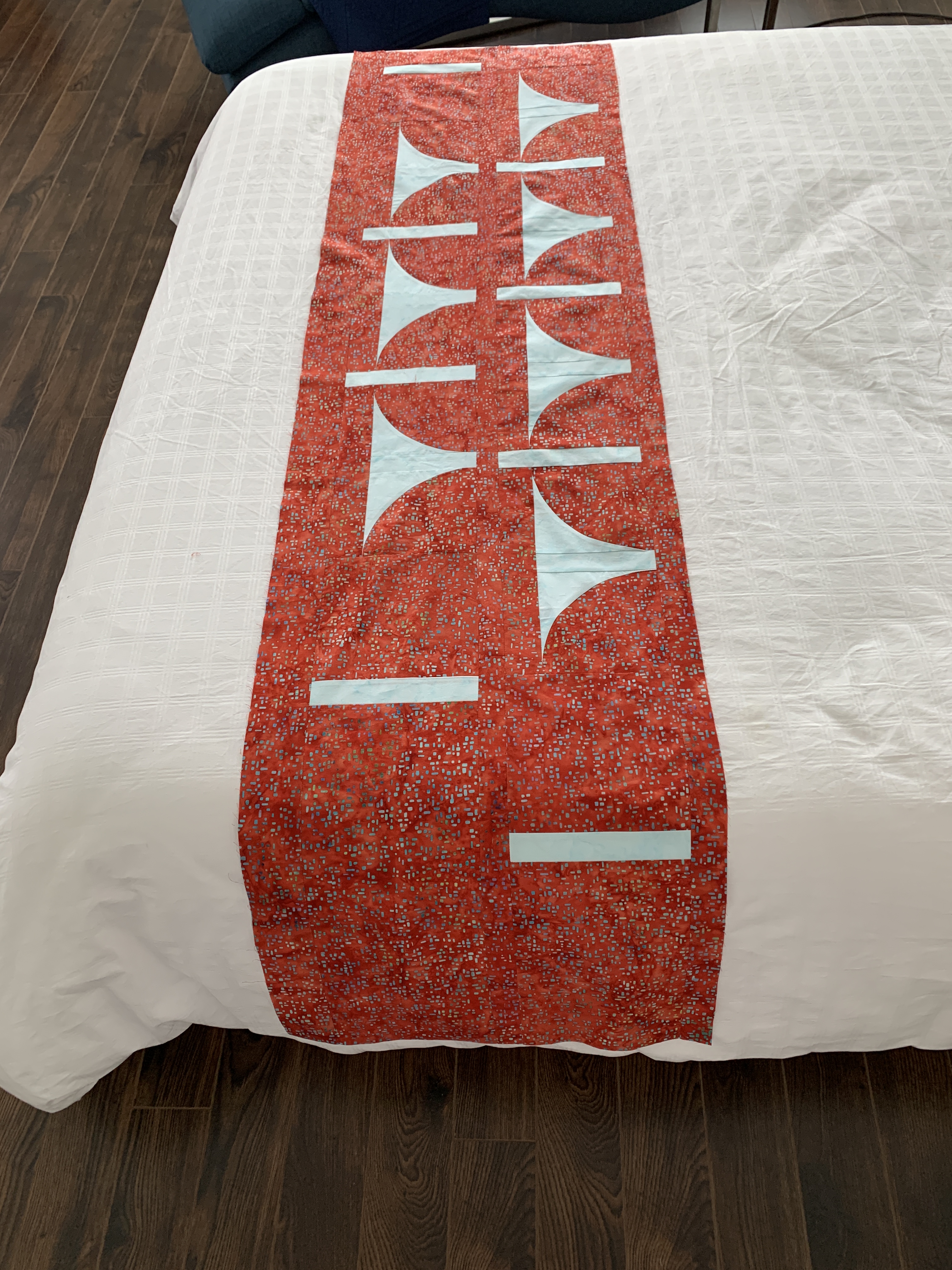
Finished Quilt Top

Now I have a finished quilt top – 51″ x 68″ (instead of 61″ x 75 1/2″) – a large lap quilt.

Yesterday, I bought turquoise fabric for the back. I have all 39 pale turquoise “pie” shaped pieces cut from the “L” pieces as I built the drunkard’s path blocks. I plan on creating a dozen or so reverse drunkard’s path blocks using scraps of various red fabrics that more or less blend with this background batik for the “L” pieces so I can set up a strip to insert into the back panel.

That’s where I am right now – I have to cut out a dozen or so drunkard’s path blocks – downsizing the turquoise “pie”shaped pieces, cutting out red blocks for the “L” shaped pieces, creating the blocks and stitching the panel.

So on to that next.


Crossroads – Quilt Finished

Well, the quilt is almost finished – I still have to hand stitch the hidden binding on the back – at the moment the binding is just pinned in place.

I elected to do a hidden binding because I wanted the contrast strips to reach the edge of the quilt without the interruption of a conventional binding. Using a hidden binding adds a “modern” touch to the  piece.

Crossroads – Quilt Top

The back was pieced from four leftover blocks with large segments from remnants of some of the grey fabrics. None of the three pieces I had were large enough to use without piecing. I added contrast elements to join the grey blocks in an asymmetric layout.

I was fortunate, when I trimmed the quilt, to have enough leftover fabric from each edge to use as binding. That has allowed me to match the binding to the back so the pattern layout is continuous. A nice surprise.

Crossroads – Quilt Back

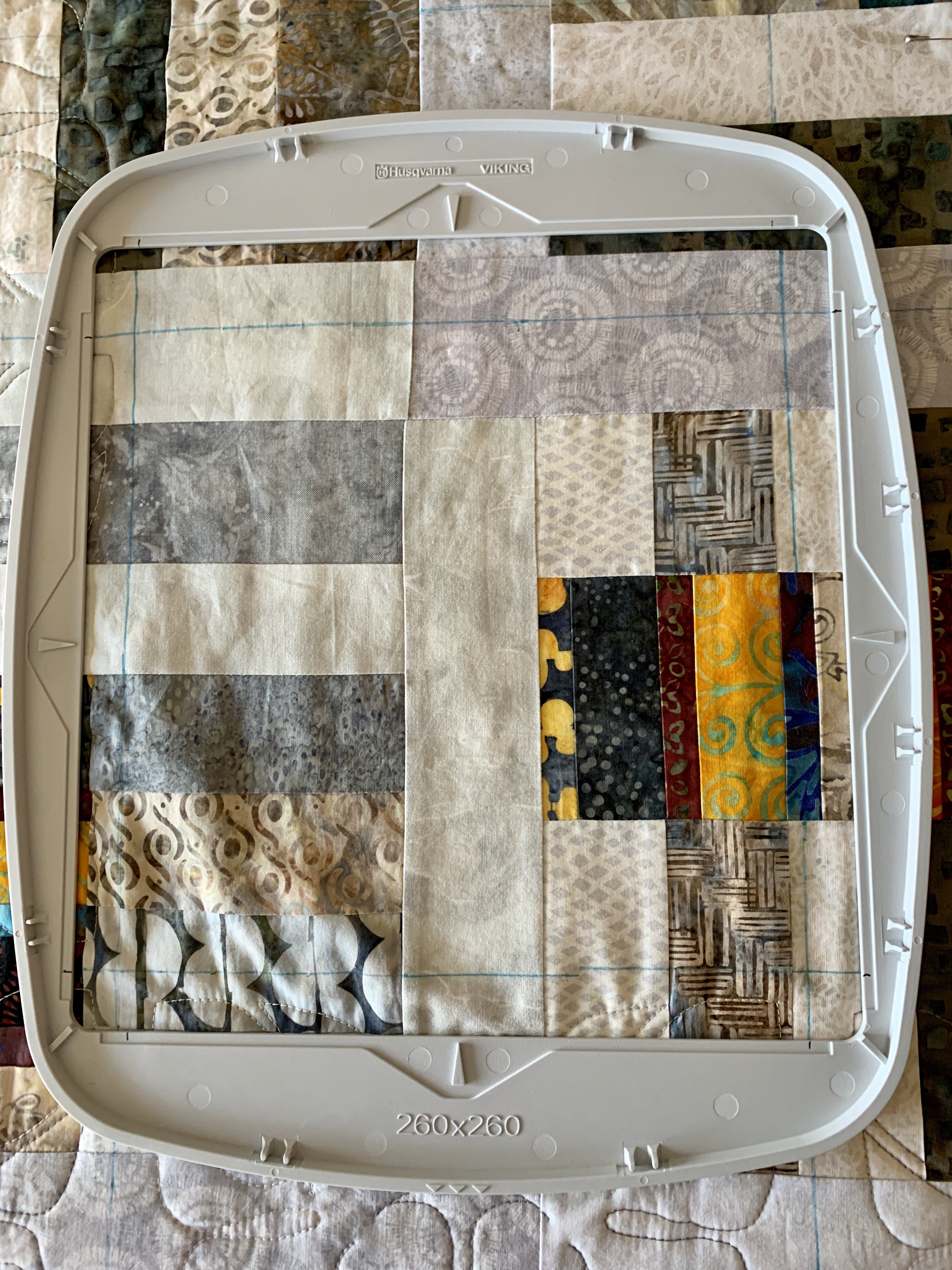
To quilt the quilt, I had to mark the quilt top into 250mm squares because the actual “blocks plus sashing” were larger than my largest hoops could accommodate. I figured the colour detail of the quilt top was strong enough that the fact the quilting block was smaller wouldn’t be obvious. So a 4 x 5 quilt layout was quilted using a 5 x 6 + 5 x 1/2 blocks. The top row of half blocks blends in – the quilting appears continuous.

Quilting In The Hoop

The quilting blocks can be seen on the reverse but the more open structure of the back panel accommodates that.

I’m actually very pleased with how this quilt turned out.

Now to hand stitch the binding and label – this evening in front of TV.

Current Quilt

I took the blocks, rotated each in turn clockwise (both vertically and horizontally) to move the contrast strip around. I then sashed the blocks in each horizontal row, assembled the rows, and sashed between the rows using pieces of the lighter fabrics (a mixture of batik and printed grey fabrics) to lighten the overall appearance of the quilt top.

Blocks Assembled

My size, at this point, is 50″ x 64″ – probably large enough for a good sized throw/lap quilt without borders. And looking at the photo, I think I’m going to do a hidden binding so those contrast elements at the edge stay at the edge.

Now to think about the reverse side. Back to my stash to see what I have in the way of largish pieces of grey fabric I can put together with 3 (possibly 4) of the extra blocks I have left over. I know there isn’t a single large piece that I can split and insert a strip to make a backing wide enough. I’m sure I will have to do more piecing than that….

I don’t have a name for this quilt – nothing pops to mind

20 Blocks – Now What?

I’ve just finished 20 blocks (actually I have 23 and could probably eke out a 24th – to use on the quilt back). The question is now what?

20 Blocks

I could just stitch the blocks together (after I’ve looked at the placement for a while and moved some around); or, do I want to add pieced sashing between the blocks to extend both length and width a bit? I do intend adding an outer border – probably pieced using both light and dark fabrics.

I guess the next step is to go through the fabrics in my stash to see what I have that might work for sashing – I don’t need all the sashing to be the same fabric, in fact, it might be interesting to mix and match fabrics – the challenge with that is to be accurate enough that I actually align the seam matches with seams in the existing blocks…

Better go look.