Sample #2

A lovely day that began with a goofy mistake. I arrived at the Lunenburg Fire Hall a bit early. It was sunny (although still cool) and as I was waiting for the others to arrive, I decided to walk across the parking lot to the water’s edge to photograph the ships in the harbour, so I got out of the car and locked it – keys still inside! Thanks goodness for CAA. I had the car open again within a half an hour. Fortunately, that wasn’t a sign of how the day would unfold.

We began with Laurie showing and explaining to us a recent art quilt piece – a beach with a family of five, ocean, hills in the background, the seaweed high tide mark… A very lovely image and as usual beautifully executed. No photos, however.

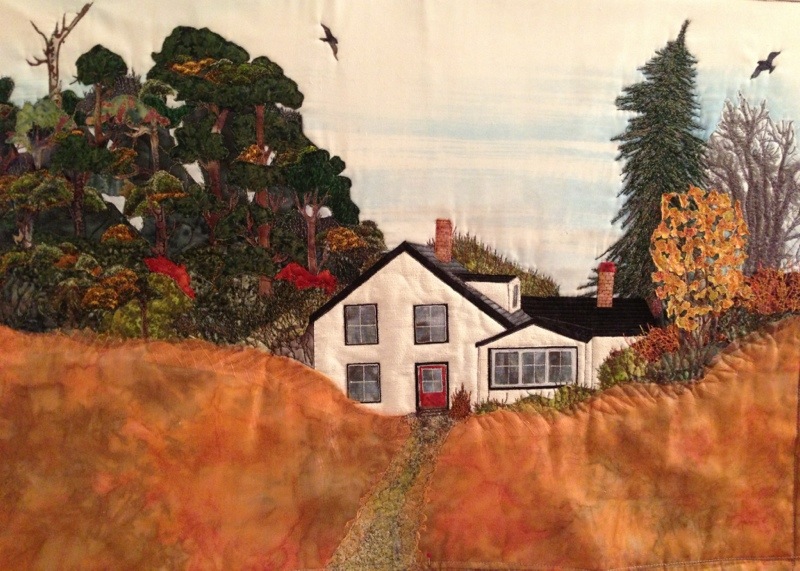
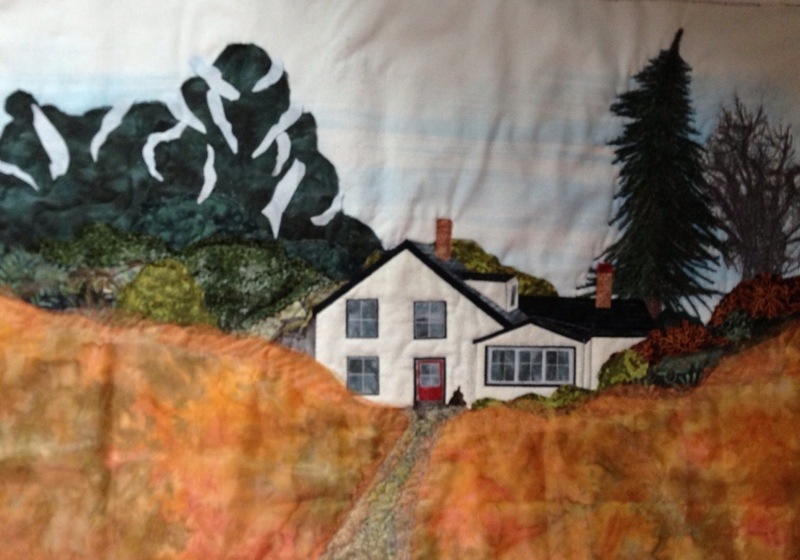
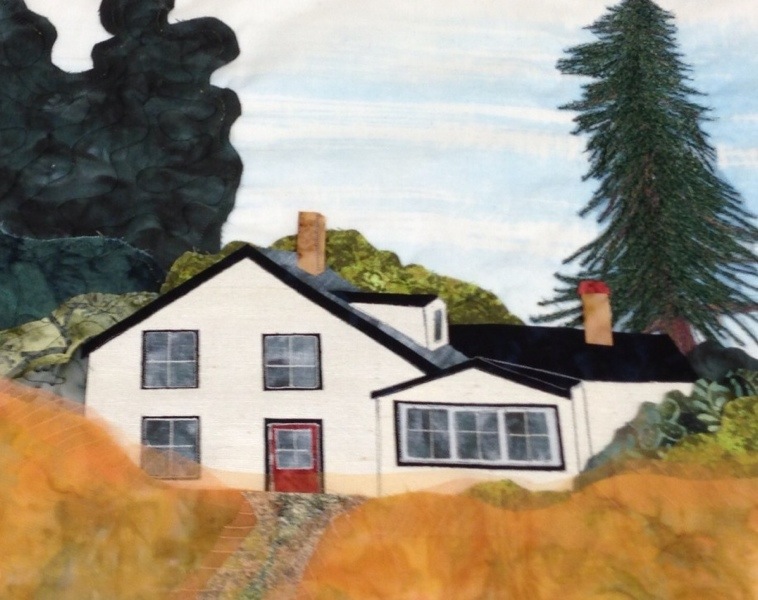
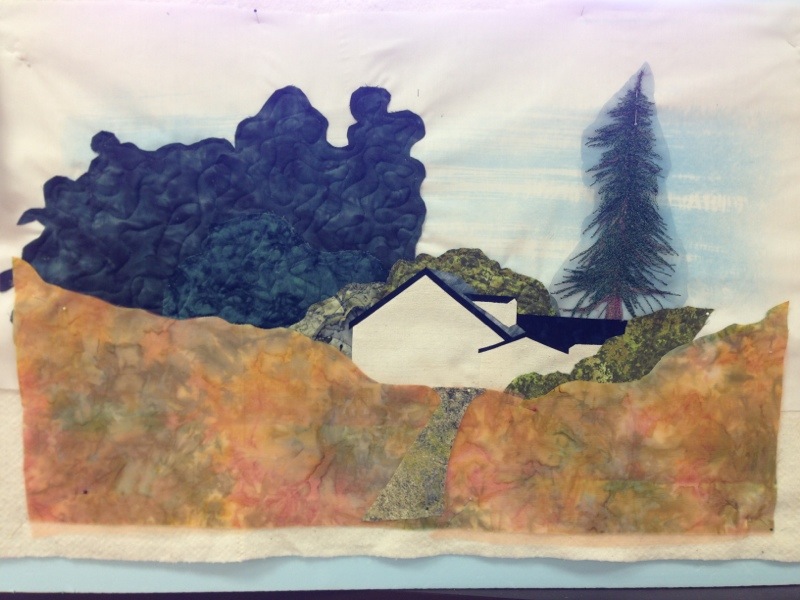
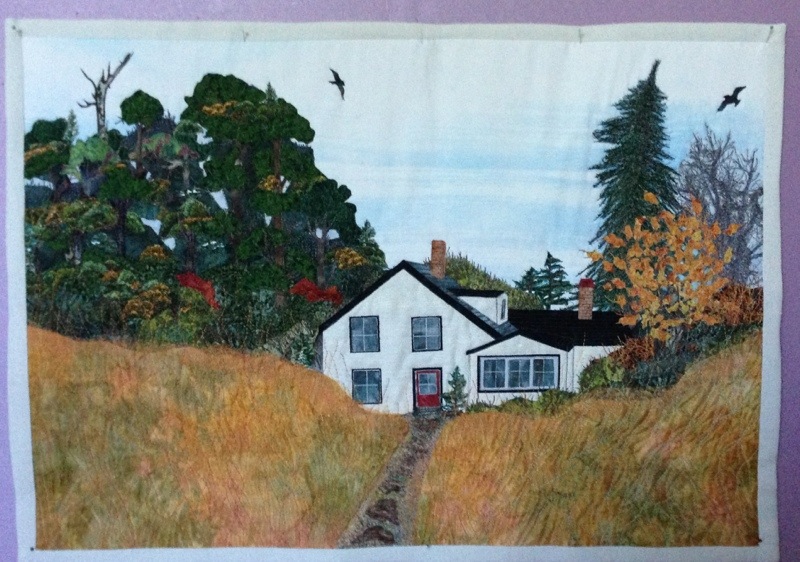
Then we explored some new techniques by “constructing” a small house. It was interesting to see how the building is assembled from many layers. The other women completed the house and stopped there. But I still had a spare background from yesterday, so I added the house, quickly created two evergreen trees and a bush to add some further interest. Then I put in a path (using free motion embroidery to set up paving stones. I began adding “grass” but didn’t get the whole space thread painted (this after all is just a sample). Finally, trimmed the edges and bound the piece – still needs hand sewing on the back.

20130910-193738.jpg

Notice also, the mullions in the windows and the edge of the roof which were also thread painted.

So with a bit more work when I get home, Sample #2 is actually a tiny art quilt. (It could use a chimney on the roof, I think and I may add one when I get a chance.)

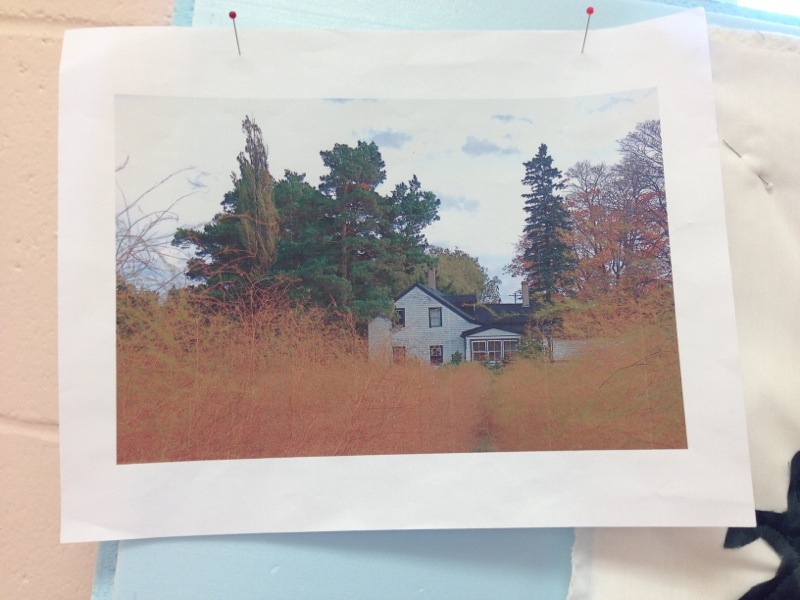
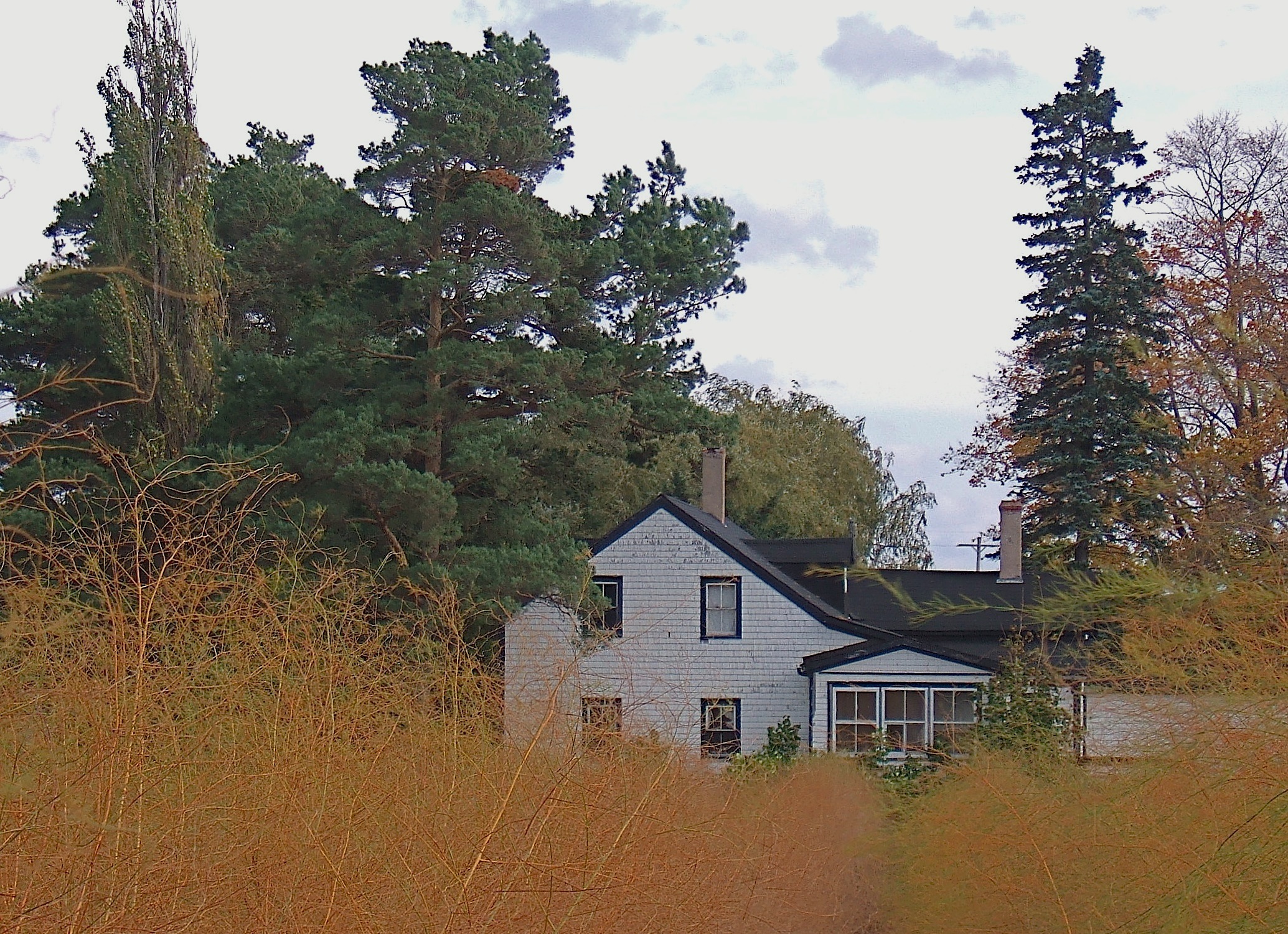
We spent the rest of the day doing some prep work for the larger pieces we’re each working on. First, Laurie gave me a transparency created from the photo I gave her. I decided, in the end, to try the asparagus field. The transparency is put on an overhead projector, projected on paper tacked to a wall. The main elements are quickly sketched in. Then the tracing process is repeated on large sheet of tracing paper. These two tracings are used as templates and to reference the overall composition as the piece unfolds.

Next comes painting paper with fabric ink which when dry is transferred to a wide strip of poly-cotton fabric to be the sky. The sky is laid out on top of the paper template, and I next spent some time auditioning fabrics for the various elements in the picture.

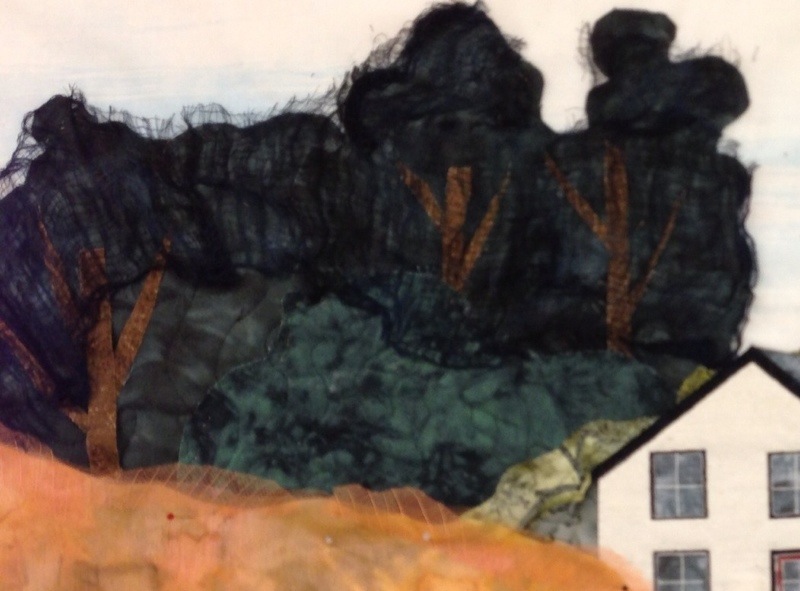
I will need lots of trees – some will get created using the cobweb lace we learned yesterday. I spent the afternoon creating a tall evergreen tree (I got about half-way through it when it was time to leave, I’ll finish the tree tomorrow.)I used an pale blue organza fabric as the base, since the top of the tree will be against the sky. My free motion stitching is improving rapidly, I’m relieved to say.

So tomorrow, I’ll take a picture of the work in progress so you can understand how it’s unfolding. I also hope to begin constructing the house which will be the focal point of the work. The real challenge is going to be the asparagus field. I have a batik with yellow, peach, soft greens. I intend to overlay that with some golden/orange organza, but I need something more – whether it’s dyed cheesecloth in a suitable range of colour, or whether I will do thread painting on the surface, I’m not sure. I did pick out thread colours that will work and I had brought a metallic thread in the right shades – I’ll have to do some experimenting to see what might work.


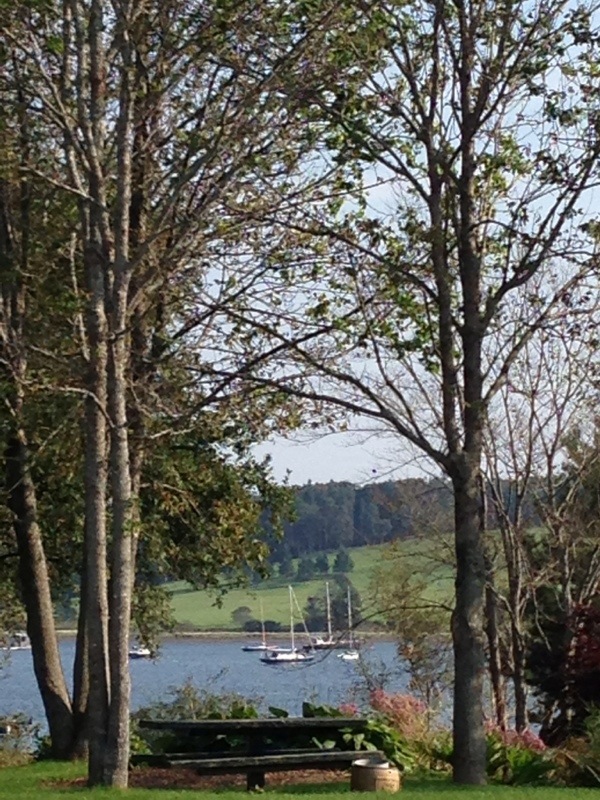
Oh, and a couple more pictures of Lunenburg:20130910-195403.jpg

20130910-200306.jpg

Sample #1

This is all kind of like “Karate Kid” the original version where Mr. Miagi is teaching Daniel karate by having him do a variety of tasks – the whole results from assembling the parts. Creating a landscape quilt is like that – many small techniques that get incorporated into a larger whole.

We worked on “cobweb lace” – you cut fabric into rather small pieces (using a pinking rotary cutter blade), lay them on a piece of cling wrap, place a piece of cling wrap over them, hoop the three layers, and free motion stitch on top of that. You remove the cling wrap by placing the piece you’ve just created between two pieces of paper and press with a hot iron.
20130909-172143.jpg
What you have is a potential tree. Place one or more of these together you could have a denser tree or a shrub.
20130909-172159.jpg
Second technique: zigzag free motion – that gives you a longer stitch because the needle is moving as well as the fabric – great for grass, or tree trunks. My problem is that the sewing machine I brought is a quilting machine and it only does a straight stitch! So I tried it out on one of the other gal’s machines.

Third technique: paint fabric dye on paper, let it dry, then press (paint side down) on a poly-cotton blend fabric – a sky.

So with these three techniques I made my first sample thread painting:
20130909-170151.jpg
Not perfect, but pretty good for a first go.


It was a gorgeous Nova Scotia September day, today. I took a few moments after class this afternoon to capture a couple of images of Lunenburg:
20130909-171927.jpg

20130909-171950.jpg

Art Quilts

A sudden change of plans – I was at Sew With Vision – the Pfaff shop not far from my house to pick up some ball-point needles for my embroidery machine (to sew knit fabric) on Thursday. It turned out that another quilter was at the shop that morning, practicing “free motion” embroidery – she was going to be attending a 5-day workshop with Laurie Swim – a quilt artist who makes amazing art quilts.

incomingfog

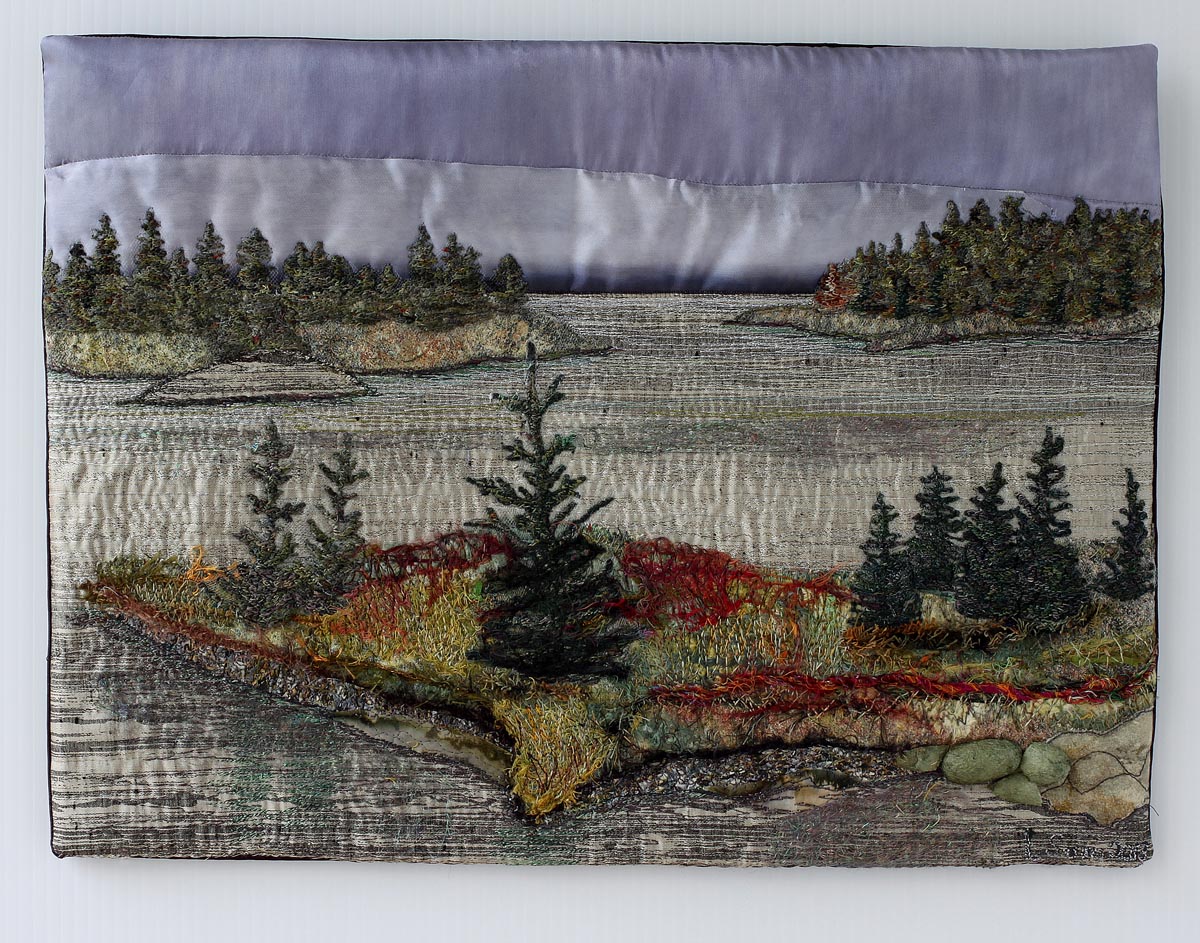
This one is called “Incoming Fog”. Check out her site – there are lots of images there of quilts she’s done.

Anyway, I emailed Laurie that evening asking her to put my name on the list for the next workshop – figuring this one was full, when I got an email back saying there was one place still available. This was yesterday – the workshop starts Monday morning! I spent the rest of the day sorting through my photos to choose a couple of possible images that might make an interesting art quilt, went through my stash of fabric to find a stack to take with me, then the thread (variegated, embroidery, specialty), and collected up my tools. This morning I packed all that stuff up ready to take with me tomorrow.

I’ll report each evening on how this all unfolds. I cancelled all appointments this coming week. Should be a great time.

Below is a sample of the images I’m taking with me:

asaparagus house cropped  Asparagus Field

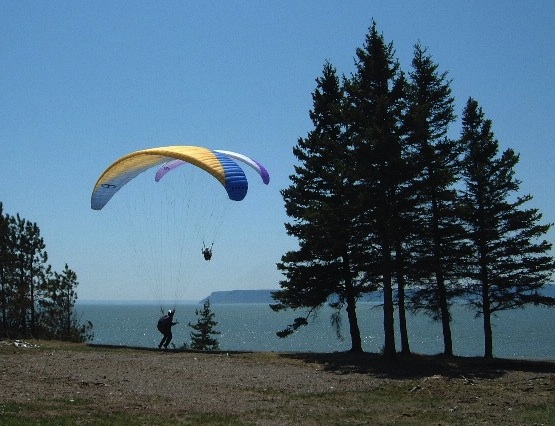
second beach cropped  Launch at Second Beach

blomidon cropped  Blomidon from  Avonport

Socks

20130901-141459.jpgAnother Pair of socks done!
I customized the yarn a bit here – I eliminated the multicolored band after the first one just to keep the rest of the pattern more subtle.
I have a second ball of this peach color – I’ll get to those socks after a couple in other colors.

Kite Flying

20130901-081617.jpg
I took my friend Sumitra’s two nieces kite flying yesterday afternoon. I haven’t been flying – must be three years since Ben, Zach and I took a couple of kites out for a spin. The night before I went through my kites to find a couple of “easy” fliers – kites that would fly reliably in light wind which is what the forecast was predicting.

We went to the Bedford waterfront. The wind was light at first but we managed to get kites aloft and we flew for about half an hour before the wind dropped. We were nearly packed up when the wind returned, the direction shifted a bit, with some strength. We got the kites out again and had fun for another 40 minutes or so.

The wind was strong enough to support my large “snowflake” box kite which has a strong pull. There was sufficient wind strength for the kite line to “sing”. The young women, who had never flown kites before, and I had a great time. I have to go again soon!

20130901-082603.jpgThe girls took a photo of me putting on my gloves as I was flying the Snowflake…

kite flying

Winter Jacket

IMG_2159

I have finally cut out the winter jacket. The fabric has been sitting in my dining room (I use the dining room table as my cutting table – with a protective cover, of course) for at least six months! Sunday, I finally cut the pieces for the jacket.

I’m making it in a deep wine corduory with the back panel in a tapestry fabric I’ve had for some time, using that fabric for piping on the front of the jacket. For warmth, I’m using Insul-Bright batting – a polyester heat reflective batting – needle punched mylar on one side – to keep rain out, and heat in. I am in the process of adding the batting to the wrong side of each lining piece. I’ll then assemble the lining and attach it to the assembled outer jacket.

I’m making the long version with the banded bottom, to keep my bum warm in winter! The reason for this particular jacket is that it has a total of 10 pockets – outside and inside, with zippers and without. Using the pockets effectively means I don’t have to carry a purse when I wear the jacket.

The Final t-Shirt

IMG_2158

This is the last of the t-Shirts, made from recutting a man’s XL shirt I picked up at Value Village. I constructed it using my serger, but I hadn’t used ball-point needles, just regular universal sharps. On all the other t-Shirts that wasn’t a problem, but it turned out to be on this one! The universal needle, instead of pushing aside the knit stitches of the fabric, cut the cotton fibre – you could see the beginnings of holes along the seams. I had to resew all the seams (less than 1/8th away from the serged seam) on my regular sewing machine using a ball-point needle. The difference in the appearance of the seam is dramatic.

Now the question is, do I want to add embroidered embellishment to some of these t-Shirts?

Intersections Quilt – Finished

I finally finished the Intersections Quilt yesterday. It took two days to do the stitch-in-the-ditch, quilt the blocks and the border, add the binding and label.

DSCF2589

This is the finished quilt top. The design I created to quilt the blocks was done in my 14″ hoop (which requires a turn to complete both sides of the design). I was trying to get the effect of having done the quilting using a long arm quilting machine. Unless you look very closely, you can’t see the design within individual blocks – the quilting does look continuous.

DSCF2597

The quilting is more obvious on the back. Again, I inserted a strip of fabrics from the top of the quilt – so I could get away with just a single length of backing fabric. There weren’t quite enough scraps left of the fabrics from the front, so I added others in the green and blue tones from my scrap stash, but you can’t tell – they blend well with those from the top of the quilt. I also quilted the border: this time I didn’t do it free stitching the machine stitch (loops), I created another embroidery to use in the endless hoop – I was surprised how easy it was to align the individual embroideries so that they joined up – unless you look closely you can’t see the joins – I was very pleased with that.

DSCF2601

This photo shows the quilting detail and the border quilting,

I’m already thinking about the next quilt.

Heirloom Embroidery

A number of years ago I learned how to do heirloom embroidery – it uses many different decorative stitches on a fine, light-weight fabric, a voile or batiste. The technique is used to decorate night gowns, fancy dresses for little girls, blouses. It involves inserting lace elements, using pin tucks and tucks, cutwork, and other decorative techniques. There are lots of books written about the technique and you can find many videos on YouTube.

Here is my first sample piece – a lace insert joined down the centre with entredeux, then rows of pin tucks, then rows of scallops and other decorative stitching.
Heirloom sample 1

Sample 2: Ribbon inserts, again joined with entredeux, then hemstitching, tucks, more hemstitching, pin tucks, some decorative stitches and a final row of hemstitching.
DSCF1116

Sample 3: This sample is done as three separate pieces. Again using hemstitching, lace insert, decorative stitches and tucks with some entredeux.
IMG_2153

I intend using all three of these as yokes for nightgowns. My current supply of nightgowns is dwindling (made from a delicate cotton, they do wear out). I need to put nightgowns on my “to do” list.

I created these three samples for a class on heirloom embroidery I taught – I had the women create heirloom samplers like these to use in whatever way they wished.