A Note on Binding My Quilts

I bind my quilts using 2 1/4″ strips cut from the width of fabric to provide a bit of give as I attach the binding (given the large lap quilt size of my quilts I need six strips). I join the strips using a mitre – the reason is the angled seams don’t attract the eye and often they are nearly invisible.

Sometimes I press the long strip in half lengthwise, but lots of times I don’t bother. I attach the binding first to the back of the quilt starting 10 inches or so from one end (to allow me to create a mitre join when I get all the way around) – no pinning, just stitching in short sections, aligning the binding against the quilt edge (with a hint of stretch), and stitching a smidgeon more than 1/2″ from the edge. When I get near to the join I stop sewing, lay the quilt flat on the cutting table, cut one end of the binding then overlap the second end, measure 2 1/4″ from the end of the first binding edge, and cut. Now I create a mitre to join the two overlapping ends of the binding – I make sure the binding is the tiniest bit short (1/8″ – 3/16″) so I can stretch the joined binding to fit the quilt (that way I don’t get a bubble in the binding). (I haven’t said anything about creating mitred corners – click here to get more or less an idea for how  I do it.)

Now I turn to the front of the quilt, fold over the binding, turn it under and pin so the turned under edge just meets my stitching from the back. I have used a number of decorative machine stitches to attach the binding on the front. Here’s the one I use most often:
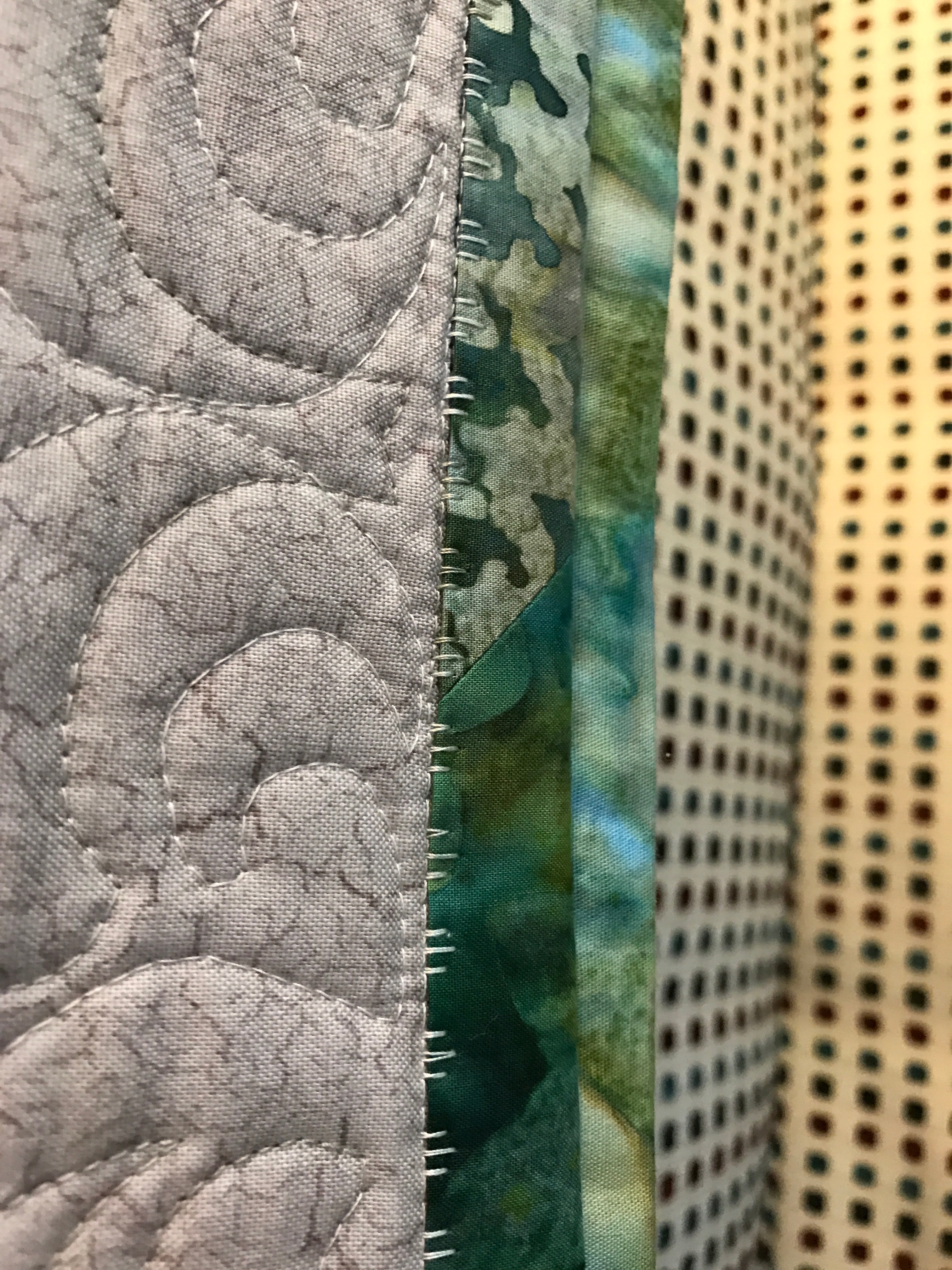
Binding From The Front

It’s a modification of one of my machine stitches – I am careful to keep the straight stitches along the edge, the stitching to the right and back overlaps the binding and holds it securely.
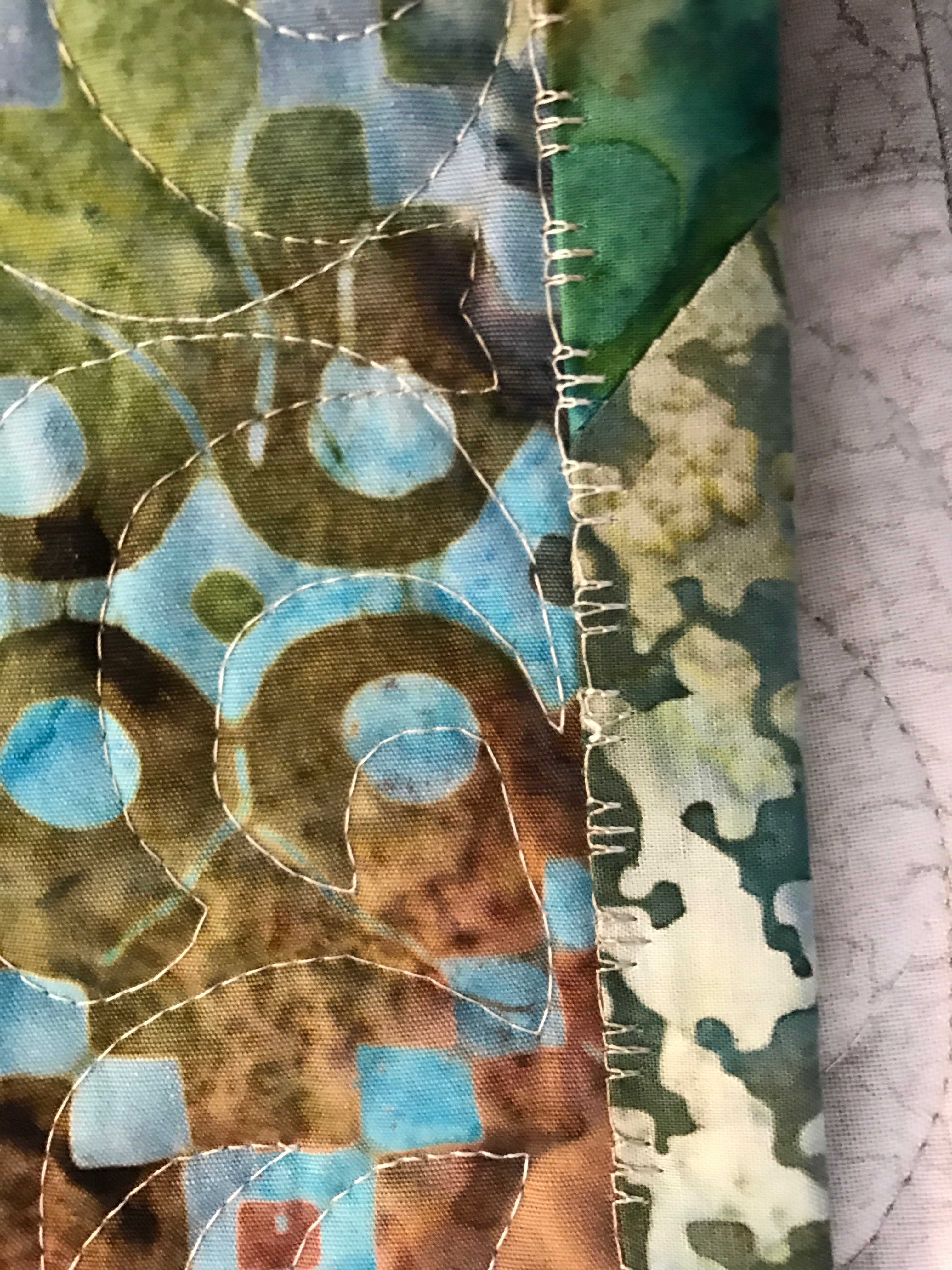
Binding On The Back

And because I’ve been careful to make my fold align with the stitching, the stitching is pretty much aligned on the back of the quilt (although my stitch tension isn’t always perfect – I don’t worry about that, it is the back of the quilt, after all.)

I’ve done this so many times that it doesn’t take long to bind a quilt.

Japanese Strip Quilt – Finished

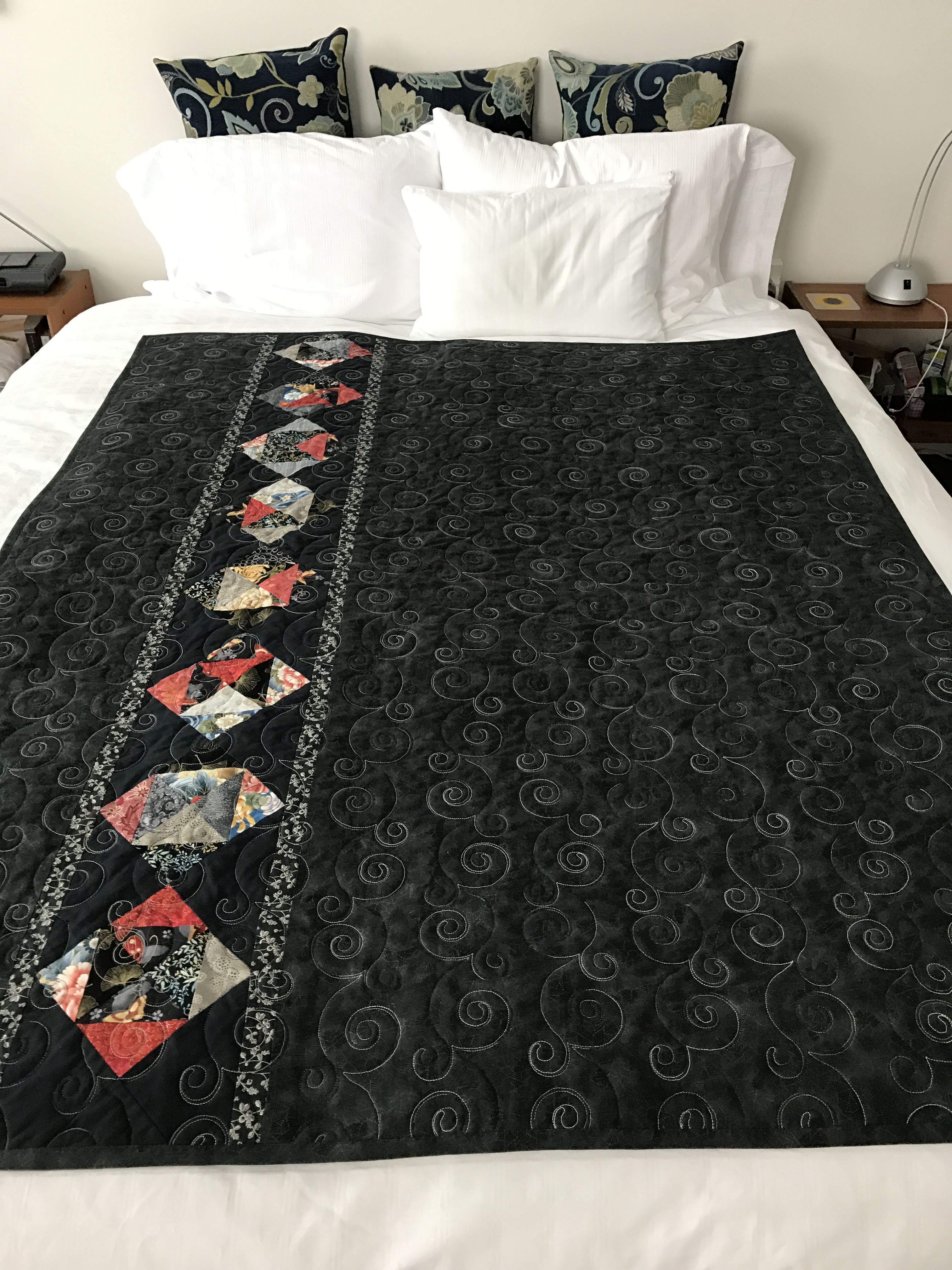
Here it is – the finished, bound quilt (just a label needed – I’ll do that later this afternoon when I get back from some errands).

Quilt Top

I did the quilting from top to bottom in line with the strips, instead of across the quilt. I wanted to emphasize the flow of the piecing. I was lucky my quilting design was the perfect size for the side borders and fills that space nicely (It was pure luck that I was able to balance the border quilting on each side!). It took a lot of precise positioning to make the embroidery joins work but it would take a hawk eye to detect the slight misalignments I decided to live with. I used a variegated white/grey/black thread, top and bottom and I like how it turned out on the back. On the front, the stitching blended well with the coloured strips. However, I darkened the light stitching in the dark strip ends because otherwise the alternating strip ends were obscured and that was a detail I worked hard to achieve.

Quilt Back

The back has worked out well. The pieced insert brings colour and interest to the back. The side borders of the strip blend well with the backing fabric yet effectively set off the insertion. I used strips of the backing fabric (which I had found in a second shop after I’d pinned the sandwich together) for binding. I’ve finally learned 2 1/4″ binding strips are better than 2 1/2″ – I have less fabric to fold under on the front of the quilt – easier to manage when I’m pinning the binding in place on the quilt front after first stitching it to the back.

I would have liked the quilt to be a wee bit longer but I was limited by my original 66″ length of backing fabric – all that was left on the bolt. The quilt is still a respectable 62″ long.

Failed Attempt

Failed Attempt

I needed to piece an eleven inch strip to insert into the single width of backing fabric I had (that’s the primary reason I piece the back of my quilts – to get the width I need for the quilts). I had lots of small amounts of the Asian print fabrics I’d used for the top so I cut single 2 1/2″ strips, sewed them together in pairs on both edges, cut triangles which resulted in 2 1/2″ squares. I assembled the squares into a central row then filled in the sides with another row of the small squares and edged with a set of light coloured triangles to set off my pieced strip against the dark backing fabric.

I decided to construct the insert panel along the diagonal so incorporating the triangles would be straight forward. Nice idea. However, in spite of the fact that I trimmed the triangles, the further I got into the panel, the more it bent away from the straight! I took tucks in strategic seams only to find my next diagonal row was even further off. With the panel half assembled, I gave up.

Unused Small Half-Square Triangles

I gathered up the unused small squares and triangles, looked at them for a while, paired the small squares, then joined two pairs to create five inch squares – I ended up with nine which I aligned on point down the middle of my cutting table (in the end I needed only eight). I had lots of the Kona solid “pepper” fabric I’d used on the quilt top – I cut 6 1/2″ squares (which I cut along the diagonal) and inserted the triangles in the spaces between the pieced squares. Finally I added two narrow strips of one of the black/white fabrics to offset the panel against the backing fabric.

Pieced Back Using Small Half-Square Triangles

So my efforts weren’t entirely in vain. I have tucked away my failed attempt. I inserted my new panel into the backing fabric (offset twelve inches from one side along the length). I pin basted the quilt sandwich and you can see I’ve begun quilting the quilt. My finished quilt will end up 49″ x 62″. My quilt design (in a 360 X 200 hoop) has worked out to 7″ x 13.7″. I’m quilting along the length of the strips rather than from side to side (to complement the strips rather than stitching across them) – I will end up quilting seven rows, each row requires 4 complete and 1 half repeat to cover the quilt from edge to edge.

So far, I’ve stitched two rows and started the third. It’ll take me another two days to finish the quilting. I plan on binding the quilt with some of the backing fabric I was able to find yesterday in the sister shop across the harbour from where I bought the original backing fabric.

I’m already planning my next project – a spring raincoat using PUL fabric (Polyurethane Laminate used to make diaper covers among other things) in black with bright umbrellas which I came across a month or so ago. Now to find a pattern….

Japanese Strip Quilt

Pieced Strip Top Completed

I finally finished piecing this strip quilt – much more difficult than I expected it to be. Assembling long strips, particularly strips that have themselves been pieced, and consisting of different fabrics, tends to produce a “bow” – so you have to alternate the direction in which each new strip is attached. This means you sew one strip placed on the top, the next the strip is beneath because you want to start at opposite ends of the growing top for alternate strips.

Assembling The Strips

The piecing of the strips themselves was also a challenge. I joined lengths of complementary fabric pieces being careful to alternate the direction of the joins from one strip to the next. Then to assemble the top each strip had to be carefully laid out, the background fabric attached at one end, that end trimmed and aligned, then the opposite background end had to be attached and trimmed.

No chain piecing here – each and every strip is unique with the joins needing to be staggered and in alternating directions. So, of course, the creating and assembling of this quilt top took much longer than piecing say a collection of half-square triangles were it’s possible to mass produce the blocks.

Now I have to come up with an idea for the back. I have 66″ of a single width of backing fabric – I will need to insert close to 10″ in order for the back to be wide enough for the top. Still thinking about what kind of piecing will complement the strips on the top.

Second Pieced Demo Pillow Cover

Finished Pillow Cover Top (Starburst arrangement)

Finished Pillow Cover Top (Starburst arrangement)

Here is the second pieced pillow cover as a demo for the gals interested in having a go at some sewing in ten days time. I had finished the 16 half-square-triangle blocks yesterday, I assembled them into a 4 x 4 array this afternoon. Added batting, stitched in the ditch around the “star” elements to quilt the cover top. Found a fabric for the back, cut batting – my original cut was 16″ – I needed 16 1/2″! so I had to cut a second piece of both batting and fabric. Quilted the cushion back along diagonal lines in both directions.

This time I applied an invisible zipper (I’m actually thinking about taking the first pillow apart and inserting an invisible zipper into that one – I bought a second one for that purpose this afternoon).

Back of Finished Pillow Cover

Back of Finished Pillow Cover

I’m about to sit down and write instructions for making a 16″ pillow cover from 10″ fabric blocks (layer cake size).

  • Step 1: Mark both diagonals
  • Step 2: Stitch 1/4″ on each side of both diagonal lines
  • Step 3: Cut along diagonal lines, then again on both the center vertical and horizontal lines which yields eight 4 1/2″ half-square triangles – perfect for this size pillow cover.
Mark Diagonals, sew 1/4" from line on each side

Mark Diagonals, sew 1/4″ from line on each side

Here’s a tip for making a pillow cover – don’t sew the corners square. I happen to own this Dritz Pillow Cover Template (I’ve had it for years!). As you can see, it rounds off the corners removing about 1/4″ – 3/8″ from the corner. This rounded corner looks square when the cover is stuffed with a pillow. You don’t get those pointy “ears” on the corners. I trimmed my corners on both the yellow pillow cover yesterday and the one I just finished.

Corner Shaping Template

Corner Shaping Template

I applied my zipper along the curved edge just fine, when finished the zipper edge looks square as do the other three sides.

Grey-Yellow III

Damn!

Just finished the top borders only to see in the photo that I’ve switched out two blocks and have then in the wrong place. So gotta carefully unstitch that area, and reposition those two blocks – not today. Maybe tomorrow.

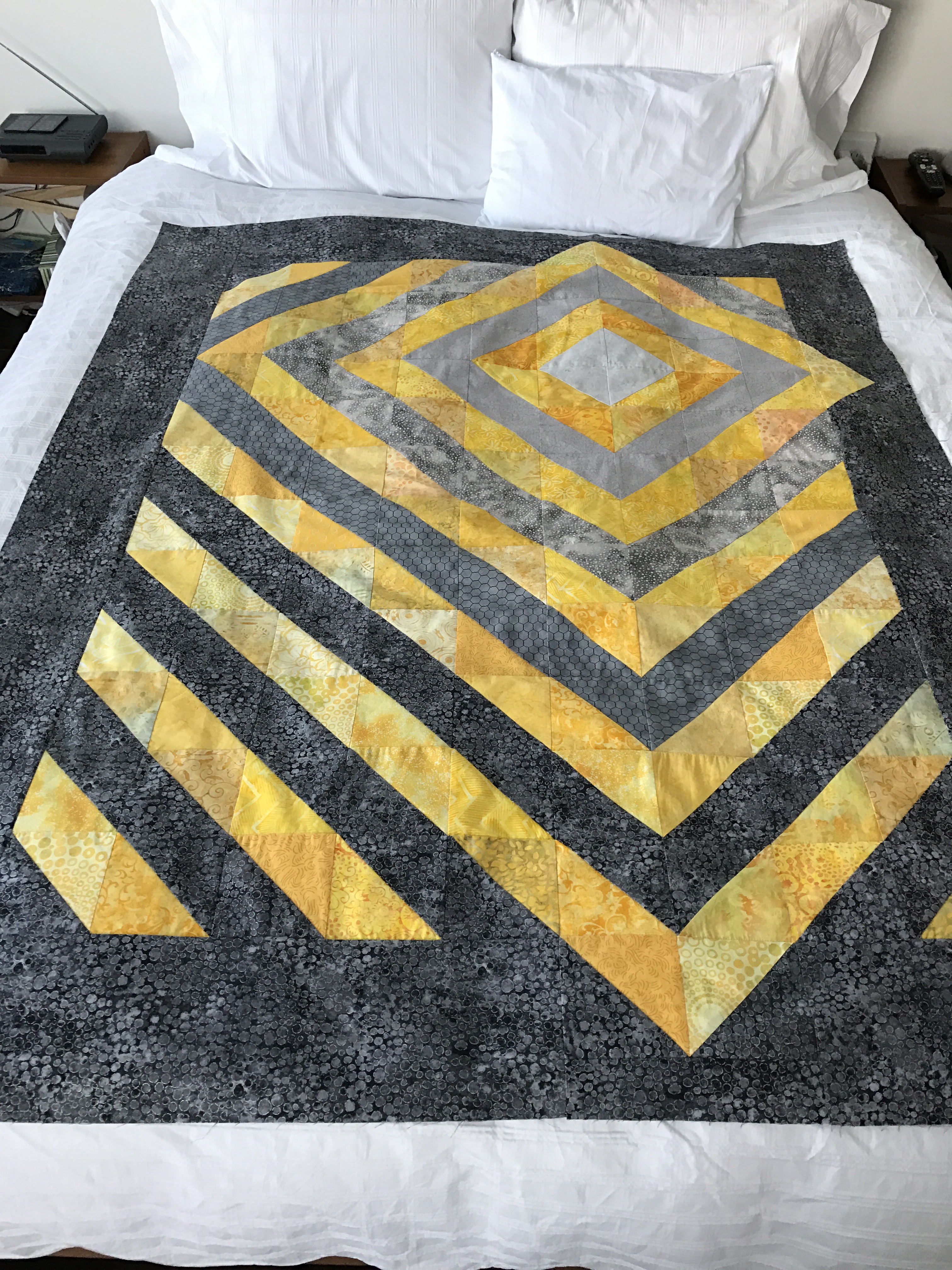
Top Finished

Top Finished

Other than that, I’m pleased with the finished top. The grey-black gradation has worked; the yellow doesn’t shift the way I was visualizing it but it’s still effective, more or less. I certainly can live with that. I’m pleased with the points integrated into the border – that worked out nicely.

So now to come up with something for the back. I have a lot of yellow/grey blocks left over – I’m going to have to play with them on the floor to see what I can come up with.

Here’s where the blocks are reversed so the greys are in the wrong place:

OK, I couldn’t stay away from the sewing – I fixed the blocks:


Then I went on to the back – remaining blocks – a spiral:

I’ll fill in around it with the backing fabric – this large 8 x 6 block will get positioned offset toward one of the quadrants.

Grey & Yellow II

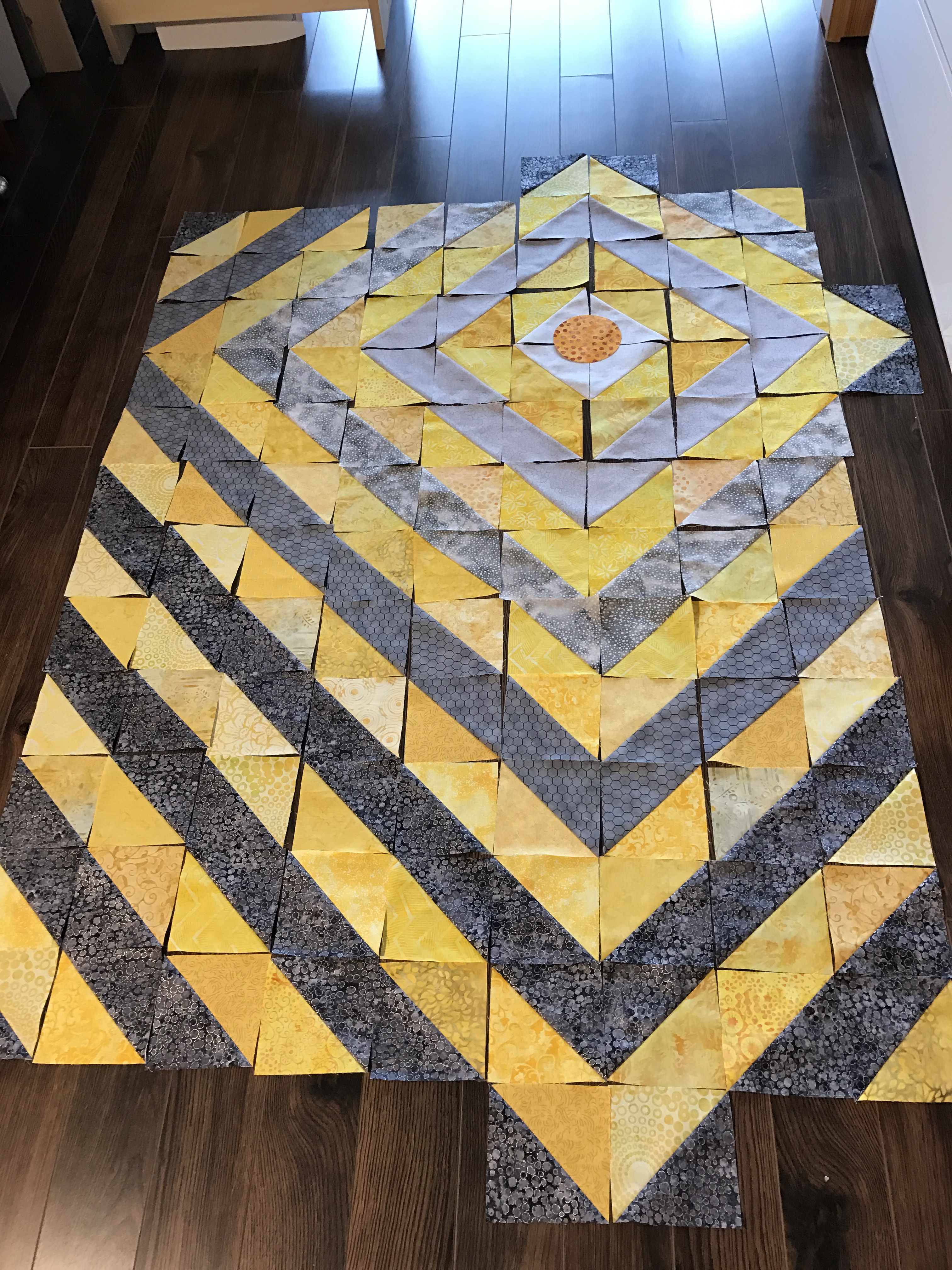
Here’s where I left off yesterday – with the darker, busier yellows in the center – too heavy, not enough gradation from center outward.

Where I left off Saturday

Where I left off Saturday

So I began playing some more. The first thing I did was add two more rows to the bottom. It just so happened I cut twice as many blocks (the size of charms – 5″ squares) of both the greys and the yellows than I needed so I had lots of squares to work with.

Next, I dug out an even lighter grey from the stash to use in the centre. I matched it up with some of the stronger yellows. Then worked my way through the other blocks swapping out those with the most detail in the pattern for more clearly yellow fabrics.

So here’s where I am today:

img_8335

Grey & Yellow – v. IV

The yellow is more uniform – I suppose I could have done this with just 7 shades of yellow fabric from a strong yellow to pale – just didn’t think of it! (The yellow gradient likely would have worked better – oh well, this will also be interesting once it’s completely sewn and quilted.)

I also think the inner very light grey “square/diamond” could use something as an accent – I tried a circle using the darkest grey fabric (neah…), next I found a flower on a dark grey background, fussy cut it and auditioned it (neah…), for the moment I’m placeholding with the golden circle with dots – but looking at the photo I think “circle” is probably the wrong shape – I still have one square left of that fabric – I think I’ll give that a try as soon as I have the top completely sewn together.

So far today I’ve managed to assemble the bottom border and five rows – hope to do the rest tomorrow.

Grey & Yellow


I’m playing with three ideas in this new quilt I began during the week. First, I felt like I wanted to work with yellow and grey. I went through my stash pulling out everything I had in those two shades (quite a lot, actually). Then went shopping for more yellow and one more grey.

Next, I decided to work with half-square triangles. I’d seen a picture of a quilt with the point elements offset into the border. An otherwise simple quilt suddenly became more interesting.
hst-1

Then, I’d seen another quilt where the colour of the blocks was graduated giving an ombre effect – in this quilt only the greys shift from light to dark, the yellows are of constant value.

ombre-quilt

I wanted to shift both colours from light to dark:

img_8326

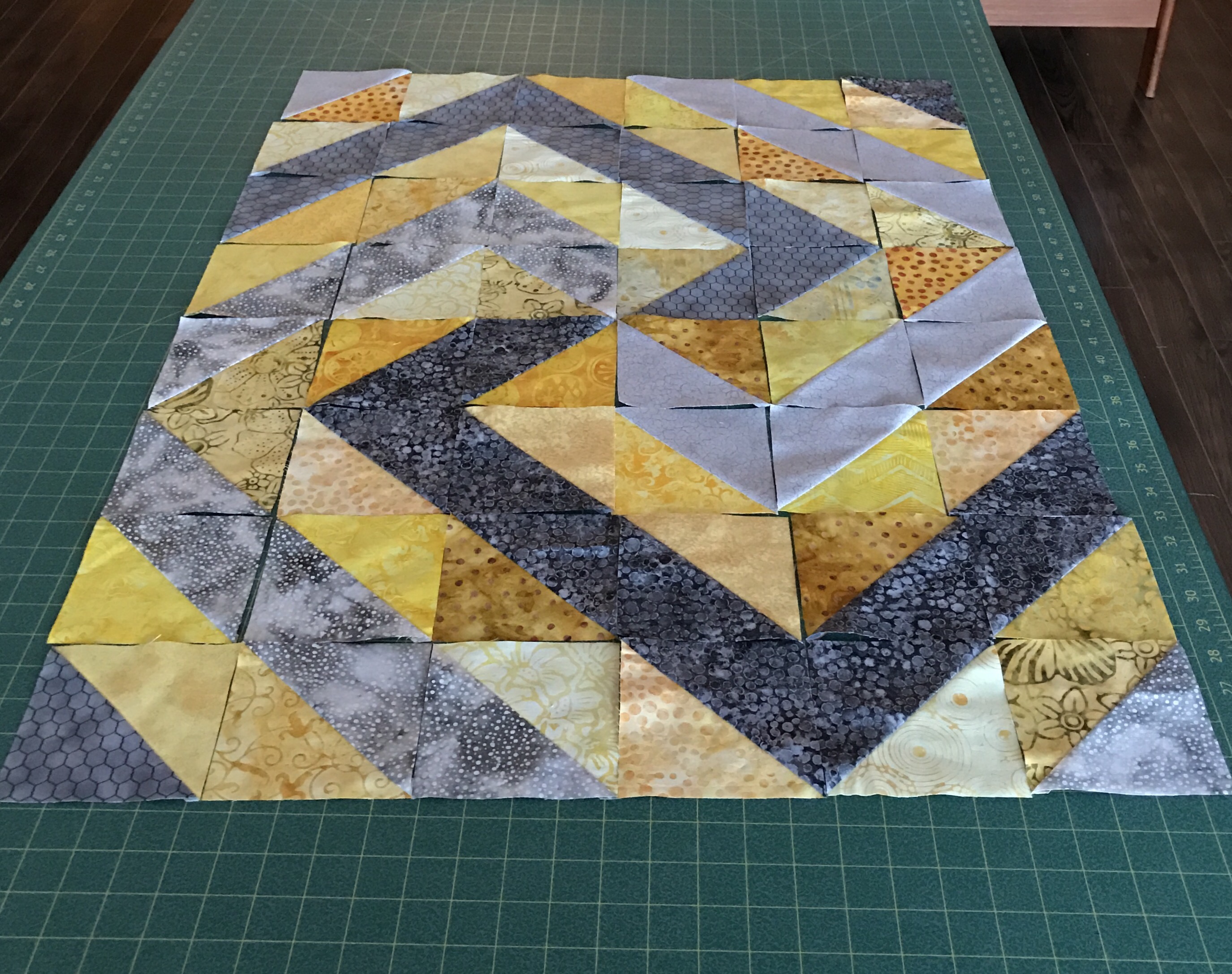
First Layout

The border here will be the dark grey embedding the yellow solidly against a dark background. I can also see from the photo I have to reposition (perhaps even swap out) some of the darker blocks with dots because they pull the eye from the overall movement in the quilt. Another thing I’m wondering is whether I shouldn’t pop a tiny bit of another colour (say a very strong orange) into some location or other – but perhaps if I’m careful repositioning the dots I might get the effect I’m after. I’ll have to play with the layout some more.

img_8328

Layout #2

Repositioning the darkest blocks with the dots has done it I think… although maybe I should gather the paler oranges together into the second or third ring – that will probably require I make new blocks – anyway, it’s time to get on with other things today. I’ll keep looking at this before stitching the blocks together…

Sunflower – Completed

img_8309

“Sunflower”

Just finished!

I started working on this piece two weeks ago. I began with the original photo – cropped it, enlarged it, then printed out sections, taped them together, traced individual petals using tissue paper, planned out the background and traced the shapes…

img_8310

“Sunflower” – paper template to enlarged size

Next I collected fabrics from my stash, bought some new pieces, started building the background, cut out the petals and arranged them in place,

img_8298

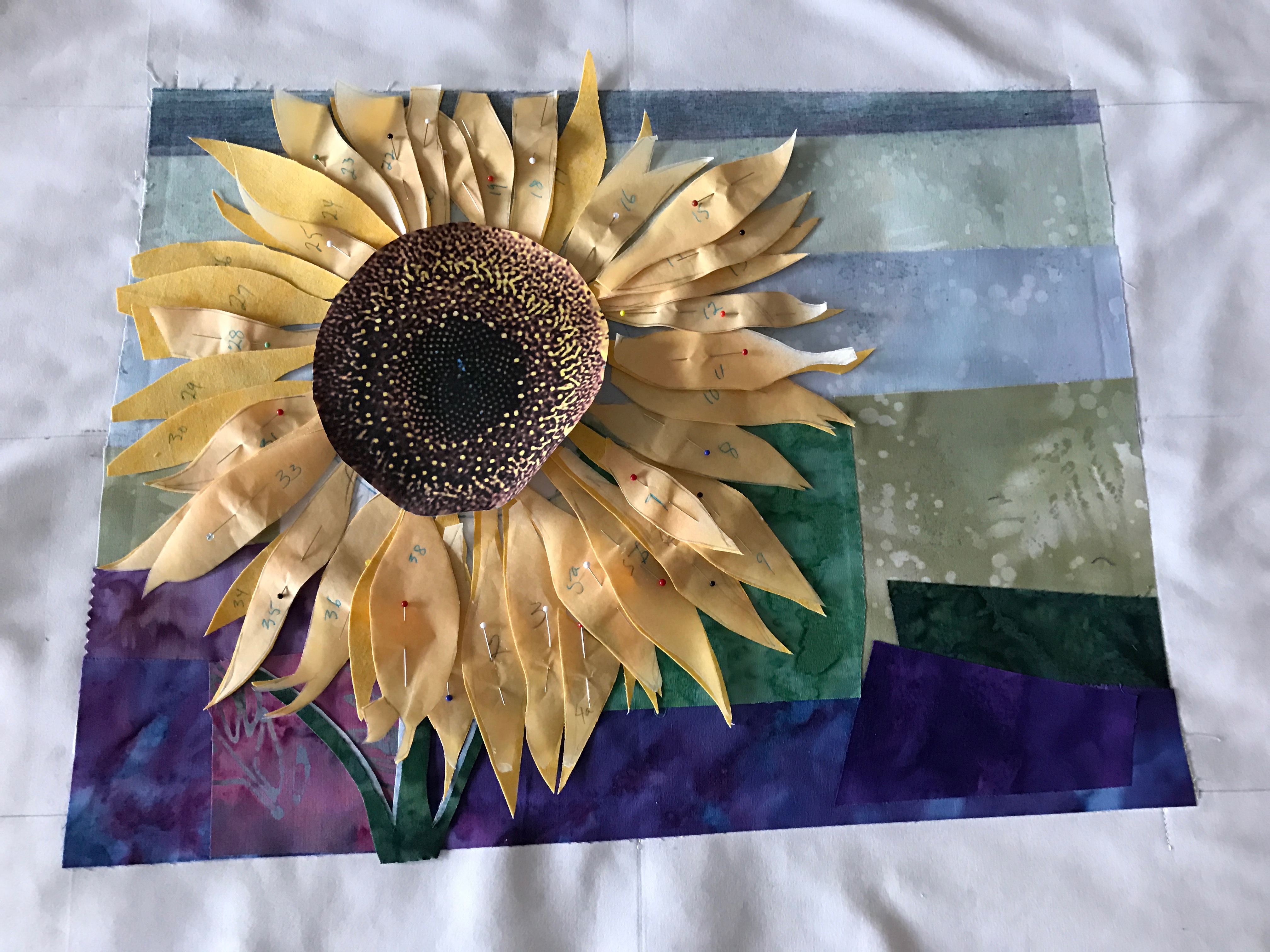
“Sunflower” – the elements cut out and positioned

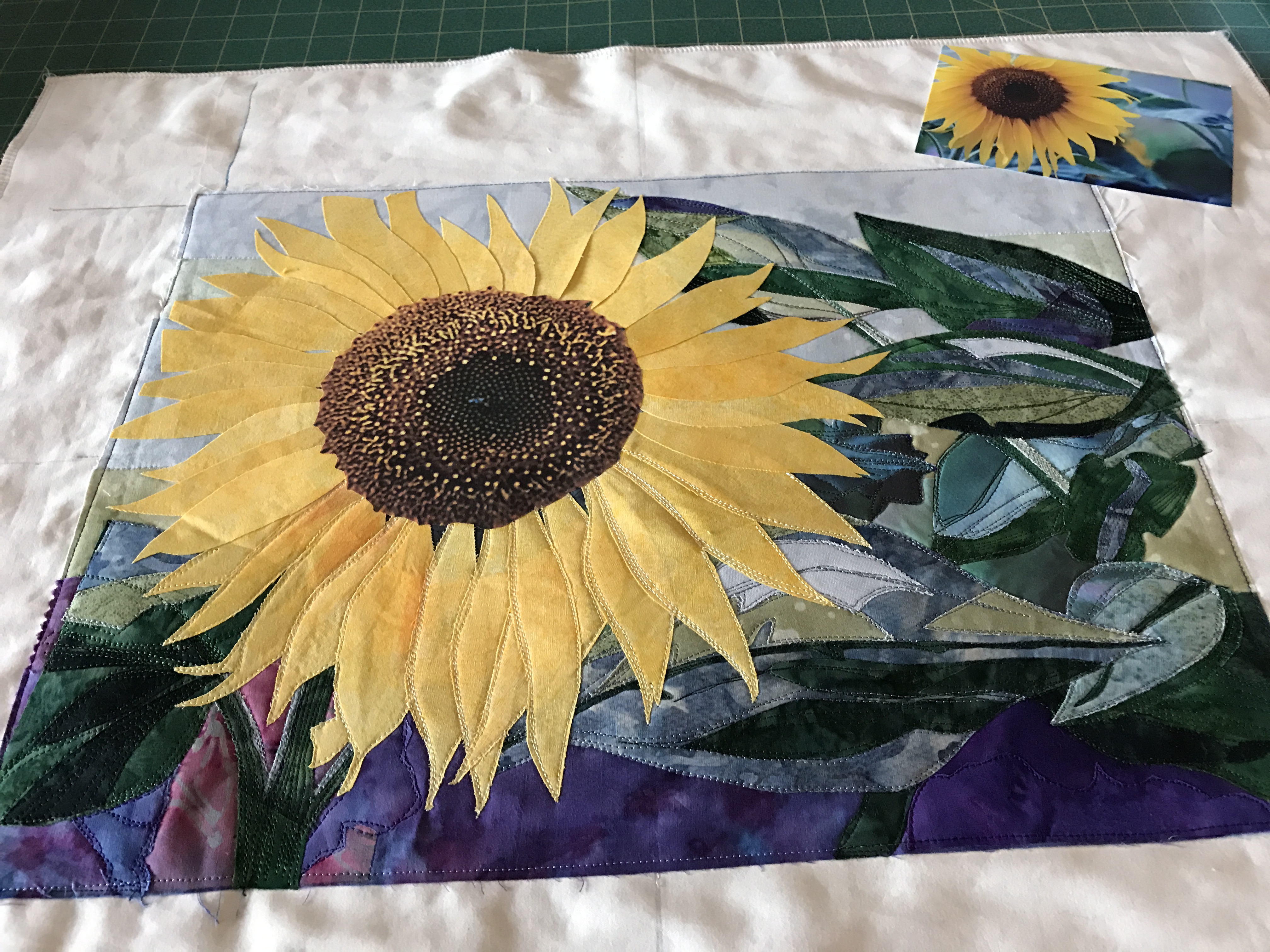
then started stitching: I laid down four horizontal strips of fabric from top to bottom, stitched them in place. Then added the leaf elements, edged stitched them – I didn’t “free motion” because I wanted more precision so, instead, I slowly freely stitched with my feed dogs in place – that allowed me to stitch very close to the edge of the appliquéd pieces. Next, I added a bit of detail and fill.

img_8300

“Sunflower” – background stitched

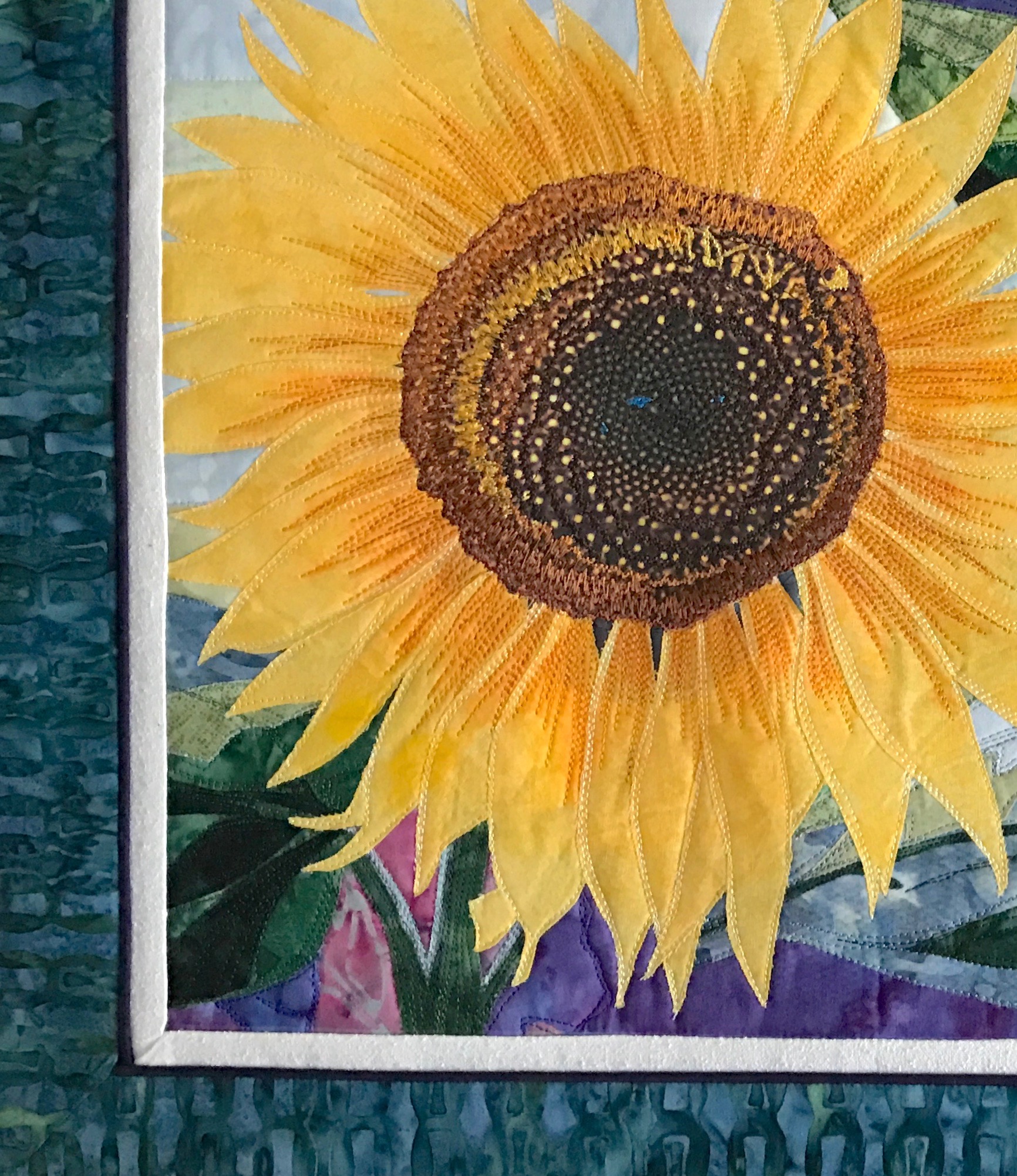
Once the background was completed, I laid out the flower petals, fused them in position, then began carefully stitching them, first using a light thread at the edges, then more golden/orange threads for the centre of each petal. Finally I stitched the centre of the flower – my goal was to bring out the spiral pattern of the florets (the centre of the flower was printed on fabric to retain the natural detail of the floret arrangement, as well as the few small bursts of blue – too small to add using cut bits of fabric).

To finish the piece, I added a 3/8″ inner border of raw silk, mitred at the corners, then a purple piping, and finally a 3″ batik frame also mitred at the corners.

Version 2

“Sunflower” – stitching detail

The whole piece I backed with muslin, including a sleeve for hanging at the top.

Now I’m walking around the apartment trying to find a place to hang it – there doesn’t seem to be one, without taking something else down! I’m really going to have to think about where to display it.

"Sunflower" without frame

“Sunflower” without frame

Sunflower I

I’ve been working on the “Sunflower” art quilt for the past few days. I pencilled in the layout on the prepared muslin backed with batting, traced the flower petals from a photo enlargement on to tissue paper then placed tracing paper beneath to retrace onto the muslin, fused some Heat ‘n Bond to the back of a piece of subtly printed bright yellow fabric, cut out all 38 petals and have so far put them aside because before I can fuse them in place I need to do all the work on the background! For the moment, I’m placeholding the centre of the flower with a paper printout to scale.

img_8291

Petals Pinned In Place

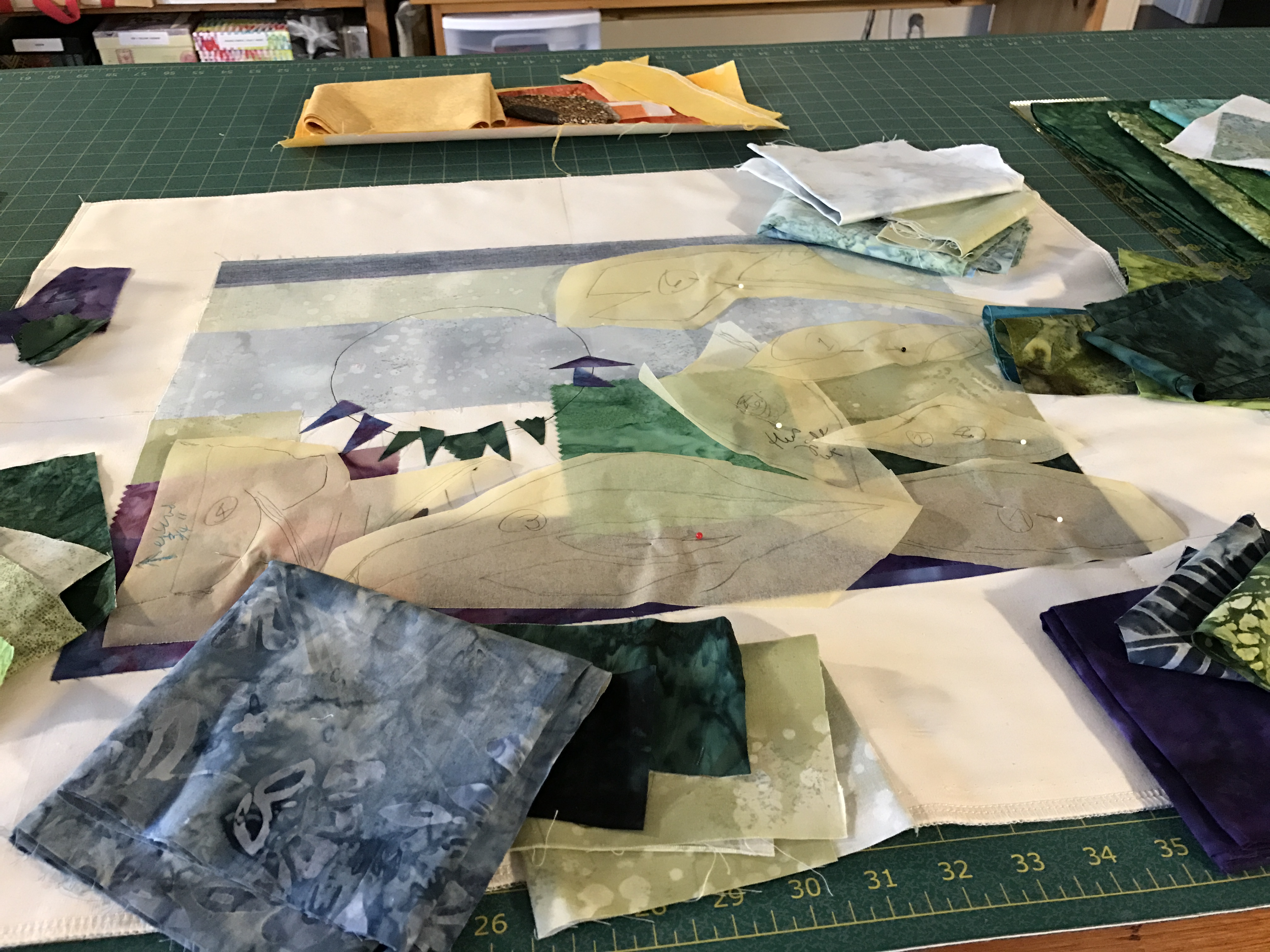
I decided to create the background working from the original photo because the detail was sharper and showed the elements in the background more clearly. I fused a pale green printed fabric to the top of the image area on the muslin (having darkened the top edge using fabric pastels – very little of that band will show when the piece is finished). Below that a soft blue. I laid in a purple/blue/pinkish batik strip as background at the bottom of the piece – leaves will be overlaid on that fabric and very little of it will be visible. I filled in most of the remaining background with pieces of greens and purples. These, too, will be mostly covered. Again, I’m using tissue paper for my templates so I can see through it to the photo enlargement, and when cut out I can see the fabric pieces beneath. I want to cover all the raw edges of the background with the foliage so that only a sense of colour peeps through.

sunflower3

Original Sunflower photo taken in 2002

Once I sorted out what fabrics I wanted to use for the foliage, I returned to working from the cropped enlargement to help me retain proportions.

Version 2

Enlarged, Cropped Image

I traced the leaves and have pinned the tracings in place on the piece. I’ve selected mostly batiks here because the colour variation in it will help with the subtlety of shading I’m trying to create. In the photo, the leaves are predominantly a very light colour reflecting the sunlight. The challenge will be achieving a realistic look to the piecing of the foliage. If, in the end I don’t like what I’ve got, I may print the foliage on fabric, fussy cut the leaves and stems, fuse that printed fabric in place and thread paint it.

Planning Out Leaves and Stems

Planning Out Leaves and Stems

I’m calling it quits for today – tomorrow I’ll begin crafting the leaves and stems hoping they will turn out as I imagine them.