Magic Squares Quilt

Having just finished the half square triangles quilt I wanted to link to the “magic squares” quilts – I did three of them but it seems I only wrote about one of them. So I thought it would be interesting to juxtapose all three of those quilts.

Here’s the first:
magic squares 1 front

This quilt was made from leftover jellyroll strips (I had a collection in shades of blue/turquoise and rust/gold/beige)- sewed 4 strips together not paying much attention to the colours I was picking up as I went along, cut the panels into 8 1/2″ blocks, put two blocks right sides together (strips at right angles), sewed around the outside, cut along the two diagonals – resulting blocks were 4 1/2″. I arranged them on the diagonal being careful to alternate the orientation of the blocks to get both pinwheels and squares. Added background triangles to square off the edges and two borders – a narrow one and a wider one.

The quilt back was the same fabric used for the background on the front with an added strip created from leftover blocks so the back would be wide enough.
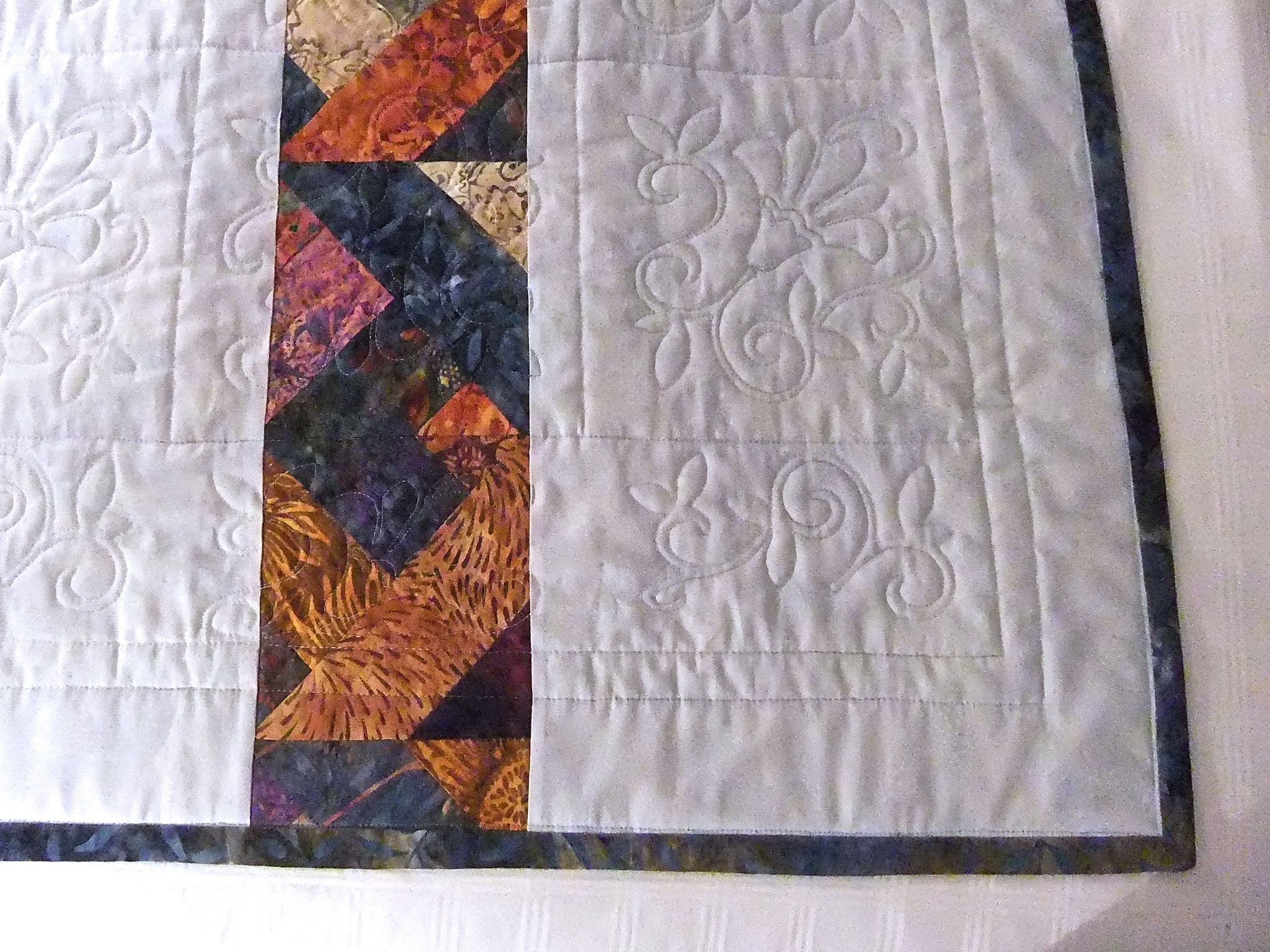
magic squares 1 back

While I was finishing this quilt I could see quite a few other possibilities for layout and contrast so I did a second quilt using the same technique – cutting 2 1/2″ strips from a “scrap bag” I’d bought from Keepsake Quilting (each scrap bag contains twelve 9″ width of fabric strips in complementary fabrics).

Here’s the second:
magic squares 2 front

In this quilt the fabrics are subdued, all in a single pallet, with two fabrics of a bolder pattern giving some contrast. This time, I stitched the 4 1/2″ blocks on the straight which gave quite a different overall effect.

magic squares 2 backOn the back, in addition to the pieced strip, I added a narrow contrast strip just to create a bit more definition on that side.

Here’s the third:
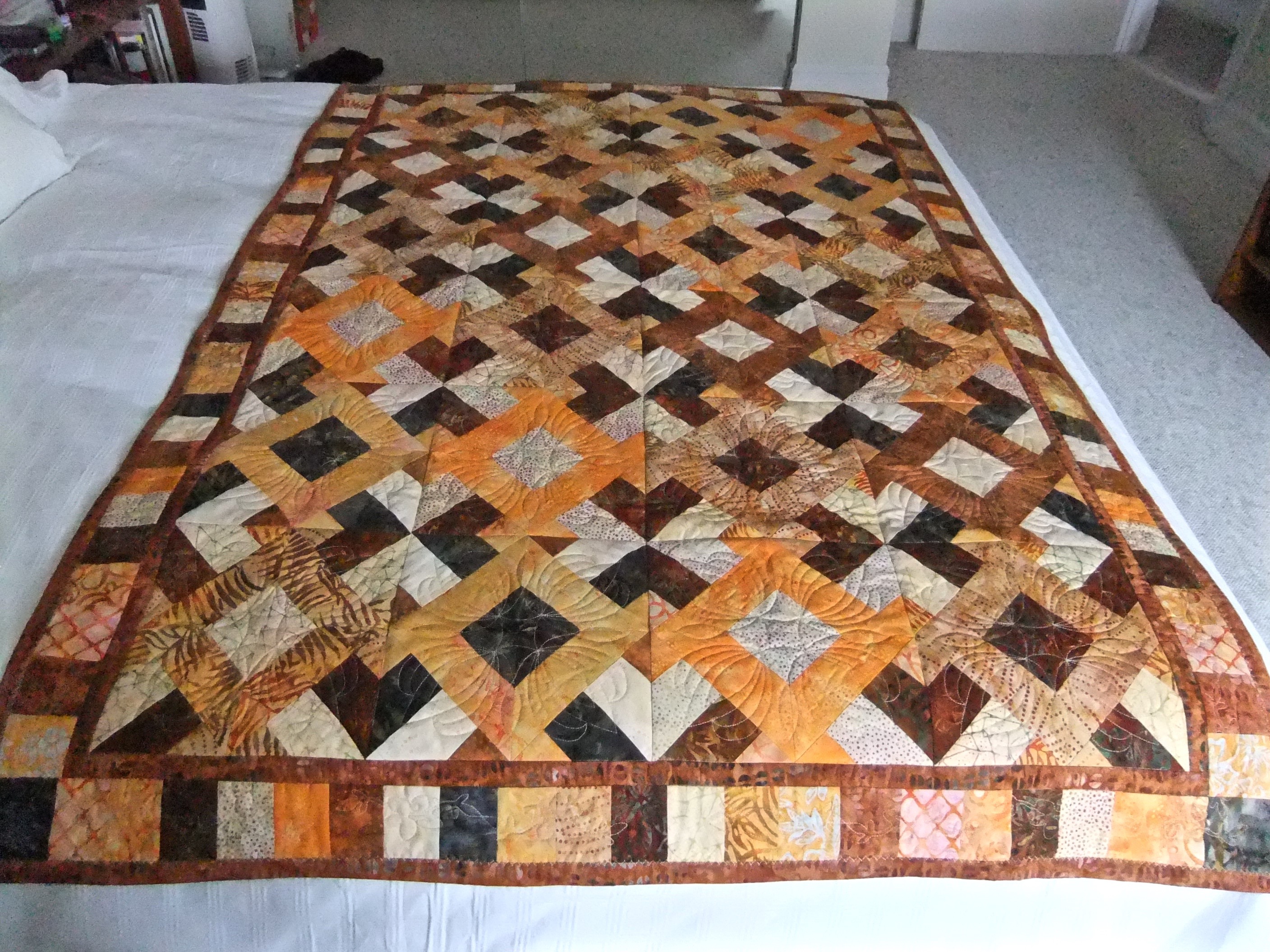
magic squares 3 front

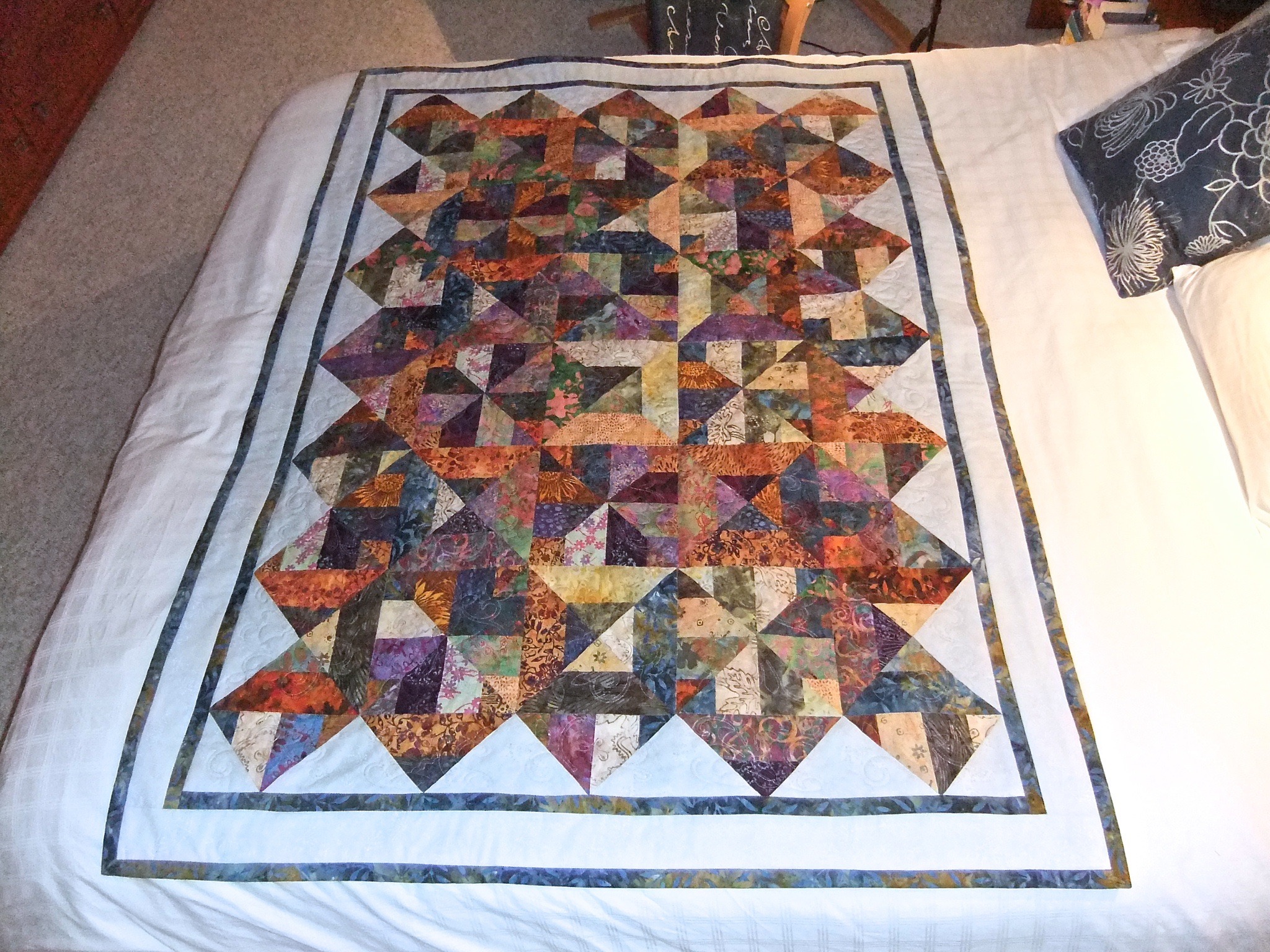
This quilt was made from another “scrap bag” – the fabrics this time were in shades of rust, brown and beige (I did have to swap out a couple of the fabrics from the scrap bag for something else in my stash that coordinated better with the set). Again, I arranged the 4 1/2″ blocks in straight rows (9 blocks in a row) taking care to stagger the resulting larger blocks, which formed squares, in rows that created a noticeable diagonal – you can see that in the photo if you follow the orange squares from the middle left to the bottom.

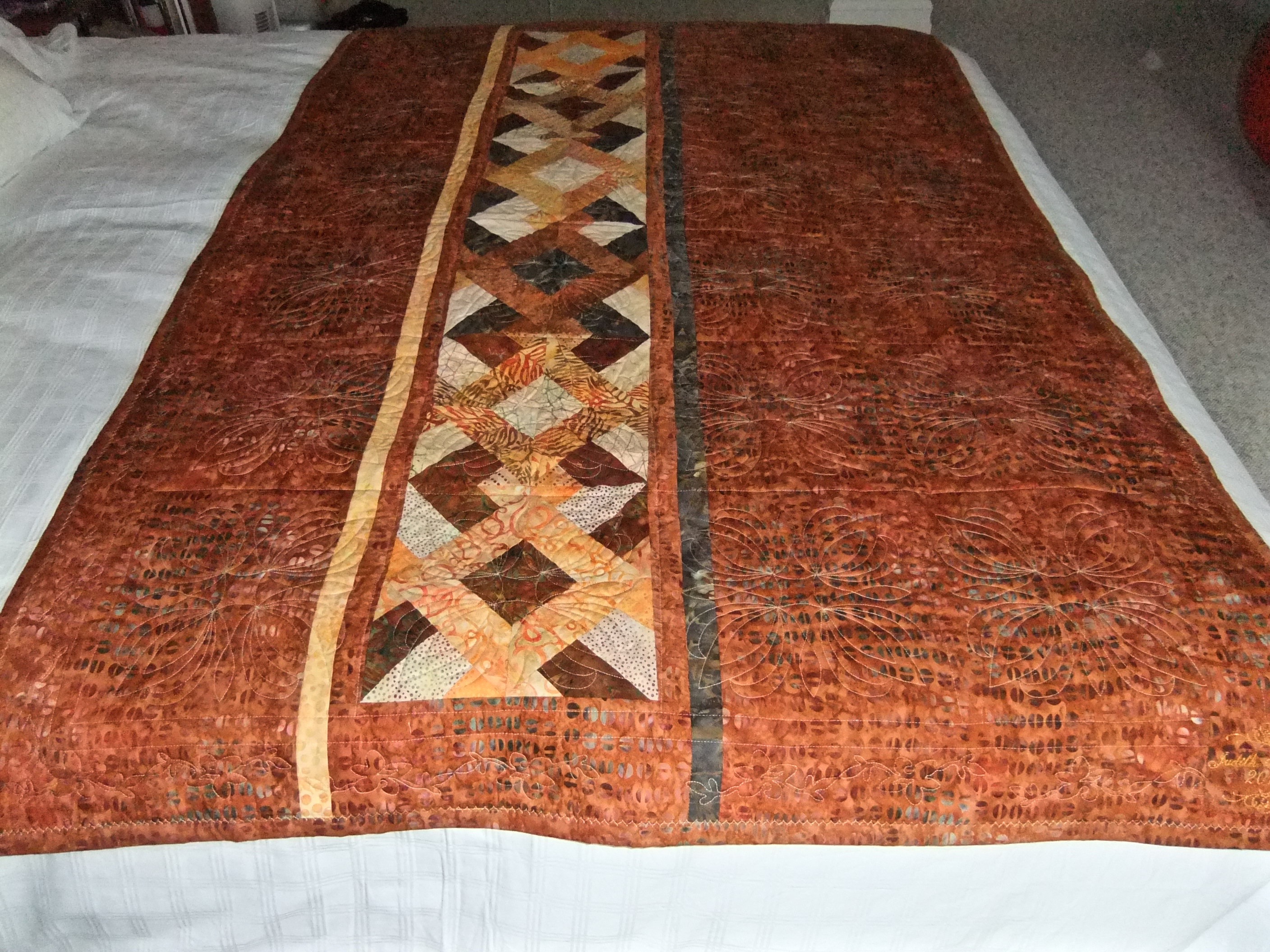
To make the quilt the final size I wanted I added a narrow border of the backing fabric, and a wider border pieced from the fabrics used in the blocks.magic squares 3 backThe back consisted of a wide strip created from leftover blocks, a 1″ sashing of backing fabric on each side and two contrasting stripes. The way in which the blocks were constructed is obscured by the final layout – so a simple technique produced a rather complex design!
I can think of many more possibilities with this “magic squares” technique – just depends on the range of colours used for the strips and the layout of the resulting blocks. I haven’t tried it, but I wonder what the design would be like if instead of cutting along the diagonal, after sewing two 8 1/2″ blocks together, I cut unequal blocks on the horizontal and vertical?

I need to look at the jellyrolls I have and think about what I might do with them.

A New Quilt

Start with a jelly roll of red batik fabrics from my stash (a jelly roll is a colleciton of 40 strips each cut from the width of a different but coordinated fabric producing a set of 2 1/2″ strips approximately 44″ in length).

Choose 28 strips (making sure to have some light strips, some dark strips and some middle value strips), sew them together in groups of four, then cut into 8 1/2″ blocks. Now what to do with the resulting 35 blocks?

In other quilts I’ve put two blocks right sides together with the stripes at right angles stitched around the outside, then cut into 4 along the diagonals.

This time I simply cut the blocks into halves along the diagonal giving me “half square triangles”. I thought about mixing the striped HST (half square triangles) with light solid triangles and join them without sashing, but the resulting quilt would have been a bit too small. I played with the triangles – decided to sew them together along the diagonal. Next I arranged the resulting blocks into a 5 x 7 array – what emerged were strong diagonal lines that I didn’t expect. Add sashing and a border and the quilt top is done.

For the back I made a few more blocks, bordered them with the light fabric and inserted the strip into the backing fabric.

I finished the quilt this morning. I wasn’t sure it would turn out as I wanted it – the pinned backing fabric wasn’t as smooth/flat as I usually manage to get it but in the end the quilt stitched up nicely.

Stacks / Galaxy Quilt

IMG_5121

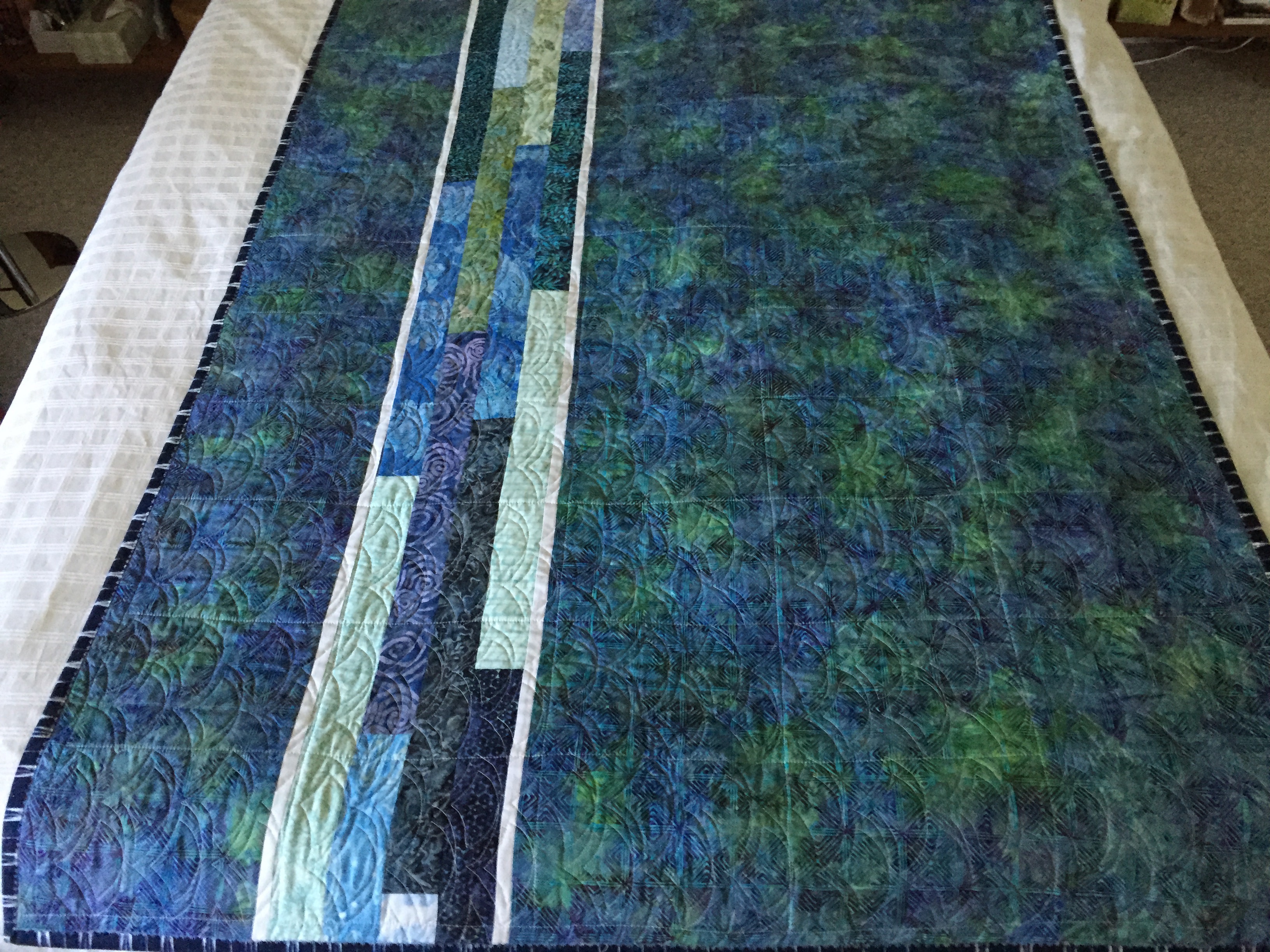
The idea for this quilt came from a pinterest photo a friend sent me a while back. I liked the idea of just creating blocks from strips of variable length with a background fabric. I had a jellyroll of blue batiks and lots of scraps in blues/greens. I’m guessing the pinterest original likely used 2 1/2″ strips but that would yield blocks too large for me to embroider in the hoop, so I reduced the strip width to 2″ (which meant cutting 1/2″ from the jellyroll strips) and created 9 1/2″ blocks of six strips each.

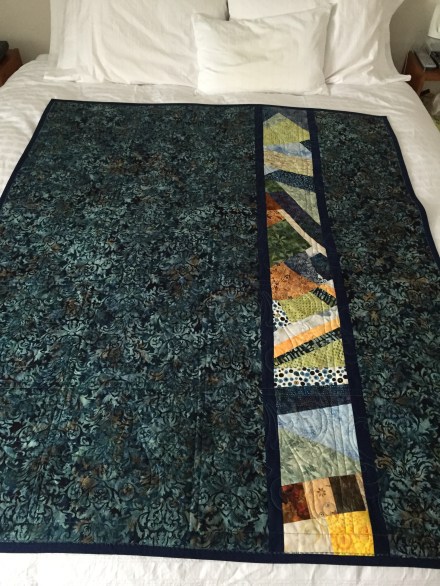
It took a while to assemble the blocks then I laid them out. I knew from the outset I’d place the strips horizontally in blocks assembled as columns (7 blocks x 5 columns = 35 blocks). I auditioned the blocks on my office carpeted floor and decided to reverse direction of two blocks which meant a narrow (1/2″) background strip to set them off from those in the adjacent column. And narrow borders so the binding would be separated from the batiks.

IMG_5122

Once the top was done, I used leftover strips to set up an 8 1/2″ wide strip the length of the quilt, inserted it into the backing fabric (so I’d have enough width for the quilt). I pinned the quilt together, stitched in the ditch (blocks that were 4 strips wide so I’d be able to quilt them in the hoop).

To quilt the whole thing, I adapted a long-arm quilting design and embroidered it in each section. Once done I added the binding (a 1/2 yd of Michael Miller fabric I bought at Britex in San Francisco for this purpose).

The embroidery design in this instance had tie-ons and tie-offs which I left (usually I remove them and draw the threads into the quilt when each block is finished). That left me on the reverse of the quilt with obvious small white clumps of thread at each tie-on/tie-off! So I did what I’ve done before – took a permanent marker in a colour that blended with the backing fabric and coloured the knots. Worked like a charm – the knots became invisible – until I turned the quilt over and discovered small grey-blue dots all over the front of the quilt!

PERMANENT marker, remember! I tried a bunch of different solvents on scraps of white fabric – bleach, soap, bleach & soap, nail polish remover, rubbing alcohol. The only solvent I didn’t try was hair spray only because I had none in the house. It was obvious that ink was there to stay.

So how was I going to salvage the quilt? I woke up this morning with an idea – smallish circles in yellow/orange hues appliquéd over each ink mark. I had some Heat ‘n Bond Easy Print Transfer Sheets so I opened Photoshop, set up a page of circles (in 3 sizes), printed two sheets, rough cut the circles, fused the transfer to the back of scraps of fabric, fussy cut the circles, then positioned them over the ink marks. I added quite a few more circles in random locations to balance the arrangement of the necessary yellow & orange dots.

IMG_5127I’ve renamed the quilt “Galaxy” – because it kind of looks like a constellation of suns. I’ve already fused the circles to the quilt front. All that remains is to stitch around the edge of each circle with some kind of decorative stitch. I’ll probably use rayon embroidery thread on the top and the same variegated Sulky I used for quilting the back in the bobbin.

So one quilt salvaged!

Jun 22/15 Update

I had to create a second set of circles using Heat ‘n Bond Lite because the first set didn’t fuse well to the quilt top – another couple of hours precision work. I carefully removed the first set of circles, fused the second set. It took the better part of two days to stitch around all 42 circles!

I used a variegated yellow Aurifil 50 on top and an olive green bobbin embroidery thread on the bottom (which disappears in the batik on the back). I had to stitch VERY slowly to outline each circle precisely.

From a distance the appliqué stitching disappears!

“Stacks” Quilt

21 blocks done so far. Each block consists of six 2″ strips of a colour joined to a white; making a 9.5 X 9.5 block (finished size will be 9″ square). The strips for the remaining 14 blocks are stacked beside my machine ready to be assembled – this will be a 35 block quilt – finished size at least 45″ X 63″ – that’s without a narrow border which I may do.

At the moment I’m thinking about reversing the direction of one block in each column for contrast, but if I do that I will want a narrow sashing (probably in white – not sure about that yet) between the columns. Until I am able to lay out all 35 blocks I can’t begin creating columns – since the design is still fluid.

More to come. Haven’t given any thought to the back yet!

New Quilt

Take knitting – I can’t leave the needles idle – finish one pair of socks, I have to start the next.

It’s become the same with quilting. One quilt finished, the next starts.

Here’s the one I’ve just begun: 

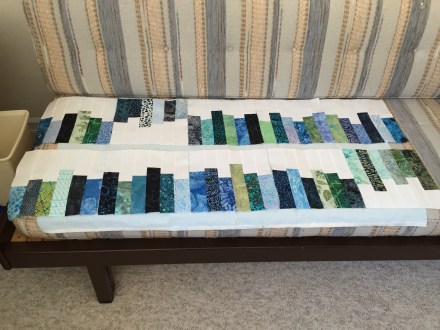
I had a  jelly roll of forty 2.5″ strips of batik fabrics in shades of blue / turquoise, I went to the stash to pick out some complementary fabrics in the same hues as well as some greens that would blend – from these I cut 2″ strips from the width of fabric. 

Why 2″? Well, my idea was to build blocks from six strips of batik with a complementary background – I auditioned several solid colours, decided white created the liveliest contrast.

For a lap quilt I want a finished width of about 45″ – six standard 2.5″ strips would give me 12″ blocks (too large for my purposes). I wanted to end up with a 5 block X 7 block quilt so I needed blocks no larger than 9″. Six 2″ strips result in a 9″ finished block. So I trimmed the jelly roll strips to 2″, cut a bunch of 2″ white strips and started improvising.   

10 blocks  done – first I arranged them in rows with all the stripes in the same direction, but tried flipping a couple.

Then I took a photo from the end on: 

Now that’s an interesting idea!  Still a 5X7 quilt but with the columns having horizontal stripes and now maybe a contrasting vertical sashing.
That’s where I am at the moment – 10 blocks created, 25 to go….

Modern Quilt II – Finished

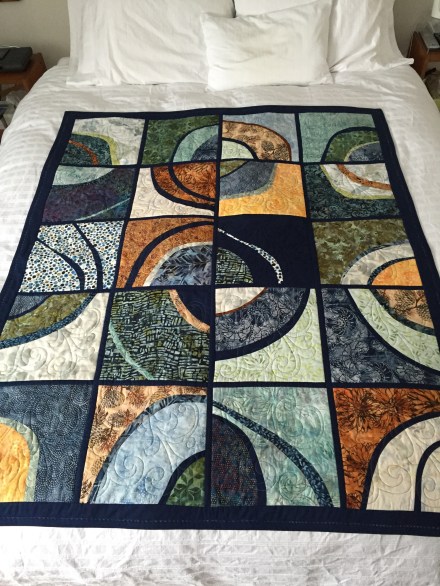
Finished the quilt today. I wasn’t sure how to quilt it – initially I was planning on echoing the curves at 1/2″ intervals but the shape of the curves in each block is quite different and I thought the finished stitching wouldn’t resonate from one block to the next. So in the end I set up an open embroidery design (240 mm x 240 mm) which had to be embroidered using my 360/350 hoop which stitches half of the design, then gets turned 180 degrees and the second half of the design is stitched. By changing the top thread colour (I used a “blendable” thread) to blend with the predominant block fabric I was able to have the stitching present but not too dominant. 

Happy with the finished quilt. Definitely got a lot of practice sewing curves – which is what I was going for.

Still enough fabric left from that set of batiks to make one, and maybe two, more quilts. 


Modern Quilt II – Improvisation


Saw a photo of a wall hanging on Pinterest based on large “wonky” curves. I’ve never really tackled curves except on the princess seams of a jacket where you have to join a convex edge to a concave one. Curve sewing seemed a good thing to learn to control. The technique is the same here as it was on the jackets except the curve is more exaggerated making the sewing more complicated in order to have the seam lay flat! 

The curves are also improvisations cut with a rotary cutter – no pattern, no templates, just free-form cutting. The first few cuts were nerve-wracking – what shape curve to cut, from where to where,… It took a couple of blocks before I started to get the hang of what I was trying to do. 

I started with 12″ blocks of each fabric, paired them up, and began cutting. I swapped the corner of one block with the fabric beneath – each cut yielded two blocks each consisting of two different fabrics. I realized on the first pair of blocks I needed to insert a thin accent strip in the block – so two curved seams! When I finished each block the outer edges were no longer straight – the blocks needed to be trimmed and squared. The resulting blocks ended up 10.25″ x 10.25″.

To join the blocks I used 1″ sashing giving me 1/2″ separations between each block. The borders are 2″ strips.

I bought backing fabric this morning (before the snow starts falling this evening). Tomorrow will definitely be a sewing day.  I’ll have to think about what improvisation to use for the back – it should be something that suggests curves!

Modern Quilt – Completed


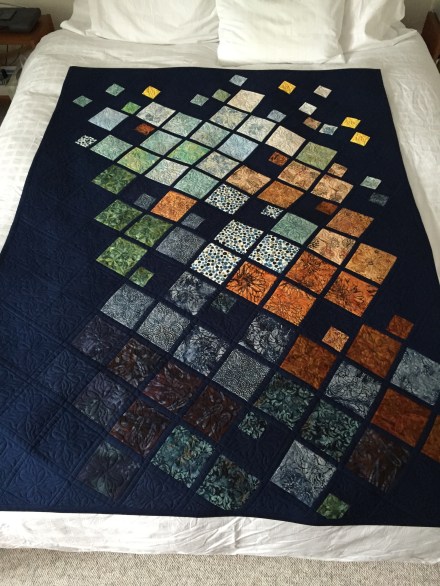
So many decisions – what colour for the background, how to arrange the coloured blocks, what width for the sashing, where to position the “floating” small blocks, what kind of design to use for the quilting, whether to quilt all the blocks or just some, what coloured thread – solid or variegated, same for all blocks or different, matching or contrasting, what colour for the binding, one colour or with an accent or two?

Improvisational quilting needs lots of decisions at each step of the process – that’s after deciding on the overall dimensions which affects the size of the individual elements, and how many will be needed.

That’s what I love about improvisation – I have no idea how my idea will turn out. The fun is building the quilt and seeing it unfold.

This quilt ended up with 154 quilted “blocks” quite a number of them partial blocks at the edges because having rotated the whole quilt 30 degrees the edges were on a 60 degree diagonal. Because I quilt in the hoop (using my embroidery machine) that was a lot of repetitive hooping – it took quite a bit of time. 

I finished the quilt this morning. I’m happy with how it turned out – it’s a keeper. The colours  coordinate with my bedroom decor, and it’s long enough to cover my toes when I pull it up to my shoulders.

Now to come with an idea for the remains of that fabric collection – I figure I have enough for at least three more quilts!

Oh, and here is the back:


Modern Quilt

IMG_4361

Just finished piecing this top for a “modern” quilt. What makes a quilt “modern”? Bold colours, improvisational piecing, layout, asymmetric design….

These are the fabrics I originally bought for the 2015 Craftsy Block of the Month quilt that I was going to make along with Nancy (@ Sew With Vision) but truth be told, I don’t particularly like that BOM quilt and the thought of working on it for a year wasn’t appealing. So I started looking at photos of non-traditional quilts and decided this one would do for a start.

I pulled more fabric from my stash so I was working with 20 fabrics in all. The intention was to create a colour flow on the diagonal, with the entire set of coloured blocks also on a slight slant. To make the coloured blocks pop, I sashed them with the background fabric so the whole has the appearance of a stained glass window. The combination of large and small blocks also added contrast to the whole.

Now to come up with something interesting for the back. I’m thinking a crazy quilt strip would work with this piecing. We’ll see once I sit down with the fabrics (I have enough left for several more quilts!) what actually comes out. That’s the fun part of this kind of quilt-making – I never quite know what I’m going end up with – that’s what I think was wrong with the BOM quilt – I really don’t enjoy following a recipe – I will continue to download the instructions for the blocks to see what new techniques I might pick up, but I’m not going to make those pieced blocks.

Art Quilt #3 – Toward the Future

IMG_4323

Click on photo to see detail.

I didn’t take a lot of photos along the way – in part because this project has been sitting around since last April – I knew what I wanted to do with the piece, but somehow it just didn’t make it to the top of my list until about 10 days ago when having finished the third pair of pants I thought it was time to do something with this quilt art work.

Finished dimensions: 18″ X 21 1/2″; it’s a “mixed media” piece – the foliage and the boys are photos printed on fabric (the printed foliage cut and pieced to create the canopy), the foreground elements are pieced quilting fabric to blend with the rest of the materials. The “matting” is raw silk; the border – batik. The boys and the background are two different photos – I had to fussy-cut them from the 8 1/2″ x 11″ printed fabric sheet so I could appliqué them into this background – two young lads walking toward the future created an interesting image, I thought.

To begin with I intended creating the foliage using a variety of green fabrics but nothing was successful – the colours were wrong, didn’t blend, didn’t look like leaves/trees. In the end, I opted to do this piece as mixed media, combining photography with appliqué quilting. I was happy with how the foliage turned out.

To enhance the intensity of the colour of the boys outfits I used oil pastels; permanent markers were helpful for blending thread colour into the fabric. The point was to end up with as realistic an image as I could manage using whatever materials let me do that. I decided not to be inhibited by any “rules” for doing art quilts. I did what worked to create the outcome I was after.

This art quilt I’m keeping – now to find a place to hang it. 

———–

March 28 2015

I follow the work of Melody Johnson – an art quilter who backs her “quilts” with a painted MDF board. I thought that an interesting idea and decided to try it on this quilt:

IMG_4516Definitely gives the piece a more finished look. I like how the blue border lightens the fabric “frame” and gives a strong edge to the work.

I have to take another look at “Asparagus Field” and think about whether I want to do the same thing with that.