Skyline #2 – Update

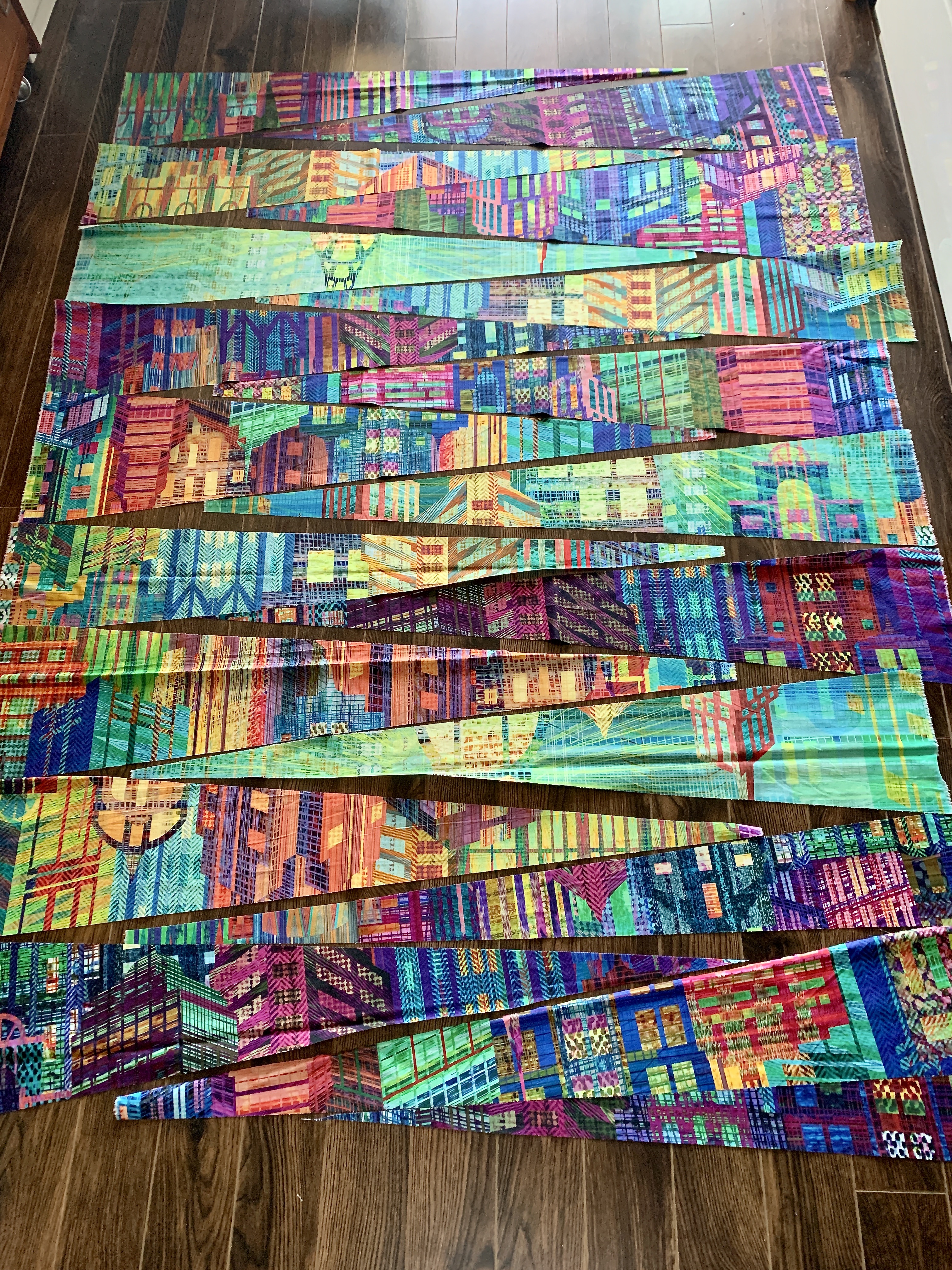
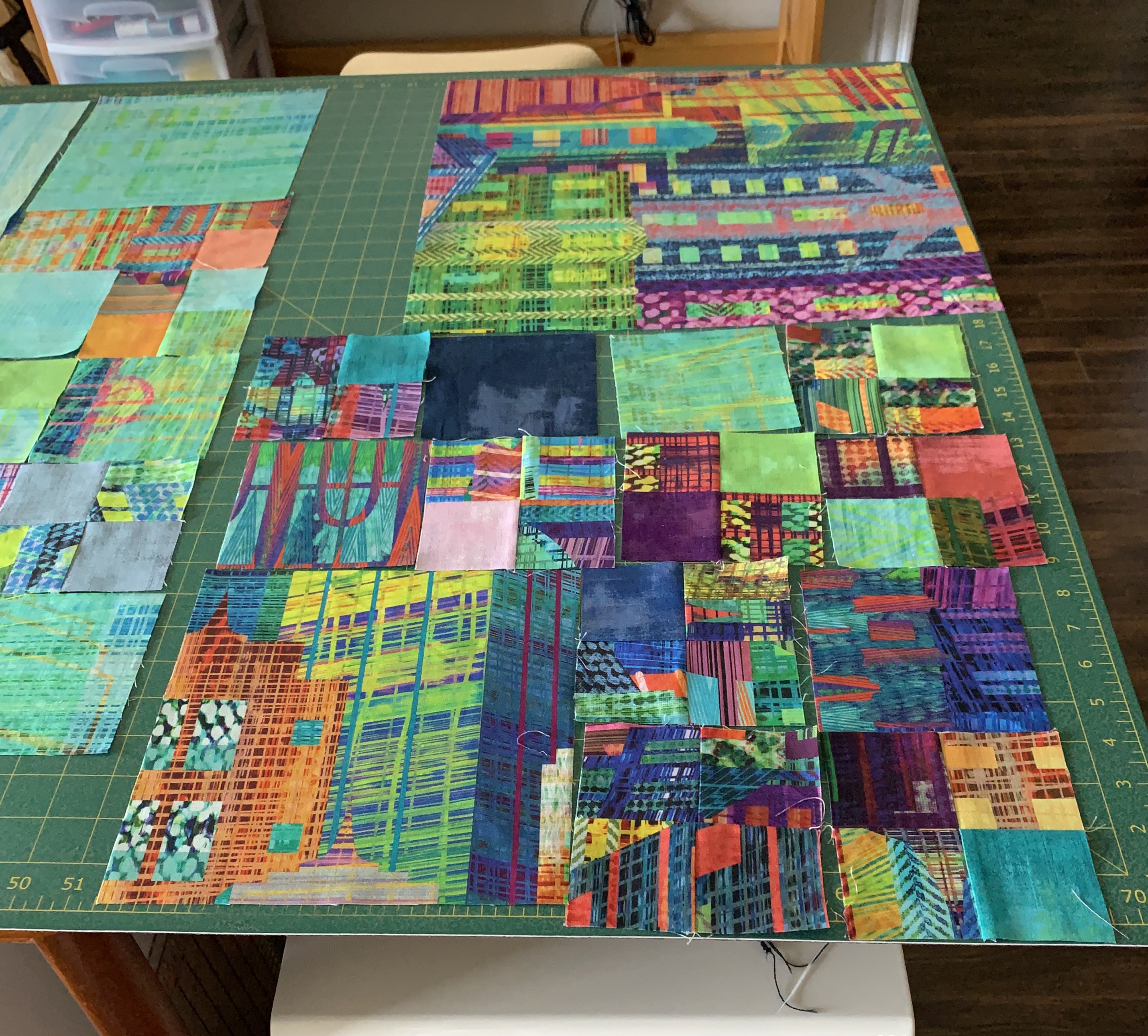
A quick update. Got a bit further this morning – I added 6 wedges with sashing.

Skyline #2 – In Progress

Not easy to do and keep the panel flat. The angle at the apex of each wedge causes a wobble in the developing edge – you can see it at the bottom of the image. I had to figure out a way to overlap each new wedge with the previous ones in order to keep the panel flat.

I think I’ve figured out I have to lay out the sashing strip, trim the panel so the sashing is applied straight, then trim any excess from the panel edge so I can sew a straight seam. When applying the next wedge, I can play with the width of the sashing so it narrows either at the point or at the outer side of the panel whichever seems right at that spot.

I’m about half done at this point. I have another 9 wedge pieces to add. I’ve squared the top and sides – the width is still around 52″ – I will trim it to 48 1/2″ (maybe 49″) when I’ve completed the whole panel.

I’m still not sure whether I want to use the piece with this horizontal layout, or whether I will rotate the panel 90° – that would necessitate adding something to either end because the panel at 52″ is not long enough – I’d need another 12″ or so.

I want to finish at close to 64″ in length whether the wedges are horizontal or vertical….

Skyline #2 – Starting The Panel

I spent some time this morning beginning to assemble the panel – some interesting problems to solve here. I don’t want all the points at the same level so I have to figure out ways of staggering them in both directions!

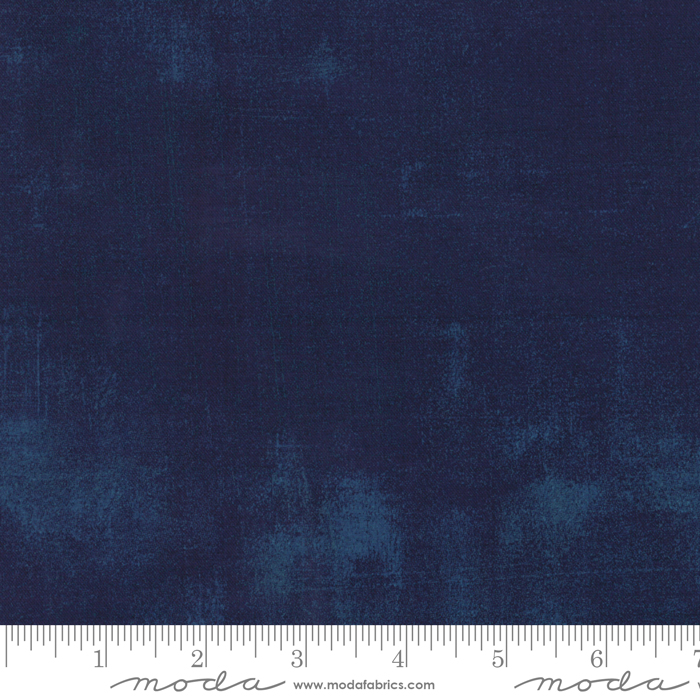
Also the width of the navy grunge “sashing” is something I’m going to have to work out piece by piece. I’ve cut sets of 1″, 1 1/4″, 1 1/2″, 1 3/4″. I think the easiest solution is to apply a strip to the ongoing edge as it is, but graduate it when I apply the next wedge so the dark blue is also present as a wedge – sometimes wide/narrow other times narrow/wide.

Skyline #2 – assembly beginning

It’s going to take time to assemble this panel because each adjacent wedge has to be attached in a way that doesn’t distort the panel – I need to keep it flat. I may have to add small wedge inserts as I go along to even out the joins between sections.

Anyway, I’ve got the panel started. I’ll try getting further tomorrow.

Skyline #2

So here goes…

I took my second panel of the Hoffman “Skyline” fabric and cut it into wedges – some narrower than others.

I laid them out on my floor in alternating directions, spreading the array a bit wider than 50″ – close to the width I’d like to end up with (allowing me room to trim after I’ve assembled the panel).

Skyline #2

I didn’t cut the lightest end of the fabric and I see now I may want to include at least one very light wedge in the array. I’ll leave this fabric on the floor and move wedges around over the next couple of days trying to decide on colour flow.

My next step is to cut my dark navy grunge fabric into strips (slightly wedge shaped, maybe) and attach those pieces to one edge of the coloured wedges. That will set up a stronger colour contrast and make the print colours brighter.

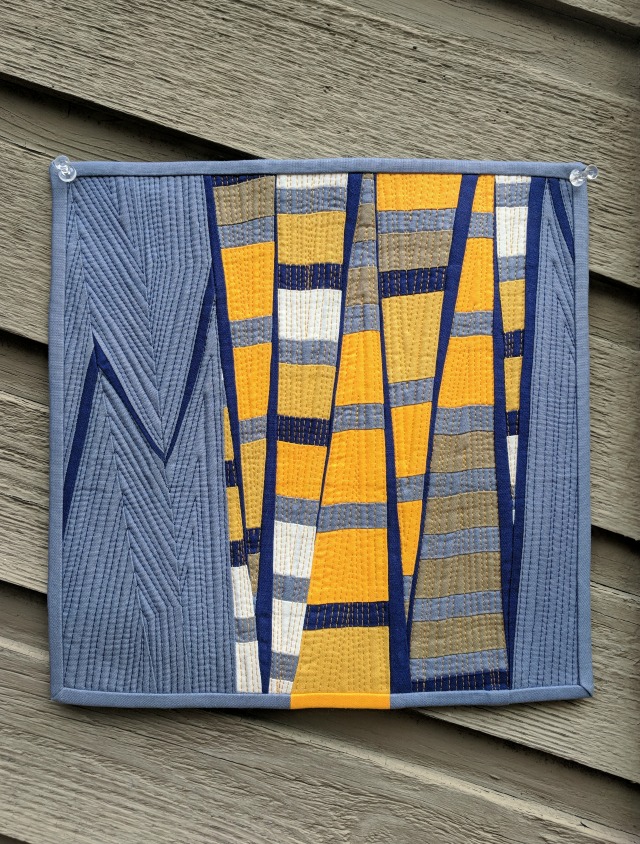
The inspiration for this project comes from Debbie Jeske’s 10″ block “Loosely Connected

Loosely Connected by Debbie Jeske

I’d come across the image on Pinterest after I’d bought the Skyline fabric and thought it was an interesting idea – I wouldn’t need to piece the wedges – just use the colour flow within the print. I’m not planning on solid end pieces, but who knows – once I have a panel assembled I might decide to include a grunge contrast at the ends, even along the sides.

I’m aiming for a finished panel about this same size as “Skylines #1” – 48″ x 64″.

So now to cut the dark blue grunge strips and begin adding them to the wedges….

Skyline #1 – Completed

Here it is. Finished. I just hand-stitched the hidden binding and the label in place.

Skyline #1

I’m quite pleased with how this piece turned out. Final dimensions: 48″ x 64″ – not a bad size for a throw quilt and still reasonable to be hung on a wall should anyone be interested.

I used three different colours of variegated Aurifil (50wt) to quilt the project – on top a darkish purple (with mauve) in the purple corner, a medium turquoise (with light turquoise) in the lighter sections, and a red blend in the peach sections. You really have to look hard to see the differences but it was necessary – a occasional dark purple segment in the turquoise or peach sections would have stuck out; same with a turquoise or red in the dark purple on the bottom right. I used a green variegated thread for the back throughout. That worked well.

I was fortunate, that when I trimmed the backing/batting off, I had enough backing fabric from the four sides that I was able to use the offcuts to bind the quilt. So the hidden binding matches the quilt back!

Skyline #1 – Back

This is the third quilt I’ve used a hidden binding on. I elected to do that here because I felt a regular binding would “frame” the quilt top and I wanted it to be open, without limits. Same with the back, the hidden binding brings the elements to the quilt edge nicely.

Now on to the second in this series.

Skyline #1 – Piecing Completed

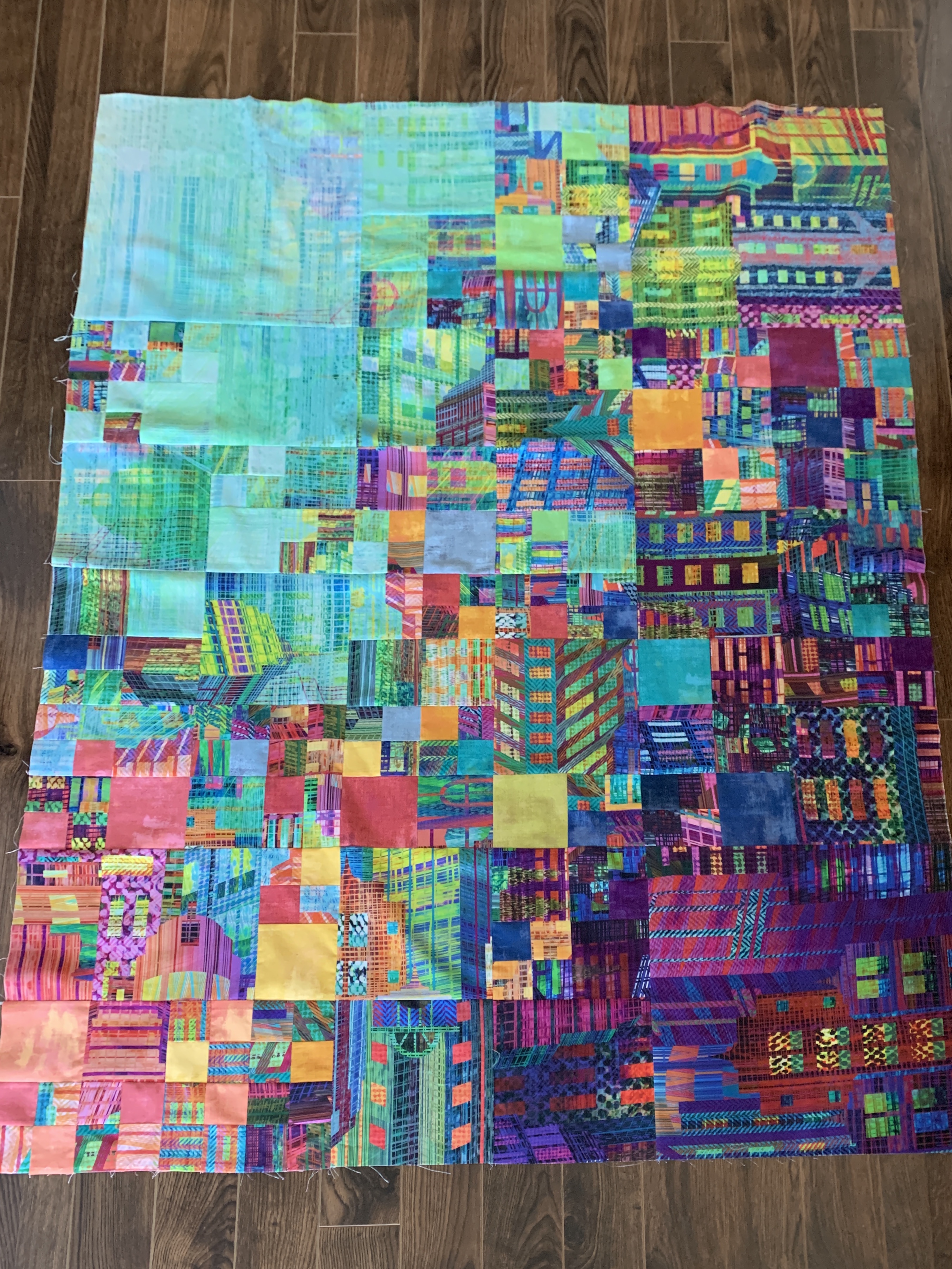
The piecing of the quilt top is finished. I’m happy with the colour flow.

Skylines #1 – Piecing Complete

Now to assemble the back, set up the quilt sandwich, and quilt it.

That’s it for today. Gotta catch a bit of the lovely weather – you can feel a hint of fall in the air – it’s been there for over a week now. It won’t be long before fall will begin showing itself.

Skyline #1

On July 9, I mentioned the Hoffman’s “Skyline” panel I’d bought – I was thinking about how I might play again with “Let The Trumpet’s Sound” drunkard’s path motif using this multi-coloured fabric.

Hoffman Skylines – Multi

I finally got going on on Aug 10, when I cut my 1m wide panel into 10 different 21″ squares. Then I walked around the fabric for another week!

I took a deep breath on Aug 17 and cut the 21″ blocks into smaller sizes:

  • 3 x 16.6″ – a dark, a medium, a light
  • 14 x 8.5″
  • 36 x 4.5″ and
  • 120 x 2.5″ blocks.

I also cut 32 x  2.5″ blocks from several complementary shades of “Grunge” fabric from my fat quarter stash. I more or less sorted everything by colour, I stitched many of the 2.5″ blocks into 4-patch elements, then I began laying out blocks on my cutting table:
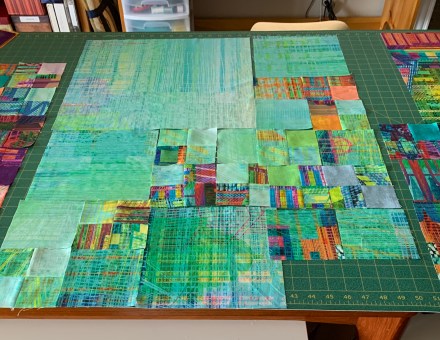
Skylines #1 – First Corner

The large pale block, two 8.5″ blocks, then filled in with a combination of 4-patch and 4.5″ blocks….
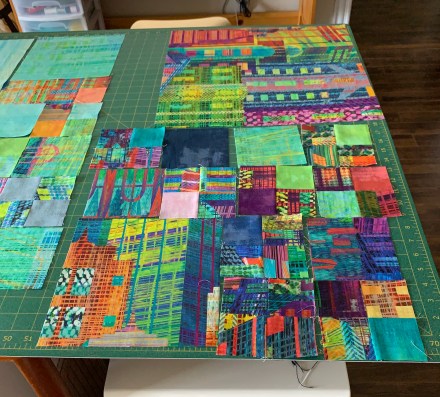
Skylines #1 – Medium Tones

Next, I grouped more blocks into medium-toned groupings until I had no more space available on my cutting table, at which point I very carefully moved everything to the floor.

Skylines #1 – Incomplete Layout

I laid out all the blocks I had cut – I still needed the equivalent of approximately 15 x 4.5″ spaces – the few remaining scraps I had left of the “Skylines” were too small so I turned again to my collection of “Grunge” fat quarters, selected a dozen I thought would coordinate well with my layout.

As I was filling in spaces, I moved blocks around until I had a more coordinated colour flow:
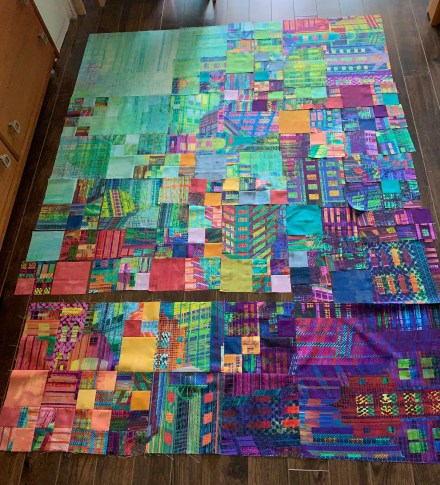
Skylines #1 – Completed Layout

Now I had a clear alignment of lights, darks, and medium colours – with a grouping of peach tones in the lower left corner.

Looking at the layout with a friend that evening, the small pale mauve “Grunge” blocks were stand-outs – they had to go; I replaced them with other colours which blended better. And then I began assembling the quilt top into 12 x 16.5″ blocks:

Skylines #1 – Partially Assembled

The top row, the second row, and the bottom row are now sewn together. The layout in the middle two rows used a couple of the 8.5″ blocks staggered across two rows – hence the jog in the second row. The third row is laid out on my cutting board ready to be assembled:
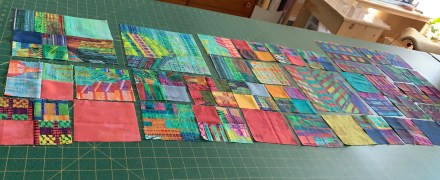
Skylines #1 – Third Row Ready to Assemble

That’s this morning’s work. Once I have all four rows done I’ll put them together. Leaving them separate at this point lets me lay them out, check for colour flow, and replace any “eye-sore” spots more easily – taking apart the smaller strips is much less complicated then replacing blocks in the middle of a large panel!

Oh, and I picked up another metre of the “Skylines” fabric – bringing my total, now, to four panels. I’ve decided to insert an 8″ – 10″ strip in the back of each of the “Skylines” quilts. Did I say I have plans for doing THREE quilts using this fabric? I intend to call the series “Skylines Triptych.”

Kaleidoscope Table Runner – IV

Before the pandemic arrived I was scheduled to teach a class on constructing a Kaleidoscope Table Runner (to demonstrate how the Stack ‘n Whack technique actually works). Do a table runner and you know how to turn the technique into a quilt or wall hanging, even a garment if you wished.

The class was cancelled. As businesses and life are slowly resuming here in Nova Scotia (we’ve effectively been without any new cases for close to a month – well one at the end of last week – someone who’d travelled from the US and then didn’t bother to quarantine for two weeks and managed to spread the virus to three young folks in PEI!) we’re beginning to think about resuming some aspects of our previous life.

So the class was rescheduled. One woman signed up, another was interested but not during the summer, so it’s been moved back till the end of September.

However, I’d started yet another kaleidoscope table runner as a demonstration piece and of course I kept working away at it.

Finished it this morning:

Kaleidoscope Table Runner IV

And here is the back:

Kaleidoscope Table Runner – Back

I did have to buy the yellow bordering fabric but the rest was constructed from fabric I had in my stash. Not many scraps left over!

I’ve finally written instructions for how to make this table runner – took a while because I kept forgetting to take photos as I went along. I was able to use images from  several different runners in order to show how the various parts of the project are constructed.

Kaleidoscope Table Runner – How To Construct

A Very Modern Quilt

A while back I saw an interesting modern quilt on Pinterest:

Pinterest Photo

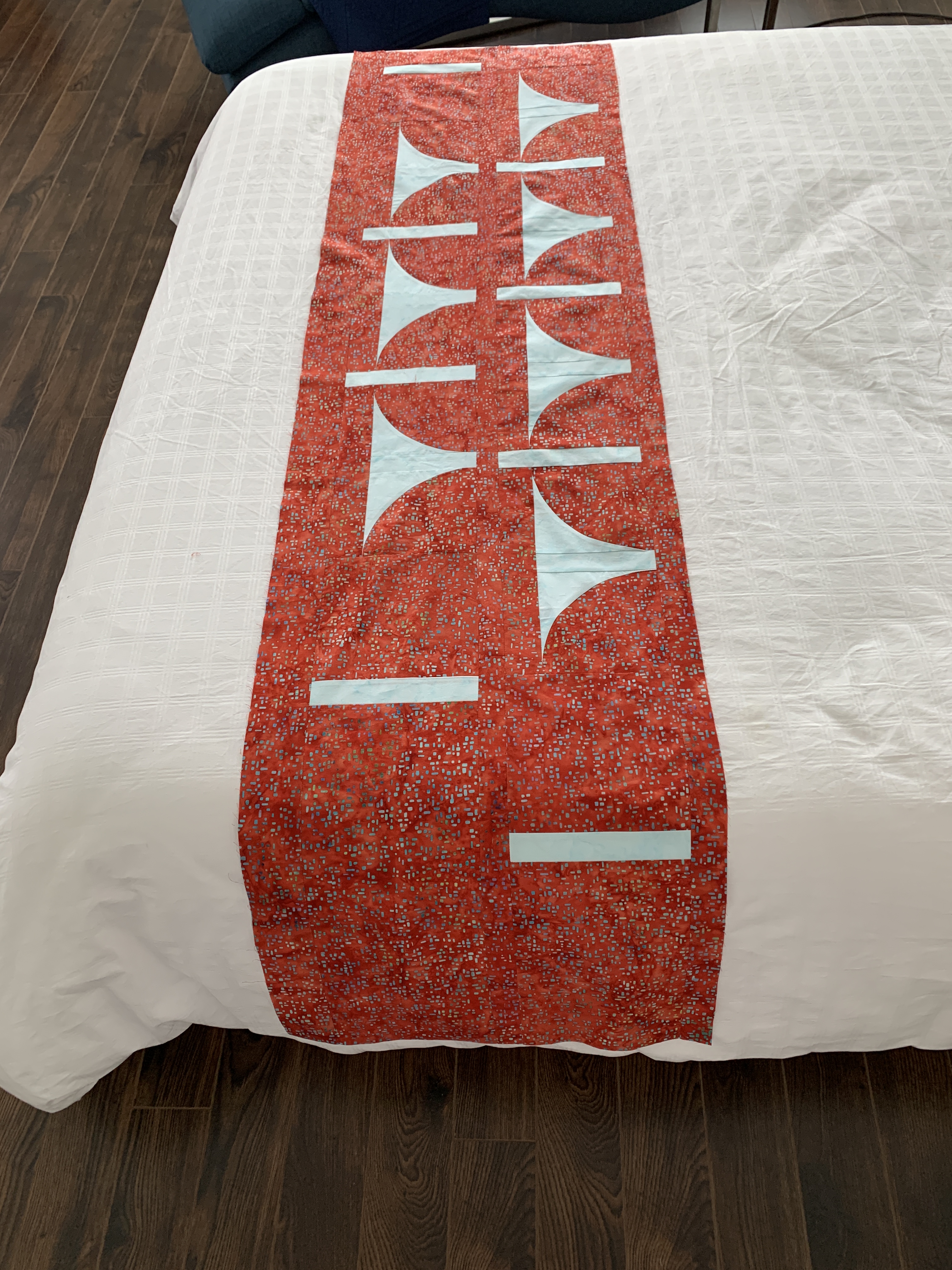
I really liked the stark contrast between the two colours and the very modern use of drunkard’s path blocks. I printed the image and put it in my “think about” pile. I had 3m of an interesting red batik I thought would work with this idea but I needed something pale to contrast with it. This is just after everything shut down in mid-March so I went online, found a pale turquoise batik at the Missouri Quilt Company and ordered 2m. That fabric took quite a while to arrive – COVID-19 in action, of course, affecting both warehouse and the postal systems. After finishing the Crossroads Quilt I decided to try this quilt.

I began to deconstruct the image, but discovered this quilt was a 2018 Kauffman quilt pattern so I downloaded it. However, the finished dimensions (a twin size quilt) were larger than I wanted to make so I scaled it by 85% (now that I have the top completed I realize I probably should have scaled it 80%). That meant downsizing all the pieces.

First, I experimented with the size of the drunkard’s path block – taking it from 6 1/2″ down to 5 1/2″ – but I couldn’t go from there until I started assembling some blocks into larger units because I wasn’t sure what size the connecting elements would actually turn out to be. I started by constructing 10 drunkard’s path blocks (I knew I needed 39 in all) and created the first column, added the second column, then the sashing elements between as well as the outside left border.

First Two Columns Assembled

The next part of the assembly was less straightforward – I constructed the remaining 29 drunkard’s path blocks and began working on the central panel:

Centre Panel

I joined the first pair of drunkard’s path blocks with sashing, add the third block to one end, next the side sashing, put the second triplet with it, then add the end sashing…. I only knew what size the sashing elements needed to be by measuring where they fit as the parts of the “block” came together. It was easier figuring out what size fabric pieces to cut as I went along by measuring where they went rather than trying to work out 85% of each piece in the pattern.

Centre Panel Attached

Finally the right-side panel – same process:

Finished Quilt Top

Now I have a finished quilt top – 51″ x 68″ (instead of 61″ x 75 1/2″) – a large lap quilt.

Yesterday, I bought turquoise fabric for the back. I have all 39 pale turquoise “pie” shaped pieces cut from the “L” pieces as I built the drunkard’s path blocks. I plan on creating a dozen or so reverse drunkard’s path blocks using scraps of various red fabrics that more or less blend with this background batik for the “L” pieces so I can set up a strip to insert into the back panel.

That’s where I am right now – I have to cut out a dozen or so drunkard’s path blocks – downsizing the turquoise “pie”shaped pieces, cutting out red blocks for the “L” shaped pieces, creating the blocks and stitching the panel.

So on to that next.


Current Quilt

I took the blocks, rotated each in turn clockwise (both vertically and horizontally) to move the contrast strip around. I then sashed the blocks in each horizontal row, assembled the rows, and sashed between the rows using pieces of the lighter fabrics (a mixture of batik and printed grey fabrics) to lighten the overall appearance of the quilt top.

Blocks Assembled

My size, at this point, is 50″ x 64″ – probably large enough for a good sized throw/lap quilt without borders. And looking at the photo, I think I’m going to do a hidden binding so those contrast elements at the edge stay at the edge.

Now to think about the reverse side. Back to my stash to see what I have in the way of largish pieces of grey fabric I can put together with 3 (possibly 4) of the extra blocks I have left over. I know there isn’t a single large piece that I can split and insert a strip to make a backing wide enough. I’m sure I will have to do more piecing than that….

I don’t have a name for this quilt – nothing pops to mind

20 Blocks – Now What?

I’ve just finished 20 blocks (actually I have 23 and could probably eke out a 24th – to use on the quilt back). The question is now what?

20 Blocks

I could just stitch the blocks together (after I’ve looked at the placement for a while and moved some around); or, do I want to add pieced sashing between the blocks to extend both length and width a bit? I do intend adding an outer border – probably pieced using both light and dark fabrics.

I guess the next step is to go through the fabrics in my stash to see what I have that might work for sashing – I don’t need all the sashing to be the same fabric, in fact, it might be interesting to mix and match fabrics – the challenge with that is to be accurate enough that I actually align the seam matches with seams in the existing blocks…

Better go look.