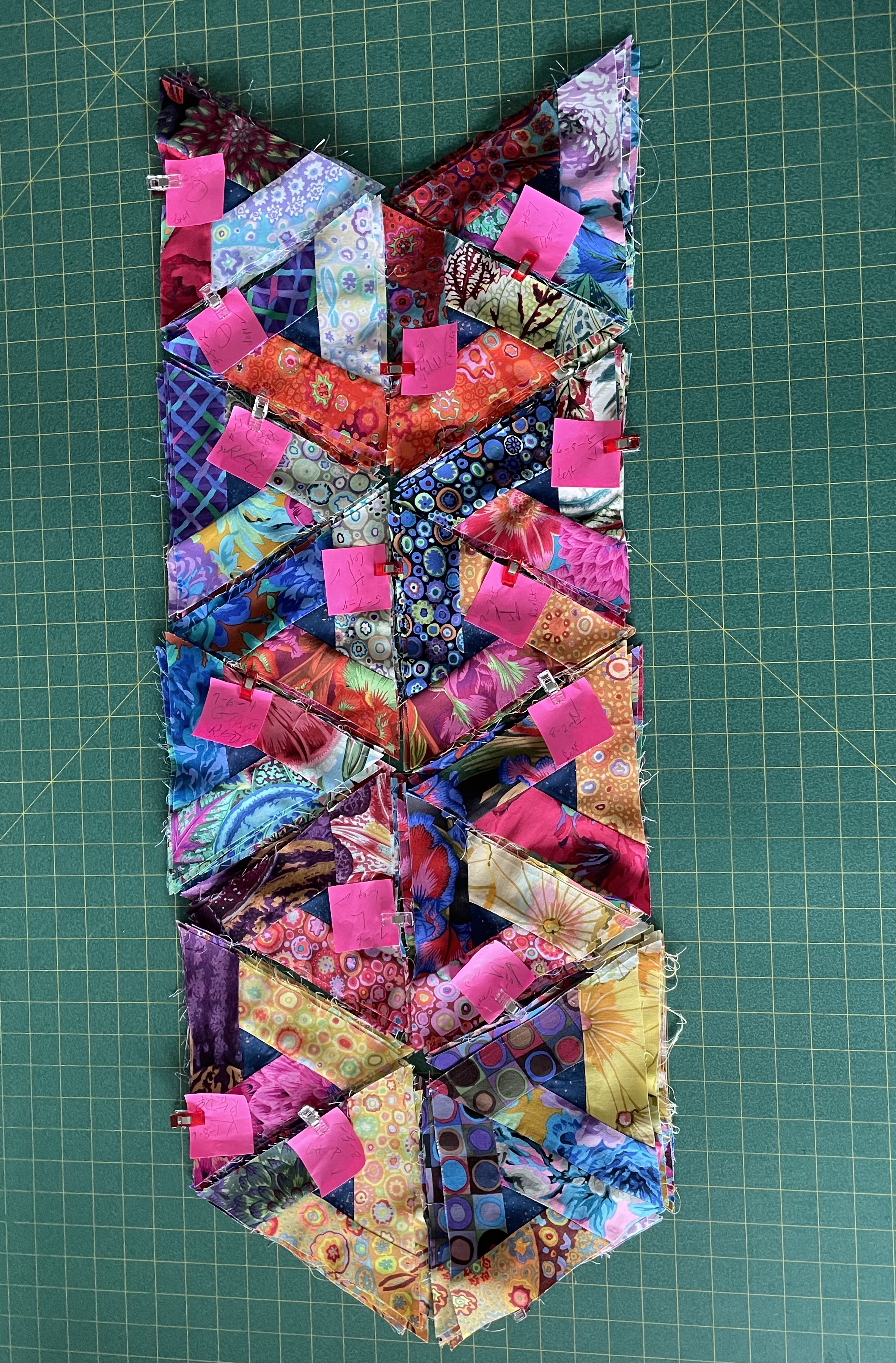
After I had the third diamond quilt underway I came across what’s called the “Escher” Quilt.
There are a lot of examples of this quilt online – I don’t know who developed the idea originally. The assembly creates the illusion of impossible interlocked elements. The quilter who’s photo I’ve shown below (whom I know only as “chiquitatarita”) posted photos of her quilt top in progress (she’d bought a kit using Kaffe Fassett Collective fabrics)- here she had two columns assembled where you can see the construction clearly. I even have quite a few of those particular fabrics!
I could make this simple and enrol in a class or I could buy a kit (which includes fabric, a pattern and instructions), but I decided to try on my own to see what I can construct using a relatively simple block.
Next I came across another blogger who also described how she worked with the kit she’d bought:
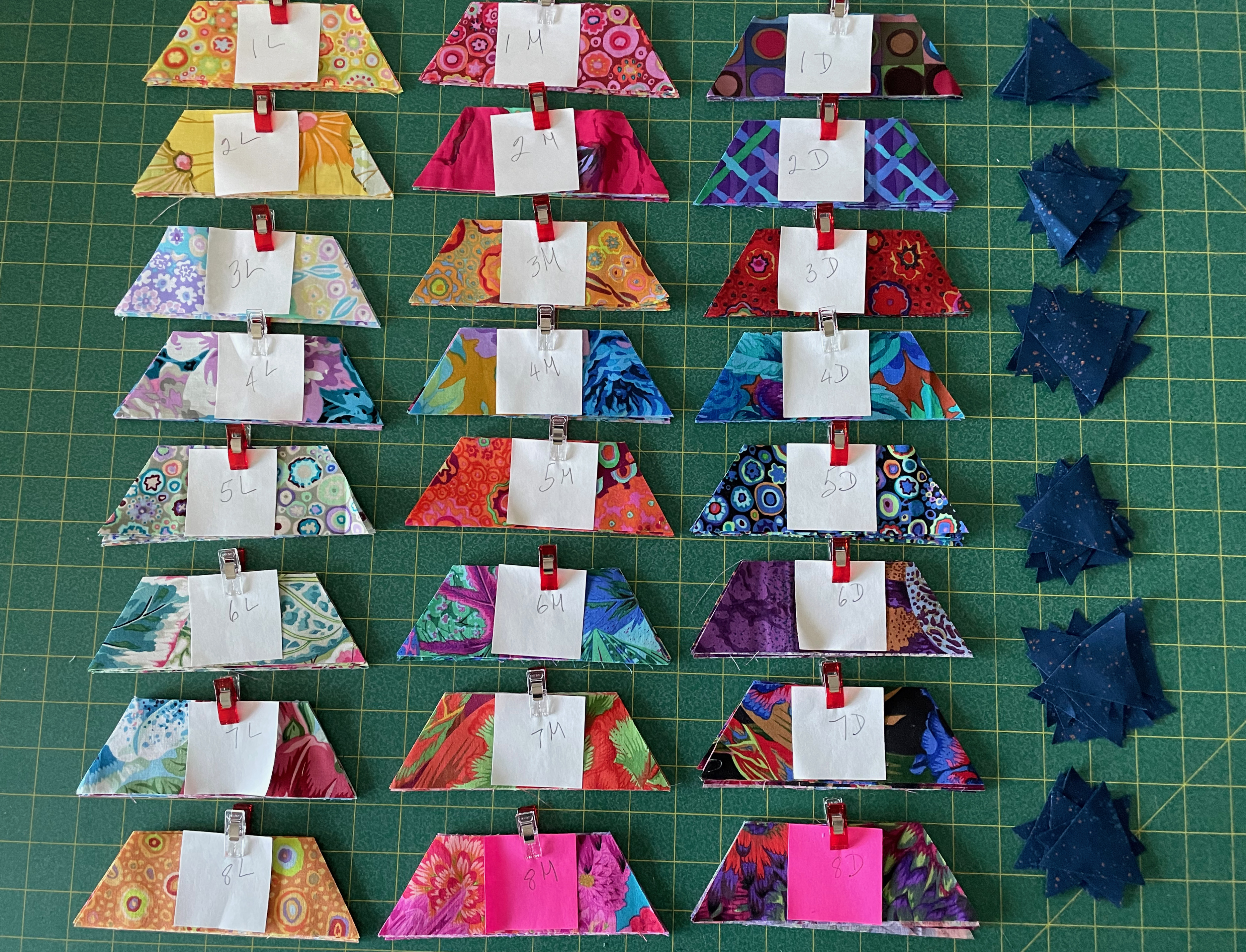
First we made a chart, and laid out all the fabrics, from one to eight down, and L/M/D across. After cutting, we needed to then pair up the pieces according to the chart. Each piece has a light, a medium, and a dark bar, but they’re different depending upon their relative location in the row.
I organized my fabric into eight sets of three groupings – light, medium, dark. I cut 2″ strips from each and cut the trapezoid shapes (16 from each fabric) plus the small dark triangles for other centre of the block.
This helps me figure out how to go through my fabrics and set up an 8 x 3 array as Sue describes above.
So I set out to create the basic block – it took several attempts to establish a size for the block using paper and pencil. Then I cut out bits of fabric to see if my calculations worked – they didn’t – not at first. However, I did finally manage to work out a reasonable size block which went together pretty well.
Triangle Unit 1
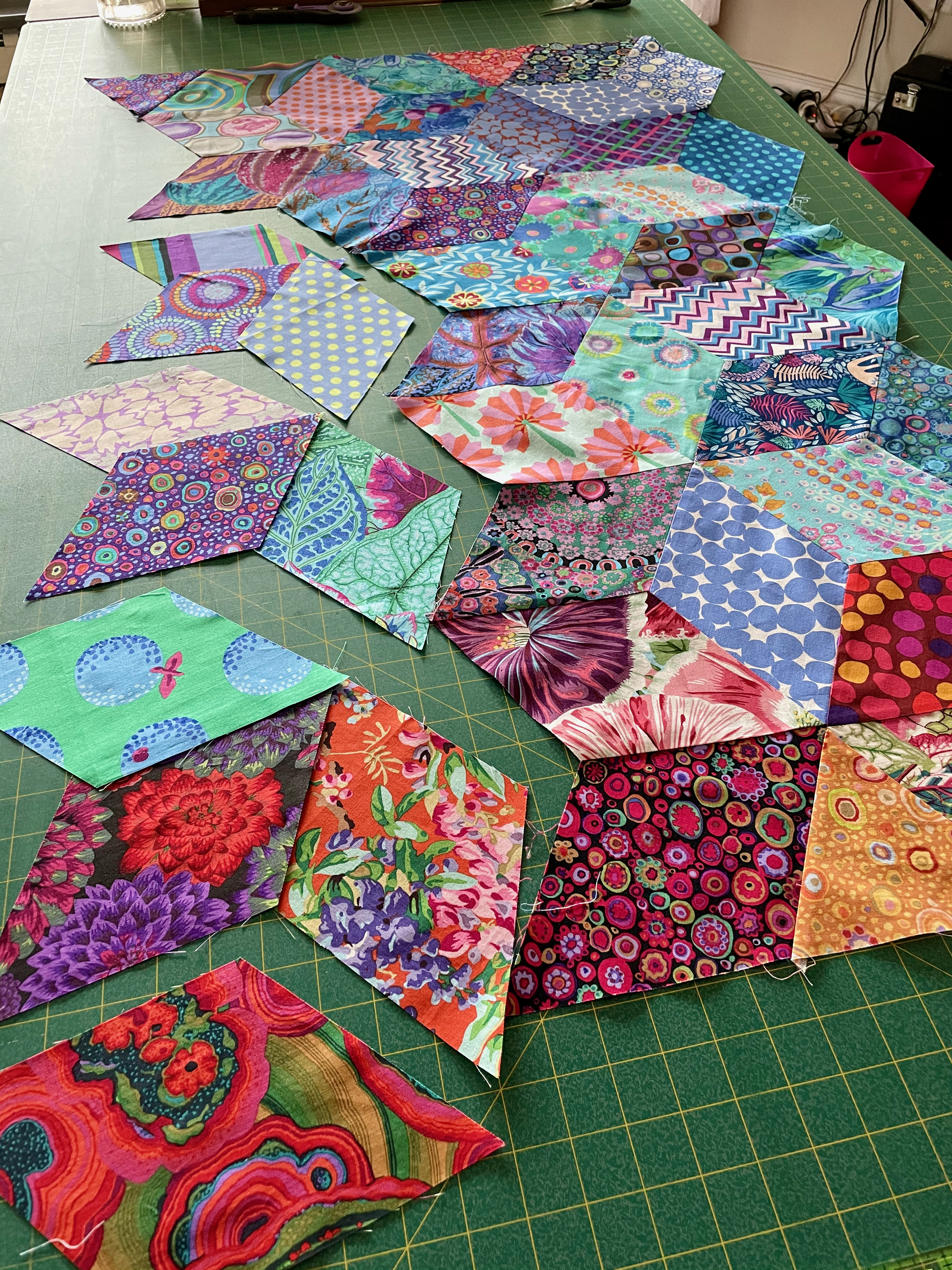
This block is one of a pair – the second one assembles in the opposite direction which lets you put the triangles together to form a connected “diamond” where the same fabric abuts to form a wide angle – you can see two in the photo below – one in brown, the second in green (I’m just working with scraps to see if I could set up a couple of blocks):
Three Triangle Units Sewn Together
The precision issues won’t be with my cutting – I now have the dimensions I know will work. It’s my sewing that will create issues – I will have to be extremely careful to sew a “scant” 1/4″ seam. When I attach the triangle to the first trapezoid I need to stitch a partial seam – which is completed when I add the third trapezoid. Then I need to carefully press each resulting triangle so the centre triangle seams are pressed outward. Finally, I will need to press the block-joining seams open, so the assembly will lay flat. I also have to remember to create my blocks in pairs – one block having the small triangle at the left of the first trapezoid, the second having it at the right end!
Now it’s time to go through my fabrics – I want 24 – set up in eight sets of Light, Medium, and Dark. I don’t have complete colour ways sets of three but I’m sure I have enough variety in my collection of Kaffe Fassett Collective fabrics to make something that will work.
Mar 29 2023:
Ina Veurink wanted more information about the size of the trapezoid elements. I just constructed one so I could answer her question.
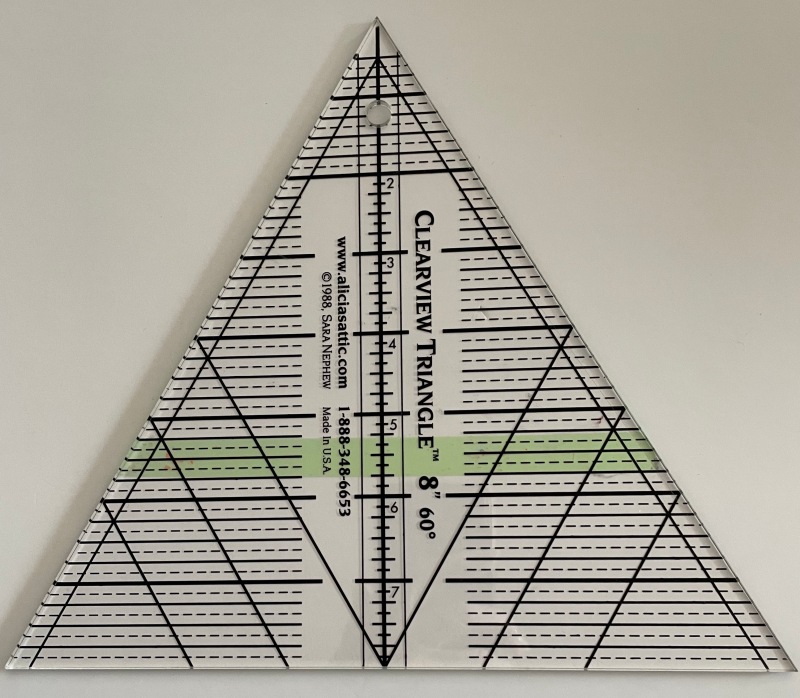
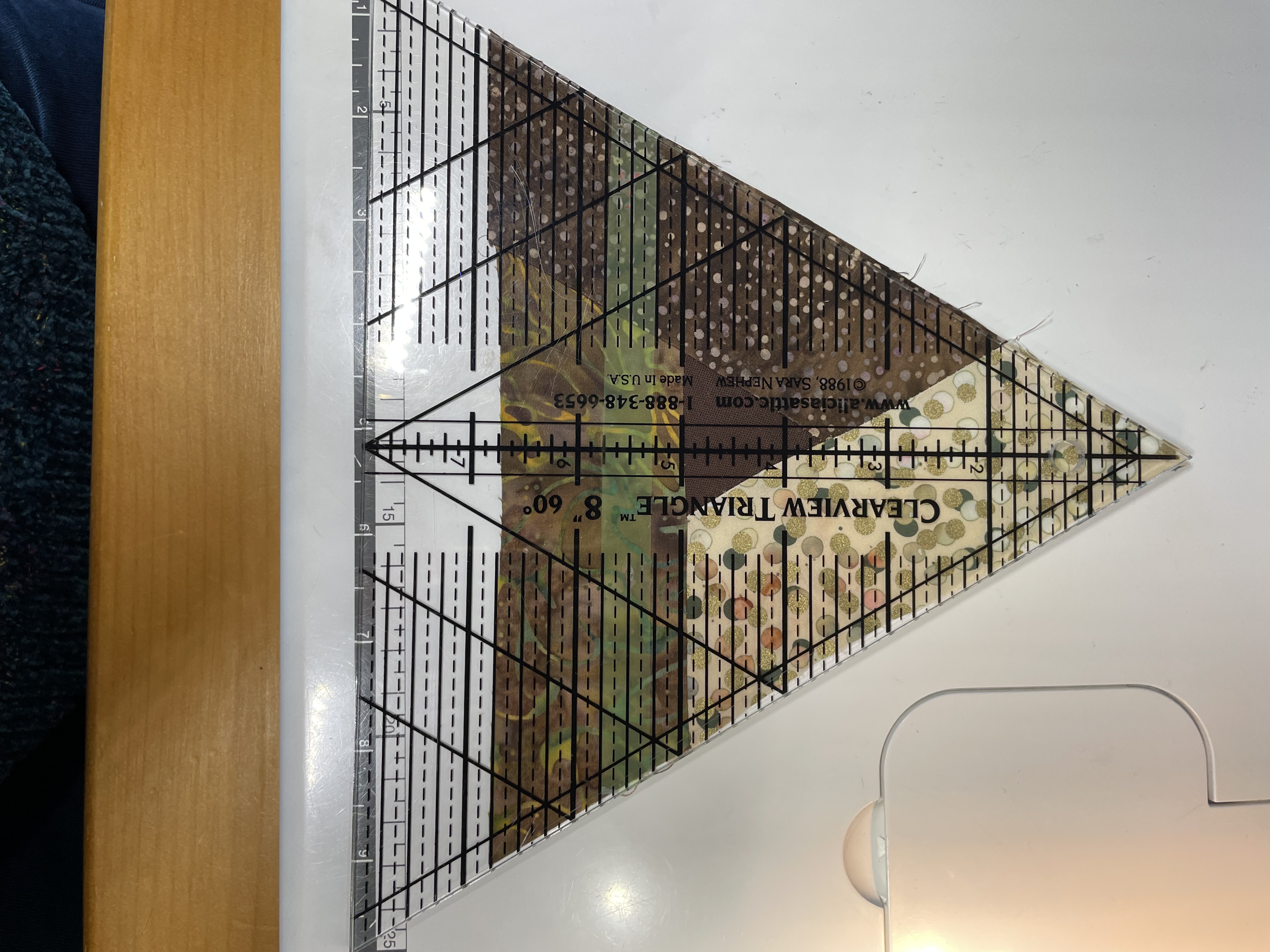
I cut 2″ fabric strips to start, from the fabrics I was going to use for the trapezoids. Next I trimmed the angles on each side using an acrylic equilateral triangle template which I’d marked with green tape at the 5 1/4″ line:
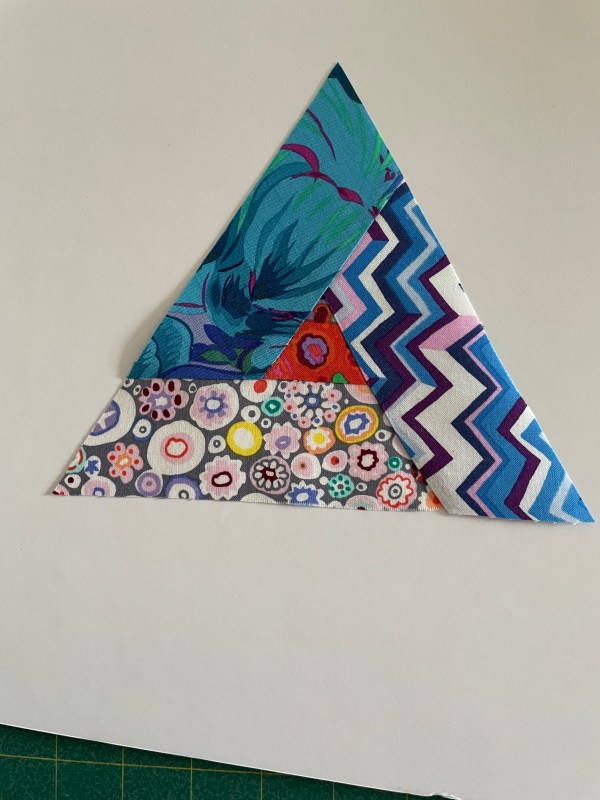
Trimmed Trapezoids From 2″ StripBlock Partially assembledAssembled Block
I laid out the 4 pieces: a 2″ triangle (in the quilt all the triangles are cut from the same dark fabric), 3 trapezoids (each 2″ tall, 5 1/4″ on the long, bottom side). I partially sewed the triangle to one end of one trapezoid
(NOTE: half the finished triangle blocks begin with the small triangle on the right, half on the left – I talked about that somewhere in the posts as I went along). It’s a partial seam because to fit the final trapezoid in, you have to be able to lift that first side of the small triangle to sew that seam. Next I attached a second trapezoid, then I fit in the third trapezoid, last I finished by completing the partial seam. Pressed and trimmed.
Finished triangle size: each side should end up at 6 3/8″ (although if your sewing was more accurate than mine on this test triangle you might actually end up closer to 6 1/2″). Whatever your final triangle size, all the triangles should finish the same size.
This is an advanced intermediate quilt (definitely not for a beginner, even with instructions).
Another note you wouldn’t pick up if you didn’t read through the comments is this one:
Just keep in mind you need 25 fabrics – one solid for the “background” triangles and any borders you plan on adding; 24 patterned fabrics – 8 light, 8 medium, 8 dark (https://jmncreativeendeavours.ca/2021/05/08/the-escher-quilt-2/)…. You’ll likely do a lot of auditioning to build a collection of 24 fabrics. As for the background, I suggest a navy (which is what I used given the colour blend of my fabrics) but black is certainly a good option (that was the background colour in the original photo I saw). All the best with this quilt. One other thought, because trying to pull together a collection of 24 fabrics can be daunting you might consider a kit that has selected fabrics for you (these quilt kits are reasonably priced: https://www.quilt-agious.com/shop/Kits/p/Escher—Batik-x46838321.htm).
Oct 28 2024
In reply to Jackie Fitch who had trouble making the triangle block (I’m doing this quick and dirty to illustrate how to assemble the block – my cutting/stitching/pressing is not absolutely perfect).
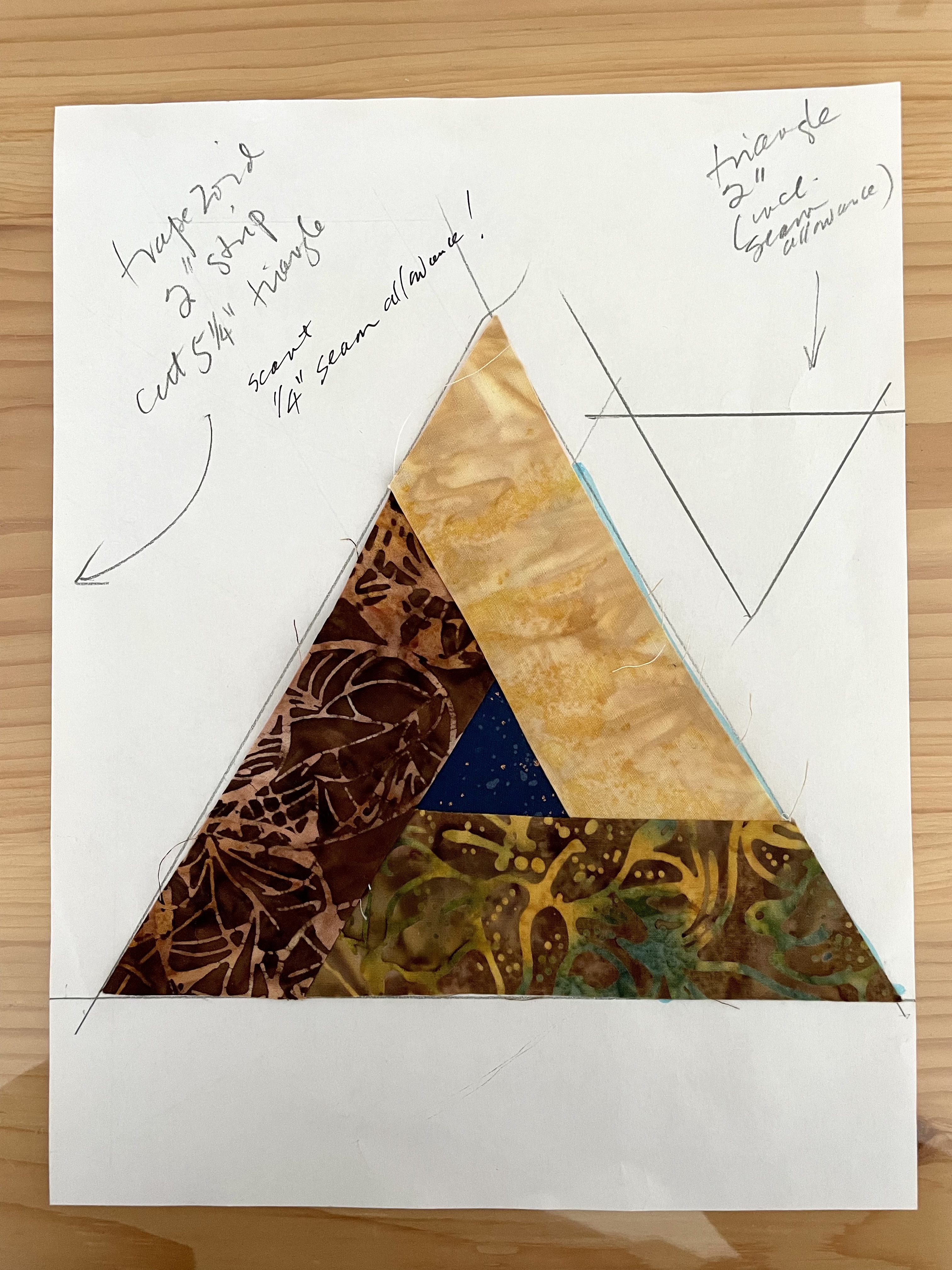
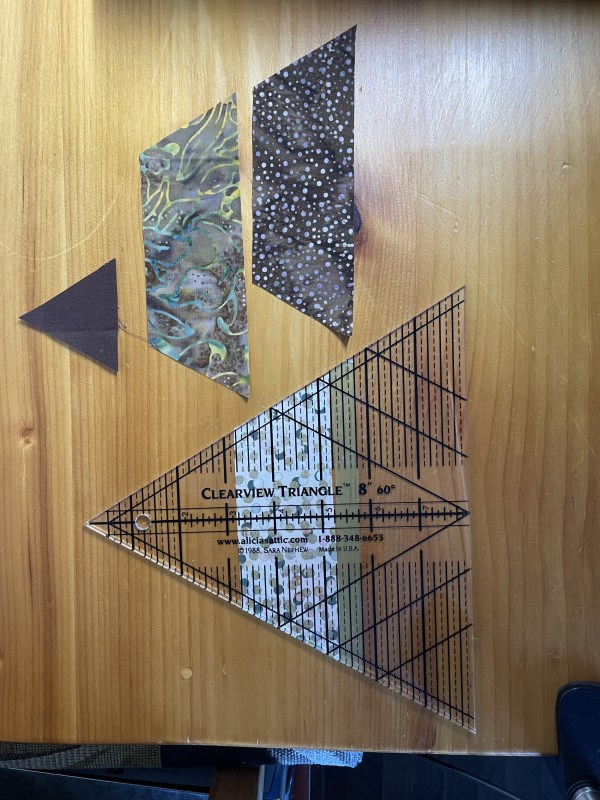
Here are the pieces: They’re all cut from 2″ strips – the trapezoids are cut with the 2″ strip positioned at the 5 1/4″ line on my triangle template (top at 2 1/4″ line). The triangle is cut from the tip with the base of the 2″ strip @ 2″.
You need to use a “scant” 1/4″ seam allowance – play around with the seam allowance until you can get the triangle outer edges to align for you (more or less).
The Pieces for the Triangle Block
You start sewing by placing the triangle on one end of the light trapezoid (half the blocks place it on the left and half on the right – when you add the next trapezoid in the second set of triangles you’re rotating in the opposite direction) [NB: I can’t remember, off hand, when adding the second trapezoid in the second set of triangles, whether you attach the medium or the dark as the second trapezoid – I’m sure I must have mentioned that.
Here it is: https://jmncreativeendeavours.ca/2021/05/09/i-was-being-so-careful/ “It turns out that four of the five finished stacks of triangles which build with the triangle on the right were sewn together counterclockwise – light strip attached to triangle, medium strip to that seam, dark strip to the remaining side – NOPE – should have been light attached to triangle, DARK next, and finally the medium – to give a clockwise rotation.”
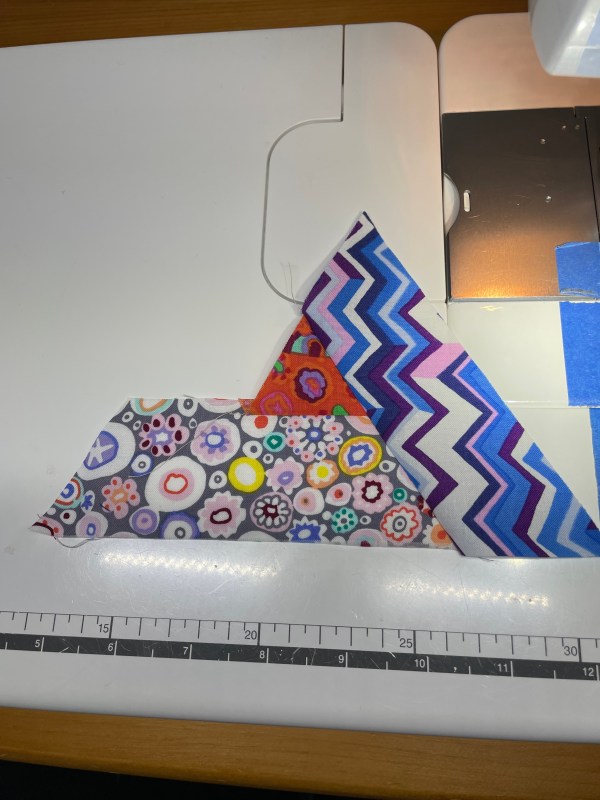
1. Place the triangle on the left end of the light trapezoid. Sew a partial seam (click on image #1 below to see the partial seam).
2. Press triangle away from the trapezoid – NOTE: I’ve pressed the seam allowance the WRONG way – its should press toward the trapezoid!
3. Place the medium trapezoid against the side where you’ve sewn the triangle to the trapezoid [Note: When constructing the second set of triangles you sew the triangle to the right end to the light trapezoid, and add the DARK trapezoid second!]
123
4. Sew this trapezoid in place – notice the dog-ears extend beyond the top edge of the trapezoid you’re adding.
5. Press this trapezoid seam allowance toward the trapezoid.
6. position the third trapezoid (you’ll notice it does fit).
456
7. Stitch the third (the dark) trapezoid in place – notice the dog-ears extending beyond the top edge of the trapezoid, be careful not to sew into the first trapezoid. Flip the trapezoid and press it (seam allowance toward the trapezoid.
8. This next seam is a tricky seam! Click on the image to see where the seam begins – at the end of the partial seam you sewed in #1.
9. Click on the image and you will see the finished seam which closes the trapezoid.
789
I can see now I missed one photo! The one showing how to fold the fabrics so you can see where you sew the final closing seam – you can infer how to do this by clicking on #8 and looking closely at how the pieces are laid out on the sewing machine bed.
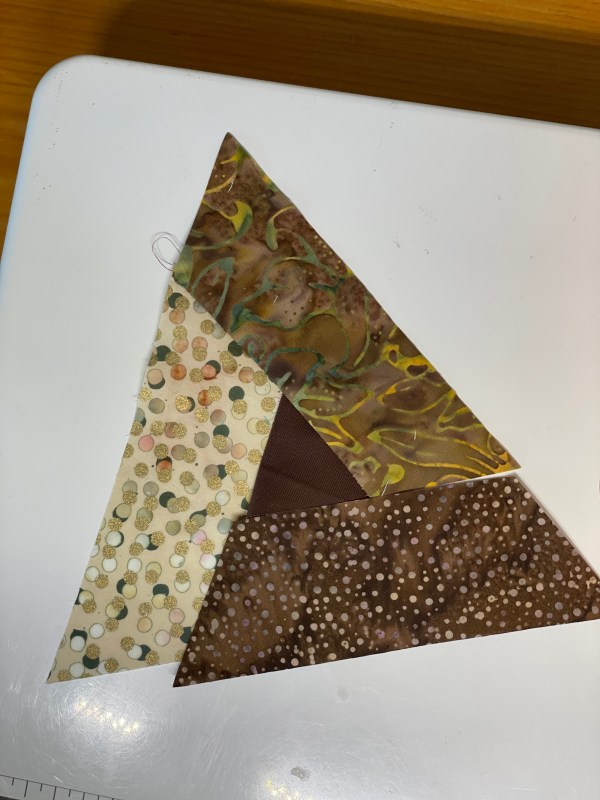
This last image should be rotated (I told you this was quick and dirty!) #10 shows the finished pressed block with the template on top. With a smidgeon of trimming, my block will end at 6 3/4″ (it’s shy a wee bit on the light trapezoid side and a smidgeon long on the medium trapezoid side).
This brown block is a bit larger than the more colourful triangle I created above – because I used a scant 1/4″ seam allowance here rather than a regular 1/4″. I advise making several practice blocks before you work on the triangles for the quilt top just to sort out what you need to do to get as close as possible to a consistent size.
10
Here’s what the finished triangle should look like on the wrong side (seam allowances pressed away from the triangle):
Back of block to show pressing
I hope this is helpful, Jackie. I can’t do you a video because I don’t have a setup to create them. Sorry.
Finished the quilt yesterday – at least for the moment I’m considering the quilt done. I’m still contemplating quilting the seams in the ditch but pressing has flattened the 6-point joins reasonably well – I may leave well enough alone.
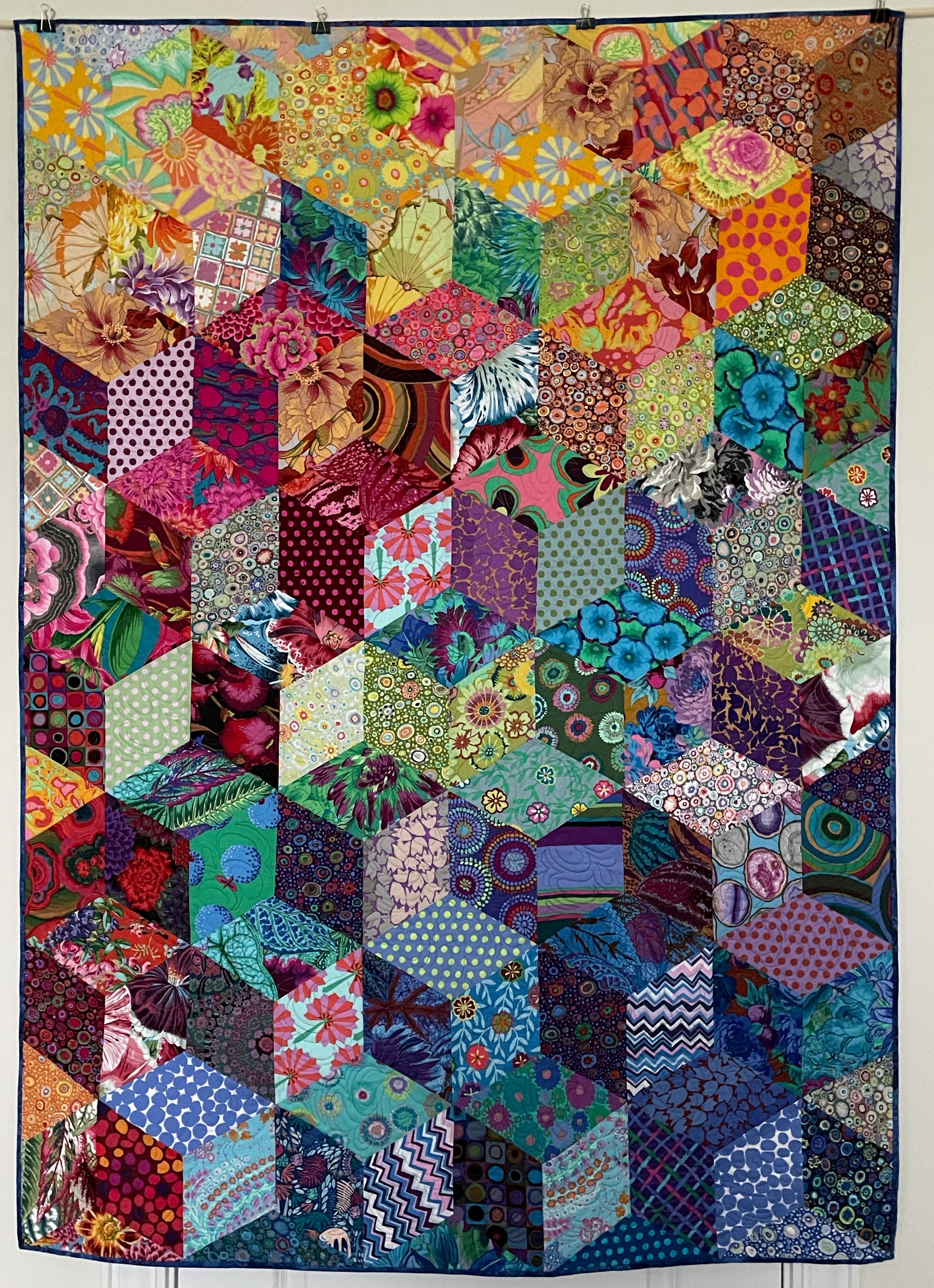
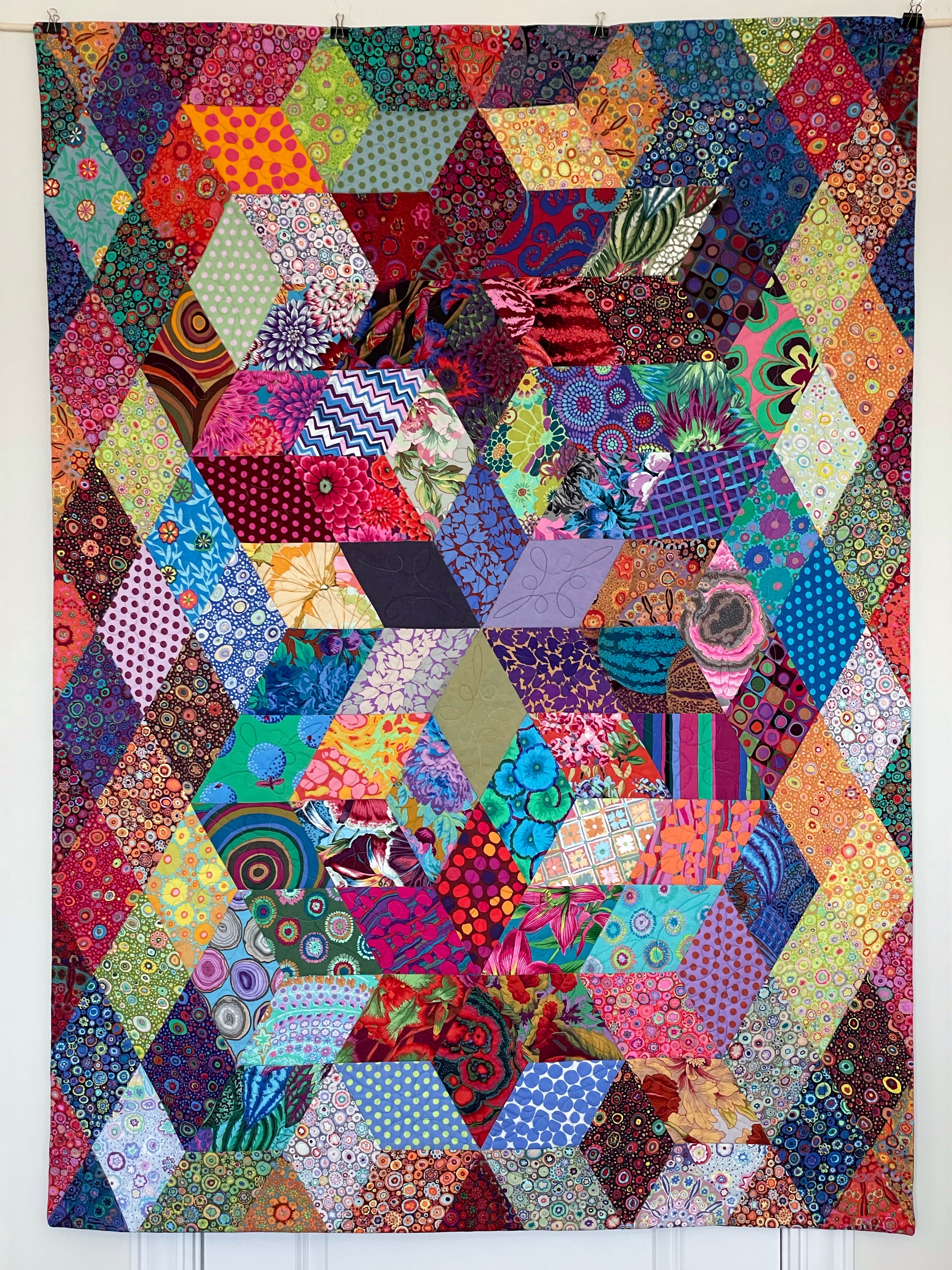
Diamonds III – Finished Top
Finished size: 47″ x 66″.
It’s hard to see in the photo but I finished with a 1/4″ binding using what scraps I could scrounge from the backing cut-offs (it was close – I have nothing left over!). In this case I stitched the binding to the front, hand stitched on the back (I usually stitch a binding to the back, fold over, and use a decorative stitch on the front). Stitching to the front with this quilt made sure I had an even 1/4″ dark edge to the quilt top.
Diamonds III – Finished Back
This is the seventh quilt finished since last August – I have time to work on one more for the showing in Parrsboro, scheduled to happen through July this summer. I have more than enough of the Kaffe Fassett Collective fabric to work with – no point in saving it because I have more KFC fabric ordered to arrive sometime in June.
I signed up for the July/August “Kaffe Quilt Along – Gathering No Moss” online workshop being offered through Hyggeligt Fabrics in St. Mary’s ON. It was the colour of the blue collection that caught my eye. I don’t expect I will construct the suggest quilt – if I do work on that quilt block, I won’t make it using just those fabrics – the blues need some kind of an accent to liven the array. I registered because I’m interested in seeing what Fassett has to say about choosing colour and planning layout.
I knew of Kaffe Fassett’s work through his knitting books and even tried a couple of his sweaters – first time I tried intarsia knitting (not my favourite kind of knitting – too fiddly).
From Fassett’s 1985 book “Glorious Knitting”
Then I as a novice quilter I came across the You Tube videos of his Tampa weekend workshop Oct 17/18 2008.
I watched all three sessions and learned a lot about colour flow. (Here is another video where he discusses colour.)
Over the next year or two I did a series of quilts with batiks (as well as large scale print fabrics) using what I’d picked up from watching the workshop videos. So I’m curious to see what he will have to say this time as people work through four different colour arrangements of the designated quilt.
I just finished quilting all ~135 diamonds (I haven’t actually counted them). It took me four days to stitch/embroider all the diamonds – somewhere in the vicinity of 16 hours.
Yesterday I learned two new things.
First – I use the Precise Positioning feature on my Pfaff Icon embroidery machine – however, in all these years I’ve been quilting my quilts I’ve used the left/right up/down feature but except when I was learning what Precise Positioning could do, I have never used the rotate feature! This set of diamonds and positioning a design within each block required I also rotate the design slightly to make sure the end of the design finished in the right position.
Second – When I’m quilting, I bring the bottom thread to the top before I start stitching. Sometimes when the machine starts the top thread gets pulled beneath the quilt sandwich, often leaving a bit of a bird’s nest below. Yesterday, I found out why that was happening! I discovered when I bring the bottom thread to the top, I have to make sure the needle position is rotated past the highest point. If I’m careful about that, my top thread stays where it is.
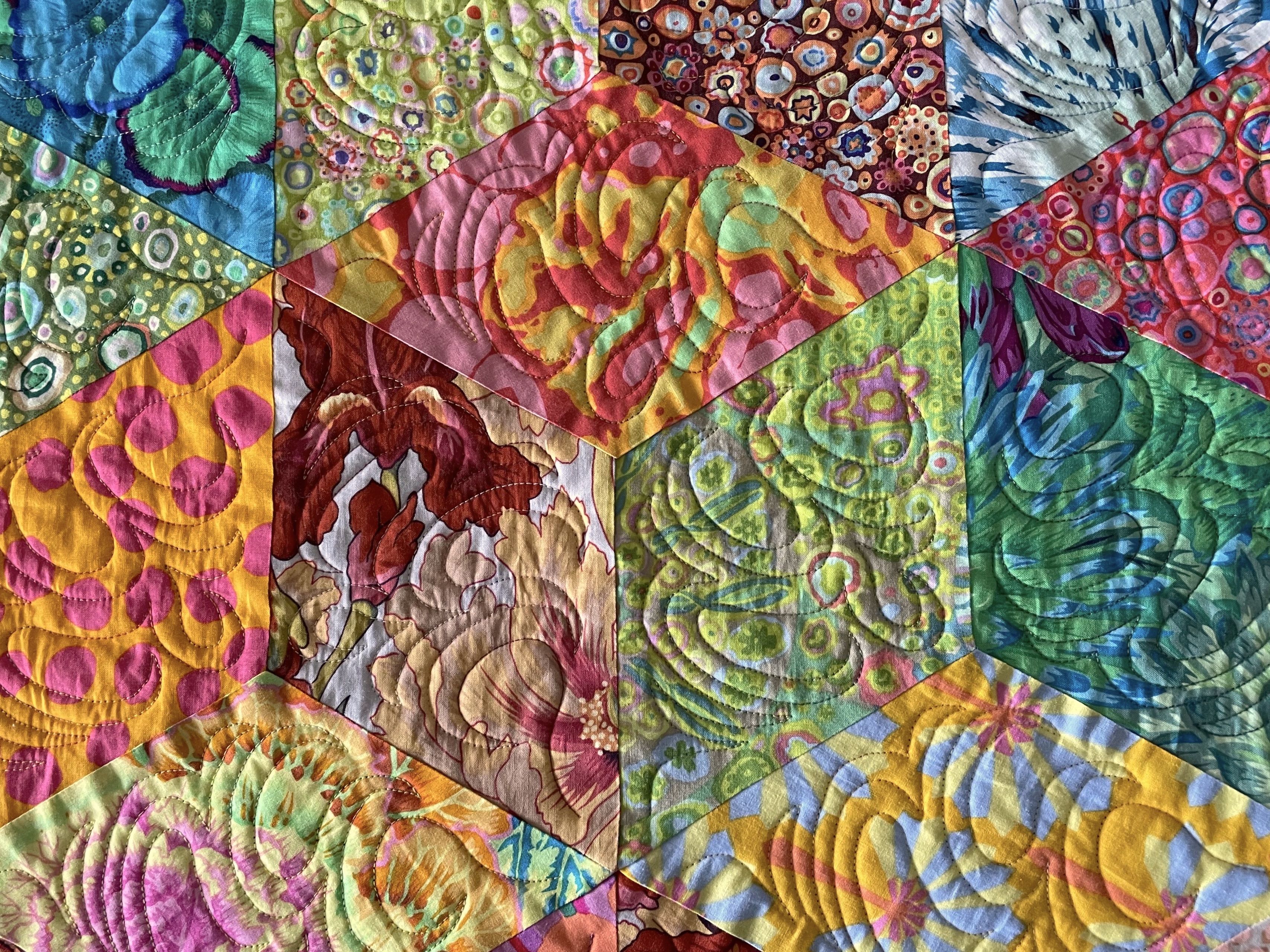
Diamonds III – Quilted
There are lots of things you can’t tell from the photo which looks a lot busier than the quilt does “in person”. You can’t see that I change thread for each block to minimize the impact of the quilting. You can’t see that I’ve embedded all thread ends from the start and stop of each embroidery. You do see the overall effect of the precise positioning of each quilting embroidery.
I still have the edge half-diamonds at the top and bottom to quilt, as well as the triangles along each side. I’ll get to that tomorrow; it won’t take long. Then, as I did on the Diamonds II quilt, I will stitch in the ditch over the entire quilt to give definition to each diamond/cube.
I did a bit of searching before starting to sew my diamonds together – I wanted to see how people generally stitch their diamonds/cubes/hexagons together for the Tumbling Blocks design. The cube/hexagon, as I learned with the previous quilt, is created using Y-seams with three diamonds. I’m getting relatively good at that, so that wasn’t my question – I wanted to know how people put the cubes together. Turns out they do what you’d expect – create each cube then butt the blocks together, but most of them are working with three fabrics (a dark, medium, light) and it’s possible to start in the centre of the project and work your way out from there.
My challenge is each cube/hexagon is unique and I want a specific colour flow. The way to assemble the quilt top, I thought, was to carefully stack the diamonds in each cube keeping it in its exact row; stitch each cube, stitch each row, then join the rows to one another.
TOO FIDDLY!
I created rows 1 & 2 separately, and managed to join them, but getting the “star” joins, involving six points, took a great deal of time, and a lot of picking out of stitching, to get the points to match precisely. So that’s not the way to do this!
How else might I assemble sub units so I can join them with less effort?
I realized, as I was sewing row 2 to row 1, that if I set up half-star units, I might be able to get the 6-point join to work more easily.
Cube layout changed to 6-point star
In this layout I have two “simple” Y-joins at each end of the star with the 6-point join in the centre of a long flat seam, rather than struggling with two Y-seams to make that 6-point connection.
I’ve laid out the rest of row #3 that way, and I’ll sew it tomorrow.
Row 3 set up as “half-stars”
I still have to work with my carefully stacked rows of cubes – but before sewing cubes, I will lay out each row as half-stars, join those units, then connect them to the rest of the quilt top.
I’ve just laid out the second pile of diamonds from the Kaffe Fassett Collective. I’d cut them from the strips I’d cut for Diamonds II and added a few more from fabrics I picked up at Woolworks just outside of Mahone Bay when I was in Lunenburg for my regular bone density scan.
Tumbling Blocks Layout
I began by colour sorting the diamonds then sorting again for intensity. I laid out the blocks so I could get a colour flow from the yellows in the top left to blues in the bottom right. I haven’t taken time yet to sit with this array – I did my best to keep the dark diamonds aligned on one side of each “cube”, lighter diamonds on the “light side” with a medium intensity for the “top” of each cube. I now need to spend some time checking that the flow allows each cube to stand out.
In actual fact I began the layout with the blue diamonds (in part because I had more blues than other colours) but once I had the layout I decided the colour flow works better from the yellow to the blue, rather than the other way around.
In this quilt I wanted the quilting to provide texture but not detract from the strength of the individual fabrics. I began at one edge stitching-in-the-ditch but I didn’t get far because I could anticipate running into trouble with the backing not distributing evenly. I switched to quilting the individual diamonds (I still haven’t counted them – there’s approximately 130-140 pieces in the quilt including the triangles and half diamonds at the edges).
Because I was quilting-in-the-hoop, I had to hoop each diamond separately as well as change the thread for each diamond. I was able to use the same variegated thread for several diamonds but to make sure the backing remained flat I started in the middle – that meant I couldn’t quilt every similar coloured block one after the other because they were distributed throughout the quilt top and I needed to work my way from centre to edge making sure the backing was taut with each hooping.
Once I had all the diamonds quilted I resumed stitching-in-the-ditch which now was straight forward.
I finished the quilt (final size: 48″ x 64 1/2″) with a hidden binding because I didn’t want to interrupt the flow of the diamonds at the edge of the piece.
Diamonds II – Quilt Back
Added a hidden binding and a label and the quilt is finished.
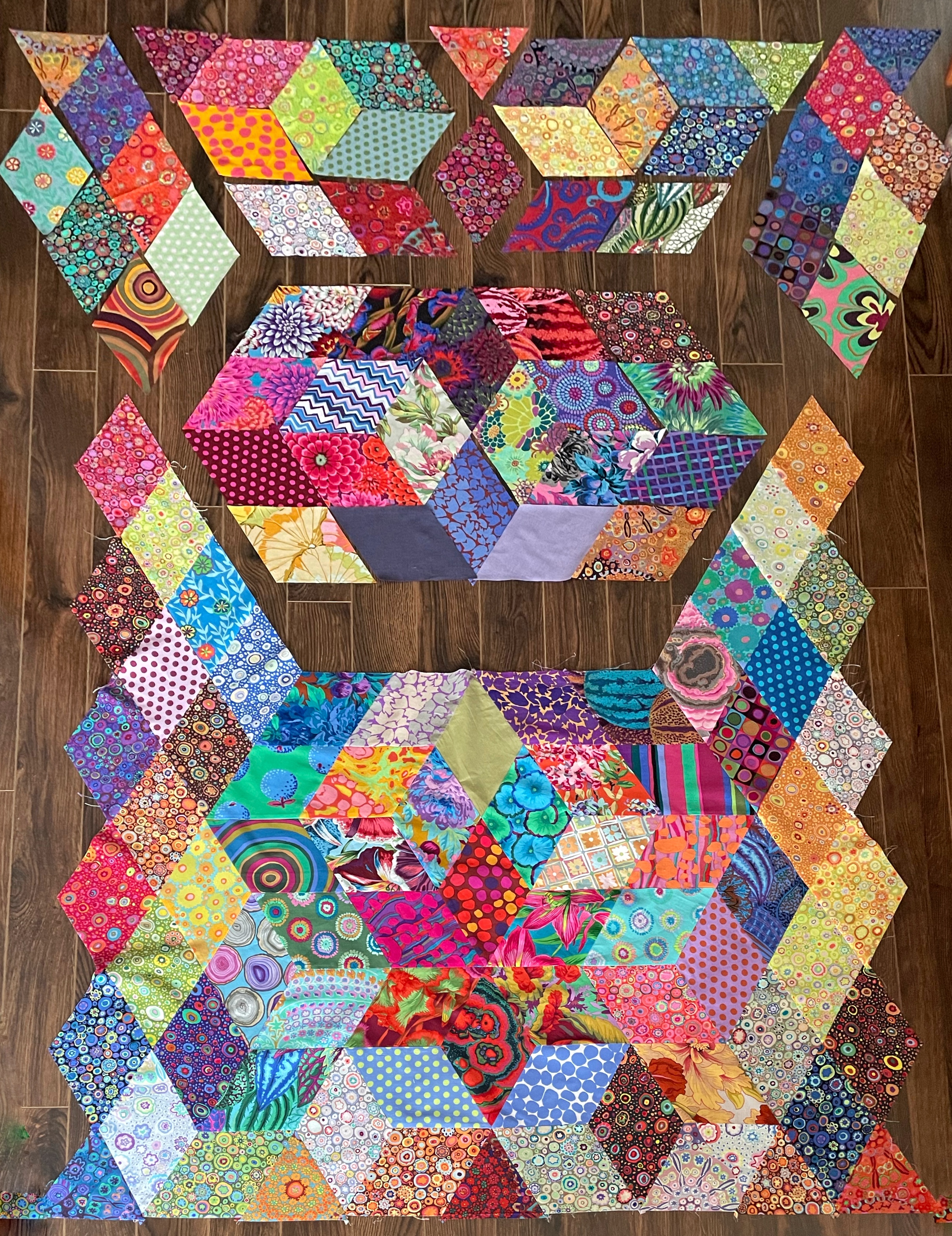
The assembling is becoming easier. I’m doing the obvious diamond strip joins then nesting pieces and doing the Y seams. I’m finding I just have to mark the strategic corners with a tiny dot where I have to remember not to sew to the edge. My Y seams are pressing nice and flat.
Bottom Half Assembled
I incorporated the side elements; next I will assemble the top extended hexagon, fit that into the bottom segment and then all I have left to do are the four top segments.
The sewing isn’t taking as long as I thought it would but it will likely take another day to stitch all the remaining blocks.
I’m just carrying on (glad I printed out a photo – I’ve needed it to keep the colour placement consistent)….
In all my years of quilting I’ve never had to sew a Y-seam! Well this assembly is going to require a combination of diamond overlap joins and Y-seams.
Assembly Started!
I did a bit of research to find out how to put this collection of diamonds together. The objective is to assemble the various hexagons where they occur (the cubes) using a Y-seam to add the third element; then joining diamonds in the usual way with the 1/4″ overlap.
This is what I’ve managed to assemble so far. I started with the cube with the yellow dots, then added the two edge triangles, next the pair of diamonds on the left, followed by the pair of diamonds with corner triangle that creates the left corner (half the triangle will be trimmed away when the sewing is finished), and finally adding the trio of diamonds immediately above with a Y-seam.
No doubt about it – it is finicky work – I’m assuming as I do more I’ll get better, and the sewing will go faster. The trick is marking the 1/4″ seam allowance join positions before sewing so you can run a pin through the dots to secure the overlap, then stitching “from dot to dot” as various people have suggested I do.
My 1/4″ eye is actually pretty good – I have marked some of the “dot” positions in what I’ve assembled so far, but I think I can do reasonably well by aligning a pin in the precise location I want to start sewing and finish sewing – I’ll see as I go along. The difficulty with marking dots on each diamond is that I don’t have a 60° diamond template with small holes in the corner start/stop seam allowance positions so I’m having to improvise using a ruler which is very cumbersome and time consuming.
I did print out a copy of the layout to work from – makes it much easier to keep track of where I’ve picked up blocks, how to align them, and then put them back where they belong.
This assembly is going to take a number of days because there are a lot of diamonds to put together but I’m underway.
Oh, and BTW, I cut 76 diamonds from the leftover 5 1/4″ strips (along with 45 triangles), colour sorted each pile, and put both aside. I try working on just one project at a time so I can actually finish it.
I’ve collected Kaffe Fassett fabrics over the years, made several quilts using them, but still had more than enough fabric remaining in my stash to use for many other projects.
Recently I bought three KF Collective fat quarter sets from Hyggeligt Fabrics in St. Mary’s ON to add to my collection. A month or so ago I also purchased a few more 1/2m pieces and another fat quarter bundle from Heidi Wulfraat’s woolworks studio in Mahone Bay (she carries the complete Free Spirit collection with quite a few out of print fabrics).
I spent most of yesterday pressing, then cutting a 5 1/4″ strip from each of the 98 KF fabrics I now have – the strip is long enough for at least 2 diamonds and a triangle.
Today, I cut out a single diamond from each fabric and began laying them out. I could have just placed diamonds in a row and then filled in below that row, but I decided to start with a “star” and work from the centre out. To begin with I had just a single 6-diamond star in the centre, but as the layout grew, I decided to add another star above and below the original star.
Then I filled in the remaining space.
Stars / Tumbling Blocks
The fabrics fell into several categories: there were “leaf ombre” and “solid” diamonds; there were large scale floral, fruit, wood, circle designs; there were a number of “dot” fabrics; and I had a lot of “paper weight” prints in a wide range of colours.
I used the three ombre/three solids as the centre star, then clustered six strong/similar coloured diamonds above and below that star. From there I filled in with the florals/fruit/wood patterns, finally I used the paper weight prints on the outer edges.
I’ve moved quite a few diamonds around already. To fill in the edges I had to cut 18 triangles and 12 more diamonds from some of the strips so there are some duplicate prints but in the centre of the panel each diamond is unique! The outer diamonds on the sides will be trimmed once the panel is sewn together – I don’t need the added width inserting half-diamonds would give me.
I didn’t try creating any kind of colour flow in this layout, although I could have. Instead, I just wanted to let each fabric speak for itself. What I find so interesting is the stars set up an optical illusion of tumbling cubes. When I look at the photo I can pick out the three stars; but as I look at the quilt, stacks of tumbling cubes keep popping out at me! The array of cubes keeps changing, the longer I look. I wasn’t expecting that to happen.
I like the optical activity this arrangement provides – I’m going to leave it pretty much as it is, I think. However, what I might do next is cut another set of diamonds from the remaining strips (and recut a few more strips from the pieces I put back into the stash) to develop a second array where I start with the stars but colour sort the fabrics to see what illusion might emerge. Wouldn’t take long at all.
Wednesday past was a glorious day – Remembrance Day. My friend Mary Ann and I decided to spend the day visiting Mahone Bay (to have lunch, visit Have A Yarn Wool Shop (if it was open), and to pick up a piece of used furniture she had seen on Kijiji,).
The day started off with dense fog here in Halifax but by the time we reached Chester the sky was clearing and in Mahone Bay it was sunny and warm – like 20°C warm.
We had lunch outdoors at The Biscuit Eater – mild enough to be without jackets. Then visited Have A Yarn – and of course I came home with a couple of balls of Sisu solid yarns (to fill in missing shades from my stash). We picked up the old table Mary Ann wanted.
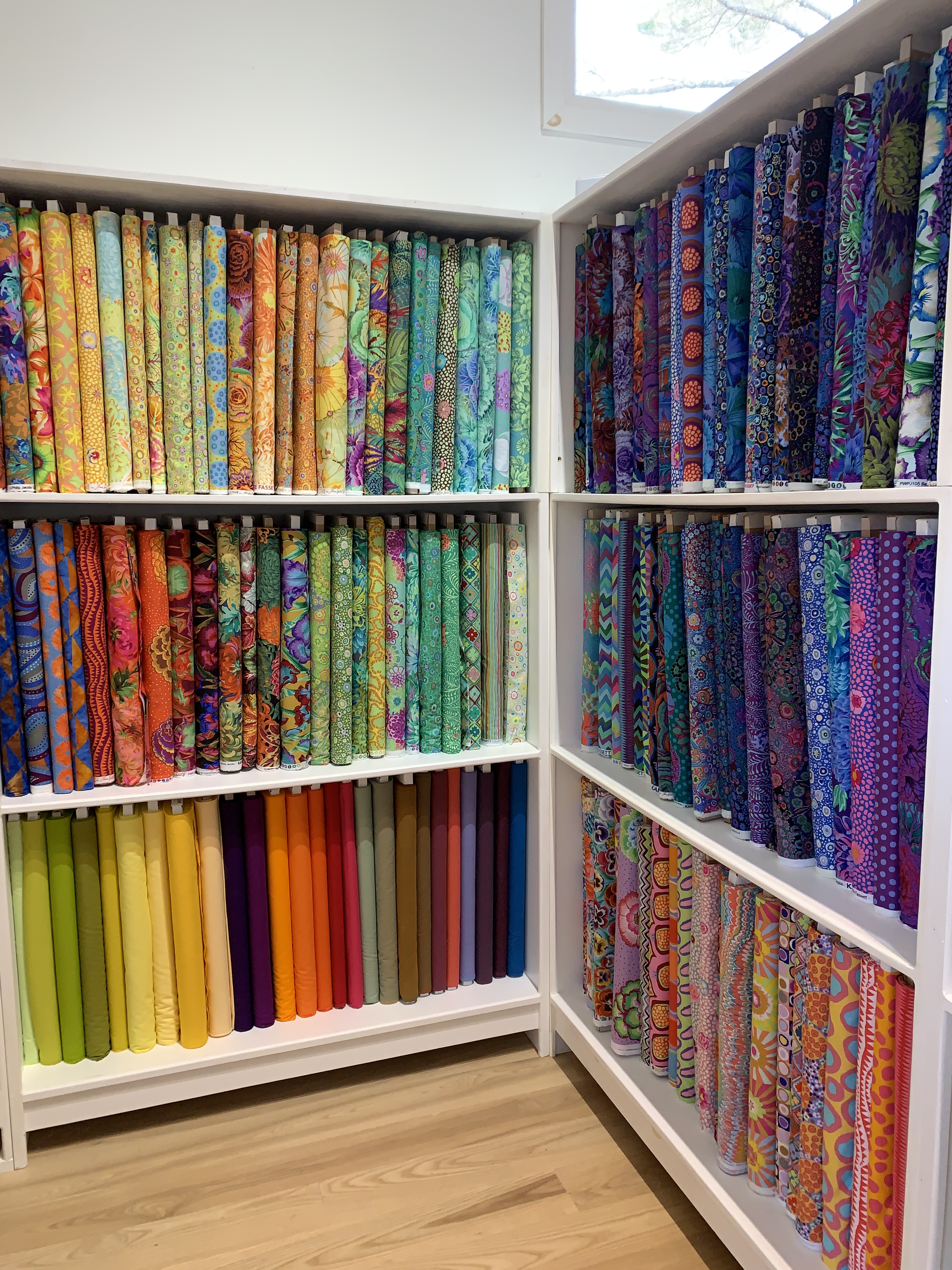
Just one section of the Kaffe Fassett Fabrics – colour sorted
She has some interesting yarns but her collection of Kaffe Fassett/Free Spirit Fabrics (the most complete in the province) is to drool over. The fabric collection is small compared to the quantity of bolts you’d see at Avonport Discount Fabrics (the other must go to fabric spot in Nova Scotia) but this is just about the complete collection of Free Spirit fabrics.
The collection is a lovely quality of quilting cotton. The prints, both large and small scale) are compelling. I spent quite a long time looking through each shelf. It was so tempting to pick out bolts but I already have one drawer in my stash with Kaffe Fassett/Philip Jacobs fabrics – I couldn’t make any decisions. In the end I did come home with a 21 piece fat quarter bundle to add to what I already have.
It’s one thing to go shopping with a quilt idea in my head – quite another to walk into a riot of colour like this and make any decisions! I had the same experience in New York in 2012 at the button warehouse we visited. I walked up and down the isles of buttons unable to pick out anything – what size? what colour? what quantity? Buttons are something you pick out after you have selected the fabrics and made decisions about what you’re making. A tailored shirt needs 11 small buttons, a wool jacket might look good with 5 large bright ones…. It’s the same with quilting fabric – do I want some fat quarters, half yards, full yard cuts? Or am I looking for a specific backing in which case I will need 2 metres. I just don’t know.
So I added some fat quarters to my collection of Kaffe Fassett fabrics:
My Collection of Kaffe Fassett Fabrics
Now I just need to think about what to make with them…. Decisions, decisions, decisions.

















 jmn
jmn